Fire and water checks
Emergency lighting testing: the codes, the two tests, and the record
Where NFPA 101, the Life Safety Code, applies, emergency lighting testing usually means a functional test of every battery-powered emergency light for at least 30 seconds each month and a full 90-minute test on battery power once a year, with both written down.
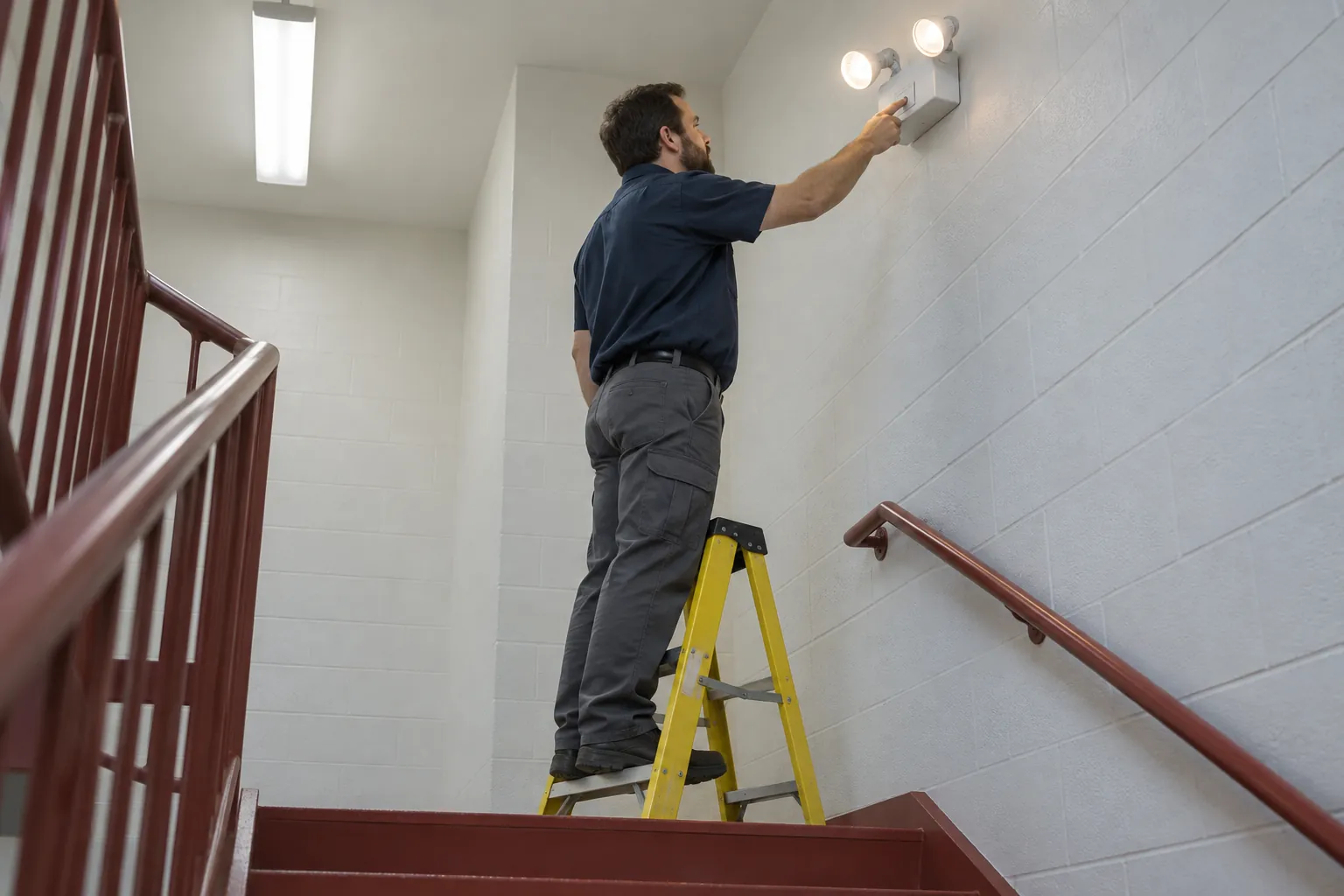
Emergency and exit lights only prove themselves when the power fails, usually at the worst possible moment, and regular testing is how a building shows its occupants, in the meantime, that they would work. This guide covers the requirements behind emergency lighting testing in the United States, what gets tested, how to run the short functional test and the full-duration test, and what the building's own record should show.
01
The rules behind emergency lighting testing
No single national rule covers emergency lighting in the United States. The duty comes from three places, depending on the building, the state and the city.
OSHA. For workplaces under federal OSHA, 29 CFR 1910.37, Maintenance, safeguards, and operational features for exit routes says that "each exit route must be adequately lighted so that an employee with normal vision can see along the exit route" and that "each exit must be clearly visible and marked by a sign reading 'Exit.'" Exit signs must be illuminated to at least five foot-candles (54 lux) by a reliable light source, with self-luminous or electroluminescent signs allowed where they meet a minimum luminance. OSHA sets what must be lit, not a test schedule. Under 29 CFR 1910.35, Compliance with alternate exit-route codes, an employer who shows compliance with the exit-route provisions of NFPA 101, 2009 edition, or the International Fire Code, 2009 edition, is treated as complying with OSHA's own exit-route rules. Check the state first: according to OSHA's State Plans page, 22 State Plans cover both private sector and state and local government workers, and seven cover only state and local government workers.
The fire code. The test schedule itself comes from the codes your state or city has adopted, and the authority having jurisdiction (AHJ), usually the fire marshal or fire department, enforces them. In many places that is NFPA 101, Life Safety Code, where section 7.9 covers emergency lighting and section 7.9.3 its periodic testing. Elsewhere it is the International Fire Code or NFPA 1 with local amendments. An NFPA document is a standard until a jurisdiction adopts it, and the edition the AHJ adopted, with its amendments, is the one that counts, not the latest one on the shelf.
Healthcare and housing. Hospitals that take Medicare and Medicaid must meet the Life Safety Code under 42 CFR 482.41, which incorporates the 2012 edition of NFPA 101 by reference. The surveyors' Form CMS-2786R, Fire Safety Survey Report, checks under tag K291 that "emergency lighting of at least 1-1/2 hour duration is provided automatically in accordance with 7.9," and under K293 that exit and directional signs have "continuous illumination also served by the emergency lighting system." In federally assisted housing, HUD's NSPIRE inspectors press the test buttons themselves.
Equipment matters too. Battery emergency lights and exit signs sold in the US are normally listed to UL 924, Emergency Lighting and Power Equipment, which covers equipment "intended to automatically supply illumination or power or both to critical areas and equipment in the event of failure of the normal supply." The listing says the unit was built to work; testing says it still does.
02
What gets tested
Before anyone can test emergency lighting properly, someone has to know where all of it is. Most buildings have a mix, and each kind is tested a little differently:
- Battery unit equipment: the wall-mounted twin-head units, often called bug-eyes or frog-eyes, in corridors, stairwells, restrooms, mechanical rooms and large open spaces. Each has its own battery, charger and a push-to-test button.
- Combination units: an exit sign with lamp heads on it. HUD's inspectors treat these as two items, a light and a sign, and a facility should too.
- Internally lit exit signs, most now LED, with a battery or fed from an emergency circuit, and self-luminous or photoluminescent signs, which have no lamp to test but must still be visible, clean and within their rated life.
- Fixtures on an emergency circuit: ordinary-looking ceiling lights fed from a generator, a central battery inverter or a transfer switch. They light when the generator or inverter picks up, so they are tested with that system, not one by one.
- Exterior egress lighting at the exit discharge, over exit doors and along the path to the public way, wherever the design puts it.
- Remote heads fed from a battery unit somewhere else, where the button that tests them may be in another room.
Build a fixture schedule: every emergency light and exit sign with an ID, its floor and location, its type, its power source (unit battery, inverter, generator), and whether it self-tests. Mark the IDs on the fixtures or on a floor plan. The schedule is what turns "we checked the lights" into "we checked these 64 lights, and these two failed". Update it after every remodel.
03
The short functional test
The short test is a functional check: cut the normal power to each light, see that it switches to battery and lights the path, and put it back. It proves the transfer works and the lamps light. It is not meant to run the batteries down. How often it is done, and for how long each light must stay on, are set by the code your AHJ enforces (in NFPA 101, section 7.9.3), so take the numbers from the adopted edition rather than from a checklist, this one included.
A trained staff member can do it. A typical walk looks like this:
- Plan the route from the fixture schedule, floor by floor, with a step ladder for units out of reach, and tell the front desk and security.
- Simulate the power failure. On unit equipment, hold the push-to-test button. Where fixtures are tested by circuit, use the test switch or the breaker for that lighting circuit only, never a breaker that feeds anything else, and follow your lockout and electrical safety rules.
- Look at each light for the whole test. HUD's NSPIRE standard puts it plainly: verify the emergency light illuminates for the entire time the test button is engaged, and that all light sources illuminate. A lamp that flickers, dims or drops out before you let go has failed.
- Check the aim and the sign. Lamp heads knocked toward the ceiling light nothing useful. The exit sign should read clearly from the corridor and from more than one viewpoint, with nothing hung in front of it.
- Restore the power and check that the charge indicator is lit again. A unit with no charge light will not be ready for the next outage.
- Record the result at the time: the date, who tested, which fixtures, and each one that failed, by ID.
Self-testing units run their own functional and duration tests and show the result on a status light, which usually blinks a pattern when the battery, lamp or charger has failed. They save the button-pushing, not the walk. Someone still has to look at every status light, write down what it shows and act on it. A self-test nobody reads is not a test.
In a large building the short test can be spread floor by floor, as long as the record shows every fixture was tested within the period.
04
The full-duration test, and lights on a generator
The long test runs battery-powered emergency lighting for its full rated duration to prove the batteries can still hold every lamp on for as long as the system was designed for. For hospitals surveyed by CMS that duration is at least 1½ hours, as K291 states. Under NFPA 101's manual method it is an annual test of at least 90 minutes; the adopted code sets how often it is done and for how long in other buildings.
Two practical points matter:
- Recharge. After a full-duration test, the batteries need time to recharge (the manufacturer's instructions say how long), and until then the building has less emergency lighting than it should. Test when the building will be lightly used afterward, or test alternate units on different days.
- Failures. A unit that dims or goes out before the end of the duration needs a new battery or a new fixture, and a retest. Log the battery date on the fixture schedule.
Emergency lighting fed from a generator is tested with the generator and transfer switch, under NFPA 110, Standard for Emergency and Standby Power Systems, where adopted. A central battery or inverter system is a stored energy system under NFPA 111, Standard on Stored Electrical Energy Emergency and Standby Power Systems. For hospitals, CMS tag K918 expects generator sets to be "inspected weekly, exercised under load 30 minutes 12 times a year in 20-40 day intervals," with "written records of maintenance and testing" kept "readily available." When the generator runs under load, somebody should walk the egress path and confirm the emergency fixtures actually lit. See our guide to generator testing.
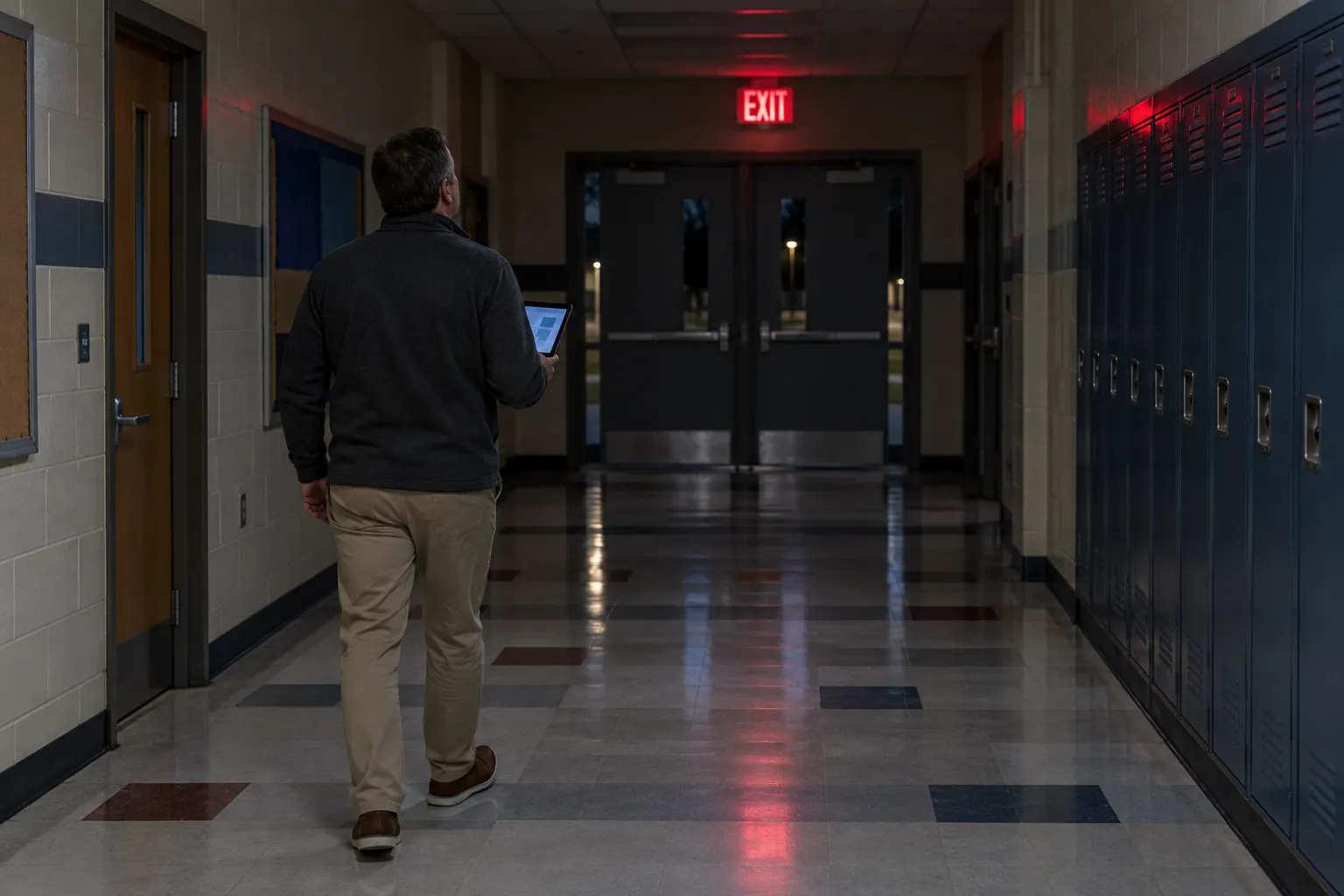
What the inspector will do. HUD's NSPIRE standard for auxiliary lighting (version 3.0) tells inspectors to engage the test button and check that the light stays lit and every lamp works. Auxiliary lighting that is damaged, missing or fails to illuminate when tested is a Severe deficiency with a 24-hour correction timeframe. Under the NSPIRE standard for exit signs, a sign that is damaged, missing, obstructed or not adequately illuminated is Life-Threatening, also with 24 hours to correct. The building that tested last month already knows which units will fail.
05
What the record should show
Whatever the adopted code's exact wording, an inspector, surveyor, insurer or auditor asking whether the emergency lighting works will want to see the testing written down. A good emergency lighting record holds:
- The fixture schedule, current, with IDs, locations, types, power sources and battery dates.
- Each short test: date, time, who tested, which fixtures, the result for each, and every failure by ID.
- Each full-duration test: date, start and end time, the duration run, the result for each fixture, and who carried it out, with the contractor's report if one was used.
- Self-test readings: what each status light or the panel showed, and when it was read.
- Deficiencies and repairs: what failed, the work order, what was done and when, and the retest.
- Changes: fixtures added, moved or removed in a remodel, and the updated schedule.
Records that stand up share a few features:
- They are written at the time, with the real date and a named person, not initials added at the end of the month.
- They are specific: "64 tested, units 2-14 and 3-07 failed", not "all OK".
- Every failure has an outcome: a repair and a retest, with dates. A failed unit that appears three months running and never gets a work order is the finding.
- Gaps are explained: a missed test with a reason is more believable than a year of identical entries in the same pen.
- Someone reviews them: a facility manager who reads the record each month sees the unit that keeps failing and the floor that never gets tested.
06
Where the record fails, and what SiteClara does about it
The short test is easy to put off. It needs someone to walk every floor with a ladder, it has to fit around occupied hours, and the clipboard lives in the engineer's office where nobody else sees it. The chirping unit in the stairwell gets mentioned to whoever is passing, then forgotten. And in a portfolio of buildings, the regional facility manager has no way of knowing which sites tested this month until the fire marshal or a HUD inspector presses the button first.
SiteClara records the in-house checks where they happen. A printed QR poster, with an optional NFC tag behind it, sits at each place a check is scheduled, such as a floor's emergency lighting route, a stairwell or the generator room. Building staff scan the code or tap the tag on their own phone, with no app to install, see the checks due there, such as the emergency lighting test for that floor, and mark each one done or say what stopped them, such as a locked mechanical room. The time and the named person are recorded as it happens, with a photo when one is asked for, for example of a self-test status light. A problem, such as a failed unit or an exit sign hidden behind a new display, is reported there with a photo and goes onto the team's list of jobs until someone closes it.
The supervisor sees what is due, done and missed across the building or portfolio, and can record the reason a check was missed. A job that needs the building manager can be escalated to them to answer. Each day the supervisor reviews and approves a report that goes to nominated management or client contacts at 8 a.m. the next morning, showing what was reported, completed and still open, and how the scheduled checks went, for example 12 of 12 completed.
07
Questions people ask
What are the NFPA 101 emergency lighting testing requirements?
Under the manual method NFPA describes in its NFPA Journal article on emergency lighting and exit marking under NFPA 101, emergency lights are operated monthly for at least 30 seconds, usually with a test button that disconnects the main power to the unit, and operated once a year for a minimum of 90 minutes to test the full capacity of the batteries. Self-testing units need no manual monthly or annual test but must be inspected every 30 days for damage and indicator lights, and computer-based systems that report and log their own self-test results need no 30-day visual inspection. The article adds that proper documentation of these tests is a must. The edition and amendments your AHJ has adopted are the ones that apply.
How many times a year should emergency lighting be tested?
With the manual method in NFPA 101, as NFPA's NFPA Journal article on emergency lighting and exit marking under NFPA 101 sets out, that is twelve monthly functional tests of at least 30 seconds each and one full test of at least 90 minutes within every 12 months. Self-testing units swap both manual tests for an inspection every 30 days of the unit and its indicator light.
How do you test emergency lights for 90 minutes?
Run each battery unit on its own battery, with normal power disconnected by the manufacturer's test procedure, for at least 90 minutes, and check that every lamp stays fully lit to the end; NFPA's NFPA Journal article on emergency lighting and exit marking under NFPA 101 describes this annual test as the one that checks the full capacity of the batteries. For hospitals, CMS surveyors check under tag K291 of Form CMS-2786R, Fire Safety Survey Report that "emergency lighting of at least 1-1/2 hour duration is provided automatically in accordance with 7.9." Allow time for the batteries to recharge afterward, and record the start and end times and each fixture that failed.
What are the OSHA inspection requirements for emergency lighting?
OSHA sets no test schedule for emergency lights. 29 CFR 1910.37, Maintenance, safeguards, and operational features for exit routes requires that "each exit route must be adequately lighted so that an employee with normal vision can see along the exit route," and that "safeguards designed to protect employees during an emergency (e.g., sprinkler systems, alarm systems, fire doors, exit lighting) must be in proper working order at all times." The test intervals come from the fire code your AHJ enforces, and regular tests with a written record are how an employer shows the exit lighting is being maintained in working order.
08
Further reading, and a list to take away
Start with the code your AHJ enforces: ask the fire marshal's office which fire code and which edition of NFPA 101 apply to your building, with any local amendments. NFPA offers free read-only access to NFPA 101 through its free access NFPA codes and standards program (a free NFPA account is required). For the workplace rules, read 29 CFR 1910.37, or your state plan's equivalent. Hospitals should read the K-tags on Form CMS-2786R, and HUD-assisted properties the NSPIRE standard: Lighting – Auxiliary and the NSPIRE standard: Exit Sign. See also our guide to exit route requirements.
Before the next test, check that:
- you know which fire code and edition your AHJ enforces, and the test intervals and durations it sets;
- every emergency light, exit sign and remote head is on a fixture schedule with an ID and a power source;
- the short test has a named owner, a deputy and a route that covers every fixture;
- each test records which fixtures were tested and which failed, by ID;
- every failure has a work order, a repair date and a retest;
- the full-duration test is booked at a time that allows recharge before the building fills up;
- self-test status lights, or the central panel, are read and recorded, not just trusted;
- the fixture schedule was updated after the last remodel.
Sources
Every document this guide quotes or links to, in the order it first cites them.
- 29 CFR 1910.37, Maintenance, safeguards, and operational features for exit routes osha.gov
- 29 CFR 1910.35, Compliance with alternate exit-route codes osha.gov
- OSHA's State Plans page osha.gov
- NFPA 101, Life Safety Code nfpa.org
- 42 CFR 482.41 govinfo.gov
- Form CMS-2786R, Fire Safety Survey Report cms.gov
- UL 924, Emergency Lighting and Power Equipment shopulstandards.com
- NFPA 110, Standard for Emergency and Standby Power Systems nfpa.org
- NFPA 111, Standard on Stored Electrical Energy Emergency and Standby Power Systems nfpa.org
- NSPIRE standard for auxiliary lighting hud.gov
- NSPIRE standard for exit signs hud.gov
- NFPA Journal article on emergency lighting and exit marking under NFPA 101 nfpa.org
- Free access NFPA codes and standards nfpa.org
Related guides
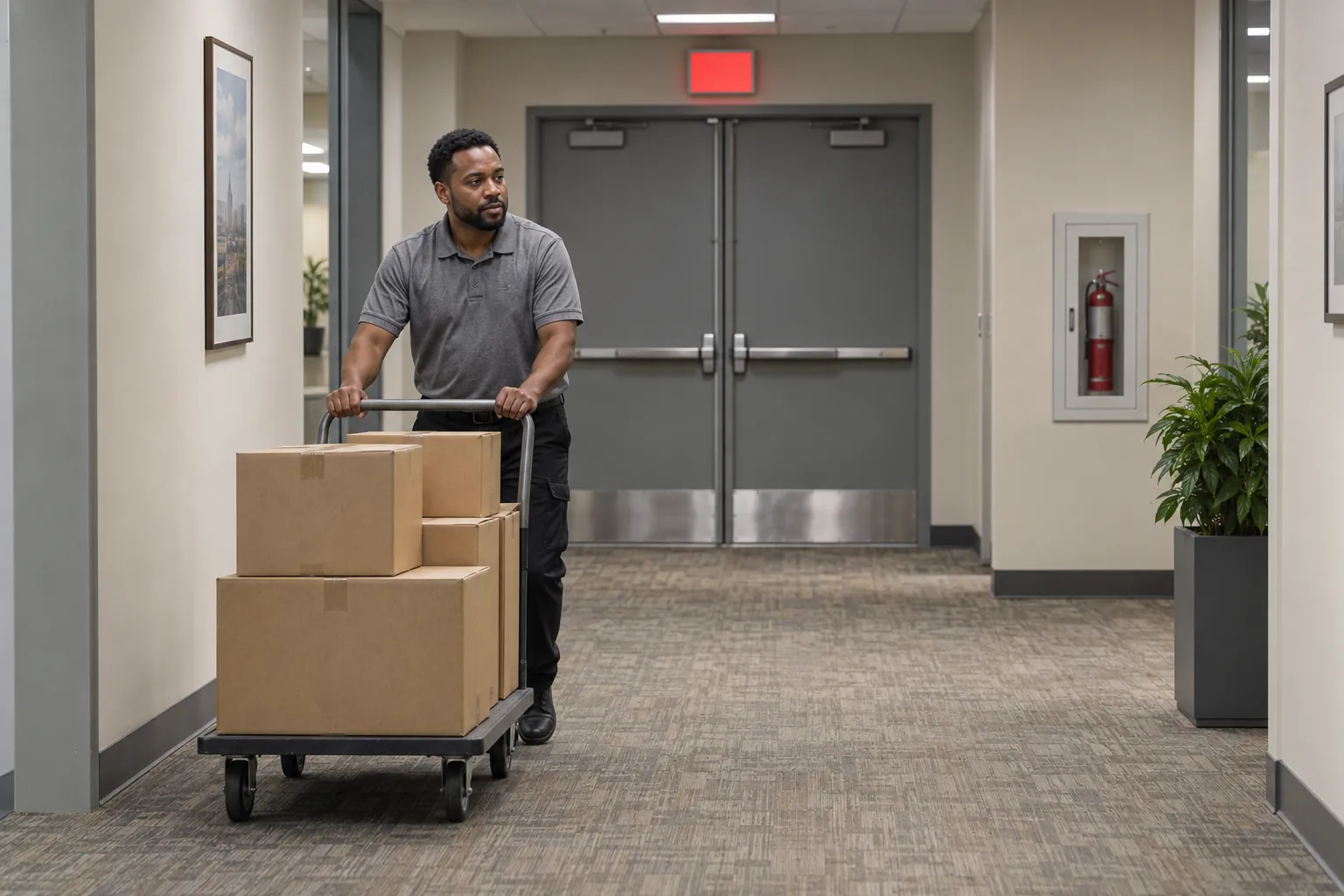 Fire and water checksOSHA exit sign and exit route requirements, and how to keep every route clearWhat OSHA 1910.36 and 1910.37 require of exit routes, exit doors and exit signs, how the fire code fits in, and how to check and record that routes stay clear.
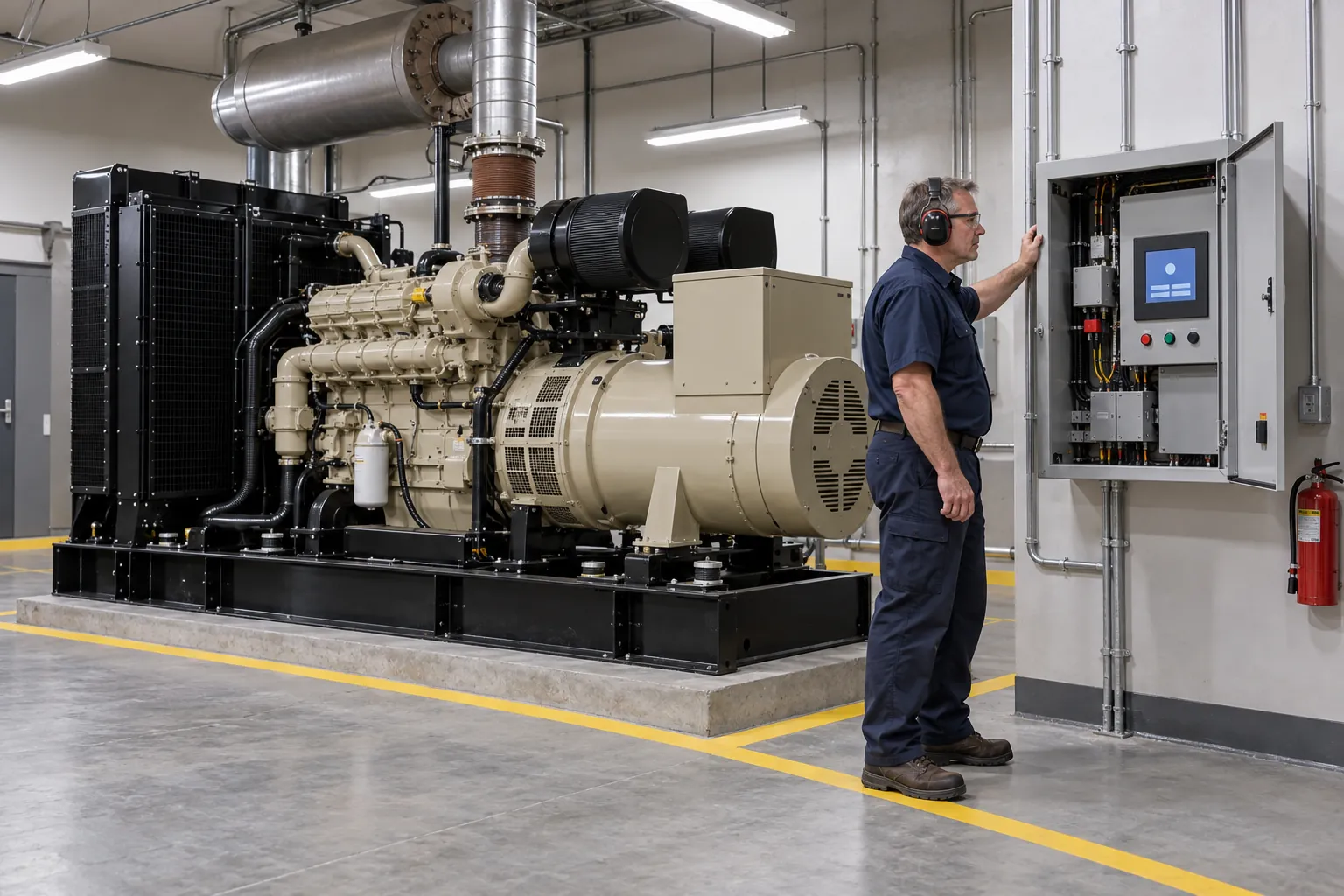 Premises and facilities managementGenerator testing: what NFPA 110 asks, and what to write downEmergency generator testing under NFPA 110: the weekly inspection, the monthly exercise under load, batteries, fuel, the 36-month test, and what the record shows.
 Fire and water checksFire alarm testing: who does what, and what the record should showFire alarm testing in the US: what NFPA 72 and OSHA ask of the owner, what gets tested, how to run a test day, and what the building's own record should show.
 Fire and water checksFire inspection checklist: what the fire marshal looks at, and how to be readyA fire inspection checklist for US businesses: what the fire marshal checks, the records to have ready, who prepares what, and how to stay ready between visits.