Premises and facilities management
Playground inspection checklist: keeping public play equipment safe between the big inspections
A playground inspection checklist is the list of surfacing, equipment, hardware and hazard checks that staff work through at a public playground on a set schedule, based in the United States on the CPSC's Public Playground Safety Handbook, the ASTM safety standards and the manufacturer's instructions.
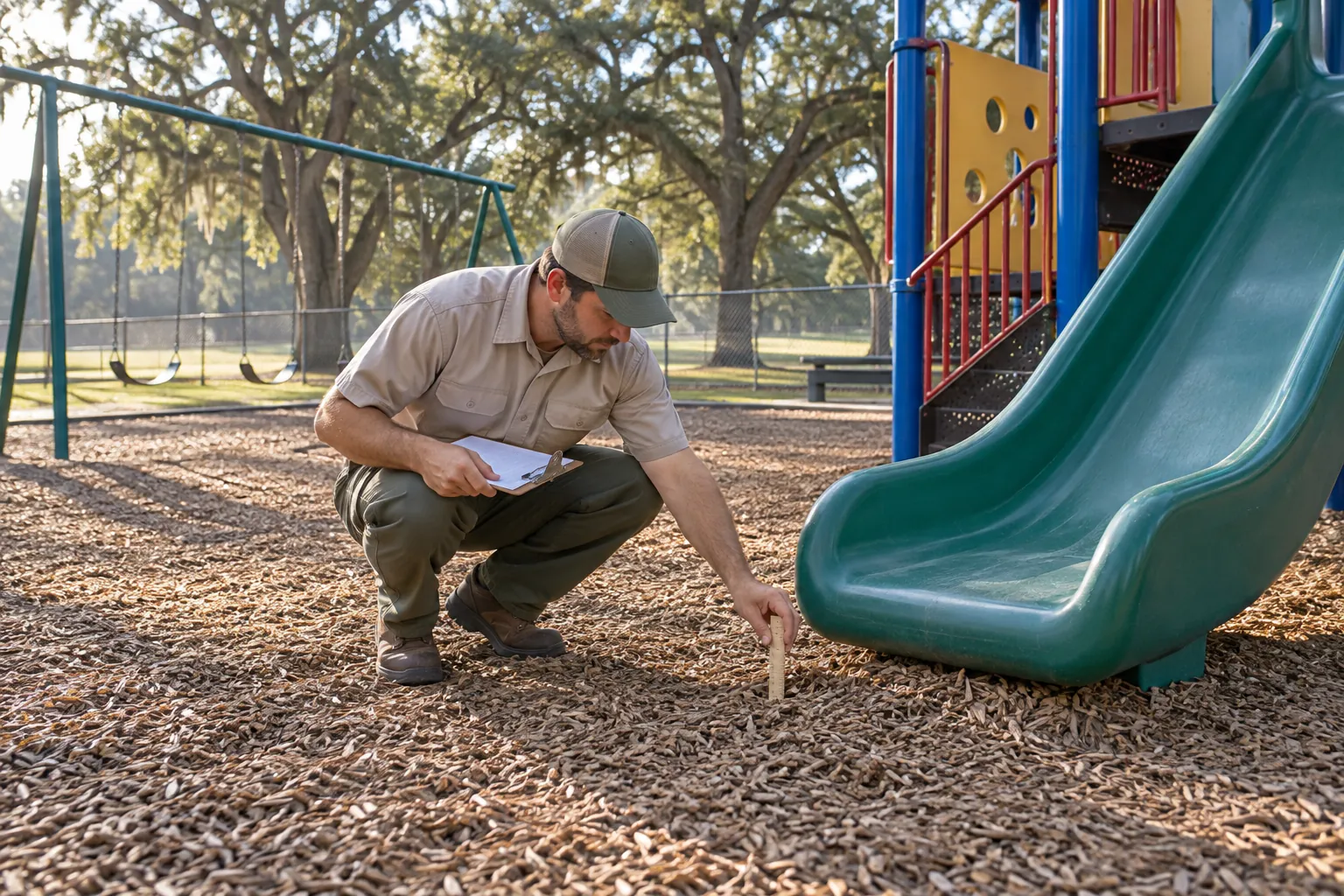
A public playground is inspected properly once in a while and looked at in passing every day. The injuries happen in between: mulch kicked out from under a swing, a bolt that worked loose, a rope a child tied to a guardrail, broken glass in the sand after a weekend. This guide covers who sets the rules for public playgrounds in the United States, what a playground inspection checklist should cover, how often to check, who should do it and what the record should show.
01
Who sets the rules: the CPSC Handbook, ASTM F1487 and your state
There is no single federal rule for inspecting a public playground. The reference almost everyone works from is the U.S. Consumer Product Safety Commission's Public Playground Safety Handbook. The current version is the 2010 edition, reissued with a CPSC cover letter in December 2015. The CPSC says plainly that it presents safety information "in the form of guidelines", because its staff believes "that guidelines, rather than a mandatory rule, are appropriate." The same page adds the part that matters for owners: "Some states and local jurisdictions may require compliance with this handbook and/or ASTM voluntary standards," and risk managers and insurers may require it too.
The Handbook covers equipment for children aged 6 months through 12 years in the playgrounds of commercial child care facilities, institutions, apartment and condominium buildings, parks, restaurants, resorts, schools and "other areas of public use". It does not cover home play sets, amusement rides, fitness equipment for users over 12 or water play equipment.
The technical detail sits in the ASTM standards the Handbook lists. The main one is ASTM F1487-25, Standard Consumer Safety Performance Specification for Playground Equipment for Public Use, which covers equipment for users from the 5th percentile 2-year-old to the 95th percentile 12-year-old and includes a section on maintenance. Companion standards cover equipment for children under 2 (F2373) and surfacing (F1292, F2075, F1951). ASTM standards are paid documents, and the Handbook says they are "primarily intended for use by equipment manufacturers, architects, designers" and others who need more technical information; routine checks rarely need more than the Handbook and the manufacturer's instructions.
Some states turn the voluntary standards into law. In California, Health and Safety Code section 115725 requires new public playgrounds, and replacement or modified equipment in existing ones, to conform to the ASTM standards and the CPSC guidelines. It requires public agencies and "all other entities operating playgrounds open to the public", a list that includes churches, hotels, offices, hospitals, shopping centers, day care settings and restaurants, to have a playground safety inspector certified by the National Playground Safety Institute carry out an initial inspection. Federal programs can do the same: the Head Start Program Performance Standards, 45 CFR 1302.47, require indoor and outdoor play equipment to meet CPSC or ASTM standards and to be "kept safe through an ongoing system of preventative maintenance". Your state's child care licensing rules may add their own requirements, so check them for the settings you run.
02
What a playground inspection checklist covers
The Handbook's Appendix A is a Suggested General Maintenance Checklist, meant as "a guide for frequent routine inspections of public playgrounds" where the manufacturer does not supply one. It is a sound base for your own. Grouped the way it groups them, a routine playground inspection checklist looks at:
- Surfacing: adequate protective surfacing under and around the equipment; no deterioration; no foreign objects or debris in loose fill; loose fill not compacted; loose fill not displaced under swings or at slide exits. The action is usually to rake and fluff, remove trash, or add more fill.
- Drainage: the whole play area drains, especially the heavy-use spots under swings and at slide exits.
- General hazards: no sharp points, corners or edges; no missing or damaged protective caps or plugs; no hazardous protrusions; no clothing entanglement hazards such as open S-hooks or protruding bolts; no crush and shearing points on exposed moving parts; no trip hazards such as exposed footings, anchoring devices, rocks or roots in a use zone.
- Security of hardware: no loose fastening devices or worn connections; moving parts such as swing hangers, merry-go-round bearings and track rides not worn.
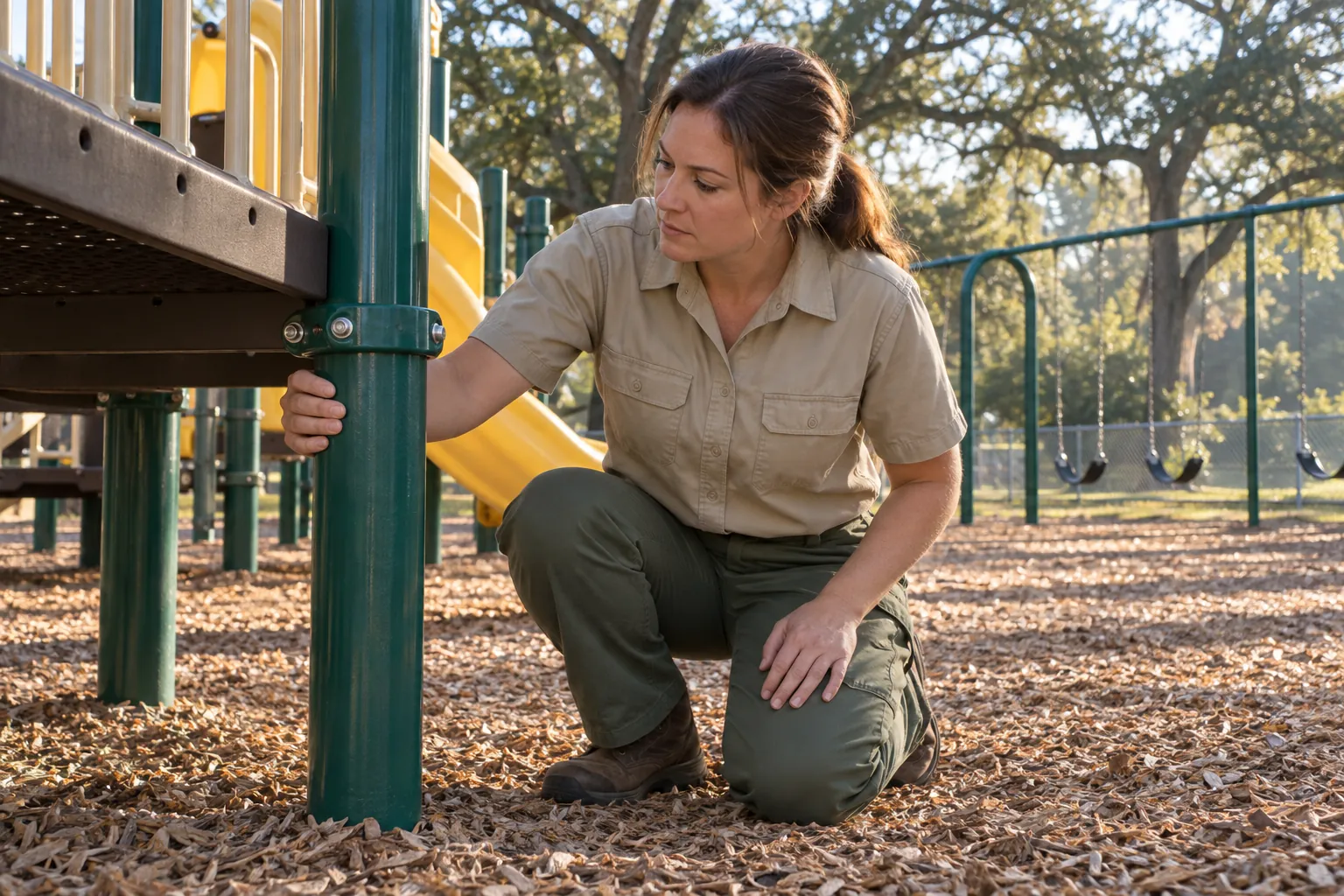
- Durability of equipment: no rust, rot, cracks or splinters, checked carefully where the equipment meets the ground; no broken or missing handrails, guardrails, protective barriers, steps or rungs; no damaged fences, benches or signs; all equipment securely anchored.
- Paint: paint, especially lead paint, not peeling, cracking, chipping or chalking, and no visible lead paint chips or dust.
- General upkeep: no user modifications such as ropes tied to equipment or swings looped over the top rail; no litter, branches, cans, bottles or glass; trash receptacles present and not full.
The Handbook's Table 3 adds a few items worth putting on the same sheet: cracks in plastics, insect damage, vandalism, wood splitting, and holes, flakes or buckling in unitary surfacing.
Add what is specific to your site: the fence line and gates at a school, the lighting and posted rules at an HOA or apartment playground, whatever a child care center's licensing checklist requires. If the manufacturer supplies its own checklist for a structure, use it for that structure, because the Handbook says the manufacturer's instructions and recommended inspection schedules "should be strictly followed."
03
Surfacing, use zones and entrapment: the checks that prevent the worst injuries
Falls are the injury pattern the Handbook is built around. It cites a CPSC study of 2,691 playground equipment-related incidents reported from 2001 to 2008 in which falls were the most common hazard pattern, at 44 percent of injuries, followed by equipment-related hazards such as breakage, tip-over, design and assembly. That is why surfacing gets more attention on a good checklist than anything else.
The Handbook's rules on surfacing are direct. A playground "should never be installed without protective surfacing of some type", and concrete, asphalt or other hard surfaces "should never be directly under playground equipment." Grass and dirt are not protective surfacing. Loose-fill surfacing materials "will compress at least 25% over time due to use and weathering": if a playground needs 9 inches of wood chips, the initial fill should be 12 inches. It advises never using less than 9 inches of loose fill, except shredded or recycled rubber, for which 6 inches is recommended, and suggests marking a minimum fill level on the equipment posts so that whoever does the routine check can see at a glance whether the depth has dropped.
The Handbook's section on maintaining loose-fill surfacing tells you where to look:
- Under swings and at slide exits: activity displaces surfacing quickly here; rake it back into place. Impact attenuating mats in these spots reduce displacement and should sit below or level with the surfacing so they do not become a trip hazard.
- Pooling water: wet mulch compacts faster than dry; puddles that keep coming back point to a drainage problem.
- Frozen surfacing: loose fill that freezes solid no longer protects, and the Handbook recommends that children not play on the equipment in those conditions.
Unitary surfaces such as rubber tiles and poured-in-place rubber are checked for holes, flakes and buckling; impact testing to ASTM F1292 is not part of a routine walk.
Use zones are the other thing a routine check protects. For a stand-alone climber, the Handbook's use zone extends a minimum of 6 feet in all directions. For a single-axis belt swing, it extends to the front and rear a minimum of twice the vertical distance from the pivot point to the top of the protective surface, and those front and rear zones should never overlap any other use zone. A bench, trash can or snow pile moved into a use zone is a finding, even if the equipment is fine.
Entrapment is rarer and more serious. The Handbook treats an opening as a possible head entrapment hazard where interior opposing surfaces are more than 3.5 inches and less than 9 inches apart, tested with the probes in its Appendix B. A routine inspector need not probe every opening, but should notice what has changed: a missing rung or panel, a rope tied to the equipment, an open S-hook. Those are fixed or closed off that day.
04
How often: the daily walk, the routine inspection and the comprehensive audit
The Handbook does not set one frequency for every playground. It says a maintenance schedule should follow the manufacturer's recommendations or, where there are none, be based on actual or anticipated use, that "frequently used playgrounds will require more frequent inspections and maintenance", and that the frequency of thorough inspections "will depend on the type and age of equipment, the amount of use, and the local climate." For loose fill it is more specific: high-use playgrounds, "such as child care centers and schools, should be checked frequently."
In practice most owners settle on three levels, which fit the Handbook's approach:
- A quick daily or before-use walk by the custodian, groundskeeper, teacher or staff member who opens the area: litter and glass, obvious damage, user modifications, surfacing under swings and slides, standing water, gates and fences. It takes a few minutes and catches what happened overnight or over the weekend.
- A routine inspection, weekly or monthly depending on use and the manufacturer's schedule, working through the full checklist: hardware, moving parts, anchoring, rust and rot, paint, surfacing depth against the marks on the posts, and use zones.
- A comprehensive or detailed playground safety inspection at longer intervals, after installation, after a major repair or a serious incident, and wherever your state requires one, often by a Certified Playground Safety Inspector. The Handbook says detailed inspections "should give special attention to moving parts and other parts that can be expected to wear."
Add a check after storms, flooding or a freeze, after a large event and after any report of vandalism, and a thorough one before a seasonal site reopens. Write the frequencies down, by playground, with who does each level: "inspected regularly" cannot be checked; "daily walk by the opening custodian, monthly checklist by the grounds supervisor" can.
05
Who inspects, what happens to a finding, and what the record should show
The Handbook says maintenance inspections "should be carried out in a systematic manner by personnel familiar with the playground, such as maintenance workers, playground supervisors, etc." The people who are there every day do the routine checks, with short training, the checklist and clear authority to close a piece of equipment.
The comprehensive level is different. The Certified Playground Safety Inspector (CPSI) certification, run by the National Recreation and Park Association, trains inspectors in hazard identification, equipment specifications, surfacing requirements and risk management. California's statute names this certification for the initial inspection; elsewhere it is what many insurers, school districts and park agencies expect for the periodic audit.
An inspection is only as good as what happens next. The Handbook is clear that "Inspections alone do not constitute a comprehensive maintenance program" and that "any problems found during the inspection should be noted and fixed as soon as possible." Repairs and replacement parts follow the manufacturer's instructions, and user modifications such as loose-ended ropes "should be removed immediately." Anything that cannot be made safe at once is closed off and reported, not left as a note on the checklist.
On records, the Handbook's section 4.4 sets out what to keep:
- records of all maintenance inspections and repairs;
- the manufacturer's maintenance instructions and any checklists used;
- the signature and date of the person who performed each inspection on the form used;
- a record of any accident and injury reported to have occurred on the playground.
The Handbook gives the reason: it "will help identify potential hazards or dangerous design features that should be corrected." A good record also answers the questions after an injury or a claim: which structure, what was checked, by whom and when, what was found, and when it was fixed. Keep audit reports with the routine records, so each finding can be traced to its repair.
06
Where the record fails, and what SiteClara does about it
Playground records fail in familiar ways. The monthly sheet shows a neat row of initials, some added the afternoon before an insurance visit. The daily walk happens but leaves no trace, so after an injury nobody can say whether the rope on the climber was there at 8 a.m. The custodian who spotted a cracked slide told whoever was nearby, and three weeks later it is still cracked.
SiteClara puts a printed QR poster at each playground or play structure, with an optional NFC tag behind it. Staff scan the code or tap the tag with their own phone, with no app to install, and sign in with a link. They see the checks due at that location, such as the daily walk or the monthly checklist, and mark each one done, or say what stopped them, such as a locked gate or a flooded play area. A problem, such as displaced mulch under the swings, a loose bolt or a rope tied to a guardrail, is reported there with a photo and goes onto the team's list of jobs until someone closes it.
The supervisor sees what is due, done and missed, and can record why a check was missed; a job that needs the building or property manager can be escalated to them to answer. Each day the supervisor reviews and approves a report that goes to nominated management or client contacts at 8 a.m. the next morning, showing what was reported, completed and still open, and how the scheduled checks went, for example 3 of 3 completed.
07
Questions people ask
How often should a playground be inspected?
There is no single federal frequency. The CPSC's Public Playground Safety Handbook says the manufacturer's recommended inspection schedules "should be strictly followed" and, where there are none, that a schedule should be based on actual or anticipated use, because "frequently used playgrounds will require more frequent inspections and maintenance." It adds that high-use playgrounds, such as child care centers and schools, should have their loose-fill surfacing checked frequently.
How do you inspect a playground?
Systematically, with a checklist. The CPSC's Public Playground Safety Handbook says maintenance inspections "should be carried out in a systematic manner by personnel familiar with the playground, such as maintenance workers, playground supervisors, etc.", using the manufacturer's checklist where there is one and the Handbook's Appendix A where there is not. Any problems found "should be noted and fixed as soon as possible."
What should be included in a playground inspection checklist?
The suggested checklist in Appendix A of the CPSC's Public Playground Safety Handbook covers surfacing, drainage, general hazards, security of hardware, durability of equipment, leaded paint and the general upkeep of the playground. Add the manufacturer's own checklist for each structure and anything your state or licensing agency requires.
08
Where to read more, and a list to take away
Start with the CPSC Public Playground Safety Handbook, especially section 4 on maintaining a playground and Appendix A, the suggested maintenance checklist. Keep the manufacturer's installation and maintenance instructions for every structure. For accessible ground surfaces, the U.S. Access Board's guide to the 2010 ADA Standards, Chapter 10: Play Areas, says they "must be inspected and maintained regularly and frequently". Then read your state's rules, such as California's Health and Safety Code section 115725, and your child care licensing regulations.
A short playground inspection checklist to take away:
- list every playground and structure, with its age group, manufacturer's instructions and the person responsible;
- walk each playground daily or before use, looking for litter, glass, damage, user modifications and displaced surfacing;
- work through the full checklist weekly or monthly, by use and by the manufacturer's schedule;
- check loose-fill depth against marks on the posts, especially under swings and at slide exits, and rake or add more fill;
- keep use zones clear of benches, trash cans, snow piles and anything else that does not belong;
- close off anything that cannot be made safe at once, and track the repair to completion;
- have a comprehensive audit done by a certified inspector where your state, insurer or funder expects it;
- have every inspector sign and date the form, and keep inspection, repair and injury records together.
Sources
Every document this guide quotes or links to, in the order it first cites them.
- Public Playground Safety Handbook cpsc.gov
- ASTM F1487-25, Standard Consumer Safety Performance Specification for Playground Equipment for Public Use store.astm.org
- Health and Safety Code section 115725 leginfo.legislature.ca.gov
- 45 CFR 1302.47 ecfr.gov
- Certified Playground Safety Inspector (CPSI) certification nrpa.org
- Chapter 10: Play Areas access-board.gov
Related guides
 Premises and facilities managementGrounds maintenance checklist: what to check outside the building, how often, and what to recordA grounds and landscape maintenance checklist for US commercial properties: walkways, turf, trees, irrigation and play areas, by season, with OSHA and ADA duties.
 Premises and facilities managementHead Start daily health and safety checklist: what 45 CFR 1302.47 asks for, and how to show it was doneA Head Start daily health and safety checklist built on 45 CFR 1302.47: what to check each morning, what runs weekly or monthly, who does it and what to record.
 Premises and facilities managementSafety walkthroughs: how to walk a building, talk to the crew and fix what you findWhat a safety walk is under OSHA's Recommended Practices, what to look at in a commercial building, how often to walk, how to record findings and close them out.
 Premises and facilities managementPreventive maintenance checklist: what to check in a commercial building, how often, and how to prove itA preventive maintenance checklist for commercial buildings: HVAC, electrical, fire and life safety, plumbing, how often, and what the record should show.