Premises and facilities management
Heat illness prevention: the rules, the hot spots in a building, and the daily routine
Heat illness prevention is the plan and the daily routine that protect people from heat-related illness while they work in high temperatures: cool water, rest, shade or a cool place to recover, time to acclimatize, and someone watching for the signs.
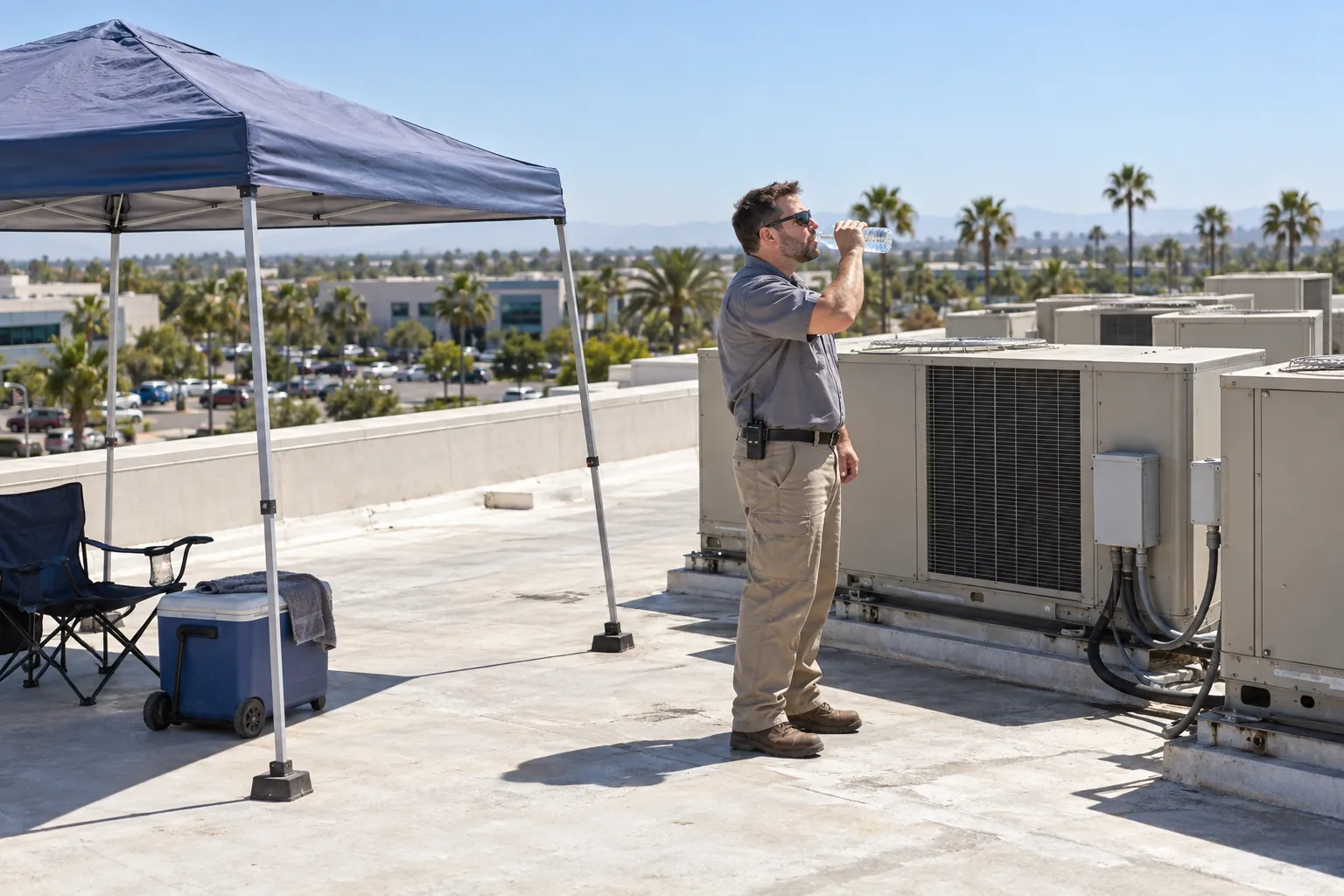
In California it is a written requirement under Cal/OSHA's outdoor rule (8 CCR 3395) and indoor rule (8 CCR 3396); elsewhere, federal OSHA relies on the General Duty Clause while its own heat rule is still a proposal, and a handful of states have rules of their own. This guide covers what the rules say, where the heat is in an ordinary building, who does what on a hot day, and what a useful record shows.
01
What the rules say: Cal/OSHA, federal OSHA and the other states
California has separate written rules for outdoor and indoor work. Title 8, section 3395, Heat Illness Prevention applies to all outdoor places of employment. It requires potable drinking water, free of charge and as close as practicable to the work, enough for "one quart per employee per hour for drinking for the entire shift"; shade for everyone on a rest or recovery period once the temperature exceeds 80 degrees Fahrenheit, and on request below that; close observation of new employees for their first 14 days; emergency response procedures; training before the work starts; and a written Heat Illness Prevention Plan. High-heat procedures at 95 degrees, including pre-shift meetings, apply to the industries the section lists, such as agriculture, construction and landscaping.
Title 8, section 3396, Heat Illness Prevention in Indoor Places of Employment, operative since July 23, 2024, applies to "all indoor work areas where the temperature equals or exceeds 82 degrees Fahrenheit when employees are present." Water, cool-down areas, emergency response, close observation, training and a written plan apply from 82 degrees. The assessment and control measures in subsection (e) apply where the temperature or heat index reaches 87 degrees, or where the temperature reaches 82 degrees and employees wear clothing that restricts heat removal or work in a high radiant heat area. There, the employer measures and records the temperature or heat index, whichever is greater, and uses engineering controls, then administrative controls, then personal heat-protective equipment. The plan may be part of the employer's Injury and Illness Prevention Program under section 3203.
Federal OSHA has no heat standard yet. Its Heat standards page points to the General Duty Clause, section 5(a)(1) of the OSH Act, under which an employer must keep the workplace "free from recognized hazards that are causing or are likely to cause death or serious physical harm," and to standards that touch heat, among them potable water (29 CFR 1910.141), first aid (1910.151) and the reporting rule in 29 CFR 1904.39: a fatality within eight hours, an inpatient hospitalization within 24. OSHA runs a National Emphasis Program on outdoor and indoor heat-related hazards, directive CPL 03-00-024, first issued in April 2022 and updated in April 2026.
OSHA published a proposed rule, Heat Injury and Illness Prevention in Outdoor and Indoor Work Settings, on August 30, 2024. Its heat rulemaking page records that the public hearing ended on July 2, 2025. At the time of writing no final rule has been issued.
Other states. OSHA's page lists Washington, Oregon, Minnesota and Colorado alongside California. Washington's WAC 296-62-09530, Outdoor heat exposure applies at 80 degrees, or 52 degrees for employees in nonbreathable or vapor barrier clothing, and requires paid preventative cool-down rest when an employee feels the need. Minnesota's Minnesota Rules 5205.0110 sets indoor heat limits as a two-hour average WBGT (wet bulb globe temperature): 86 degrees for light work, 80 for moderate and 77 for heavy. Maryland's Heat Stress Standards, COMAR 09.12.32, effective September 30, 2024, apply indoors and outdoors at a heat index of 80 degrees, with rest breaks of at least 10 minutes every two hours at a heat index of 90 to 100 and at least 15 minutes every hour above 100. Check which rule covers your staff before you write the plan.
02
Where the heat is in an ordinary building
Heat illness is usually pictured in a field or on a roofing crew. Building services teams meet it too, often in places nobody measures. The usual hot spots are these:
- Mechanical rooms and penthouses: boiler rooms, chiller plants, elevator machine rooms and air handler rooms. Hot equipment can make a high radiant heat area in Cal/OSHA's sense, where the globe temperature is at least five degrees above the air temperature.
- Roofs, attics and crawl spaces: rooftop unit service, filter changes and roof inspections in the afternoon sun, and attic work under an uninsulated deck.
- Kitchens, dish rooms and laundries: steam and dryers add humidity, which raises the heat index well above the thermostat reading.
- Unconditioned buildings in summer: school gyms, older wings and warehouses during summer deep cleaning, with the air handling set back or off.
- Outdoor posts and rounds: security officers at gate booths, parking structures and event entrances; day porters on exterior sweeps; grounds crews. A guard booth with a failed air conditioner is an oven.
- Protective clothing: coveralls, chemical-resistant suits and impermeable gowns trap heat, and Cal/OSHA's indoor rule and Washington's outdoor rule lower their thresholds for them.
The personal side matters as much as the place. OSHA's Protecting New Workers page states that "almost half of heat-related deaths occur on a worker's first day on the job or a worker's first day back after an extended absence" and that over 70 percent occur during a worker's first week. In building services that means the new hire, the temp covering a vacancy, the officer moved to an outdoor post for the first time, and the custodian back from two weeks off.
03
What the heat illness prevention plan covers
In California the plan is written, in English and in the language understood by the majority of the employees. Outside California, OSHA's Heat illness prevention planning page asks the same questions: who provides oversight each day, how new workers build tolerance, how heat is measured, and what happens on a heat advisory. For a building services team a working plan answers these:
- Who is in charge on the day. OSHA says an individual at the worksite "should be responsible for monitoring conditions and implementing the employer's heat plan throughout the workday." Name the role for each shift.
- Where the hot areas are. The locations from section 02 that apply to your building, and who works there.
- How heat is measured. A thermometer or heat index meter in the hot rooms, a WBGT meter where radiant heat is the problem, or the forecast and OSHA's heat calculator outdoors, with when and by whom.
- Water. Where it is, who restocks it, and how much. Cal/OSHA's figure is one quart per employee per hour for the whole shift; Maryland's standard requires at least 32 ounces per employee per hour to be available.
- Cool-down areas. Where they are for each hot area, and how they stay cool. Cal/OSHA requires indoor cool-down areas to be kept below 82 degrees unless the employer shows that is infeasible.
- Rest. Anyone can take a preventative cool-down rest when they feel the need, and under both California rules they are not sent back until signs and symptoms have gone, and never in less than five minutes. Add scheduled breaks for high heat.
- Acclimatization. How new and returning staff are eased in and observed. OSHA suggests 20 percent of the normal duration on the first day, increasing by 20 percent a day; California requires close observation for the first 14 days.
- Emergencies. How someone calls for help from each location, including a roof or a remote booth, who is authorized to call 911, and how the ambulance finds the right entrance. This should agree with your emergency action plan.
- Training. For everyone before heat work, and for supervisors on their part in the plan.
04
Who does what on a hot day
A hot-day routine for a building services team usually looks like this:
- Before the shift: the supervisor checks the forecast, any heat advisory or extreme heat warning, and the first readings in the hot rooms. If the plan's threshold is met, the high-heat routine starts with a short talk on water, breaks, symptoms and who to call.
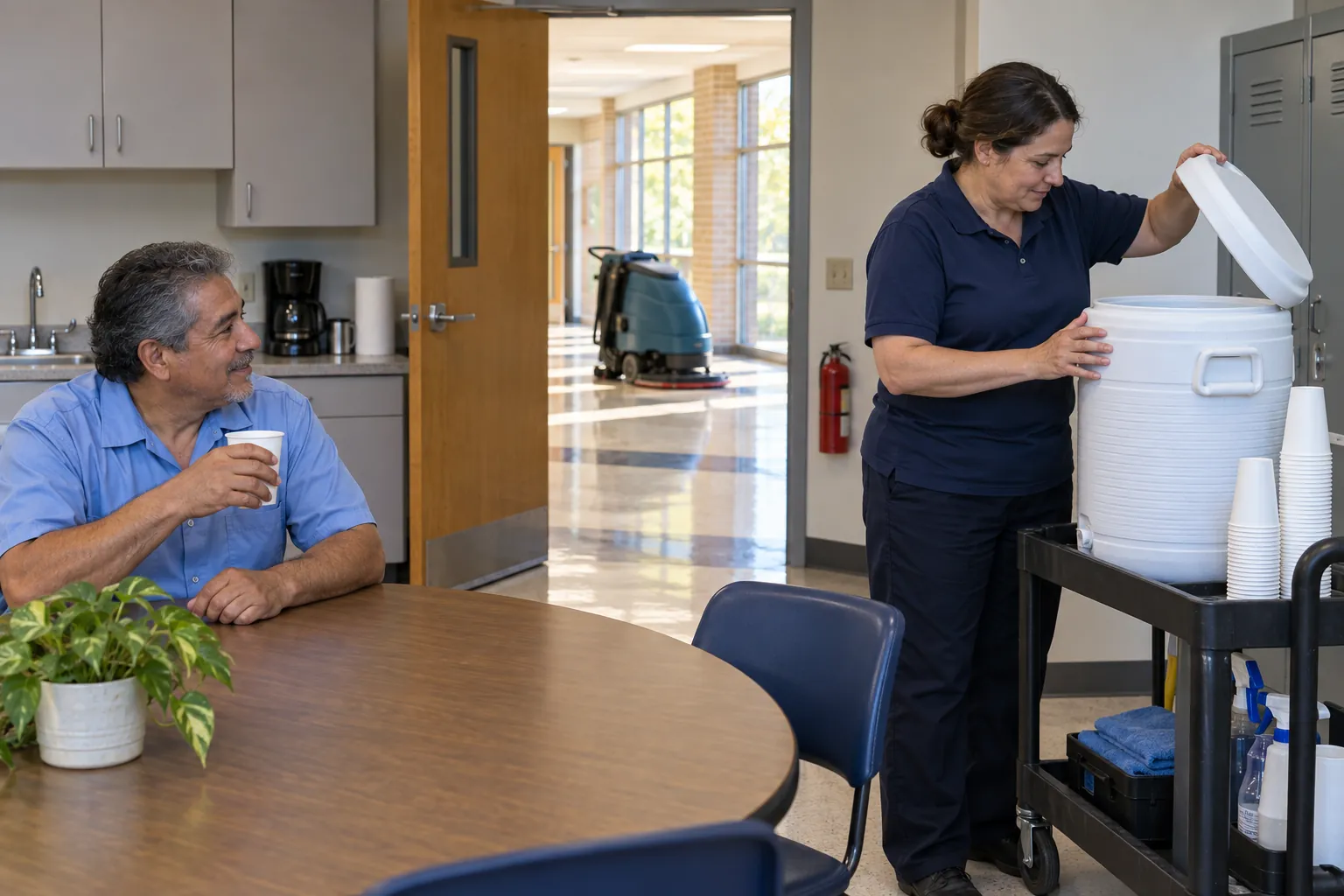
- Water and cool-down areas: someone checks that coolers are full and cold and the cool-down room is open, cool and not used as storage.
- Rescheduling: roof work, exterior sweeps and heavy floor work move to the early morning where they can; long jobs in hot rooms are split and rotated.
- Watching: new and returning staff are checked on by name. Lone workers on outdoor posts or in mechanical rooms check in at set times by radio or phone, and a missed check-in is followed up.
- Readings through the day: in California's indoor rule, measurements are taken again when they are reasonably expected to be 10 degrees or more above the previous ones. A failed air conditioner in a guard booth or a chiller trip on a summer afternoon is exactly that moment.
- Reporting: a broken water cooler, a warm cool-down room, a booth with no air conditioning, or a colleague who looks unwell is reported at once, to someone who will act.
Heat exhaustion often comes first: headache, nausea, dizziness, weakness, thirst and heavy sweating. The CDC's first aid is to move the worker out of the heat, give liquids, cool them and get medical care. OSHA's Water. Rest. Shade. page adds that workers "should not rely on feeling thirsty to prompt them to drink."
05
What a useful heat illness prevention record shows
California's indoor rule is specific about one record. Where subsection (e) applies, the employer must "establish and maintain accurate records of either the temperature or heat index measurements, whichever value is greater," with "the date, time, and specific location of all measurements," retained for 12 months or until the next measurements are taken, whichever is later. Keep that record in the form your safety manager or Cal/OSHA consultant has agreed; it is a required record in its own right.
Around it sits the everyday evidence that the plan was followed. For each hot day and hot area it should be possible to show:
- that water and the cool-down area were checked, by whom and at what time, and what was done when they were not right;
- that the readings were taken where the plan says, and what the reading was;
- that the pre-shift talk happened on a high-heat day, and who attended;
- which staff were new or returning and who observed them;
- what was reported during the day, who it went to and when it was fixed;
- any heat illness, the first aid given and whether it led to a report under 29 CFR 1904 or a recordable case on the OSHA 300 log;
- that training was given, with dates and names.
A good record is written when the check is done, by the person who did it, where it was done, with a photograph of a full cooler or a reading when one helps. A record filled in at the end of the week proves only that someone had a pen.
06
Where the record fails, and what SiteClara does about it
Heat plans fail on the hot day, not on paper. The sheet says water and cool-down areas are checked every two hours, but it was initialed at the end of the shift. The officer in the gate booth told the supervisor the air conditioner had quit, and nobody wrote it down. When someone goes to the hospital, there is nothing to show when the cooler was last filled or who knew about the booth.
SiteClara puts a printed QR poster at each location that matters, such as the cool-down room, the boiler room door, the guard booth or the roof hatch, with an optional NFC tag behind it. Staff scan the code or tap the tag on their own phone, with no app to install, and sign in with a link. They see the checks due at that location, such as a two-hourly water and cool-down area check on a hot day, and mark each one done, with a photo when one is asked for, or say what stopped them, such as a locked door. A problem, such as an empty cooler or a booth with no air conditioning, is reported there with a photo and goes onto the team's list of jobs until someone closes it.
The supervisor sees what is due, done and missed, and can record why a check was missed; a job that needs the building manager, such as a failed air conditioner the team cannot fix, can be escalated to them to answer. Each day the supervisor reviews and approves a report that goes to nominated management or client contacts at 8 a.m. the next morning, showing what was reported, completed and still open, and how the scheduled checks went, for example 12 of 12 completed.
07
Questions people ask
What are three ways to prevent heat illness?
Water, rest and shade. OSHA's Water. Rest. Shade. page says employers should provide cool water because "proper hydration is essential to prevent heat-related illness," should require breaks when heat stress is high, with longer and more frequent breaks as it rises, and should give workers "a cool location where they can take their breaks and recover from the heat." Workers should stay hydrated by drinking regularly, not only when they feel thirsty.
How do you help someone with heat exhaustion?
The CDC's Heat-Related Illnesses page says to take the worker to a clinic or emergency room for evaluation, or call 911 if medical care is unavailable, and to have someone stay with them until help arrives. Meanwhile, move them out of the hot area, give them liquids, remove unnecessary clothing, including shoes and socks, cool them with cold compresses or cold water on the head, face and neck, and encourage frequent sips of cool water. Signs of heat stroke, such as confusion or loss of consciousness, mean calling 911 at once.
Can you train your body to tolerate heat?
Yes, gradually. OSHA's Protecting New Workers page calls this acclimatization: the body sweats more, loses less salt and gets rid of heat more efficiently. It recommends one to two weeks, starting new workers at 20 percent of the normal duration on the first day and adding 20 percent a day, and warns that tolerance is lost after an extended absence such as vacation or sick leave, and over the winter.
Is it harder to tolerate heat as you age?
Yes. The CDC's Heat and Older Adults (Aged 65+) page says older adults "do not adjust as well as young people to sudden changes in temperature," are more likely to have a chronic medical condition that changes the body's response to heat, and are more likely to take medicines that affect how the body controls its temperature or sweats. Older staff are at higher risk, and the plan should allow for it.
08
Where to read the rules, and a list to take away
In California, read 8 CCR 3395 and 8 CCR 3396, and fold the plan into your Cal/OSHA IIPP. Elsewhere, start with OSHA's Heat standards page, which lists the states with their own rules, and its heat rulemaking page for the status of the federal proposal. Keep the CDC's Heat-Related Illnesses page on the wall of every cool-down room.
For a heat illness prevention routine that holds up on the hottest day, check that:
- you know which rule covers your staff: Cal/OSHA, another state plan, a state heat rule or federal OSHA;
- the plan is written, names who is in charge each shift, and is in the languages your team reads;
- every hot area in the building is listed;
- readings are taken where and when the plan says, and in California the 3396 records are kept for 12 months;
- water is cool, close and restocked, and cool-down areas are open, cool and big enough;
- anyone can take a cool-down rest when they need one, and nobody goes back until symptoms are gone;
- new and returning staff are eased in and watched by name for their first two weeks;
- lone workers check in on a schedule, and a missed check-in is followed up;
- everyone knows the signs of heat stroke and that the answer is 911;
- each check and each reported problem is recorded by the person who did it, with a time and a photo when something is wrong.
Sources
Every document this guide quotes or links to, in the order it first cites them.
- Title 8, section 3395, Heat Illness Prevention dir.ca.gov
- Title 8, section 3396, Heat Illness Prevention in Indoor Places of Employment dir.ca.gov
- Heat standards page osha.gov
- Heat rulemaking page osha.gov
- WAC 296-62-09530, Outdoor heat exposure app.leg.wa.gov
- Minnesota Rules 5205.0110 revisor.mn.gov
- Heat Stress Standards, COMAR 09.12.32 labor.maryland.gov
- Protecting New Workers osha.gov
- Heat illness prevention planning osha.gov
- Heat-Related Illnesses cdc.gov
- Water. Rest. Shade. osha.gov
- Heat and Older Adults (Aged 65+) cdc.gov
Related guides
 Premises and facilities managementThe Cal/OSHA Injury and Illness Prevention Program: what 8 CCR 3203 asks, and how to run it in a buildingCalifornia's Injury and Illness Prevention Program under 8 CCR 3203: the required elements, scheduled inspections, corrections, training and the records to keep.
 Fire and water checksEmergency action plan: what OSHA requires, and how to keep the plan workingWhat an emergency action plan must contain under OSHA 1910.38, who needs one, how alarms, wardens, drills and reviews fit in, and what the record should show.
 Premises and facilities managementBuilding engineer duties: what the job covers, and how to show it is doneBuilding engineer duties in a commercial building: running the plant, rounds and logs, lockout, refrigerant and boiler rules, vendors, and a record that holds up.
 Premises and facilities managementSafety walkthroughs: how to walk a building, talk to the crew and fix what you findWhat a safety walk is under OSHA's Recommended Practices, what to look at in a commercial building, how often to walk, how to record findings and close them out.