Cleaning
Janitorial daily report: what goes in it, and how to make it worth reading
A janitorial daily report is a short record of one shift's cleaning at one building, written by the night supervisor or lead custodian, that shows which tasks were performed, which were not and why, what went wrong and what needs someone else's attention.
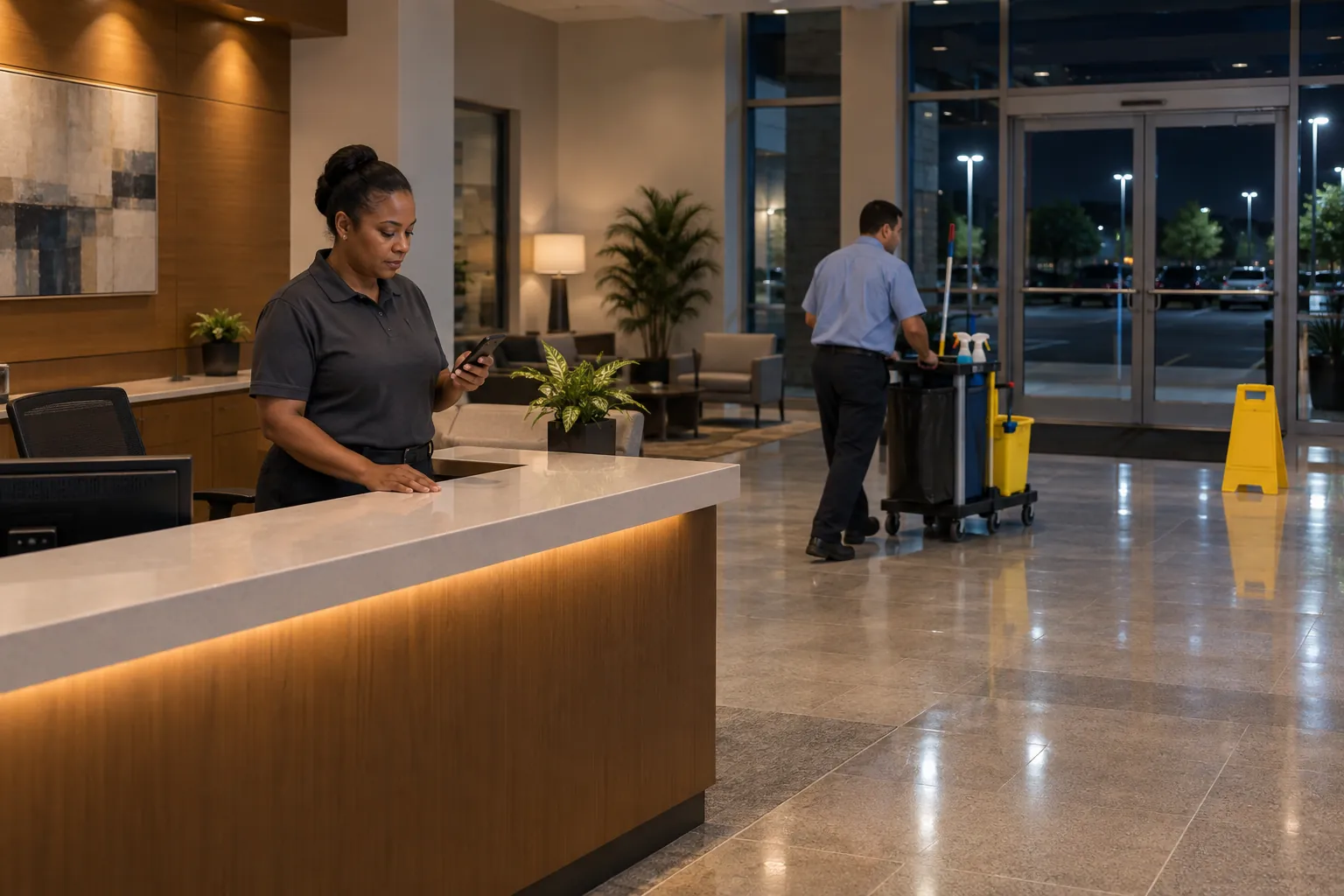
Done well, it lets a facility manager or property manager see the state of the building before the tenants arrive, and it gives the contractor evidence for the monthly review. Done badly, it is a copy of yesterday's report with the date changed. This guide covers what belongs in a janitorial daily report, who writes which part, how it relates to the logs a regulation requires, and how to keep it honest.
01
What a janitorial daily report is, and why no law asks for one
A janitorial daily report (also called a custodial shift report, a daily cleaning report or, on some contracts, a daily service report) is a record of one shift or one day of cleaning at one building. It usually goes from the night supervisor or lead custodian to the account manager at the company providing the janitorial services, and from there, or directly, to the customer's facility manager or property manager. In-house custodial staff at school districts, universities and hospitals keep the same kind of report for their own managers.
No federal law requires a janitorial daily report. What the law requires is the outcome the report describes. OSHA's walking-working surfaces standard, 29 CFR 1910.22, says "All places of employment, passageways, storerooms, service rooms, and walking-working surfaces are kept in a clean, orderly, and sanitary condition," and that walking-working surfaces are "inspected, regularly and as necessary, and maintained in a safe condition." The sanitation standard, 29 CFR 1910.141, says "All places of employment shall be kept clean to the extent that the nature of the work allows." Where employees may be exposed to blood, the Bloodborne Pathogens Standard, 29 CFR 1910.1030, goes further: "The employer shall determine and implement an appropriate written schedule for cleaning and method of decontamination."
Those duties sit with employers, and a building usually has two: the owner or tenant whose employees use the space, and the contractor whose custodians clean it. The daily report is where they meet.
The industry's management standard points the same way. ISSA's Cleaning Industry Management Standard (CIMS), which according to the CIMS frequently asked questions "applies to all facility service provider organizations – building service contractors (BSCs) and in-house organizations – regardless of organization size," has Quality Systems and Service Delivery among its five sections. A daily report is one of the plainest ways a cleaning organization shows that its quality system is in use, not only written down.
02
What goes in a janitorial daily report
The best daily reports are short and follow a consistent order every day, so the reader can find what changed. A facility manager should be able to read one in two minutes. Whatever the template, most contain these parts:
- The header: building, date, shift, the supervisor or lead who wrote it, and the crew on duty. Names are enough; this is not a timesheet.
- Routine work completed: the areas serviced against the scope of work, by floor or zone. Restrooms, lobbies and entrances, break rooms, offices, trash and recycling removal, and any day porter rounds.
- Work not completed, and why: an office locked, a conference room in use until 10 p.m., a floor closed for a contractor, a crew member out and not covered. This is the part most often left blank, and the part the customer most needs.
- Periodic and project work: carpet extraction, floor stripping and refinishing, high dusting, window or glass work, and whether it was done as scheduled.
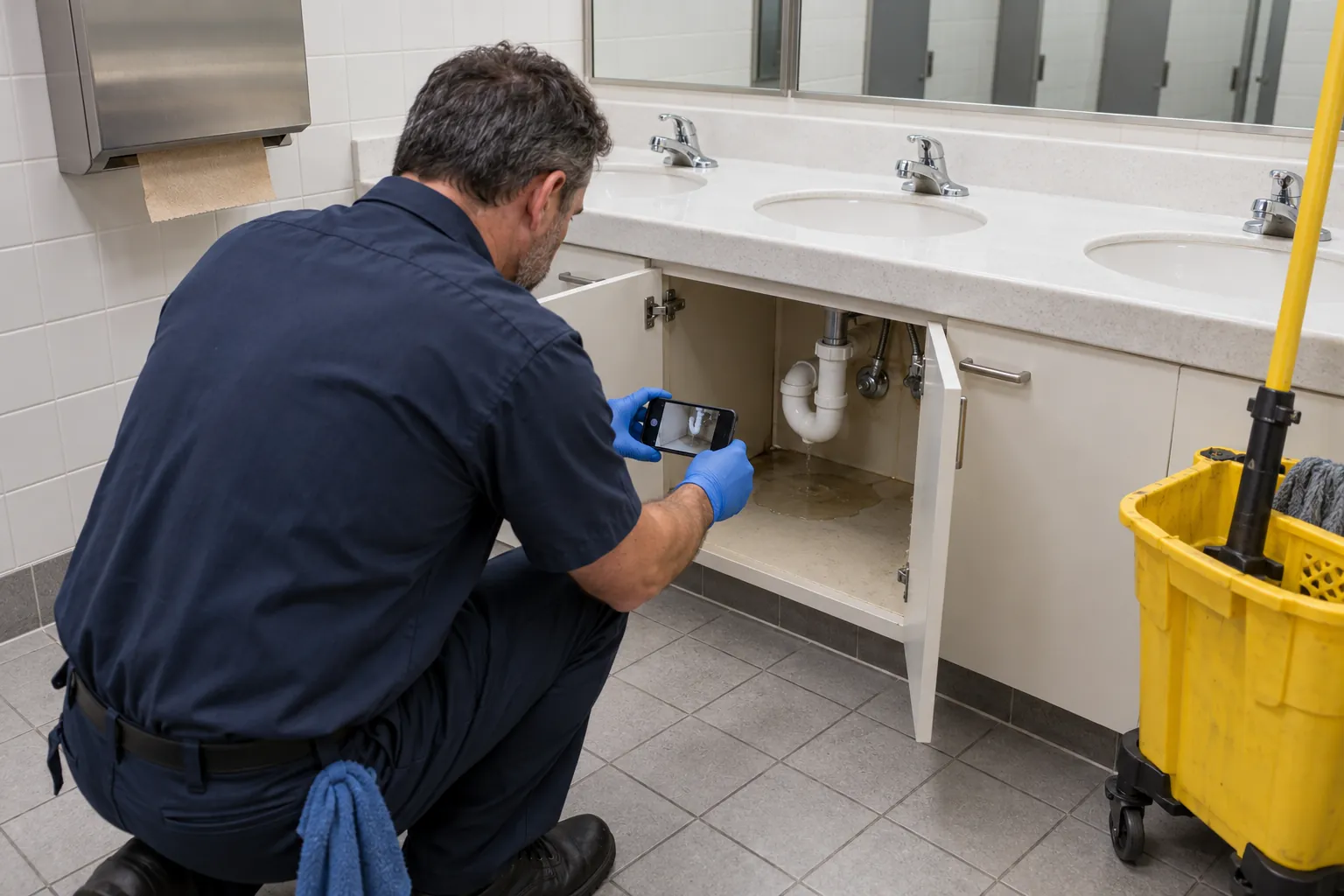
- Maintenance issues found: leaks, running toilets, burned-out lights, damaged ceiling tiles, broken dispensers, pest sightings. The report should say where, what, and who it was passed to, whether a work order was raised in the customer's system or the building engineer was told directly.
- Safety and security observations: spills and how they were handled, trip hazards, blocked exits, doors found unlocked or propped open, alarms, anything the security officer on post should know.
- Incidents: an injury to a custodian, a slip reported by a building occupant, a blood or body fluid cleanup, a chemical splash. The daily report notes that one happened and points to the full incident report; it does not replace it.
- Supplies and equipment: restroom paper and soap stock, chemicals running low, equipment out of service, such as an auto scrubber or a backpack vacuum waiting for repair.
- Customer requests and complaints: what the tenant or facility manager asked for during the shift, and what was done about it.
- Notes for the next shift: the pass-down, such as an event in the lobby tomorrow morning, a floor that needs a second look, a key to return.
03
Who writes which part, and when
A daily report assembled at the end of the shift from memory is the weakest kind. The information in it is only as good as the moment it was captured, so it helps to split the work.
- Custodians record as they go. A restroom check is marked when it is done, a leak is reported when it is found, a locked office is noted when the custodian reaches it. Custodians should not be writing prose; a tick, a short note and, where it helps, a photo are enough.
- The lead or supervisor walks the building. A walk-through during the shift, not only at the end, catches missed areas while there is still time to fix them. The supervisor adds what they found and what was fixed.
- The supervisor writes the summary. At the end of the shift, the supervisor turns the crew's records into the report: the exceptions first, then the routine. They add their own judgment in a sentence or two, such as "Third floor behind because of the late meeting; restrooms and trash done, vacuuming carried to tomorrow."
- The account manager reviews it. Before it reaches the customer, someone at the contractor should read it, answer anything that needs an answer, and check that follow-ups from yesterday were closed.
- The facility manager reads it before the building opens. A report that lands at 6 a.m. can be acted on before the tenants arrive. One that lands at noon is history.
Agree on the timing and the format at the start of the contract, in the quality control section of the scope of work or the service level agreement (the janitorial quality control guide covers that section). Say who receives the report, by what time, and what counts as an exception that needs a phone call rather than a line in the report: a flood, a break-in, an injury, a building found unsecured.
04
What good evidence looks like in a daily report
The difference between a useful report and a useless one is rarely the template. It is whether the entries could be wrong. A report that says "all areas cleaned" every night cannot be wrong, and so it tells the reader nothing. A report that says "Restrooms 2F checked 7:40 p.m. and 10:15 p.m. by R. Alvarez; 4F men's room closed 9 p.m. to 11 p.m. for a plumbing repair, cleaned at 11:20 p.m." can be checked, and so it can be believed.
Good entries share a few features:
- Time and place: when the work was done and exactly where, down to the floor and room.
- A named person: who did it, or who found the problem.
- Exceptions stated plainly: what was missed, with the reason. A missed area with a good reason is a normal night; a missed area hidden is a trust problem.
- A photo where words are not enough: a leak, damage found at the start of the shift, a condition the next shift or the building engineer needs to see.
- A handoff that closes: a maintenance issue reported yesterday should appear today as fixed, still open, or passed on, not simply disappear.
- A standard to compare against: the report is read against the scope of work and the frequencies in it, and ideally against an agreed appearance level.
For that last point, APPA publishes appearance levels that a contract can refer to. According to APPA's cleaning operations page, the association first published its Custodial Staffing Guidelines in 1992, and its current guidelines cover 23 room types with productivity standards and five levels: Orderly Spotlessness (Level 1), Ordinary Tidiness (Level 2), Casual Inattention (Level 3), Moderate Dinginess (Level 4) and Unkempt Neglect (Level 5). A contract that specifies Level 2 in restrooms and Level 3 in storage areas gives both sides a shared vocabulary for the daily report and the inspections behind it.
For routine surfaces outside healthcare, the CDC's guidance on when and how to clean and disinfect a facility is a useful reference for what the routine should include. It advises that facilities "Clean high-touch surfaces regularly (for example, pens, counters, shopping carts, door handles, stair rails, elevator buttons, touchpads, restroom fixtures, and desks)" and notes that "In most situations, cleaning regularly is enough to prevent the spread of germs." A daily report that shows high-touch points were done, and when, answers the question most occupants actually ask.
05
The daily report, incident reports and the logs a regulation requires
A daily report is a working record. It sits beside several other records that have their own rules, and it should not be confused with them. It is useful documentation, but it is not, on its own, the compliance record any of those rules asks for.
- The OSHA injury and illness records. Under 29 CFR 1904.29, employers covered by the recordkeeping rule "must use OSHA 300, 300-A, and 301 forms, or equivalent forms, for recordable injuries and illnesses," and "must enter each recordable injury or illness on the OSHA 300 Log and 301 Incident Report within seven (7) calendar days of receiving information that a recordable injury or illness has occurred." A line in the daily report that a custodian was hurt is how the safety manager hears about it; it is not the OSHA 300 log.
- Severe injury reporting. Under 29 CFR 1904.39, a work-related death must be reported to OSHA "Within eight (8) hours," and an in-patient hospitalization, amputation or loss of an eye "Within twenty-four (24) hours." That is a phone call or an online report by the employer, not a note in tomorrow's daily report.
- Bloodborne pathogens records. Where custodians clean up blood, 29 CFR 1910.1030 has its own schedule, training and exposure follow-up. The daily report can note that a cleanup took place; the exposure control plan and its records live elsewhere.
- Hazard communication. OSHA's Hazard Communication Standard, 29 CFR 1910.1200, requires employers to "develop, implement, and maintain at each workplace, a written hazard communication program" and to provide training "at the time of their initial assignment, and whenever a new chemical hazard the employees have not previously been trained about is introduced into their work area." A new chemical on the supply line in the daily report is a prompt to check that program, not a substitute for it.
- Customer work orders. A leak found by a custodian becomes a work order in the customer's maintenance system. The daily report records that it was reported; the work order system tracks the repair.
Keep the daily reports for as long as the contract says, and at least as long as the customer might need them to answer a complaint or a slip-and-fall claim. The OSHA forms have their own retention period, set in 29 CFR Part 1904 itself.
06
Where the daily report fails, and where SiteClara fits
Most janitorial daily reports fail in the same few ways. The restroom log on the back of the door is initialed for every hour of the shift at the start of it. The supervisor's summary is written at 5 a.m. from memory, so it lists what should have happened rather than what did. A missed area is left off rather than written down, and a leak found at 10 p.m. is mentioned to whoever was passing and never reaches the building engineer. The facility manager reads "all areas completed" and then takes a complaint about the fourth-floor restroom at 8:15 a.m.
SiteClara records the checks at the place they are done. A printed QR code poster at each location, with an optional NFC tag behind it, lets custodians scan or tap on their own phone, with no app to install, and see the checks due there. They mark each one done, or say what stopped them, at the time, with a photo when one is asked for. A problem, such as a leak, a broken dispenser or a spill, can be reported with a photo on the spot, and it goes onto the team's list of jobs until someone closes it.
The supervisor sees what is due, done and missed during the shift, not after it, and gives the reason a check was missed from the company's own list, with a few words. At the end of the day they review the totals and photos, add a note and approve the day's report. The approved report goes to nominated managers or customer contacts at 8 a.m. the next morning by default: what was reported, what was completed, what is still open, and how the scheduled checks went, for example 11 of 12 completed with the reason for the one that was not. A report the supervisor has not approved is held, not sent. That gives the daily report a source recorded at the time, location by location, rather than reconstructed at the end of the shift.
07
Questions people ask
What is a daily housekeeping report?
In a workplace, a daily housekeeping report is the same kind of record as a janitorial daily report: an account of one day's cleaning and tidying, and of the hazards found and corrected. Housekeeping is the heading OSHA gives the rule in its sanitation standard, 29 CFR 1910.141 that all places of employment are kept clean to the extent that the nature of the work allows. The walking-working surfaces standard, 29 CFR 1910.22, adds that surfaces are kept free of hazards such as leaks and spills, and that hazardous conditions are corrected or repaired before an employee uses the surface again. A housekeeping report shows when that was done.
What should be included in a daily workplace cleaning checklist?
The high-touch surfaces, the restrooms, the floors and the trash, each with the time it was done and who did it. The CDC's When and How to Clean and Disinfect a Facility advises cleaning high-touch surfaces regularly, such as door handles, stair rails, elevator buttons, restroom fixtures and desks, cleaning other surfaces when they are visibly dirty, and disinfecting areas where people have obviously been ill. OSHA's sanitation standard, 29 CFR 1910.141, requires washing facilities to be maintained in a sanitary condition, and lavatories to have hot and cold, or tepid, running water, hand soap and towels or air blowers, so a restroom line should cover supplies as well as cleaning.
How do I create a daily activity report?
Start from a short checklist of what to look for at each location, have the people doing the work record each item when it is done, note anything found with the time and place, and add a photo of a problem where words are not enough. OSHA's Hazard Identification and Assessment guidance recommends the same habits for workplace inspections: use checklists that highlight things to look for, have workers take part, document inspections so you can later verify that hazardous conditions are corrected, and take photos or video of problem areas.
08
Further reading, and a list to take away
OSHA publishes the housekeeping, sanitation and bloodborne pathogens standards cited above, and the recordkeeping rule in 29 CFR Part 1904. ISSA publishes the Cleaning Industry Management Standard, and APPA its custodial appearance levels and staffing guidelines. In a state plan state, start from the state's own occupational safety and health program.
Before you agree on the format of a janitorial daily report, or review one you already receive, check that:
- it follows the same order every day, with exceptions first;
- routine work is recorded against the scope of work, by floor or zone;
- work not completed is listed, with the reason;
- entries carry a time, a place and a named person;
- maintenance issues show who they were passed to, and yesterday's reappear as fixed, open or passed on;
- incidents point to the full incident report, and injuries reach whoever keeps the OSHA 300 log;
- it reaches the facility manager before the building opens;
- someone at the contractor reads it before the customer does;
- it is compared, from time to time, with an inspection of the building itself.
Sources
Every document this guide quotes or links to, in the order it first cites them.
- Walking-working surfaces standard, 29 CFR 1910.22 osha.gov
- Sanitation standard, 29 CFR 1910.141 osha.gov
- Bloodborne Pathogens Standard, 29 CFR 1910.1030 osha.gov
- CIMS frequently asked questions cims.issa.com
- State Plans osha.gov
- Cleaning operations appa.org
- When and how to clean and disinfect a facility cdc.gov
- 29 CFR 1904.29 osha.gov
- 29 CFR 1904.39 osha.gov
- Hazard Communication Standard, 29 CFR 1910.1200 osha.gov
- Hazard Identification and Assessment osha.gov
- Cleaning Industry Management Standard cims.issa.com
Related guides
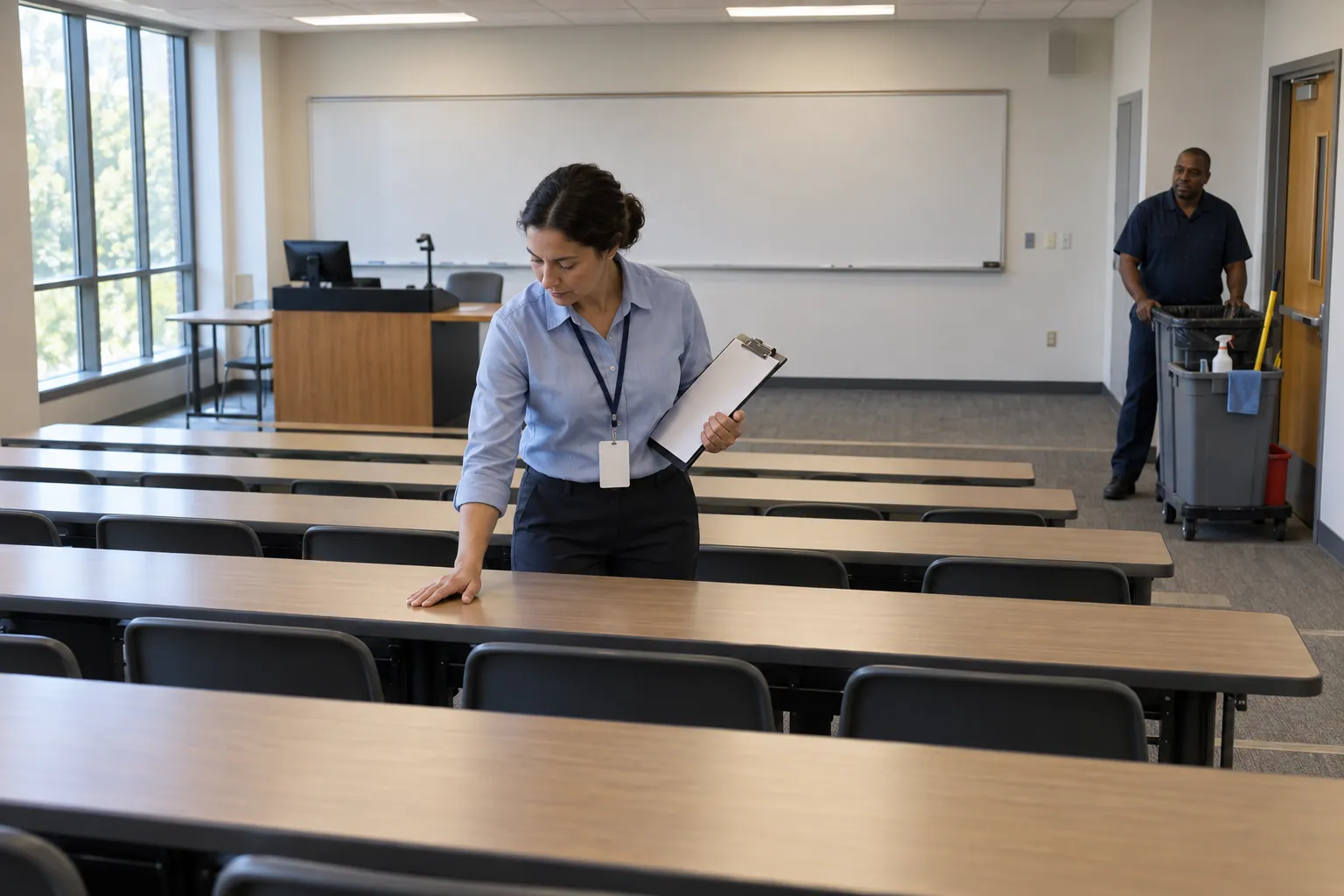 CleaningJanitorial quality control: how to inspect, score and fix the cleaningHow janitorial quality control works: QA versus QC, building a cleaning inspection checklist, APPA appearance levels, sampling, scoring and corrective action.
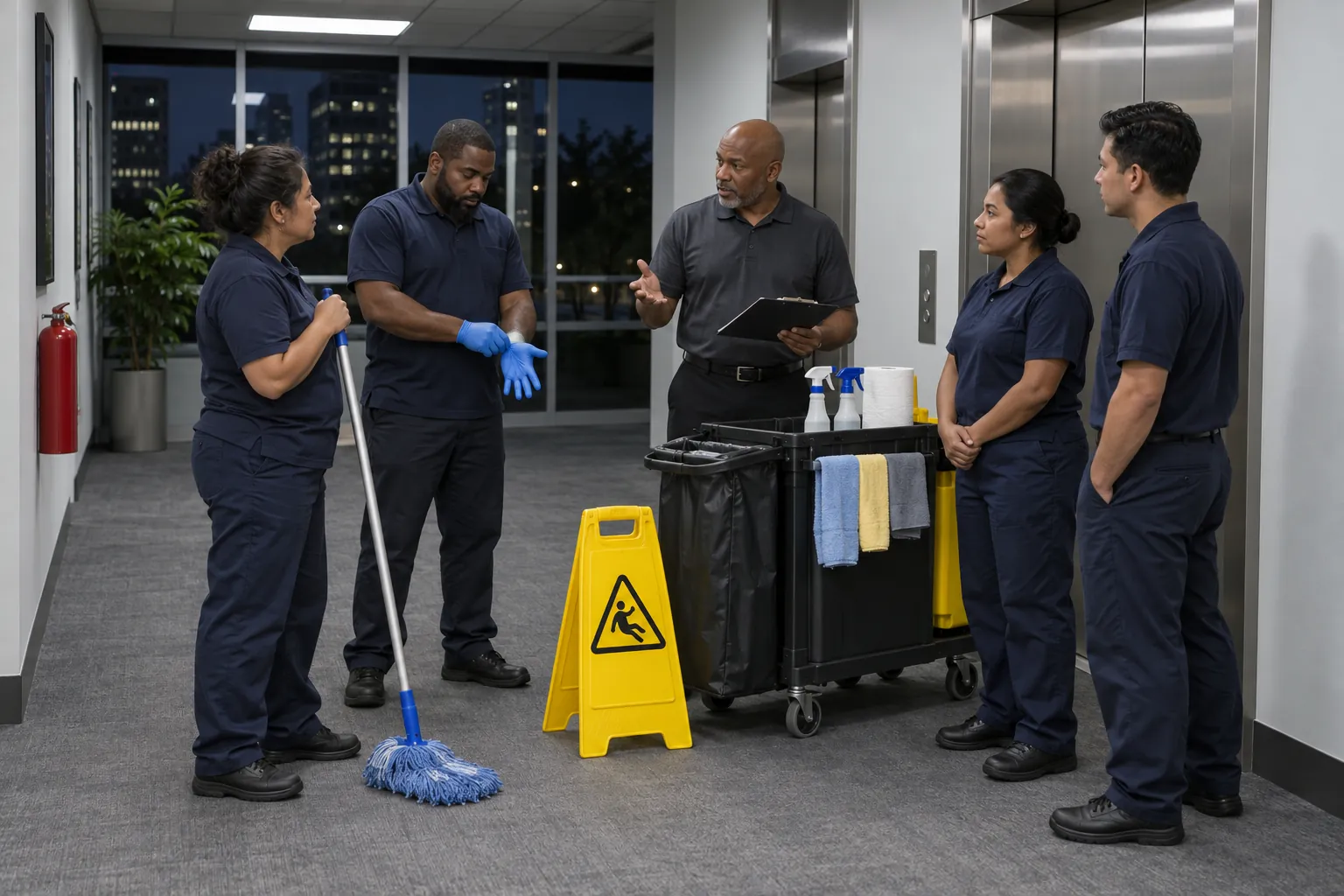 CleaningJanitorial supervisor duties: what the job involves, and what good looks likeWhat a janitorial supervisor does: the core duties, a typical night shift, the OSHA rules behind the work, inspecting the cleaning and reporting to the client.
 CleaningCleaning log sheet: what to record, who initials it, and what it provesWhat a cleaning log sheet should record in offices, break rooms, kitchens and clinics, the OSHA and Food Code rules behind it, and what each set of initials proves.
 CleaningRestroom cleaning log: what to record, and how to make it believableWhat a restroom cleaning log should record, how often to check, the OSHA and Food Code rules behind it, and how to keep a log a client or inspector will believe.