Security patrols
Mall security: what officers do, what the law lets them do, and the record behind it
Mall security is the team of private security officers that a shopping center's owner or management company employs or contracts to patrol the common areas, parking lots and entrances, help shoppers and tenants, respond to incidents and report what happened; they are not police, and states such as California and Texas license or register them as security officers.
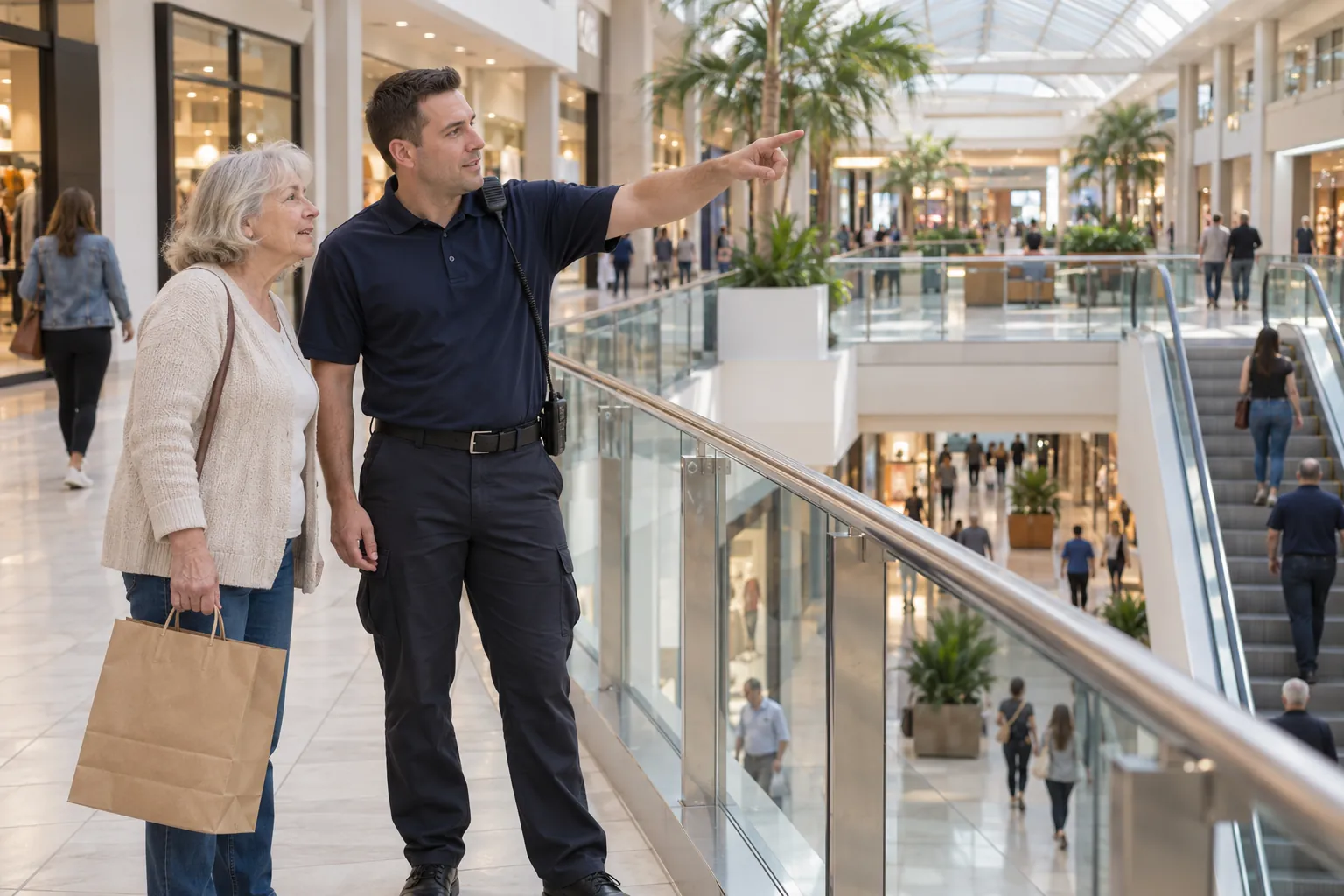
No federal law says a mall must have security, so what the officers may do comes from state licensing law, the state's rules on arrest and detention by private persons, and the post orders the owner writes. This guide covers those rules, the duties of a mall security officer, how the patrol is run, and the records that show it was done.
01
What mall security is, and the state laws behind it
A shopping mall is private retail property that invites the public in. The owner, or the management company running the center, decides how it is secured: a security company on contract, an in-house security department, or both. Either way the officers act for the owner, and their authority to patrol, enforce the center's rules and ask someone to leave comes from the owner's control of the property, not from any police power.
The states regulate who may do the work. In California, the Bureau of Security and Investigative Services (BSIS) licenses security companies and registers their officers. A private patrol operator under Business and Professions Code Section 7582.1 furnishes, for any consideration, "a watchman, guard, patrolperson, or other person to protect persons or property." A mall's own staff are covered too: Business and Professions Code Section 7574.01 defines a proprietary private security officer as an unarmed employee providing security for one employer who "is required to wear a distinctive uniform clearly identifying the individual as a security officer" and "is likely to interact with the public while performing their duties."
In Texas, the Occupations Code, Chapter 1702 (Private Security) covers a guard company providing a guard or patrol service on contract to "prevent entry, larceny, vandalism, abuse, fire, or trespass on private property." Section 1702.222 says an individual acts as a security officer if employed "by a security services contractor or the security department of a private business." In-house staff are usually outside the chapter, but Section 1702.323(d) brings them in when they come into contact with the public, wear a uniform, badge or patch associated with security, and do guard work: the position of a uniformed officer on a mall concourse.
02
What mall security officers do
A mall security officer's duties are set by the center's post orders, the written instructions for each post. Most combine a visible patrol with assistance for shoppers, visitors and tenants, and a fast response in an emergency:
- Opening and closing: unlocking and securing the entrances, checking that the concourse is clear at night, and setting alarms.
- Patrols of the common areas: concourses, the food court, restrooms, elevators and escalators, stairwells, the service corridors behind the stores and the loading docks.
- Parking lots and garages: foot or vehicle patrols, help for shoppers with a lost car or a dead battery, escorts at closing, and reports of failed lighting.
- Cameras and dispatch: watching the surveillance cameras (CCTV) in the security office, answering radio and tenant calls, and sending officers where they are needed.
- Emergency response: first on scene at medical calls, fire alarms, evacuations, severe weather and lockdowns, and meeting police, fire and EMS at the door.
- Lost children: running the center's search procedure. A common model is Code Adam, the National Center for Missing & Exploited Children's program, whose search procedures and protocols are offered "free of charge" and which its owner says is used in hundreds of thousands of locations.
- The code of conduct: enforcing the center's posted rules on behavior, calming disturbances, and asking people who break the rules to leave.
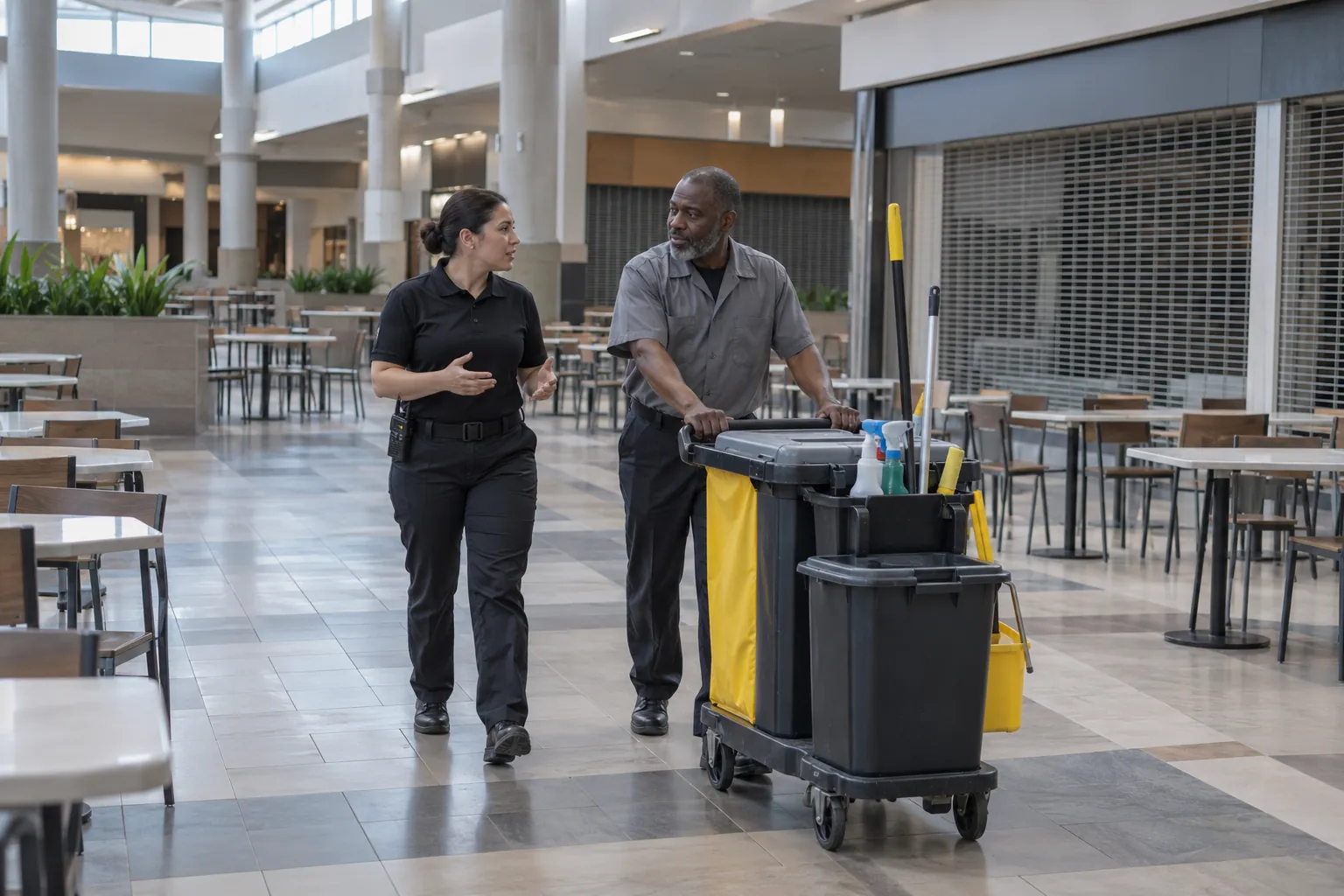
- Hazards: guarding spills, broken glass and leaks until custodial or maintenance staff arrive, so a hazard does not become an injury.
- Tenant support: responding to tenants' store alarms and calls about an aggressive customer, and handling lost and found.
- Reporting: the daily activity report, incident reports and the pass-down to the next shift.
03
What mall security can and cannot do
Mall security officers, often called mall security guards, are not law enforcement. Unless a state or city has commissioned them as special police, which is uncommon, they have no police powers; in most respects they have the powers of a private person acting for the owner:
- Ask a person to leave. The owner can withdraw permission to be on the property, and officers can say so for the owner; see the trespass notice guide. California's Penal Code Section 602.1 makes it a misdemeanor to obstruct or intimidate people at a business open to the public and then refuse to leave when asked by the owner or the owner's agent, but it does not apply to lawful labor union activity or to activities protected by the California or United States Constitution. Leafleting and protest are questions for the owner's attorney, not the officer.
- Arrest, as a private person. California's Penal Code Section 837 says "a private person may arrest another" for "a public offense committed or attempted in his presence," or for a felony in stated circumstances. Other states set their own rules. A wrongful arrest exposes the officer, the security company and the owner to a claim of false imprisonment, so the post orders should say when officers observe, report and call police instead.
- Detain a suspected shoplifter, where the law extends the privilege to them. Many states give merchants a limited right to hold a suspect briefly, often called the shopkeeper's privilege. California's Penal Code Section 490.5(f) lets a merchant with probable cause "detain a person for a reasonable time for the purpose of conducting an investigation in a reasonable manner," and limits a search to bags and packages, "not including any clothing worn by the person." Texas's Civil Practice and Remedies Code Section 124.001 privileges a person who "reasonably believes that another has stolen or is attempting to steal property" to detain them "in a reasonable manner and for a reasonable time." Under Florida Statutes Section 812.015, "a law enforcement officer shall be called to the scene immediately" after a merchant takes a person into custody, and New York General Business Law Section 218 gives a defense where a person was "detained in a reasonable manner and for not more than a reasonable time."
The shopkeeper's privilege belongs to the merchant and the people acting for it; California defines a merchant as the owner or operator of premises used for retail sale, and their agents and employees. Whether an officer employed by the mall's landlord counts as a store's agent is not something to assume. The post orders should say whether mall officers detain at all, or stand by while the store's own retail security, its loss prevention staff, and the police deal with it.
What officers may carry is a licensing question. In Texas, Occupations Code Section 1702.161 bars employment as a security officer to carry a firearm without a security officer commission, and Section 1702.323(b) applies that to a mall's own in-house officers too. In California, Business and Professions Code Section 7583.12 requires a guard registration card and a firearm qualification card, and the BSIS security guard fact sheet says baton and tear gas carriers need their own training. See armed vs. unarmed security.
04
The mall security patrol: where to go, when, and what to check
A mall patrol has two jobs: to be seen, since visibility deters theft and vandalism and helps shoppers feel safe, and to find problems before they become incidents. A good patrol plan sets out:
- The checkpoints: each entrance, the food court, every restroom, elevator lobbies, stairwells, the service corridors and their exit doors, loading docks, trash compactor areas, each parking level and the lot perimeter, with what to check at each.
- The times: rounds at opening, during business hours and after closing, varied so a pattern cannot be learned, with extra rounds at peaks such as school release, evenings and holiday weekends.
- What to look for: blocked or propped exit doors, fire equipment hidden behind deliveries, spills and trip hazards, failed lighting, unattended bags, vehicles in fire lanes, suspicious activity such as someone trying store doors after closing, and anyone who seems lost, unwell or in distress.
- The closing sweep: every restroom, stairwell and service corridor checked before the doors are locked, so nobody is left inside.
- What happens on a finding: who is called, what is written down, and how the problem reaches the person who can fix it.
A shopping center is a public gathering in the federal government's terms: the Cybersecurity and Infrastructure Security Agency's page on securing public gatherings names "shopping centers" among the places where people gather freely. CISA's Employee Vigilance – Power of Hello page teaches four steps, "Observe, Initiate a Hello, Navigate the Risk, and Obtain Help," which fit a mall officer's approach to someone who looks out of place: a friendly greeting first, then a judgment, then help.
Officers face safety risks of their own. OSHA defines workplace violence as "any act or threat of physical violence, harassment, intimidation, or other threatening behavior that occurs at the work site," and its workplace violence overview notes "there are currently no specific OSHA standards for workplace violence." In California, Labor Code Section 6401.9 requires employers, with some exceptions, from July 1, 2024, to maintain a workplace violence prevention plan and a violent incident log kept for at least five years (see the California workplace violence prevention guide).
05
Incidents, reports and the records that show the work was done
When something goes wrong at a mall, a fall in the food court, a fight in the parking lot, a complaint that someone was detained unlawfully, an insurer, an attorney or a detective asks first for the record. Four documents carry most of the weight:
- The daily activity report (DAR): each officer's shift in time order, from rounds walked to calls answered.
- The incident report: one per incident, written the same shift, with facts, times, witnesses, what was done and who was told. Any use of force needs its own use of force report.
- The pass-down log: what the next shift needs to know, such as a broken door, a person asked to leave, or a store alarm that keeps sounding.
- The patrol record: which checkpoints were visited, when, by whom, and what was found.
The patrol record is the one most often missing. A DAR line reading "patrolled common areas, all secure" every hour does not show that anyone looked at the restroom where a shopper later fell, or the loading dock door found propped open next morning. A record made at the checkpoint, at the time, by a named officer, turns "we patrol regularly" into evidence, and over a month it shows the owner where incidents cluster and which hazards keep coming back. Keep personal details of shoppers and suspects in the incident reports, not in general patrol notes.
06
Where the record fails, and where SiteClara fits
The incident reports are usually written properly, because something happened. The weak record is the routine one: the round walked at 2 p.m. with nothing to show for it, the hazard mentioned to whoever was passing, the service corridor door that keeps being propped open and is never fixed.
SiteClara is a way to record the routine part. A printed QR poster, with an optional NFC tag behind it, goes at each checkpoint that matters: an entrance, a restroom, a service corridor exit, a loading dock, a parking level. The officer scans the code or taps the tag on their own phone, with no app to install, sees the checks due at that point and marks them done, or says what stopped them. The time and the named officer are recorded as it happens, with a photo when one helps. A problem found on the round, such as a spill, a failed light or a propped door, is reported there and goes onto the team's list of jobs until someone closes it.
The security supervisor sees what was due, done and missed, with the reason where one was given, and a job that needs the center's building manager can be escalated to them to answer. Each day the supervisor reviews the totals and photos, adds a note and approves a report that goes to nominated management or client contacts at 8 a.m. the next morning, showing what was reported, what is still open and how the scheduled checks went.
07
Questions people ask
Is mall security considered law enforcement?
No. Mall security officers are private employees of a security company or of the mall, with the powers of a private person acting for the owner. Texas's Occupations Code Section 1702.222 describes a security officer as someone employed "by a security services contractor or the security department of a private business," and California's Penal Code Section 837 sets out when "a private person may arrest another."
What can mall security do to you?
They can ask you to leave, call the police, and, where state law allows and there is probable cause, detain you for a reasonable time over suspected theft. In California the merchant's privilege in Penal Code Section 490.5(f) allows only "a reasonable amount of nondeadly force," and a search of bags but not "any clothing worn by the person."
Does mall security carry weapons?
Only if they are licensed for it where the state requires a license: in states such as Texas and California, an officer who carries a firearm on duty needs one. In Texas that is a security officer commission under Occupations Code Section 1702.161; in California, a guard registration and a firearm qualification card under Business and Professions Code Section 7583.12.
How long is mall security training?
It depends on the state's training requirements. In California, Business and Professions Code Section 7583.6 requires a course in the power to arrest and the use of force before registration, 32 hours of security officer skills within six months (16 of them within 30 days), and eight hours every year after that. Florida requires "a minimum of 40 hours of professional training" for a Class D security officer license under Florida Statutes Section 493.6303.
Can mall security give you a parking ticket?
Not a police or city citation: mall security officers are not police, so a notice they leave on a windshield comes from the owner, not the city. What the owner can do about a car is set by state law. In California, Vehicle Code Section 22658 lets the owner of private property have a vehicle removed where, among other routes the section allows, a sign "not less than 17 inches by 22 inches in size, with lettering not less than one inch in height" is displayed "in plain view at all entrances to the property," prohibiting public parking, saying that vehicles will be removed at the owner's expense, and giving the telephone number of the local traffic law enforcement agency and the name and telephone number of each towing company that has a written general towing authorization agreement with the owner.
08
Where to read the law, and a short list to take away
Start with your own state's security licensing law and its rules on arrest and detention by private persons. In California that is the BSIS security guard fact sheet and the Business and Professions Code; in Texas, Occupations Code Chapter 1702. For the federal side, read CISA's pages on securing public gatherings. To take away:
- Before hiring a security company, check that it and every officer, in-house security personnel included, hold the licenses your state requires.
- Write the post orders with the owner's attorney: who may ask people to leave, who may detain, and when to call police.
- Decide whether mall officers detain suspected shoplifters at all, or support store staff and police.
- List the checkpoints and times, including service corridors, loading docks and the closing sweep.
- Have a lost child procedure, and practice it, so officers are trained for the situations they are most likely to meet.
- Record every round at the checkpoint, at the time, by name, and follow every hazard until it is fixed.
- Write incident reports the same shift, and keep personal details out of patrol notes.
Sources
Every document this guide quotes or links to, in the order it first cites them.
- Business and Professions Code Section 7582.1 leginfo.legislature.ca.gov
- Business and Professions Code Section 7574.01 leginfo.legislature.ca.gov
- Occupations Code, Chapter 1702 (Private Security) statutes.capitol.texas.gov
- Code Adam, the National Center for Missing & Exploited Children's program missingkids.org
- Penal Code Section 602.1 leginfo.legislature.ca.gov
- Penal Code Section 837 leginfo.legislature.ca.gov
- Penal Code Section 490.5(f) leginfo.legislature.ca.gov
- Civil Practice and Remedies Code Section 124.001 statutes.capitol.texas.gov
- Florida Statutes Section 812.015 flsenate.gov
- New York General Business Law Section 218 nysenate.gov
- Business and Professions Code Section 7583.12 leginfo.legislature.ca.gov
- BSIS security guard fact sheet bsis.ca.gov
- Securing public gatherings cisa.gov
- Employee Vigilance – Power of Hello page cisa.gov
- Workplace violence overview osha.gov
- Labor Code Section 6401.9 leginfo.legislature.ca.gov
- Business and Professions Code Section 7583.6 leginfo.legislature.ca.gov
- Florida Statutes Section 493.6303 flsenate.gov
- Vehicle Code Section 22658 leginfo.legislature.ca.gov
Related guides
 Security patrolsSecurity patrols: what they are, how to run them and how to prove themWhat a security patrol is in the US: the five common types, mobile patrol, state licensing, a patrol checklist, routes and timing, and records that hold up.
 Security patrolsTrespass notice: giving one properly, and keeping a record that holds upWhat a trespass notice is under US state law, who can give one, what a written notice should say, and how security officers record it so it holds up later.
 Security patrolsSecurity post orders: what they should say, and how to know they are followedSecurity post orders in the US: what they are, what state rules say, what to include, how to write, sign and review them, and how to check they are followed.
 Security patrolsSecurity daily activity report: what to include, and how to write one that holds upThe security daily activity report (DAR): what to record, how to write entries that hold up, how it differs from an incident report, and how to review and keep it.