Security patrols
Security patrols: what they are, how to run them and how to prove them
A security patrol is a planned round of a property by a security officer, on foot or in a vehicle, to check that it is secure, to find and deal with anything out of the ordinary, and to deter crime by being seen.
Also written for United Kingdom · Canada · South Africa
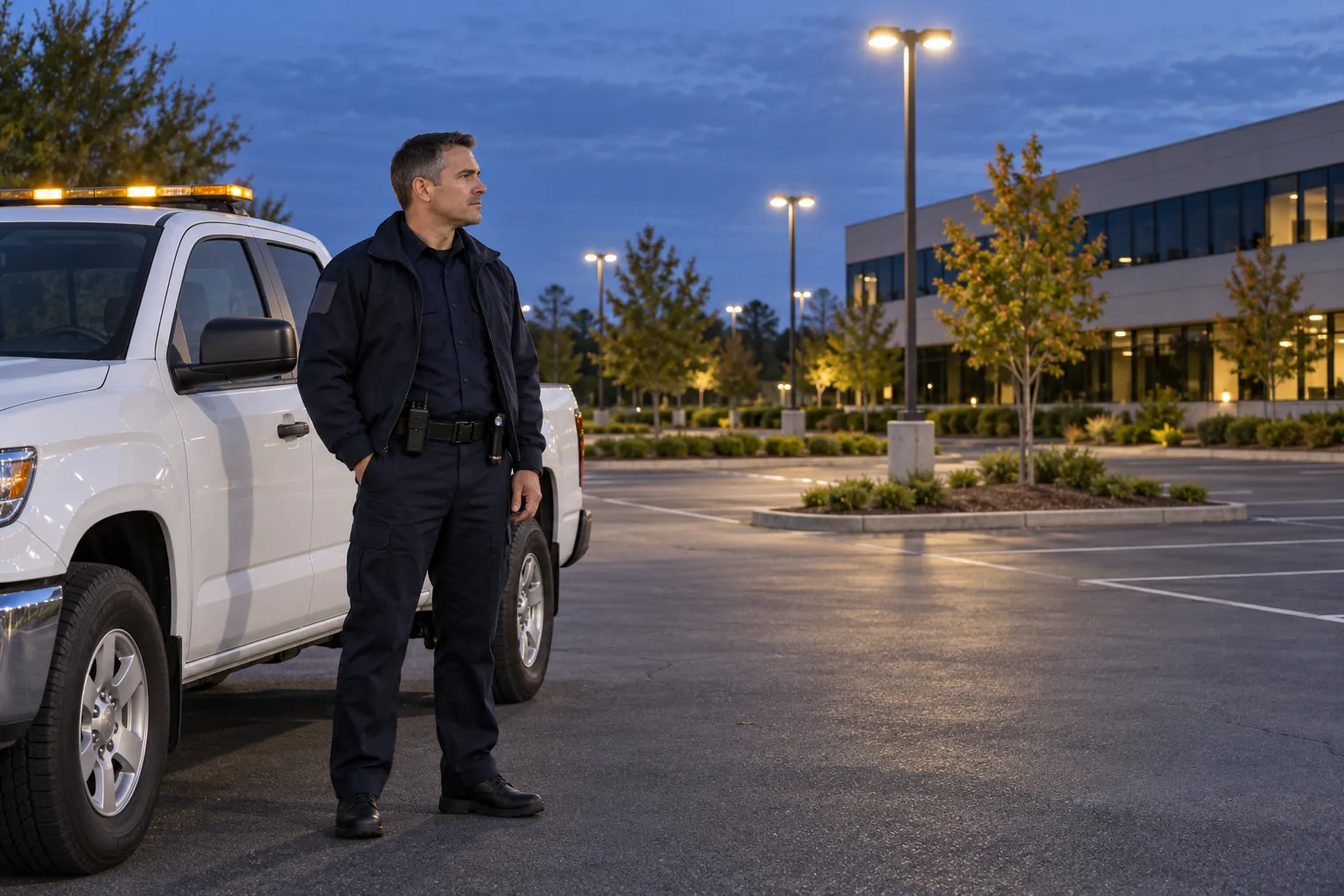
It is the part of the shift a client rarely sees, often at night. This guide covers what a patrol is and who regulates the people who do it, the common types, including mobile patrol, a checklist of what a patrol should check, how to plan routes and timing, and how to record each patrol so that the client, the supervisor and the next shift can see what happened.
01
What a security patrol is, and who regulates it
A security patrol is a scheduled or random round of a site by a security officer, sometimes called a security guard or patrol officer, to check doors, gates, lighting and equipment, look for signs of intrusion, damage or hazards, and be visibly present. Its purpose is threefold: to deter theft, trespass and vandalism, to detect problems early, whether a break-in or a burst pipe, and to report what was found to the people who need to act on it. Patrols are written into the site's post orders.
No federal law says a building must be patrolled, or how often. The need comes from the client, the insurer, the contract and, for a fire watch, the fire code official. What the law regulates is who may do the work, and that is state law. Three large states show the pattern:
- California: the Private Security Services Act, Business and Professions Code Chapter 11.5, section 7582.1, defines a private patrol operator as a person who, for any consideration, "agrees to furnish, or furnishes, a watchman, guard, patrolperson, or other person to protect persons or property". The Bureau of Security and Investigative Services (BSIS) licenses the company and registers each guard, and its security guard fact sheet sets the training: power to arrest before registration, the 32-hour security officer skills course (16 hours within 30 days of employment and the remaining 16 within six months), and eight hours of continuing training a year after that. In-house officers who wear a distinctive uniform and deal with the public are covered too, as proprietary private security officers under section 7574.01.
- Texas: under Occupations Code Chapter 1702, section 1702.108, a guard company is one that provides "a private watchman, guard, or street patrol service on a contractual basis" to, among other things, "prevent entry, larceny, vandalism, abuse, fire, or trespass on private property". The Texas Department of Public Safety's Private Security Program regulates the industry, licensing guard companies and the individual officers they employ, and an officer who carries a firearm must hold a security officer commission. Section 1702.323 exempts most in-house staff, but not those who carry a firearm, or who deal with the public and do guard work in a security uniform, badge or patch.
- New York: under Article 7-A of the General Business Law, guards are registered with the Department of State, and its security guard training requirements page sets an 8-hour pre-assignment course, 16 hours of on-the-job training within 90 days of employment and an 8-hour annual in-service course.
Other states have their own boards and rules. Before a patrol contract starts, check the company's license and that every officer is registered and trained as the state requires.
02
Types of security patrol, including mobile patrol
Patrol types are industry usage rather than legal categories, but security companies and clients usually describe five types of security patrols, and one site often uses more than one:
- Foot patrol: an officer walks the building and grounds, inside and out. Foot patrols are slow but thorough: an officer on foot can try a door and smell smoke.
- Vehicle patrol: a marked car, truck, golf cart or utility vehicle covers a large site, such as a distribution center, a campus, a business park or a construction site. The vehicle itself needs checking each shift; see our guide to patrol vehicle inspection.
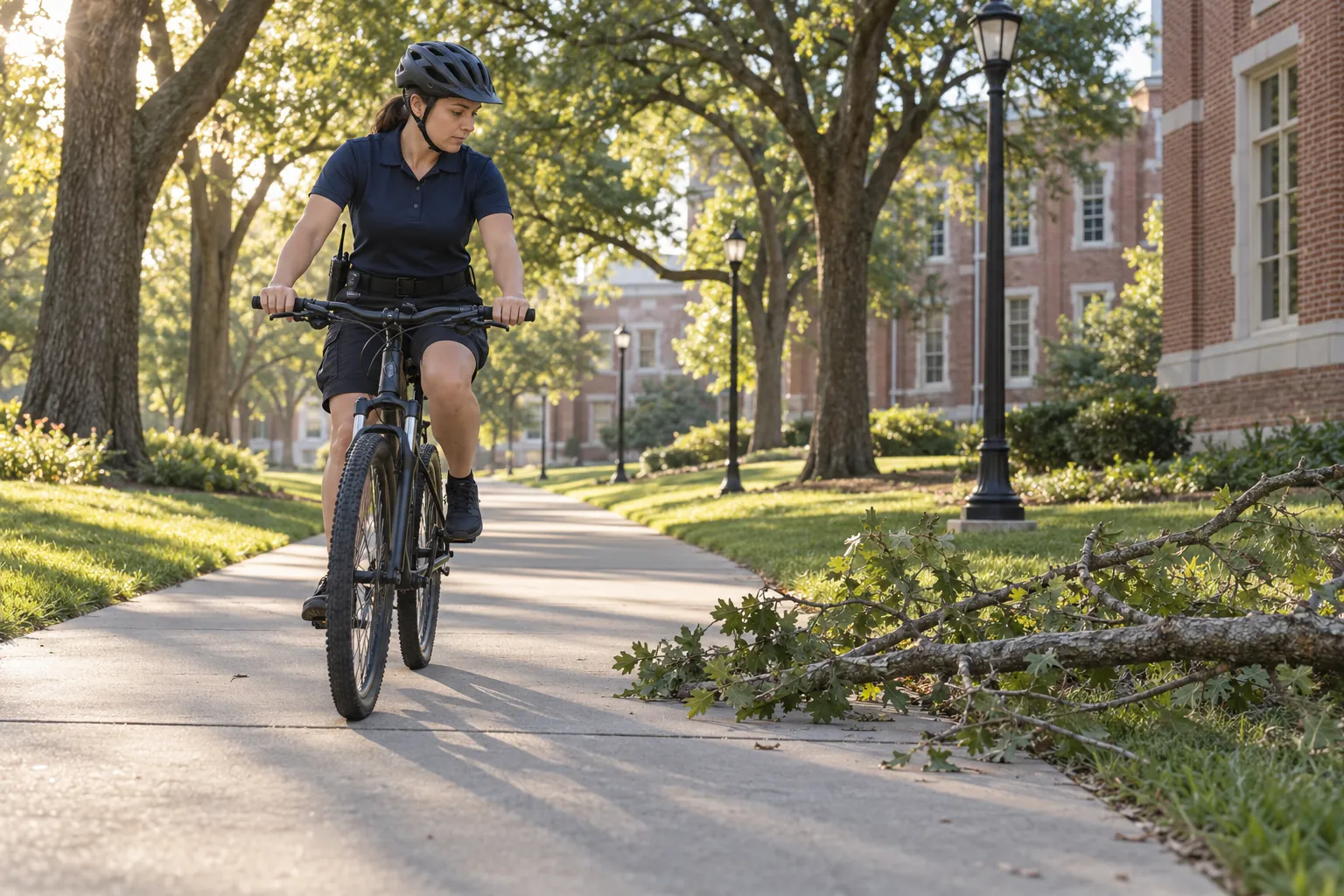
- Bike patrol: a bicycle or e-bike on a campus, a downtown district or a large parking lot, quicker than walking.
- Mobile patrol: one officer drives between several clients' properties on a route, visiting each at agreed times or at random, for a lock-up, an unlock, a set number of drive-throughs or an alarm response. California's section 7582.1 describes the officer who does this on public streets as a street patrolperson, a guard who works "by street patrol service utilizing foot patrol, motor patrol, or other means of transportation in public areas, streets or public thoroughfares in order to serve multiple customers."
- Post-based patrol: the officer at a fixed post, such as a lobby desk or a gatehouse, leaves it at set intervals to patrol, then returns. This is common in office and apartment buildings.
A random patrol varies its start time and route so that it cannot be predicted, and a virtual patrol has a remote operator monitoring the site's surveillance cameras. A camera cannot check that a door has latched, so virtual patrols rarely replace walking the building.
A contract for mobile patrols should say how many visits each night, the window for each, what the officer does on each visit (a drive-through, a perimeter walk, a check of every exterior door) and how quickly the company responds to an alarm. Patrol services paid by the visit are only as good as their proof of each visit.
03
A security patrol checklist: what each round should check
A patrol plan starts with a list of the places that matter. For most commercial and residential properties it includes:
- The perimeter: fences, gates, walls and barrier arms, looking for gaps, damage, items stacked against a fence and gates left unlocked. Our perimeter security checklist covers the fence line in detail.
- Entrances, exterior doors and openings: entry and exit doors, loading dock doors, roll-up doors, roof hatches and ground-floor windows, checked closed and locked, with no sign of forced or unauthorized entry.
- Parking lots and garages: lighting, vehicles left overnight or parked where they should not be, people sleeping in cars or stairwells, and anything that could be used to climb or start a fire.
- Sensitive rooms: mechanical and electrical rooms, IT closets, storerooms, pharmacies and anywhere holding cash or high-value stock.
- Fire and life safety: exit routes and exit doors unobstructed, fire doors closed, exit signs lit, the fire alarm panel showing normal, fire extinguishers in place, no trash piled against the building.
- Building problems: water leaks, lights out, doors that will not latch, alarms on equipment, freezers or server rooms out of temperature, elevators out of service.
- People: anyone on the property after hours, contractors working late, suspicious vehicles or behavior, and signs of loitering or vandalism, handled as the post orders say.
Each item becomes a checkpoint on the route: a named place where the officer stops, checks what the post orders say to check, and records that they were there. The list should follow the risk, not the floor plan, so a security patrol checklist template is a starting point, not the checklist itself.
At each checkpoint the officer checks what is listed, looks for signs of attempted entry or damage, notes anything unusual, fixes what can be fixed on the spot, such as closing a window, and reports what cannot. The post orders should say in advance which findings mean a 911 call, which go to the client's contact or the company's dispatch, and which can wait for the morning. Many findings are building problems rather than crimes, and getting them to the facilities team quickly is much of the job.
04
Planning patrol routes, frequency and timing
Patrols are one layer alongside locks, lighting, access control, alarms and cameras, and should cover the gaps the others leave. The plan answers three questions, written into the post orders so that a relief officer walks the same patrol as the regular one:
- Route: a logical order of checkpoints that covers the perimeter, the exterior doors and the high-risk rooms without doubling back. Many sites split it into an exterior and an interior patrol.
- Frequency: how many patrols per shift. A common pattern is a patrol at lock-up, patrols through the night and a last patrol before the building opens, but the right number depends on the site, recent incidents and the season.
- Timing: when each patrol starts. An officer who leaves the desk on the hour, every hour, tells anyone watching exactly when the back lot is empty. Vary start times within a window and, where the layout allows, vary the direction of the route.
Random timing makes the record harder to read, because a patrol due at 2 a.m. might properly start at 2:20. The answer is to schedule each patrol in a window, such as "one patrol between 1 a.m. and 3 a.m.", and record the actual time each checkpoint was reached. Proof that the patrol happened then rests on the checkpoints, not the timetable.
The post orders should also say what happens to the desk while its officer is patrolling, and how long a patrol usually takes, so that one running far over is noticed.
Patrol officers often work alone and at night, so their own safety is part of the plan. The General Duty Clause, Section 5(a)(1) of the OSH Act, requires every employer to provide a workplace "free from recognized hazards that are causing or are likely to cause death or serious physical harm". OSHA's workplace violence page says there are currently no specific OSHA standards for workplace violence, and names working late at night or in areas with high crime rates, and working alone or in small groups, among the risk factors. The plan should say how the officer checks in with dispatch, and what happens when a check-in is missed.
05
Recording each patrol and handing over
A patrol that leaves no record cannot be shown to have happened. At a minimum every patrol goes into the daily activity report (DAR) with its start and finish times and what was found. A better record shows each checkpoint separately, so that a patrol that stopped halfway is visible. A patrol record that holds up gives:
- the officer's name, not just the post or the shift;
- the actual time each checkpoint was reached, recorded at the time;
- what was found at each checkpoint, including "all secure" where it was;
- each incident or building problem, with a photo where it helps, who it was reported to and when;
- any patrol or checkpoint missed, with the reason, such as an alarm response or a call that took the officer elsewhere;
- a supervisor's review, so that someone other than the officer reads it.
Paper logs are still common. Electronic guard tour systems time-stamp each checkpoint. Whatever the method, write the record during the patrol, not from memory at the end of the shift. In California, section 7582.26 provides that no licensee or employee "shall knowingly make any false report to his or her employer or client for whom information was being obtained", and that whoever submits a written report to a client "shall exercise diligence in ascertaining whether or not the facts and information in the report are true and correct." Anything serious found on patrol gets its own incident report, not just a line in the DAR.
At the shift change, the outgoing officer briefs the incoming one on what the patrols found and what is still open, and records it in the pass-down log. An exit door that would not latch at 4 a.m. is the day shift's problem too.
Supervisors and clients should read patrol records for patterns as well as gaps: the same exit door propped every Friday night, or a patrol that always runs short on one shift. A security supervisor who reviews the record every day, and makes unannounced site visits, is the best check that patrols are done well and not just done.
06
Where patrol records fail, and where SiteClara fits
The usual patrol record is one line in the DAR: "2:00 a.m. patrol completed, all secure." It tells a supervisor that the officer says they patrolled, not which checkpoints were reached or when. A leak found at 3 a.m. stays in the report instead of reaching the people who fix it, and the client, who is paying for the patrols, sees nothing unless they ask. On a mobile patrol, a client may never know whether the third visit of the night happened at all.
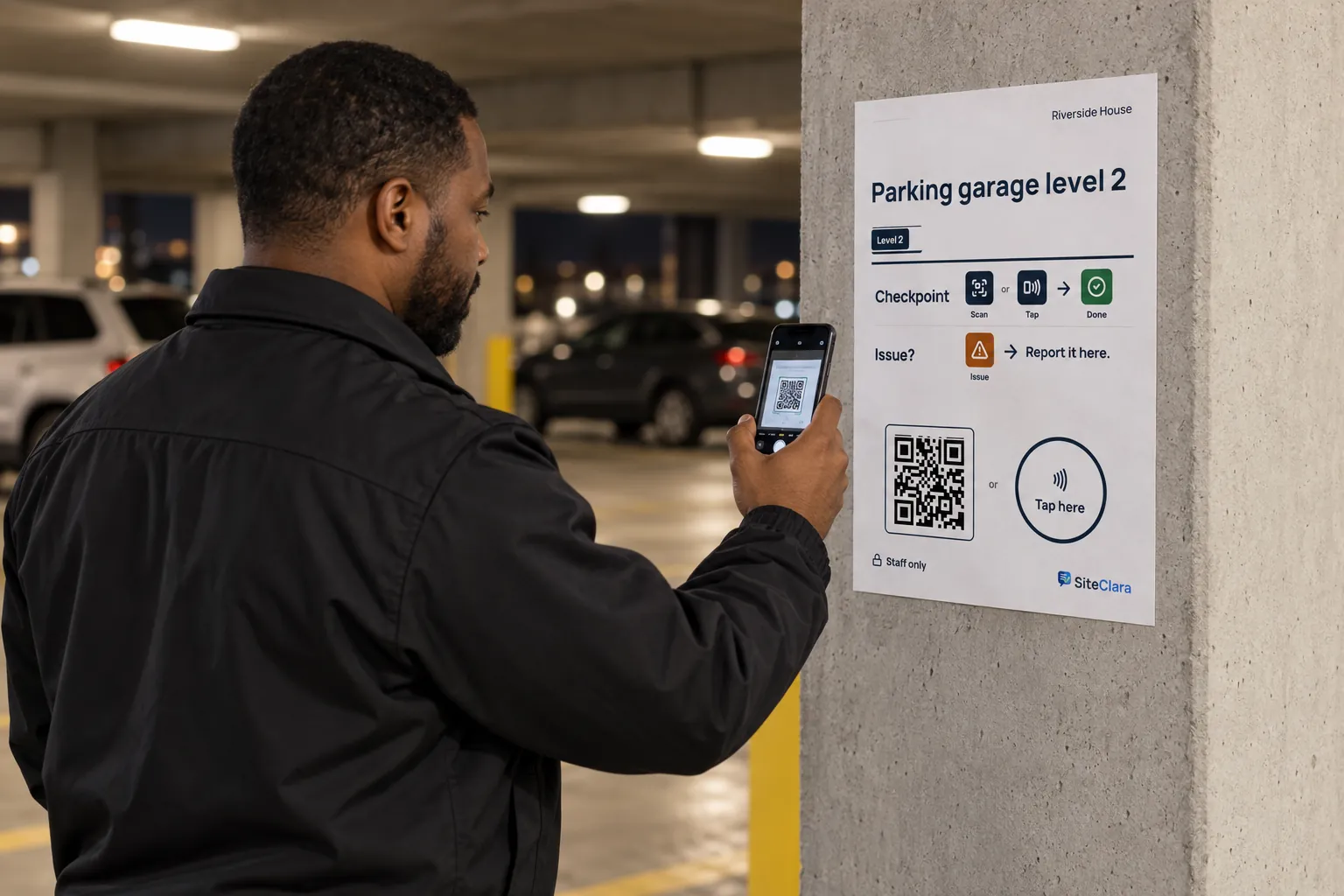
SiteClara records a patrol checkpoint by checkpoint. A printed QR poster, with an optional NFC tag behind it, goes at each checkpoint on the route. The officer scans the code or taps the tag on their own phone, with no app to install. At each checkpoint they see the checks due there and mark them done, or explain what stopped them, and they can report an issue or incident with a photo. A reported issue goes onto the team's list of jobs until someone closes it, and a supervisor can escalate a job to the building manager.
The supervisor sees what was due, what was done and what was missed, and can record the reason a patrol was missed. Each day the supervisor reviews and approves a report that goes to nominated client or management contacts the next morning, showing what was reported, what was completed, what is still open and how the scheduled checks went.
07
Questions people ask
Can a security patrol pull you over?
Not as the police can, because a private security officer has only a private person's powers. In California, for example, a guard's power to arrest is that of any private person under California Penal Code section 837, "for a public offense committed or attempted in his presence", and California Vehicle Code section 27605 forbids anyone to own or operate a motor vehicle painted in the manner of a police traffic patrol car "to resemble a motor vehicle used by a peace officer or traffic officer on duty", with exceptions such as funeral escorts and film companies. A patrol that sees a driver break the law on a public road reports it to the police.
What is the highest paid security guard?
Of the top industries in which security guards work, healthcare and social assistance paid the highest median annual wage, $44,920 in May 2025, according to the Bureau of Labor Statistics' Occupational Outlook Handbook: Security Guards and Gambling Surveillance Officers. Educational services followed at $44,250, against a median of $38,020 for all security guards and $37,350 in investigation, guard, and armored car services.
08
Further reading, and a list to take away
Your state's licensing authority publishes who must be licensed or registered and the training they need: in California the Bureau of Security and Investigative Services, in Texas the Department of Public Safety's Private Security Program, in New York the Department of State. OSHA publishes the General Duty Clause and its workplace violence guidance. For a fire watch, start with your local fire marshal.
Before the next patrol plan is agreed, check that:
- the security company holds the license your state requires and every officer on the schedule is registered;
- the patrol plan is written into the post orders, with each checkpoint named and what to check there;
- patrols are scheduled in time windows, with start times and directions varied;
- the post is covered or secured while the officer patrols, and the officer has a way to check in;
- escalation for each kind of finding is written down, with phone numbers;
- each checkpoint is recorded at the time, by a named officer, with findings and photos where useful;
- missed patrols and checkpoints are recorded with a reason;
- a mobile patrol contract says how each visit is proved;
- handovers go into the pass-down log, and a supervisor reviews the patrol record every day.
Sources
Every document this guide quotes or links to, in the order it first cites them.
- Private Security Services Act, Business and Professions Code Chapter 11.5, section 7582.1 leginfo.legislature.ca.gov
- Security guard fact sheet bsis.ca.gov
- Proprietary private security officers under section 7574.01 leginfo.legislature.ca.gov
- Occupations Code Chapter 1702, section 1702.108 statutes.capitol.texas.gov
- Texas Department of Public Safety's Private Security Program dps.texas.gov
- Security guard training requirements dos.ny.gov
- Penal Code section 837 leginfo.legislature.ca.gov
- Business and Professions Code section 7582.26 leginfo.legislature.ca.gov
- Section 5(a)(1) of the OSH Act osha.gov
- Workplace violence page osha.gov
- California Vehicle Code section 27605 leginfo.legislature.ca.gov
- Occupational Outlook Handbook: Security Guards and Gambling Surveillance Officers bls.gov
Related guides
 Security patrolsGuard tour systems: how they work and how to choose oneHow guard tour systems record security patrols – wands, RFID, NFC, QR codes and GPS apps – what the patrol data shows, and what to ask before you choose one.
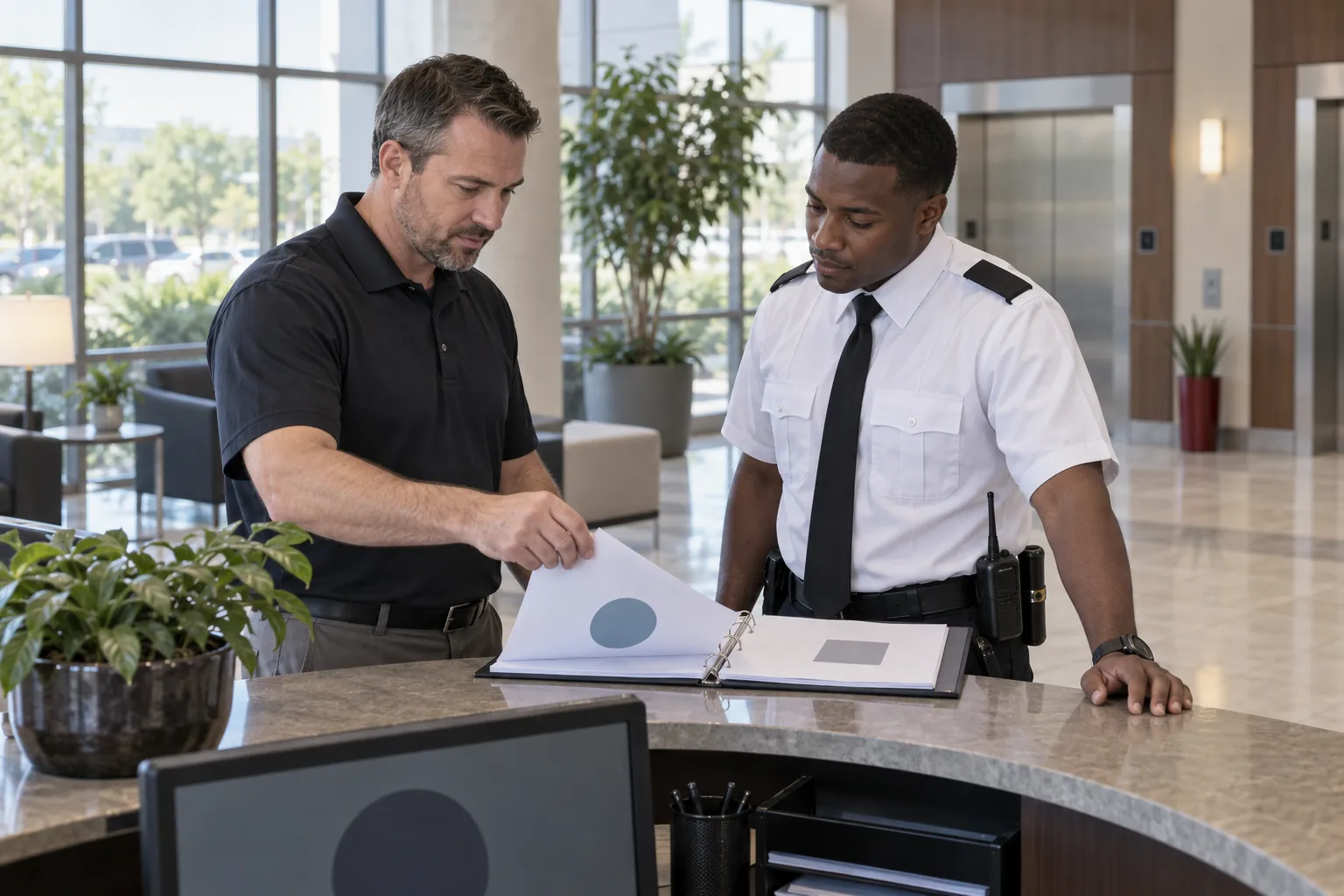 Security patrolsSecurity post orders: what they should say, and how to know they are followedSecurity post orders in the US: what they are, what state rules say, what to include, how to write, sign and review them, and how to check they are followed.
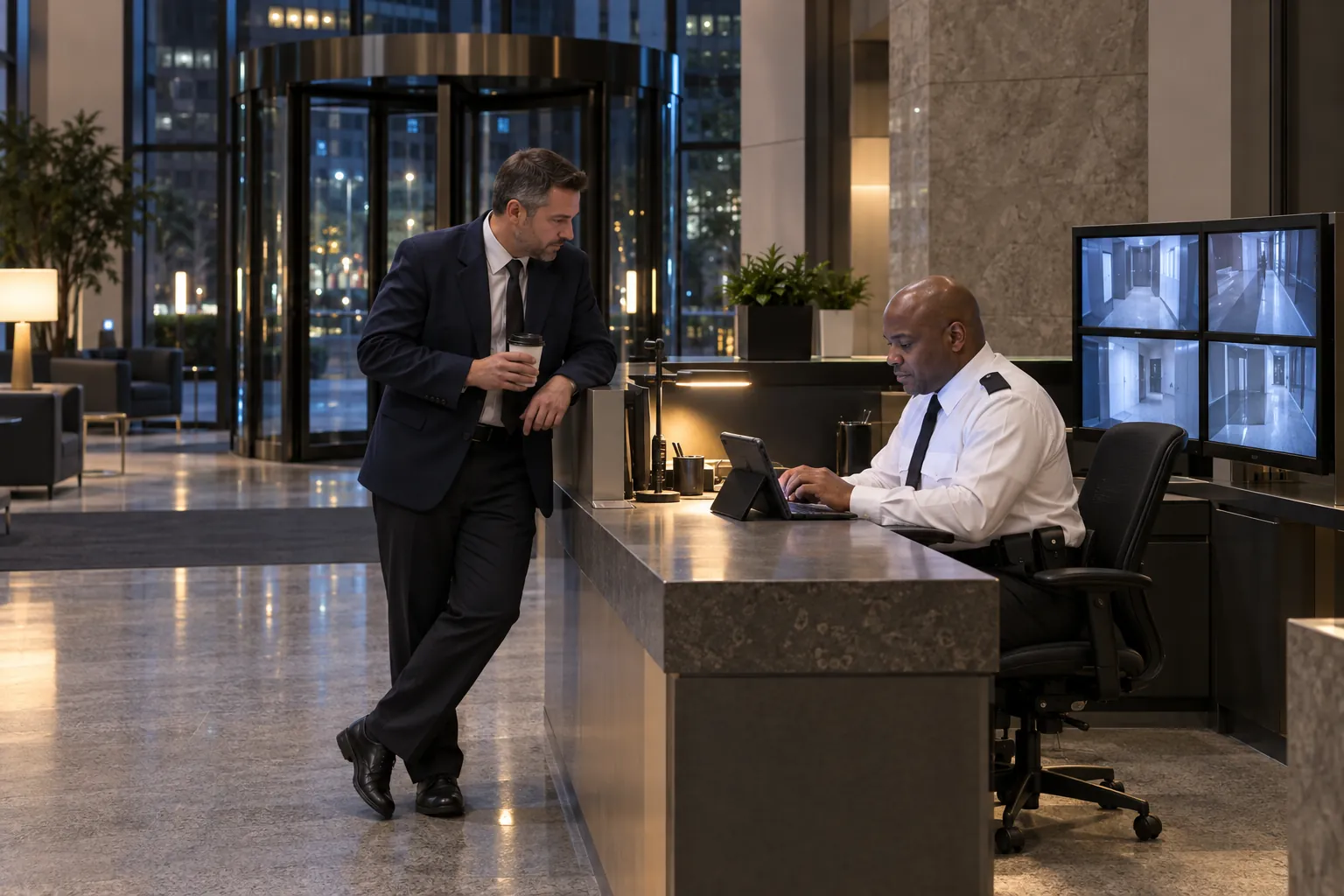 Security patrolsSecurity daily activity report: what to include, and how to write one that holds upThe security daily activity report (DAR): what to record, how to write entries that hold up, how it differs from an incident report, and how to review and keep it.
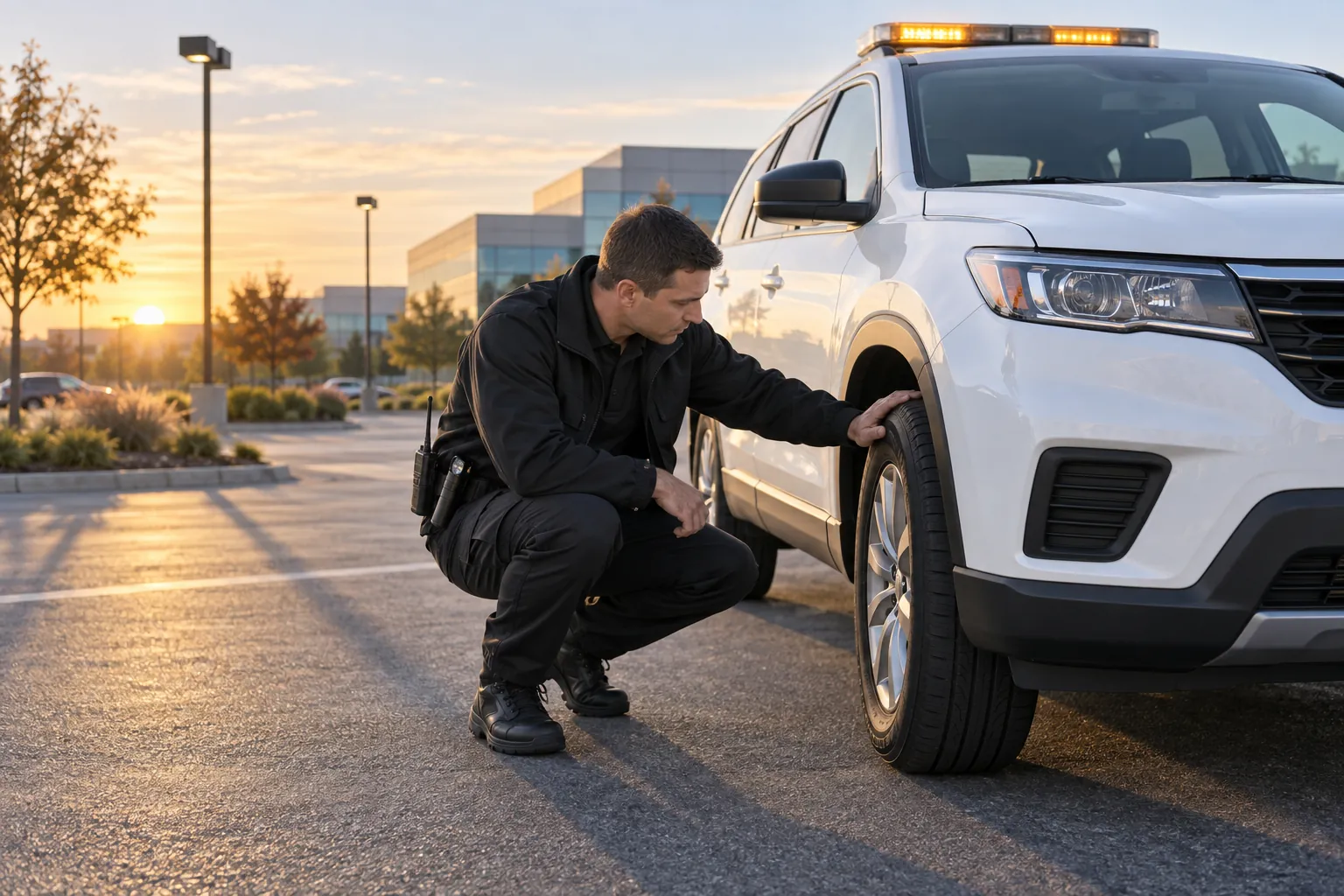 Security patrolsPatrol vehicle inspection checklist: what to check before every shift, and how to prove itA patrol vehicle inspection checklist for security teams: what to check each shift, the FMCSA rules as a model, handling defects, and a record that holds up.