Cleaning
Nursing home housekeeping: what CMS expects, and how to show it was done
Nursing home housekeeping is the department that keeps residents' rooms, bathrooms, common areas and linens clean, safe and sanitary, a service federal rules require of every nursing home certified for Medicare or Medicaid.
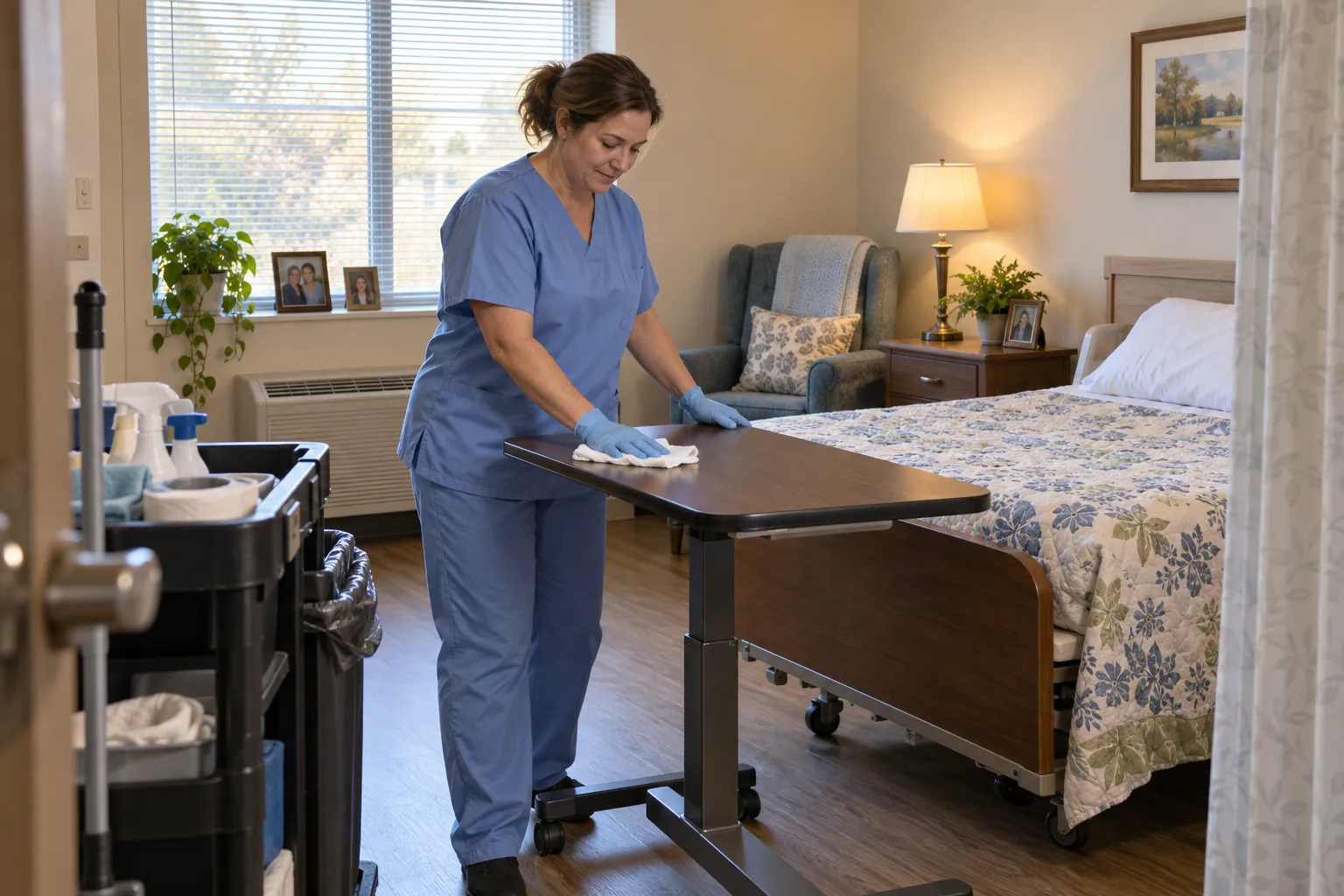
It is not a back-office service: the building is the residents' home, and CMS surveyors judge it both as a home and as a place where infection spreads easily. This guide covers the federal requirements behind nursing home housekeeping, the F-tags they are surveyed under, the housekeeping team's duties day to day, how often things are cleaned, and how an administrator can show that the work was actually done.
01
The federal rules behind nursing home housekeeping
A skilled nursing facility or nursing facility that takes Medicare or Medicaid must meet the Requirements for Long Term Care Facilities in 42 CFR Part 483. Three sections shape what the housekeeping department does.
The first is a resident right. 42 CFR 483.10(i), Safe environment, says: "The resident has a right to a safe, clean, comfortable and homelike environment." The facility must provide, among other things, "Housekeeping and maintenance services necessary to maintain a sanitary, orderly, and comfortable interior" (483.10(i)(2)) and "Clean bed and bath linens that are in good condition" (483.10(i)(3)). Surveyors cite a failure here as F584.
The second is infection control. 42 CFR 483.80, Infection control, requires "an infection prevention and control program designed to provide a safe, sanitary, and comfortable environment and to help prevent the development and transmission of communicable diseases and infections." The program must follow "accepted national standards", include written standards, policies and procedures, and have "A system for recording incidents identified under the facility's IPCP and the corrective actions taken by the facility." Paragraph (e) covers linens: "Personnel must handle, store, process, and transport linens so as to prevent the spread of infection." The program is reviewed at least once a year under 483.80(f). This is F880, and it is where most environmental cleaning findings land.
The third is the building itself. 42 CFR 483.90, Physical environment, requires at 483.90(i) "a safe, functional, sanitary, and comfortable environment for the residents, staff and the public" (F921), and at 483.90(i)(4) "an effective pest control program so that the facility is free of pests and rodents" (F925).
CMS explains how surveyors apply these rules in the State Operations Manual, Appendix PP, Guidance to Surveyors for Long Term Care Facilities (Rev. 232, issued July 23, 2025). It is free, and for most F-tags it sets out the regulation with the intent, definitions, guidance, survey procedures and probes that apply.
02
What housekeeping covers in practice
Appendix PP defines "environment" for F584 as "any environment in the facility that is frequented by residents, including (but not limited to) the residents' rooms, bathrooms, hallways, dining areas, lobby, outdoor patios, therapy areas and activity areas." Areas used only by staff or the public, such as the break room, medication room, laundry and kitchen, fall under F921 instead. The housekeeping team's duties usually cover most of both:
- Resident rooms and bathrooms: daily cleaning of frequently touched surfaces, the toilet and sink, floors and trash, done around the resident's routine and with respect for their belongings.
- Discharge and transfer cleaning: a full clean and disinfection when a resident leaves a room, before the next admission. Appendix PP lists cleaning "at the time of discharge" as part of the program.
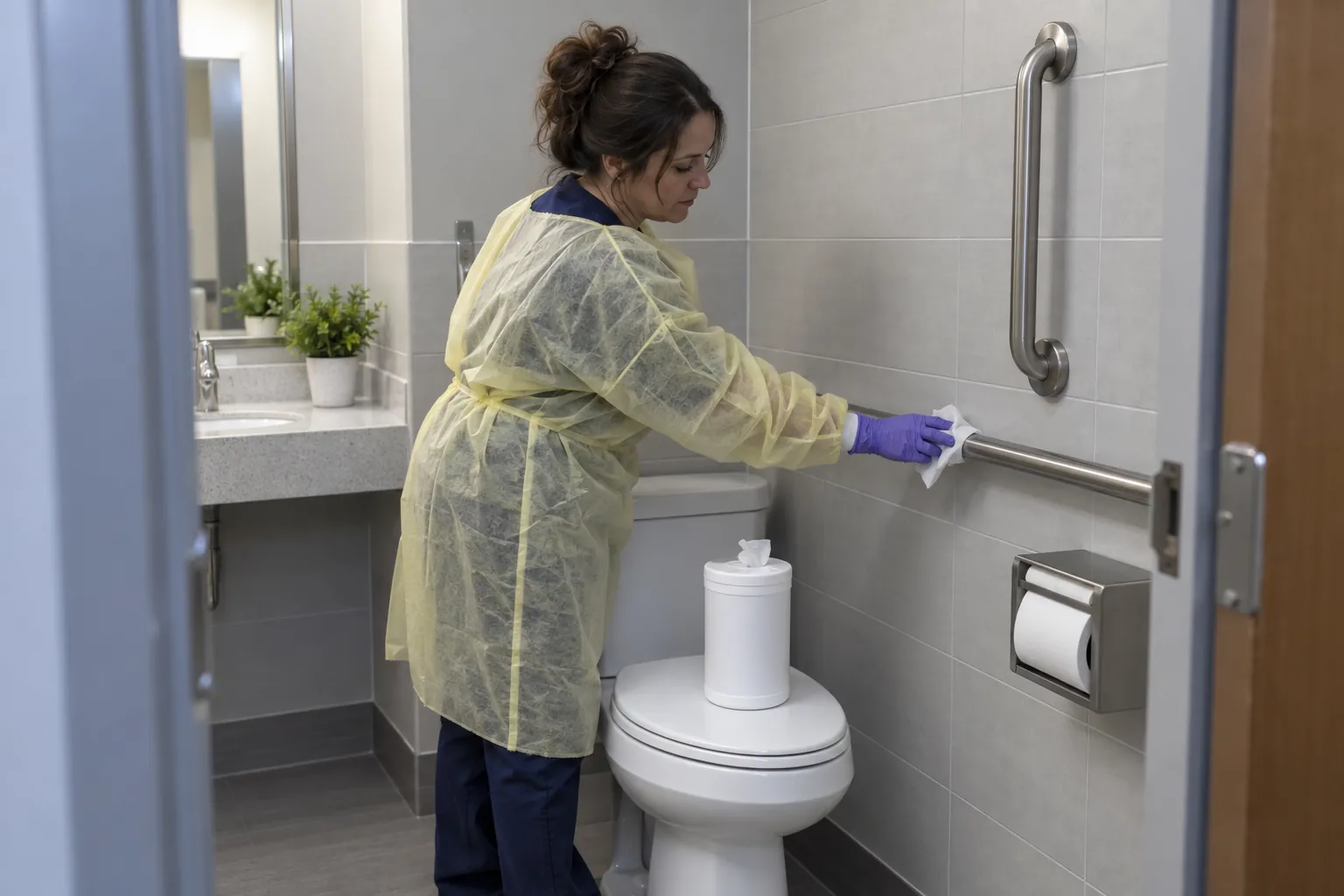
- Rooms on transmission-based precautions: cleaning with the personal protective equipment (PPE) the sign on the door calls for, and the disinfectant the organism calls for.
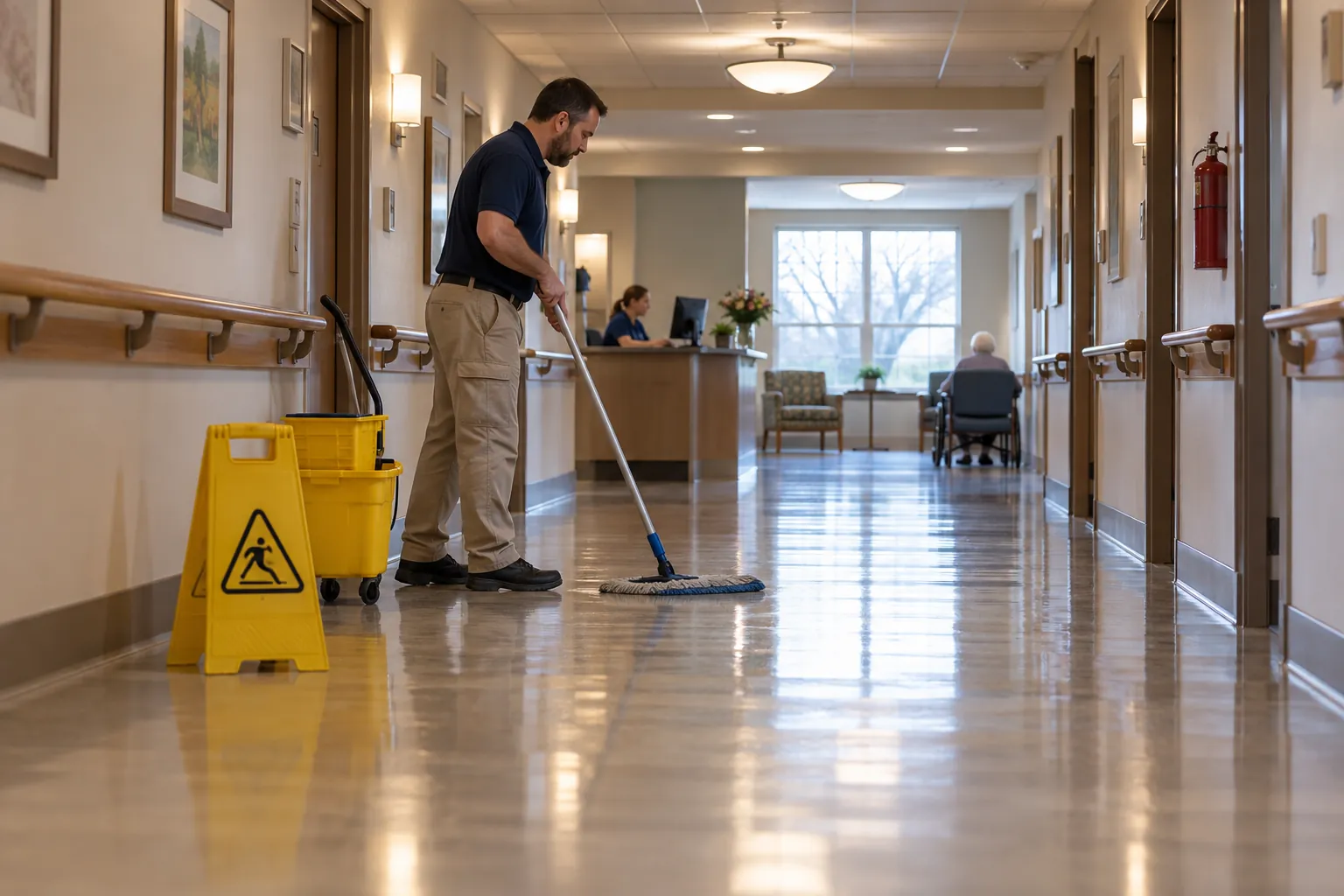
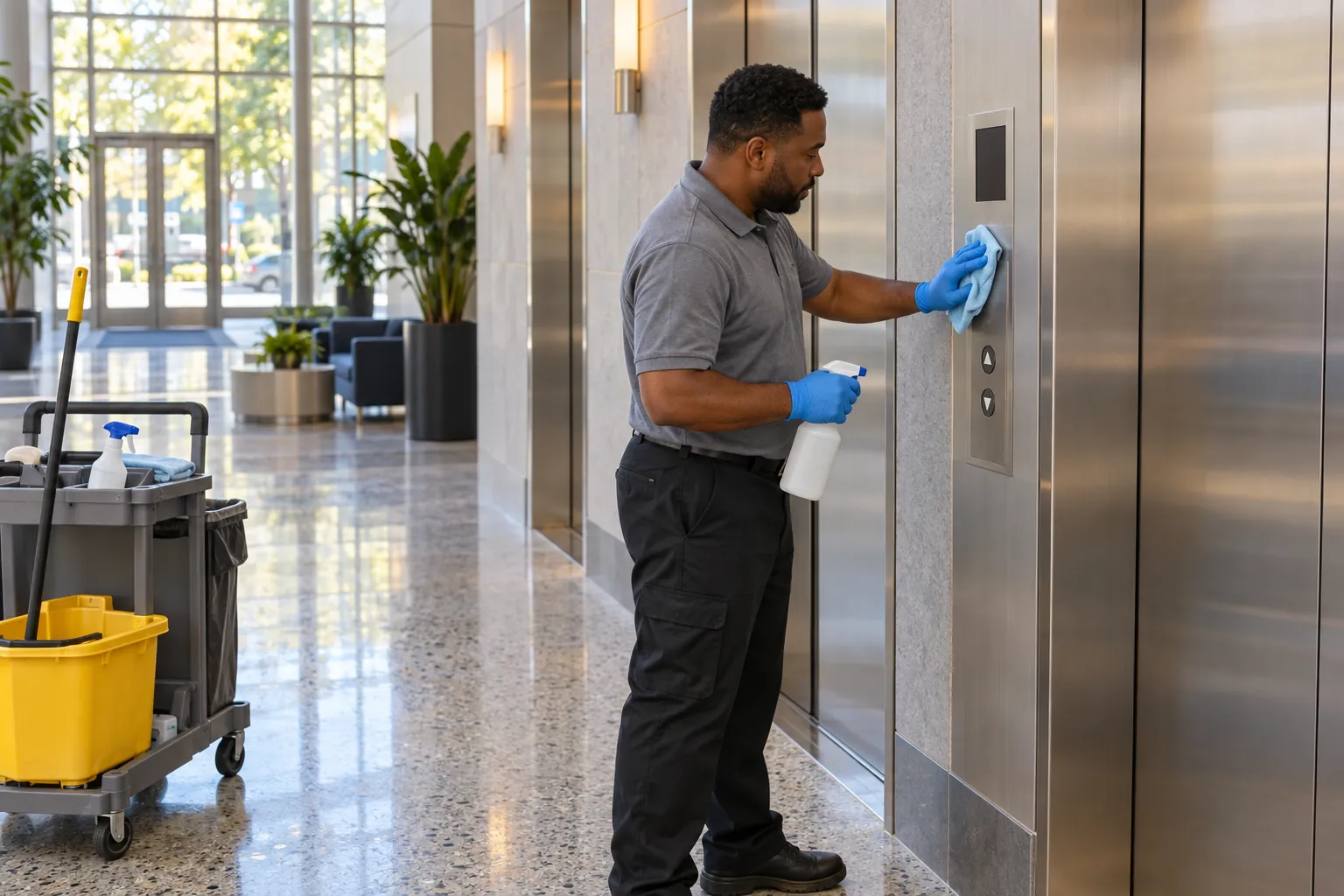
- Common areas: dining and day rooms, therapy areas, the lobby, public restrooms, corridor handrails, elevators.
- Shared resident care equipment where housekeeping owns it, such as shower chairs and commodes; write down who cleans what.
- Linens and laundry, often a combined housekeeping and laundry department: collection, transport, processing and storage of linens and residents' personal clothing.
- Privacy curtains and window treatments, which surveyors look at under both F584 and F880.
- Floors, trash and reporting: daily mopping with periodic stripping and refinishing, trash and regulated waste out of care areas, and pests, leaks, odors and damage passed to maintenance promptly.
The homelike standard changes how this work is done. Appendix PP says "It is the responsibility of all facility staff to create a 'homelike' environment and promptly address any cleaning needs," and counts "the elimination of institutional odors" as part of it. A housekeeper who knocks and puts the family photographs back where they were is doing part of that job.
03
How often to clean, and with what
No federal rule sets a cleaning frequency for every surface in a nursing home. The frequencies come from your written policies, which must follow accepted national standards under 483.80. The standard most programs cite is the CDC and HICPAC Guidelines for Environmental Infection Control in Health-Care Facilities (2003), which Appendix PP names in its F880 guidance. Its Environmental Services section sets the principle: "high-touch housekeeping surfaces in patient-care areas (e.g., doorknobs, bedrails, light switches, wall areas around the toilet in the patient's room, and the edges of privacy curtains) should be cleaned and/or disinfected more frequently than surfaces with minimal hand contact."
Appendix PP's F880 guidance gives the anchors a surveyor will look for:
- "Routine cleaning and disinfection of frequently touched or visibly soiled surfaces in common areas, resident rooms, and at the time of discharge."
- "Routine cleaning and disinfection of resident care equipment including equipment shared among residents."
- For a resident on transmission-based precautions, clean and disinfect frequently touched surfaces "(e.g., bed rails, over-bed table, bedside commode, lavatory surfaces in resident bathrooms) with an EPA-registered disinfectant for healthcare use at least daily and when visibly soiled."
- Privacy curtains "should be changed when visibly dirty and should be laundered or disinfected" with an EPA-registered disinfectant, following the curtain and disinfectant manufacturers' instructions.
A workable schedule has three layers: daily (occupied rooms and bathrooms, common areas, public restrooms, and busy high-touch points more than once), on an event (discharge, a body fluid spill, an outbreak) and periodic (curtains, vents, high dusting, floor care and a deep clean of each room on rotation).
Method matters as much as frequency. Appendix PP says disinfection of noncritical items and surfaces "should be performed with an EPA-registered disinfectant labeled for use in healthcare settings" and that "All applicable label instructions on EPA-registered disinfectant products must be followed (e.g., use-dilution, shelf life, storage, material compatibility, safe use and disposal)." The EPA's page of selected EPA-registered disinfectants says "The surface should be visibly wet for the entire contact time. This may mean the product needs to be reapplied." A quick wipe that dries in ten seconds does not meet a product's contact time.
Some organisms need a specific product. Appendix PP notes that C. difficile spores "can live on inanimate surfaces for up to 5 months" and that alcohol-based hand rub does not kill them. The EPA keeps List K, products effective against Clostridioides difficile (C. diff) spores, and List P, products effective against Candida auris. The infection preventionist decides when they are used.
The CDC section adds two practical points: launder cloths and mop heads after use and let them dry before reuse, and make fresh cleaning solution each day, discarding what is left.
04
Who does what: housekeeping, nursing and the infection preventionist
The regulations put the program on the facility, so the facility must decide who does each part and write it down.
- The administrator owns compliance with Part 483 and the resources the department gets.
- The infection preventionist, required by 483.80(b), is responsible for the infection prevention and control program, including products and outbreak procedures.
- The housekeeping and laundry supervisor (sometimes environmental services, or EVS) turns the program into daily assignments, trains staff and checks the work.
- Housekeepers and floor techs clean to the schedule and report what they find.
- Nursing staff usually clean resident care equipment between residents, such as glucose meters and blood pressure cuffs, and handle spills during care.
- Maintenance repairs what housekeeping reports and often coordinates the pest control contractor.
The hand-offs are where things fall through, such as a commode cleaned by nobody because each department thought the other owned it. A one-page matrix of each item and area, who cleans it and when, settles that before a surveyor asks.
Training is part of the program. Under OSHA's Bloodborne Pathogens standard, the employer must "determine and implement an appropriate written schedule for cleaning and method of decontamination based upon the location within the facility, type of surface to be cleaned, type of soil present, and tasks or procedures being performed in the area" (29 CFR 1910.1030(d)(4)(i)), and contaminated work surfaces must be decontaminated "immediately or as soon as feasible when surfaces are overtly contaminated or after any spill of blood or other potentially infectious materials." Under Hazard Communication, safety data sheets must be "readily accessible during each work shift to employees when they are in their work area(s)", and employees must be trained on the hazardous chemicals in their work area "at the time of their initial assignment." With high turnover, that means training before the first shift, and a record of it.
05
How surveyors check housekeeping, and what good evidence looks like
State survey agencies inspect for CMS and mostly judge housekeeping by looking, asking and watching. Appendix PP's probes for F584 include "Are resident care areas and equipment kept clean and in good repair?" and "Do window treatments, bed linens, towels, privacy curtains, etc., appear clean and in good condition?" For F925, "Evidence of pest infestation in a particular space is an indicator of noncompliance," and surveyors ask staff, residents and their representatives whether they have seen pests. Under F880, Appendix PP tells every team member to observe infection prevention practices "throughout the survey", including care of residents on transmission-based precautions, and to "Observe laundry services throughout the survey (e.g., resident and laundry rooms) to determine whether staff handle, store, process, and transport linens appropriately." Concerns are followed up with staff interviews and record reviews, which is when your housekeeping records are read.
A resident who tells a surveyor the bathroom is only cleaned on some days is evidence in its own right. The best defense is a building that is clean when they walk in; the second best is a record that answers the question behind a complaint: was this room cleaned, when, and by whom?
Good housekeeping evidence has a few features:
- Written policies and a cleaning schedule by area and item, with the products and method for each, matched to the infection prevention program.
- Daily assignment sheets or a digital equivalent showing which rooms and areas each person covered, with times.
- Discharge cleaning records for each room, completed before the room is released.
- Supervisor inspections, a sample of rooms each day checked against a standard, with what was found and corrected.
- Periodic work, maintenance and pest records: curtain changes and floor care by room and date, reports with the dates raised and closed, and the pest contractor's service reports.
- Training records for bloodborne pathogens, hazard communication and the facility's own procedures.
Fluorescent marking or ATP testing on a sample of rooms measures whether a surface was cleaned well, which a log cannot. A log shows whether it was cleaned at all. You need both.
06
Where the housekeeping record fails, and what SiteClara does about it
Resident rooms get most of the attention. The record thins out elsewhere: the public restroom by the lobby, the dining room after dinner, the shower room at the end of the hall. The evidence is often a log sheet on the back of a door, initialed in a column, sometimes filled in for a whole shift at once. Nobody can tell when a check was done, a missed round is rarely written down as missed, and a broken grab bar or a sighting of pests noted on the sheet waits until someone reads it.
SiteClara records those checks at the location. A printed QR code poster, with an optional NFC tag behind it, goes at each place a check is scheduled. A housekeeper scans the code or taps the tag on their own phone, with no app to install, sees the checks due there, and marks each one done or says what stopped them, for example a room they could not enter because care was in progress. The time and the named person are recorded as it happens, with a photo when one is asked for. A problem found on the round, such as a leaking toilet, goes onto the team's list of jobs until someone closes it.
The housekeeping supervisor sees what is due, done and missed, and records the reason when a check was missed. Each day they review the totals and photos, add a note and approve a report that goes the next morning to nominated managers, such as the administrator or, where housekeeping is contracted out, the facility's contract manager. It shows what was reported, completed and still open, and how the scheduled checks went, for example 22 of 24 completed, with the reasons for the two that were not.
07
Questions people ask
What do housekeepers do at a nursing home?
Housekeepers at a nursing home clean residents' rooms and bathrooms, common areas and shared equipment, handle bed and bath linens, and report repairs and pests, which is how a facility meets 42 CFR 483.10(i), Safe environment. It requires "Housekeeping and maintenance services necessary to maintain a sanitary, orderly, and comfortable interior" and "Clean bed and bath linens that are in good condition," as part of the resident's right to "a safe, clean, comfortable and homelike environment." They also carry out the environmental cleaning in the facility's infection prevention and control program, described above.
What are the top skills for housekeeping staff?
The U.S. Department of Labor's O*NET OnLine profile of Maids and Housekeeping Cleaners (37-2012.00) lists three skills: service orientation, "Actively looking for ways to help people"; coordination, "Adjusting actions in relation to others' actions"; and time management, "Managing one's own time and the time of others." In a nursing home, add the training OSHA requires at initial assignment, on bloodborne pathogens and hazard communication, and the facility's own infection control procedures.
08
Further reading, and a list to take away
Start with the State Operations Manual, Appendix PP, for F584, F880, F921 and F925, then 42 CFR 483.10, 483.80 and 483.90, the CDC's Guidelines for Environmental Infection Control in Health-Care Facilities and the EPA's disinfectant lists, all linked above. Your state's nursing home licensing rules complete the picture.
Before your next survey, check that:
- there is a written cleaning schedule by area and item, with the product and method for each;
- a one-page matrix says who cleans each piece of shared equipment and each area, housekeeping or nursing;
- every product in use is EPA-registered for healthcare, and staff know its contact time;
- List K and List P products are stocked where the infection preventionist says they are needed;
- discharge cleaning is recorded for every room before it is released;
- privacy curtains, cloths and mop heads are laundered on a schedule and when soiled;
- clean and soiled linen are kept apart in storage and in transport;
- a supervisor inspects a sample of rooms every day and records what was corrected;
- housekeepers have bloodborne pathogens and hazard communication training before they start, and safety data sheets are within reach on every shift;
- the housekeeping records are part of the annual review of the infection prevention and control program.
Sources
Every document this guide quotes or links to, in the order it first cites them.
- 42 CFR 483.10(i), Safe environment ecfr.gov
- 42 CFR 483.80, Infection control ecfr.gov
- 42 CFR 483.90, Physical environment ecfr.gov
- State Operations Manual, Appendix PP, Guidance to Surveyors for Long Term Care Facilities cms.gov
- Bloodborne Pathogens standard, 29 CFR 1910.1030 osha.gov
- Hazard Communication standard, 29 CFR 1910.1200 osha.gov
- OSHA-approved State Plans osha.gov
- Guidelines for Environmental Infection Control in Health-Care Facilities cdc.gov
- Environmental Services section cdc.gov
- Selected EPA-registered disinfectants epa.gov
- List K, products effective against Clostridioides difficile (C. diff) spores epa.gov
- List P, products effective against Candida auris epa.gov
- O*NET OnLine profile of Maids and Housekeeping Cleaners (37-2012.00) onetonline.org
Related guides
 CleaningC. diff cleaning: killing the spores, and showing it was doneHow to clean for C. diff: why ordinary disinfectants miss the spores, choosing a List K product, daily and discharge cleans, and how to show each clean was done.
 CleaningHigh-touch surfaces: a cleaning routine you can show was doneHigh-touch surfaces as the CDC describes them: which ones to list area by area, how often to clean and disinfect them, the right method, and a record that holds up.
 CleaningHospital environmental services: what EVS does, and how to show it was doneWhat hospital environmental services (EVS) does, the CDC, CMS and OSHA rules behind it, cleaning frequencies, who cleans what, and how cleaning is checked.
 CleaningTerminal cleaning: how to do it, and how to show it was doneWhat terminal cleaning is, when it is done, the CDC steps in order, the products for C. diff and C. auris rooms, and how a hospital checks the clean was thorough.