Premises and facilities management
NYC building superintendent requirements: the law, the duties and the record
In New York City, state law requires an apartment building housing thirteen or more families, whose owner does not live there, to have a janitor or superintendent who lives in the building or within two hundred feet of it and has charge of it.
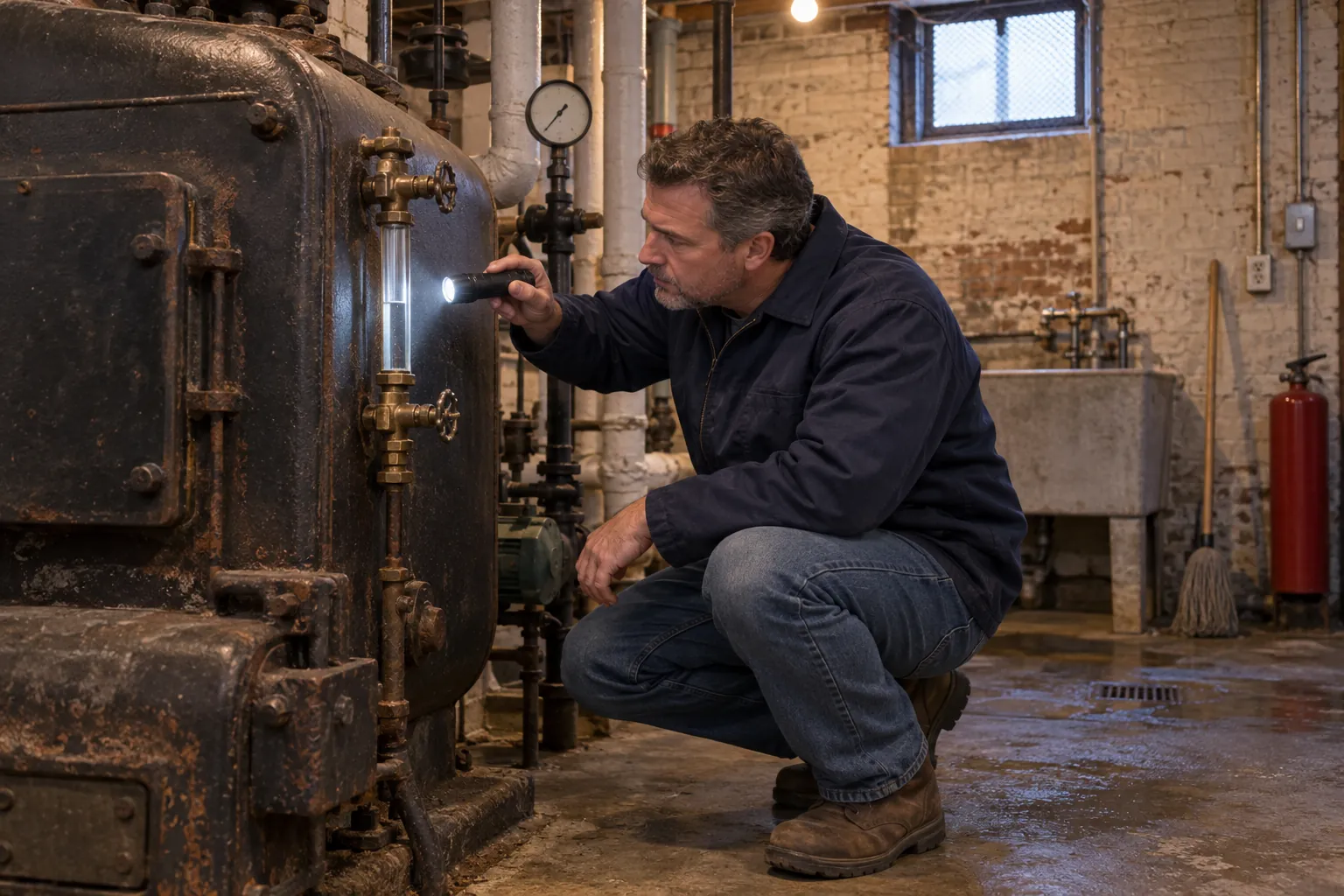
The owner still answers to the Department of Housing Preservation and Development (HPD) for heat, hot water, pests, garbage and repairs. This guide sets out the New York State and New York City rules behind the job, what a super actually does through the day and the year, and how an owner or managing agent can show that the routine work was done.
01
What the law requires: a janitor or super who lives on site or nearby
This guide covers a New York State law and New York City rules. It applies to multiple dwellings in the five boroughs, the apartment buildings the law defines as housing three or more families, and it does not describe the rules of any other city or state.
It is also not about the Department of Buildings' Construction Superintendent registration, which is for the person supervising construction or demolition work on a building, not for the super who runs it once people live there; the questions near the end cover that credential.
The requirement for a resident super starts in state law. Multiple Dwelling Law section 83, Janitor or housekeeper, says: "Whenever there are thirteen or more families occupying any multiple dwelling and the owner does not reside therein, there shall be a janitor, housekeeper or some other person responsible on behalf of the owner who shall reside in said dwelling, or within a dwelling located within a distance of two hundred feet from said dwelling, and have charge of such dwelling, except that where two or three multiple dwellings are connected or adjoining, one resident janitor shall be sufficient."
Read closely, that sentence sets four conditions:
- The trigger is thirteen or more families living in the building, and an owner who does not live there.
- The person may be called a janitor, a housekeeper or "some other person responsible on behalf of the owner". In the trade the job is almost always called the superintendent, or the super; in a large co-op or condominium it may be the resident manager.
- Where they live: in the building, or in a dwelling within two hundred feet of it.
- What they do: they "have charge of such dwelling". The law lists no tasks. Two or three connected or adjoining buildings may share one resident janitor.
The city adds its own requirement. The New York City Housing Maintenance Code, in Title 27 of the Administrative Code, has its own article on janitorial services, Article 13 (§§ 27-2052 to 27-2056); § 27-2053, Obligations of owner, begins: "The owner of a multiple dwelling shall provide adequate janitorial services." These are the texts HPD enforces. Read their current official text before deciding what your building needs; unit counts, residence and round-the-clock cover are where a paraphrase misleads, so this guide does not paraphrase them.
The owner's other fixed point is HPD's annual registration. According to HPD's page Register Your Property, owners of a multiple dwelling must register every year, with an "annual registration deadline" of September 1, and give the managing agent's name, address and phone number and "a telephone number within the greater metropolitan area where an owner or managing agent may be reasonably expected to be reached at all times."
02
What a building superintendent covers in practice
A super's job differs with the size and age of the building and how many porters work under them, but the substance comes from the owner's obligations, which HPD's owners' guide summarizes: owners must "Provide and maintain security measures, heat, hot and cold water, and good lighting", "Address leaks, mold, and pest issues immediately and conduct annual inspections for these conditions", and "Provide smoke detectors, carbon monoxide detectors, and ensure appropriate fire egress." In a building with a super, most of that lands on the super's rounds:
- Heat and hot water. HPD's page Heat and Hot Water says heat "must be provided between October 1st and May 31st". Between 6 a.m. and 10 p.m., when it is below 55 degrees Fahrenheit outside, apartments must be at least 68 degrees; overnight, at least 62 degrees whatever the weather outside. Hot water "must be provided 365 days per year at a constant minimum temperature of 120 degrees Fahrenheit".
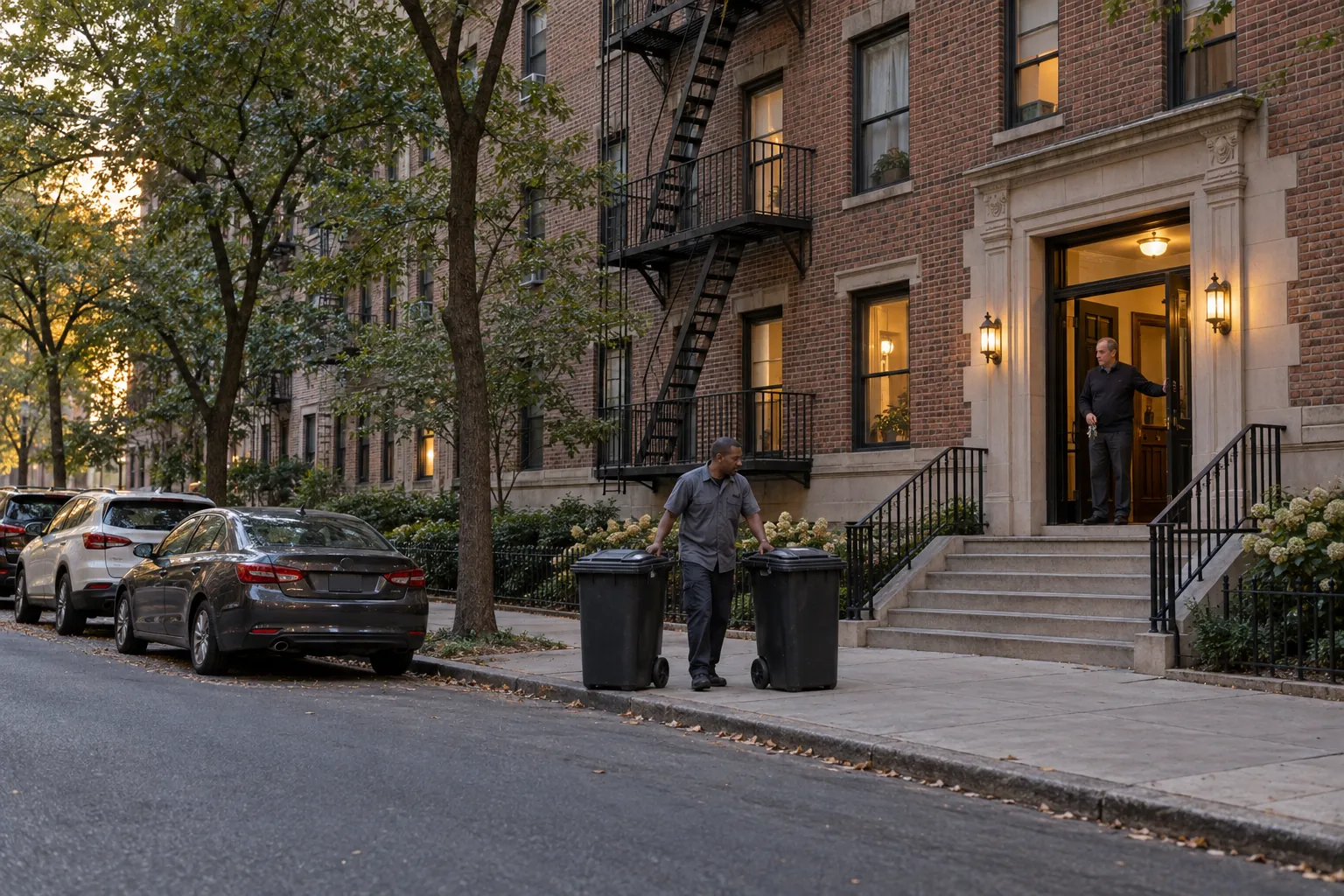
- Garbage and recycling. The Department of Sanitation's page Trash says a building of ten or more units may put trash out after 6 p.m. in a bin of 55 gallons or less with a secure lid, or after 8 p.m. if bags go straight on the curb, and that "all waste must be set out by midnight."
- Self-closing doors. HPD's page on self-closing doors says owners "should check self-closing doors periodically and must make prompt repairs to door closing mechanisms or defective doors and door frames", citing HMC § 27-2041.1. The owners' guide adds that a self-closing door, "when opened and released, returns to the closed position and self-latches shut."
- Fire escapes and sprinklers, which the owners' guide says "must be maintained in proper working order", and the stairs, halls and exits kept clear.
- Pests. Fix leaks, contain garbage and let the pest control contractor in. The owners' guide notes that "New York State law requires that owners hire only pest control professionals licensed by the NY State Department of Environmental Conservation (DEC) to treat apartments for pests."
- Leaks and mold, found early and reported, and vacant apartments cleaned of mold before a new tenant moves in.
- Lighting, locks and intercoms in the common areas.
- Repairs, access and emergencies: small repairs by the super, larger ones by contractors the super lets in, and first response to a flood or a boiler failure.
Much of the work in a New York building has to be done by somebody who holds the right license or certification. Part of the super's job is knowing where that line is.
03
Through the year: the dates that land on the super's desk
Some of an owner's obligations fall on fixed dates. The office files them, but the super usually delivers the notices, lets inspectors in and posts the signs:
- October 1 to May 31: heat season. The boiler is serviced and running before it starts.
- By September 1: property registration, with the managing agent's details and the always-answered phone number up to date.
- December 1 to 31: the bedbug filing. HPD's page on bedbugs says owners file each December for the year from November 1 to October 31, reporting the number of units, the units with infestations, the units treated and the units reinfested after treatment. It is only as good as the building's record of treatments.
- Every year: the annual notices. The owners' guide lists the annual notice on lead poisoning and window falls, and the annual notice on stove knob covers, among the notices owners must give tenants.
- Every year: the lead-based paint inspection. Where a building was built before 1960 and a child under six lives in an apartment or routinely spends ten or more hours a week there, owners "must visually inspect the apartments and common areas for lead-based paint hazards at least once a year."
- Every year: mold. Owners of multiple dwellings must "Annually inspect units for mold and respond to any complaints received directly from tenants or HPD."
- At every turnover: the lead-based paint work the owners' guide calls "turnover", done by appropriately certified contractors before the new tenant moves in, and the apartment cleaned of mold.
- Signs, checked regularly: among them the janitor's name and address, and who holds the keys to the boiler room.
04
The super's daily and weekly rounds
None of the rules above says how often a super should walk the building. A written walk-through is the owner's or managing agent's own tool, and it is what turns "the super takes care of it" into something a property manager can check. A workable walk-through for a mid-size walk-up or elevator building looks something like this:
- Boiler room, first thing. In heat season, confirm the boiler is running, the water level and pressure look normal and there is no leak or smell; note anything for the service company.
- Lobby and entrance. Front door closes and locks, intercom works, mailroom and package area tidy, lights on, floor clean and dry.
- Top down through the stairs and halls. Each landing: lights working, self-closing doors closing and latching, nothing stored in the stairs or halls, windows and window guards in common areas intact, no sign of leaks or pests.
- Roof door and bulkhead. Closed, not propped, the roof clear of anything that could block a drain.
- Laundry room and basement. Machines running, lint and spills cleared, floor drains clear, no standing water.
- Trash room and compactor. Cleaned, recycling sorted, bins lidded, set out on the right night and brought back in after collection.
- Sidewalk and entrance, swept and, in winter, cleared.
Weekly or monthly items sit on top: meeting the pest control contractor and noting the apartments treated, walking vacant apartments, and checking the posted signs.
In a larger building the super runs porters and a handyperson, and checks their work as well as doing it. Tenants' complaints should each have a time received and a time fixed, however they come in.
05
Records that hold up when HPD or the owner asks
Tenants complain to HPD by calling 311, and HPD inspects. The owners' guide says HPD "inspects for the conditions listed below on every inspection and will issue violations where warranted", and that some violations lead HPD to carry out emergency repairs, with the cost billed to the property and, if unpaid, filed as a tax lien. On self-closing doors, it says inspectors "check the self-closing door mechanism of every apartment that they inspect, and confirm self-closing doors in common areas are working."
Some records are required outright. Among owners' duties, the guide lists "Maintain records about compliance with lead-based paint, mold and self-closing door regulations", and on lead it warns of "significant civil penalties that can be imposed for the failure to keep all of these documents for 10 years."
Around them sits the working record of the building, which no statute prescribes but every owner needs when a tenant says the heat was off all weekend, or the hall light has been out for a month. Good evidence of the super's routine work has the same features wherever it is kept:
- Where: the boiler room, the fourth-floor landing, the trash room, not just "the building".
- When: the date and time the check was done.
- Who: the super, a porter or the relief super, by name.
- What was found, and a photo where it helps: the door that would not latch, the leak under the sink, the bags left out early.
- What happened next: fixed on the spot, reported to the managing agent, or passed to a contractor, with the date it was closed.
Heat complaints are the hardest to answer from memory. A record of boiler room checks through heat season, and of what the super did on the day of the complaint, is far more useful than an assurance. A temperature sensor records the temperature, not the rounds.
Whoever covers the super's days off should use the same walk-through and the same record, so the gap does not show up as a week with nothing written down.
06
Where the record fails, and what SiteClara does about it
In many buildings the super's work is real but the record of it is thin. The rounds sheet in the boiler room was filled in on Friday for the whole week. A tenant told the porter about a leak in the hallway ceiling, the porter meant to tell the super, and the first written trace is an HPD violation. When the managing agent asks whether the halls were walked and the self-closing doors checked last month, the answer is a promise rather than a record.
SiteClara records that routine work at the place it happens. A printed QR poster at each location, such as the boiler room, the trash room, each stair landing, the roof door or the laundry room, with an optional NFC tag behind it, lets the super, the porters and the relief super scan the code or tap the tag on their own phone, with no app to install. They see the scheduled checks due there and mark each one done, or say what stopped them, with a photo when one is asked for. A problem found there goes onto the building's list of jobs until someone closes it, and the supervisor's queue groups open jobs by building and floor. A supervisor can escalate a job to the building's manager, who can answer it.
Each day the supervisor reviews the day's checks and photos, gives a reason for any check that was missed, and approves a report, which goes to the property manager and other nominated contacts at 8 a.m. the next morning. It shows what was reported, what was completed, what is still open and how the scheduled checks went.
07
Questions people ask
Does a NYC building superintendent need a license?
Multiple Dwelling Law section 83 sets no license, exam or course for the resident janitor or super: it asks only that someone responsible on behalf of the owner lives in the building or within two hundred feet of it and has charge of it. The city's Housing Maintenance Code asks for competence instead: under § 27-2055, an owner required to employ a janitor "shall certify in writing to the department that such owner's janitor is competent", including to operate the machinery that provides central heat and hot water, and must file a new certificate within sixty days of hiring a new janitor. No certificate is needed for a janitor who has completed a course of at least fifteen hours given or approved by the Department of Buildings. Particular tasks in the building may still need a licensed or certified person, as the section on what a super covers explains. The registration people often mean by "superintendent license" is the Department of Buildings' Construction Superintendent registration, which is for construction and demolition work, not for running an occupied building.
Does the super have to live in the building?
Under Multiple Dwelling Law section 83, where thirteen or more families live in a multiple dwelling and the owner does not, the janitor, housekeeper or other responsible person must live in the building or "within a distance of two hundred feet from said dwelling". Where two or three multiple dwellings are connected or adjoining, "one resident janitor shall be sufficient."
What are the requirements for a NYC Construction Superintendent registration?
The Department of Buildings' page Obtain a Construction Superintendent Registration says applicants must be at least 18, able to read and write English, have "satisfactorily completed a Department-approved 40-hour site safety course within the one (1) year prior to application" and hold a valid Site Safety Training (SST) Supervisor card. They must also meet one experience pathway, such as "three (3) years of experience serving as a full-time project supervisor with on-site responsibility over the construction or demolition of buildings in New York City, within the five (5) years prior to application". Applications go through DOB NOW.
08
Further reading, and a list to take away
Start with Multiple Dwelling Law section 83 and HPD's owners' guide, then HPD's pages and the Department of Sanitation's trash rules, all linked above. For the city's own requirement, read Housing Maintenance Code Article 13, §§ 27-2052 to 27-2056, in its current official text.
If you own or manage a New York City apartment building, or you have just taken a job as its super, make sure you know:
- whether the resident janitor rules apply, and that the super lives where the law says;
- who covers the super's days off and vacations, and how tenants reach them;
- that HPD registration is current, with a managing agent phone number that is answered at all times;
- the heat season temperatures, and how the building shows it met them;
- which apartments have a child under six or a child 10 or younger, for the lead and window guard duties;
- who the licensed pest control contractor is, and where the record of treated apartments is kept for the December filing;
- which signs must be posted, and when they were last checked;
- where the rounds are recorded, and who reads the record.
Sources
Every document this guide quotes or links to, in the order it first cites them.
- Multiple Dwelling Law section 83, Janitor or housekeeper nysenate.gov
- ABCs of Housing: Owners' Guide (January 2024) nyc.gov
- Register Your Property nyc.gov
- Heat and Hot Water nyc.gov
- Trash nyc.gov
- Self-closing doors nyc.gov
- Bedbugs nyc.gov
- Obtain a Construction Superintendent Registration nyc.gov
Related guides
 Premises and facilities managementCustodian duties: what the job involves, and how to show it was doneCustodian duties in schools, offices, churches and public buildings: cleaning, restrooms, opening and locking, safety checks, OSHA rules and a record of the work.
 Premises and facilities managementCommon area inspection checklist: what to check, how often, and the record to keepA common area inspection checklist for apartment, condo and commercial buildings: what to check, how often, the codes and case law behind it, and the record to keep.
 CleaningTrash room cleaning: the codes, the schedule and the recordHow to keep a trash room clean, safe and pest-free: the property maintenance, fire and OSHA rules behind it, a cleaning schedule, and what to record.
 Premises and facilities managementBoiler log: what to record, how often, and what the state expectsWhat a boiler log should record, how often to take readings and test the low-water cutoff, what state boiler rules and ASME CSD-1 expect, and where logs fail.