Premises and facilities management
Common area inspection checklist: what to check, how often, and the record to keep
A common area inspection checklist is the list of checks, location by location, that an inspector works through on a regular walk of a building's shared spaces, so that hazards and defects are found, recorded and fixed before someone is hurt.
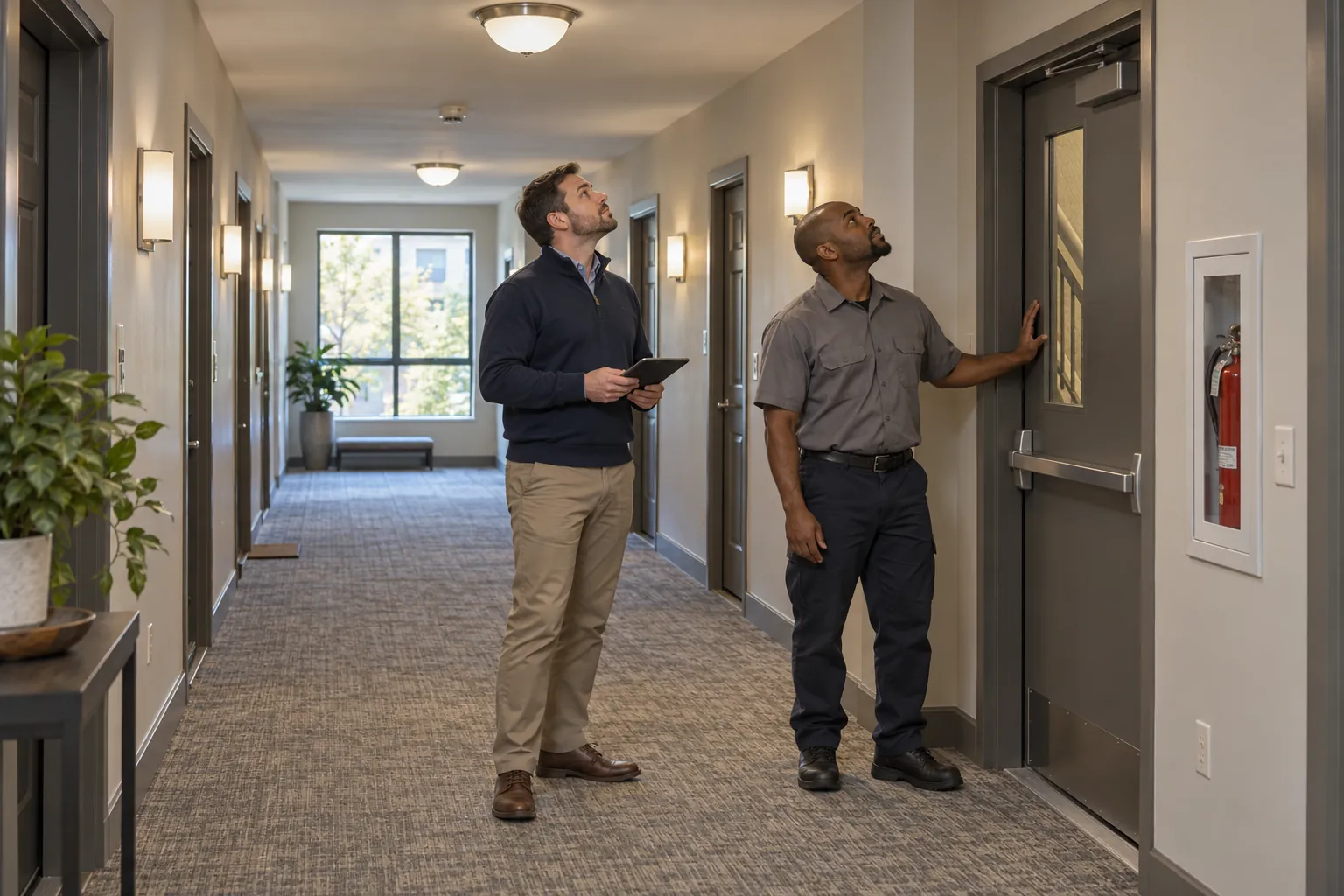
Lobbies, hallways, stairwells, elevators, garages and walkways are shared by everyone and noticed by no one until something goes wrong. A common area inspection is the regular walk that finds the burned-out stair light, the loose handrail and the propped fire door before a resident, tenant or visitor does. This guide covers where the duty comes from, a common area inspection checklist you can adapt, how often to walk, and what a record needs to show if a claim or a code official ever asks.
01
What a common area inspection is, and where the duty comes from
A common area inspection is a planned walk of the shared parts of a property, looking for defects and hazards and recording what was found. It is narrower than a full property inspection: individual units are left to move-in, move-out and annual unit inspections, arranged with each tenant or owner. In a rental building the common areas are the owner's; in a condominium or HOA community they are usually common elements maintained by the association; in an office or retail building they are the landlord's, with the cost recovered through common area maintenance (CAM) charges.
No single federal law says how often a hallway must be walked. The duty is built from several layers, depending on the building and the state:
- The property maintenance or housing code. Many cities and counties adopt the International Property Maintenance Code (IPMC), 2024 edition, Chapter 3, General Requirements, or an earlier edition, usually with local amendments; others have their own housing code. A model code is not law until a jurisdiction adopts it, so check which code and edition your code official enforces.
- Premises liability, which is state law. An owner or manager who fails to take ordinary care of a property can be liable to the people injured on it. California puts the general rule in California Civil Code section 1714: everyone is responsible "for an injury occasioned to another by his or her want of ordinary care or skill in the management of his or her property or person". Each state has its own statutes and case law, so the details differ.
- OSHA, for the people who work there. Where employees use the common areas, as porters, custodians, engineers, security officers or office staff, 29 CFR 1910.22, the walking-working surfaces standard, requires that walking-working surfaces "are inspected, regularly and as necessary, and maintained in a safe condition". Check OSHA's State Plans page first: there are "22 State Plans covering both private sector and state and local government workers, and seven State Plans covering only state and local government workers".
- The ADA, where the building is open to the public. Under the Department of Justice's ADA Title III regulations, 28 CFR 36.211, a public accommodation "shall maintain in operable working condition those features of facilities and equipment that are required to be readily accessible to and usable by persons with disabilities". It allows "isolated or temporary interruptions in service or access due to maintenance or repairs"; a ramp left blocked for weeks is unlikely to count as one.
- HUD's standards, for assisted housing. HUD's NSPIRE standards include Handrail, Steps and Stairs, Trip Hazard, Exit Sign, Door–Fire Labeled, Litter and Infestation, among others. A property facing NSPIRE inspections should walk its common areas against the same list.
02
A common area inspection checklist
Organize the checklist by location in the order the inspector walks, so each space is checked in one pass and nothing is skipped because it sits at the far end of the building. Adapt it to what the property actually has:
- Entrances and lobby: doors open, close and latch; walk-off mats lie flat; floors dry and free of trip hazards; lighting working; accessible entrance, door opener and route clear.
- Corridors and hallways: carpet and flooring secure, no loose seams or lifted tiles; lighting working along the whole length; no bikes, strollers, furniture or trash bags stored in the path; exit signs lit; fire extinguishers in place and not blocked; smoke and carbon monoxide alarms, where fitted, in place and undamaged; ceiling tiles and walls free of stains that suggest a leak from a unit or the roof.
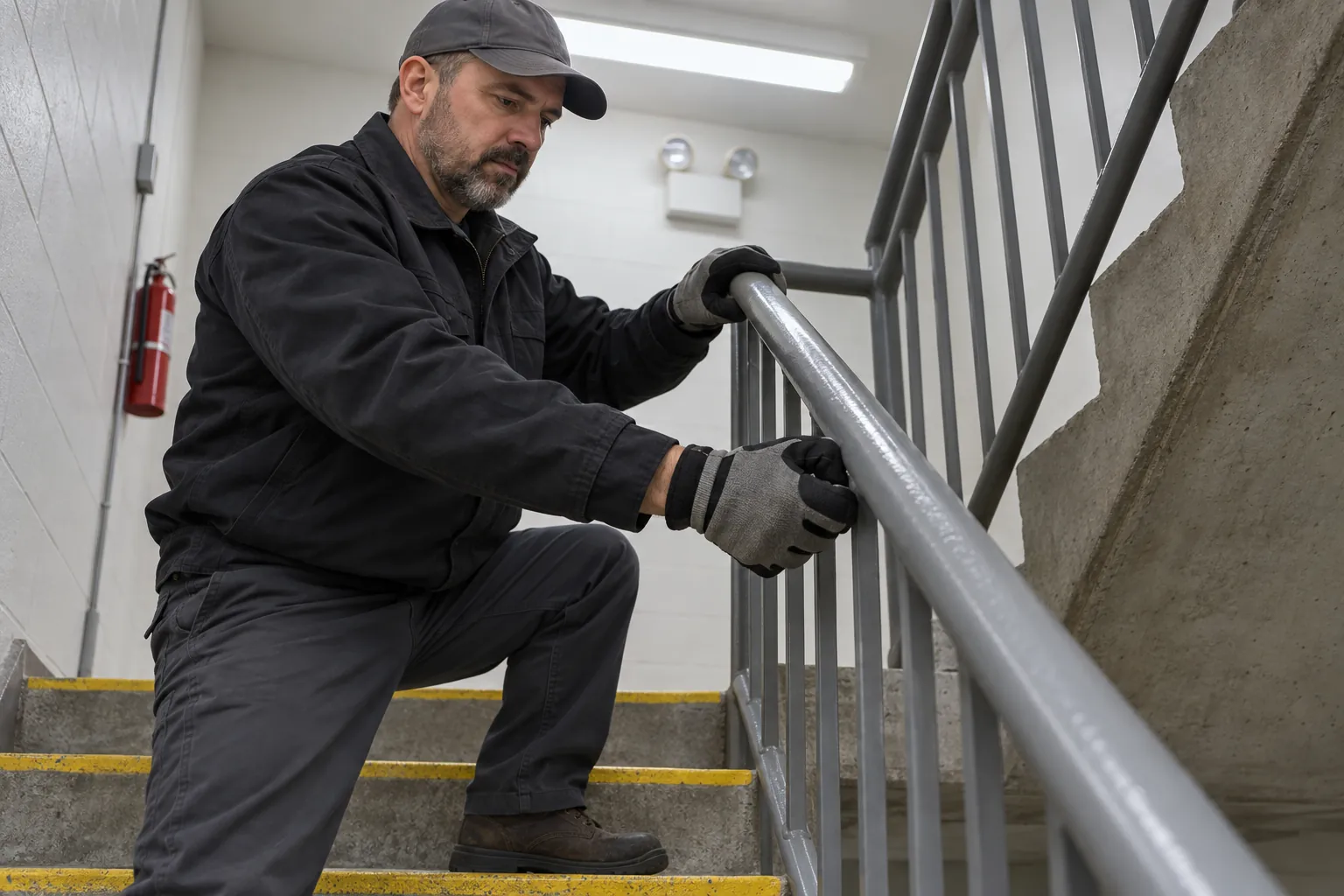
- Stairwells: treads and nosings intact; handrails and guards firm; lighting working on every landing; stair doors self-closing and latching, never wedged; nothing stored under or on the stairs.
- Elevators: car and landing sills level, emergency phone or intercom answering, lights and call buttons working. Periodic inspection and testing belong to the elevator contractor and the state or city inspector, not the walk.
- Trash rooms, laundry and amenity rooms: chute doors close; no loose trash, spills or water on the floor; no signs of pests; equipment in order; doors and access control working.
- Parking lots and garages: potholes, ponding water, lights out, accessible spaces and access aisles clear. See the parking lot inspection guide.
- Sidewalks and grounds: cracked or heaved slabs and trip edges at joints, landscaping cut back from paths, lights and signs, handrails on exterior steps, and snow and ice in season.
- Balconies, decks and exterior stairs: visible rot, rust, loose railings, water staining and sagging, reported for a qualified person to look at. The inspector records; they do not judge the structure.
Write down what the walk does not cover. Fire alarm testing, sprinkler inspection, backflow testing, elevator inspection and structural surveys are separate programs with their own qualified people and their own records. The common area walk notices when something in those systems looks wrong, and reports it.
03
How often to inspect, and who does it
Match the frequency to how much each space is used and how quickly a hazard can appear there. A common pattern:
- Every day, often more than once: the lobby and entrances, elevators, trash rooms and a quick walk of the main corridors, usually by the porter, custodian, superintendent or security officer as part of their shift.
- Weekly: every floor's corridor, every stairwell top to bottom, the garage and the laundry and amenity rooms, walked by the on-site maintenance team or building engineer with the checklist.
- Monthly or quarterly: a full walk by the property manager or community association manager, inside and out, including the roof access, grounds, parking and exterior elevated elements seen from the ground.
- After an event: a storm, a power outage, a move-out day, construction work or a complaint.
Give each walk an owner by name or by post, not "the maintenance team". The person walking should fix small things on the spot, such as a wedge pulled from a fire door or a curled mat, and know exactly who to tell about everything else.
Some inspections are required by statute and must be done by a licensed professional; the routine walk supports them but never replaces them. California and Florida give examples:
- California apartments. California Health and Safety Code section 17973 requires exterior elevated elements, such as balconies, decks, porches, stairways and walkways, with a walking surface more than six feet above ground and supported wholly or substantially by wood or wood-based products, in buildings with three or more multifamily dwelling units, to be inspected by a licensed or certified professional. "The inspection shall be completed by January 1, 2026, and by January 1 every six years thereafter."
- California condominiums. Under California Civil Code section 5551, "at least once every nine years" the association's board must have a licensed structural or civil engineer or architect visually inspect a random and statistically significant sample of the exterior elevated elements it maintains.
- Florida condominiums and cooperatives. Florida Statutes section 553.899 requires a milestone structural inspection by a licensed architect or engineer for buildings of three habitable stories or more, by December 31 of the year the building reaches 30 years of age, "and every 10 years thereafter".
04
Recording findings, and what good evidence looks like
Good documentation answers five questions for every walk: where, when, who, what was found, and what happened next. It has:
- The location, specific enough to find again: "Building B, stair 2, landing between floors 3 and 4", not "stairs".
- The date and time of the walk, recorded when it happened, not filled in afterward.
- The name of the person who walked it, not a department or initials nobody can decode later.
- What was found satisfactory, as well as what was wrong: a record of defects alone cannot show that a hallway was walked and was fine.
- A photo of each defect, and a second photo when it is fixed. Photos taken on the walk, with the date and time, show the condition as it was, which a written note alone cannot.
- A priority and an owner for each defect, with the date it was reported and the date it was closed.
Grade what you find so the urgent things are handled first. A simple scale works well:
- Make safe now: a missing handrail, a blocked exit, water on a stair, a dark stairwell, a broken glass door. Guard or close off the area before leaving it. OSHA's walking-working surfaces standard says that where a repair "cannot be made immediately, the hazard must be guarded" until it is corrected.
- Fix within days: a burned-out corridor light with others still working, a curled mat edge, a door closer that is slow to latch, a lifted carpet seam.
- Plan and budget: worn stair nosings across a building, faded parking lot striping, a lobby floor near the end of its life. These feed the capital plan and, for associations, the reserve study.
In a workplace, 29 CFR 1910.37, the exit route standard, says "exit routes must be free and unobstructed" and each must be "adequately lighted so that an employee with normal vision can see along the exit route." In residential common areas the adopted fire code sets the rule, and the authority having jurisdiction decides how it applies.
05
Closing the loop: repairs, residents and trends
A defect written down and then left is worse than one never noticed, because the record now shows the owner knew. Every item needs a work order or a named person, a target date and a closing entry.
- Make the handover explicit. Agree who the inspector tells and how. "I mentioned it to someone" is not a handover.
- Check that the fix is actually done. Walk the item again after the work order closes. A light marked fixed that is still out is a common failure, and the next walk should catch it.
- Take reports from the people who use the building. Residents, tenants and office staff see the common areas at hours the inspector does not. Give them one clear way to report a hazard, and put their report on the same list as the inspector's findings.
- Look for repeats. The same wet patch by the same entrance every rainy morning is a cause to fix, such as a longer walk-off mat, not a defect to log again. Florida's statute cited above treats a condition that "occurred with regularity" as foreseeable, which is a good test for any building.
- Report upward. Give the owner, the property managers or the association board a short monthly summary: walks done against planned, open items by priority and anything needing capital money. Older residents and visitors are most at risk; the CDC's older adult falls page says falls among adults 65 and older "caused over 43,000 deaths in 2024, making it the leading cause of injury death for that group."
Put accessibility items on the same list: a broken door opener or the only elevator out of service. Record the date each failed and the date it was restored.
06
Where the common area inspection record fails, and what SiteClara does about it
The property manager's monthly walk usually has a record. It is the daily and weekly walks that fail: initialed on a clipboard or a sheet taped inside the trash room door, sometimes for the whole week at once, often not at all. A burned-out stair light seen on Tuesday is mentioned to whoever was passing. When a resident falls on that stair on Friday, nobody can say when it was last walked, by whom, or whether the light was reported.
SiteClara records those routine checks where they happen. A printed QR code poster, with an optional NFC tag behind it, goes at each point on the walk: the lobby, each floor's corridor, each stairwell, the elevator lobby, the trash room, the garage level. The inspector scans the code or taps the tag on their own phone, with no app to install, sees the checks due at that location and marks each one done or says what stopped them, with a photo when one is asked for. The time and the named person are recorded as it happens. A defect is reported on the spot with a photo and goes onto the team's list of open jobs, grouped by building and floor, until someone closes it; a supervisor can escalate it to the building manager, whose answer is kept on the job.
The supervisor sees what was due, done and missed across the property, and records the reason a check was missed from a set list with a few words. Each day they review and approve a report that goes to the property manager, owner or other nominated contacts at 8 a.m. the next morning, showing what was reported, what was completed, what is still open and how the scheduled checks went.
07
Further reading, and a list to take away
Ask your code official which property maintenance code and edition applies, and read the International Property Maintenance Code, Chapter 3 if that is the model adopted. Read OSHA's 29 CFR 1910.22 and 29 CFR 1910.37, the ADA Title III regulations and, for assisted housing, the NSPIRE standards. Ask counsel about your state's premises liability rules.
Before the next walk, check that:
- every common area is on the list, inside and out, in the order it is walked;
- each location has checks specific enough that two people would find the same thing;
- each walk has a named owner and a frequency, with extra walks after storms, outages and move days;
- the inspector can make a hazard safe on the spot and knows who to tell about the rest;
- every finding has a location, a date, a name, a photo, a priority and an owner;
- every item is closed with a date, and the fix is checked on the next walk;
- residents, tenants and staff have one clear way to report a hazard;
- statutory inspections by licensed professionals are on the calendar, with their reports kept;
- the owner or board gets a short monthly summary of walks done, open items and repeats.
Sources
Every document this guide quotes or links to, in the order it first cites them.
- International Property Maintenance Code (IPMC), 2024 edition, Chapter 3, General Requirements codes.iccsafe.org
- California Civil Code section 1714 leginfo.legislature.ca.gov
- 29 CFR 1910.22, the walking-working surfaces standard osha.gov
- OSHA's State Plans page osha.gov
- ADA Title III regulations ada.gov
- NSPIRE standards hud.gov
- Florida Statutes section 768.0755 leg.state.fl.us
- California Health and Safety Code section 17973 leginfo.legislature.ca.gov
- California Civil Code section 5551 leginfo.legislature.ca.gov
- Florida Statutes section 553.899 leg.state.fl.us
- 29 CFR 1910.37, the exit route standard osha.gov
- Older adult falls page cdc.gov
Related guides
 Premises and facilities managementProperty inspection report: how to walk the property, and what the report should showHow a property manager runs a site visit of a commercial or multifamily property and writes the inspection report: what to walk, how often, and what to record.
 Premises and facilities managementSlip, trip, and fall prevention: keeping floors, stairs, and walkways safe every daySlip, trip, and fall prevention in a commercial building: what OSHA 1910.22 requires, where people fall, the controls that work, and how to check and record them.
 Premises and facilities managementEngineering rounds: how to walk the plant, and how to show it was walkedEngineering rounds in a commercial building: what to walk, the readings to take, how often, the rules behind them, and a round log that shows the plant was checked.
 Premises and facilities managementHOA maintenance checklist: what the association maintains, how often to check it, and what to recordAn HOA maintenance checklist for community associations: who maintains what, what to walk and how often, state-required inspections, and the record to keep.