Cleaning
Trash room cleaning: the codes, the schedule and the record
A trash room is the room where a building's garbage and recycling are held until the hauler collects them, usually at the foot of the chute in an apartment building or by the loading dock in a commercial one.
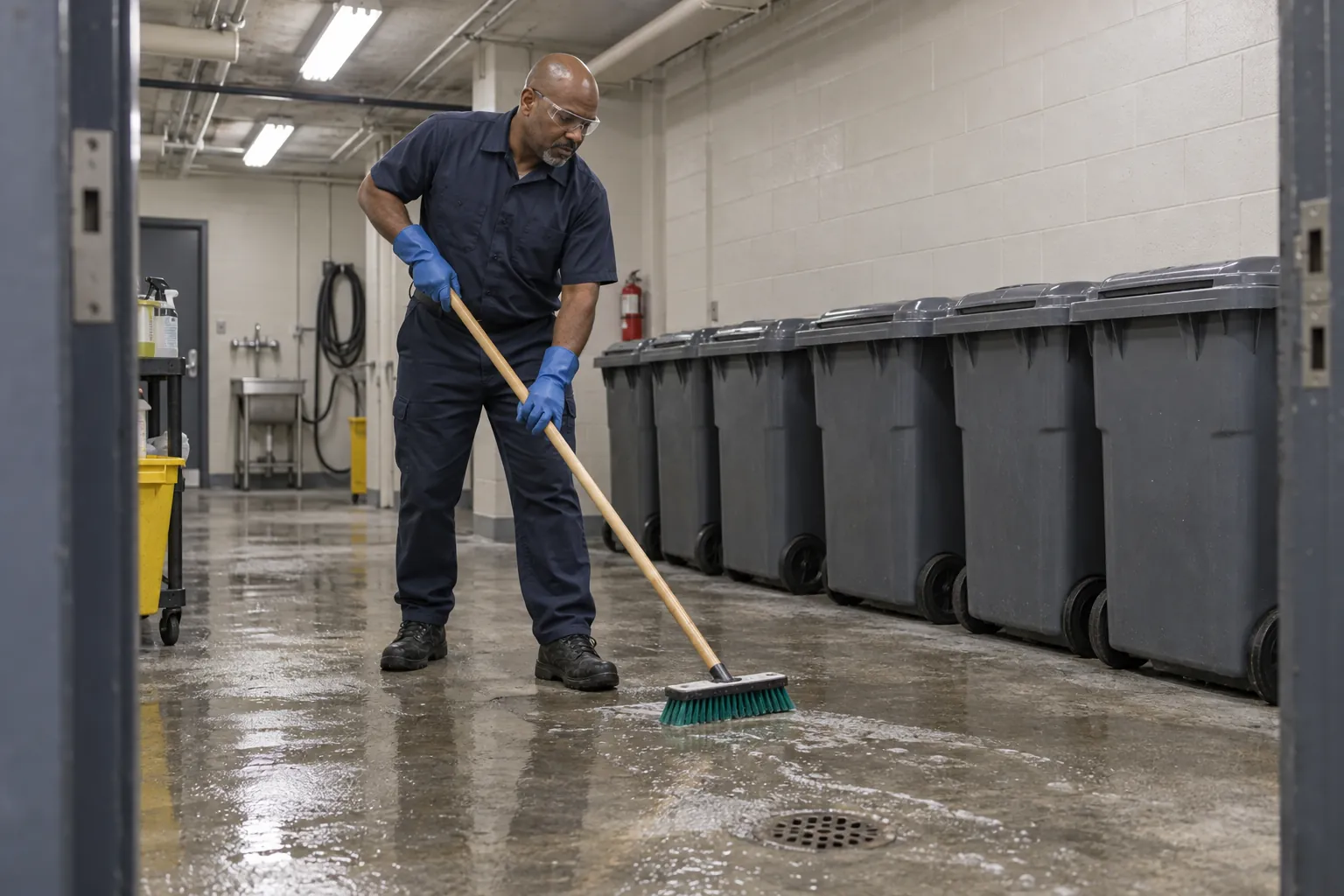
It is also the least visited room in most buildings and the one that causes the most trouble when it is neglected: odors in the corridor, rodents in the basement, a propped fire door, a compactor nobody should be touching. This guide covers the codes behind a clean trash room, what the cleaning should include, how often to do it, how to do the dirty parts safely, and how to keep a record that shows it was done.
01
The codes behind a clean trash room
No single federal rule is written about trash rooms. The duty to keep one clean comes from the property maintenance code your city or county has adopted, the fire code and, where people are employed, OSHA. Many American jurisdictions build their property maintenance rules on the International Property Maintenance Code (IPMC), 2024 edition, Chapter 3, often with local amendments, so check which edition your code official enforces.
- Accumulation, IPMC 308.1: exterior property and premises, "and the interior of every structure, shall be free from any accumulation of rubbish or garbage."
- Containers, IPMC 308.2.1: "The owner of every occupied premises shall supply approved covered containers for rubbish, and the owner of the premises shall be responsible for the removal of rubbish."
- Businesses, IPMC 308.3.2: the operator of every establishment producing garbage must provide, "and at all times cause to be utilized, approved leakproof containers provided with close-fitting covers" until the garbage is removed from the premises.
- Pests, IPMC 309: structures are to be kept free from insect and rodent infestation, and the owner of a structure with two or more dwelling units, a multiple occupancy, a rooming house or a nonresidential structure is responsible for pest elimination "in the public or shared areas of the structure and exterior property" (309.4), which includes a shared trash room.
Where people work in the building, OSHA adds its own floor. Under 29 CFR 1910.141, Sanitation, a receptacle for putrescible waste must not leak, must be able to be thoroughly cleaned, and must have "a solid tight-fitting cover, unless it can be maintained in a sanitary condition without a cover" (1910.141(a)(4)(i)). Waste must be removed "as often as necessary or appropriate to maintain the place of employment in a sanitary condition" (1910.141(a)(4)(ii)), and where vermin are found, "a continuing and effective extermination program" is required (1910.141(a)(5)). The walking-working surfaces standard, 29 CFR 1910.22, requires storerooms and service rooms to be kept "in a clean, orderly, and sanitary condition."
Cities can go further. New York City's Health Code Article 151, Rodents, Insects, and Other Pests, requires garbage, other waste and recyclables to be kept in "tightly covered, watertight receptacles made of a material type and grade that is resistant to rodents, insects and other pests" until they are moved out for a scheduled pickup (151.02(b)), and the Health Department can order a building to keep the property free of waste "by regularly cleaning and maintaining areas where waste is stored and/or compacted before its removal" (151.02(d)(5)). Where your city has its own health or sanitation code, that is the rule an inspector will cite first.
02
What trash room cleaning covers
"Trash room" means different things in different buildings: a chute access room on each floor and a compactor room in the basement of a high-rise apartment building or condo, a central waste and recycling room by the loading dock of an office tower, hospital or school, or an outdoor dumpster enclosure behind a strip center. The cleaning scope is similar in all of them:
- Floors: swept, then wet-mopped or scrubbed with a degreaser, including corners, under racks and around container wheels.
- Floor drains: cleared and flushed so they drain freely and hold no standing water or odor.
- Containers and carts: emptied on schedule, washed inside and out, liners replaced, lids kept closed to prevent garbage from drawing flies and rodents; broken lids and cracked carts reported for replacement.
- Walls and doors: spot-cleaned where bags have leaked or been dragged, lower walls washed on a schedule.
- Chute doors and hoppers: wiped and disinfected on each floor, checked to close and latch, blockages reported rather than cleared by hand.
- Compactor area: debris and leachate cleaned up around the machine, with anything inside it left to trained staff under lockout.
- Pests and odor: droppings, flies and roaches noted and reported, bait stations left alone, odors traced to a drain, a leaking cart or residue rather than masked.
The room also collects things that do not belong there: mattresses, paint, batteries, electronics. The crew report them so the property manager can arrange removal with the hauler.
03
Fire safety in the trash room
A trash room is a room full of fuel, which is why the fire code has a lot to say about it. Many jurisdictions adopt the International Fire Code (IFC), 2024 edition, Chapter 3 or an earlier edition, with local amendments; a few use NFPA 1 instead. The authority having jurisdiction (AHJ), usually the fire marshal, decides which code applies and how. Under the 2024 IFC:
- Accumulation, 304.1: "Combustible waste material creating a fire hazard shall not be allowed to accumulate in buildings or structures or upon premises."
- Oily rags, 304.3.1: materials susceptible to spontaneous ignition, such as oily rags, must be stored in a listed disposal container, and "Contents of such containers shall be removed and disposed of daily."
- Larger containers, 304.3.3: containers over 5.33 cubic feet (40 gallons) must have lids, and containers and lids must be noncombustible or low heat release materials.
- Dumpsters, 304.3.4 and 304.3.5: dumpsters of 1 cubic yard or more are not to be stored in buildings or within 5 feet of combustible walls, openings or roof eave lines, subject to the material rules and the listed exceptions for sprinklered areas and dedicated container buildings.
The building code decides how the room was built, and the cleaning routine has to keep those features working. The International Building Code (IBC), 2024 edition, Chapter 7 (713.13) requires waste, recycling and linen chutes to comply with NFPA 82, Chapter 6, says "Doors into chutes shall be self-closing," and puts chute access rooms and the discharge room behind fire-rated construction with self- or automatic-closing doors. IBC Chapter 9 (903.2.11.2) requires sprinklers at the top of rubbish and linen chutes and in their terminal rooms, and IBC Table 509.1 requires a 1-hour separation or sprinklers for waste and linen collection rooms over 100 square feet outside healthcare.
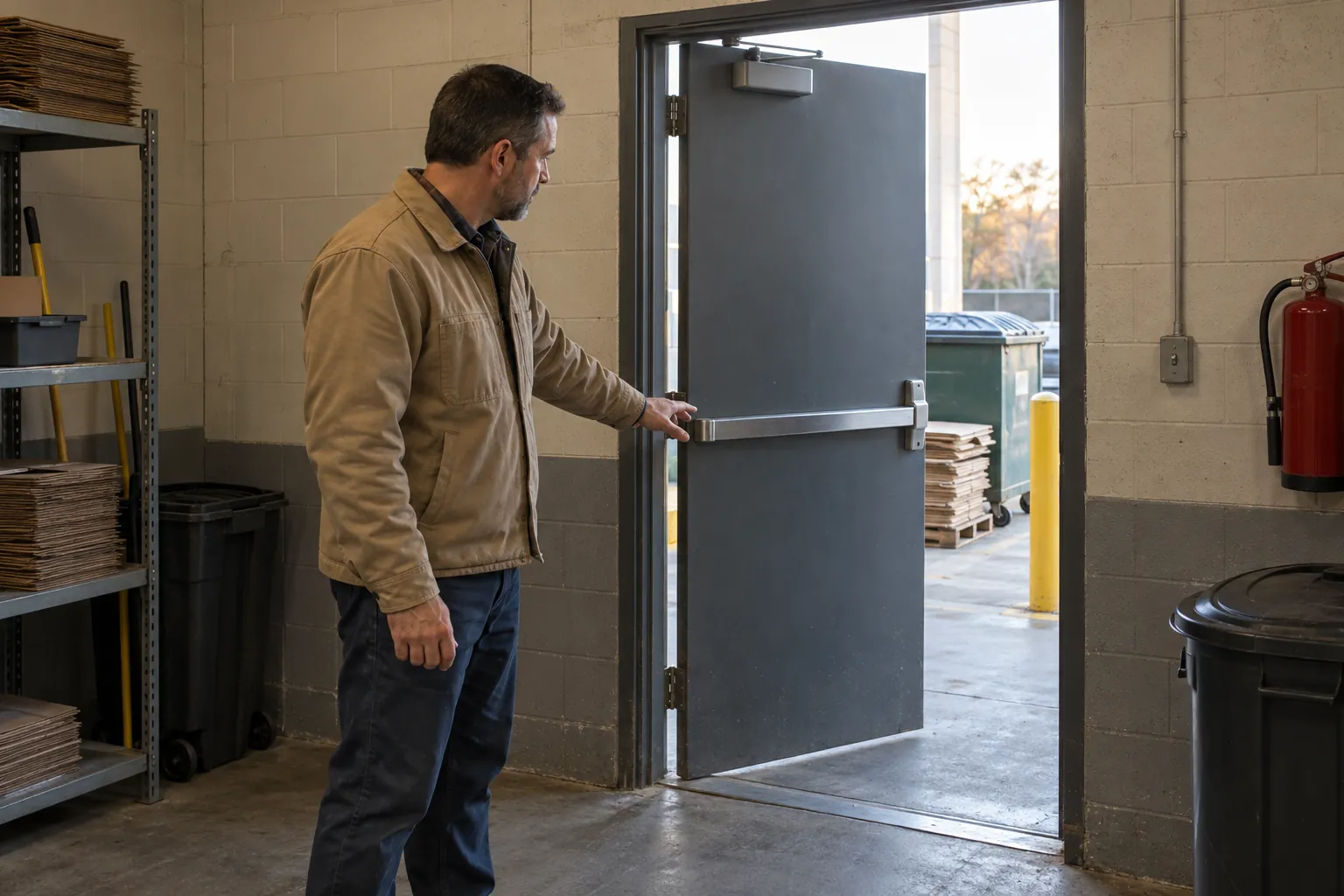
For the crew, that turns into a short list of things never to do. The IFC Chapter 7 says fire doors "shall not be blocked, obstructed, or otherwise made inoperable" (705.2), that hold-open devices and closers must be maintained, and that swinging fire doors "shall close from the full-open position and latch automatically" (705.2.4). So:
- never prop a trash room or chute room door open, even for a few minutes;
- report a door that does not close and latch, or a chute door that stays open, the same day;
- never hang anything from a sprinkler, and keep cardboard and bags well below the heads;
- keep bags out of the path to the exit door;
- report smoke or a burning smell in the chute at once and follow the building's emergency action plan.
04
How often to clean, and how to do it safely
No code sets a cleaning frequency for a trash room; the codes set the outcome, and the frequency follows how the room is used. A typical janitorial scope of work in a busy building looks like this:
- Daily or every shift: pick up loose trash, check containers are not overflowing and lids close, spot-mop spills, wipe chute hoppers, check doors latch, empty oily rag containers, note pests and odors.
- Weekly: scrub the whole floor with a degreaser, flush drains, wash and disinfect carts and containers, wash lower walls and kick plates.
- Monthly or quarterly: full wash-down, deep clean behind racks and around the compactor, and chute cleaning by a specialist contractor on the property manager's schedule.
- Extra cleans after collection days, heat waves and events, when leaks, odors and flies build up.
Food service, hospitals and labs usually need a tighter schedule set by the health department or the infection prevention team, and regulated medical waste has its own handling rules; keep it apart from the general routine.
Personal protective equipment. Trash rooms hold broken glass, needles and leaking bags. Heavy-duty gloves, slip-resistant shoes and eye protection when spraying are the minimum. Where staff can reasonably be expected to contact blood, OSHA's Bloodborne Pathogens standard, 29 CFR 1910.1030, applies: reusable bins and cans likely to become contaminated "shall be inspected and decontaminated on a regularly scheduled basis," and contaminated broken glassware "shall not be picked up directly with the hands." Never compress a bag by hand or foot, and report loose needles.
Rodent droppings. The CDC's How to Clean Up After Rodents says not to vacuum or sweep rodent urine, droppings or nesting materials. Ventilate first, wear rubber or plastic gloves, spray with a bleach solution (1.5 cups of household bleach in 1 gallon of water) or an EPA-registered disinfectant "until very wet," let it soak for 5 minutes, and wipe up with paper towels.
Compactors and balers. Cleaning around a compactor is janitorial work; reaching into one is not. OSHA's lockout/tagout standard, 29 CFR 1910.147, covers servicing where "unexpected energization or start up" could injure someone, including placing part of the body into the point of operation, so a jam is cleared under lockout by someone trained. 29 CFR 570.63, Hazardous Occupations Order No. 12, makes operating, cleaning or adjusting balers and compactors particularly hazardous for 16- and 17-year-olds, with a narrow exemption to load, but not operate or unload, certain scrap paper balers and paper box compactors. A summer hire should not be on compactor duty.
05
Inspecting the trash room, and what good evidence looks like
A trash room check takes a supervisor, building engineer or day porter two minutes. What matters is that it happens on schedule, covers the same things every time, and sends problems to someone who will fix them:
- Floor: no loose bags, spills or standing water; drain clear.
- Containers: not overflowing, lids close, no leaks.
- Doors: room and chute doors close and latch; nothing propping them.
- Fire safety: nothing near sprinkler heads, oily rag container emptied, exit path clear.
- Pests and odor: droppings, flies, roaches, bait stations intact, no smell in the corridor.
- Items for removal: bulky or hazardous items needing a special pickup.
Good evidence answers four questions: was the room checked, when, by whom, and what was found. A column of initials on the door answers only the first. Entries should carry the actual time, a name that identifies one person and anything wrong, with a photo when it helps the property manager, the pest control operator or the hauler, and each problem needs a trail of who it went to and when it was fixed.
Pest sightings belong in the building's pest sighting log. In New York City, where the Health Department orders a written pest management plan under Article 151, the plan must include a schedule for routine inspections and "a log of visits by pest management professional(s) and the names of pesticides, if any, applied on each visit."
Look at the pattern, not only the day. A room that overflows every Friday needs a change to the collection schedule, not a harder-working porter, and rodents that keep coming back usually mean a structural gap the owner has to fix.
06
Where the trash room record fails, and what SiteClara does about it
Trash rooms are where paper records are weakest. The sheet on the door gets wet, torn or thrown out. Nobody from management goes down to read it, so a missed clean is found when a tenant complains about the smell in the elevator lobby. Initials filled in on Friday look the same as initials written at the time, the broken chute door stays broken because the building engineer never saw the note, and the droppings the porter saw on Monday are news to the pest control operator on Thursday.
SiteClara replaces the sheet with a tag at the trash room door: a printed QR code poster, with an NFC tag behind it if staff would rather tap than scan. A porter or custodian scans the code or taps the tag on their own phone, with no app to install, and completes the check. The time and the person are recorded as it happens. If something is wrong, such as an overflowing container, a door that will not latch, a leak or signs of rodents, they record it there with a photo, and it goes onto the team's list of open jobs until someone closes it.
Scheduled checks are set per location, so each floor's chute room and the basement compactor room can have their own. The crew see what is due and mark it done, or say what stopped them, such as a compactor being serviced. The supervisor sees what was done and what was missed, and can record why. At the end of the day the supervisor reviews it, adds a note, and the approved report goes to the property manager at 8 a.m. the next morning.
07
Questions people ask
What is a trash room?
It is the room where a building's garbage and recycling are kept until they are collected. In a building with a chute, it is the room at the bottom: New York City's 1 RCNY §24-01, Construction and Maintenance of Refuse Chutes and Refuse Rooms, says "A refuse collection room shall be provided at the bottom of all chutes at the cellar or lowest story level to receive the refuse," and that such rooms "shall be used only for receipt of refuse and for refuse compacting equipment."
Why is it called a refuse room?
Refuse is the word building rules use for garbage and rubbish together.New York City's 1 RCNY §24-01, Construction and Maintenance of Refuse Chutes and Refuse Rooms, describes refuse chutes as those "used for conveyance of garbage and rubbish from upper floors of a building to a cellar or other location," and calls the room they empty into a refuse room. Trash room, garbage room and refuse room all name the same space.
How big does a trash room need to be?
No federal rule sets a size; it is set locally, usually when the building is permitted. In California, Public Resources Code section 42911 requires each local agency to adopt an ordinance "relating to adequate areas for collecting and loading recyclable materials in development projects," and since July 1, 2005 a local agency may not issue a building permit for a development project unless the project provides adequate areas for collecting and loading recyclables. Ask your city's planning or building department what its ordinance requires.
08
Further reading, and a list to take away
Start with the property maintenance code and fire code your jurisdiction has actually adopted; your city or county code official and fire marshal can tell you which editions and amendments apply. The ICC's Digital Codes site has the International Property Maintenance Code and the International Fire Code. For workers, read OSHA's sanitation standard alongside your State Plan if you have one. For pests, the CDC's Controlling Wild Rodent Infestations explains the principle of removing food, water and shelter, and your city's health department will have its own rules, as New York's Article 151 shows.
Before you rewrite the trash room routine, check that:
- each trash, chute and compactor room is in the janitorial scope of work with its own frequency;
- containers have lids that close, and anything over 40 gallons meets the fire code's material rules;
- doors close and latch, and nothing is stored near sprinkler heads;
- the crew have gloves, eye protection and tools for glass and needles, and know not to sweep rodent droppings;
- compactor jams are cleared under lockout, and no one under 18 operates the machine;
- every check records the actual time, one named person and what was found;
- pest sightings reach the pest control operator, and faults reach whoever fixes them;
- your state's OSHA plan and your city's health code have been checked for anything that goes further.
Sources
Every document this guide quotes or links to, in the order it first cites them.
- International Property Maintenance Code (IPMC), 2024 edition, Chapter 3 codes.iccsafe.org
- 29 CFR 1910.141, Sanitation osha.gov
- Walking-working surfaces standard, 29 CFR 1910.22 osha.gov
- OSHA-approved State Plans osha.gov
- Health Code Article 151, Rodents, Insects, and Other Pests nyc.gov
- International Fire Code (IFC), 2024 edition, Chapter 3 codes.iccsafe.org
- International Building Code (IBC), 2024 edition, Chapter 7 codes.iccsafe.org
- IBC Chapter 9 codes.iccsafe.org
- IBC Table 509.1 codes.iccsafe.org
- IFC Chapter 7 codes.iccsafe.org
- Bloodborne Pathogens standard, 29 CFR 1910.1030 osha.gov
- How to Clean Up After Rodents cdc.gov
- Lockout/tagout standard, 29 CFR 1910.147 osha.gov
- 29 CFR 570.63, Hazardous Occupations Order No. 12 ecfr.gov
- 1 RCNY §24-01, Construction and Maintenance of Refuse Chutes and Refuse Rooms nyc.gov
- Public Resources Code section 42911 leginfo.legislature.ca.gov
- Controlling Wild Rodent Infestations cdc.gov
Related guides
 CleaningCommon area cleaning: what it covers, how often, and how to show it was doneWhat common area cleaning covers in apartment, condo and commercial buildings, how often, the OSHA and code rules behind it, and how to show each visit happened.
 Premises and facilities managementPest sighting log: recording pest activity so it gets dealt withWhat a pest sighting log should record, who fills it in, how sightings reach your pest control provider, and the US rules behind it: FDA Food Code, OSHA and CMS.
 CleaningDay porter duties: what the job covers, and how to prove the roundsWhat a day porter does in an occupied building, a sample daily route, the OSHA rules behind the work, and how to show a client the rounds really happened.
 CleaningJanitorial closet requirements: the sink, the chemicals and the daily checkWhat US codes and OSHA require of a janitorial closet: the service sink, chemical storage, SDS, eyewash, clear panels and housekeeping, and a routine closet check.