Premises and facilities management
Pool log sheet: what to record, how often, and what the health department expects
A pool log sheet is the daily record of a commercial, public or semi-public pool's water: the free chlorine or bromine reading, the pH, the time and who took it, and what was done when a reading was out of range.
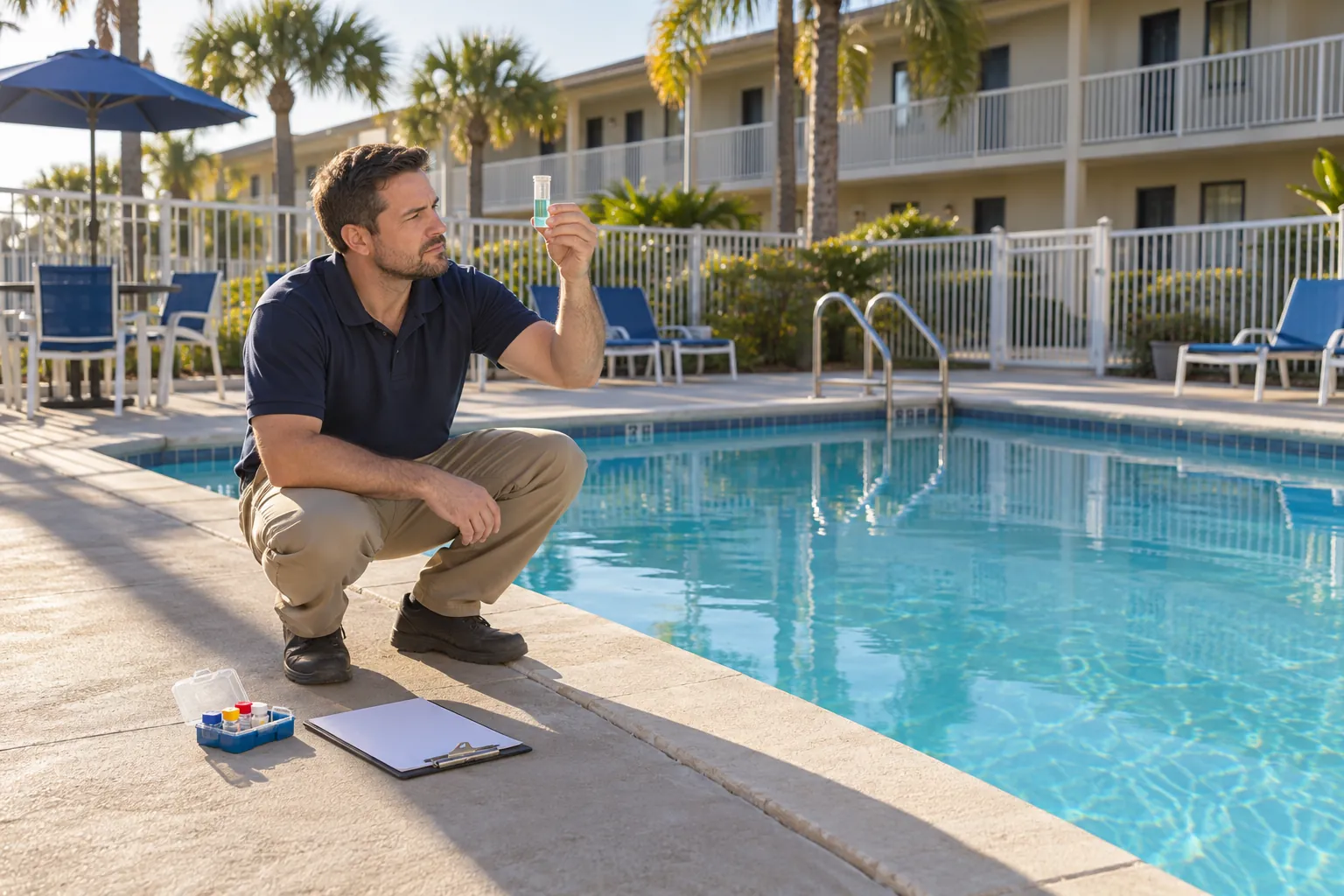
Hotels, apartment communities, HOAs, fitness centers, schools and parks all keep one, and it is usually the first thing a health inspector asks to see. This guide covers what goes on the sheet, how often to test, who signs it, what the CDC's Model Aquatic Health Code and state pool rules in Florida and Texas say, and why so many logs do not stand up.
01
What a pool log sheet is, and whose rule asks for one
A pool log sheet, also called a pool chemical log or water testing log, records the chemistry of a pool or spa at set times through the day, and what was done about it: at least the date, time, pool, free chlorine or bromine, pH and the initials of the person who tested.
There is no federal pool log rule. Public pools are regulated by state health departments, often through county or city health departments, each with its own pool code, permit and inspections. "Public" is usually broad: pools at hotels, apartment complexes, condominiums, HOAs, clubs, gyms and schools, not just municipal pools.
The national reference point is the CDC's 2024 Model Aquatic Health Code (5th edition), or MAHC. In the CDC's words on its About the Model Aquatic Health Code page, "The MAHC is not a federal law. The MAHC is a CDC guidance document and only becomes law if voluntarily adopted by a local, state, territorial, or tribal jurisdiction." Where it applies, the MAHC requires aquatic facility records to be "kept for a minimum of 3 years" and "available upon request by the AHJ" (section 6.4.1.2.1), the AHJ being the authority having jurisdiction, usually the health department.
Some states spell the log out in their own rules:
- Florida. Chapter 64E-9, Florida Administrative Code, rule 64E-9.004(11) (amended June 11, 2023), makes "the keeping of a daily record of information regarding pool operation" the responsibility of the pool owner or operator, on the state's form DH 921, Monthly Swimming Pool Report, or a customized form that contains the appropriate information. The record "shall reflect manually conducted pool water tests for pH and disinfectant levels at least once every 24 hours," and must be "retained at the pool and made available to the department upon request."
- Texas. 25 TAC Chapter 265, Subchapter L, Public Swimming Pools and Spas, section 265.193(l), requires that "a record of all pool and spa water chemical testing must be recorded in a pool or spa log, either electronically or manually in a logbook," kept for a minimum of three years and provided to DSHS or the local regulatory authority within five business days if the log is kept off site.
Other states and counties set their own frequencies, forms and retention periods, so the first job is to read the pool code that applies to your building.
02
What goes on a pool log sheet
The MAHC's list of "Daily Water Monitoring and Testing Records" (section 6.4.1.6) is the fullest starting point: 17 items, from pH, disinfectant and combined chlorine to filter pressures, backwash times, equipment failures and daily attendance. Texas section 265.193(l) adds the corrective side: each entry records "any action taken to correct chemical readings," including chemicals added, re-tests, closures and fecal incidents. Together they give these columns:
- Date, time and pool: one line per test, naming the pool, spa or splash pad when there is more than one.
- Free chlorine (or total bromine), tested by the DPD method, and total chlorine so that combined chlorine can be worked out.
- pH.
- Controller readings: the ORP in millivolts and the controller's pH, recorded at the same time as the manual test so the two can be compared.
- Water temperature (heated pools and spas) and clarity.
- Flow and filter: flow or filter pressures, and backwash times.
- Weekly and monthly tests: alkalinity, calcium hardness, cyanuric acid (CYA), saturation index.
- Chemicals added, action taken and re-test for any reading out of range.
- Closures and reopening, with times and reasons.
- Initials of the person who tested, and the operator's review.
Florida's form DH 921 is a monthly grid of this kind. Whatever the format, every blank should mean something: a pool closed that day is written as closed, not left empty.
03
How often to test, and the ranges to test against
Frequency depends on the jurisdiction, the pool and whether chemicals are fed automatically:
- MAHC 2024 (section 5.7.5): free chlorine (or total bromine) and pH "shall be tested at all aquatic venues prior to opening each day." With a manual feed system and no automated controller, they are tested before opening and "every 2 hours while open to the public"; with an automated feed system, before opening and "every 4 hours while open to the public." Alkalinity is tested weekly; calcium hardness, CYA and the saturation index monthly.
- Texas (section 265.193(o)): at Class A and B pools, including those open to the general public, disinfectant and pH every two hours while open, or three times a day with an automatic controller. At Class C pools, such as hotels, apartments and condominiums, three times a day where on-site staff such as lifeguards run the pool (once a day with an automatic controller), otherwise at least once a day; where an electronic controller sends the readings to the certified operator daily, a test-kit reading once a week, logged beside the controller's reading.
- Florida (rule 64E-9.004(11)): manual tests for pH and disinfectant at least once every 24 hours, and weekly CYA where chlorinated isocyanurates are used. Rule 64E-9.004(1)(d)3 adds that an ORP controller "does not negate the manual daily testing requirement."
- CDC operating guidance: the CDC's Operating and Managing Public Pools, Hot Tubs and Splash Pads page advises testing pH and disinfectant "at least twice per day (hourly when in heavy use)" at pools and hot tubs.
Follow the rule that applies to your pool, and test more often when bather loads are heavy, after a storm or event, and whenever the water looks or smells wrong.
Each reading means something only against its range. Ranges vary by state, and the product label sets the upper limit for a registered disinfectant. The MAHC's figures are a sound reference:
- Free chlorine, minimum: 1.0 ppm in pools not using CYA, 2.0 ppm in pools using CYA, and 3.0 ppm in spas (section 5.7.3.1.1.2).
- Bromine, minimum: 3.0 ppm in pools and 4.0 ppm in spas, with a maximum of 8.0 ppm while bathers are present (section 5.7.3.1.2).
- pH: "maintained at 7.0 - 7.8" (section 5.7.3.4.1).
- CYA: at or below 90 ppm (section 5.7.3.1.3.2).
Florida sets free chlorine at 1 to 10 mg/L in conventional pools (5 mg/L maximum indoors) and 2 to 5 mg/L in spa-type pools; Texas sets its ranges in section 265.193(c) and caps CYA at 100 ppm. Print your ranges at the head of the log sheet, so the person testing sees at once whether a reading needs action.
04
Who tests, who signs, and what happens when a reading is out
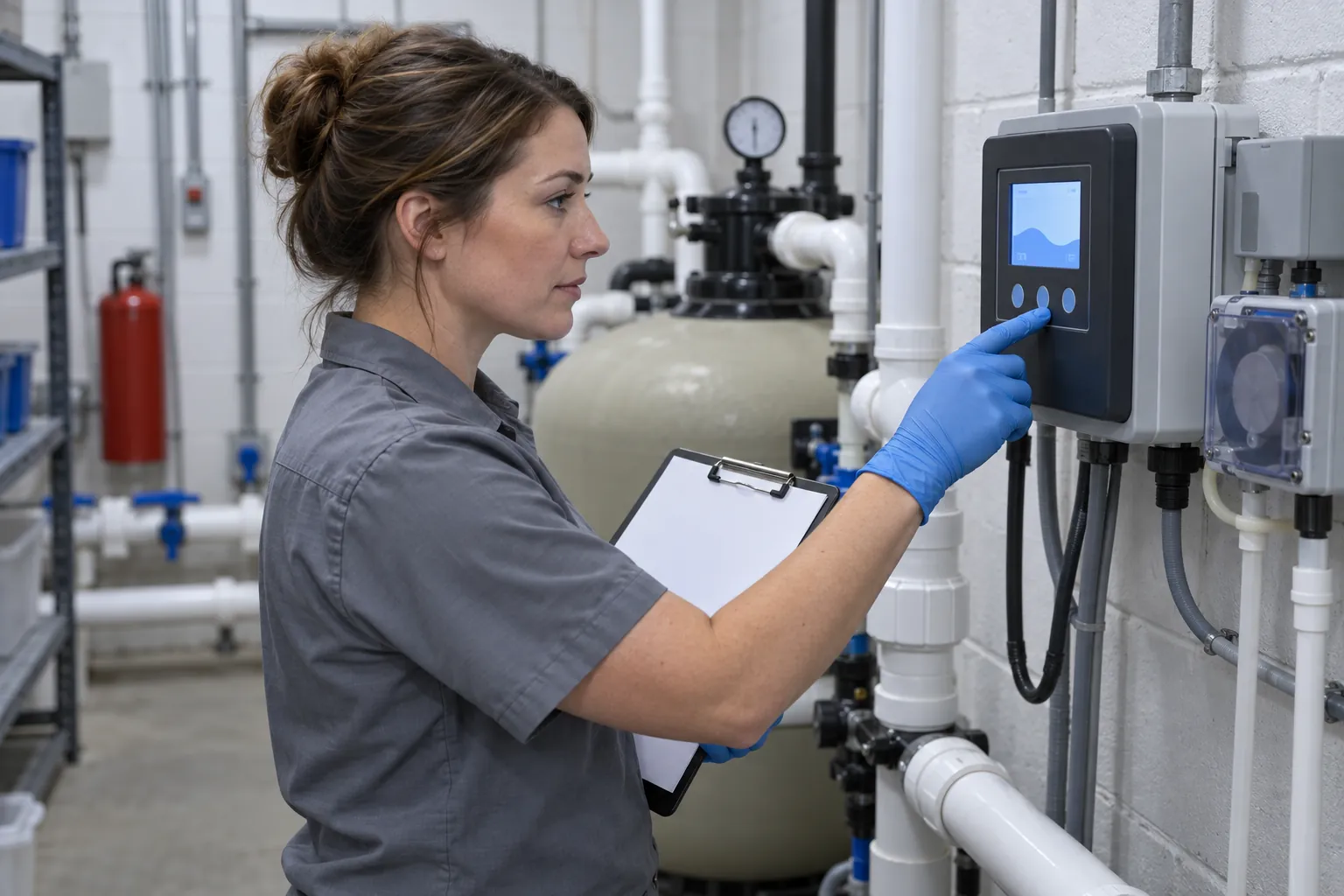
Most codes separate the certified operator, responsible for the pool, from the staff who test day to day. Texas section 265.194(b) requires every pool and spa to be "maintained under the supervision and direction of a properly trained and certified operator," who "is not required to be on-site when the pool or spa is open." Florida says "any able person can test the pool water and record it in the report." So a front desk agent, a leasing office team member, a lifeguard or a maintenance technician may take the readings while a certified operator, often a pool service company, sets the chemistry and reviews the log. Whoever tests needs training on the kit, the ranges, and whom to call when a reading is out.
Three things make a reading trustworthy:
- The right test. The MAHC, Florida and Texas all specify the DPD method for free chlorine.
- In-date reagents. The MAHC's chemical inventory log records "the expiration date for water quality chemical testing reagents" (section 6.4.1.5.1).
- A manual test, not just the controller. The MAHC says operator-based remote monitoring "shall not be a substitute for manual water quality testing," and Florida and Texas require manual tests alongside a controller.
A reading out of range needs the action taken and a re-test, not just the number. Some readings mean closing. The MAHC's imminent health hazards (section 6.6.3.1), for which the AHJ may order immediate closure, include disinfectant below the minimum, free chlorine above 10 ppm while bathers are present, pH below 6.5 or above 8.0, and a pool bottom that cannot be seen. Your state's list may differ; write it at the top of the sheet.
The certified operator or facility manager should read the log weekly, look for patterns (a pH that drifts every afternoon, a gap every Sunday) and sign it.
05
The other pool records that sit beside the log
The chemistry log is one of several records an inspector may ask for. Under the MAHC, and similar state codes, a pool also keeps:
- A daily pre-opening inspection (section 6.4.1.3.1): 21 items, among them drain and suction outlet covers secure and unbroken, safety equipment in place, controllers operating, chemical storage locked, and gates self-latching.
- A chemical inventory log (section 6.4.1.5), with reagent expiration dates.
- A body fluid contamination response log (section 6.4.1.8): each fecal, vomit or blood incident, with the closure, chlorine and pH at the time and at reopening. The CDC's Responding to Pool Contamination pages set out the cleanup.
- Incident reports and lifeguard rescue records (section 6.4.1.4), and staff certifications (section 6.4.1.7).
Pool chemicals are also a workplace hazard. OSHA's Hazard Communication Standard, 29 CFR 1910.1200, requires safety data sheets "readily accessible during each work shift to employees when they are in their work area(s)," and training on the hazards (in a state plan state, the state's rule applies). The CDC's Pool Chemical Safety page adds that only trained staff should handle pool chemicals and that the storage area and pump room should be secured.
06
Where the record fails, and what SiteClara does about it
Pool logs fail in familiar ways. A column of identical readings at the same times every day, in the same pen, written up at the end of a shift or the end of the week. A reading written as a number when the test was never done, because the front desk was busy and the reagent bottle was empty. The pre-opening checklist initialed for the week on Monday. A low chlorine reading logged with no action and no re-test. A broken gate latch or a cracked drain cover mentioned to whoever was passing and never written down, so the pool service company and the property manager never hear of it. At a weekend or after hours, nobody can say whether the pool was tested at all.
SiteClara records the checks at the location. A printed QR poster, with an optional NFC tag behind it, sits at each place a check is scheduled, such as the pool equipment room door, the pool gate or the spa. Staff scan the code or tap the tag on their own phone, with no app to install, see the checks due there, and mark each one done or say what stopped them, such as a locked pump room or a test kit out of reagent. The time and the named person are recorded as it happens, with a photo when one is asked for, for example of the test kit's color comparator or the controller display. A problem, such as a gate that does not self-latch or a missing drain cover, is reported there with a photo and goes onto the team's list of jobs until someone closes it.
The supervisor sees what is due, done and missed, and can record the reason a check was missed. A job that needs the building manager can be escalated to them to answer. Each day the supervisor reviews and approves a report that goes to nominated management or client contacts at 8 a.m. the next morning, showing what was reported, completed and still open, and how the scheduled checks went, for example 5 of 6 pool rounds completed.
07
Further reading, and a list to take away
Start with the pool code that applies to your building, from your state health department or the county or city environmental health office that issues the pool permit, and check which edition it adopts and whether it uses the MAHC. The CDC's 2024 Model Aquatic Health Code is free, and sections 5.7 (water quality) and 6.4 (records) are the parts a pool log is built on. The CDC's Operating and Managing Public Pools, Hot Tubs and Splash Pads, Pool Chemical Safety and Responding to Pool Contamination pages are short and practical. For worked examples of state rules, read Florida's rule 64E-9.004 and Texas's 25 TAC Chapter 265, Subchapter L.
Before the pool opens for the season, check that:
- you know which state or local pool code applies, and what testing frequency and records it requires;
- the log sheet has a column for every reading your code asks for, with the target ranges printed at the top;
- the test kit uses the DPD method for chlorine or bromine, and every reagent is in date;
- free chlorine or bromine and pH are tested before opening every day, and through the day as often as your code requires;
- controller and ORP readings are logged beside the manual test, never instead of it;
- every out-of-range reading has an action and a re-test recorded, and staff know when the pool must close;
- the daily pre-opening inspection, chemical inventory and body fluid contamination logs are kept alongside the chemistry log;
- SDSs and PPE are near the chemical storage room, which is locked, and staff who handle chemicals are trained;
- each entry is initialed by the person who tested, and the certified operator's name and contact are known to the staff on site;
- someone reviews and signs the log every week, and records are kept at least as long as your code requires (three years under the MAHC and in Texas).
Sources
Every document this guide quotes or links to, in the order it first cites them.
- 2024 Model Aquatic Health Code (5th edition) cdc.gov
- About the Model Aquatic Health Code cdc.gov
- Rule 64E-9.004(11) flrules.org
- 25 TAC Chapter 265, Subchapter L, Public Swimming Pools and Spas dshs.texas.gov
- Operating and Managing Public Pools, Hot Tubs and Splash Pads cdc.gov
- Responding to Pool Contamination cdc.gov
- Hazard Communication Standard, 29 CFR 1910.1200 osha.gov
- Pool Chemical Safety cdc.gov
Related guides
 Premises and facilities managementBoiler log: what to record, how often, and what the state expectsWhat a boiler log should record, how often to take readings and test the low-water cutoff, what state boiler rules and ASME CSD-1 expect, and where logs fail.
 Premises and facilities managementBuilding engineer duties: what the job covers, and how to show it is doneBuilding engineer duties in a commercial building: running the plant, rounds and logs, lockout, refrigerant and boiler rules, vendors, and a record that holds up.
 Fire and water checksLegionella water management program: the plan, the routine checks, and the record that proves themWhat a Legionella water management program covers under ASHRAE 188 and the CDC toolkit: control limits, routine monitoring, corrective action and the record.
 CleaningNorovirus cleanup: how to deal with vomit and diarrhea without spreading the virusHow to clean up vomit and diarrhea so norovirus does not spread: the CDC steps, bleach strength, EPA List G, the Food Code plan, OSHA duties and the record.