Premises and facilities management
PTAC maintenance: what to clean, how often, and what to record for each unit
PTAC maintenance is the routine cleaning and inspection of each packaged terminal air conditioner or heat pump in a building: the return air filters, usually cleaned monthly, then the condenser and evaporator coils, the base pan that catches condensate, the drain path and the wall sleeve, usually inspected every few months and cleaned once or twice a year, at the intervals the manufacturer's manual sets for the model.
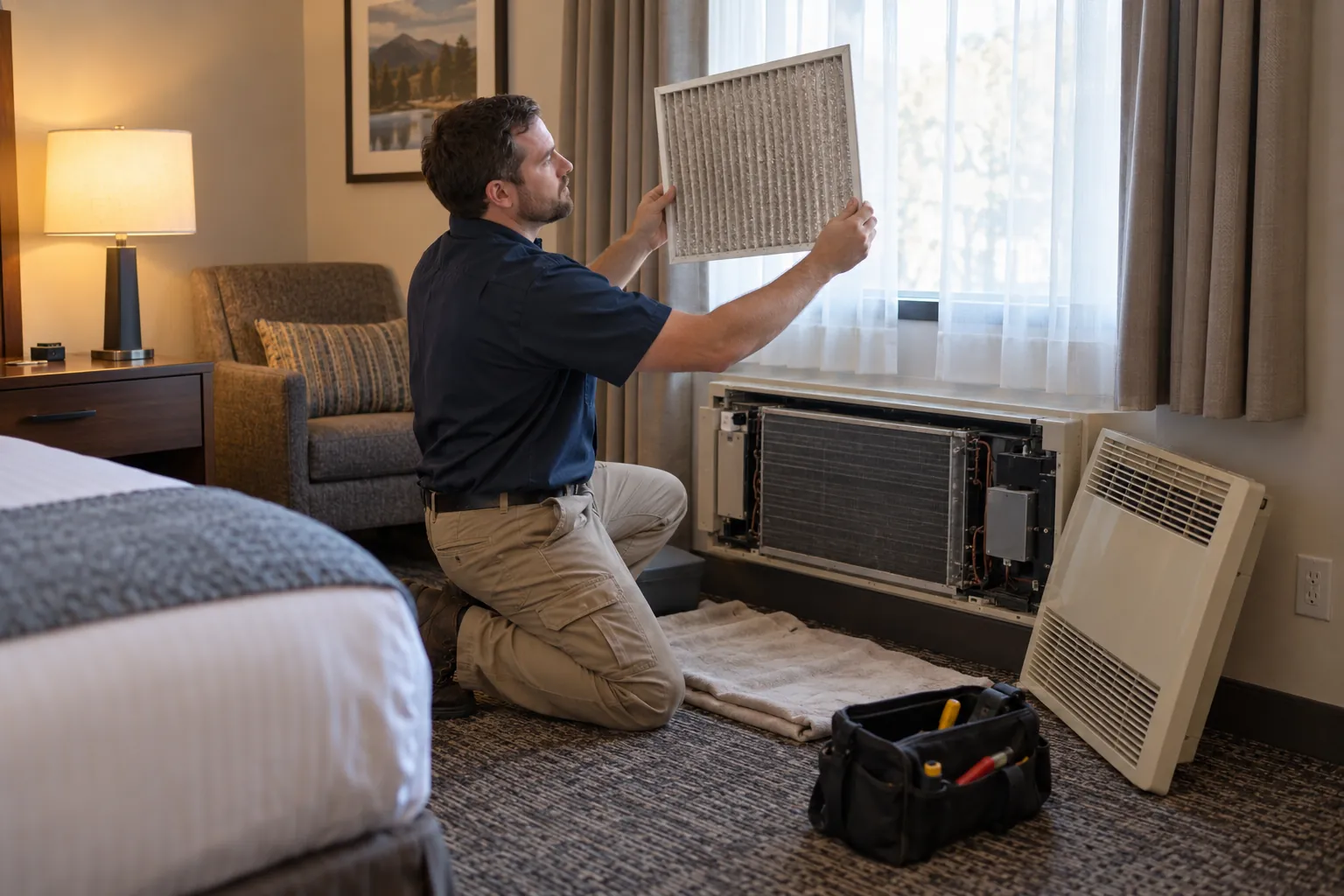
In a hotel, an apartment building, a senior living community or a residence hall there may be hundreds of these through-the-wall units, and the work is done room by room around guests and residents. This guide covers which rules reach the work, what a preventive maintenance round covers, a sample schedule, who may do which task, and what the record for each unit should show.
01
What a PTAC is, and which rules stand behind its maintenance
A PTAC is a packaged terminal air conditioner, the self-contained unit under the window of a hotel room, apartment or resident room. Federal efficiency rules define it in 10 CFR 431.92 as "a wall sleeve and a separate un-encased combination of heating and cooling assemblies specified by the builder and intended for mounting through the wall". A PTHP, a packaged terminal heat pump, is the same unit using "reverse cycle refrigeration as its prime heat source", with a supplementary heat source behind it.
No federal rule says how often to clean a PTAC. The standards you will see named do different jobs:
- AHRI 310/380 is a rating standard, not a maintenance standard. The Department of Energy's test procedure at 10 CFR 431.96 applies AHRI 310/380-2014 to test a new unit's efficiency. The DOE's PTAC and PTHP standards page says manufacturers have had to meet federal efficiency standards "since 1994". None of it tells you how to keep a unit performing.
- ANSI/ASHRAE/ACCA Standard 180-2018, Standard Practice for Inspection and Maintenance of Commercial Building HVAC Systems is the industry's minimum practice. ASHRAE says it "establishes minimum HVAC inspection and maintenance requirements" for commercial buildings. It is voluntary until a code, lease, contract or owner's policy makes it binding.
- The manufacturer's installation, operation and maintenance manual for each model sets the intervals, the filter type, what may be washed and how the chassis comes out of the sleeve. The Department of Energy's FEMP O&M Best Practices Guide, Release 3.0, chapter 9 takes the same line: "As a rule, this guide will first defer to the manufacturer's recommendations on equipment operations and maintenance."
Some rules are law, and they reach the people doing the work rather than the schedule: the EPA's refrigerant rules, which treat most PTACs as small appliances; OSHA's lockout/tagout exception for plug-in equipment; and, in some buildings, a health care or housing rule on the temperature the unit must hold. Each is covered below.
02
What PTAC maintenance covers, part by part
Start from the units actually installed: every room, the PTAC unit in it by asset tag or serial number, the model, and whether it is a PTAC or a heat pump. Mixed fleets are common after years of piecemeal replacement, and two models side by side may want different filters. A preventive maintenance (PM) visit to one unit usually covers:
- The front cover and grille: wiped down, clips intact, nothing such as a bed or curtain blocking the airflow.
- Return air filters: cleaned with a vacuum or washed and dried, or replaced if disposable, and checked for tears and fit. A clogged filter restricts airflow and lets dirt through onto the coil.
- The fresh air vent door and screen, where fitted: clean and set as the property wants.
- The indoor coil (the evaporator): clean fins, no matted lint or dust on the face.
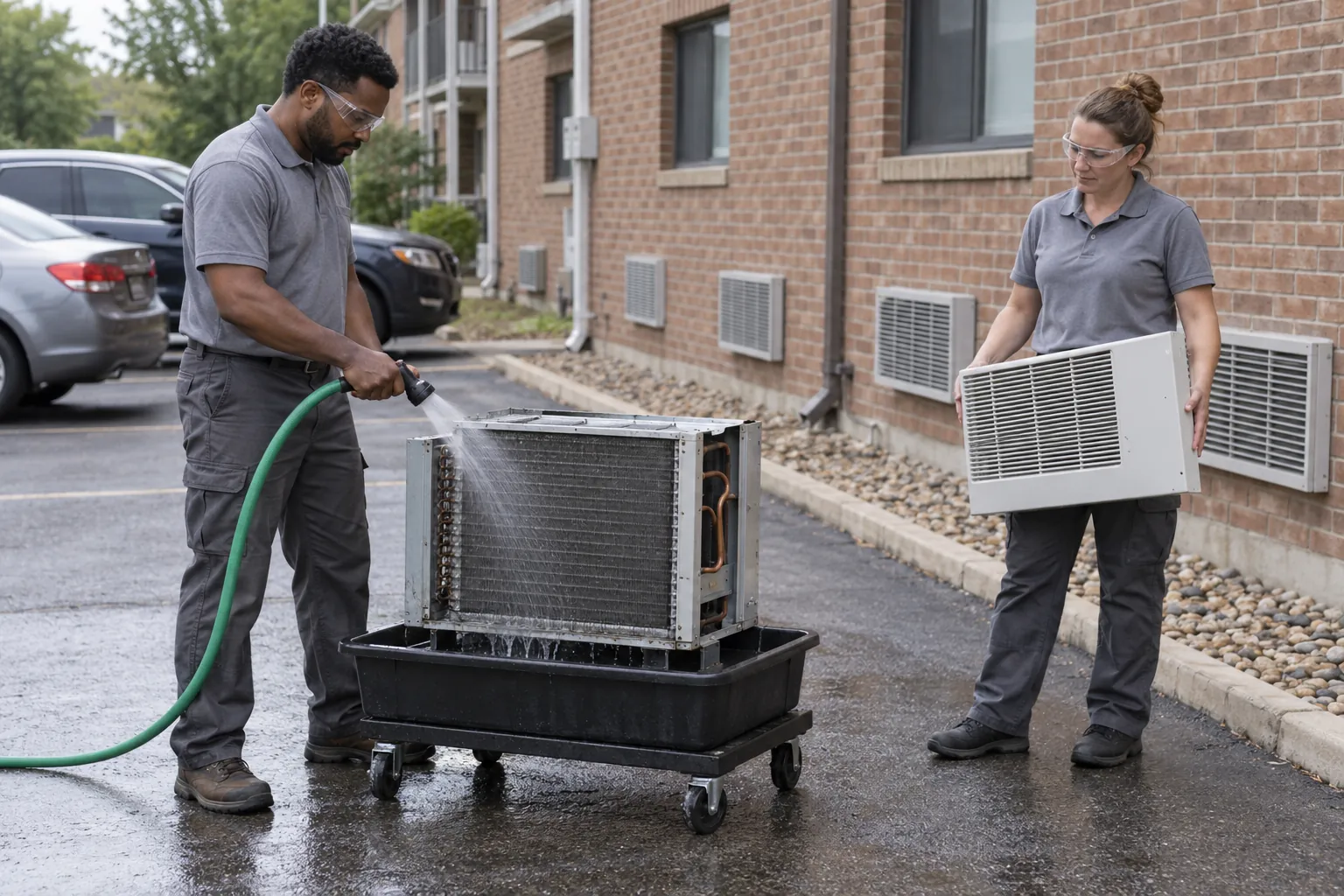
- The outdoor coil (the condenser) and louver: clear of lint, leaves, nesting material and grime.
- The base pan (the unit's drain pan) and drain line: no sludge, slime or standing water, with condensate leaving where it should, not into the wall or down the face of the building.
- Fans and motors: the blower wheel and outdoor fan clean and running quietly.
- The wall sleeve: sealed and sloped as the manual specifies, with no water damage around it inside the room.
- The power cord, plug and receptacle: undamaged, not crushed behind furniture, and any test and reset device on the cord tested as the manual says.
- Controls: the unit cools and heats, and any wall thermostat, occupancy sensor or setpoint limit works; any fault code the control board shows is written down.
Two signs take a unit out of its routine. Water where it should not be, in the carpet or down the outside wall, means a drain or sleeve problem. A musty smell at start-up means something is growing in the pan or on the coil. The EPA's Mold Remediation in Schools and Commercial Buildings Guide, chapter 2, says: "Keep heating, ventilation and air conditioning (HVAC) drip pans clean, flowing properly and unobstructed," and "Maintain low indoor humidity, below 60% relative humidity (RH), ideally 30-50%, if possible."
03
A sample PTAC maintenance schedule
Take each interval from the manual, then adjust it for the room: a beachfront hotel, a room with a pet, or a senior living apartment where the unit runs all year needs shorter intervals than a quiet office suite. The FEMP guide puts filter intervals "between 1 and 6 months, depending on the dirt loading from indoor and outdoor air", and, for the hot water and chilled water coils it discusses, says each facility "should develop appropriate cleaning schedules" from its own periodic inspections; the same logic applies to a PTAC's coils. For one manufacturer's units, GE Appliances' How to Properly Clean and Maintain Zoneline Air Conditioners says filters "should be checked weekly and cleaned monthly" and indoor coils "should be checked every 6 months for build-up of lint/debris". A pattern that suits many hotels and apartment buildings:
- At every checkout or room inspection, by the room attendant or inspector: the unit runs, blowing cold air on cooling and warm air on heating, and the room reaches temperature; no noise, smell, water or ice; nothing blocks the unit; controls back at the property's default; anything wrong reported as a work order.
- Monthly, by maintenance: clean or replace the filters, check the vent screen, look at the coil face and base pan through the filter opening.
- Quarterly, or at each change of season: test cooling before the cooling season and heating before the heating season on every unit, so faults turn up in empty rooms rather than for a guest at night; look at the coils, condenser and evaporator, and the base pan for lint, debris and slime; clear the drain and check the sleeve; pull the chassis and clean it now where the manual or the room's conditions call for it.
- Once or twice a year: pull every chassis and clean the coils, the blower wheel, the fan and the base pan, more often near the coast or building work; inspect the cord, plug, receptacle and electric heat kit; list units that keep failing for replacement; review the schedule against the year's work orders.
Occupied rooms are the usual gap in a room-by-room PM. Plan the round with the front desk or the leasing office, record a room that could not be entered as skipped with the reason, and carry it to the next available day rather than next quarter. In a hotel, a unit pulled for cleaning or repair puts the room out of order; the record should show when it came back.
04
Who does each task, and what the law says
Room attendants and inspectors notice and report; they do not open the unit. Maintenance technicians clean filters, coils, pans and drains, pull chassis and swap failed units from spares. The chief engineer or maintenance supervisor owns the unit list, the schedule and the record, and decides when a unit is replaced rather than repaired. An EPA-certified technician, in house or from a contractor, does any work that opens the refrigerant circuit.
The refrigerant circuit. Under the EPA's Section 608 rules, 40 CFR 82.152 defines a small appliance as one "fully manufactured, charged, and hermetically sealed in a factory with five (5) pounds or less of refrigerant", including "room air conditioners (including window air conditioners, portable air conditioners, and packaged terminal air heat pumps)". The EPA's Section 608 technician certification requirements list certification "For servicing small appliances (Type I)". Cleaning filters and coils does not open the circuit; adding refrigerant or replacing a compressor does. The leak repair rules, 40 CFR 82.157 (50 pounds or more of an ozone-depleting refrigerant) and 40 CFR 84.106 (15 pounds or more of an HFC, excluding the "residential and light commercial air conditioning and heat pump subsector"), start well above a single PTAC's charge.
Disposal. Under 40 CFR 82.155, the final processor of a small appliance, such as a scrap recycler, must recover the remaining refrigerant or verify "using a signed statement or a contract" that it was recovered, naming who recovered it and when. Keep a copy with the unit's record.
Electrical safety. OSHA's lockout/tagout standard, 29 CFR 1910.147, does not cover cord and plug equipment where the hazard "is controlled by the unplugging of the equipment from the energy source and by the plug being under the exclusive control of the employee performing the servicing or maintenance." For most PTACs that means: unplug it and keep the plug where only you control it. A hard-wired unit needs the full procedure. In states with an OSHA-approved state plan, the state's rule applies. Coil cleaners are chemicals too; see the hazard communication program guide.
Nursing homes. For a facility certified by Medicare or Medicaid, 42 CFR 483.90(d)(2) requires it to "Maintain all mechanical, electrical, and patient care equipment in safe operating condition", and 42 CFR 483.10(i)(6) says "Facilities initially certified after October 1, 1990 must maintain a temperature range of 71 to 81 °F". Assisted living is regulated by each state.
Apartments. Where the owner supplies heat through PTHPs or PTACs with electric heat, local housing law may set the temperature. In New York City, the HPD heat and hot water information page says heat must be provided "between October 1st and May 31st": at least 68°F inside from 6 a.m. to 10 p.m. when it is below 55°F outside, and at least 62°F overnight.
05
What the record for each unit should show
Keep records per PTAC unit, not per round. For any one room you should be able to say when its unit was last cleaned, by whom, what was found and what happened next. Each visit should record:
- the room and the unit's asset tag or serial number;
- the date and the name of the person who did the work;
- the tasks done: filters, coils, pan, drain, sleeve, heat and cool tested;
- what was found, such as a clogged drain or a damaged cord, and the work order raised for it;
- rooms skipped, with the reason and the date they were caught up;
- for refrigerant work, the certified technician, and for a disposed unit, the recovery statement.
Keep the history for the unit's life. The Department of Energy's 2023 final determination on PTAC and PTHP standards (88 FR 9136) assumed an average lifetime of eight years, with "a range of lifetimes up to 16 years". A record showing which rooms keep calling for service is what lets the chief engineer plan replacements instead of replacing on failure in July.
A PTAC record you can trust has entries made on the day, room by room, in the order of the rooms on the floor; a reason against every skipped room and a later entry showing it was done; faults turned into work orders that were closed; and a count of rooms done against rooms due that adds up for each floor.
06
Where the record fails, and what SiteClara does about it
PTAC PM fails in a familiar way. The quarter's round is marked complete when the technician got through two floors of five, because occupied rooms were skipped and never revisited. Filters are "cleaned" on a sheet filled in at the end of the week. A room attendant notices water under the unit in room 412, mentions it to whoever is at the desk, and nobody hears of it again until the carpet smells.
SiteClara records those routine checks where they happen. A printed QR poster, with an optional NFC tag behind it, sits at each place a check is scheduled, such as a guest room, an apartment or a floor's service closet. Staff scan the code or tap the tag on their own phone, with no app to install, see the checks due there, and mark each one done or say what stopped them, such as a guest in the room. The time and the named person are recorded as it happens, with a photo when one is asked for, such as a clean base pan. A problem, such as water under a unit, is reported there with a photo and goes onto the team's list of jobs until someone closes it.
The supervisor sees what is due, done and missed, and can record the reason a check was missed. Each day the supervisor reviews and approves a report that goes to nominated management or client contacts at 8 a.m. the next morning, showing what was reported, completed and still open, and how the scheduled checks went, for example 46 of 48 rooms checked.
07
Questions people ask
How often should PTAC units be cleaned?
As often as the manufacturer's manual for the model says, adjusted for how dirty the air is. The Department of Energy's FEMP O&M Best Practices Guide, chapter 9 puts filter intervals "between 1 and 6 months, depending on the dirt loading from indoor and outdoor air", and, for the hot water and chilled water coils of air handling systems, says each facility "should develop appropriate cleaning schedules" from its own periodic inspections. For one manufacturer's units, GE Appliances' How to Properly Clean and Maintain Zoneline Air Conditioners says filters "should be checked weekly and cleaned monthly" and indoor coils "should be checked every 6 months for build-up of lint/debris". Many hotels and apartment buildings clean PTAC filters monthly and the coils once or twice a year.
What would the symptoms of a dirty coil be?
A unit with dirty condenser or evaporator coils gives less heating or cooling for the same running time, and rooms are more often reported too warm or too cold. The FEMP O&M Best Practices Guide, chapter 9, writing about the hot water and chilled water coils of air handling systems, says that as dirt and debris build up, "it inhibits the heat transferred from the working fluid to the air stream, thus reducing the efficiency of the HVAC system", and that dirty filters can let air bypass them and deposit dirt on the heating and cooling coils, giving "dirty coils, poor heat transfer, and general inefficiency". A PTAC's coils lose heat transfer to dirt in the same way.
What is the life expectancy of a PTAC?
The Department of Energy assumes an average PTAC or PTHP lifetime of eight years, within a range up to 16 years, in its 2023 final determination on PTAC and PTHP energy conservation standards. How long a particular unit lasts depends on its use, its location and its maintenance.
Do PTAC units cause mold?
A PTAC that is kept clean and drains properly should not, but a blocked base pan or drain, standing water, or a leak into the wall or carpet gives mold the moisture it needs. The EPA's Mold Remediation in Schools and Commercial Buildings Guide, chapter 2, says to "Keep heating, ventilation and air conditioning (HVAC) drip pans clean, flowing properly and unobstructed", to keep indoor humidity "below 60% relative humidity (RH), ideally 30-50%, if possible", and to "Clean and dry wet or damp spots within 48 hours."
08
Further reading, and a list to take away
Start with the manufacturer's manual for each model, then ASHRAE's page on Standards 180 and 211, chapter 9 of the FEMP O&M Best Practices Guide on filter intervals and coil cleaning in air handling systems, 40 CFR 82.152 for refrigerant work and 29 CFR 1910.147 for lockout/tagout. Before you rely on your PTAC maintenance program, check that:
- every room's unit is listed with its asset tag or serial number, model and type;
- each task has an interval from the manual, adjusted for the room's use, and a named owner;
- cooling and heating are tested on every unit before each season;
- skipped rooms are recorded with a reason and caught up within days, not quarters;
- refrigerant work is done only by a Section 608 certified technician, and disposed units leave with a recovery statement;
- technicians unplug a unit and keep the plug under their control, or lock out a hard-wired one;
- each unit's history is kept for its life, and repeat callers are on the replacement list.
Sources
Every document this guide quotes or links to, in the order it first cites them.
- 10 CFR 431.92 ecfr.gov
- 10 CFR 431.96 ecfr.gov
- PTAC and PTHP standards page energy.gov
- ANSI/ASHRAE/ACCA Standard 180-2018, Standard Practice for Inspection and Maintenance of Commercial Building HVAC Systems ashrae.org
- FEMP O&M Best Practices Guide, Release 3.0, chapter 9 www1.eere.energy.gov
- Mold Remediation in Schools and Commercial Buildings Guide, chapter 2 epa.gov
- How to Properly Clean and Maintain Zoneline Air Conditioners geappliances.com
- 40 CFR 82.152 ecfr.gov
- Section 608 technician certification requirements epa.gov
- 40 CFR 82.157 ecfr.gov
- 40 CFR 84.106 ecfr.gov
- 40 CFR 82.155 ecfr.gov
- Lockout/tagout standard, 29 CFR 1910.147 osha.gov
- 42 CFR 483.90(d)(2) ecfr.gov
- 42 CFR 483.10(i)(6) ecfr.gov
- HPD heat and hot water information nyc.gov
- 2023 final determination on PTAC and PTHP standards (88 FR 9136) govinfo.gov
Related guides
 Premises and facilities managementHotel preventive maintenance checklist: guest rooms, public areas and the systems behind themA hotel preventive maintenance checklist: guest room PM, public areas, pools, life safety and plant, how often, who does it, and what the record should show.
 Premises and facilities managementCommercial HVAC maintenance checklist: what to check, how often, and what to recordA commercial HVAC maintenance checklist by equipment and frequency, rooftop units to chillers, with ASHRAE 180, the EPA refrigerant rules and the records to keep.
 Premises and facilities managementHVAC filter change log: what to record, how often, and who signs itWhat an HVAC filter change log should record, how often to check and change filters, which ASHRAE standards and state rules apply, and where filter logs go wrong.
 Premises and facilities managementThe apartment make-ready checklist: how to turn a unit properly, and prove itAn apartment make-ready checklist room by room: the order of work, the safety items HUD, EPA and state law require, and the photos and sign-off that prove it.