Cleaning
HazCom: the written program, the SDS binder, and the checks that keep them true
HazCom is OSHA's Hazard Communication standard, 29 CFR 1910.1200, which requires every employer with hazardous chemicals in the workplace to keep a written hazard communication program, a safety data sheet for each hazardous chemical, labels on workplace containers, and training for the employees who could be exposed.
Also written for United Kingdom · Australia · South Africa
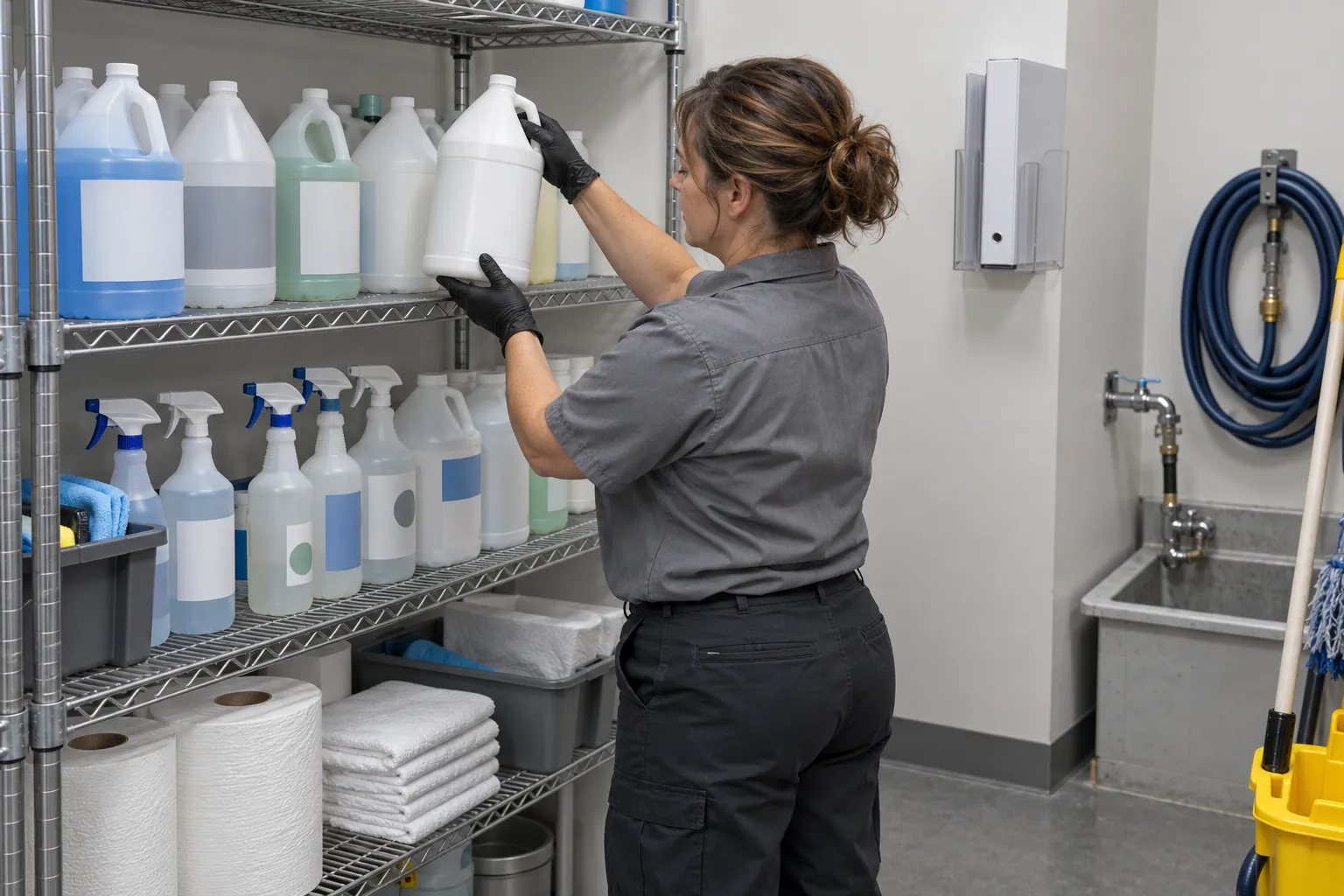
For a janitorial contractor, a school district or a facility team with its own custodians, that means the disinfectant, the restroom cleaner, the floor stripper and the concentrate in the dispenser, in every janitor closet the team works from. This guide covers what the standard requires, what the written program has to say, how to keep an SDS binder current, the labeling rules that catch secondary bottles, training, and the routine checks that show the program is still working.
01
What HazCom is, and the standard behind it
HazCom is the short name for OSHA's Hazard Communication standard, 29 CFR 1910.1200, the Hazard Communication Standard (HCS). Paragraph (b)(1) requires "all employers to provide information to their employees about the hazardous chemicals to which they are exposed, by means of a hazard communication program, labels and other forms of warning, safety data sheets, and information and training." A hazardous chemical is any chemical classified as a physical or health hazard, a simple asphyxiant, combustible dust, or a hazard not otherwise classified. The same paragraph requires chemical manufacturers and importers to classify the hazards of the chemicals they produce or import, and paragraphs (f) and (g) have them pass that information downstream on labels and safety data sheets (SDS). Paragraph (a)(1) says the requirements are intended to be consistent with the United Nations Globally Harmonized System of Classification and Labeling of Chemicals (GHS), primarily Revision 7.
The center of the standard is paragraph (e)(1): "Employers shall develop, implement, and maintain at each workplace, a written hazard communication program which at least describes how the criteria specified in paragraphs (f), (g), and (h) of this section for labels and other forms of warning, safety data sheets, and employee information and training will be met." The program must include a list of hazardous chemicals known to be present, using a product identifier that matches the safety data sheet, and say how employees will be told about the hazards of non-routine tasks. Under paragraph (e)(4) it must be available on request to employees, their representatives and OSHA.
It is one of the standards OSHA cites most: on OSHA's list of the Top 10 most frequently cited standards for fiscal year 2025, Hazard Communication in general industry is second.
02
What a hazard communication program covers in a building
In building services the chemical list is mostly the janitorial shelf, but rarely only that:
- Cleaning and floor care: all-purpose, glass and restroom cleaners, degreasers, floor strippers and finishes, carpet extraction chemicals, and dispenser concentrates.
- Sanitizers and disinfectants: quaternary ammonium products, bleach and hydrogen peroxide products.
- Maintenance chemicals: lubricants, solvents, paints, adhesives, boiler and cooling water treatment, and pool chemicals.
- Fuels, gases and fumes: OSHA's Small Entity Compliance Guide for Employers That Use Hazardous Chemicals (OSHA 3695, 2014) says the standard covers chemicals in all forms, liquids, solids, gases, vapors, fumes and mists, "whether they are 'contained' or not".
The consumer product exemption rarely covers a custodian. Paragraph (b)(6)(ix) exempts a consumer product only where its workplace use results in "a duration and frequency of exposure which is not greater than the range of exposures that could reasonably be experienced by consumers". In a 1991 letter of interpretation on hazard communication and consumer products, OSHA said that if it is the employee's job "to clean sinks all day, or part of the day, with such frequency that is greater than one would be expected to be experienced at home, then the employee is entitled to the hazard communication information". Glass cleaner used now and then at a front desk may be exempt; the same bottle on a custodian's cart is not.
Registered sanitizers and disinfectants are a partial exception. Paragraph (b)(5)(i) says the standard does not require labeling of a pesticide subject to EPA's labeling rules under the Federal Insecticide, Fungicide, and Rodenticide Act, so the product's own container carries its EPA label instead. The exemption is for labeling only: they still go on the chemical list, need a safety data sheet and are covered by training.
Most buildings are multi-employer workplaces. Under paragraph (e)(2), where an employer's chemicals could expose another employer's employees, its program must say how it will give them on-site access to safety data sheets and tell them about precautions and the labeling system in use. A janitorial contractor brings its chemicals into a client's building, the building engineers keep boiler chemicals where custodians clean, and a flooring contractor arrives for a weekend: each program should say who exchanges that information, and how.
03
Writing the hazard communication program
OSHA's Small Entity Compliance Guide says the written program "does not need to be lengthy or complicated" and sets out six steps to an effective hazard communication program:
- Learn the standard and identify responsible staff, with one person coordinating.
- Prepare a written program, with a list or inventory of every hazardous chemical in the workplace, compiled by surveying the workplace and checking purchasing records.
- Ensure containers are labeled.
- Maintain safety data sheets and make sure they are readily accessible.
- Inform and train employees before initial assignment and when new hazards arrive.
- Evaluate and reassess the program periodically, and revise it for new chemicals and new hazards.
A generic HazCom program template is a starting point, not a program. The guide says "the written plan must list the chemicals present at the site, indicate who is to be responsible for the various aspects of the program in your facility, and indicate where written materials will be made available to workers", and that an OSHA compliance officer "will ask to see your written plan." Its sample program in Appendix A dates from 2014, before the 2024 update, so read it alongside the current standard.
For a janitorial company the program usually belongs to the employer, with a section for each building. Paragraph (e)(5) lets the written program be kept at the primary workplace where employees travel between sites during a shift. The guide suggests that larger workplaces may compile lists "by work area", which in a building usually means one list per janitor closet or chemical storage room.
At a minimum, a building's hazard communication plan should cover these elements: who coordinates it; which chemicals are present, closet by closet; how a new product is approved and its SDS obtained before first use; how secondary containers are labeled; where the SDSs are and how night staff reach them; how training is done; how contractors and the client exchange information; how non-routine tasks, such as stripping a gym floor or clearing a spill, are briefed; and when it was last reviewed.
04
The SDS binder and workplace labels
Under paragraph (g)(8), employers must keep a safety data sheet for each hazardous chemical and "ensure that they are readily accessible during each work shift to employees when they are in their work area(s)." Electronic access is allowed if it creates no barriers to immediate access. OSHA's brief Hazard Communication Standard: Safety Data Sheets (OSHA 3514) says employers may keep SDSs "in a binder or on computers as long as the employees have immediate access to the information without leaving their work area when needed and a back-up is available for rapid access to the SDS in the case of a power outage or other emergency." That is why the SDS binder survives in janitorial work: it needs no password, signal or charged phone in a basement closet at night.
A safety data sheet follows a standard format of 16 sections in a fixed order. OSHA 3514 says sections 12 to 15 must be included for consistency with the Globally Harmonized System, but "OSHA will not enforce the content of these sections because they concern matters handled by other agencies." Section 2 (hazards), 4 (first aid), 7 (handling and storage, including precautions for safe handling) and 8 (exposure controls and personal protection) are the ones a custodian needs fastest.
Keeping the binder current is the hard part. The compliance guide says employers "must maintain the current version of the SDS", that employers should set up purchasing procedures so that the SDS arrives before a product is first used, and that "If you cannot show a good faith effort to receive the SDS, you can be cited for not having the SDS for a hazardous chemical", so keep a note of every request to a supplier. When a product is retired, 29 CFR 1910.1020 treats SDSs as exposure records: they need not be kept for a set period as long as some record of the substance, where it was used and when is kept for at least 30 years.
Labels are the other half. OSHA's Hazard Communication Standard Labels QuickCard (OSHA 3492) says shipped labels must have "pictograms, a signal word, hazard and precautionary statements, the product identifier, and supplier identification". In the workplace:
- Every workplace container needs, under paragraph (f)(6), either the full shipped label or the "Product identifier and words, pictures, symbols, or combination thereof, which provide at least general information regarding the hazards of the chemicals". A spray bottle filled from a dispenser needs one.
- The immediate-use exemption is narrow. Paragraph (f)(8) excuses only portable containers "intended only for the immediate use of the employee who performs the transfer." A bottle filled at the start of a shift and left on the cart for the next person is not covered.
- Labels stay on. Paragraph (f)(9) forbids removing or defacing labels on incoming containers unless the container is immediately marked with the required information.
- English, legible and visible. Paragraph (f)(10) requires workplace labels or other forms of warning to be "legible, in English, and prominently displayed on the container, or readily available in the work area throughout each work shift"; other languages may be added alongside English.

05
Training, and the checks that keep the program working
The hazard communication training requirements start at paragraph (h)(1), which requires training on the hazardous chemicals in an employee's work area "at the time of their initial assignment, and whenever a new chemical hazard the employees have not previously been trained about is introduced". Under (h)(3) it covers how to detect a release, the hazards, how to protect themselves (work practices, emergency procedures and personal protective equipment) and the employer's program, including labels and how to use an SDS. The OSHA-NIOSH InfoSheet Protecting Workers Who Use Cleaning Chemicals (OSHA 3512) says it "must be provided BEFORE the worker begins using the cleaner", "in a language and vocabulary that they can understand." The federal standard does not require a training record, but without one an employer has little to show an inspector.
The compliance guide says program coordinators "should routinely walk around the workplace to check that containers are labeled as required and that workers are following established work practices". The standard sets no frequency, so the program should. A workable pattern:
- Every shift, on the cart: every bottle labeled, nothing in an unmarked or food container, no bottle topped up with a different product.
- Weekly, at each janitor closet: the SDS binder matches the shelf, incoming labels are intact, incompatible products such as bleach and ammonia-based cleaners are kept apart, and spill supplies and any required eyewash are in place.
- When a product arrives: it is approved, its SDS is in the binder before first use, and the crew is trained on any new hazard.
- Quarterly: reconcile the chemical list against purchasing and the shelves, archive retired SDSs, and test the electronic back-up from a closet.
- Yearly: review the written program, the contractor information exchange and training, including the 2024 changes.
Good evidence is the date, the closet, who checked, what was found and what was done. A photograph of an unlabeled bottle or a missing binder says more than a checkmark.
06
Where the HazCom record fails, and what SiteClara does about it
Most HazCom failures are not in the written program, which sits in a folder at the branch office. They are in the closets. The binder holds the SDS for a product the building stopped buying two years ago and not the one it switched to. A spray bottle on the night cart has no label. The monthly closet check was initialed for the whole quarter in one sitting, and when an inspector or a client asks when a closet was last checked and by whom, nobody can say.
SiteClara records routine checks where they happen. A printed QR code poster, with an optional NFC tag behind it, goes at each place a check is scheduled, such as a janitor closet or a chemical storage room. A custodian or supervisor scans the code or taps the tag with their own phone, with no app to install, sees the checks set for that place, and marks each one done or says what stopped them. The building writes the checks, so a closet check can ask whether the binder matches the shelf and every bottle is labeled, with a photo of the shelf. The time and the named person are recorded as it happens. A problem found, such as a missing SDS, goes onto the team's list of jobs until someone closes it.
The janitorial supervisor sees what is due, done and missed, and records the reason a check was missed. Each day they approve a report that goes the next morning to nominated managers, such as the facility manager or the client, showing what was reported, completed and still open.
07
Questions people ask
What are the four main requirements of the Hazard Communication Standard?
Paragraph (b)(1) of 29 CFR 1910.1200, Hazard Communication requires employers to inform employees about the hazardous chemicals they are exposed to by four means: a written hazard communication program, labels and other forms of warning, safety data sheets, and information and training.
Does OSHA require an SDS binder?
No: 29 CFR 1910.1200(g)(8) requires safety data sheets to be readily accessible during each work shift to employees in their work area, and allows electronic access and other alternatives to paper copies as long as they create no barriers to immediate access.
Does OSHA require HazCom training every year?
No. Paragraph (h)(1) of 29 CFR 1910.1200 requires training at the time of an employee's initial assignment and whenever a new chemical hazard they have not been trained about is introduced into their work area; it sets no annual refresher. A State Plan may set its own rules.
What are the OSHA HazCom changes for 2026?
The compliance dates of the 2024 update fall due. Paragraph (j) of 29 CFR 1910.1200 gives manufacturers, importers and distributors evaluating substances until May 19, 2026, after the extension from January 19, 2026 announced in OSHA QuickTakes, January 15, 2026, and gives employers until November 20, 2026 to update, as necessary, alternative workplace labeling, the written program and training for newly identified hazards in substances.
Do cleaning products used at work need an SDS?
Yes, when they are hazardous chemicals used more often or for longer than a consumer would use them. OSHA's 1991 letter of interpretation on hazard communication and consumer products says an employee whose job is to clean sinks all day, or part of the day, more often than one would at home, is entitled to the hazard communication information and training.
08
Further reading, and a list to take away
OSHA's Hazard Communication topic page links the standard, the Small Entity Compliance Guide, the SDS brief and the Labels QuickCard. The OSHA-NIOSH InfoSheet on cleaning chemicals is written for employers of janitors and housekeepers. In a State Plan state, read the state's own standard too.
Before you sign off on a building's hazard communication program, check that:
- the written program names its coordinator and fits this building, not a generic template;
- the chemical list matches the shelves, closet by closet, with the same product identifiers as the SDSs and labels;
- every hazardous chemical has a current SDS reachable on every shift, with a back-up for electronic access;
- retired SDSs, or a record of what was used where and when, are kept for 30 years;
- every secondary container is labeled, and no incoming label is removed or defaced;
- contractors and the client have exchanged SDS access, precautions and labeling information;
- custodians are trained before first use and when a new hazard arrives, in a language they understand;
- closets and carts are checked on a schedule, and a problem found is followed until it is fixed;
- the program is updated for the 2024 changes by November 20, 2026 for substances and May 19, 2028 for mixtures.
Sources
Every document this guide quotes or links to, in the order it first cites them.
- Hazard Communication standard, 29 CFR 1910.1200 osha.gov
- Top 10 most frequently cited standards osha.gov
- OSHA QuickTakes, January 15, 2026 osha.gov
- State Plans osha.gov
- Title 8, section 5194, Hazard Communication dir.ca.gov
- Small Entity Compliance Guide for Employers That Use Hazardous Chemicals osha.gov
- 1991 letter of interpretation on hazard communication and consumer products osha.gov
- Hazard Communication Standard: Safety Data Sheets osha.gov
- 29 CFR 1910.1020 osha.gov
- Hazard Communication Standard Labels QuickCard osha.gov
- OSHA-NIOSH InfoSheet Protecting Workers Who Use Cleaning Chemicals osha.gov
- Hazard Communication osha.gov
Related guides
 CleaningChemical dilution control: getting the mix right, every bottle, every shiftHow a chemical dilution control system works, what OSHA HazCom and EPA labels require, how to check dispensers and bottles, and what the record should show.
 CleaningJanitorial closet requirements: the sink, the chemicals and the daily checkWhat US codes and OSHA require of a janitorial closet: the service sink, chemical storage, SDS, eyewash, clear panels and housekeeping, and a routine closet check.
 CleaningJanitorial PPE: the hazard assessment, the kit and the daily checkJanitorial PPE under OSHA 29 CFR 1910.132: the hazard assessment, gloves, eye protection, footwear, bloodborne pathogens, training, payment and the daily check.
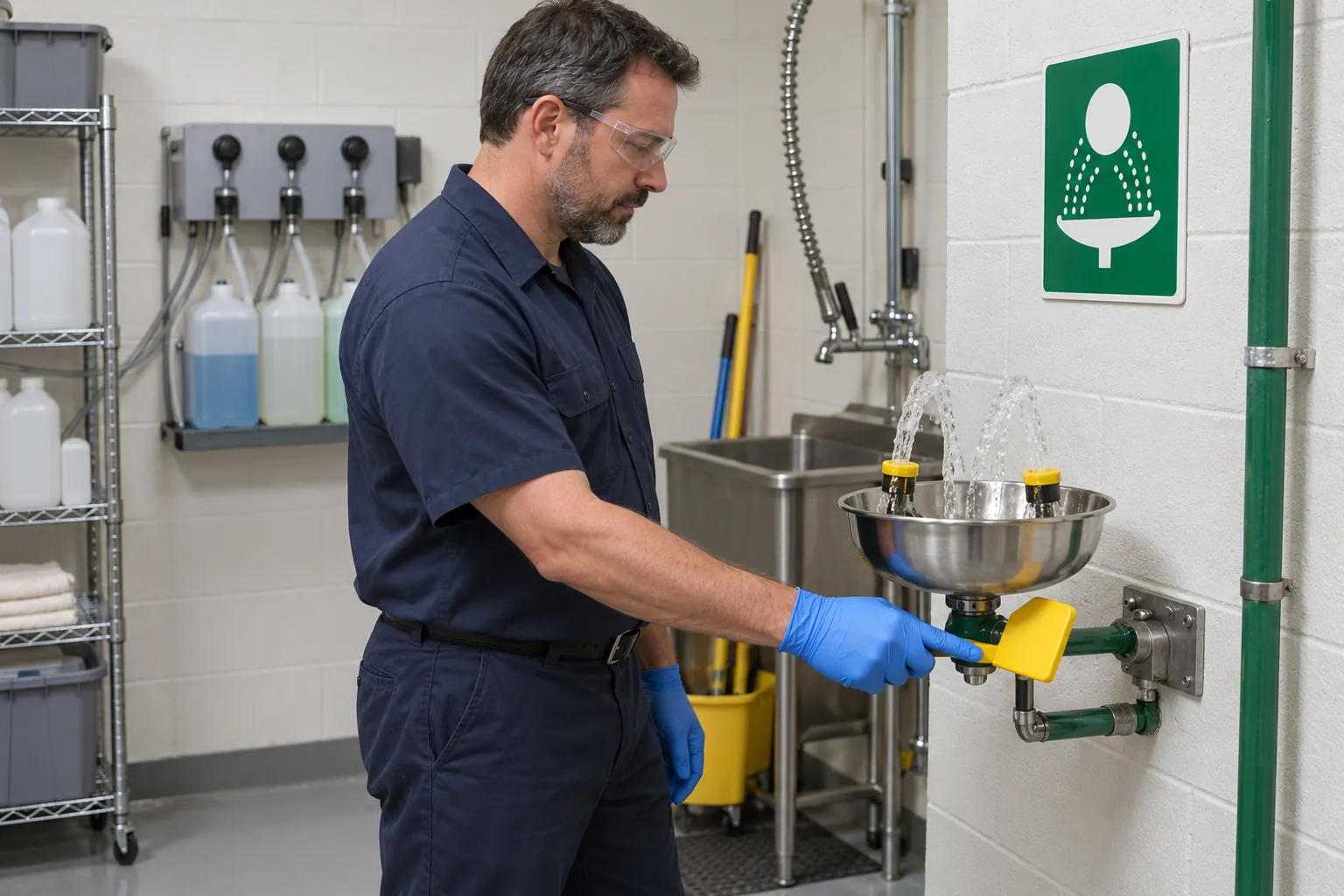 Premises and facilities managementOSHA eyewash station requirements: the rule, the 10-second reach and the weekly flushOSHA eyewash station requirements under 29 CFR 1910.151(c) and ANSI/ISEA Z358.1: where a station goes, what it must deliver, the weekly flush and what to record.