Cleaning
Slip resistance testing: what the DCOF number means and when a floor needs testing again
Slip resistance testing measures how much grip a hard floor gives a pedestrian, usually as a wet dynamic coefficient of friction (DCOF) taken with a tribometer under ANSI A326.3-2021, which sets a wet DCOF of 0.42 or greater for level interior hard flooring expected to be walked on when wet with water.
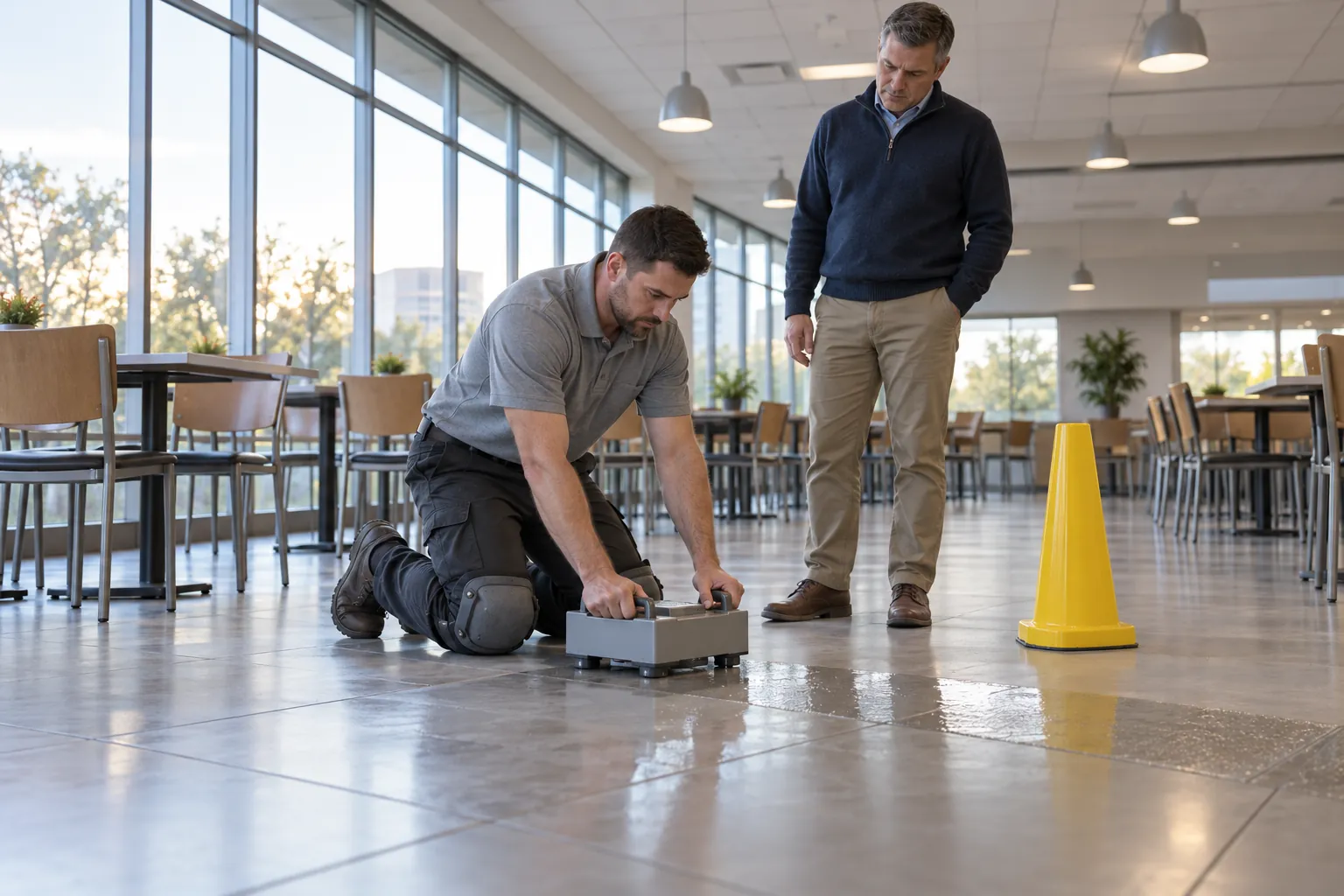
The number is a starting point, not a verdict: the same floor can test well when it is installed and badly a year later, after a new cleaner, a coat of finish, or simply wear. This guide covers what the tests measure, what OSHA and the ADA actually require, what a good number is for each kind of area, when to test again, how a field test is run, and how cleaning keeps or loses the result.
01
What slip resistance testing measures, and whose rule it is
Floor slip resistance is measured as a coefficient of friction: the force needed to slide one surface over another, divided by the weight pressing them together. Static coefficient of friction (SCOF) is the force to start something sliding; dynamic coefficient of friction (DCOF) is the force to keep it sliding. The two American test methods most often named for hard floors, ANSI A326.3 and NFSI B101.3, both measure DCOF with the floor wet.
The main American test method for hard flooring is ANSI A326.3-2021, American National Standard Test Method for Measuring Dynamic Coefficient of Friction of Hard Surface Flooring Materials, released in February 2022 by the Tile Council of North America (TCNA), which makes a free copy available. It can be used "in the laboratory or in the field": an automated drag-sled tribometer pulls a rubber (SBR) test foot across the floor wetted with a 0.05% sodium lauryl sulfate (SLS) solution. TCNA's DCOF page notes the method has been the ceramic tile industry's standard for DCOF since 2012, first in section 9.6 of ANSI A137.1.
The National Floor Safety Institute publishes the other family, the NFSI B101 standards: B101.3-2022 for wet DCOF, B101.1-2022 for wet SCOF, B101.0-2021 for walkway audits, and B101.2-2025 for the effect of cleaners and treatments on wet friction.
Other machines are in use too. The pendulum test of ASTM E303-22 swings a rubber slider across the surface and measures the energy it loses. A reading from one machine is not a reading on another's scale: the Access Board's floor and ground surfaces guide notes that rating systems are unique to the test method, so a level of slip resistance means something only with its measurement protocol named.
The law is less specific than people expect:
- OSHA sets no number. 29 CFR 1910.22 requires each workroom floor to be "maintained in a clean and, to the extent feasible, in a dry condition" and walking-working surfaces kept free of hazards such as leaks and spills. It names no coefficient of friction and no test. OSHA's 2003 letter of interpretation on static coefficients of friction, now an archive document, explained that the often-quoted 0.5 came from a nonmandatory appendix to a 1990 proposed rule, and that no OSHA standard specifically requires employers to use or have devices to measure it.
- The ADA asks for slip resistant, without a value. Section 302.1 of the 2010 ADA Standards for Accessible Design requires floor and ground surfaces to be stable, firm, and slip resistant. The Access Board's guide to floor and ground surfaces says the standards set no minimum coefficient of friction "because a consensus method for rating slip resistance remains elusive."
- Standards bind by adoption or contract. A326.3 says the use of American National Standards "is completely voluntary"; it becomes a requirement when a specification, lease, warranty, or facility standard writes it in.
So testing is not a statutory duty in itself. It is how a building shows its floors were chosen and kept in the condition 1910.22 and the ADA describe, and it is often the first thing asked for after a fall.
02
What a good DCOF is, area by area
A326.3-2021 sorts hard flooring into product use categories in its Table 1. The values below apply to the BOT-3000E tribometer named in the standard; it says a device used as an equivalent may have different threshold values, which must be correlated to the BOT-3000E's.
- Interior, Dry (ID): dry DCOF of 0.42 or greater. Level floors kept dry and free of contaminants when in use, such as office buildings, hotel lobbies, and indoor malls outside the food court; walk-off mats may be needed at their entrances.
- Interior, Wet (IW): wet DCOF of 0.42 or greater, or manufacturer-declared. Level interior floors "expected to be walked on when wet with water," such as entry foyers, public restrooms without showers, grocery stores, and the front of house in fine and casual dining restaurants with a closed kitchen.
- Interior, Wet Plus (IW+): manufacturer-declared. Public showers, locker rooms, interior pool decks, and quick-service restaurant dining areas; an informative note gives at least 0.50 wet as generally accepted.
- Exterior, Wet (EW) and Oils/Greases (O/G): manufacturer-declared. Outdoor walkways, patios, and pool decks (not ice or snow), and kitchens with grills or fryers; informative notes give at least 0.55 wet as generally accepted.
Three things are easy to miss. First, A326.3 says a floor that meets 0.42 is "not necessarily suitable for all projects": the specifier still has to weigh traffic, expected contaminants, expected maintenance, and wear. Second, a floor below 0.42 wet is not automatically wrong; unless the manufacturer declares otherwise, the standard says such floors, including polished surfaces, shall be installed only where they "will be kept dry when walked upon" and proper safety procedures are followed when cleaning. That makes cleaning part of the safety case for every glossy lobby. Third, the standard gives no single limit for ramps and inclines, showers, or floors contaminated with anything other than water, such as grease, because too many other factors decide the risk.
The NFSI uses a different scale for its product certification. Its testing page says that under B101.3, wet DCOF values greater than 0.45 "are considered High-Traction," and values from 0.30 to 0.44 are considered moderate traction and labeled "Slip-Resistant" (the barefoot test, B101.4, uses higher bands). When a report gives a number, check which standard and which device it was measured under before comparing it with anything else.
03
When to test, and when to test again
None of the documents above sets a retest interval for a floor in use. The frequency is the building's to decide, and the useful approach is to test when something has changed or something has gone wrong:
- Before choosing a floor. Ask the manufacturer for the product use classification or wet DCOF and match it to the area: an Interior, Dry tile does not belong at a rainy-day entrance without a plan for keeping it dry.
- After installation. A field test of the installed floor gives a baseline under the building's own conditions.
- After a coating, sealer, or finish goes down. A326.3 section 3.3 says flooring coated after installation "shall only be used in areas that can be kept dry, unless otherwise declared by the coating's manufacturer," and that testing after a coating should follow the coating manufacturer's method, or the standard's dry procedure if there is none. Stripping and refinishing a resilient floor is the obvious case.
- After a change in the cleaning regime. A new cleaner, a different dilution, or a new scrubber pad can change the result. A326.3 warns that acidic cleaners, citrus degreasers, solvents, and sealer strippers "can potentially change the DCOF of the flooring surface."
- As the floor wears. A326.3 says installed flooring's DCOF "can change over time as a result of wear and surface contaminants." Busy entrances, restrooms, and food areas are the obvious candidates for a retest cycle of the building's own choosing.
- After a slip and fall, a near miss, or a complaint. Test the area as it was, then again after cleaning, so the result shows whether the floor or what was on it was the problem.
- After a change of use. A break room that becomes a food service area has moved into a different category.
Whatever the trigger, write down why and when the test was done.
04
How a field test is run, and what the report should say
A field slip resistance test under A326.3 section 9.2 follows a set order. The tester chooses the areas, each "a contiguous space with hard surface flooring of the same or similar type," and test locations within them: high and low traffic, different textures, and places commonly exposed to contaminants. Each location gets at least three test samples.
The tester then decides whether to test under clean conditions or prevailing conditions. Clean means scrubbing the surface with a neutral light-use cleaner, and where needed a stronger cleaner, then rinsing until the cloth comes up clean. Prevailing means testing the floor "as is," removing only obvious solid debris such as crumbs or coffee grounds and noting what was removed. The difference between the two is often the most useful result: a floor that tests well clean and badly as is has a maintenance problem, not a flooring problem.
Each sample gets four measurements, two along one wetted path with the device turned 180 degrees between them, and two along a fresh path at 90 degrees. The tribometer is checked on the standard's validation surface before and after, and the standard warns that grout joints and textured surfaces can give misleading results.
Section 11 lists what the report should contain:
- the floor type and a unique name or number for each test area;
- the device used and its calibration due date, the test foot material, and the SLS concentration;
- the cleaning chemicals used and whether each area was tested cleaned or as is;
- the validation readings before and after, and whether they fell within range;
- each individual reading and the average for each sample, wet and, if asked for, dry;
- a description or photographs of each test area "sufficient to re-locate the test areas";
- the conditions at the time: contaminants, coatings or sealers, traffic, maintenance equipment, and walk-off mats. This is the item that lets the next test be compared fairly with this one.
No federal rule says who may test; it is usually done by a floor-safety consultant or testing laboratory with its own tribometer. The NFSI runs a Walkway Auditor Certificate Holder (WACH) course on auditing building walkways "through observation and measurement based on the NFSI B101 Standards." Whoever tests, ask which standard and device they will use before the work starts, so the result can be compared with earlier ones.
05
Keeping the result: cleaning, finishes, and the daily record
A test is a snapshot. Between tests, the floor's grip depends on the people who clean it.
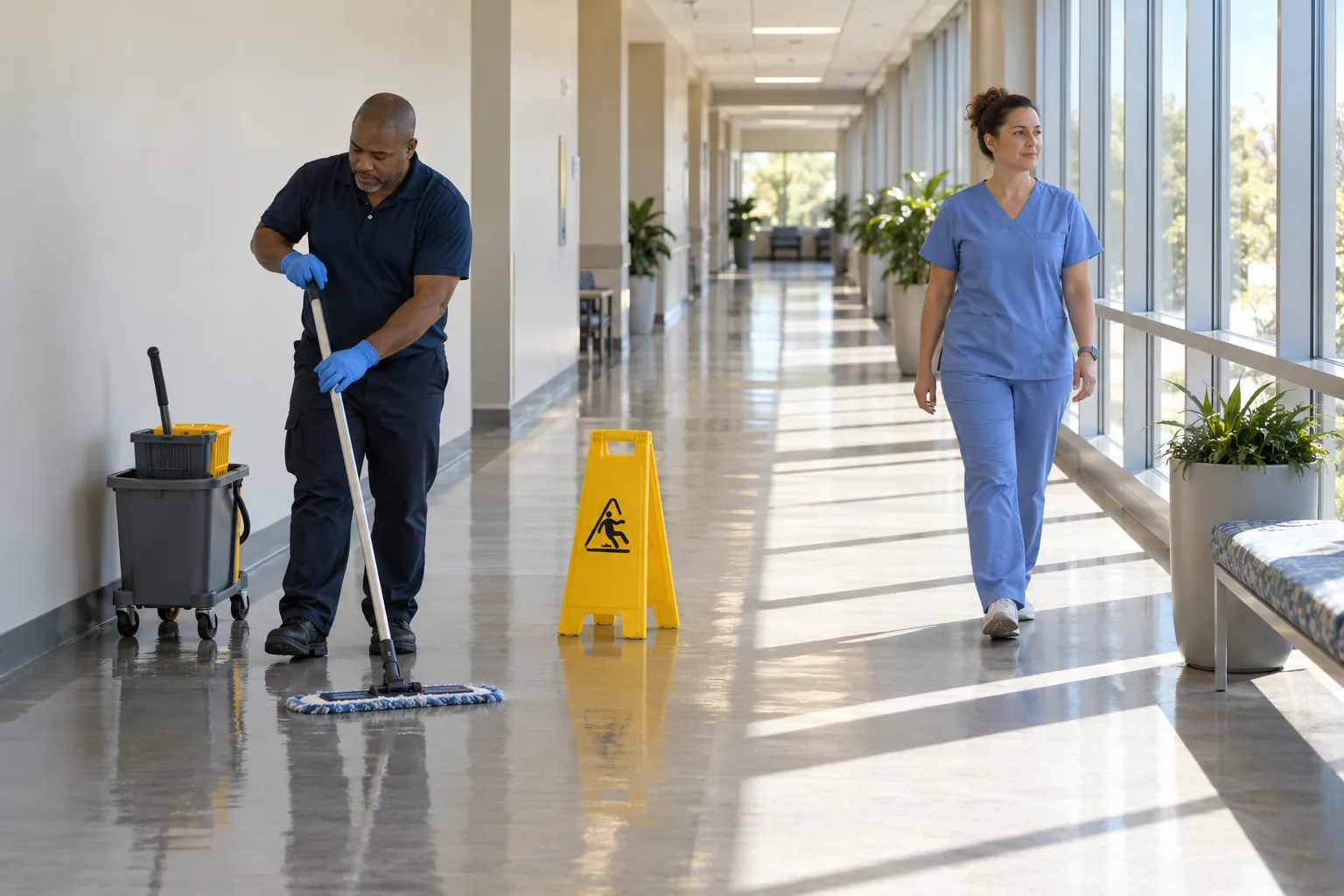
- Use the cleaner the floor was tested with, at the right dilution. NIOSH's Slip, Trip, and Fall Prevention for Healthcare Workers (DHHS (NIOSH) Publication No. 2011-123) says to make sure cleaning products "are mixed according to manufacturer's directions" and can be used on common floor contaminants.
- Pick the solution up. The same guide says research has shown a two-step process is better than damp mopping: solution applied with a dripping mop, then removed with a wrung mop a few minutes later, before it dries.
- Date every change. A new chemical, finish, or scrubber pad is a change to the floor: record the date and retest the busiest areas.
- Keep low-DCOF floors dry. A floor below 0.42 wet relies on being kept dry when walked on: entrance matting, wet-weather checks, and signs used properly; see the wet floor sign requirements guide.
- Deep clean on a schedule. A326.3 says deep cleaning and traction-enhancing maintenance "may be needed periodically" to maintain DCOF; put the schedule in the scope of work.
Good evidence that a floor was kept as it was tested is three things kept together: the test reports, the record of the cleaning regime with the date of each change, and the routine checks, such as an hourly entrance check on a wet day, described in the slip, trip, and fall prevention guide; 1910.22(d)(1) requires walking-working surfaces to be inspected "regularly and as necessary" but sets no frequency.
06
Where the record fails, and what SiteClara does about it
The test report is rarely what goes missing. What goes missing is everything around it. The janitorial contractor changes floor cleaner in March and nobody notes the date. The lobby is refinished over a long weekend and the promised retest never happens. The wet-weather entrance checks are in the post orders but in no record. When someone falls in the lobby in November, the building can show a good DCOF from two years ago and very little about the floor that morning.
SiteClara works on that daily part of the record. A printed QR poster at each location, with an optional NFC tag behind it, lets custodial and day porter staff scan or tap with their own phone, with no app to install. They see the checks due there, such as the entrance check on a wet morning or the restroom floor on the regular round, and mark each one done or say what stopped them, with a photo when one is asked for. A slippery patch or a lifted mat found there is reported with a photo and stays on the team's list of jobs until someone closes it.
The supervisor sees what was due, done, and missed, and can record why a check was missed. A job the team cannot fix, such as a floor that needs retesting or a coating that needs replacing, can be escalated to the building manager to answer. Each day the supervisor approves a report that goes to designated management or client contacts at 8 a.m. the next morning: what was reported, what was completed, and what is still open.
07
Questions people ask
What does slip resistance mean?
Slip resistance is how well a walking surface resists a foot or shoe sliding on it, and it is measured as a coefficient of friction. The Access Board's Guide to the ADA Standards, Chapter 3: Floor and Ground Surfaces says accessible surfaces must be slip resistant, especially for people who use canes, crutches, and other walking aids, but that the standards "do not specify a minimum level of slip resistance (coefficient of friction)."
What is a good coefficient of friction for flooring?
For level interior hard flooring expected to be walked on when wet with water, ANSI A326.3-2021 sets a wet DCOF of 0.42 or greater unless the manufacturer declares otherwise; the value applies to the BOT-3000E tribometer. The standard adds that a floor meeting 0.42 is "not necessarily suitable for all projects," and that a floor below 0.42 wet, unless the manufacturer declares otherwise, should be installed only where it will be kept dry when walked upon. A number measured under another standard or on another machine is on a different scale and cannot be compared with it directly.
What is the ASTM standard for slip resistance?
There is no single one. ASTM E303-22, Standard Test Method for Measuring Surface Frictional Properties Using the British Pendulum Tester is the pendulum test: it measures the energy a rubber slider loses as it swings across a test surface, in the field or in the laboratory. ASTM F2508-23, Standard Practice for Validation of Walkway Tribometry Using Research-based Reference Materials sets out how walkway tribometry is validated against reference materials ranked by human subjects. The old static test for tile, ASTM C1028-07e1, was withdrawn in 2014 with no replacement; for hard flooring in the United States, the DCOF method most often specified is ANSI A326.3, which is not an ASTM standard.
What qualifies a shoe as slip-resistant?
No federal rule defines it. ASTM F2913-19, Standard Test Method for Measuring the Coefficient of Friction for Evaluation of Slip Performance of Footwear and Test Surfaces/Flooring Using a Whole Shoe Tester measures the dynamic coefficient of friction between footwear and flooring in the laboratory "for evaluating relative slip performance." Ask the supplier which test and which value stand behind a slip-resistant label.
08
Where to read more, and a list to take away
Read ANSI A326.3-2021 itself, linked from TCNA's DCOF page, and the NFSI's list of B101 standards. For the law, read 29 CFR 1910.22 and OSHA's Walking-Working Surfaces page, plus the state's own rule where one of the 22 State Plans covering private employers applies. For accessible routes, read section 302 of the 2010 ADA Standards and the Access Board's floor and ground surfaces guide; for cleaning practice, NIOSH's Slip, Trip, and Fall Prevention for Healthcare Workers.
Before the next floor change or wet season, check that:
- each hard floor has a known product use category and a test result, with the standard and device named;
- areas walked on when wet, such as entrances, restrooms, and food areas, test at or above the value for their category;
- every floor below 0.42 wet has a plan for keeping it dry when walked on;
- a change of cleaner, dilution, pad, coating, or finish is dated and triggers a retest of the busiest areas;
- field test reports record whether each area was tested cleaned or as is, with photos to find the spot again;
- the daily entrance, restroom, and wet-weather checks are recorded as they happen, with a name and a time;
- after any fall, the area is tested as it was, and the test, the cleaning record, and the day's checks are kept together.
Sources
Every document this guide quotes or links to, in the order it first cites them.
- ANSI A326.3-2021, American National Standard Test Method for Measuring Dynamic Coefficient of Friction of Hard Surface Flooring Materials tcnatile.com
- DCOF page tcnatile.com
- NFSI B101 standards nfsi.org
- ASTM E303-22 store.astm.org
- Floor and ground surfaces guide access-board.gov
- 29 CFR 1910.22 osha.gov
- Letter of interpretation on static coefficients of friction osha.gov
- 2010 ADA Standards for Accessible Design ada.gov
- Testing page nfsi.org
- Walkway Auditor Certificate Holder (WACH) nfsi.org
- Slip, Trip, and Fall Prevention for Healthcare Workers cdc.gov
- ASTM F2508-23, Standard Practice for Validation of Walkway Tribometry Using Research-based Reference Materials store.astm.org
- ASTM C1028-07e1 store.astm.org
- ASTM F2913-19, Standard Test Method for Measuring the Coefficient of Friction for Evaluation of Slip Performance of Footwear and Test Surfaces/Flooring Using a Whole Shoe Tester store.astm.org
- Walking-Working Surfaces osha.gov
- State Plans osha.gov
Related guides
 Premises and facilities managementSlip, trip, and fall prevention: keeping floors, stairs, and walkways safe every daySlip, trip, and fall prevention in a commercial building: what OSHA 1910.22 requires, where people fall, the controls that work, and how to check and record them.
 CleaningWet floor sign requirements: what OSHA asks for, and how to use the sign wellWhat OSHA and ANSI Z535 require of a wet floor sign, when one is needed, where to place it, when to take it in, and how to show the wet floor was managed.
 CleaningFloor stripping and waxing: how to do it, how often, and how to show it was doneFloor stripping and waxing for janitorial teams: the step-by-step procedure, how often VCT needs it, OSHA rules on chemicals, asbestos tile and wet floors.
 CleaningFloor scrubber maintenance: the daily routine, the battery room and the record behind themFloor scrubber maintenance for janitorial teams: end-of-shift checks, battery charging, squeegees and pads, what OSHA expects, and a record that shows it was done.