Cleaning
Floor stripping and waxing: how to do it, how often, and how to show it was done
Floor stripping and waxing is the periodic deep maintenance of a hard floor, most often vinyl composition tile (VCT), in which a chemical stripper and a floor machine remove the old finish down to the bare floor, the floor is rinsed clean of residue, and several thin coats of new floor finish, still called wax in the trade, are applied and left to dry and harden.
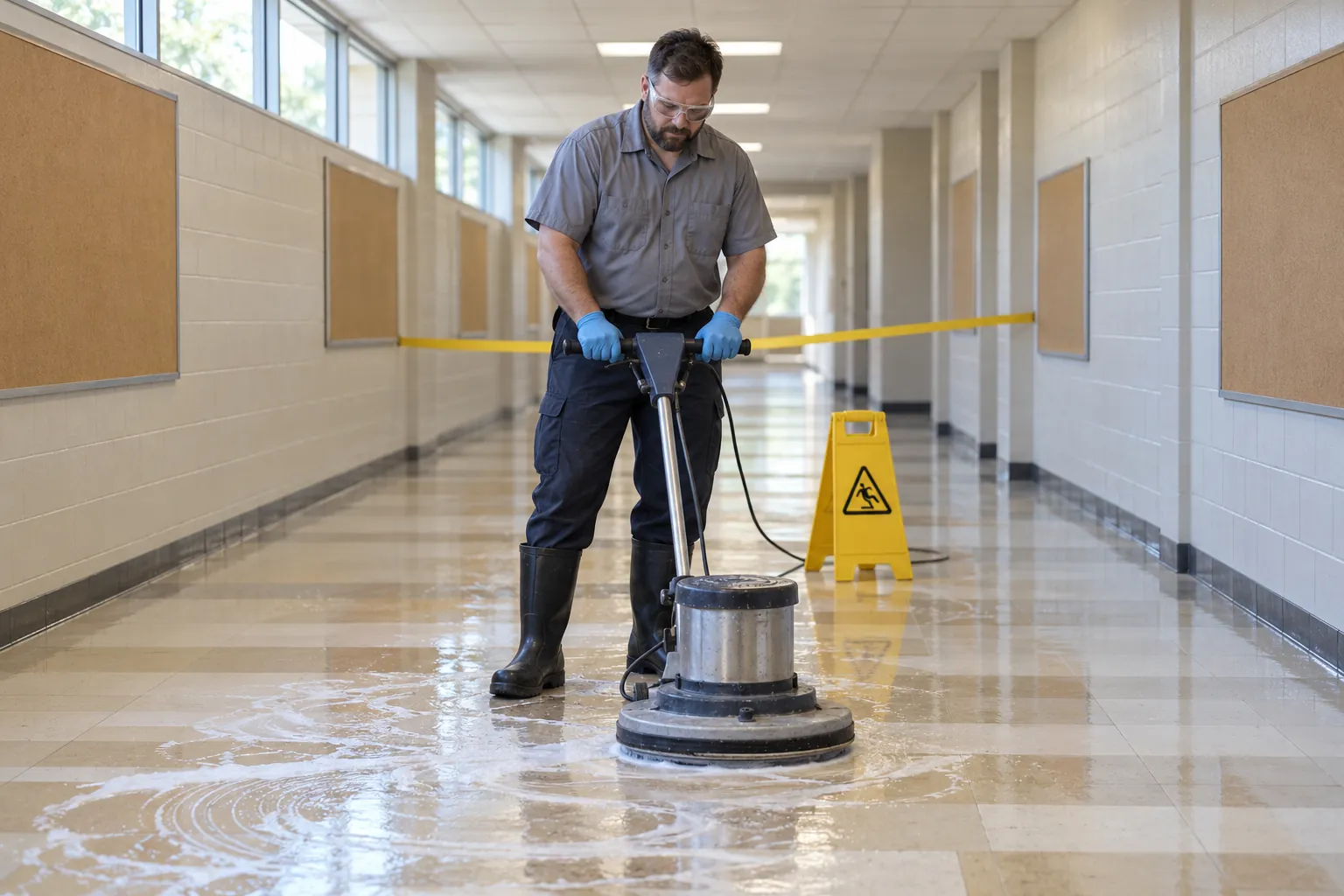
No federal rule says how often it must be done; OSHA's walking-working surfaces standard requires floors to be kept clean, dry where feasible and free of hazards, and the chemicals, the machines and any older asbestos tile bring rules of their own. This guide covers the step-by-step procedure, how often a commercial floor needs stripping, what OSHA expects while the work is under way, who does what, and how to keep a record that shows the floor was done when and how it was meant to be.
01
What floor stripping and waxing is, and what the rules say
Floor stripping and waxing, also called strip and refinish, is the heaviest routine job in hard floor care. A stripping solution softens the old finish, a low-speed floor machine breaks it up, the slurry is picked up, and the floor is rinsed until no stripper is left. New finish then goes down in thin coats, each dry before the next. Crews still say wax, but what goes on most commercial floors today is a polymer floor finish or floor polish rather than a true wax. Between full strips, maintaining clean floors comes down to daily dust mopping and damp mopping, burnishing with a high-speed machine, and a scrub and recoat, which takes off only the top coats before fresh ones go on.
No federal regulation says how often a floor must be stripped or how many coats it needs. The legal duty is the condition of the floor. OSHA's walking-working surfaces standard, 29 CFR 1910.22, requires that "the floor of each workroom is maintained in a clean and, to the extent feasible, in a dry condition," that walking-working surfaces are "inspected, regularly and as necessary, and maintained in a safe condition," and that hazardous conditions are "corrected or repaired before an employee uses the walking-working surface again." A corridor wet with stripper is exactly that hazard. The chemicals come under OSHA's Hazard Communication standard, 29 CFR 1910.1200, and the gloves and goggles under the personal protective equipment standard, 29 CFR 1910.132.
Federal OSHA covers most private employers, but OSHA's State Plans page lists 22 State Plans covering private sector and state and local government workers, and seven covering only state and local government workers. In a State Plan state, such as California, check the state's own rules too.
02
Which floors get stripped and waxed, and what the job includes
Commercial floor stripping and waxing is built around VCT, the tile in most school corridors, cafeterias and back-of-house areas, which relies on its finish for protection and appearance. Sheet vinyl, luxury vinyl tile (LVT), rubber and linoleum often come with a factory coating and their own maintenance instructions, and some should not be stripped with an ordinary stripper at all; terrazzo, stone and sealed concrete may be finished, sealed or polished. Follow the flooring manufacturer's maintenance guide for the product actually installed.
A strip and refinish job, written into the janitorial scope of work or a work order, usually includes:
- moving furniture, mats and trash cans out, and back once the finish has hardened;
- closing the area with barricades and wet floor signs for the whole job;
- protecting baseboards and walls from stripper splash;
- stripping, picking up the slurry and rinsing until the floor is free of residue;
- applying the agreed number of coats, with drying time between them;
- burnishing, if the finish and the building's routine call for it;
- disposing of used stripper the way the building allows, and cleaning the machines, pads and buckets.
03
How to strip and wax a floor, step by step
Every product has its own dilution, dwell time and drying time, so the label and safety data sheet come first, but the order of work is broadly the same. As a published example, the Weber State University custodial hard floor maintenance procedures apply stripper to one 6 feet by 6 feet area at a time, keep it wet, let it "sit on finish for 12 to 15 minutes," then "mop floor 3-5 times with neutral floor cleaner" and "apply 3-5 coats of finish," allowing the first coat "to dry and harden for 24 hours if possible." A typical floor stripping procedure:
- Plan. Confirm the floor type, its asbestos status, the products, and when the area can be closed long enough for the finish to dry.
- Close the area with barricades and wet floor signs at every way in, and clear the furniture.
- Dust mop to remove loose soil and grit.
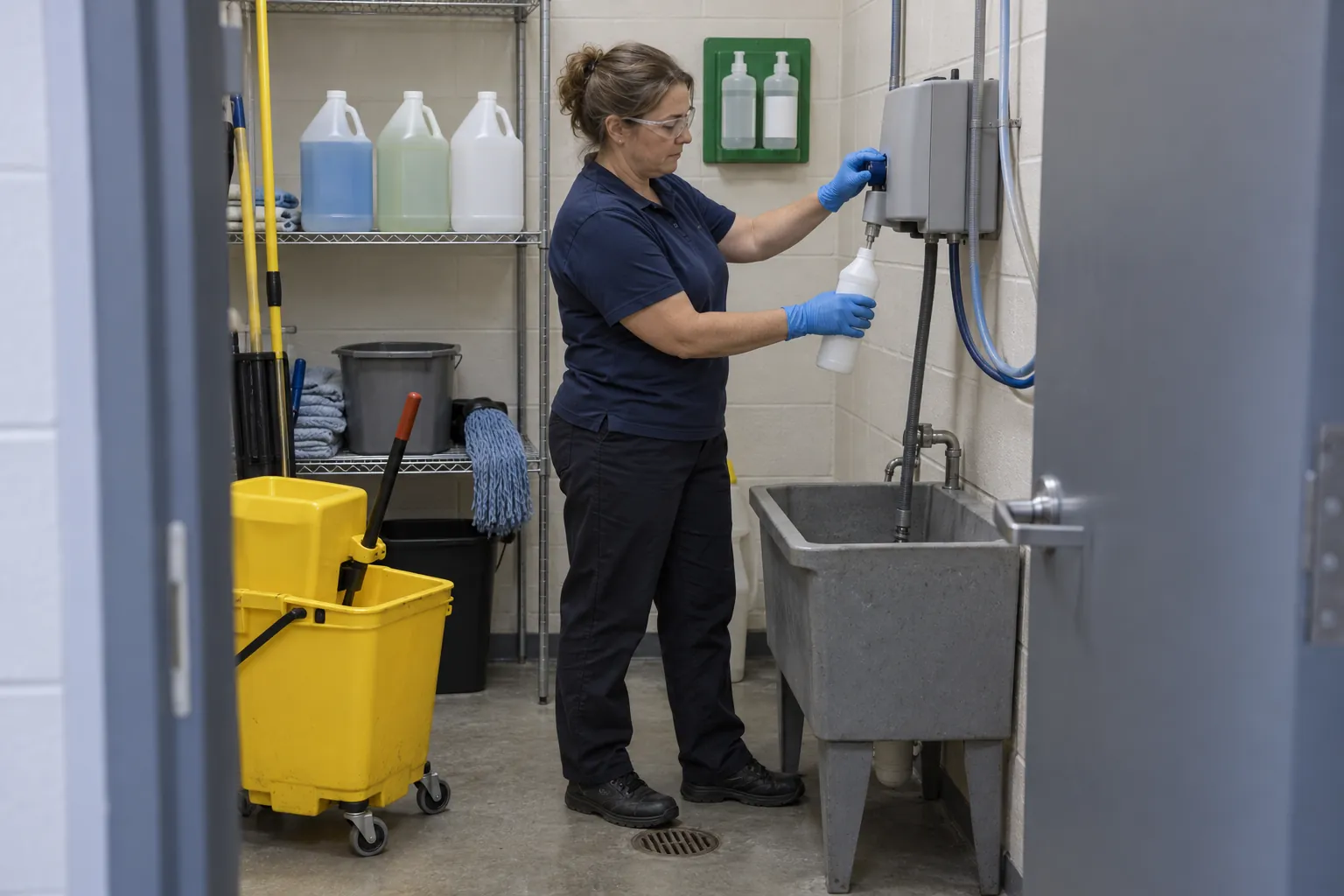
- Mix the floor stripping solution to the manufacturer's dilution, from a dispenser where one is fitted; see chemical dilution control.
- Apply it to a section small enough to keep wet, and let it dwell for the time on the label without drying.
- Scrub with a stripping pad on a low-speed machine, and scrape the edges and corners the machine cannot reach.
- Pick up the slurry with a wet vacuum or auto-scrubber before it dries.
- Rinse with clean water or a neutral cleaner, more than once. Stripper left on the floor is a common reason new finish looks hazy or will not bond.
- Let the floor dry and check it: no old finish, no residue, no water in the seams.
- Apply thin coats of finish, working toward the exit, and let each coat dry before the next.
- Let the finish cure for the time the manufacturer gives before traffic, furniture or burnishing, and only then take the signs away.
Chemicals. The University of Kentucky's floor stripper and wax disposal fact sheet describes its concentrated stripper as "corrosive material" and says "manufacturer dilution rates should be followed at all times." Under 1910.1200 the employer must keep a safety data sheet for each hazardous chemical "readily accessible during each work shift to employees when they are in their work area(s)," and train employees "at the time of their initial assignment" and whenever a new chemical hazard is introduced. A bucket or bottle filled from a labeled container needs no label only if it is "intended only for the immediate use of the employee who performs the transfer."
Protective equipment. The employer must assess the hazards, select the PPE, and "verify that the required workplace hazard assessment has been performed through a written certification" (1910.132(d)(2)). 29 CFR 1910.133 requires eye or face protection for exposure to "liquid chemicals, acids or caustic liquids," and where corrosive materials may reach the eyes or body, 29 CFR 1910.151(c) requires "suitable facilities for quick drenching or flushing of the eyes and body" within the work area. See janitorial PPE.
04
How often a floor should be stripped and waxed
There is no fixed interval. It depends on traffic and the wear and tear it brings, grit tracked in from outside, entrance matting, and above all on the care between strips: a floor that is dust mopped and damp mopped daily, burnished on a routine and given a scrub and recoat when the top coats wear goes much longer between full strips. Weber State's procedures leave floor refinishing to each custodial area supervisor "on an as needed basis." The signs a floor is due for a full strip:
- the finish has worn through to bare tile in traffic lanes and at doorways;
- old coats have built up and yellowed along edges, in corners and under furniture;
- a scrub and recoat no longer brings the appearance back;
- the finish is scratched, peeling or powdering.
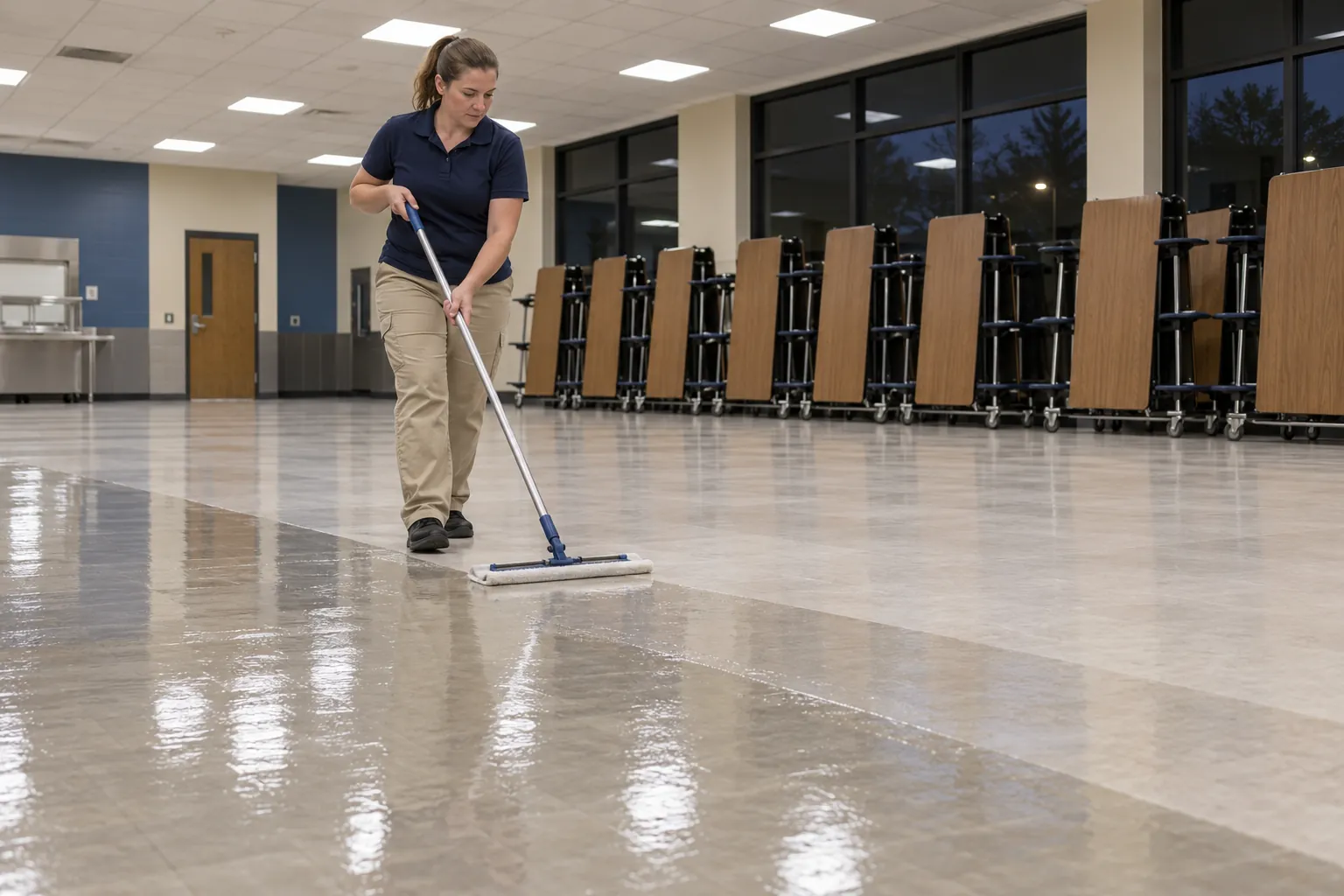
In schools the full strip is traditionally the summer job, when corridors are empty long enough for the finish to harden; offices, hospitals, stores and other commercial space usually work area by area, overnight or over a weekend. Write the frequency of floor stripping, waxing and burnishing into a floor care calendar by area, with entrances, cafeterias and other high-traffic areas more often than quiet offices, and review it against what the floors actually look like.
Slip resistance. ASTM's D2047, Standard Test Method for Static Coefficient of Friction of Polish-Coated Flooring Surfaces as Measured by the James Machine, is the laboratory test floor finishes are marketed against: polishes and other floor coatings "having a static coefficient of friction of not less than 0.5, as measured by this test method, have been recognized as providing nonhazardous walkways." It tests the product, dry, not your floor. For floors in place, the National Floor Safety Institute publishes the ANSI/NFSI B101 standards, including B101.3-2022 for measuring the wet dynamic coefficient of friction (DCOF) of hard-surface floors. Choose a finish whose label states the slip resistance it was tested to, and rinse the stripper off completely, because residue under the finish makes a patchy, slippery floor.
Burnishers. Many large buildings use propane burnishers between strips. OSHA's Carbon Monoxide Poisoning fact sheet lists propane among the fuels that produce CO and names the internal combustion engine as "one of the most common sources of exposure in the workplace" and tells employers to ventilate, maintain equipment that can produce CO "in good working order," "consider switching from gasoline-powered equipment to equipment powered by electricity, batteries, or compressed air if it can be used safely," and "provide personal CO monitors with audible alarms if potential exposure to CO exists."
05
Who does what, and what good evidence looks like
- The floor tech or custodian follows the procedure, wears the PPE, keeps the area closed and reports damage rather than finishing over it. Weber State's procedures say floor refinishing "will be performed by custodial employees specially trained on the floor refinishing process."
- The crew lead or janitorial supervisor plans the work by area, confirms the asbestos status and products, inspects the finished floor and signs the area back into use.
- The facility manager sets the floor care calendar, provides the owner's asbestos information, agrees when areas can close and checks the result against the contract.
Disposal. The University of Kentucky's fact sheet says used floor stripper and wax "must never be poured into the campus storm drains"; there, the diluted solution goes down the slop sinks to the sanitary sewer, followed by plenty of water. Rules differ between sewer authorities, so ask the facility manager how to manage used stripper in that building, or ask the local sewer authority, before the first job.
Good evidence lets anyone answer, for any area, when it was last stripped, by whom, with what, and how it looked afterward. It is what a client asks for when a contractor bills for a floor stripping and waxing service:
- each area identified by name or room number;
- the date, the crew and the number of coats;
- the stripper and finish used, with safety data sheets on file;
- the floor's asbestos status, confirmed before the first strip;
- photos before the work and after the last coat, taken at the time;
- scrub and recoat and burnishing recorded against the same areas;
- damage found during the job, reported and followed through to repair.
06
Where the record fails, and what SiteClara does about it
Floor care is the work most often billed and least often shown. The usual record is a line in a floor care calendar marked done, or an invoice for "strip and wax, east corridor." Nobody can say afterward which night it was done, who did it, or whether the cafeteria was skipped because it could not be closed.
SiteClara records scheduled checks at the place they happen. A printed QR poster, with an optional NFC tag behind it, sits in each area, such as a corridor or the cafeteria. Staff scan or tap on their own phone, with no app to install, see the checks due there, such as the floor strip scheduled for that area, and mark each one done or say what stopped them. The time and the named person are recorded as it happens, with a photo when the check asks for one, so a check at the start and one at the end can carry the floor before and after. Damage found during the job goes onto the team's list of jobs until it is closed.
The supervisor sees what is due, done and missed, and records the reason a check was missed. Each day they review it, add a note and approve a report that goes to the facility's designated contacts the next morning at 8:00 by default.
07
Questions people ask
How often should a floor be stripped and waxed?
As often as the floor needs it: no federal rule sets an interval. The Weber State University custodial hard floor maintenance procedures leave floor refinishing to each custodial area supervisor "on an as needed basis." Daily mopping, regular burnishing and a scrub and recoat all lengthen the time between full strips.
What is the proper way to strip and wax a floor?
Follow the product labels, in the order the Weber State University custodial hard floor maintenance procedures set out: apply stripper to a small section and "allow stripper to sit on finish for 12 to 15 minutes," scrub and pick up the slurry, rinse with neutral floor cleaner several times, then "apply 3-5 coats of finish."
How many hours does it take to strip and wax a floor?
Longer than the scrubbing, because the finish must dry and harden. The Weber State University custodial hard floor maintenance procedures say to "allow first coat to dry and harden for 24 hours if possible," which is why most floors are done overnight, over a weekend or during a school vacation.
Can you pour used floor stripper down the drain?
Never into a storm drain. The University of Kentucky's Floor Stripper and Wax fact sheet says used stripper "must never be poured into the campus storm drains" and sends the properly diluted solution down the slop sinks in the housekeeping rooms, to the sanitary sewer, "followed by large amounts of water." Check with your local sewer authority first.
08
Further reading, and a list to take away
Start with the labels and safety data sheets for your stripper and finish, and the flooring manufacturer's maintenance guide. For the federal rules, read OSHA's 29 CFR 1910.22, the Hazard Communication standard, 29 CFR 1910.132 for PPE and 29 CFR 1910.1001 for older floors that may contain asbestos. Before the next job, check that:
- the floor type is known, and its asbestos status confirmed for asphalt or vinyl flooring installed in 1980 or earlier;
- safety data sheets are available on every shift, and the crew is trained on each chemical and machine;
- gloves, splash goggles and an eyewash are on hand wherever concentrated stripper is used;
- the area stays closed with barricades and signs until the finish is dry;
- stripper is mixed to the label and rinsed off completely, and coats are thin;
- used stripper never goes into a storm drain;
- each area's strip is recorded when and where it is done, by name, with before and after photos.
Sources
Every document this guide quotes or links to, in the order it first cites them.
- 29 CFR 1910.22 osha.gov
- Hazard Communication standard, 29 CFR 1910.1200 osha.gov
- 29 CFR 1910.132 osha.gov
- State Plans osha.gov
- 29 CFR 1910.1001 osha.gov
- Weber State University custodial hard floor maintenance procedures weber.edu
- Floor stripper and wax disposal fact sheet env.uky.edu
- 29 CFR 1910.133 osha.gov
- 29 CFR 1910.151(c) osha.gov
- D2047, Standard Test Method for Static Coefficient of Friction of Polish-Coated Flooring Surfaces as Measured by the James Machine store.astm.org
- ANSI/NFSI B101 standards nfsi.org
- Carbon Monoxide Poisoning fact sheet osha.gov
Related guides
 CleaningFloor scrubber maintenance: the daily routine, the battery room and the record behind themFloor scrubber maintenance for janitorial teams: end-of-shift checks, battery charging, squeegees and pads, what OSHA expects, and a record that shows it was done.
 CleaningWet floor sign requirements: what OSHA asks for, and how to use the sign wellWhat OSHA and ANSI Z535 require of a wet floor sign, when one is needed, where to place it, when to take it in, and how to show the wet floor was managed.
 CleaningChemical dilution control: getting the mix right, every bottle, every shiftHow a chemical dilution control system works, what OSHA HazCom and EPA labels require, how to check dispensers and bottles, and what the record should show.
 Premises and facilities managementSlip, trip, and fall prevention: keeping floors, stairs, and walkways safe every daySlip, trip, and fall prevention in a commercial building: what OSHA 1910.22 requires, where people fall, the controls that work, and how to check and record them.