Fire and water checks
Types of fire extinguishers: which one for which fire, and where it belongs
The main types of fire extinguishers in South African buildings are dry chemical powder (DCP), carbon dioxide (CO2), water, foam, wet chemical and clean agent, and each is made for particular classes of fire: A for ordinary solids, B for flammable liquids and gases, C for live electrical equipment, D for combustible metals and F for cooking oils and fats.
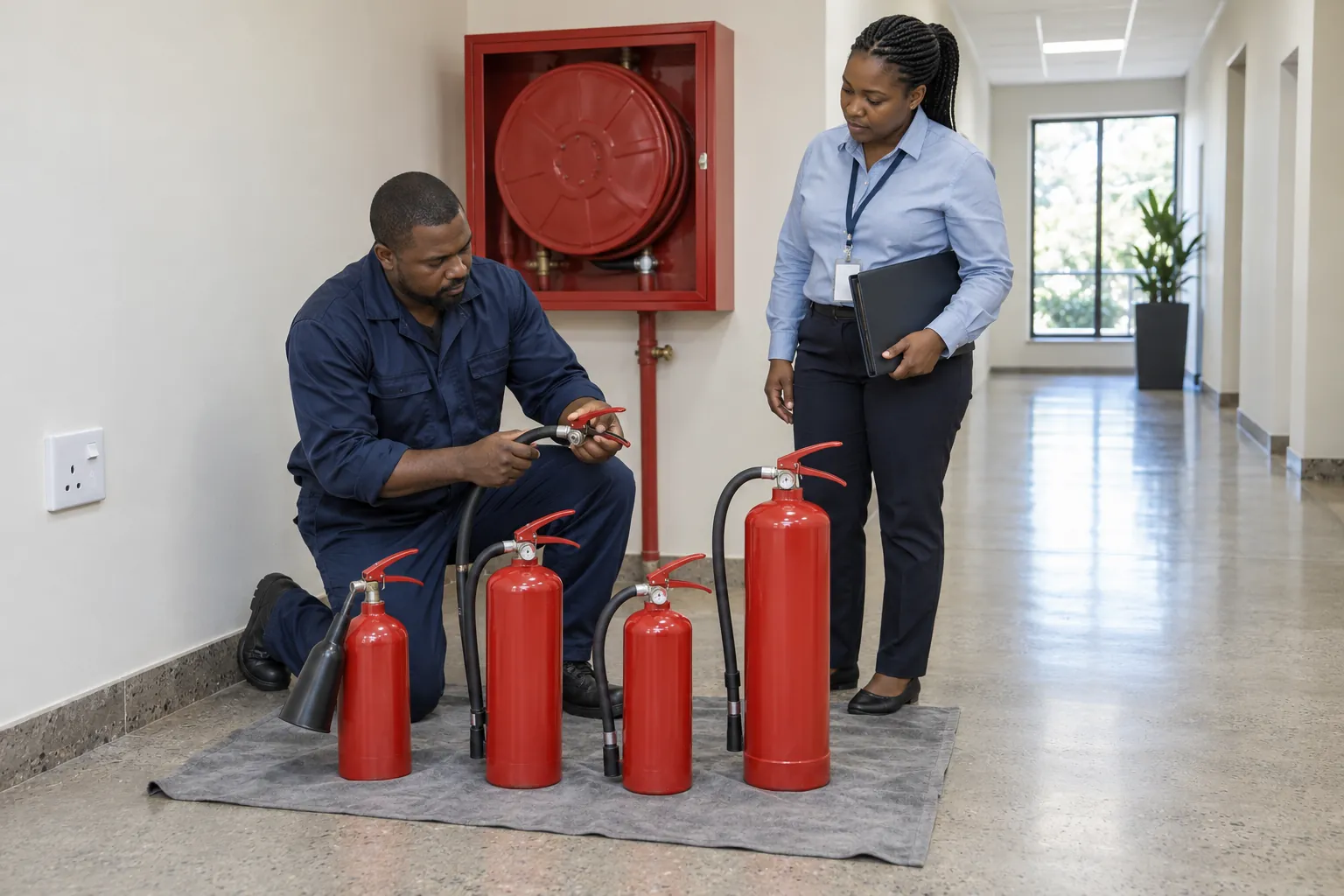
Which types a building needs, how many and where is set when it is designed, under Part T of the National Building Regulations and SANS 10400-T, and by the municipal fire service, and every extinguisher is then serviced under SANS 1475-1 by a permit or certificate holder. The people who look after the building day to day do not choose the types, but they should know what belongs at each fire point and notice when it is wrong. This guide covers the classes of fire, the types of extinguisher, who decides which goes where, who services them, and what the site team needs to know and record.
01
The classes of fire, as South African documents use them
Fires are grouped into classes by what is burning. The plainest South African government statement of the classes is in the Guideline for a Mandatory Code of Practice on the Prevention of Fires at Mines (Government Notice 6329 of 20 June 2025), issued by the Chief Inspector of Mines. Its basic fire theory is that a fire needs three things present at once, "a fuel source, an ignition (heat) source and oxygen (air)", and it classes fires by the fuel. It is written for mines, but the same letters are used on South African extinguishers and charts:
- Class A, ordinary combustibles: solid materials such as "wood, paper, fabric, plastics and most kinds of solid waste materials".
- Class B, flammable liquids and gases: "flammable or combustible liquids or gases such as petrol or propane gas".
- Class C, energised electrical equipment: electrical fires involving "potentially energised electrical equipment", which the guideline says "may be caused by short-circuiting or overloaded electrical networks".
- Class D, combustible metals: most often "magnesium, potassium, titanium and zirconium"; once such a fire is started, the guideline says, "the fire is self-sustaining".
- Class F, cooking oils and fats: "unsaturated cooking oils in well-insulated cooking appliances located in commercial kitchens", kept apart from class B because of their special characteristics.
The product standards use the same letters. The SABS describes SANS 1910:2025, Portable refillable fire extinguishers (edition 2.01, approved 15 December 2025) as covering extinguishers "suitable for use on fires of classes A, B C, D and F", and SANS 1567:2026, Portable rechargeable fire extinguishers – CO2 type extinguishers (edition 2.04, approved 30 March 2026) as covering CO2 extinguishers "suitable for use on class BC fires".
02
The types of fire extinguisher, and what each is for
SANS 1910:2025 covers stored-pressure refillable extinguishers and lists "water-based (including foam type) and dry chemical powder, wet chemical and clean agent type fire extinguishers"; CO2 extinguishers are covered by SANS 1567. The common types, and the classes they are usually marked for, are:
- Dry chemical powder (DCP). The general-purpose extinguisher of South African offices, schools, shops, parking levels and vehicles. Used on class A, B and C fires, it leaves a fine residue over everything nearby, so it is not the first choice beside delicate equipment.
- Carbon dioxide (CO2). For class B and C fires, so it is placed beside switchboards, server and comms rooms, generator rooms and other electrical equipment, where it leaves no residue. CO2 displaces oxygen: the mines guideline forbids CO2 extinguishers in confined spaces because the gas "will make it harder to breathe, leading to asphyxiation for the user as well as other employees".
- Water. For class A fires only: paper, wood, textiles and furniture. Never on live electrical equipment or burning cooking oil.
- Foam. For class A fires and for flammable liquids in class B, so it suits workshops, stores of paints or fuels, and parking levels.
- Wet chemical. For class F fires in commercial kitchens, canteens and food courts, usually beside a fire blanket. An ordinary water extinguisher must never be used on burning cooking oil.
- Clean agent. Gaseous or vaporising agents that leave no residue, used where equipment or records would be damaged by powder or water; now within the scope of SANS 1910.
- Class D powder. Special extinguishers for the particular metal involved, found in some workshops, laboratories and factories. An ordinary building does not need one, and the choice is for a specialist who knows the metal.
Wheeled (mobile) extinguishers, larger units on wheels, turn up in plant yards, fuel stores and loading areas. Old halon units may still be found: the mines guideline notes that South Africa "has agreed to abide by the Montreal Agreement on the use of CFC products". If you find one, ask the servicer what should replace it.
Fire hose reels and fire blankets are fire-fighting equipment but not extinguishers: hose reels are water for class A fires and are serviced under SANS 1475-2, and blankets are for small cooking fires.
03
Who decides which extinguisher goes where
The choice is made when a building is designed or altered, and confirmed by the municipal fire service. Regulation T1(1)(e) of the National Building Regulations requires every building to be designed, constructed and equipped so that, in case of fire, "adequate means of access, and equipment for detecting, fighting, controlling and extinguishing such fire, is provided". Regulation T1(2) deems that met where the design, construction and equipment comply with SANS 10400-T:2024, The application of the National Building Regulations Part T: Fire protection. Under regulation T2(1)(a) an owner commits an offence by failing to "provide sufficient fire extinguishers", by installing extinguishers "that do not comply with the relevant South African national standard", or by failing to ensure that they are "installed, maintained and serviced in accordance with SANS 10105".
SANS 10400-T is where the number and type come from: the SABS describes it as providing "deemed-to-satisfy requirements for compliance with part T (Fire Protection) of the National Building Regulations". Your fire engineer or servicer works from the current edition, and the local authority may ask for more where it thinks the standard is not enough. SANS 10105-1:2021, The use and control of fire-fighting equipment Part 1: Portable and wheeled (mobile) fire extinguishers gives, in the SABS's words, "the requirements for the selection, installation, inspection and use" of extinguishers.
For a workplace in use, regulation 13J(2) of the General Safety Regulations, 2025 (Government Notice 5954 of 6 March 2025), under the Occupational Health and Safety Act 85 of 1993, requires the employer, having regard to the workplace and "the amount and type of flammable articles" on the premises, to provide "an adequate supply of suitable firefighting equipment at strategic locations or as may be recommended by the fire chief of the local authority concerned", maintained in good working order. The same words were regulation 9(2) of the Environmental Regulations for Workplaces, 1987, repealed by regulation 21 of the Physical Agents Regulations, 2024 18 months after their promulgation.
The municipal fire by-laws then apply. Section 17(1) of the City of Cape Town Community Fire Safety By-law, 2002 and section 25(1) of the eThekwini Fire By-law, 2022 tie the provision of extinguishers to the National Building Regulations; on premises registered for flammable substances, section 39(2) of the City of Johannesburg Emergency Services By-laws lets the Chief Fire Officer, where there is "any exceptional hazard or risk", "specify the type of fire extinguisher to be installed" and require more of them. Other municipalities have their own.
In practice the approved fire plan and the servicer's records show what belongs at each fire point. Typical choices are:
- corridors, receptions, offices, classrooms and stairwell landings: DCP, with hose reels on the same fire points;
- server rooms, switchgear, distribution boards, lift motor rooms and generator rooms: CO2, often beside a DCP;
- commercial kitchens and canteens: wet chemical and a fire blanket;
- workshops, paint and fuel stores and loading bays: foam or DCP, and wheeled units where the risk is large;
- parking levels and vehicles: DCP.
04
Who services each type, and how often
Every type is serviced to one standard, SANS 1475-1:2025, The production of reconditioned fire-fighting equipment Part 1: Portable and wheeled (mobile) rechargeable fire extinguishers (edition 4, approved 31 October 2025). Section 16(1) of the Johannesburg by-laws requires every owner to have extinguishers serviced and maintained in accordance with SABS 0105 and SABS 1475 (the old numbers of SANS 10105 and SANS 1475) and inspected "by an appropriately registered and competent person at least once every 12 months".
Who may do the work is limited. Section 17(3) of the Cape Town by-law and section 25(8) of the eThekwini by-law allow only the holder of an SABS permit or of a certificate from the South African Qualifications Certification Committee (SAQCC Fire) to fill, recharge, modify, repair, inspect or test an extinguisher. An extinguisher may not leave the premises for servicing unless a similar one in good working condition takes its place for the time being (Cape Town section 17(7)); in eThekwini the servicer must supply it (section 25(3)), and the owner must tell the Municipality if they do not (section 25(4)).
The service is also the moment to put a wrong type right. If the server room's CO2 has been replaced by a DCP, or the kitchen has a powder extinguisher instead of a wet chemical, tell the servicer and the person responsible for fire safety before the visit, so the right unit comes back. The guide to the SANS 1475 extinguisher service covers the visit and the certificate.
05
What the site team needs to know, and record
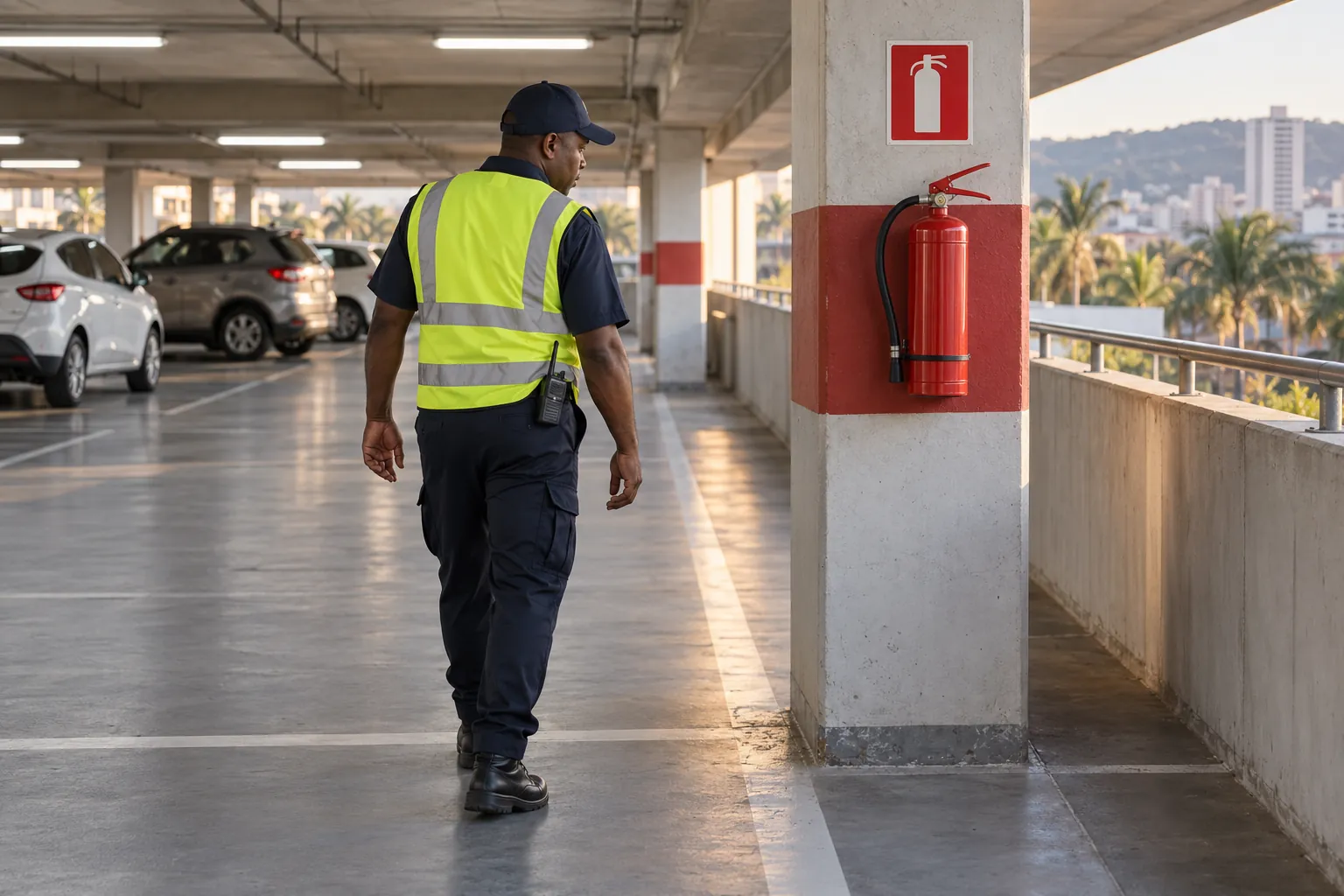
Security officers, cleaners, caretakers and fire marshals pass the extinguishers every day and are the people most likely to notice that one is missing, has been moved or is the wrong type. Section 8(2)(e) of the OHS Act requires the employer to provide the information, instructions, training and supervision needed for employees' health and safety. For extinguishers that means everyone knowing, at least:
- which type is at each fire point on their floor or round, and which kind of fire it is for;
- that water and foam extinguishers are never used on live electrical equipment, and a water extinguisher never on burning cooking oil, which calls for wet chemical or a fire blanket;
- that a CO2 extinguisher is not for use in a small enclosed space;
- that raising the alarm and helping everyone evacuate comes first;
- who to tell when an extinguisher is missing, used, damaged or the wrong type.
Keep one list of every extinguisher by location, type and size; see the guide to the fire equipment register. The routine look between services, at the pin and seal, the gauge, the label and the access, is in the fire extinguisher checklist; add to it a check that the type at each point matches the list. A wrong or missing type is a fault to report the same day: section 31(5) of the eThekwini by-law requires defects to be attended to "without delay".
06
Where the record fails, and what SiteClara does about it
The usual record of which extinguisher is where is the servicer's list from the last annual visit and a fire plan on the wall by reception. Between visits, units are moved for a refit, borrowed for the kitchen, swapped after a discharge or taken by a tenant, and nobody updates either. A guard notices a powder extinguisher in the server room, mentions it to whoever is passing, and it is forgotten.
SiteClara puts the check at the fire point. A printed QR poster, with an optional NFC tag behind it, sits at each fire point or group of fire points. A security officer, cleaner or supervisor scans the code or taps the tag on their own phone, with no app to install, sees the checks due at that location, and marks each one done or says what stopped them, with a photo when one is asked for, such as the extinguisher and its label. The named person and the time are recorded as it happens. A missing, used or wrong extinguisher is reported there with a photo and goes onto the team's list of open jobs until someone closes it.
The supervisor sees what is due, done and missed, and gives the reason when a check was missed. Each day the supervisor reviews and approves a report that goes to the client's facilities manager and other nominated contacts at 08:00 the next morning, showing what was reported, completed and still open, and how the scheduled checks went.
07
Questions people ask
What is a class F fire?
A class F fire is a fire in cooking oils and fats, which the Guideline for a Mandatory Code of Practice on the Prevention of Fires at Mines (2025) describes as "unsaturated cooking oils in well-insulated cooking appliances located in commercial kitchens". The guideline says such fires are "technically a sub-class" of flammable liquids and gases but are classed separately because of their special characteristics, and that "water mist can be used to extinguish such fires". Water mist is not an ordinary water extinguisher: in a kitchen, the wet chemical extinguisher and fire blanket described above are kept for them.
What is a class D fire?
A class D fire is a fire in combustible metals, most often "magnesium, potassium, titanium and zirconium" according to the Guideline for a Mandatory Code of Practice on the Prevention of Fires at Mines (2025). The guideline says that, apart from metals that burn in contact with air or water such as potassium and sodium, these metals on their own are not an unusual fire risk because they conduct heat away from hot spots efficiently, but that once combustion is induced "the fire is self-sustaining". The class D extinguishers described above are specialist equipment, chosen for the metal concerned.
Where should fire extinguishers be located in buildings?
In a workplace, regulation 13J(2) of the General Safety Regulations, 2025 requires the employer to provide suitable fire-fighting equipment "at strategic locations or as may be recommended by the fire chief of the local authority concerned", having regard to the size, construction and location of the workplace and the flammable articles on the premises. Section 16(1)(a) of the City of Johannesburg Emergency Services By-laws requires fire-fighting equipment to be installed "in a manner and condition ready for use in an emergency".
08
Where to read the official text, and a list to take away
Nationally, read Part T of the National Building Regulations (regulations T1 and T2), regulation 13J of the General Safety Regulations, 2025 and section 8 of the Occupational Health and Safety Act 85 of 1993. The classes of fire are defined in section 8.2.2.4 of the Guideline for a Mandatory Code of Practice on the Prevention of Fires at Mines. Then read your municipality's fire by-law: the three quoted here are the City of Cape Town Community Fire Safety By-law, 2002, the eThekwini Fire By-law, 2022 and the City of Johannesburg Emergency Services By-laws. The SANS standards named in this guide are sold by the SABS; your fire engineer and servicer should hold current copies. Before the next round, check that:
- there is one list of every extinguisher by location, type and size, matching the fire plan;
- every fire point has the type its risk calls for: CO2 by electrical equipment, wet chemical and a blanket in kitchens;
- any halon unit or unexplained swap is raised with the servicer;
- the annual servicing is booked with an SABS permit or SAQCC Fire certificate holder, and the certificate is filed;
- staff on every round know which type is for which fire, and that getting out comes first;
- a missing, used or wrong extinguisher is reported the same day, with a named owner and a date.
Sources
Every document this guide quotes or links to, in the order it first cites them.
- Guideline for a Mandatory Code of Practice on the Prevention of Fires at Mines (Government Notice 6329 of 20 June 2025) gov.za
- SANS 1910:2025, Portable refillable fire extinguishers store.sabs.co.za
- SANS 1567:2026, Portable rechargeable fire extinguishers – CO2 type extinguishers store.sabs.co.za
- National Building Regulations thedtic.gov.za
- SANS 10400-T:2024, The application of the National Building Regulations Part T: Fire protection store.sabs.co.za
- SANS 10105-1:2021, The use and control of fire-fighting equipment Part 1: Portable and wheeled (mobile) fire extinguishers store.sabs.co.za
- General Safety Regulations, 2025 (Government Notice 5954 of 6 March 2025) gov.za
- Occupational Health and Safety Act 85 of 1993 gov.za
- Environmental Regulations for Workplaces, 1987 labour.gov.za
- Physical Agents Regulations, 2024 gov.za
- City of Cape Town Community Fire Safety By-law, 2002 openbylaws.org.za
- EThekwini Fire By-law, 2022 openbylaws.org.za
- City of Johannesburg Emergency Services By-laws openbylaws.org.za
- SANS 1475-1:2025, The production of reconditioned fire-fighting equipment Part 1: Portable and wheeled (mobile) rechargeable fire extinguishers store.sabs.co.za
Related guides
 Fire and water checksFire extinguisher checklist: the routine check between annual servicesA fire extinguisher checklist for South African buildings: what to look at between SANS 1475 services, who checks, how often, and what the record should show.
 Fire and water checksSANS 1475: the annual fire extinguisher service, and what the record should showWhat SANS 1475 means for a fire extinguisher service in South Africa: who may do it, how often, the certificate, and how it differs from the monthly check.
 Fire and water checksFire equipment checklist: the register of everything, and when each item is dueA fire equipment checklist for South Africa: the register of every extinguisher, hose reel, hydrant and installation, service intervals and the record by-laws want.
 Fire and water checksFire marshal duties: the daily checks, the job in an evacuation, and the recordWhat a fire marshal does in a South African workplace: the law behind the role, the daily walk round, the job in an evacuation, training and the record.