Fire and water checks
Fire extinguisher checklist: the routine check between annual services
A fire extinguisher checklist is the list of points someone on site looks at on every extinguisher between annual services: that it is in its place, visible and unobstructed, with its safety pin and seal intact, its gauge in the green, no damage, and a service label in date.
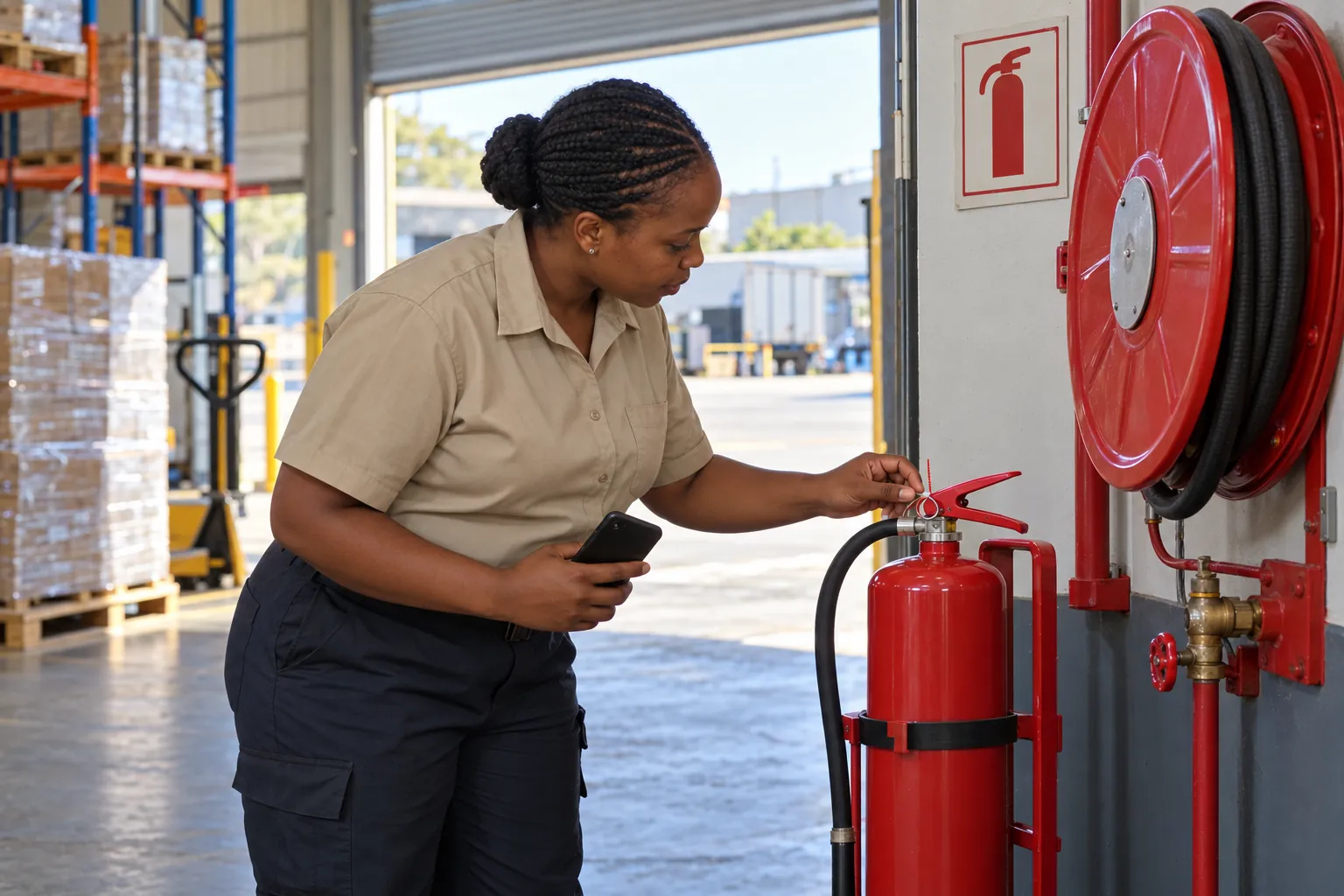
In South Africa the annual service under SANS 1475 is work for an SABS permit holder or a technician certified by SAQCC Fire, but the equipment must be kept in good working order all year, and the checklist is how a building knows it is. No by-law quoted here sets a frequency for the in-house check, so monthly is a sensible default rather than a legal rule. This guide covers where the duty comes from, the checklist itself, who does it and how often, what to do about a fault, and what the record should show.
01
The duty behind the checklist
Nationally, the duty sits in the General Safety Regulations, 2025 (Government Notice 5954 of 6 March 2025), made under the Occupational Health and Safety Act 85 of 1993. Regulation 13J(2) requires an employer, having regard to the size, construction and location of the workplace and the flammable articles on the premises, to "provide on the premises an adequate supply of suitable fire-fighting equipment at strategic locations or as may be recommended by the fire chief of the local authority concerned, and such equipment shall be maintained in good working order". Regulation 14 makes a failure to comply with regulation 13J an offence. Behind it is section 8(1) of the Act: every employer must provide and maintain, as far as is reasonably practicable, a working environment that is safe and without risk to the health of employees.
The detail comes from the fire safety by-law of the municipality where the building stands. Three metros show how the by-laws speak about the year between services:
- City of Johannesburg. Section 16(1)(a) of the City of Johannesburg Emergency Services By-laws requires the owner to ensure that all fire-fighting equipment is "installed in a manner and condition ready for use in an emergency". Section 16(3) says that, except for inspection, service, repair or fire-fighting, "no person may remove or interfere with any fire-fighting equipment", and section 16(4) that no person may "alter, damage, misuse or render ineffective" it.
- eThekwini (Durban). Section 31(5) of the eThekwini Fire By-law, 2022 requires the owner or person in charge to have defects and outstanding maintenance attended to "without delay", "so as to ensure that the fire protection equipment is fully functional at all times". Section 32 forbids anyone to "tamper or interfere with fire-protection systems" or to make them "less effective or inaccessible".
- City of Cape Town. Section 19 of the Community Fire Safety By-law, 2002 (as amended to 2015) says a person may not "render less effective, inoperative, inaccessible, or tamper and interfere with a fire extinguisher", except in emergencies, maintenance, drills or prescribed testing.
Those duties run all year; the specialist service comes once. All three by-laws call up the service standard, SANS 1475 (Part 1 covers extinguishers), and the standard on extinguishers in use, SANS 10105 (Johannesburg and Cape Town cite them by their older numbers, SABS 1475 and SABS 0105), whose Part 1 is now SANS 10105-1:2021, The use and control of fire-fighting equipment Part 1: Portable and wheeled (mobile) fire extinguishers, which the SABS describes as giving "the requirements for the selection, installation, inspection and use" of extinguishers. The annual service itself is covered in the guide to the SANS 1475 extinguisher service.
Other municipalities have their own fire by-laws, and a lease, client contract or insurer may set its own frequency or format for the in-house check; where one does, follow it.
02
What the checklist covers
The checklist covers every portable and wheeled fire extinguisher on the premises, in every place it is meant to be: corridors and stairwell landings, receptions, kitchens and canteens, plant rooms, generator rooms and switchgear, workshops, stores, the guardhouse and the parking levels. Which types go where is decided when the building is designed and fitted out, under the National Building Regulations and SANS 10105-1, and on the fire department's advice. The checker does not choose the types but should know what belongs where: the wrong type in a place is a finding in itself. The common types are:
- Dry chemical powder (DCP), found in offices, schools, shops and vehicles and used on a wide range of fires; stored-pressure models carry a pressure gauge.
- Carbon dioxide (CO2), placed near electrical equipment, server rooms and switchgear; it has no gauge, so the servicer checks it by weight.
- Foam and water, for fires in solids such as paper, wood and textiles, and foam for flammable liquids too.
- Wet chemical, for cooking oil and fat fires in commercial kitchens.
Fire hose reels and hydrants can be checked on the same round, though they are serviced under a different part of the standard, SANS 1475-2. Fire blankets in kitchens belong on the same round too. Keep one list of all the fire equipment on the premises, by location, so the checklist and the servicer work from the same list; see the guide to the fire equipment register.
03
The fire extinguisher checklist, point by point
The in-house fire extinguisher inspection is visual and quick: a few seconds at each unit once the checker knows what to look for. At each extinguisher, check that it:
- is in its designated location, on its bracket, hook or stand, and has not been moved, removed or swapped for a different type;
- is visible and easy to access, with nothing stacked in front of it, no furniture, stock, bins, pallets or cleaning trolleys in the way, and its safety sign in place above or beside it;
- has its safety pin and tamper seal intact, which shows it has not been used or interfered with;
- shows a pressure gauge reading in the green, where it has a gauge; a needle in the red on either side means the pressure is too low or too high and it needs the servicer;
- shows no physical damage: no dents, corrosion or rust, no sign of leakage, and no cracked, perished or blocked hose or nozzle;
- has its operating instructions on the body, legible and facing outwards;
- carries a service label or tag in date, showing a service within the last 12 months by the servicer.
Hose reels on the same round: the hose rolled neatly on the drum, the nozzle in place, the cabinet or area clear, and no sign of leaks. Fire blankets: in their holder, with the pull tapes hanging free.
04
Who does the check, and how often
Who. Anyone the owner or employer names, once the servicer or the person responsible for fire safety has shown them what to look for. It is often the building or facilities manager, a caretaker, a fire marshal for their floor, a cleaning supervisor, or a security officer on patrol, who passes every fire point anyway. Assign one person to each area, and a deputy, so the round does not stop when someone is on leave. A health and safety representative may also inspect the workplace, including its health and safety equipment, "at such intervals as may be agreed upon with the employer" under section 18(1)(g) of the OHS Act; that is a separate check, not a replacement for the routine one. See the guides to the health and safety representative and fire marshal duties.
How often. None of the by-laws quoted here sets a frequency for the in-house check; they set the annual service and require the equipment to be ready or fully functional in between. Monthly is a sensible default for most offices, schools and commercial buildings. Check more often where extinguishers are at risk: busy public areas, parking levels, loading bays, construction work on site, and anywhere they have gone missing before. Ask the servicer and the insurer what they expect, and write the answer into the building's fire plan.
At extra times. Check the affected area straight away after:
- any fire, false alarm or incident in which an extinguisher may have been used;
- the annual service, to confirm every extinguisher is back on its bracket and any loan units are in place (Cape Town section 17(7) and eThekwini section 25(3) require a temporary replacement when one is taken away);
- building work, a refit or a tenant moving out, when extinguishers are moved or covered up.
Training. Section 8(2)(e) of the OHS Act requires the employer to provide the information, instructions, training and supervision needed for employees' health and safety. For the checklist, show each checker what a fault looks like and who to tell; everyone else should know which extinguisher is for what, and that raising the alarm and getting out comes first.

05
What to do about a fault, and what the record should show
A checklist is only as good as what happens to the faults it finds. Report each one the same day to whoever arranges the servicer, and treat these as urgent:
- A missing extinguisher. Until it is replaced, that area has no extinguisher. Find out whether it was moved, stolen or taken for use, and record it in the occurrence book if security keeps one.
- A broken tamper seal, a missing pin or a pressure gauge in the red. The extinguisher may be partly or fully discharged. Take it out of service and call the servicer; do not put it back on the bracket.
- An extinguisher that has been used, even for a second. It must be recharged or replaced by a permit or certificate holder.
Less urgent faults, such as a blocked extinguisher, a missing sign or a faded label, are put right by the people on site, and the round records that they were. eThekwini's section 31(5) requires defects to be attended to "without delay", and section 31(6) requires the owner to notify the Municipality immediately when a fire protection system or a component of it is taken out of service, and again when it is restored.
An extinguisher inspection checklist that will stand up to a fire safety inspection, an insurer's survey or a client's audit shows:
- the date and time of each check, and the name of the person who did it;
- each extinguisher checked, by location and type, not one tick for the whole building;
- what was found at each, pass or fault, in the checker's own words;
- for each fault, who was told, when, and when it was put right;
- extinguishers that could not be checked, such as a locked tenant's store, and why.
Keep it with the servicer's certificate and the comprehensive service record the by-laws require (Johannesburg section 16(1)(d) asks for one to be furnished to the Chief Fire Officer every 12 months).
06
Where the record fails, and what SiteClara does about it
In many buildings the in-house check lives on a card tied to each extinguisher or a sheet in the security office. The card is initialled for three months at once, the sheet becomes one tick for the whole building, and a fault spotted by a guard on patrol or a cleaner is mentioned to whoever is passing. Nobody can then say whether the extinguisher on the third floor was on its bracket in July.
SiteClara puts the check where the extinguisher is. A printed QR poster, with an optional NFC tag behind it, sits at each fire point or group of fire points. Security officers, cleaners and supervisors scan the code or tap the tag on their own phone, with no app to install, see the checks due at that location, and mark each one done or say what stopped them, with a photo when one is asked for, such as the gauge or the service label. The named person and the time are recorded as it happens. A fault, such as a missing extinguisher, a broken seal or a blocked fire point, is reported there with a photo and goes onto the team's list of open jobs until someone closes it.
The supervisor sees what is due, done and missed, and gives the reason when a check was missed. Each day the supervisor reviews and approves a report that goes to the client's facilities manager and other nominated contacts at 08:00 the next morning, showing what was reported, completed and still open, and how the scheduled checks went, for example all 24 fire points checked.
07
Questions people ask
What needs to be checked on a fire extinguisher?
That it is in its place, visible and easy to reach, with its safety pin and tamper seal intact, its pressure gauge in the green, no physical damage, and a service label showing a service within the last 12 months. The by-laws set the outcome rather than the list: section 16(1)(a) of the City of Johannesburg Emergency Services By-laws requires fire-fighting equipment to be "ready for use in an emergency", section 16(1)(c) requires an inspection by "an appropriately registered and competent person at least once every 12 months", and section 19 of the City of Cape Town Community Fire Safety By-law, 2002 forbids anyone to make an extinguisher "inaccessible" or to "tamper and interfere" with it.
What should be included in a fire extinguisher inspection checklist?
Every extinguisher by location and type, the points checked at each, what was found, the date and the name of the checker, and for each fault who was told and when it was put right. Section 31(5) of the eThekwini Fire By-law, 2022 requires defects to be attended to "without delay" so the equipment is "fully functional at all times", and section 16(1)(d) of the City of Johannesburg Emergency Services By-laws requires the owner to keep "a comprehensive service record of all fire-fighting equipment"; the in-house checklist is how the year between services is shown.
08
Where to read the official text, and a list to take away
Start with your own municipality's fire safety by-law. The three quoted here are the City of Johannesburg Emergency Services By-laws (as consolidated to 31 August 2011), the eThekwini Fire By-law, 2022 and the City of Cape Town Community Fire Safety By-law, 2002 (as amended to 2015). By-laws change, so confirm the current text with the municipality. Nationally, read regulation 13J of the General Safety Regulations, 2025 and sections 8 and 18 of the Occupational Health and Safety Act 85 of 1993. SANS 10105-1:2021 is sold by the SABS; your servicer should hold a current copy. Your local fire department can advise on your own building. Before the next round, check that:
- there is one list of every extinguisher, hose reel and fire blanket, by location and type;
- each area has a named checker and a deputy, and they know the checklist;
- the frequency is written down, with extra checks after incidents, services and building work;
- each check is recorded extinguisher by extinguisher, with the name and the date;
- every fault has an owner and a date, and used or tampered extinguishers go to the servicer;
- the annual service is booked with a permit or certificate holder, and the certificate is filed;
- staff know which extinguisher is for what, and that getting out comes first.
Sources
Every document this guide quotes or links to, in the order it first cites them.
- General Safety Regulations, 2025 (Government Notice 5954 of 6 March 2025) gov.za
- Occupational Health and Safety Act 85 of 1993 gov.za
- City of Johannesburg Emergency Services By-laws openbylaws.org.za
- EThekwini Fire By-law, 2022 openbylaws.org.za
- Community Fire Safety By-law, 2002 openbylaws.org.za
- SANS 10105-1:2021, The use and control of fire-fighting equipment Part 1: Portable and wheeled (mobile) fire extinguishers store.sabs.co.za
Related guides
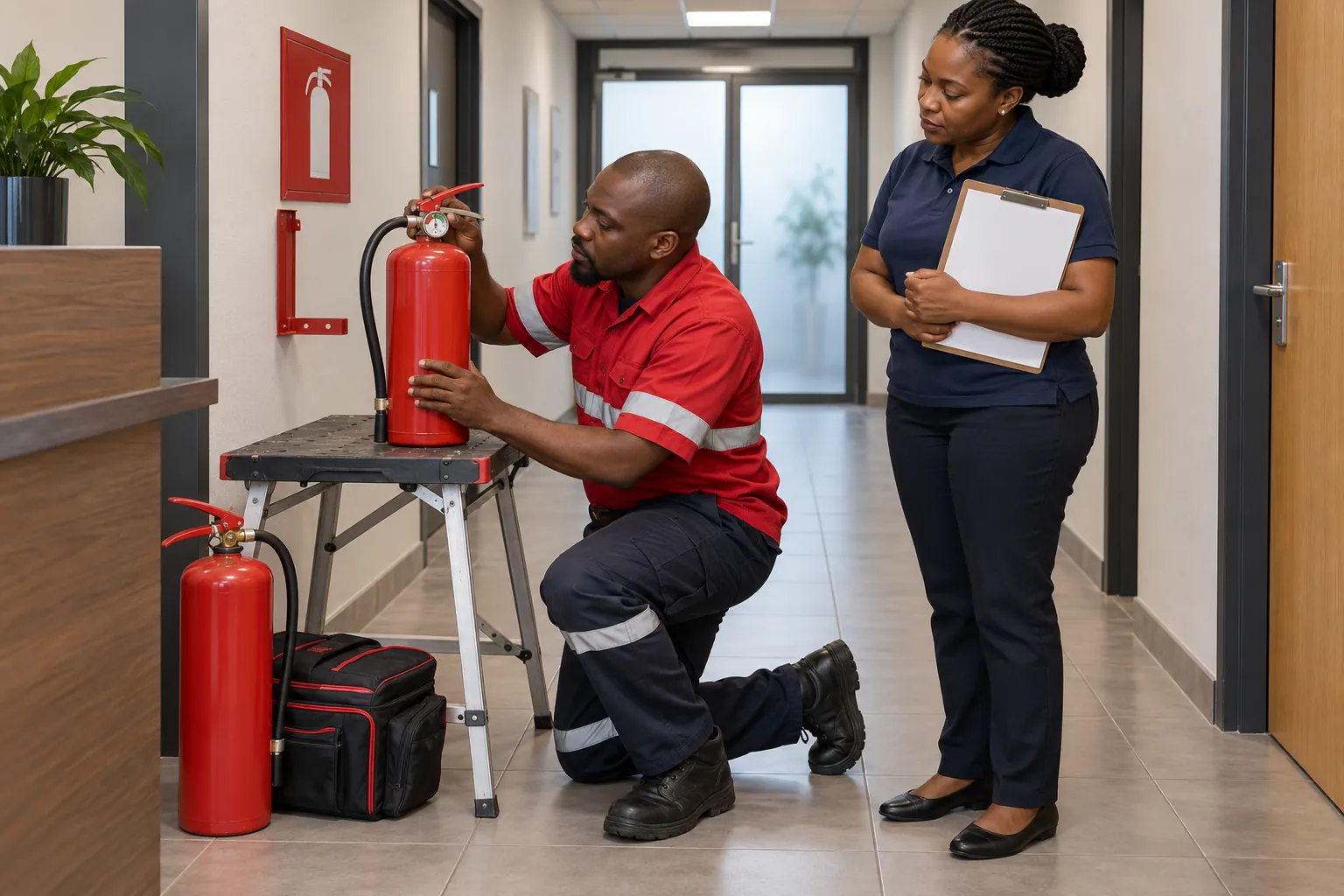 Fire and water checksSANS 1475: the annual fire extinguisher service, and what the record should showWhat SANS 1475 means for a fire extinguisher service in South Africa: who may do it, how often, the certificate, and how it differs from the monthly check.
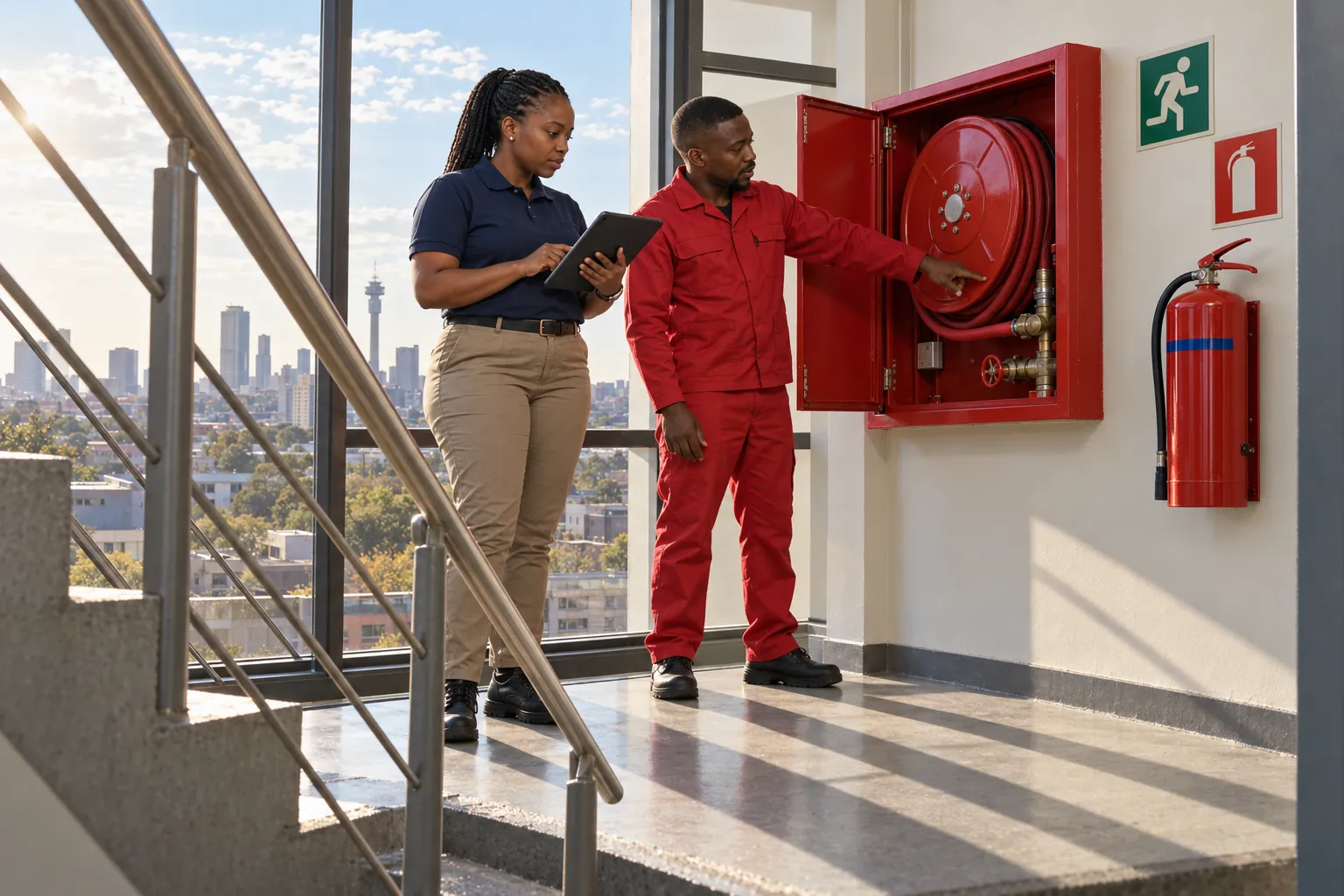 Fire and water checksFire equipment checklist: the register of everything, and when each item is dueA fire equipment checklist for South Africa: the register of every extinguisher, hose reel, hydrant and installation, service intervals and the record by-laws want.
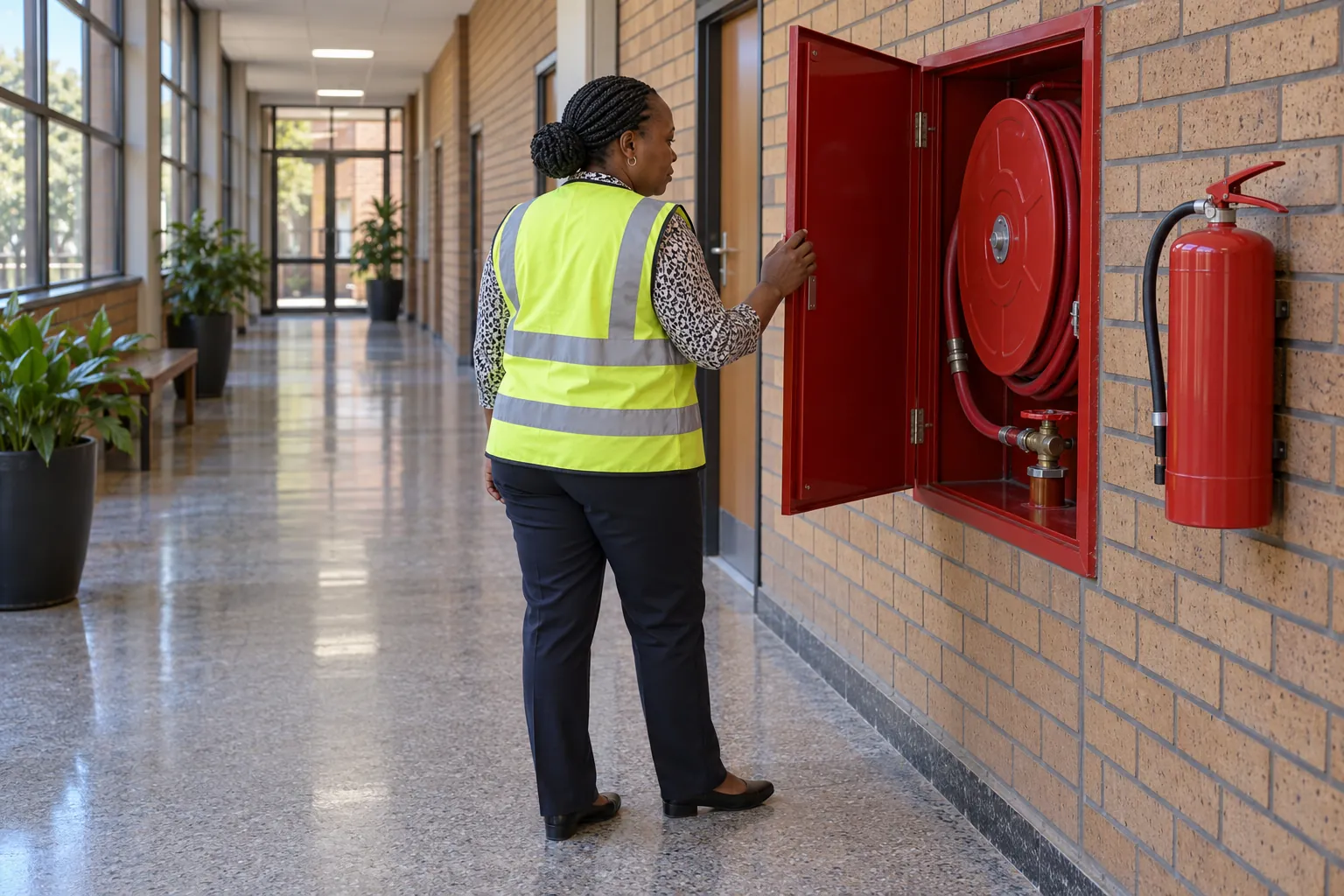 Fire and water checksFire marshal duties: the daily checks, the job in an evacuation, and the recordWhat a fire marshal does in a South African workplace: the law behind the role, the daily walk round, the job in an evacuation, training and the record.
 Fire and water checksFire drills: how to plan, run and record an evacuation drillHow often South African by-laws ask for a fire drill, how to plan and time one, what the drill register must record, and how to follow up what it finds.