Fire and water checks
SANS 1475: the annual fire extinguisher service, and what the record should show
SANS 1475 is the South African National Standard for reconditioning fire-fighting equipment: Part 1 (SANS 1475-1:2025) covers the servicing of portable and wheeled rechargeable fire extinguishers, and Part 2 (SANS 1475-2:2024) fire hose reels and hydrants.
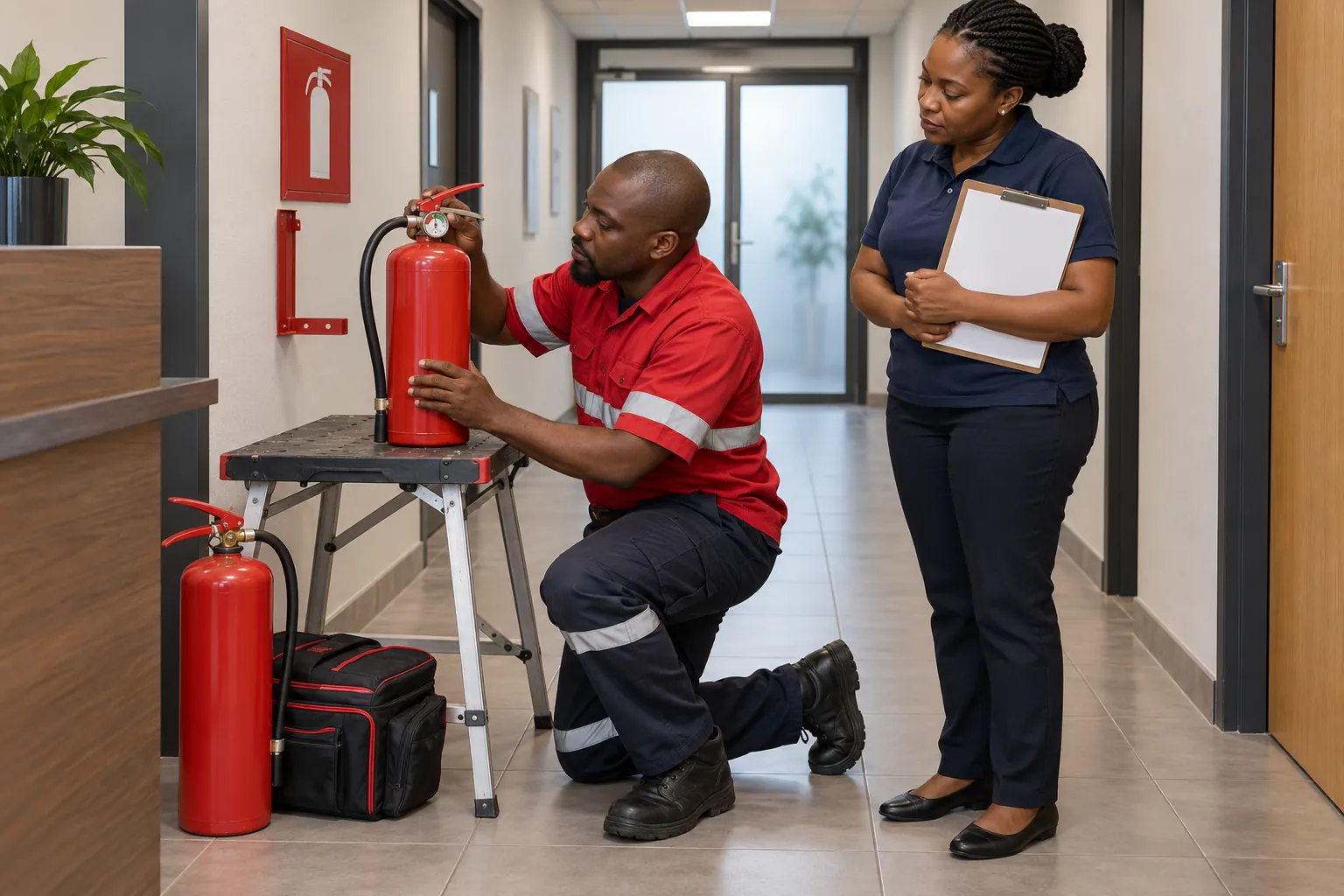
Municipal fire by-laws make it binding by requiring extinguishers to be maintained to it, usually at least every 12 months, and in Cape Town and eThekwini only by an SABS permit holder or an SAQCC-certified person. It is the annual service by a registered servicer, not the monthly look staff can do. This guide covers where the duty comes from, who may do the work, the service visit, the certificate and service record that show compliance, and the year between services.
01
What SANS 1475 is, and how it becomes binding
SANS 1475-1:2025, The production of reconditioned fire-fighting equipment Part 1: Portable and wheeled (mobile) rechargeable fire extinguishers is published by the South African Bureau of Standards (SABS). Edition 4 was approved on 31 October 2025 and replaces edition 3.04 of 2010. The SABS describes it as covering "the administrative and technical details and controls applicable to the acceptable reconditioning of any portable and wheeled (mobile) rechargeable fire extinguisher". In practice, reconditioning is the service: filling, recharging, repairing, inspecting and testing an extinguisher already in use.
Its companion is SANS 10105-1:2021, The use and control of fire-fighting equipment Part 1: Portable and wheeled (mobile) fire extinguishers, which sets requirements for "the selection, installation, inspection and use" of extinguishers. SANS 1475-1 is about the servicer's work on the extinguisher; SANS 10105-1 is about the extinguisher in its place.
Like most SANS standards, SANS 1475 is voluntary on its own. It becomes a legal requirement when a law calls it up, and for a building in use that law is usually the fire safety by-law of the municipality where the building stands. People often speak of fire codes; in South Africa the rules that bind a building in use are these by-laws, the standards they name and the national regulations below. Three metros show the pattern:
- City of Cape Town. Section 17(2) of the Community Fire Safety By-law, 2002 (as amended to 2015): "Fire extinguishers must be maintained strictly in accordance with the requirements of the Occupational Health and Safety Regulations, SABS 1475: Part 1, SABS 1571, SABS 1573 and SABS 0105: Part 1." (SABS 0105 is now SANS 10105.)
- eThekwini (Durban). Section 25(2) of the eThekwini Fire By-law, 2022 uses the same words with current numbers: extinguishers "must be maintained strictly in accordance with the requirements of the Occupational Health and Safety Regulations, SANS 1475: Part 1, SANS 11601, SANS 1572 - and SANS 10105: Part 1". Section 25(7) does the same for hose reels and hydrants under SANS 1475 Part 2 and SANS 10105 Part 2.
- City of Johannesburg. Section 16(1)(b) of the City of Johannesburg Emergency Services By-law, 2004 requires every owner of a building to ensure that "all portable and mobile fire-extinguishers and all hose reels on the premises are serviced and maintained in accordance with SABS 0105 and SABS 1475".
Nationally, the General Safety Regulations, 2025 (Government Notice 5954 of 6 March 2025) under the Occupational Health and Safety Act 85 of 1993 set the employer's duty without naming a standard. Regulation 13J(2) requires every employer to "provide on the premises an adequate supply of suitable fire-fighting equipment at strategic locations or as may be recommended by the fire chief of the local authority concerned, and such equipment shall be maintained in good working order", having regard to the workplace and the flammable articles on the premises. Under regulation 14, failing to comply is an offence.
02
What the annual service covers, and what it does not
The SANS 1475 service is the specialist part of looking after fire equipment, and a building needs it alongside three other things:
- The annual service under SANS 1475. A permit holder or SAQCC-certified technician examines each extinguisher, and refills, recharges, repairs or tests it, or takes it out of service. Hose reels and hydrants are serviced under SANS 1475-2.
- The routine visual check between services. Each extinguisher in its place, visible and unobstructed, seal intact, gauge in range, undamaged, label in date. SANS 10105-1 covers inspection. See the fire extinguisher checklist.
- The register of all fire equipment. Every item, where it is and when it was last checked and serviced. See the fire equipment register.
- The fire detection and alarm system. A separate installation, maintained by its own competent person. See SANS 10139 fire alarm maintenance.
The standard applies to rechargeable extinguishers, the ones designed to be refilled and put back into service. It is about the work done on them, not about whether a building has enough of the right type in the right places. That is for the National Building Regulations, SANS 10400-T:2024, The application of the National Building Regulations Part T: Fire protection, SANS 10105-1 and the fire department's requirements. A servicer should report a missing or unsuitable extinguisher, but putting it right is the owner's job, and the national regulation says the equipment "shall be maintained in good working order" all year, not only on the day of the service.
03
Who may service a fire extinguisher
The by-laws restrict the work to people who hold one of two qualifications. Section 25(8)(a) of the eThekwini Fire By-law says a person may not "fill, recharge, modify, repair, inspect or test a fire extinguisher unless that person is a holder of a permit issued by the South African Bureau of Standards or certificate of competence issued by the South African Qualifications Certification Committee". Cape Town's section 17(3) says the same of work "in terms of SABS 1475: Part 1", for juristic and natural persons alike. The committee is the body known in the trade as SAQCC Fire. Johannesburg's section 16(1)(c)(iii) asks for inspection "by an appropriately registered and competent person".
The duty is not only on the servicer. Under section 17(4) of the Cape Town by-law, the owner or person in charge "may not allow a fire extinguisher to be filled, recharged, reconditioned, modified, repaired, inspected or tested by a person not in possession of a permit or certificate". If the fire department finds work done by someone without one, section 17(5) requires it to instruct the owner to have the work done again by someone who holds one.
Before appointing a servicer, and whenever the technician on site changes:
- Ask for the company's SABS permit and each technician's SAQCC Fire registration, and check with the issuing body that they are current.
- Check that they cover the work: extinguishers under Part 1, and hose reels and hydrants under Part 2 if the same firm services those.
- Keep copies with the service record, and ask for new ones when they expire.
- Put in the contract what is serviced, how often, what the certificate will contain and how quickly defects are put right.
Appointing a servicer does not move the by-law duty off the owner, who must still make sure the equipment is serviced and the record kept. Where the servicer works on the premises as a mandatary, the arrangement can be set out in a section 37(2) agreement under the OHS Act.
04
How often, and what happens on the service visit
How often. The usual interval is at least once every 12 months. Section 16(1)(c)(iii) of the Johannesburg by-law requires fire-fighting equipment to be "inspected by an appropriately registered and competent person at least once every 12 months". Table 2 in section 31 of the eThekwini Fire By-law gives 12 months for portable fire extinguishers. An extinguisher that has been used, damaged or tampered with needs attention at once, not at the next annual visit. Ask the servicer which extinguishers also need a periodic pressure test, and to record for each one when its next service and any pressure test are due.
Keeping the building covered. An extinguisher taken away is a gap in the building's protection, and the by-laws deal with it:
- Cape Town section 17(7): an extinguisher "may not be removed from the premises" for servicing "unless the appliance is replaced temporarily with a similar appliance in good working condition".
- eThekwini section 25(3): the competent person "must temporarily replace them with similar appliances in good condition", and under section 25(4) the owner or occupier must notify the Municipality if they do not.
- eThekwini section 25(6): removal "must be evenly distributed and not more than 50 percent of the available fire extinguishers on any floor or any area shall be removed from service at any one time".
- Neither by-law allows an extinguisher to be serviced where that would itself be dangerous: Cape Town section 17(8) forbids it "in an area where such action would create a danger or hazard", and eThekwini section 25(5) where it "would create a fire hazard".
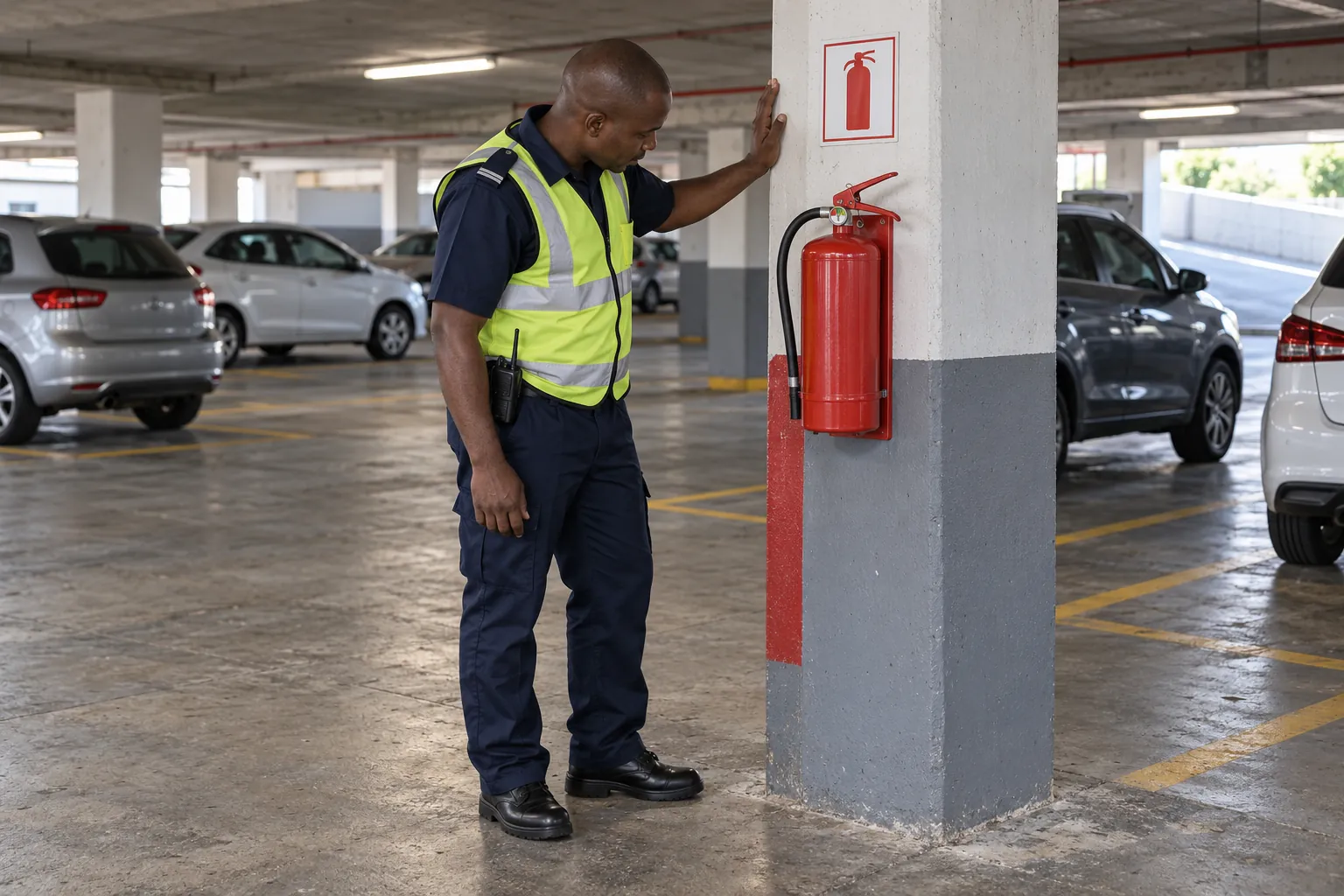
On the day. Give the servicer the register, so every extinguisher is found, including those in plant rooms and tenants' stores, and arrange access to locked areas in advance. Tell the security officer on duty who is coming. Before the servicer leaves, walk the building floor by floor and confirm that every extinguisher is back on its bracket or stand, with its signage visible, and that any loan units are in place.
When something cannot be fixed. Where equipment "cannot readily be repaired to a functional state", the servicer must notify the Chief Fire Officer in writing (Johannesburg section 16(2)(b); eThekwini section 31(4)(b) adds the owner and the action needed). eThekwini section 31(5) then requires the owner to have defects attended to "without delay", and section 31(6) to notify the Municipality immediately when a fire protection system or component is taken out of service, and again when it is restored.
05
The certificate, the service record, and what good evidence looks like
When the work is done, the servicer certifies it. Section 16(2)(a) of the Johannesburg by-law requires every person who inspects, services or repairs fire-fighting equipment to "certify in writing that the equipment or installation concerned is fully functional" and to "furnish that certificate to the owner of the premises". eThekwini's section 31(4)(a) uses the same words. That certificate is the statutory evidence of the service. Each extinguisher usually also carries the servicer's label, showing when it was serviced and by whom.
The owner keeps the record. Johannesburg's section 16(1)(d) requires "a comprehensive service record of all fire-fighting equipment and service installations on the premises", furnished to the Chief Fire Officer every 12 months; eThekwini's section 31(1) a "detailed service record" kept for examination by the Municipality; and Cape Town's section 18 a "detailed record of such tests and maintenance" of a fire protection system.
A service record that will stand up to a fire safety inspection, an insurer's survey or a client's audit shows:
- each extinguisher by its location and serial number, with its type and size;
- the date it was serviced, what was done, and when its next service and any pressure test are due;
- the servicer's SABS permit number and the SAQCC Fire registration of the technicians who did the work;
- every defect, every extinguisher taken away and the loan unit that replaced it;
- the signed certificate that the equipment is fully functional, or the written list of what is not.
The weak point is rarely the certificate itself. It is the gap between the list of extinguishers the servicer saw and the list the building has, and the defects written on page two that nobody chased. Reconcile the two lists after every visit, and treat an extinguisher missing from the certificate as unserviced until the servicer confirms otherwise.
06
Where the record fails, and what SiteClara does about it
The annual certificate says the extinguishers were fully functional on the day the servicer visited. It says nothing about the other 364. In most buildings the checks in between live on a card tied to each extinguisher or a sheet in the security office, initialled for the month in one go, and a defect found by a guard on patrol or a cleaner goes to whoever happens to be passing, if it is reported at all.
SiteClara records routine checks where they happen. A printed QR poster, with an optional NFC tag behind it, sits at each location, such as a fire point, a corridor, a stairwell or a plant room. Cleaners, security officers and supervisors scan or tap on their own phone, with no app to install, see the checks due there, and mark each one done or say what stopped them, with a photo when one is asked for, such as the gauge or the service label. The time and the named person are recorded as it happens. A fault found there, such as a missing extinguisher, a broken seal or a blocked fire point, goes onto the team's list of open jobs until someone closes it, which is also a way to follow a servicer's list of defects through to the end.
The supervisor sees what is due, done and missed, gives the reason a check was missed, and approves a daily report that goes to the client's facilities manager and other nominated contacts at 08:00 the next morning: what was reported, completed and still open, and how the scheduled checks went.
07
Questions people ask
What are the legal requirements for fire extinguishers in South Africa?
Nationally, regulation 13J(2) of the General Safety Regulations, 2025 requires every employer to provide an adequate supply of suitable fire-fighting equipment at strategic locations, or as the local fire chief recommends, and to keep it in good working order. The municipal fire by-law then sets how it is maintained: section 25(2) of the eThekwini Fire By-law, 2022, for example, requires extinguishers to be maintained in accordance with SANS 1475 Part 1 and SANS 10105 Part 1, and section 31 requires a detailed service record.
What is the difference between SANS 1475 Part 1 and Part 2?
SANS 1475-1:2025 covers the reconditioning of portable and wheeled (mobile) rechargeable fire extinguishers. SANS 1475-2:2024 covers the reconditioning of fire hose reels and hydrants, and does not cover supplying or installing them. Section 25(7) of the eThekwini Fire By-law, 2022 calls up Part 2 for hose reels and hydrants.
Who needs a SANS 1475 permit?
Anyone who fills, recharges, modifies, repairs, inspects or tests a fire extinguisher. Section 25(8)(a) of the eThekwini Fire By-law, 2022 forbids that work unless the person holds a permit issued by the South African Bureau of Standards or a certificate of competence from the South African Qualifications Certification Committee (SAQCC Fire), and section 17(3) of the City of Cape Town Community Fire Safety By-law, 2002 makes the same rule for work under SABS 1475 Part 1.
Where can I get a fire compliance certificate for fire extinguishers?
From the servicer who does the work. Section 16(2)(a) of the City of Johannesburg Emergency Services By-law, 2004 requires every person who inspects, services or repairs fire-fighting equipment to certify in writing that it is fully functional and to give that certificate to the owner of the premises, or to tell the Chief Fire Officer in writing if it cannot readily be repaired. The owner keeps it with the service record, which Johannesburg's section 16(1)(d) requires to be sent to the Chief Fire Officer every 12 months.
08
Where to read the official text, and a list to take away
Start with your own municipality's fire safety by-law. The three quoted here are the City of Cape Town Community Fire Safety By-law, 2002 (as amended to 2015), the eThekwini Fire By-law, 2022 and the City of Johannesburg Emergency Services By-law, 2004 (as consolidated to 31 August 2011). By-laws change, so confirm the current text with the municipality. Nationally, read regulation 13J of the General Safety Regulations, 2025 under the Occupational Health and Safety Act 85 of 1993. The standards, SANS 1475-1:2025, SANS 1475-2:2024 and SANS 10105-1:2021, are sold by the SABS; your servicer should hold current copies. Before and after each annual service, check that:
- you know which by-law applies, the standards it names and the interval it sets;
- the company's SABS permit and each technician's SAQCC Fire registration are current, and you have copies;
- every extinguisher, hose reel and hydrant on the register was seen, and loan units covered anything taken away;
- you have the written certificate that the equipment is fully functional, or a written list of defects;
- each defect has an owner and a date, and the fire department was told where the by-law requires it;
- the checks between services are done at the extinguisher and recorded as they happen.
Sources
Every document this guide quotes or links to, in the order it first cites them.
- SANS 1475-1:2025, The production of reconditioned fire-fighting equipment Part 1: Portable and wheeled (mobile) rechargeable fire extinguishers store.sabs.co.za
- SANS 10105-1:2021, The use and control of fire-fighting equipment Part 1: Portable and wheeled (mobile) fire extinguishers store.sabs.co.za
- Community Fire Safety By-law, 2002 openbylaws.org.za
- EThekwini Fire By-law, 2022 openbylaws.org.za
- City of Johannesburg Emergency Services By-law, 2004 openbylaws.org.za
- General Safety Regulations, 2025 (Government Notice 5954 of 6 March 2025) gov.za
- Occupational Health and Safety Act 85 of 1993 gov.za
- SANS 10400-T:2024, The application of the National Building Regulations Part T: Fire protection store.sabs.co.za
- SANS 1475-2:2024 store.sabs.co.za
Related guides
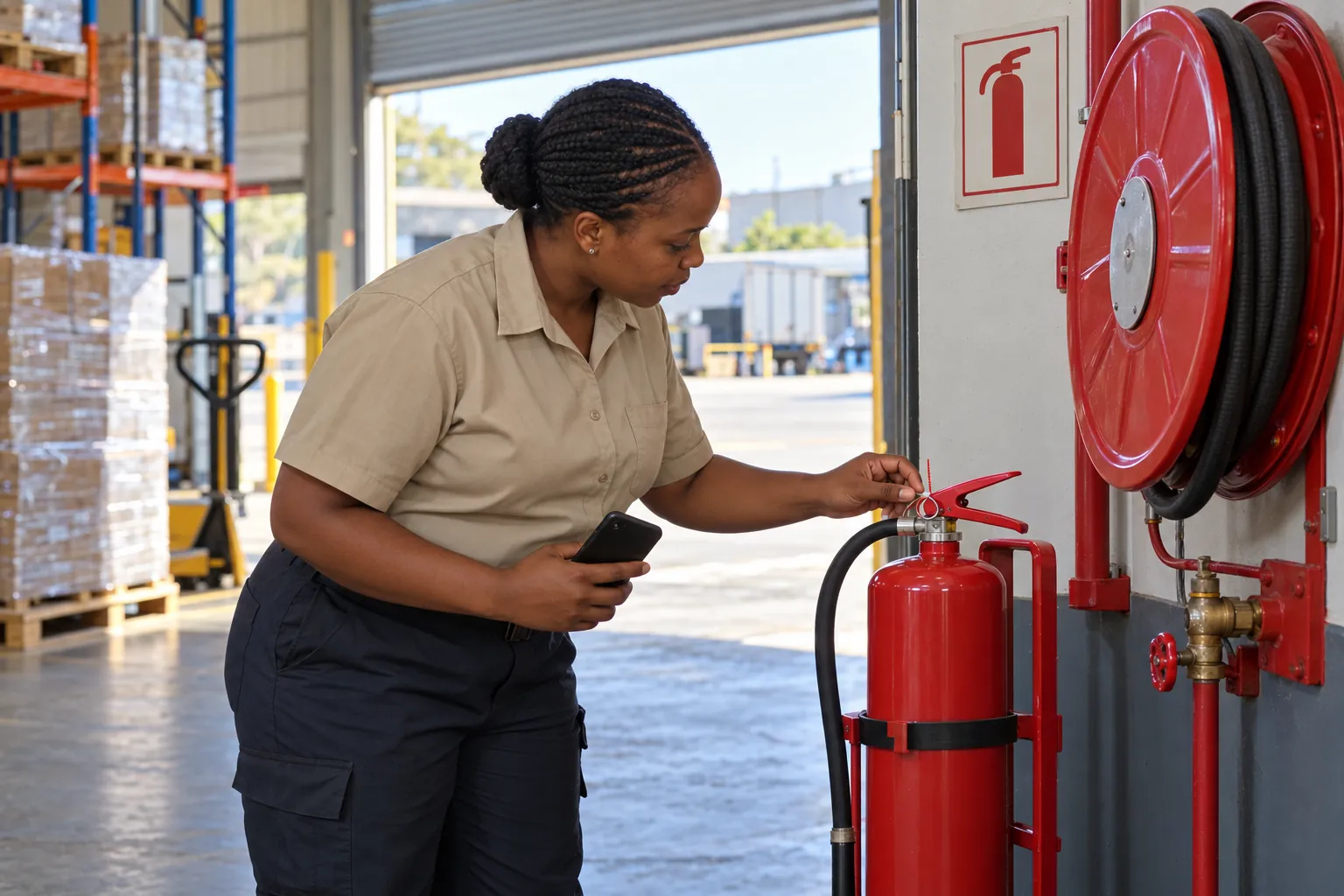 Fire and water checksFire extinguisher checklist: the routine check between annual servicesA fire extinguisher checklist for South African buildings: what to look at between SANS 1475 services, who checks, how often, and what the record should show.
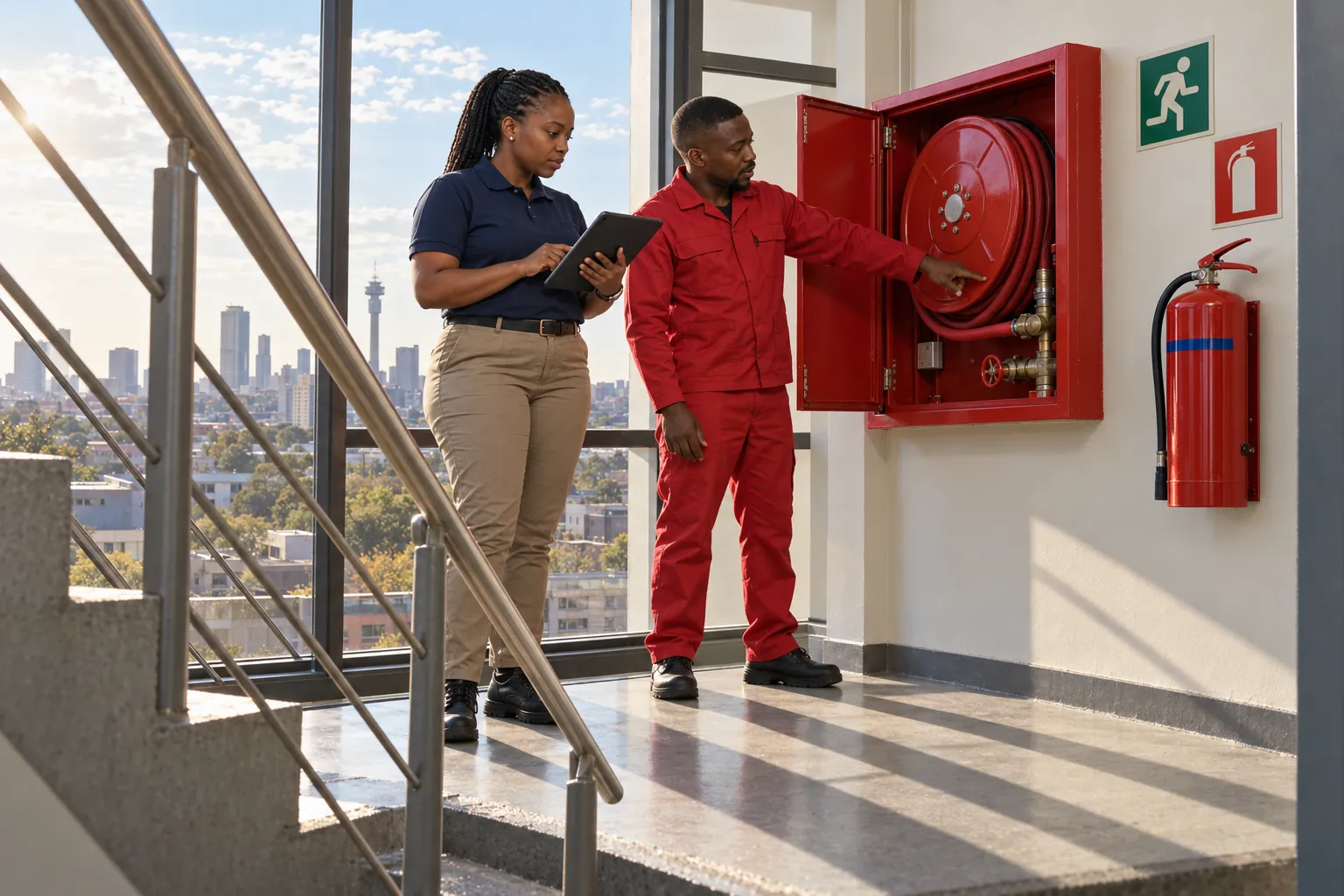 Fire and water checksFire equipment checklist: the register of everything, and when each item is dueA fire equipment checklist for South Africa: the register of every extinguisher, hose reel, hydrant and installation, service intervals and the record by-laws want.
 Fire and water checksSANS 10139: maintaining, testing and recording a fire alarm systemSANS 10139 explained: when the fire detection code applies, how by-laws call it up, the routine tests on site, servicing by a registered person, and the log book.
 Fire and water checksFire marshal duties: the daily checks, the job in an evacuation, and the recordWhat a fire marshal does in a South African workplace: the law behind the role, the daily walk round, the job in an evacuation, training and the record.