Fire and water checks
Fire marshal duties: the daily checks, the job in an evacuation, and the record
A fire marshal's duties are to keep their area ready to evacuate day to day, by checking that escape routes, exit doors, fire doors and fire extinguishers are clear and in place, and, when the fire alarm sounds, to lead people out safely, sweep the area and report it clear at the assembly point, as the building's emergency evacuation plan sets out.
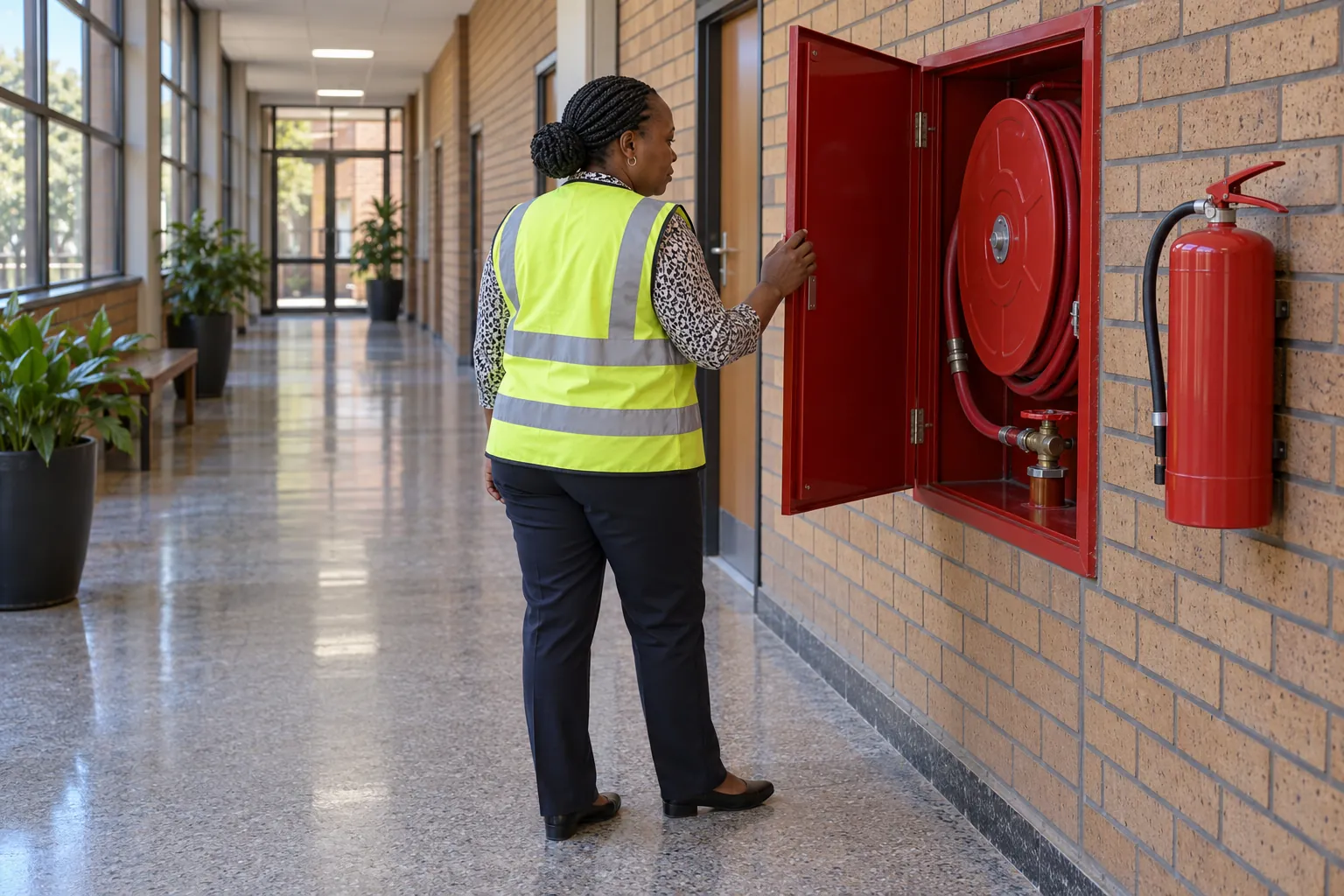
South African law does not use the words fire marshal or fire warden: the role is how an employer meets the Occupational Health and Safety Act 85 of 1993 and its General Safety Regulations, and how an owner meets the fire safety by-law of the municipality where the building stands. This guide covers where the duties come from, how many marshals a building needs, the checks they make, what they do in an evacuation, their training, and how to keep a record that shows the work was done.
01
The fire marshal role, and the law behind it
A fire marshal, also called a fire warden or floor warden, is usually an ordinary member of staff with a reflective vest in a drawer and an area they know well. Neither title appears in the national Act, its regulations or the three metro by-laws quoted here; the duties come from what those laws require of employers and building owners.
Nationally, section 8(1) of the Occupational Health and Safety Act 85 of 1993 requires every employer to provide and maintain, as far as is reasonably practicable, a working environment that is safe and without risk to the health of employees. Section 8(2)(e) includes "providing such information, instructions, training and supervision as may be necessary". Section 14 requires employees to co-operate, obey the health and safety rules and procedures, and report an unsafe situation as soon as practicable.
The General Safety Regulations as amended by Government Notice 5954 of 6 March 2025 set out what the marshal's walk round protects. Regulation 13J(1) requires every employer, "in order to expedite the evacuation of a workplace in case of fire", to ensure that every exit door is "kept clear and capable of being easily and rapidly opened from inside", that fire escape staircases are "kept clear of any material or other obstruction", and that there are at least two means of egress as far apart as practicable. Regulation 13J(2) requires suitable fire-fighting equipment at strategic locations, "maintained in good working order".
The municipal by-laws are where the role is written into a plan. The City of Cape Town Community Fire Safety By-law, 2002 defines an emergency evacuation plan as one that "assigns responsibility to various staff", indicates the escape routes and provides for a safe and quick evacuation, and the eThekwini Fire By-law, 2022 defines its emergency preparedness plan in the same words. Schedule 1 of the City of Johannesburg Emergency Services By-laws asks a plan to name the members of the emergency team, including its management, the continuity officers, the fire teams and the first aid teams, and to set out their duties and responsibilities. A building's fire marshals are that assigned staff, or that emergency team.
02
Appointing fire marshals, and how many a building needs
None of the laws quoted here sets a number of fire marshals per head or per floor. Regulation 2(1) of the General Safety Regulations requires every employer to evaluate the risk of any condition or situation that may arise from its activities, and the number of marshals should come out of that risk assessment and the emergency evacuation plan. Work it out from:
- The layout: the number of floors, stairwells and exits, and areas people rarely see, such as basement parking, plant rooms, store rooms and ablutions.
- The people: staff, tenants, learners, patients or guests, visitors and contractors, and anyone who will need help to get out.
- The hours: a marshal who works days does nothing for the night cleaners or the weekend security officers. Each shift needs its own.
- Absence: leave, sickness, training days and site visits. A floor with one marshal is, for part of every month, a floor with none, so name a deputy.
Many employers appoint their marshals in writing, as they do other health and safety roles, so that the person knows the area and duties they have taken on and the plan can name them. In a building shared by several tenants, the owner or managing agent usually runs the plan and each employer provides marshals for its own floor. Cleaning, security and maintenance contractors take part too: say so in each contractor's section 37(2) agreement and in the officers' site instructions, because at night the security officer on post may be the only marshal in the building. Johannesburg's section 18(1)(b) asks designated premises to set up a fire protection committee of occupiers; that committee, or the health and safety committee, is a good place to keep the list of marshals current.
03
Fire marshal duties day to day: the walk round
Most of the role is a short visual walk round of the marshal's area at a regular time. It is not a service or a competent person's inspection, but it catches the everyday problems that make an evacuation slower or a fire worse. A typical walk round covers:
- Escape routes: passages, stairs and landings clear of boxes, furniture, cleaning trolleys and deliveries. Cape Town's section 15 and eThekwini's section 18 both prohibit obstructing any part of an escape route.
- Exit doors: unlocked, or fitted with an approved release, and opening easily from inside, as regulation 13J(1)(b) requires. Check escape doors on access control or magnetic locks, and the pedestrian gate out to the assembly point.
- Fire doors: closed and closing fully onto the latch. eThekwini's section 19(3) forbids disconnecting the self-closer or wedging a fire door so that it cannot close.
- Fire equipment: every fire extinguisher on its bracket, unobstructed, with its pin and seal in place and the gauge, where fitted, in the green; hose reels unobstructed and not used for cleaning or watering.
- Manual call points and the alarm panel: call points unobstructed and undamaged, and the panel, where the marshal is asked to check it, showing normal with no fault or isolation lights.
- Signs and emergency lighting: exit signs visible, and emergency light indicators on.
- Housekeeping: combustible rubbish building up, heaters near paper and overloaded adaptors.
- The assembly point: reachable, and not taken over by parked vehicles, skips or building works.
Check escape routes and doors daily, because they change with every delivery, and the rest weekly. Keep the list to about ten minutes of walking: a long checklist makes the check slower, and a slow check is the one that stops happening. Where the building runs on a standby generator or UPS, the marshal should also know what access-controlled doors, gate motors and lifts do during load shedding, and report a door or gate that stays locked.
Servicing is someone else's job: Cape Town's section 17(3) allows only a permit or certificate holder to recharge, inspect or test an extinguisher under SABS 1475-1, and section 18 requires fire protection systems to be tested and maintained regularly, with a detailed record. The marshal notices what goes wrong between visits and reports it, so that it goes onto the fire equipment register and to the service provider.
04
The fire marshal's duties in an evacuation
When the alarm sounds, the marshal helps get everyone out of their area quickly and calmly, and tells the person in charge what they found. The detail belongs in the building's emergency evacuation plan, but it usually runs like this:
- Put on the vest so people can see who is leading, and tell those nearby to leave by the nearest safe exit without going back for belongings.
- Sweep the area on the way out, including ablutions, meeting rooms, kitchens and store rooms, without delaying your own escape and without opening a door where there are signs of fire behind it.
- Close doors behind you to slow the spread of fire and smoke.
- Keep people out of the lifts, which may stop, and will not run during load shedding without backup power.
- Help people who need assistance, as the plan sets out, and tell the person in charge exactly where anyone waiting for help is.
- Report at the assembly point to the chief marshal or person in charge: whether the area is clear, any room that could not be checked, and anything seen.
- Help with the roll call against staff lists, the visitor register and the contractors' sign-in, and keep people at the assembly point until the fire service or the person in charge gives the all clear.
Johannesburg's section 18(1)(e) asks the owner of designated premises to identify a place of safety near the building "for the purpose of compiling a list of survivors". The marshals' reports make that list, and it tells the fire service whether anyone may still be inside.
Where security officers open the gates and keep people from going back in, put that in the site's security officer duties so a relief officer knows it too. A marshal may use an extinguisher or hose reel on a small fire only if trained to, the alarm has been raised and there is a clear way out behind them. Nobody is expected to put themselves at risk, and in many buildings the plan is simply to get out.

05
Training, drills and what a good record shows
Section 8(2)(e) of the Act requires the training that is necessary, and Johannesburg's Schedule 1 says everyone who works or lives on premises with an evacuation plan should be suitably trained in first aid or fire fighting, emergency aid, emergency evacuation procedures and emergency management techniques. Marshals need more: their own area and route, how to sweep it, the types of extinguisher and when not to use one, and how to report at the assembly point, with a new marshal shown the walk round itself.
Marshals are tested in fire drills. Cape Town's section 23(4) requires listed premises to test the plan "in its entirety at a maximum of six-monthly intervals" or when it has been revised, eThekwini's section 33(5) at least every 12 months, and Johannesburg's guideline says a plan "should be drilled at least twice each year". Both the Cape Town and eThekwini by-laws require each test to be kept in a register, and Johannesburg's Schedule 1 asks for the plan to be reviewed whenever a member of the emergency team's management stops working at the premises.
A good record of the marshals' checks answers three questions for whoever reviews it: were the checks done, by whom, and what happened to the problems found? Each entry should carry:
- the date and time the check was done, written at the time;
- the area or route checked, and the name of the marshal;
- what was found, including the wedged fire door and the boxes on the stairs, not just ticks;
- who each problem was reported to, and the date it was put right;
- checks that were missed, and why, such as a marshal on leave with no deputy.
Exceptions make the record believable. A year of walk rounds with nothing ever found does not suggest a perfect building; it suggests the sheet is being signed rather than walked.
06
Where the record fails, and what SiteClara does about it
On paper, the marshal's check is a line on a sheet inside a cupboard door: easy to sign without walking the route, easy to miss when the marshal is on leave, and hard to follow up. The fire door wedged open on Tuesday is still wedged on Friday, because the sheet sends the problem to nobody.
SiteClara records routine checks where they happen. A printed QR poster, with an optional NFC tag behind it, sits at each point on the route, such as a stairwell landing, a final exit or the alarm panel. The marshal scans or taps with their own phone, with no app to install, sees the checks due there, and marks each one done or says what stopped them, with a photo when one is asked for. The time and the named person are recorded as it happens.
A problem found on the walk round, such as a blocked exit, is reported there with a photo and stays on the team's list of open jobs until someone closes it. The supervisor sees which checks are due, done and missed, gives the reason one was missed, and approves a daily report that goes to nominated management or client contacts the next morning, showing how the scheduled checks went and what is still open.
07
Questions people ask
What are the responsibilities of a fire marshal in South Africa?
They are whatever the building's evacuation plan assigns to them. The City of Cape Town Community Fire Safety By-law, 2002 defines an emergency evacuation plan as one that "assigns responsibility to various staff", indicates the escape routes and provides for a safe and quick evacuation, and section 33 of the eThekwini Fire By-law, 2022 requires an emergency preparedness plan to detail the appropriate action to be taken by the staff or the occupants in a fire or other threatening emergency. In practice that means checking escape routes, exits and fire equipment day to day, and leading people out and reporting the area clear when the alarm sounds.
What qualifications do you need to test fire extinguishers?
A permit from the South African Bureau of Standards or a certificate of competence from the South African Qualifications Certification Committee. Section 17(3) of the City of Cape Town Community Fire Safety By-law, 2002 and section 25 of the eThekwini Fire By-law, 2022 both forbid anyone else to fill, recharge, repair, inspect or test an extinguisher, and section 16(1)(c) of the City of Johannesburg Emergency Services By-laws requires fire equipment to be inspected by an appropriately registered and competent person at least once every 12 months. A fire marshal checks that extinguishers are in place and undamaged, but does not service them.
How often should you refresh fire marshal training?
None of the three by-laws quoted here sets an interval for refresher training, but each marshal is tested whenever the plan is. Section 23(4) of the City of Cape Town Community Fire Safety By-law, 2002 requires the plan to be tested in its entirety at a maximum of six-monthly intervals, or when it has been revised, and section 33 of the eThekwini Fire By-law, 2022 at least every 12 months, with each test kept in a register. Refresh a marshal's training when a drill shows a gap, when the plan or the building changes, and when they take on a new area.
08
Where to read the official text, and a list to take away
Nationally, read the Occupational Health and Safety Act 85 of 1993, sections 8 and 14, and Government Notice 5954 of 2025 amending the General Safety Regulations, regulation 13J. Then read your own municipality's fire safety by-law: the three quoted here are the City of Cape Town Community Fire Safety By-law, 2002 (as amended to 2015), the eThekwini Fire By-law, 2022 and the City of Johannesburg Emergency Services By-laws (as consolidated to 31 August 2011). Other municipalities differ, so confirm the current text with yours. Escape routes are designed to SANS 10400-T:2024, The application of the National Building Regulations Part T: Fire protection, sold by the SABS. For your fire marshals, make sure that:
- the risk assessment and the evacuation plan say how many marshals are needed, with a deputy for each and cover on every shift;
- each marshal, including contractors' officers and cleaners, knows their area and duties;
- the walk round is short, and walked, not signed;
- each problem found goes to someone who will fix it, and missed checks carry a reason;
- drills are held at the interval your by-law sets;
- the list of marshals is updated whenever one leaves.
Sources
Every document this guide quotes or links to, in the order it first cites them.
- Occupational Health and Safety Act 85 of 1993 gov.za
- General Safety Regulations as amended by Government Notice 5954 of 6 March 2025 gov.za
- City of Cape Town Community Fire Safety By-law, 2002 openbylaws.org.za
- EThekwini Fire By-law, 2022 openbylaws.org.za
- City of Johannesburg Emergency Services By-laws openbylaws.org.za
- SANS 10400-T:2024, The application of the National Building Regulations Part T: Fire protection store.sabs.co.za
Related guides
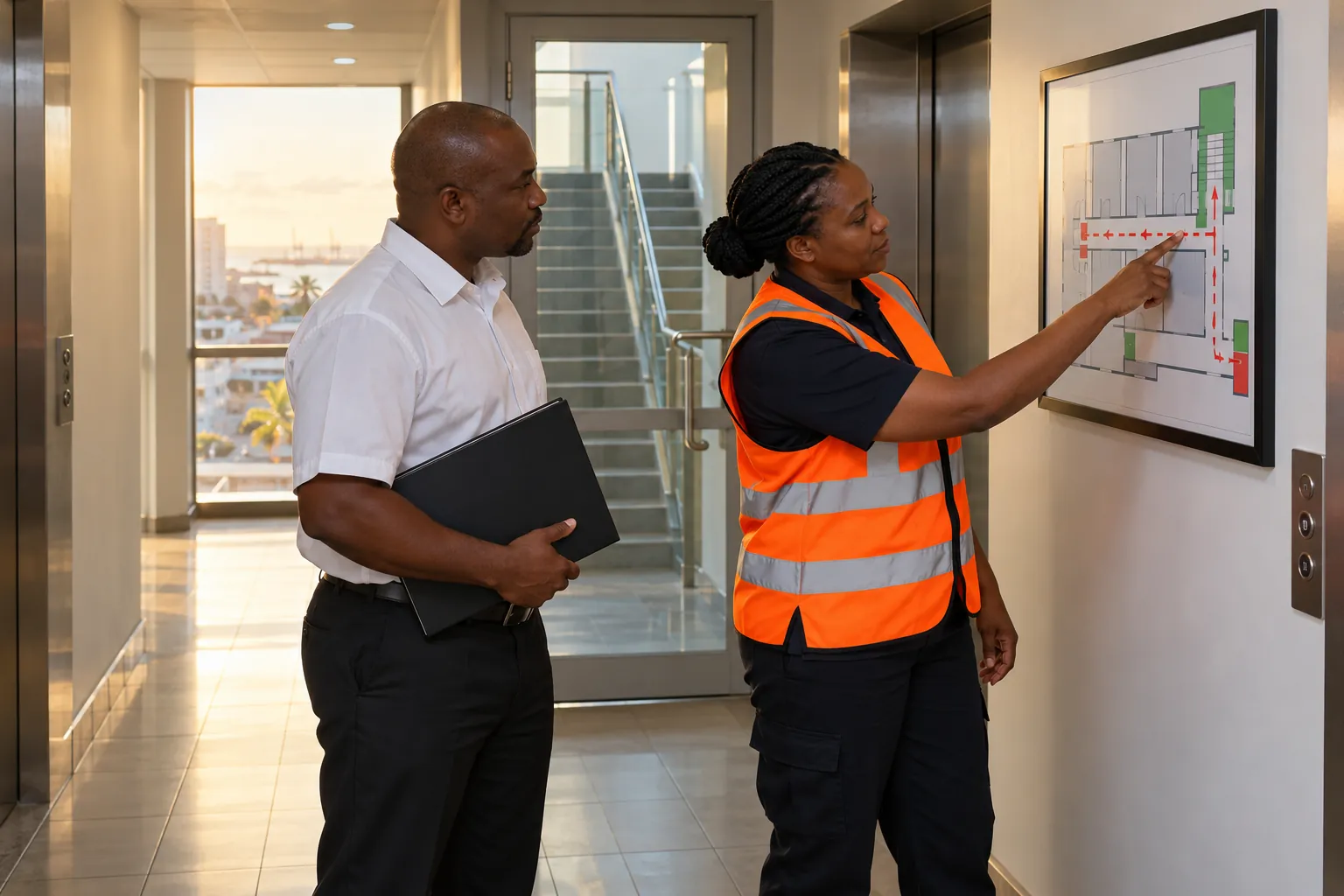 Fire and water checksEmergency evacuation plans: what goes in one, and how to keep it trueWhat an emergency evacuation plan must contain in South Africa, which by-laws require one, how often it is reviewed and tested, and keeping escape routes usable.
 Fire and water checksFire drills: how to plan, run and record an evacuation drillHow often South African by-laws ask for a fire drill, how to plan and time one, what the drill register must record, and how to follow up what it finds.
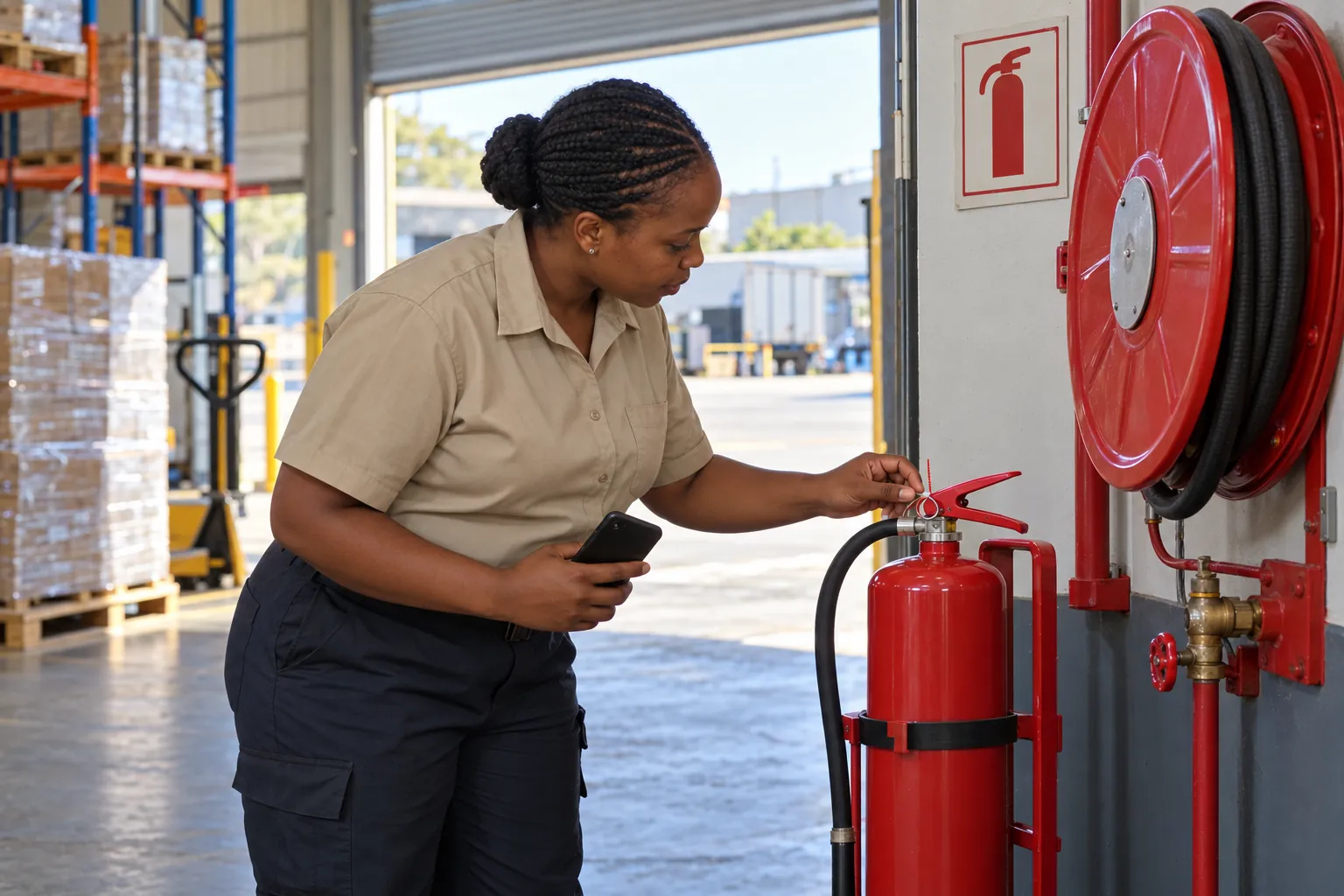 Fire and water checksFire extinguisher checklist: the routine check between annual servicesA fire extinguisher checklist for South African buildings: what to look at between SANS 1475 services, who checks, how often, and what the record should show.
 Fire and water checksFire equipment checklist: the register of everything, and when each item is dueA fire equipment checklist for South Africa: the register of every extinguisher, hose reel, hydrant and installation, service intervals and the record by-laws want.