Fire and water checks
Fire equipment checklist: the register of everything, and when each item is due
A fire equipment checklist is the building's register of every item of fire-fighting equipment and every fire service installation on the premises, each extinguisher, hose reel, hydrant, alarm panel, emergency light, fire door and sprinkler valve, with where it is, when it was last serviced, by whom and when it is next due.
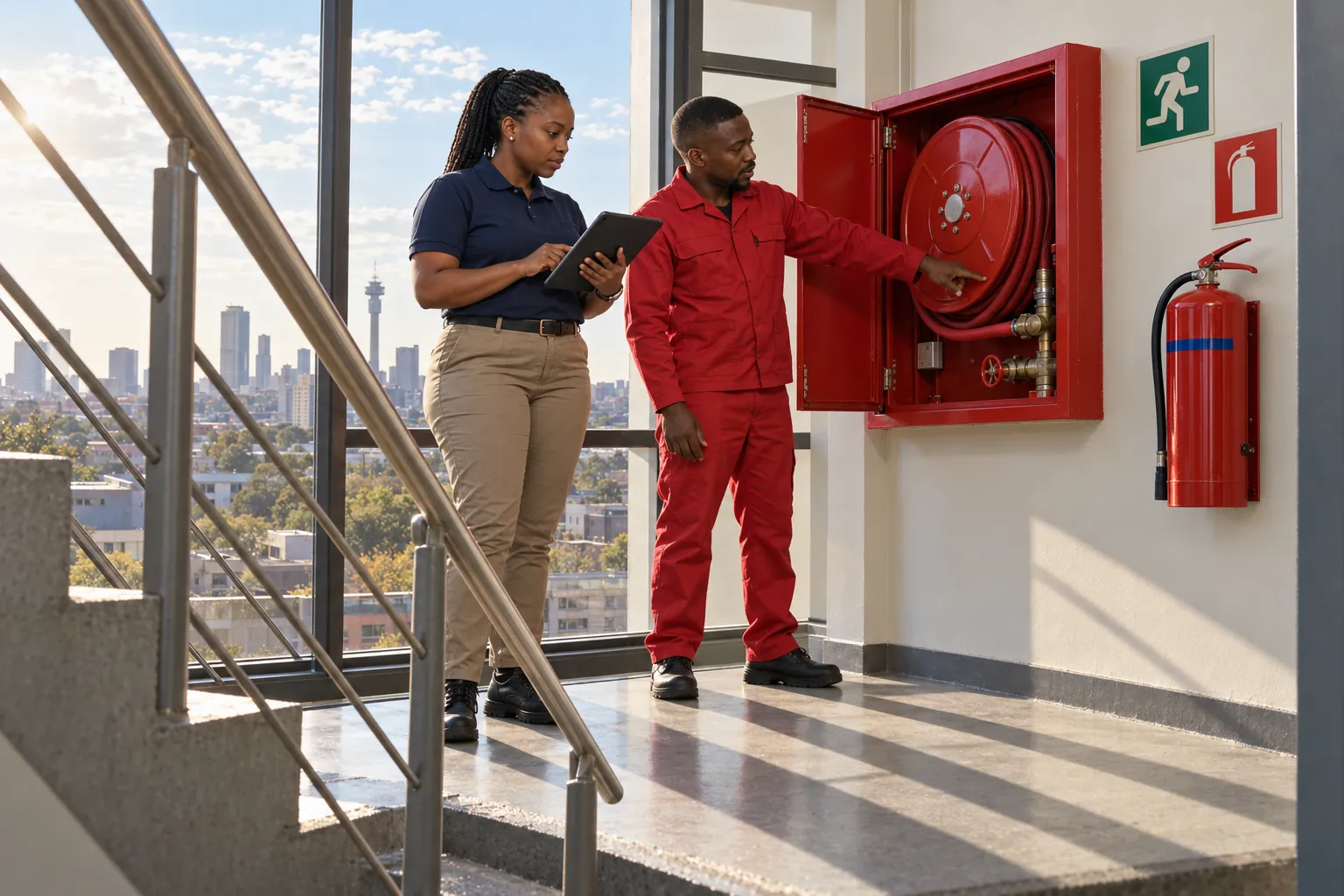
In South Africa the duty to keep that equipment in good working order is national, in regulation 13J(2) of the General Safety Regulations, 2025, and the record itself comes from the municipality's fire by-law: the City of Johannesburg's requires a comprehensive service record of all fire-fighting equipment and service installations to be furnished to the Chief Fire Officer every 12 months. This guide covers what goes on the register, how often each item is checked and serviced, who keeps it, and how to keep it true between services.
01
What a fire equipment register is, and the duty behind it
A fire equipment register is the building's list of its fire equipment, item by item, with the history of each. Every other fire record hangs off it: the monthly extinguisher round, the servicer's certificate and last Tuesday's fault all refer to an item that should be on the list.
Nationally, the duty is in the General Safety Regulations, 2025 (Government Notice 5954 of 6 March 2025), made under the Occupational Health and Safety Act 85 of 1993. Regulation 13J(2) requires an employer, having regard to the size, construction and location of the workplace and the flammable articles on the premises, to "provide on the premises an adequate supply of suitable fire-fighting equipment at strategic locations or as may be recommended by the fire chief of the local authority concerned, and such equipment shall be maintained in good working order". Regulation 14 makes a failure to comply with regulation 13J an offence. Behind both is section 8(1) of the Act: every employer must provide and maintain, as far as is reasonably practicable, a working environment that is safe and without risk to health.
The record comes from local government. The detail of fire safety in a building in use is set mainly by the fire by-law of the municipality where it stands, and the by-laws of the three largest metros each ask for one:
- City of Johannesburg. Section 16(1) of the City of Johannesburg Emergency Services By-laws requires every owner of a building to ensure that all fire-fighting equipment and service installations are maintained in good working condition by a competent person, inspected by an appropriately registered and competent person at least once every 12 months, and that "a comprehensive service record of all fire-fighting equipment and service installations on the premises is maintained and furnished to the Chief Fire Officer every 12 months".
- eThekwini (Durban). Section 31(1) of the eThekwini Fire By-law, 2022 requires the owner or person in control to have fire protection systems inspected, tested and maintained by a competent person at the intervals in its Table 2, and to "keep a detailed service record of the test and maintenance of the system for examination by the Municipality".
- City of Cape Town. Section 18(1) of the Community Fire Safety By-law, 2002 (as amended to 2015) requires a fire protection system to be tested and maintained regularly "and that a detailed record of such tests and maintenance of the system be kept"; extinguishers are dealt with separately, in section 17.
None of these by-laws uses the word "register", and none prescribes a form. A register is simply the practical way to meet them: you cannot keep a comprehensive service record of all the equipment unless you know what all the equipment is. Other municipalities word theirs differently, so check yours with the local fire department.
02
What goes on the register: the fire equipment list
The Johannesburg by-law gives a useful starting list, because its definitions separate the two things the service record must cover. Fire-fighting equipment "means any portable or mobile fire extinguisher, hose reel or fire hydrant". A service installation means "any automatic fire-extinguishing installation, fire pump connector, fire pump, emergency power or stand-by generator, fire detection, locating or alarm system, emergency lighting or evacuation communication system, mechanical ventilation system, pressure regulation system, smoke ventilation system, hoist, symbolic safety sign and smoke or fire door assembly".
In practice, walk the building floor by floor and list every item you find, including:
- Portable and wheeled extinguishers: dry chemical powder, CO2, foam, water and wet chemical, with the size of each;
- Fire hose reels and their cabinets, and hydrants, internal and in the grounds, with the fire brigade connection;
- Fire blankets in kitchens and canteens;
- The fire alarm and detection system: the panel, and the zones, call points and detectors as the installer's drawings number them;
- Sprinklers and other automatic systems: the sprinkler control valves, fire pumps and tanks, and any gas, powder or foam suppression in server rooms or kitchens;
- Emergency lighting and emergency power, including the standby generator where it supports fire systems;
- Smoke ventilation and pressurisation of stairs and lobbies, and the kitchen extraction system;
- Fire doors and smoke doors, and the escape signs and fire equipment signs.
For each item, the register holds the same columns:
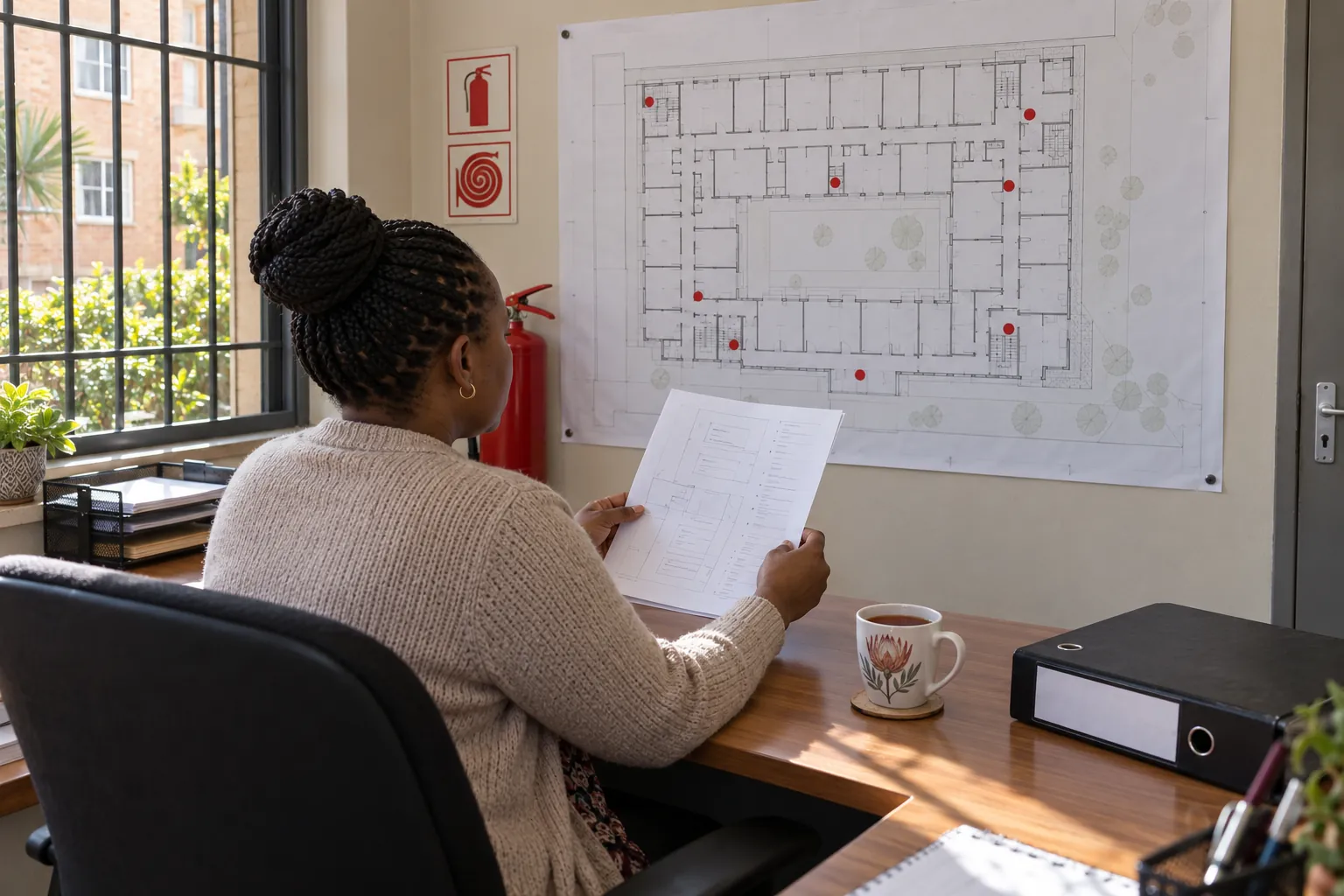
- a reference number, marked on the item or its bracket and on a floor plan;
- its location, precise enough to find in the dark: "Level 3, east stair lobby, beside the lift";
- its type and size, and the standard it is serviced to;
- the servicer and their permit, registration or certificate number;
- the date of the last service and the date the next is due;
- the in-house check it belongs to, and how often;
- its status: in service, out for service with a loan unit in its place, out of service, or removed.
Keep one list. When the servicer's job card, the security round and the manager's spreadsheet each count the extinguishers differently, nobody knows which is right.
03
The checklist: how often each item is checked and serviced
Each line on the register carries two rhythms: the service by a competent person, set by the by-law and the standard, and the in-house check between services, set by the owner. Table 2 of the eThekwini Fire By-law is the clearest published list of the first. It gives these testing and maintenance intervals:
- portable fire extinguishers, fire hose reels and fire hydrants: 12 months;
- sprinkler systems and drenchers: weekly, 12-monthly and three-yearly, under SANS 10287;
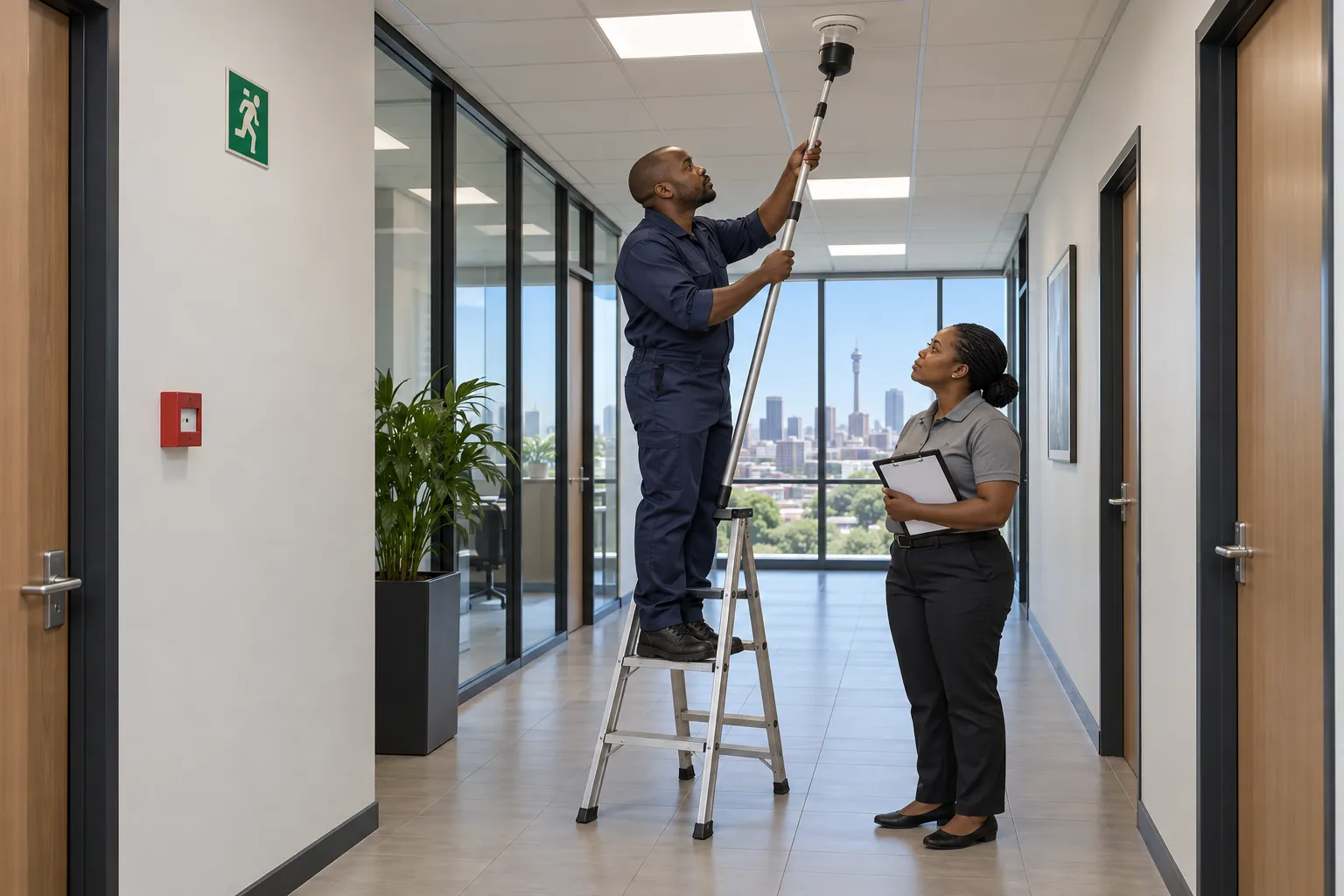
- fire alarm and detection systems: as SANS 10139 and the manufacturer set, see the guide to SANS 10139 fire alarm maintenance;
- smoke management systems: a six-monthly test and a 12-monthly service;
- emergency lighting and emergency power: monthly;
- commercial kitchen extraction: six-monthly, under SANS 1850;
- gaseous, powder and foam systems: 12-monthly;
- the fire water reticulation system: 12 months.
Johannesburg sets a floor for all of it: inspection by an appropriately registered and competent person at least once every 12 months, and servicing to the manufacturer's specifications. Where your by-law is silent, the standard and the manufacturer set the interval.
No by-law quoted here fixes the in-house check, but all of them expect the equipment to be ready for use between services, which nobody can know without looking. A sensible pattern for most offices, schools, shopping centres and residential blocks is:
- daily: the fire alarm panel shows normal, and escape routes and fire doors are clear;
- weekly: the fire alarm test from a call point in rotation, and the sprinkler checks;
- monthly: every extinguisher, hose reel and fire blanket on the register, as in the fire extinguisher checklist, with signs and fire doors;
- after anything unusual: a fire, a false alarm, building work, a break-in or a service visit, check that area against the register.
Agree the intervals with your servicer and insurer and write them on the register, so each is a decision, not a habit.
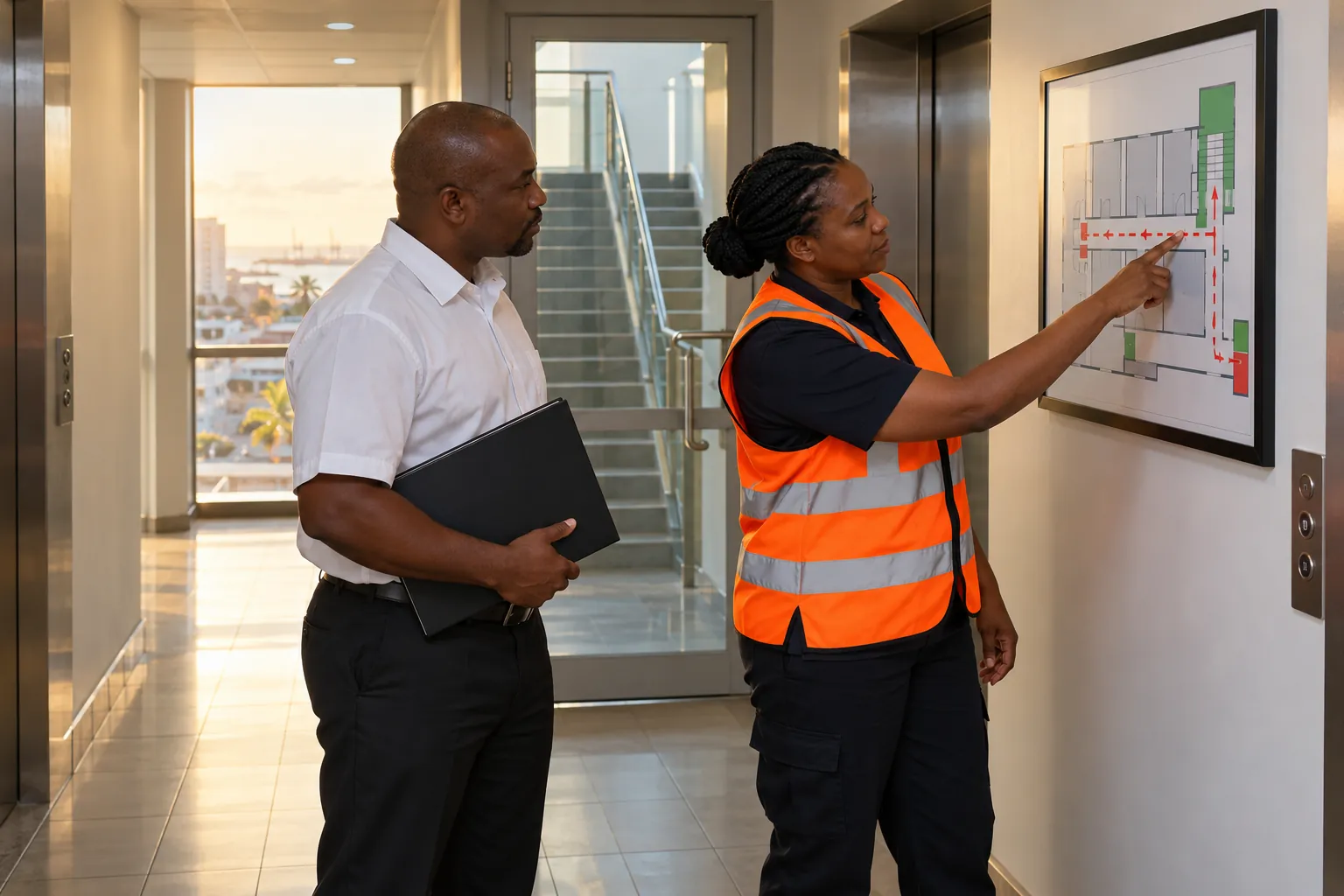
The register covers equipment only. Fire drills and the rest of the fire protection programme are kept with the emergency evacuation plan, as section 18(1)(d) of the Johannesburg by-law requires for designated premises.
04
Who keeps the register, and who does each check
The by-laws put the duty on the owner or the person in charge of the premises, and the General Safety Regulations put the equipment duty on the employer. In a multi-tenant office block, a shopping centre or a sectional title scheme those are different parties, so agree in writing who keeps the register. Usually the owner or managing agent keeps it for the common areas and the installations, and each tenant adds its own equipment on the same numbering.
Entries come from several people, each responsible for part of it:
- the facilities manager, who owns the register, books services and chases faults;
- the servicers: for extinguishers, an SABS permit holder or a technician with a certificate of competence from the South African Qualifications Certification Committee (eThekwini section 25(8)(a), Cape Town section 17(3)); for other systems, a competent person "registered with the relevant controlling body recognised by the municipality", in eThekwini's words;
- the people doing the in-house checks: a caretaker, a fire marshal for each floor, or security officers who pass every fire point on patrol;
- the health and safety representative, who may inspect the workplace, including its health and safety equipment, under section 18(1)(g) of the OHS Act at intervals agreed with the employer.
Where a contractor does the checks or the servicing, the arrangement belongs in a written section 37(2) agreement or the service contract, naming the register as the list the contractor works from, and the register is updated from each servicer's certificate the same week. Under section 8(2)(e) of the OHS Act the employer provides the information, training and supervision employees need: here, which items are theirs, what a fault looks like and who to tell.
05
Keeping the register true: faults, changes and certificates
Certificates. Section 16(2) of the Johannesburg by-law and section 31(4) of the eThekwini by-law require whoever inspects, services or repairs the equipment to certify in writing that it is fully functional and give the certificate to the owner, or, if it cannot readily be repaired, to notify the Chief Fire Officer in writing (in eThekwini, the owner and the Chief Fire Officer, with the outstanding defects and the action needed). File each certificate against its items: an item no certificate mentions was either missed or no longer exists.
Faults. eThekwini's section 31(5) requires the owner or person in charge to have defects and outstanding maintenance attended to "without delay", "so as to ensure that the fire protection equipment is fully functional at all times". Section 31(6) requires the Municipality to be notified immediately when a system or component is taken out of service, and again when it is restored; Cape Town's section 18(6) says the same, and 18(7) requires the owner or person in charge to take all steps the controlling authority deems necessary to provide alternate equipment meanwhile.
Changes. When an extinguisher goes for service, Cape Town's section 17(7) requires a similar appliance in good working condition in its place; record the loan unit. When a refit moves equipment or an item is stolen, change the register the same day.
A register that will stand up to a fire department inspection, an insurer's survey or a client's compliance audit shows:
- every item numbered, located and typed, matching a floor plan;
- for each, the last service, servicer, certificate and next date due;
- each in-house check, by date, item and the name of the person who did it;
- every fault, with the date found, who was told and the date fixed;
- items out of service, the notice to the fire department and the date restored;
- items that could not be checked, and why.
Keep old registers and certificates: none of these by-laws sets a retention period, but an inspector or insurer will want each item's history.
06
Where the register fails, and what SiteClara does about it
Most registers fail quietly. The list has not been walked since the building opened, so it shows stolen extinguishers and misses a tenant's. The in-house round is a column of ticks filled in at month end. A security officer mentions a blocked hose reel cabinet to whoever is passing, and the next to hear of it is the servicer, eleven months later.
SiteClara can hold the working record of the checks between services. A printed QR poster, with an optional NFC tag behind it, goes at each fire point, named to match the register. Caretakers, security officers and fire marshals scan the code or tap the tag on their own phone, with no app to install, see the checks scheduled at that location, and mark each one done or say what stopped them, with a photo when one is asked for, such as the gauge, the seal or the service label. The named person and the time are recorded as it happens. A fault is reported there with a photo and goes onto the team's list of open jobs until someone closes it.
The supervisor sees what is due, done and missed across the building, and gives the reason when a check was missed. Each day the supervisor reviews and approves a report that goes to the client's facilities manager and other nominated contacts at 08:00 the next morning, showing what was reported, completed and still open, and how the scheduled checks went, for example all 36 fire points checked.
07
Questions people ask
What is on a fire-fighting equipment list?
Every portable or mobile fire extinguisher, hose reel and fire hydrant on the premises, which is how the City of Johannesburg Emergency Services By-laws define fire-fighting equipment. A complete register adds the service installations the same by-law lists, such as sprinklers, fire pumps, the fire alarm, emergency lighting, the standby generator, smoke ventilation, safety signs and fire doors.
What does a fire equipment inspection checklist include?
Section 16(1) of the City of Johannesburg Emergency Services By-laws sets out what the owner must ensure: every item installed ready for use in an emergency; extinguishers and hose reels serviced to SABS 0105 and SABS 1475; everything maintained in good working condition by a competent person, inspected and serviced to the manufacturer's specifications, and inspected by an appropriately registered and competent person at least once every 12 months; and a comprehensive service record kept and furnished to the Chief Fire Officer every 12 months.
How often must fire equipment be serviced in South Africa?
Under the Johannesburg and eThekwini by-laws, extinguishers, hose reels and hydrants are inspected or serviced at least every 12 months; other by-laws, such as Cape Town's, point to the SANS standards instead of stating an interval. Other systems are serviced at the intervals their standard sets. Table 2 of the eThekwini Fire By-law, 2022, for example, puts emergency lighting at monthly and smoke management at a six-monthly test; check your own municipality's by-law.
08
Where to read the official text, and a list to take away
Start with your own municipality's fire by-law; the three quoted here are the City of Johannesburg Emergency Services By-laws (as amended to 31 August 2011), eThekwini's Fire By-law, 2022 and Cape Town's Community Fire Safety By-law, 2002 (as amended to 2015), and by-laws change, so confirm the current text. Nationally, read regulation 13J of the General Safety Regulations, 2025 and sections 8 and 18 of the Occupational Health and Safety Act 85 of 1993. The SABS sells the standards: SANS 10105-1:2021, The use and control of fire-fighting equipment Part 1: Portable and wheeled (mobile) fire extinguishers, and SANS 1475-2:2024, The production of reconditioned fire-fighting equipment Part 2: Fire hose reels and hydrants; your servicer should hold current copies. See also the guide to the SANS 1475 extinguisher service.
Before the next inspection, check that:
- every item of fire equipment and every service installation is on one register, numbered and marked on a floor plan;
- the register has been walked against the building in the last year, and after every refit or tenant change;
- each item shows its servicer, last service, certificate and next date due;
- each item belongs to a named in-house check with a written frequency;
- every fault has an owner and a date, and items out of service were reported to the fire department;
- loan units are recorded while equipment is away for service;
- the owner, managing agent and tenants have agreed in writing who keeps which part;
- the service record is ready to send to the fire department when your by-law asks for it.
Sources
Every document this guide quotes or links to, in the order it first cites them.
- General Safety Regulations, 2025 (Government Notice 5954 of 6 March 2025) gov.za
- Occupational Health and Safety Act 85 of 1993 gov.za
- City of Johannesburg Emergency Services By-laws openbylaws.org.za
- EThekwini Fire By-law, 2022 openbylaws.org.za
- Community Fire Safety By-law, 2002 openbylaws.org.za
- SANS 10400-T:2024, The application of the National Building Regulations Part T: Fire protection store.sabs.co.za
- SANS 10105-1:2021, The use and control of fire-fighting equipment Part 1: Portable and wheeled (mobile) fire extinguishers store.sabs.co.za
- SANS 1475-2:2024, The production of reconditioned fire-fighting equipment Part 2: Fire hose reels and hydrants store.sabs.co.za
Related guides
 Fire and water checksFire extinguisher checklist: the routine check between annual servicesA fire extinguisher checklist for South African buildings: what to look at between SANS 1475 services, who checks, how often, and what the record should show.
 Fire and water checksSANS 1475: the annual fire extinguisher service, and what the record should showWhat SANS 1475 means for a fire extinguisher service in South Africa: who may do it, how often, the certificate, and how it differs from the monthly check.
 Fire and water checksSANS 10139: maintaining, testing and recording a fire alarm systemSANS 10139 explained: when the fire detection code applies, how by-laws call it up, the routine tests on site, servicing by a registered person, and the log book.
 Fire and water checksEmergency evacuation plans: what goes in one, and how to keep it trueWhat an emergency evacuation plan must contain in South Africa, which by-laws require one, how often it is reviewed and tested, and keeping escape routes usable.