Premises and facilities management
Near miss reports: recording the close calls before someone is hurt
A near miss report is a short written record of an event at work that could have injured someone or caused damage but did not.
In South Africa it rests on section 14(d) of the Occupational Health and Safety Act 85 of 1993, which requires every employee to report an unsafe or unhealthy situation to the employer or the health and safety representative as soon as practicable. Outside major hazard installations, neither the Act nor the General Administrative Regulations, 2003 require ordinary near misses to be recorded, so the report is a management tool rather than a statutory form. This guide covers what counts as a near miss on a cleaning, security or facilities contract, how to write the report, who tells whom, and how to turn reports into fixes.
01
What a near miss is, and what South African law says about it
A near miss is an unplanned event that could have caused injury, ill health or damage and, through luck or a quick reaction, did not: the ceiling tile that dropped into an empty passage, the cleaner who caught the handrail as her foot slid on a loose stair nosing. The Occupational Health and Safety Act 85 of 1993 does not use the phrase. Section 1 defines a "hazard" as "a source of or exposure to danger", and "danger" as "anything which may cause injury or damage to persons or property". A near miss is a hazard that has shown itself, and three provisions of the Act bear on it:
- Section 14(d), the employee's duty. Every employee shall, "if any situation which is unsafe or unhealthy comes to his attention, as soon as practicable report such situation to his employer or to the health and safety representative for his workplace or section thereof", and the representative "shall report it to the employer".
- Section 8(2)(b) and (d), the employer's duty. The employer must take reasonably practicable steps "to eliminate or mitigate any hazard or potential hazard" before resorting to personal protective equipment, and establish what hazards are attached to the work and what precautions they call for. A near miss report is information about a hazard the employer may not yet have found.
- Section 24(1)(c), the near miss that must be reported. Where someone's health or safety was endangered and a dangerous substance was spilled, a substance under pressure was released uncontrolled, machinery fractured or failed so that objects flew, fell or moved uncontrolled, or machinery ran out of control, it must be reported to an inspector although nobody was hurt. The Act calls this simply an incident; this guide calls it a section 24(1)(c) incident.
The incident register does not cover ordinary near misses. Regulation 9(1) of the General Administrative Regulations, 2003 (Government Notice R. 929) requires an Annexure 1 record of every incident reportable under section 24 "and also of any other incident which resulted in the person concerned having had to receive medical treatment other than first aid". A slip that ended in nothing meets neither test, so the law leaves the record to the employer. What it does require is that the unsafe situation is reported.
02
What counts as a near miss on a cleaning, security or facilities contract
Most near misses on a building contract are ordinary, which is exactly why they go unreported. Examples a supervisor should want to hear about:
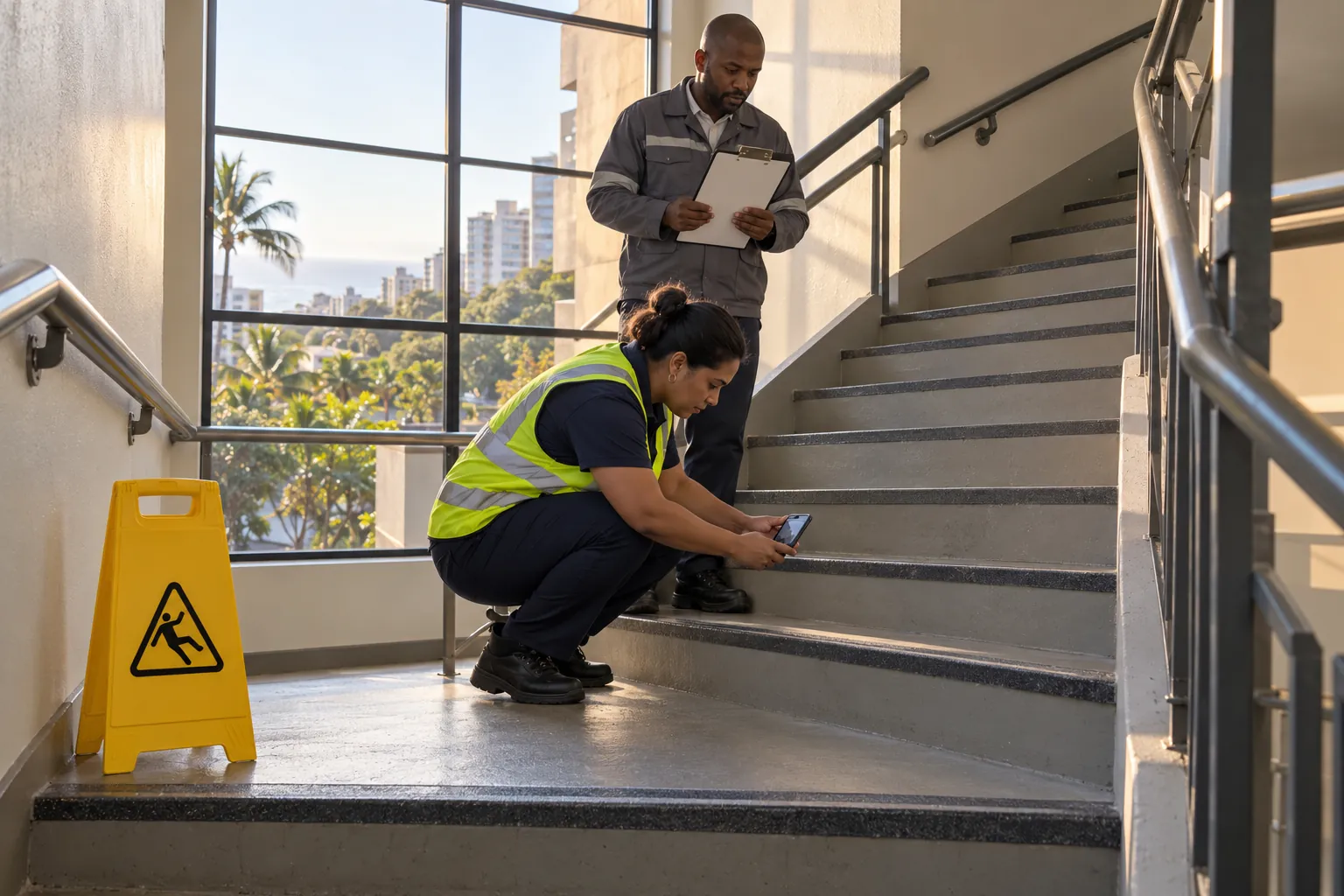
- A cleaner's foot slides on a freshly mopped stairwell landing because the wet floor sign was left at the bottom of the flight. She catches the rail and does not fall.
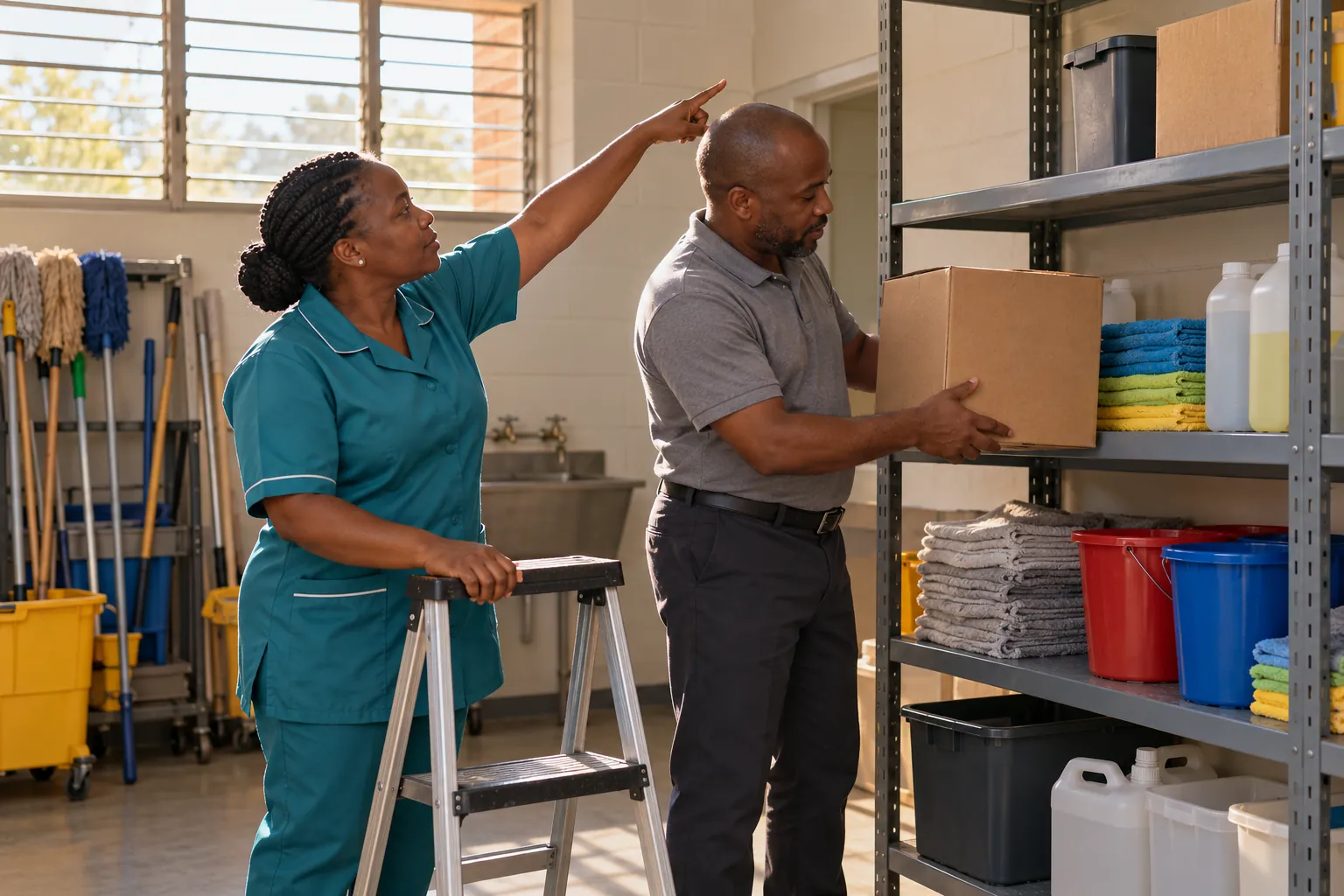
- A box of archive files slides off the top shelf in a store room seconds after a porter has walked underneath.
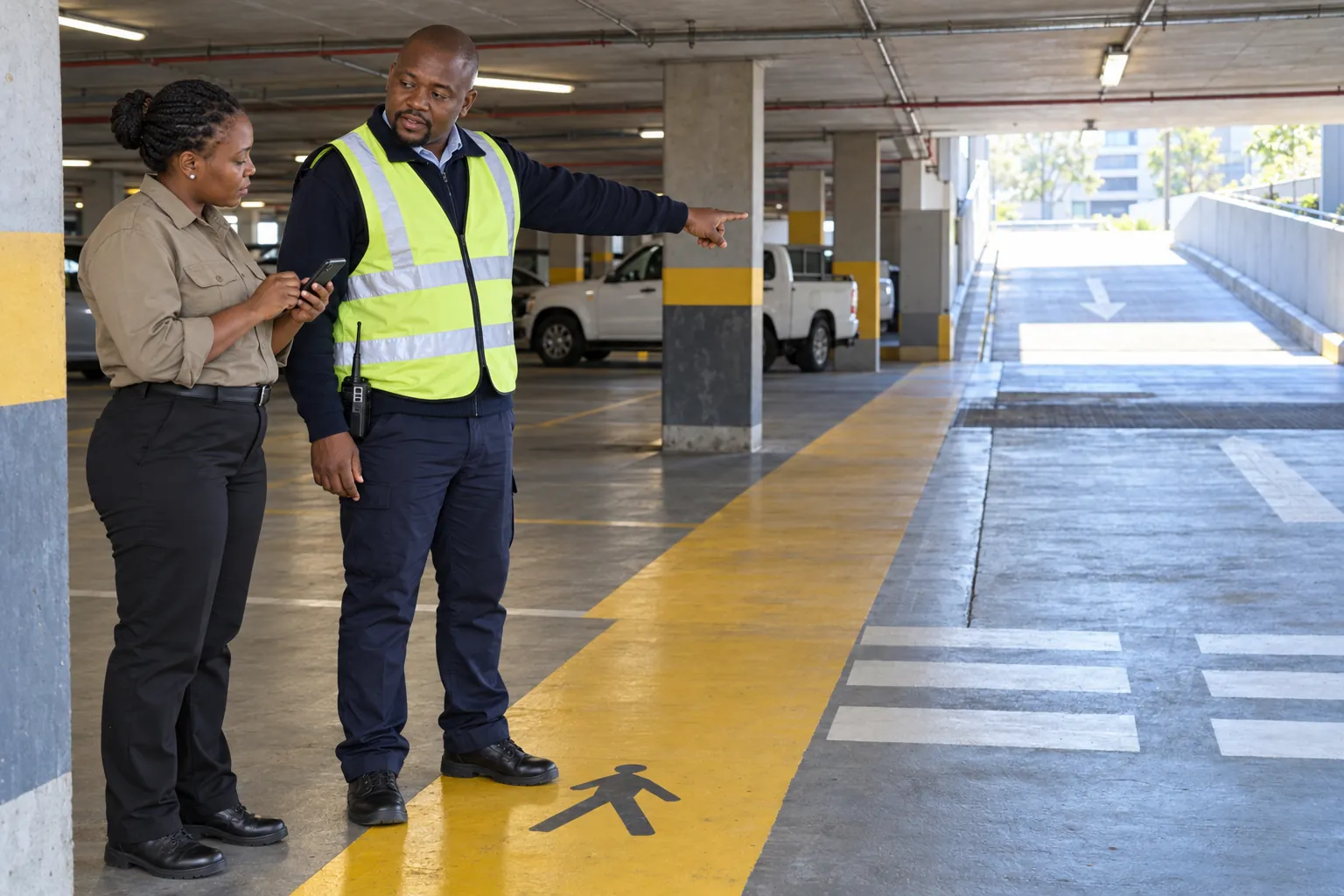
- A contractor reverses a bakkie through the basement parking with nobody guiding him, and a pedestrian steps back just in time.
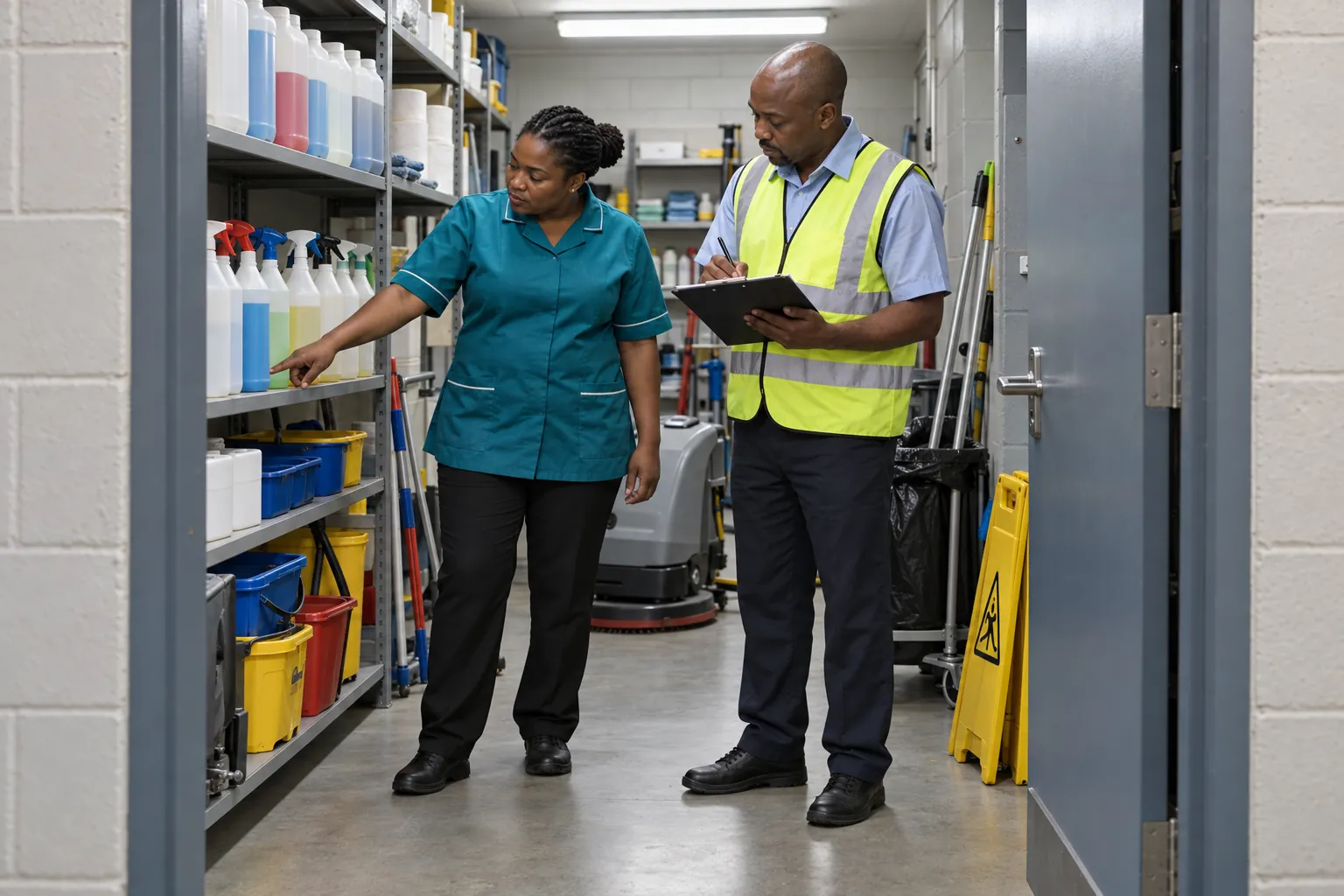
- Two cleaning chemicals are mixed in one bucket in the ablutions and give off fumes; nobody needs treatment. If a dangerous substance was spilled and someone was endangered, it is a section 24(1)(c) incident, not only a near miss.
- A security officer on a night patrol misses a step in a stairwell whose emergency lighting did not come on during load shedding.
- A maintenance artisan finds a cracked ladder stile only after climbing it to change a light fitting.
Three kinds of event are worth keeping apart, because each goes somewhere different:
- An unsafe condition: a hazard exists but nothing has happened yet, such as a chained fire escape or a missing drain cover. It is reported under section 14(d) and fixed.
- A near miss: something happened, and nobody was hurt and nothing was damaged. It is reported, looked into in proportion to what could have happened, and fixed.
- An incident: someone needed treatment beyond first aid, or the event is reportable under section 24. It goes into the Annexure 1 register and is investigated within seven days. See incident reporting and investigation.
03
How to write a near miss report
Many employers use a short near miss report form, on paper or on a phone. A good near miss report takes a few minutes and answers the questions of whoever has to fix the problem. Regulation 8(3) of the General Administrative Regulations asks, for an incident to someone who is not an employee, what happened, where, when, how and why, and the names of witnesses; that order works for a near miss too. A report should give:
- Where, precisely: "Block C stairwell, fourth step from the bottom between levels 1 and 2", not "Block C".
- When: the date, the time and the shift.
- What happened, in plain words and in order.
- What could have happened: the realistic worst outcome. This decides how seriously it is followed up.
- The cause as the reporter sees it: the loose nosing, the missing sign, the blocked view.
- What was done at once: a sign put out, the area cordoned off, the item taken out of use, the supervisor told.
- A photograph, where it is safe to take one, before anything is moved.
- Who reported it and who saw it, so the supervisor can ask questions, not so anyone can be blamed.
- The follow-up, completed by the supervisor: the action, its owner, the due date and the date it was closed.
Keep the report to facts. It is not a disciplinary record, and a form that asks "who was at fault?" gets fewer reports.
04
Who reports, who hears, and why nobody should be punished for it
Under section 14(d), the person who sees the unsafe situation reports it to their employer or to their health and safety representative. In practice the fastest route is the shift supervisor, by radio or phone, followed by the written report before the shift ends.
Section 18(1) lets a representative "identify potential hazards and potential major incidents at the workplace", examine the causes of incidents together with the employer, and make representations to the employer or the health and safety committee, or to an inspector where those fail. Near miss reports are the representative's best source of potential hazards, so copy them in. The health and safety committee may make recommendations to the employer under section 20(1)(a) and must keep a record of each one under section 20(2); a monthly summary of near misses, fixed and open, gives it something concrete to recommend on.
Reporting only works if nobody is punished for it. Section 26 of the Act forbids an employer from dismissing an employee, cutting their pay or altering their conditions or position to their disadvantage because they did anything the Act requires or allows them to do, and section 14(d) requires the report. Thank the reporter, fix the problem, and tell them it was fixed.
05
Turning near miss reports into fixes
A near miss report that goes into a file and stays there has changed nothing. Work through each one in the same order:
- Make it safe, the same shift. Tape off the step, take the ladder out of use, remove the chemical.
- Check whether it must be reported. A section 24(1)(c) incident must, under regulation 8(1) of the General Administrative Regulations, be reported forthwith to the provincial director by telephone or similar means.
- Look into it in proportion. A near miss that could have killed someone, such as a fall from height or a vehicle and a pedestrian, deserves the same investigation as an injury, asking "why?" of each answer until it reaches something the organisation controls.
- Give each action an owner and a date, and close it when the fix has been checked, not when it was requested.
- Tell the reporter what was done.
Then look for patterns. Once a month, read the reports together: the same stairwell, the same task, the same shift. Feed what you find into the site's hazard identification and risk assessment, because section 8(2)(d) requires the employer to establish the hazards of the work, and a near miss is a hazard the assessment may have missed.
Measure the effectiveness of reporting with care. The number of reports is not a measure of safety: a site with none usually has a reporting problem rather than a perfect record, and a target that rewards fewer reports gets fewer reports. Better measures are how quickly reports are made safe, how many actions close by their due date, and whether the same hazard keeps returning.
06
Where the record fails, and what SiteClara does about it
Near misses are lost in familiar ways. The cleaner tells whoever was passing, who forgets. The officer writes it in the occurrence book, which never leaves the guardroom. A message in a team chat group scrolls out of sight by morning. The job is closed when the request was sent rather than when the step was fixed. When someone is later hurt there, nobody can show who knew.
SiteClara records the working evidence where it happens. A printed QR poster, with an optional NFC tag behind it, sits at each location, such as a stairwell, an ablution block or a guard point. Cleaners, officers and supervisors scan or tap on their own phone, with no app to install. There they can report a fault or hazard, with a photo when one is asked for, and it goes onto the team's list of open jobs until someone closes it, with the time and the named person recorded as it happens. The same scan shows the routine checks due at that location, to be marked done or to say what stopped them. The supervisor sees what is open, due, done and missed, and approves a daily report for the client's facilities manager.
07
Questions people ask
How would you report a near miss?
Report it to your employer or your health and safety representative as soon as practicable: section 14(d) of the Occupational Health and Safety Act 85 of 1993 requires every employee to report any unsafe or unhealthy situation that comes to their attention, and the representative must pass it to the employer. The Department of Employment and Labour's guide What every worker and employer should know about health and safety in the workplace adds that an incident that may influence your health or cause an injury must be reported to the employer, an authorised person or the representative as soon as possible, but no later than by the end of the shift. In practice, make the area safe, tell your supervisor, then write the report before you go home.
How do you write a near miss report?
Follow the order that regulation 8(3) of the General Administrative Regulations, 2003 uses for an incident to someone who is not an employee: what happened, where it happened, when it happened (date and time), how it happened, why it happened, and the names of witnesses. Add what could have happened and what was done at once. Annexure 1 of the same regulations then asks for a short description, the suspected cause, recommended steps to prevent a recurrence and the action the employer took, which are the right headings for the supervisor's follow-up.
What are examples of near misses?
Section 24(1)(c) of the Occupational Health and Safety Act 85 of 1993 names the near misses the law treats most seriously: a dangerous substance spilled, a substance under pressure released uncontrolled, machinery fracturing or failing so that objects fly, fall or move uncontrolled, or machinery running out of control, in each case with someone's health or safety endangered but nobody necessarily hurt. The Department of Employment and Labour's Explanatory Notes: Major Hazard Installation Regulations, 2022 give the example of an overflow of a flammable substance while an installation is being charged. On an ordinary site, a slip without a fall or a box dropping where someone has just walked is a near miss too.
08
Where to read the official text, and a list to take away
Sections 8, 14, 18, 20, 24 and 26 are in the Occupational Health and Safety Act 85 of 1993 on gov.za, and regulations 8 and 9 with the Annexure 1 form are in the General Administrative Regulations, 2003. The Department of Employment and Labour's guide What every worker and employer should know about health and safety in the workplace sets out the worker's duty to report unsafe or unhealthy conditions and the representative's role in identifying potential dangers. Check the current text before relying on an old copy. On a site you run or service, check that:
- every cleaner, officer and artisan knows a near miss must be reported, to whom, and before the shift ends;
- the form is short, asks what could have happened, and does not ask who was to blame;
- someone can tell a near miss from a section 24(1)(c) incident, and knows who phones it in;
- each report gets an owner, a due date and a closing check, and the reporter hears what was done;
- the section 37(2) agreement says how a contractor's staff pass hazards to the client and hear back;
- repeated near misses at one location or task change the risk assessment.
Sources
Every document this guide quotes or links to, in the order it first cites them.
- Occupational Health and Safety Act 85 of 1993 gov.za
- General Administrative Regulations, 2003 labour.gov.za
- Explanatory Notes: Major Hazard Installation Regulations, 2022 gov.za
- Occupational Health and Safety Act 85 of 1993 gov.za
- What every worker and employer should know about health and safety in the workplace labour.gov.za
Related guides
 Premises and facilities managementIncident reporting and investigation under the OHS ActSection 24 of the OHS Act, the regulation 8 reporting clocks, the Annexure 1 incident register and the seven-day investigation, for cleaning, security and FM teams.
 Premises and facilities managementHazard identification and risk assessment: how a HIRA is done, and how it stays trueWhat a HIRA is under the OHS Act and its regulations, how to identify hazards and rate risks, who takes part, when to review it, and how rounds keep it honest.
 Premises and facilities managementHealth and safety representatives: who needs them, and what they doWhen a workplace needs a health and safety representative under section 17 of the OHS Act, how many, how they are designated, and what a SHE rep may do.
 Premises and facilities managementHealth and safety committees: members, meetings and recordsWhen a workplace needs a health and safety committee under section 19 of the OHS Act, who sits on it, how often it meets, and the records it must keep.