Security patrols
Occurrence book: what goes in the OB, and how to keep one that stands up
An occurrence book (OB) is the bound, page-numbered logbook that security officers keep at a guardhouse or control room, in which every takeover, patrol, visitor, alarm, fault and incident on a site is written up in time order by the officer on duty.
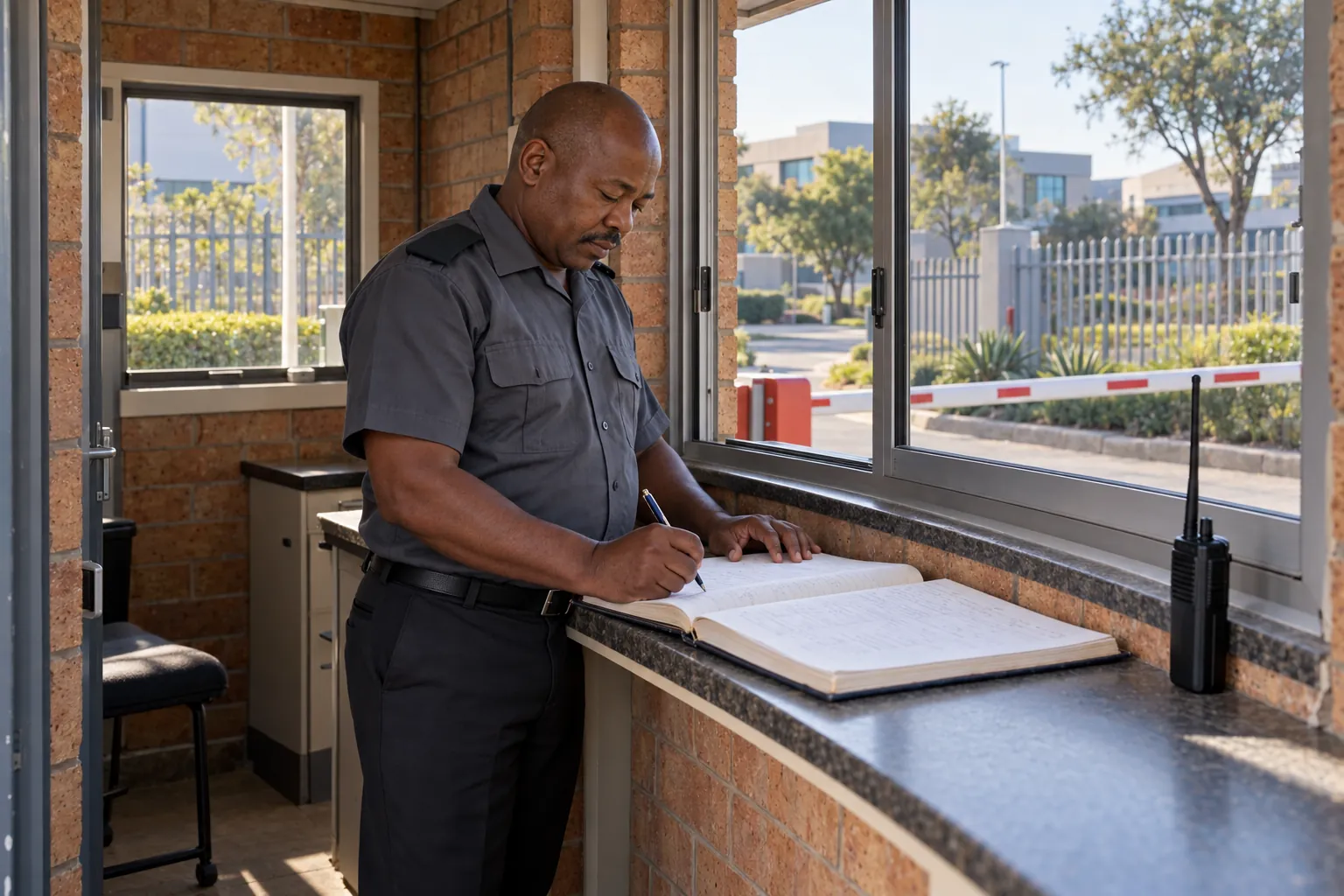
No Act names the OB, but the Private Security Industry Regulations, 2002 require a security business to keep all records concerning the service it renders for at least four years, available to PSIRA inspectors, and the OB is usually the first of them that a client, an inspector or an investigator asks to see. This guide covers what an OB should contain, how to write entries that can be relied upon, how it differs from an incident report and the OHS Act's Annexure 1, and whether to keep it on paper or electronically.
01
What an occurrence book is, and what the law says about it
An occurrence book, almost always called the OB, is a chronological record of everything significant that happens on a guarded site during each shift. It lives where the post is manned: the guardhouse at an estate's boom gate, the security desk in an office block's reception, the control room of a shopping centre or a factory. Every officer on duty writes in it. Kept electronically, it is often called an e-OB.
No South African statute says "keep an occurrence book". The duty to keep records comes from the Private Security Industry Regulation Act 56 of 2001 and the regulations made under it. Regulation 10(1) of the Private Security Industry Regulations, 2002 says every security business "must, subject to this regulation, keep all the records and documents concerning the management, administration and other matters relating to the rendering of security service by it". Regulation 10(2) requires the originals to be kept "in a secure and orderly manner", available for inspection by PSIRA, for at least four years. The list in regulation 10(7) names registers, personnel files, client contracts and a daily posting sheet, but not the OB. A book recording the service rendered on a client's site is hard to treat as anything other than such a record, so the safe course is to keep completed OBs as the regulation requires.
The Code of Conduct for Security Service Providers, 2003 adds the reason the book matters. Section 9(5) requires a provider to render the contracted service "with such a degree of skill, diligence and care as may be expected of a reasonable, competent and qualified security service provider". Section 13(2) requires a security business to implement systems of management, control and supervision that ensure "effective control over the rendering of security services" and "lawful, trustworthy, disciplined and competent conduct by security officers". A well-kept OB is the most ordinary evidence that both are happening. Chapter 4 of the Code also binds employers of in-house security officers.
The book can also be read by people outside the business. Section 34 of the Act lets a PSIRA inspector, without prior notice, enter premises where a security service is rendered and require "all or any records or documentation relating to the activities of the security service provider". Clients and insurers read it too, and it is produced at disciplinary hearings and in court.
02
What goes in an occurrence book
The site instructions (sometimes called post orders) should say what goes in the OB on each site and what goes in separate registers. A typical list of OB entries on a South African site includes:
- Takeover and handover: the time, the officer's full name, PSIRA registration number and grade, and what was handed over – keys, radios, equipment, open issues and anything still being dealt with.
- Patrols: the time each patrol started and ended, the route or points covered, and what was found: open doors and windows, lights out, damage to the perimeter or the electric fence.
- Vehicles and people at the gate: out-of-hours entries, contractors and deliveries, or a reference to the visitor register where access is logged there.
- Keys: keys issued and returned, if there is no separate key register.
- Alarms and callouts: intruder and fire alarm activations, electric fence alarms, armed response called and the time it arrived, with the cause and what was done.
- Power and plant: load shedding or outages, the standby generator starting and stopping, gate motors and booms failing, water leaks.
- Firearms, where the post is armed: the firearm and ammunition issued and returned, as the site instructions require. The posting sheet under regulation 10(7)(f) must record any firearm provided, its type and number, and the ammunition.
- Incidents: a short, timed summary, a reference to the full incident report, and whether the police were called and the reference number they gave.
- Injuries and hazards: anyone hurt on site, with a reference to the injury or incident record the employer keeps, and hazards found on patrol such as a blocked fire escape or a trip hazard.
- Visits and instructions: supervisor and area manager visits, client instructions received, and by whom.
- End of shift: a closing entry, signed, stating that the post was handed over and to whom.
Where a separate register exists on site or at the office, the OB entry refers to it rather than copying it.
03
How to write OB entries that can be relied upon
An OB entry is valuable because it was written at the time, by a named officer, in the order things happened. The conventions that protect that value are simple and long established:
- Write in pen, in the bound book. Pages are numbered and none is ever torn out.
- Time every entry in the 24-hour clock, and write the date at the top of each shift and each new page.
- Write it as it happens, or as soon as possible afterwards. If an entry is late, say so: "02:40 (entered 03:15)".
- Leave no gaps. Rule off blank lines at the end of an entry so nothing can be added later.
- Correct, never erase. No correction fluid and no scribbling out. Strike through the mistake with a single line so it stays readable, write the correction, and initial it.
- Record facts. What was seen, heard and done, by whom, where and when. Leave out opinion and rumour.
- Name people and numbers: vehicle registrations, the armed response unit that attended, the police reference number, the person a fault was reported to.
- Sign every entry, and sign on and off each shift with your name and PSIRA number.
A weak entry reads: "22:00 Patrol done. All in order." A useful one reads: "22:00 Commenced patrol, route B, all 12 points. 22:18 Loading bay roller door found unlocked, no signs of forced entry, secured. 22:20 Reported to control room (Officer Dlamini). 22:41 Patrol complete. Signed J. Mokoena, PSIRA no. 1234567." (The name and number are illustrative.) The second tells the next shift, the supervisor and the client what happened, what was done and who was told.
Write for a reader who was not there and cannot ask what an abbreviation meant. Guidance on turning an OB entry into a full report is in security report writing.
04
Occurrence book, incident report and the OHS Act's Annexure 1
The OB is a summary in time order. It is not the place for a full account of a serious incident, and it is not the statutory record of workplace injuries. Three records are often confused:
- The OB entry records that something happened, when, who dealt with it and what the next step was, in a few lines.
- The incident report is a separate, fuller account written the same shift, covering the sequence of events, witnesses, damage and actions taken. The OB entry refers to it by number.
- The Annexure 1 record is the employer's statutory register of workplace incidents under the Occupational Health and Safety Act.
Section 24 of the Occupational Health and Safety Act 85 of 1993 requires incidents in which a person dies, becomes unconscious, loses a limb or part of a limb, or is injured or becomes ill so that they are likely to die, suffer a permanent physical defect or be unable to work for at least 14 days, and certain dangerous occurrences, to be reported to an inspector by the employer. Regulation 9 of the General Administrative Regulations, 2003 then requires the employer to keep "a record in the form of Annexure 1 for a period of at least three years" of every incident reportable under section 24 and of any other incident in which the person "had to receive medical treatment other than first aid". Each must be investigated within seven days and the findings entered in Annexure 1.
An officer who records an injury in the OB has not completed Annexure 1. On a guarded site the injured person may be the client's employee, a contractor or the officer, and the employer who must keep the record differs in each case. The site instructions should say who is told, and the OB should record that they were.
When the police attend, section 7(3) of the Code of Conduct requires a security service provider to furnish, without undue delay, "all the information and documentation" that a member of a security service or an organ of state may lawfully require. The OB is often part of that.
05
Checking, keeping, and paper or electronic
Checking. A supervisor should read and sign the OB on every site visit, following up anything left open: a fault not reported, a patrol missing, an entry that does not make sense. This is part of what section 13(2) of the Code means by systems of control and supervision.
Keeping. Regulation 10(2)(b) of the Private Security Industry Regulations requires records to be kept for at least four years from the date they came into existence, unless another law requires longer or PSIRA's director directs in writing that they be kept longer, at the business's administrative office or a place the director has approved in writing (regulation 10(2)(a)). Collect completed books from site, label them with the site and dates, and store them securely.
Personal information. An OB holds names, ID numbers, vehicle registrations and sometimes descriptions of people, so the Protection of Personal Information Act 4 of 2013 applies to it. Section 19 requires the responsible party to secure the integrity and confidentiality of personal information with "appropriate, reasonable technical and organisational measures". Section 14 says records must not be kept longer than necessary for their purpose unless, among other grounds, retention is required or authorised by law or required by a contract.
Paper or electronic. Regulation 10(4) allows records to be kept "in an electronic format through the use of an appropriate computer program", unless PSIRA directs otherwise or another law dictates otherwise, provided an accurate, dated back-up copy is made separately at least every day on which a service is rendered and the information changes, and kept available for inspection. Section 15 of the Electronic Communications and Transactions Act 25 of 2002 says a data message must not be refused as evidence merely because it is electronic, and that its weight depends on how reliably it was generated, stored and kept intact and how its originator was identified.
So an electronic OB can do the job, if entries are timed and attributed to a named officer, cannot be edited without trace and are backed up. A paper book has the advantage that everyone understands it and it needs no power during load shedding; its weaknesses are that it can be written up after the event, is read only by whoever visits the post, and is lost if the guardhouse is damaged.
06
Where the occurrence book fails, and where SiteClara fits
The OB is good at recording what the officer chose to write. It is weak at proving the routine: "22:00 patrol complete, all in order" reads the same whether the officer walked every point on the perimeter or wrote it from the guardhouse chair. A fault written up at 03:00 stays in the book unless someone passes it on. The client sees the book only when they visit the post, and by then the week is history.
SiteClara records the routine part of the shift where it happens. A printed QR poster, with an optional NFC tag behind it, goes at each checkpoint: a gate, a fire escape, a plant room, a level of the parkade. The officer scans the code or taps the tag on their own phone, with no app to install, and marks the scheduled check done or says what stopped them. The time and the named officer are recorded as it happens. A fault or incident found on the round can be reported there with a photo, and it goes onto the team's list of jobs until someone closes it.
The supervisor sees what was due, done and missed, and can record the reason a check was missed. At the end of the day the supervisor reviews the totals and photos, adds a note, records who was told and approves the daily report, which goes by email to nominated management or client contacts at 08:00 the next morning: what was reported, what was completed, what is still open and how the scheduled checks went.
07
Questions people ask
What is an occurrence book used for?
An occurrence book is used to record, in time order, everything significant on a guarded site during each shift: takeovers, patrols, visitors, alarms, faults and incidents. It tells the next shift what is still open, shows the supervisor and the client what the service delivered, and is one of the records concerning the service that regulation 10 of the Private Security Industry Regulations, 2002 requires a security business to keep "in a secure and orderly manner, available for inspection by the Authority" for at least four years.
How does the OB work in security?
The book stays at the post, and every officer on duty signs on, writes each entry as it happens with the time against it, and signs off at handover; a supervisor reads and signs it on each visit. Completed books go back to the administrative office, where regulation 10(2) of the Private Security Industry Regulations, 2002 requires records to be kept, and section 34 of the Private Security Industry Regulation Act 56 of 2001 lets a PSIRA inspector require whoever is in control of the premises, or supervises or administers the service there, to produce "all or any records or documentation relating to the activities of the security service provider". Regulation 10(4) allows the same records to be kept "in an electronic format through the use of an appropriate computer program", with an accurate, dated back-up copy made separately at least every day on which a service is rendered and the information changes.
08
Further reading, and a list to take away
PSIRA publishes the Act, the Private Security Industry Regulations, 2002 and the Code of Conduct on psira.co.za. The Department of Employment and Labour publishes the OHS Act and the General Administrative Regulations, including the Annexure 1 form.
Before the next book is opened on site, check that:
- the site instructions say what goes in the OB and what goes in separate registers;
- every officer knows how to write, correct and sign an entry, and signs on with their PSIRA number;
- entries are made in real time, in order, with the time against each;
- incidents in the book refer to a separate incident report, and injuries to the employer's Annexure 1 record;
- faults recorded are passed on to someone who will fix them, and the entry says who;
- a supervisor reads and signs the book on every visit;
- completed books are collected, stored securely and kept for at least four years;
- an electronic OB, if you use one, attributes every entry to a named officer and is backed up daily.
Sources
Every document this guide quotes or links to, in the order it first cites them.
- Private Security Industry Regulation Act 56 of 2001 gov.za
- Private Security Industry Regulations, 2002 psira.co.za
- Code of Conduct for Security Service Providers, 2003 psira.co.za
- Occupational Health and Safety Act 85 of 1993 gov.za
- General Administrative Regulations, 2003 labour.gov.za
- Protection of Personal Information Act 4 of 2013 gov.za
- Electronic Communications and Transactions Act 25 of 2002 gov.za
Related guides
 Security patrolsSecurity report writing: what to record, with examples that stand upHow South African security officers write incident, patrol and shift reports: what each must record, worked examples, and what PSIRA's rules expect.
 Security patrolsSecurity officer duties and responsibilities: what the post involves, and how it is checkedSecurity officer duties in South Africa: PSIRA registration, patrols, access control, the OB, incidents, what officers may not do, and how duties are checked.
 Security patrolsGuard patrol systems: how they work, what they prove, and how to choose oneHow a guard patrol system records security patrols in South Africa: wands, RFID, NFC, QR and GPS, what PSIRA and POPIA mean for the data, and what to ask.
 Security patrolsVisitor register: what to record at the gate, and what the law lets you askWhat a visitor register should record in South Africa, what a guard may ask at the gate, and what POPIA says about ID numbers, copies and how long to keep it.