Fire and water checks
Standby generator checks: the checklist, the law and the log
A standby generator checklist is the short routine of weekly and monthly checks on a building's generator – the control panel left on auto with no alarms, the fuel, oil and coolant levels, leaks, the starter battery and charger, and a regular test run on load – written down each time, so that the generator is known to start and carry the building when the mains power fails.
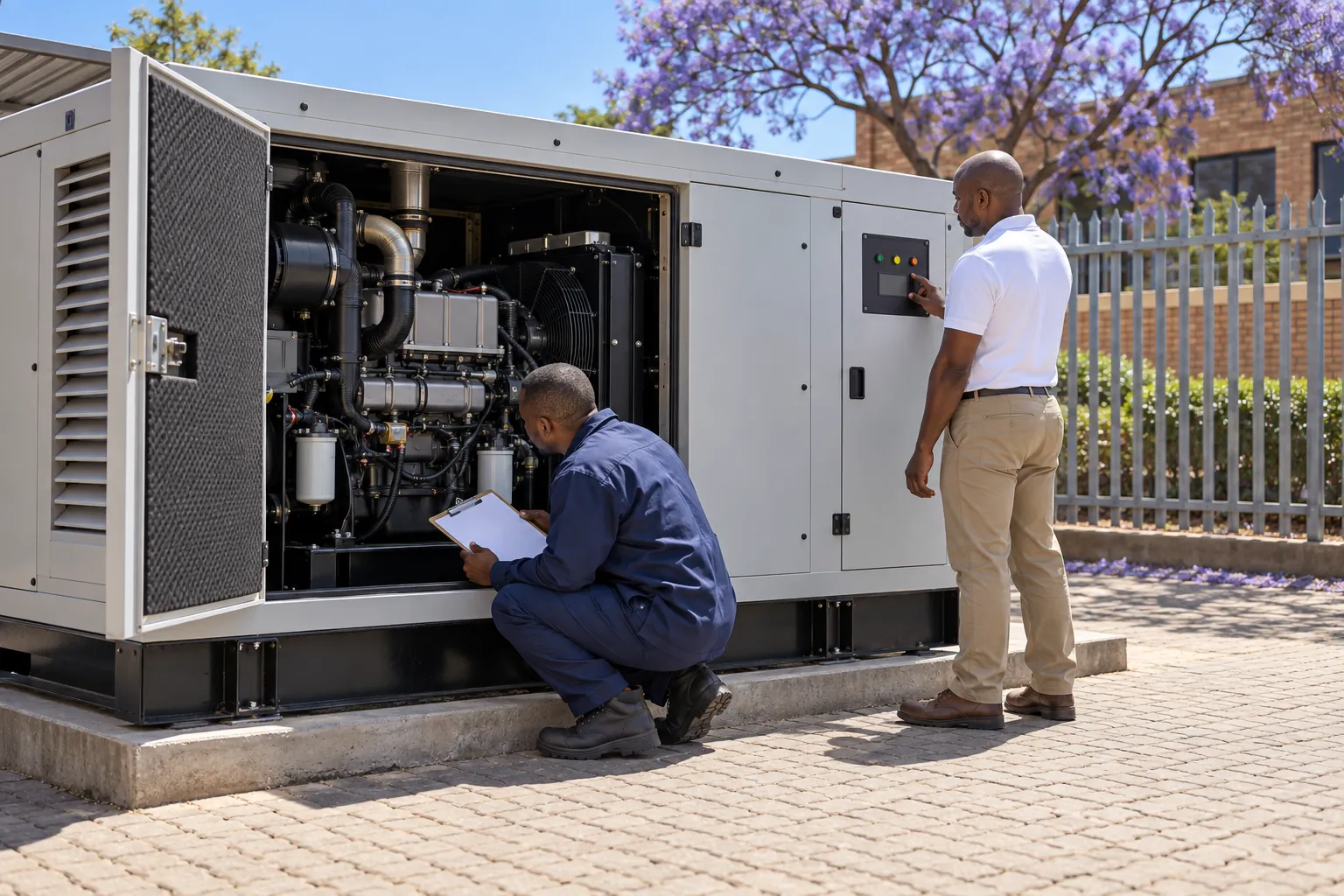
No South African law prescribes the checklist itself. The duty to keep the generator safe and in working order comes from the Occupational Health and Safety Act 85 of 1993 and the Electrical Machinery Regulations, 2011; the changeover and wiring that connect it fall under the Electrical Installation Regulations, 2009 and SANS 10142-1; and some municipal fire by-laws, Johannesburg's among them, list a stand-by generator among the installations that must be maintained, inspected and recorded. This guide covers the law, what the system includes, the routine checks and the test run, load shedding and fuel, servicing, and what the generator log should show.
01
The law behind a standby generator
Load shedding made the standby generator ordinary plant in office blocks, schools, shopping centres, warehouses and sectional title schemes. No single law sets out a generator checklist, but several layers of law apply to the generator, the wiring that connects it and, in some municipalities, its records.
- The OHS Act. The Occupational Health and Safety Act 85 of 1993 defines machinery as any article used "for converting any form of energy to performing work", or for "developing, receiving, storing ... transforming, transmitting" or "controlling any form of energy", which describes a generator set. Section 8(2)(a) requires every employer to provide and maintain "systems of work, plant and machinery that, as far as is reasonably practicable, are safe and without risks to health".
- The Electrical Machinery Regulations, 2011. The Electrical Machinery Regulations, 2011 (Government Notice R. 250 of 25 March 2011, in force from 1 July 2011) apply, under regulation 2(1), to those who "design, manufacture, install, sell, generate or use electrical machinery". Regulation 5 requires notices at the entrances to premises "where generating plant and transforming, switching or linking apparatus are situated", and regulations 4 and 7 cover work on disconnected machinery, the labelling of control gear and lock-out notices.
- The Electrical Installation Regulations, 2009. Under regulation 2(1) of the Electrical Installation Regulations, 2009 (Government Notice R. 242 of 6 March 2009), the user or lessor of an electrical installation "shall be responsible for the safety, safe use and maintenance" of it. Regulation 5(1) requires installation to an incorporated standard, and Government Notice R. 243 of 6 March 2009 incorporates SANS 10142-1, The wiring of premises Part 1: Low-voltage installations. The changeover switch and the circuits that connect a generator to the building are part of that installation.
- The municipal fire by-law. Fire safety in a building in use is municipal, and some by-laws name the generator directly. The City of Johannesburg Emergency Services By-laws define a "service installation" to include any "emergency power or stand-by generator", and section 16 makes the owner responsible for keeping it ready for use in an emergency, maintained by a competent person and inspected at least once every 12 months, with a service record.
02
What a standby power system includes
A checklist that looks only at the engine misses most of what fails. A standby power system usually includes:
- the generator set: the diesel engine, alternator and cooling system, in a canopy or plant room;
- the fuel system: the base or bulk tank, any day tank, the filters, and the bund or drip tray;
- the starter battery and charger, which keep the set ready to start;
- the control panel or auto mains failure (AMF) panel, with its mode selector, alarms and hours meter;
- the changeover switch, automatic or manual, that moves the load from the mains to the generator and back;
- the exhaust and the air openings that let the set breathe and cool;
- the UPS, where there is one, carrying servers, access control, CCTV or the control room until the generator takes the load;
- the essential circuits it carries, which on many sites are not the whole building.
The work divides three ways. The owner, managing agent or facilities manager, and the caretaker or security staff who act for them, run the routine checks, keep fuel in the tank and record runs and faults. The generator service company services, repairs and load tests the set. A registered electrical contractor does any work on the changeover and the wiring: regulation 6(1) of the Electrical Installation Regulations says no person may do electrical installation work as an electrical contractor unless registered as one. Write that split into the service contract.
03
The weekly and monthly generator checklist
The routine is short, and most of it is looking. Take the checks and the maintenance schedule from the manufacturer's manual and the service company. On most sites they come down to a weekly walk-round and a monthly test run.
A weekly visual inspection, with the set not running:
- Control panel: the mode selector is on auto, not manual or off, and the panel shows no alarm or warning. A generator left on off after a service will not start at the next outage.
- Fuel: the fuel level is read and recorded, and is at or above the minimum the site has set for a long outage.
- Leaks: no fuel, oil or coolant under the set, around the tank, at the fuel lines or in the bund or drip tray.
- Oil and coolant: levels are within the marks, where the manufacturer allows site staff to check them.
- Belts, hoses and connections: from the outside, with the set isolated as the manual says, no cracked or slack belts, no split or weeping hoses, and no loose or scorched cable connections at the battery or the panel.
- Battery and charger: the charger is on and shows normal charging, and the battery terminals are clean and tight, with no corrosion.
- Housekeeping: the enclosure is clean and locked, the air openings are clear, nothing is stored against the set, and the regulation 5 notices are in place.
- Exhaust: the pipe is intact and cannot blow into a window, an air intake or a place where people wait.
- UPS, where there is one: its panel shows normal operation with no battery or bypass alarm.
A monthly test run on load. A generator that starts and idles has proved very little. The test that matters carries the essential load, through the changeover, for the time the manufacturer recommends:
- Agree the time and tell tenants and the control room: the changeover may blink the lights.
- Check the set before starting: fuel, oil, coolant, battery and no leaks.
- Start the test by simulating a mains failure, where the service company has set that up, so the automatic start and changeover are proved too.
- Confirm the changeover: the generator takes the load and the essential circuits work.
- Watch the panel for alarms, and look and listen for leaks, smoke or unusual noise.
- Return to mains, let the set run on for its cool-down, and confirm the load is back on the mains.
- Put the panel back on auto, and check it shows no alarm.
- Record the test: the hours meter reading, the fuel level, the result, and anything that did not work.
A failed start, a changeover that did not happen, an alarm or a leak is a fault. Report it to the service company the same day: until it is fixed, the building has no standby power.
04
Load shedding, fuel and the checks after an outage
During load shedding the generator may run for hours on most days, and needs checking as a machine in daily use. Most failures are simple: an empty tank, a flat battery, a set left on manual, or oil and coolant nobody looked at.
After every outage, once the mains is back:
- confirm the changeover returned the load to the mains and the set shut down after its cool-down;
- check the panel is on auto and shows no alarm;
- record the start and stop times, the hours meter reading and the fuel level;
- refill the tank, or order fuel, before the next outage, not during it;
- look for leaks and check the oil and coolant, as the manufacturer's manual allows;
- note when the running hours bring the next service due.
Fuel is the check most often missed. Set a minimum level that will carry the essential load through the longest outage expected, and order fuel below it. Diesel stored for months can take up water and grow sludge that blocks filters, so ask the service company how to check it.
The quantity of fuel stored can bring in the fire by-law. Section 37(6) of the City of Cape Town's Community Fire Safety By-law, 2002 requires a flammable substance certificate before more than 200 litres of a flammable liquid in its danger groups is stored or used, and section 39 sets rules for above-ground tanks, including a bund able to hold 110% of the tank's contents. Other municipalities set their own thresholds; ask the fire safety section whether the generator's fuel counts before a bigger tank goes in.

05
Servicing, the certificate of compliance and the generator log
Generator maintenance beyond the routine checks, such as oil and filter changes, the cooling and fuel systems, the belts and hoses, the alternator, a load bank test and the changeover's maintenance, is for the service company, at the manufacturer's intervals, usually by running hours or months, whichever comes first. Hours pile up during load shedding, so compare the hours meter with the service interval at every check.
Some by-laws set their own floor. Section 16(1)(c) of the Johannesburg by-laws requires every service installation, which includes a stand-by generator, to be maintained in good working condition by a competent person, inspected and serviced in accordance with the manufacturer's specifications, and inspected by an appropriately registered and competent person at least once every 12 months. Under section 16(2) whoever services or repairs it must certify in writing that it is "fully functional" and give the certificate to the owner, or notify the Chief Fire Officer in writing if it cannot readily be repaired. In eThekwini, Table 2 in section 31 of the eThekwini Fire By-law, 2022 gives "Emergency Lighting / Emergency Power Supply" a maintenance and test interval of "Monthly", to the manufacturer's specifications, and section 31(1) requires a detailed service record to be kept for the municipality to examine.
Changes to the connection are electrical installation work. Regulation 7(4) of the Electrical Installation Regulations requires the user or lessor to obtain a certificate of compliance for at least any addition or alteration to an installation that already has one, and regulation 9(1) says no person other than a registered person may issue it. A new generator, changeover switch or circuit should end with a certificate for that work.
The generator log is usually a book or file in the plant room, with the service company's reports filed behind it. For each check or run, an entry should show:
- the date and time, and whether it was a weekly check, a test run or an outage;
- the hours meter reading and the fuel level, and fuel delivered;
- the result: panel on auto with no alarms, no leaks, levels correct, changeover worked;
- any fault, who it was reported to and when it was cleared;
- the name of the person who did it.
The same log should record every service visit, every repair and every time the set was out of service. Johannesburg's section 16(1)(d) requires the comprehensive service record to be furnished to the Chief Fire Officer every 12 months. Show the log to the service company at each visit.
06
Where the record fails, and what SiteClara does about it
The generator log usually looks fine. What it hides is how the entries got there. The weekly ticks are filled in on a Friday, in one pen, by someone who never opened the canopy. The set was left on manual after a service and nobody noticed. Fuel levels were written down but never compared with the minimum, so the tank ran dry mid-outage. A leak found on the night shift was told to whoever was at the guardhouse and never reached the service company. And a managing agent with many buildings cannot tell which generators were checked this week without phoning round.
SiteClara records routine checks where they happen. A printed QR poster, with an optional NFC tag behind it, is put up at each location, such as the generator enclosure, the plant room or the UPS room. Whoever does the check scans the code or taps the tag on their own phone, with no app to install, sees the checks due there, such as the weekly walk-round or the monthly test run, and marks each one done or says what stopped them, with a photo when one is asked for, for example of the panel or the fuel gauge. The time and the named person are recorded as it happens. A fault found there, such as a leak or a battery alarm, goes onto the team's list of open jobs until someone closes it.
The supervisor sees what is due, done and missed, gives the reason a check was missed, and approves a daily report that goes to the building manager, the managing agent and other nominated contacts at 8am the next morning: what was reported, completed and still open, and how the scheduled checks went.
07
Questions people ask
What maintenance should I include in a generator maintenance checklist?
Two kinds: the routine checks site staff perform and record, such as the panel on auto, fuel, oil, coolant, leaks, the battery and a monthly test run on load, and the servicing the manufacturer specifies. Section 16(1) of the City of Johannesburg's Emergency Services By-laws requires a stand-by generator to be maintained in good working condition by a competent person, inspected and serviced in accordance with the manufacturer's specifications, inspected by an appropriately registered and competent person at least once every 12 months, and covered by a comprehensive service record. Work on the changeover or the wiring is electrical installation work: where a certificate of compliance was previously issued, regulation 7(4) of the Electrical Installation Regulations, 2009 requires one for at least the addition or alteration, and under regulation 9(1) only a registered person may issue it.
What are the maintenance checklists for DG sets?
A DG set is a diesel generator set, and its checklists are usually a weekly visual inspection, a monthly test run on load and the service company's schedule by running hours. No national law sets the interval; the manufacturer does, and some by-laws add a floor. Table 2 in section 31 of the eThekwini Fire By-law, 2022 gives "Emergency Lighting / Emergency Power Supply" a maintenance and test interval of "Monthly", to the manufacturer's specifications, and section 31(1) requires a detailed service record to be kept for the municipality to examine.
08
Further reading, and a list to take away
The Electrical Machinery Regulations, 2011 and the Electrical Installation Regulations, 2009 are made under the OHS Act. SANS 10142-1 is sold by the SABS. Johannesburg's Emergency Services By-laws, the eThekwini Fire By-law, 2022 and Cape Town's Community Fire Safety By-law, 2002 are on Open By-laws South Africa. For the rest of the plant, see preventative maintenance and the fire equipment register.
Before the next outage, check that:
- the control panel is on auto and shows no alarm, and someone checks it every week;
- the fuel level is recorded, there is a minimum level for a long outage, and someone orders fuel when it falls below it;
- the set is run on load through the changeover every month, and the result is recorded;
- the service company works to the manufacturer's intervals, by hours as well as months, and leaves a written report;
- any change to the changeover or wiring ends with a certificate of compliance from a registered person;
- faults go to the service company the same day, and the log shows when they were cleared;
- you know what your municipality's by-law requires, and the service record is ready for the fire service.
Sources
Every document this guide quotes or links to, in the order it first cites them.
- Occupational Health and Safety Act 85 of 1993 labour.gov.za
- Electrical Machinery Regulations, 2011 saflii.org
- Electrical Installation Regulations, 2009 labour.gov.za
- Government Notice R. 243 of 6 March 2009 labour.gov.za
- SANS 10142-1, The wiring of premises Part 1: Low-voltage installations store.sabs.co.za
- City of Johannesburg Emergency Services By-laws openbylaws.org.za
- Community Fire Safety By-law, 2002 openbylaws.org.za
- Physical Agents Regulations, 2024 (Government Notice 5952 of 6 March 2025) gov.za
- EThekwini Fire By-law, 2022 openbylaws.org.za
Related guides
 Premises and facilities managementPreventative maintenance for buildings: how to plan it and show it was donePreventative maintenance for South African buildings: the OHS Act duty, the asset register and schedule, lift, electrical and fire tasks, and records that hold up.
 Fire and water checksFire equipment checklist: the register of everything, and when each item is dueA fire equipment checklist for South Africa: the register of every extinguisher, hose reel, hydrant and installation, service intervals and the record by-laws want.
 Fire and water checksSANS 10139: maintaining, testing and recording a fire alarm systemSANS 10139 explained: when the fire detection code applies, how by-laws call it up, the routine tests on site, servicing by a registered person, and the log book.
 Premises and facilities managementFacilities manager duties: what the job covers under South African law, and how to show it is doneA facilities manager's duties in South Africa: the OHS Act duties they carry, contractors, lifts, electrics, fire and ablutions, and the records that show it.