Security patrols
Duties of a security supervisor: what the role involves, and what PSIRA expects
A security supervisor oversees a team of security officers on one or more sites: posting and briefing them, visiting their posts, checking the occurrence book, making sure they are registered and equipped, handling incidents and discipline, and reporting back to the security business that employs them.
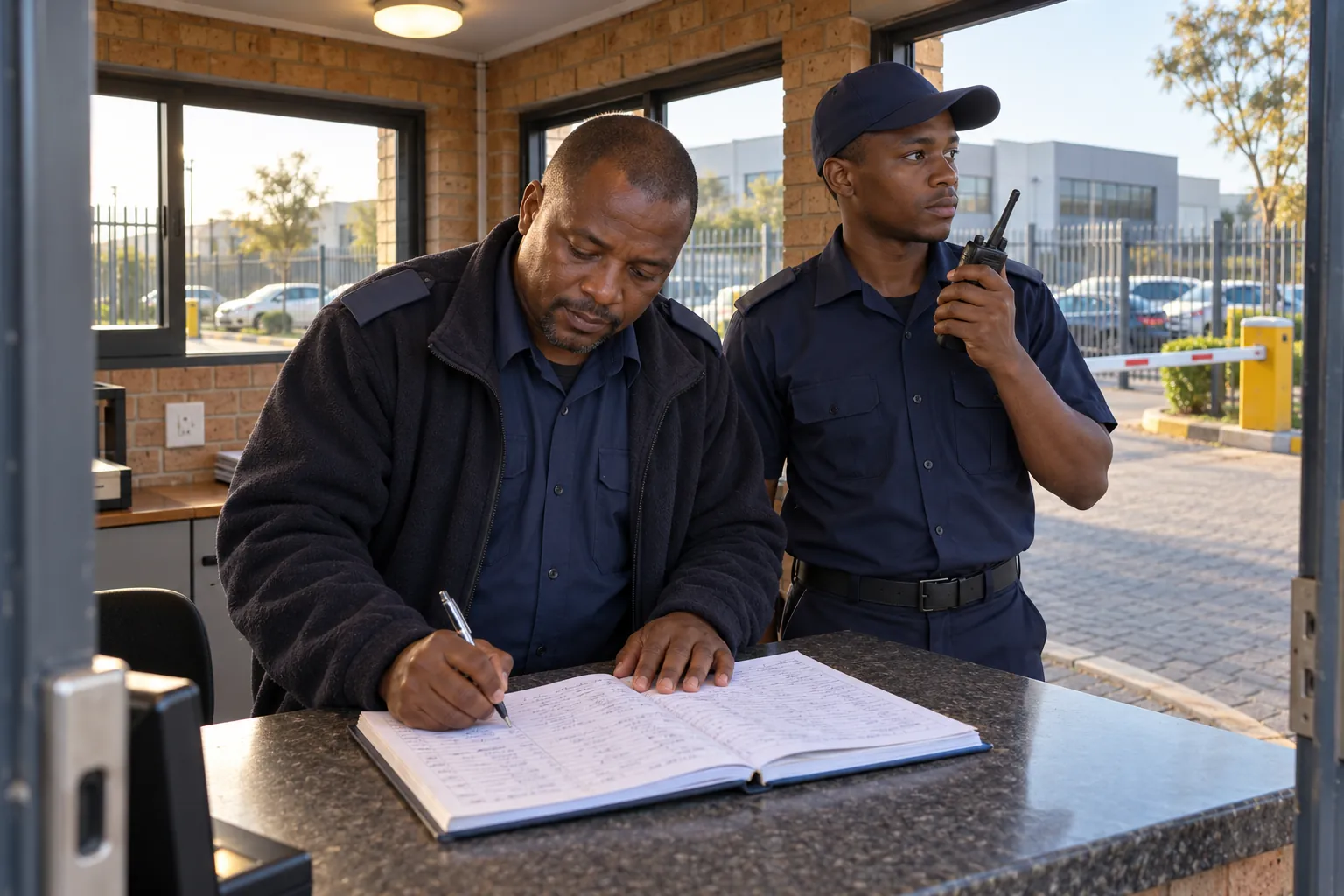
Regulation 13 of the PSIRA Code of Conduct for Security Service Providers, 2003 requires that business to have its services properly managed, controlled and supervised by appropriately trained, experienced or skilled persons. Most pages on the subject are job adverts. This guide is written for the security company that has to supervise its posts and for the client, facilities manager or body corporate paying for that supervision: where the duty comes from, what a supervisor actually does on a visit, which records sit behind the role, and how to tell whether supervision happened or was only written down.
01
What a security supervisor is, and where the duty comes from
Supervision is itself a security service in South African law. Section 1 of the Private Security Industry Regulation Act 56 of 2001 lists the activities that count as a security service, and paragraph (l) is "managing, controlling or supervising the rendering of any of the services" in the paragraphs before it, guarding and patrolling among them. Section 20(1)(a) says no one may render a security service for reward unless registered as a security service provider. A supervisor therefore needs PSIRA registration of their own, exactly as the officers they supervise do.
The training bar is higher. Regulation 3(3) of the Private Security Industry Regulations, 2002, in PSIRA's compilation of the Act, the Regulations and the Code, says a person who intends to render the service in paragraph (l), managing, controlling or supervising, must have completed at least the training course recognised as grade B when applying for registration, where every other officer needs grade E.
The duty to supervise sits on the business. Regulation 13(1) of the Code of Conduct for Security Service Providers, 2003, in the same PSIRA compilation, made under section 28 of the Act and binding on every security service provider, requires a security business to ensure that its services and officers "are properly managed, controlled, supervised and administered by appropriately trained, experienced or skilled persons". Regulation 13(2) requires systems of supervision reasonably necessary for the size of the business, the number of officers and the services rendered, to ensure effective control and "lawful, trustworthy, disciplined and competent conduct" by its officers.
Regulation 11(5) applies this to each officer: the employer must take reasonable steps to ensure that an officer placed with a client has been told the nature and scope of their duties and legal powers, "is properly managed, controlled and supervised", has the equipment needed, and is properly disciplined. In-house security is not exempt: regulation 23(c) requires an employer guarding its own premises to "appoint and use ... a responsible person to manage, supervise and control" its security officers.
Labour law describes the job. Sectoral Determination 6: Private Security Sector, as amended by Government Notice R. 871 of 25 August 2009 under the Basic Conditions of Employment Act 75 of 1997, defines a grade B security officer as one who supervises, controls, instructs or trains grade C, D or E officers or general workers "and reporting thereon to an employer or any other specified person". It also defines a mobile supervisor as "a security officer who is required to drive a motor vehicle between sites in the course of supervising, inspecting or controlling security officers".
02
The duties of a security supervisor, in practice
No regulation lists a supervisor's tasks one by one. What the Code requires the business to achieve, and what a client can reasonably expect in protecting its people, property and assets, turns into the same working list on most contracts:
- Posting and cover: the right officer, with the right grade and registration, on each post every shift, and relief when someone does not arrive. Regulation 11(3) of the Code forbids using an officer for a service they are not trained or registered for.
- Briefing: each officer knows the site instructions, the post's duties and the limits of their legal powers before standing a shift, as regulation 11(5)(a) requires.
- Post visits: visiting each post during the shift, nights and weekends included, to check the officer is present, alert, in uniform and doing the job.
- The occurrence book: reading and signing the OB on every visit, and following up what it records.
- Equipment: radios, torches, patrol devices and any firearm issued present, working and lawfully held, under regulation 11(5)(c) and (d).
- Incidents: taking control of an incident and making sure it is reported to the client, to the police where the law requires, and written up the same shift.
- Emergency response: knowing the site's emergency protocols for fire, evacuation, alarms and medical emergencies, and leading the officers' response until the client's people or the emergency services take over.
- Discipline and welfare: dealing with lateness, sleeping on duty and absence from post under the disciplinary code, and noticing an officer who is unwell or has not had a break.
- Client liaison and reporting: being the contact the client's facilities or estate manager can call, and reporting to the business on the posts supervised, which is part of the grade B definition itself.
On a larger contract a site supervisor stays on one site, a mobile supervisor visits several, and the control room tracks patrols, alarms and CCTV between visits. What matters is that each task has a named owner and a record. The skills the role needs are as much leadership as security knowledge: handling people fairly, writing clearly, and staying calm in difficult situations.
03
What a supervisor checks on a post visit
The post visit is the heart of the job. How often visits happen is not set in law; the contract or the site instructions should say it, by shift and by post. A visit worth the name covers the same ground each time:
- The officer. Present, awake and on the right post; in the standard uniform with the company's badges and a name and registration number badge, as regulation 13 of the 2002 Regulations requires; and carrying the PSIRA certificate of identification, which regulation 9(5) says must be produced on request to a client or anyone the client authorises in writing.
- The OB. Entries in order, in the officer's own words, at the times things happened, with nothing squeezed in later. The supervisor reads back to the last visit, signs with the time and records any instruction given.
- The patrols. Whether the patrols in the site instructions were walked, checked against the guard patrol system where there is one, and whether anything found was written up.
- The site. A short walk: gates, doors, lighting, the perimeter, anything the OB mentioned. A fault found is passed to whoever fixes it, not only mentioned.
- The equipment. Radio charged, torch, keys accounted for, and any firearm and ammunition checked against the register.
- The record of the visit. A visit report noting the time, what was found and what was done, so the business, and the client if the contract says so, can see the visit happened.
Vary the times. A visit at the same time each night tells an officer when to be awake.
04
Incidents, discipline and officers' safety
A security supervisor is also a supervisor under the Occupational Health and Safety Act 85 of 1993. Section 8(2)(e) requires every employer to provide "such information, instructions, training and supervision as may be necessary" for employees' health and safety, and section 8(2)(i) to ensure work is done "under the general supervision of a person trained to understand the hazards associated with it". For guarding, those hazards include working alone at night, confrontation, traffic at gates and long shifts.
Section 14 puts matching duties on the officer, and the supervisor is usually who receives what the officer reports. Under section 14(d) an employee who notices something unsafe must report it as soon as practicable; under section 14(e) an employee involved in an incident that injures them or may affect their health must report it "not later than the end of the particular shift" unless that was not possible. Regulation 9 of the General Administrative Regulations, 2003 (Government Notice R. 929) requires the employer to record reportable incidents, and any incident needing medical treatment beyond first aid, in the form of Annexure 1, to keep that record for at least three years, and to have each one investigated within 7 days. A supervisor is often the person appointed to investigate. See incident reporting and investigation for the steps.
Discipline is part of supervision, not separate from it. Regulation 11(8) of the Code requires every security business to draw up and "properly and consistently enforce" a disciplinary code for its officers, and regulation 11(9) requires it to give the police all relevant information it knows about an offence listed in the Schedule to the Act allegedly committed by one of its officers. A supervisor who finds an officer asleep, drunk or absent from post is usually the first witness; their notes, made at the time, are what a fair hearing later relies on.

05
The records behind supervision, and what good evidence looks like
Much of what a supervisor does ends up in records the security business must keep and PSIRA may inspect. Regulation 10 of the Private Security Industry Regulations, 2002, in PSIRA's compilation, requires every security business to keep records of how it renders its services, available for PSIRA inspection, for at least 4 years, and to update them within 7 days of a change. Regulation 10(7) lists what they include, among them:
- A posting sheet for every day or part of a day of service, with each officer's full names, level of accredited training and registration number, the client and the place served, the nature of the service, its duration in hours, and any firearm or ammunition issued.
- An attendance register for every security officer and other employee, materially in the form of BCEA 3.
- Personnel files for each officer, including a description of their duties, every disciplinary step taken, and a copy of their training documentation.
Regulation 10(4) allows these records to be kept electronically, with a dated back-up made each day the records change. The supervisor often fills in or checks the posting sheet, so a wrong registration number on a post usually starts there.
The client is entitled to know how supervision works. Regulation 9(2)(f) of the Code requires a provider to give a client who reasonably needs it sufficient and correct information about "the management, control and supervision of the rendering of the security service as well as reasonable contact particulars of security officers performing such functions". A client can therefore ask who supervises the site, how often, and how to reach them.
Good evidence of supervision is specific and made at the time: the OB signed with the time, a visit report naming the post, what was checked and what was done, and a follow-up when something was found. A monthly summary saying "all posts visited" shows only that someone wrote it.
06
Where supervision records fail, and where SiteClara fits
Supervision usually fails quietly. The site instructions say the supervisor visits every post twice a night. The OB carries a signature at 01:00 and another at 04:00 on every page, in the same pen, and nothing else about the visit. A broken perimeter light the supervisor noticed is mentioned to the officer and never reaches whoever repairs it. At the monthly meeting the client asks how often the night posts were visited, and the answer is a spreadsheet typed up afterwards.
SiteClara records routine checks at the place they happen. A printed QR poster, with an optional NFC tag behind it, sits at each point where a check is scheduled: a guardhouse, a gate, a perimeter corner, a plant room, a loading bay. An officer or a supervisor scans or taps with their own phone, with no app to install, sees the checks due there and marks each one done or says what stopped them. The time and the named person are recorded as it happens, with a photo when one is asked for. A fault found at a point goes onto a list of open jobs until someone closes it.
A supervisor sees what is due, done and missed at each site, gives the reason when a check was missed, and each day reviews and approves a short report that goes to the client's nominated contacts the next morning. For a client asking how supervision works, that is an answer made at the time rather than written up at the end of the month.
07
Questions people ask
Does a security supervisor need PSIRA registration?
Yes. Under section 1 of the Private Security Industry Regulation Act 56 of 2001, "managing, controlling or supervising" the rendering of guarding and the other listed services is itself a security service, and section 20(1)(a) says no one may render a security service for reward unless registered as a security service provider.
What grade is a security supervisor?
Usually grade B. Sectoral Determination 6: Private Security Sector, as amended in 2009, defines a grade B security officer as one who supervises, controls, instructs or trains grade C, D or E officers or general workers and reports on that work to the employer or another specified person. The same determination lets a grade C officer supervise grade D or E officers and a grade D officer supervise grade E officers, so a contract should say which it means.
What is a mobile supervisor?
A mobile supervisor is "a security officer who is required to drive a motor vehicle between sites in the course of supervising, inspecting or controlling security officers", as defined in Sectoral Determination 6: Private Security Sector.
08
Where to read the official text, and a list to take away
The primary sources, all national:
- The Private Security Industry Regulation Act 56 of 2001, for the definition of a security service and the duty to register.
- PSIRA's compilation of the Act, the Private Security Industry Regulations, 2002 and the Code of Conduct for Security Service Providers, 2003, in one document: regulations 3, 9, 10 and 13 of the 2002 Regulations, and regulations 9, 11, 13 and 23 of the Code.
- Sectoral Determination 6: Private Security Sector, as amended by Government Notice R. 871 of 2009, for the grade and mobile supervisor definitions. Its pay schedules are dated: check current pay rules with the Department of Employment and Labour.
- The Occupational Health and Safety Act 85 of 1993, sections 8 and 14, and the General Administrative Regulations, 2003, regulation 9.
A short list for a security business or a client reviewing supervision on a site:
- Name the supervisor for each site and shift, with their PSIRA registration and grade, and give the client their contact details.
- Write the visit frequency into the contract or site instructions, by post and shift, nights and weekends included.
- Make each visit leave a record: the OB signed with the time and a visit report.
- Check uniform, the PSIRA card, equipment and the OB on every visit, at varied times.
- Pass every fault to whoever fixes it and follow it up until closed.
- Keep the posting sheet accurate every day, and review supervision with the client from the records.
Sources
Every document this guide quotes or links to, in the order it first cites them.
Related guides
 Security patrolsSecurity officer duties and responsibilities: what the post involves, and how it is checkedSecurity officer duties in South Africa: PSIRA registration, patrols, access control, the OB, incidents, what officers may not do, and how duties are checked.
 Security patrolsOccurrence book: what goes in the OB, and how to keep one that stands upThe security occurrence book (OB) in South Africa: what to record each shift, how to write entries, what PSIRA and the OHS Act require, and paper or electronic.
 Security patrolsPSIRA grades: what grades E to A mean, and which grade a post needsPSIRA grades E to A explained for clients and security providers: where the grades come from, what each covers, which grade a post needs and how to check it.
 Security patrolsSecurity report writing: what to record, with examples that stand upHow South African security officers write incident, patrol and shift reports: what each must record, worked examples, and what PSIRA's rules expect.