Security patrols
PSIRA grades: what grades E to A mean, and which grade a post needs
PSIRA grades are the five training levels for security officers in South Africa, from grade E, the entry course every officer needs before registering with PSIRA, up to grade A, the highest.
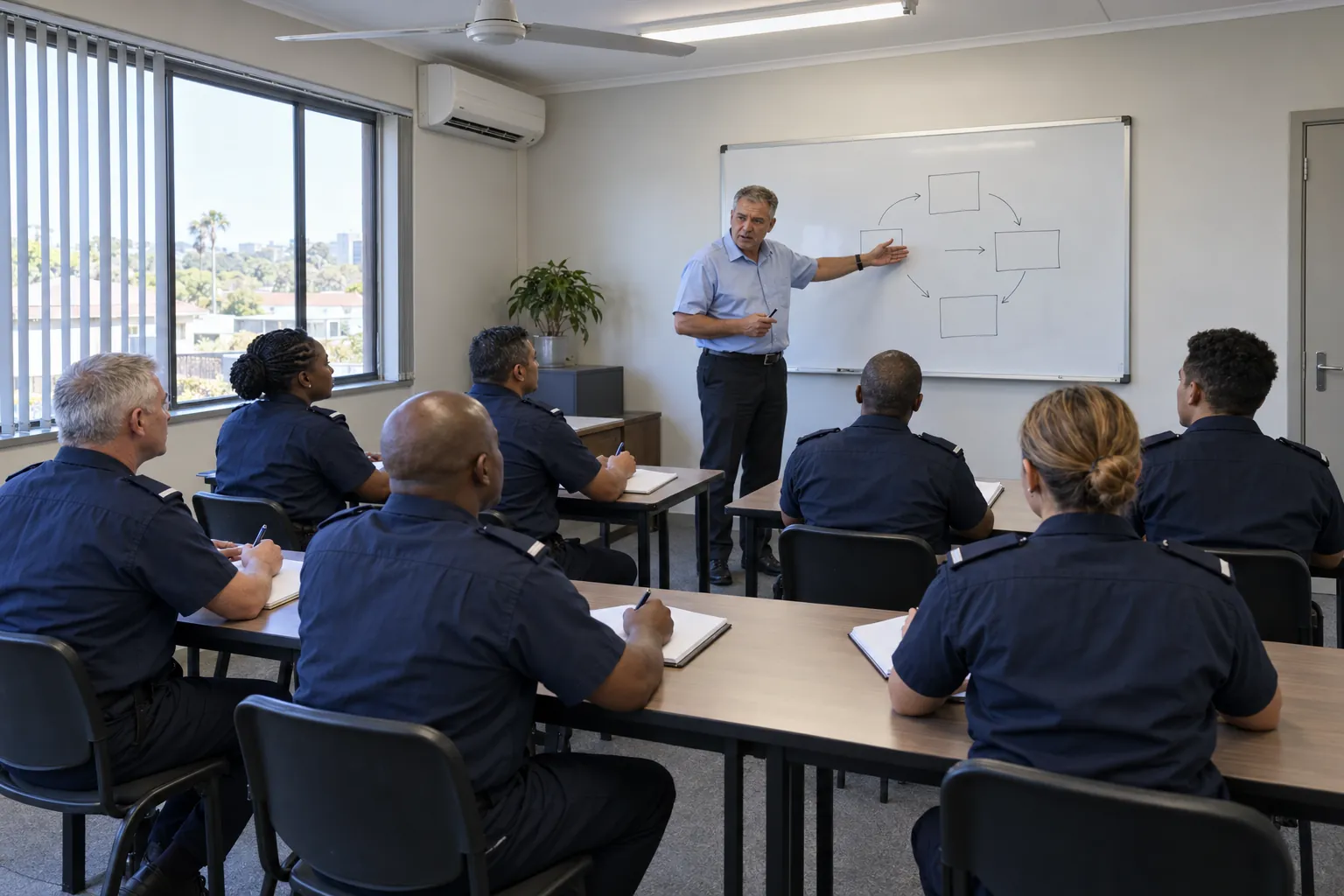
They were set by the Training Regulations, 1992 and Board Notices 93 and 102 of 1995, which PSIRA still applies under section 44 of the Private Security Industry Regulation Act 56 of 2001. This guide is written for the people on either side of a security contract: the security providers deciding who goes on a post, and the client, facilities manager or body corporate deciding what to ask for. It sets out where the grades come from, what each one covers, which grade suits which post, and what evidence shows the right grade is actually on site.
01
What the PSIRA grades are, and where they come from
The grades are older than PSIRA. They were set by the Security Officers Board under the Security Officers Act 92 of 1987, through the Training Regulations, 1992. As quoted in PSIRA's 2016 research report, Training Standards in the South African Private Security Industry, regulation 3(2) told the Board to "determine different training levels for different categories or grades of security officers", and to set the modules, minimum training times and testing for each.
The courses themselves were set by board notices. PSIRA's Training Division page lists them: Board Notice 93 of 1995 for grades E to C and Board Notice 102 of 1995 for grades B to A, alongside separate notices for assets in transit and reaction services (1996), special events security (1998) and dog handlers, DH 1 to DH 5 (1999). The same page says the training regulations "remained valid in terms of Section 44 of the Private Security Industry Regulation Act 56 of 2001". Section 44(2)(c) is the transitional provision: a regulation made under the repealed Security Officers Act and in force when the new Act began "remains in force to the extent that it is compatible with this Act, until amended, abolished or replaced".
The grades are also built into registration. Regulation 3(2) of the Private Security Industry Regulations, 2002 says everyone applying to register as a security service provider must have completed, at an accredited training establishment, "at least the training course described and recognized as 'Grade E'". Regulation 3(3) sets grade B as the minimum for those who run a security business (anyone performing executive or managing functions, and its directors, members, partners, trustees or administrators) and for anyone who registers to manage, control or supervise the rendering of a security service.
The grades are often criticised as dated, and PSIRA published draft training regulations on 24 June 2016 (Government Notice R. 756) built on qualifications on the National Qualifications Framework. At the time of writing, September 2026, PSIRA's Training Division page still lists the 1995 board notices for the grades.
02
Grade E to grade A: what each grade covers
What each grade does is defined in Sectoral Determination 6: Private Security Sector, made under the Basic Conditions of Employment Act 75 of 1997, and PSIRA ties the training courses to those job descriptions. In plain words, from the amendment of 25 August 2009 (Government Notice R. 871):
- Grade E: guarding, protecting or patrolling premises or goods, including handling or controlling dogs while doing so. The entry level, and the minimum for registration.
- Grade D: controlling or reporting on the movement of people or vehicles through checkpoints or gates, searching people and, if necessary, restraining them, searching goods or vehicles, and supervising grade E officers. A grade D officer may also be asked to do any grade E duty.
- Grade C: supervising or controlling grade D or E officers, driving a vehicle while supervising them or to transport officers, and armed response. A grade C officer may also be asked to do any grade D duty.
- Grade B: supervising, controlling, instructing or training grade C, D or E officers or general workers and reporting on them to the employer, with driving where needed, and any grade C duty.
- Grade A: advising or reporting on any matter affecting guarding or protection services, helping screen candidates for employment, taking responsibility for staff training, drawing money or taking possession of negotiable documents, guarding goods and supervising subordinate staff, and any grade B duty.
Sectoral Determination 6 also defines an armed response officer as one paid at least the grade C rate for armed response duties, including driving, and an armed security officer as one paid at least the grade D rate who is issued with a firearm. A control or communication centre operator is paid "as for relevant security officer grading". Reaction services, assets in transit, events and dog handling have courses of their own, and regulation 11(4) of the Code requires firearm training as the law requires: these sit on top of a grade.
Each grade includes the duties of the one below. The 2009 amendment also changed pay, not training: its schedule for the year from 1 September 2010 says "Grade E Security Officers will be incorporated into Grade D". The training grade E still exists.
03
Which grade a post needs
An officer must be trained for the service they actually render. Regulation 9(10)(a) of the Code of Conduct for Security Service Providers, 2003 says a provider may not use anyone for a security service unless they are registered and have "successfully completed the security training required in terms of law in respect of the rendering of the relevant security service". Regulation 11(3) forbids using an officer for a service needing training they lack, and regulation 23 applies the same to in-house security.
PSIRA's Guidelines for compliance in terms of the Private Security Industry Regulation Act during events (June 2018) put it plainly, reading the grades against the Sectoral Determination 6 job descriptions: "a security officer conducting guarding through patrolling, must complete Grade E. A security officer who performs access control and search goods or vehicles must complete Grades E and D." That reading gives a practical way to match a grade to a post:
- Patrol only, such as a night patrol of a warehouse yard or a school after hours, with no gate or search duties: grade E at least.
- Gatehouse, boom or reception, controlling who and what comes in, checking vehicles or searching bags: grade D at least.
- Shift leader supervising other officers on the site, or driving to check posts: grade C.
- Armed response: grade C for pay, plus the firearm and reaction training required.
- Site or contract supervisor over several posts, instructing officers and reporting to the employer: grade B.
- Operations or contract manager advising the client, screening recruits and running training: grade A.
Most sites mix these posts, so the grade belongs to each post, not to the contract. A sectional title complex may need a grade D officer at the main gate, a grade E patrol of the perimeter wall at night and a grade C shift leader across both. Writing each post's grade into the site instructions, alongside the security officer duties for the post, gives the provider something clear to staff to and the client something clear to check.
Grade and cost are related but not in step. PSIRA's Illustrative Costing Guideline with effect from 2 March 2024 shows separate minimum monthly salaries for grades A and B and one shared figure for grades C, D and E, so a higher grade at a gate may buy more training for little difference in the minimum wage. Pay has been negotiated in the National Bargaining Council for the Private Security Sector since its registration on 22 June 2018, as PSIRA's circular on the role of PSIRA and the bargaining councils explains; check the current main agreement.
04
What evidence of a grade looks like
A security business has to be able to show which officer, with which training, was on which post. Regulation 10(7) of the Private Security Industry Regulations, 2002 lists the records a security business must keep, including:
- a posting sheet for every day of service, with the names and "the level of accredited security training of every security officer utilised", their registration numbers, the client and address, and any firearm issued (regulation 10(7)(f));
- a personnel file on each officer, including "a true copy of official documentation indicating the level of accredited security training" (regulation 10(7)(g));
- a register of every officer employed (regulation 10(7)(a)) and an attendance register (regulation 10(7)(e)).
Regulation 10(2) says the originals must be kept in a secure and orderly manner, available for PSIRA to inspect, for at least four years. Regulation 11(2) of the Code says a security service provider must, before employing anyone as a security officer, take all reasonable steps to verify their registration status, level of training and qualifications.
The client is entitled to know as well. Regulation 9(2)(e) of the Code says a security service provider must, whenever a client reasonably needs the information to make an informed decision, give the client "the registration status as security service provider, training level and relevant conditions of service of the security officers used or to be used". PSIRA's consumer awareness page tells clients to check that the business and every officer deployed are registered, that the business can produce a letter of good standing from PSIRA, and that "all security officers appointed for the service are registered with PSiRA and received relevant training for service being rendered". It points to PSIRA's online verification of individuals and businesses and its mobile app; checking PSIRA registration covers that step.
Good evidence is three things that agree: the site instructions giving each post's grade, the posting sheet saying who was on it and their training level, and the officer's registration and certificate matching both.

05
Keeping the right grade on the post
Most grade problems are not in the tender. They happen on a Saturday night when the gate officer phones in sick and the reliever sent is a grade E officer from a patrol post, or when a new site starts before enough grade C officers are available. The fixes are routine:
- Reliefs at the right grade: the relief pool for a site should cover its highest-graded post, not only its lowest.
- No silent substitution: regulation 9(10)(b) of the Code says a provider may not use another security service provider without the client's consent.
- A named person in charge: regulation 11(5)(b) says officers must be "properly managed, controlled and supervised". On most contracts that is the security supervisor, checking each post against the posting sheet.
- Refresher training: regulation 11(7) requires training at least once a year on the law regulating the industry and the Code of Conduct.
- A monthly check by the client: compare the site's posting sheets against registration and training level, and raise any post staffed below its grade.
PSIRA checks too. Its events guideline says the Authority "will verify the registration as well as training status of all the security officers" before an event, and the posting sheets and personnel files must be kept available for PSIRA to inspect. A client who has already compared those records against the site instructions will not be surprised by what an inspection finds.
06
Where the record fails, and where SiteClara fits
The grade on paper and the officer on the post drift apart quietly. The posting sheet is filled in at the office from the roster; the reliever who covered the night shift may not appear on it; and the occurrence book reads "all correct" in one hand for twelve hours. When a client asks who was on the gate at 02:00 and whether the perimeter was patrolled, the records cannot say.
SiteClara records the checks a post exists to do, where they are done. A printed QR poster, with an optional NFC tag behind it, sits at each checkpoint: the main gate, a fire escape, the generator room, a corner of the perimeter. The officer scans or taps on their own phone, with no app to install, and marks the scheduled check done or explains what stopped them. The time and named officer are recorded as it happens, with a photo when one is asked for, and a fault found goes onto the team's list of open jobs until someone closes it.
The supervisor sees what is due, done and missed, and records why a check was missed. Each day they review the totals and photos, add a note and approve a report that goes to nominated client or management contacts at 08:00 the next morning. With the named officer on each round known, comparing it against the posting sheet and the post's grade is a short job.
07
Further reading, and a list to take away
The Private Security Industry Regulation Act 56 of 2001 is on gov.za. PSIRA publishes the Private Security Industry Regulations, 2002, the Code of Conduct for Security Service Providers, 2003, the board notices on its Training Division page and a client's checks on its consumer awareness page. Each grade's duties are in Sectoral Determination 6: Private Security Sector.
Before you agree the grades on a security contract, check that:
- each post is described by what it does and given its own grade;
- gate, boom, reception and search posts are at least grade D;
- on-site supervisors are at least grade C, and contract supervisors grade B;
- the contract says whether "grade" means the training grade, the job grade or both;
- armed, reaction, event or dog posts name their extra training;
- the relief pool covers the site's highest-graded post;
- posting sheets showing each officer's training level will be shared with you;
- registration and a letter of good standing have been checked with PSIRA.
Sources
Every document this guide quotes or links to, in the order it first cites them.
- Training Standards in the South African Private Security Industry psira.co.za
- Training Division psira.co.za
- Private Security Industry Regulation Act 56 of 2001 gov.za
- Private Security Industry Regulations, 2002 psira.co.za
- Draft training regulations psira.co.za
- Sectoral Determination 6: Private Security Sector gov.za
- Code of Conduct for Security Service Providers, 2003 psira.co.za
- Guidelines for compliance in terms of the Private Security Industry Regulation Act during events psira.co.za
- Illustrative Costing Guideline psira.co.za
- The role of PSIRA and the bargaining councils psira.co.za
- Consumer awareness psira.co.za
Related guides
 Security patrolsChecking PSIRA registration: how to verify a security company and its officersHow a client checks PSIRA registration: the security company, every officer on site, the letter of good standing, and why section 38(3)(g) makes it the client's job.
 Security patrolsSecurity officer duties and responsibilities: what the post involves, and how it is checkedSecurity officer duties in South Africa: PSIRA registration, patrols, access control, the OB, incidents, what officers may not do, and how duties are checked.
 Security patrolsDuties of a security supervisor: what the role involves, and what PSIRA expectsWhat a security supervisor does in South Africa: the PSIRA Code's duty to supervise, grade B, post visits, the OB, incidents, discipline and the records behind them.
 Security patrolsThe PSIRA Code of Conduct: what it requires, and how a client can hold a provider to itThe PSIRA Code of Conduct for Security Service Providers, 2003 for clients and security companies: who it binds, what it requires and how PSIRA enforces it.