Cleaning
Public toilet cleaning: frequencies, sharps and accessible facilities
Public toilet cleaning in Australia is done to a frequency each council or operator sets for each block, from three times a week at a little-used block to seven times a day in a busy city, within the WHS, sharps and disability access duties that the law does set.
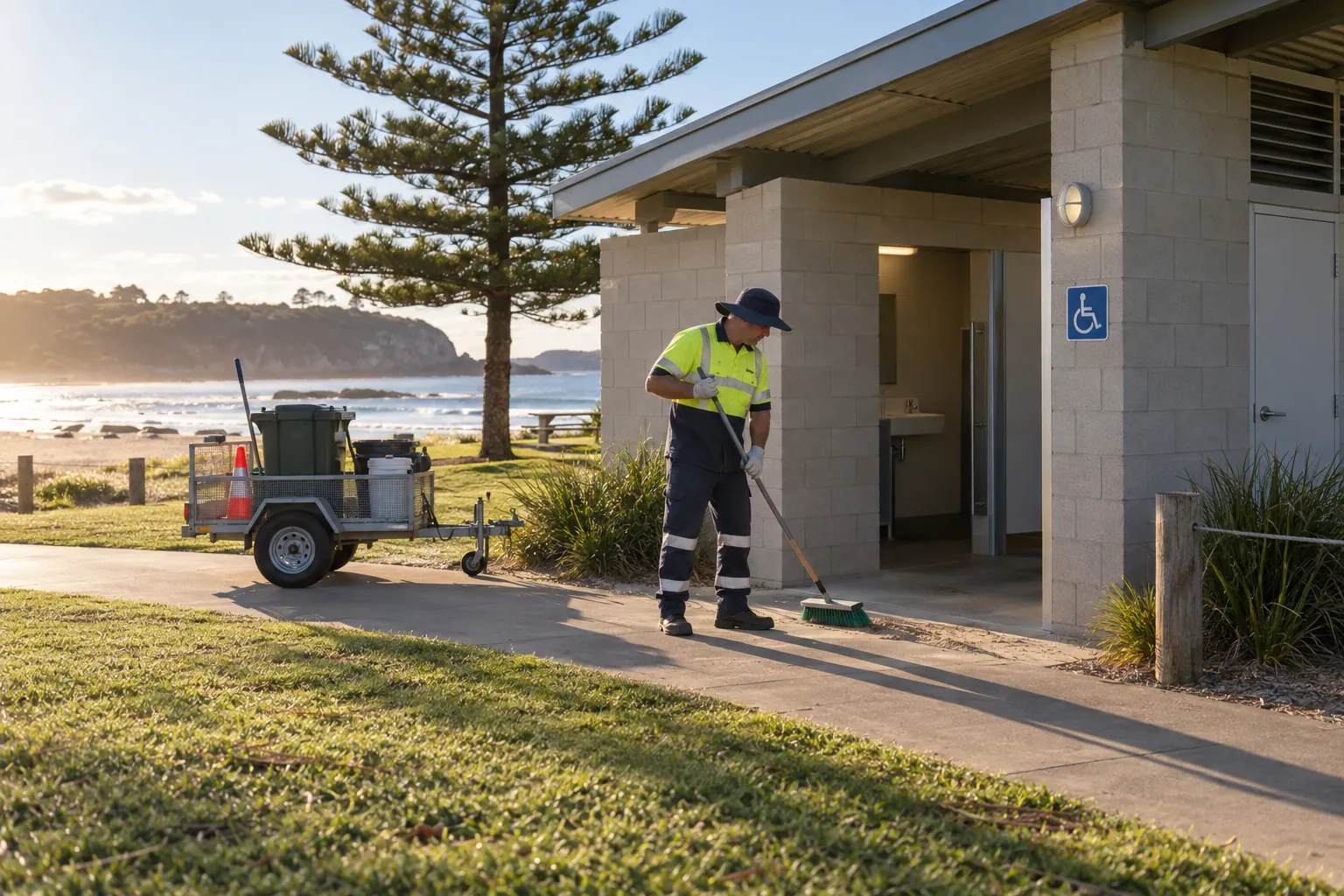
Public toilets are cleaned for people the team will never meet, at all hours, often with nobody on site. This guide covers running them well in Australia: who holds the duties, what a service covers, how often to visit at peak times, handling needles and vandalism safely, accessible toilets and Changing Places, and letting the public report a problem.
01
Who provides public toilets, and the law behind them
Public toilets in Australia are run by local councils in parks, foreshores and town centres, by state agencies in national parks and rest areas, by transport operators, and by shopping centres, sports grounds and event organisers. Some are cleaned by in-house staff, many under a contract that covers cleaning and lock-up together.
No building code or WHS law sets how often a public toilet must be cleaned. That is a service level each provider chooses, in a public toilet strategy, a specification or the contract, written down for each block. What the law sets are the duties around the work and the facility:
- Work health and safety. In every state and territory except Victoria, the WHS Act follows the national model. In Queensland's Work Health and Safety Act 2011, section 19(1) requires a person conducting a business or undertaking (a PCBU) to ensure, so far as is reasonably practicable, the health and safety of its workers, and section 19(2) that "the health and safety of other persons is not put at risk from work carried out": the cleaners and the public.
- Victoria. The Occupational Health and Safety Act 2004 still applies there. Section 23 requires an employer to ensure, so far as is reasonably practicable, that "persons other than employees of the employer are not exposed to risks to their health or safety arising from the conduct of the undertaking of the employer".
- Cleaning chemicals. Regulation 351 of the model regulations, as made in Queensland's Work Health and Safety Regulation 2011, requires a PCBU to manage the risks of "using, handling, generating or storing a hazardous chemical at a workplace": the acids, disinfectants, graffiti removers and other cleaning products on the round.
- Disability discrimination. Section 23 of the Disability Discrimination Act 1992 makes it unlawful to discriminate on the ground of disability "by refusing to allow the other person the use of any facilities in such premises that the public or a section of the public is entitled or allowed to use". It applies to existing facilities as well as new ones.
- Access to premises. The Disability (Access to Premises – Buildings) Standards 2010 apply to new buildings and new parts approved on or after 1 May 2011, and their Access Code covers a Class 10a "non-habitable building located in an accessible area intended for use by the public and containing a sanitary facility, change room facility or shelter": which takes in the standalone toilet block.
The Premises Standards apply not only to designers and certifiers but to a building manager: a person with responsibility for, or control over, any Access Code matter other than design and construction, with property owners, lessees, property managers and "operational staff" given as examples. A compliant accessible toilet that is locked without explanation, used as a store or left out of order is where that part begins.
Where cleaning is contracted out, council and contractor both hold duties for the same work. Outside Victoria, section 46 of the WHS Act requires each of them, so far as is reasonably practicable, to consult, cooperate and coordinate activities with the other. The cleaning contract guide covers what to put in the scope.
02
What a public toilet service covers
A public toilet takes harder use than a workplace amenities room, and many Australian blocks are open to weather, sand and leaf litter. A full service, which keeps the facility hygienic and working, covers:
- Pans and urinals: bowls, rims, seats, flush buttons and the floor around them, cleaned and disinfected, with urinal troughs flushed and descaled on schedule.
- Basins, taps and hand dryers: cleaned, with water running, sensor taps and dryers working.
- Cubicles: doors, locks, partitions, hooks and the sanitary disposal units.
- Floors: swept and mopped with disinfectant, with extra attention to drains and the base of pans and urinals, where smells start.
- Touch points: door handles, push plates, flush buttons, lock turns and baby change tables.
- Consumables: toilet paper, soap and paper towel restocked and dispensers checked.
- Sharps disposal units: checked for damage and fill level. City of Sydney, in its Public Toilet Strategy 2014, installed sharps disposal bins "as standard public health fixtures in all its public toilets", serviced by a contracted medical waste disposal service.
- Beach amenities: outdoor showers, foot taps and change benches, with sand cleared from floors and drains.
- Walls, mirrors and faults: graffiti logged for removal; leaks, blockages, broken locks and failed lights reported.
- The approach: litter, the path and ramp, lighting and the posted opening hours.
Periodic work belongs on its own schedule: descaling, grout and drains, cobwebs and dust at high level, and machine-scrubbing or pressure-washing where the fittings allow. Automated units still need people: Glen Eira City Council's Public Toilet Strategy 2010 records that its automated toilets were "cleaned at least daily in addition to the automated wash cycle which is usually set at every 30 cycles of use".
03
How often, and what changes at peak
The right frequency follows use. Two published council strategies show the range. City of Sydney's 2014 strategy says its public toilets "are serviced between two and seven times per day depending on location and frequency of use", and that service staff, besides cleaning and restocking, "are responsible for reporting maintenance problems for repair". Glen Eira's 2010 strategy described a frequency "fixed for each toilet" that ranged "from twice daily for high use toilets to three times per week for lower use toilets", and recommended that the frequency and timing be reviewed for all its public toilets, "with particular attention to those in high use areas in or near commercial centres".
As a starting point (a rule of thumb, not a published standard):
- Every 30 to 60 minutes at peak: interchanges, shopping centres, stadiums, festivals, and foreshore blocks on hot weekends.
- Several times a day: busy town-centre and CBD toilets, playgrounds and sports reserves on game days.
- Daily or every second day: quiet reserves, rest areas and small towns, with a full service at least daily wherever a block opens daily.
Timing matters as much as the count. Glen Eira's strategy noted that "an additional clean during the day could be beneficial to high-use toilets", especially in the afternoon. A foreshore block needs its visits in summer afternoons, a station block at the commuter peaks, a sports ground at the breaks and after the final siren. Hourly visits through a quiet morning and none in the lunchtime rush produce a full sheet and a complaint.
For an event, plan a full clean before gates open, frequent checks throughout with a named person for each block, and a full clean afterwards.
04
Needles, bodily fluids and vandalism, handled safely
These risks belong in the risk assessment and the induction before anyone works a round alone. NSW Health's community sharps management page says councils must "implement reasonable measures to minimise risks from discarded sharps to workers, volunteers, and the public", including appropriate sharps disposal bins.
Discarded needles and syringes
The NSW Community Sharps Guidance (December 2023) calls training for every worker involved "essential" and recommends that it includes:
- never placing hands into a hidden area, such as a drain, cavity or garbage bag;
- never attempting to recap, break or bend a needle;
- placing a sharps container on the ground beside the item, picking it up with tongs and putting it in sharp end first, with nobody standing nearby;
- washing hands with soap and water afterwards, and cleaning the tongs with detergent and warm water, then a suitable disinfectant.
Look before reaching into bins, behind cisterns and inside dispensers, and send full containers out as clinical waste, not in the general bin. If a cleaner is injured, healthdirect's page on needlestick injuries says to wash the area with plenty of water, not to squeeze or rub it, to cover it with a clean dressing and to get medical advice immediately. It says the risk of infection is very low; the injury still needs reporting and follow-up.
Bodily fluids: use a spill kit, gloves and apron, and close the cubicle until it is done.
Vandalism and graffiti: record damage when it is found, with a photo, the time and the location; make it safe, for example by closing a cubicle with a broken door or isolating a broken fitting; and report it to whoever repairs it. City of Sydney's strategy commits to action graffiti in public toilets for removal "within 24 hours of being identified by maintenance staff or being reported to Council". The graffiti removal guide covers methods. Cleaners should not confront anyone behaving aggressively; they should leave and report it. A record of repeated damage by block and time of day supports the case for better lighting or different opening hours.
05
Accessible toilets, Changing Places, and letting the public report problems
Under clause F2.4 of the Access Code in the Premises Standards, a Class 10a public toilet block needs at least one accessible unisex sanitary compartment at each bank of male and female compartments, entered "without crossing an area reserved for one sex only", plus an ambulant compartment where the bank has other toilets. Those are design rules; the cleaning round keeps them working. On every visit, check:
- Clear space: nothing stored in the room, and bins placed so they do not block the transfer space beside the pan or the circulation space at the basin.
- Grab rails, the basin, taps and dryer: clean, secure and working.
- The door and lock: opening easily and locking properly, with any automatic door and its buttons working.
- Any call button or alarm fitted: working, and someone knows who answers it.
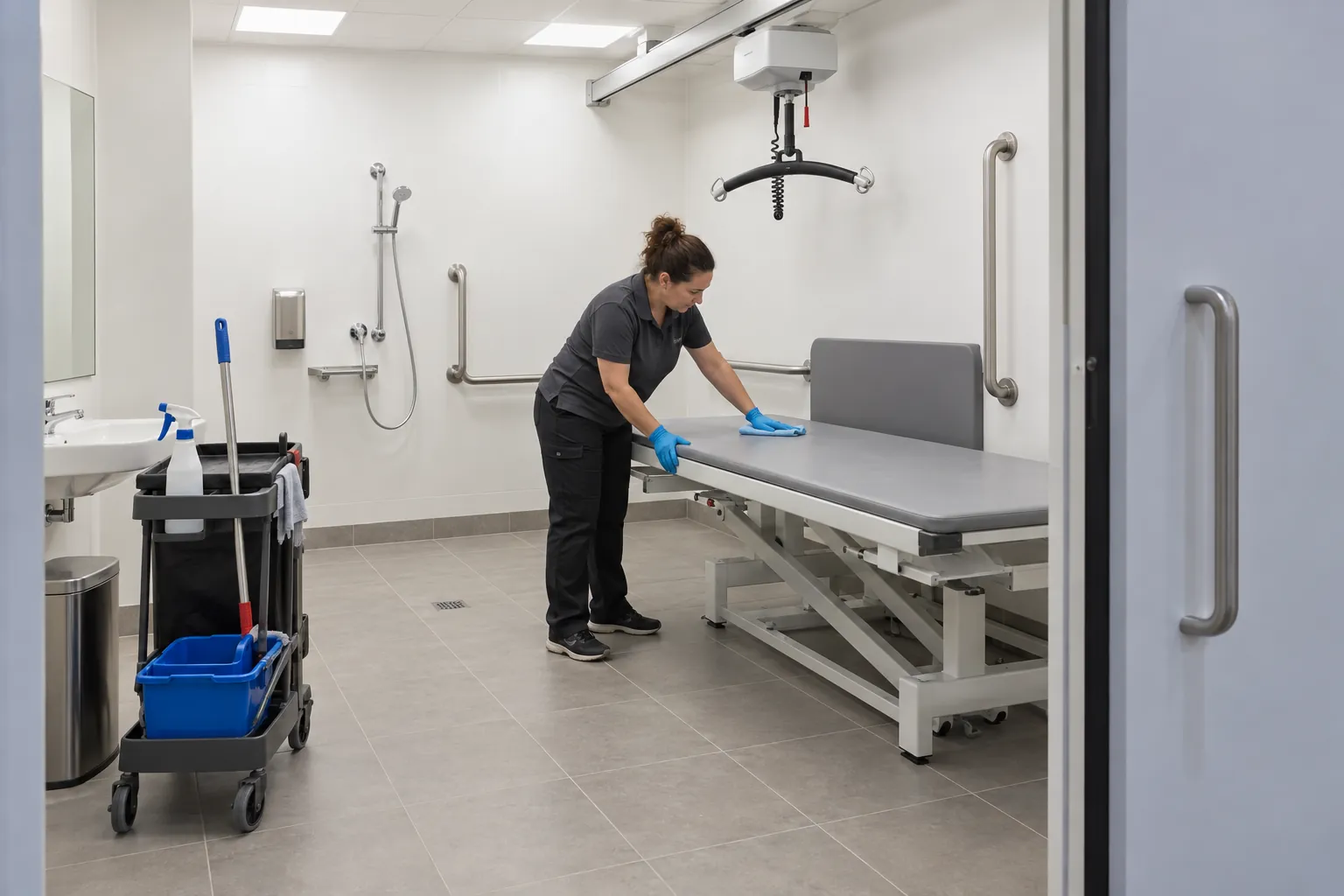
Accessible adult change facilities and Changing Places. Clause F2.9 of the same Access Code requires a unisex accessible adult change facility in certain large new buildings, including shopping centres for 3,500 people or more, major sports venues, large museums and theatres, and airport terminals, built to Part F3, which requires each to have a hoist, a change table, an automated sliding entrance door, and operating instructions for the hoist and change table. Clean the bench, hoist controls and rails as touch points, check the hoist is charged and works, and report a fault at once, because without it the room cannot be used. Regulation 213 of the model WHS regulations requires plant such as a hoist to be maintained and inspected by a competent person, following the manufacturer's recommendations; that is separate from cleaning, but the round is often where a fault is first noticed.
Many Changing Places are locked with the Master Locksmiths Access Key (MLAK). The Changing Places MLAK page says facilities using it "are more likely to be kept clean and provide a safe environment", and that the National Construction Code does not require one. City of Sydney's 2014 Public Toilet Strategy says it does not use MLAK on its public toilets "as it may be perceived to be an access barrier by visitors and tourists especially those from overseas". Either way, the round checks that the lock works.
Tell people what is there. The Australian Government's National Public Toilet Map lists opening hours and features such as MLAK access, Changing Places, baby change and sharps disposal, and anyone can suggest an update to a listing. When hours change or a room is out of use, update the map as well as the door.
Public reporting. The public find most problems first. Glen Eira's strategy was candid that outside the cleaning regime, "extra cleaning or repairs depend upon a user or potential user calling to report it". A sign at each block saying how to report a blocked pan, a broken lock or a needle, with a reference for that block, turns the public into an early warning, if the report reaches the team on duty and someone closes it.
06
Where the public toilet record fails, and what SiteClara does about it
Public toilets are spread across a local government area, a rail network or a showground, and the team moves between them in a ute. A paper sheet in each block tells the contract manager nothing until someone collects it; a missed visit is found by the public first; and a report made through customer service can take days to reach the person who could have closed the cubicle that morning. When a resident asks whether the foreshore block was serviced on Saturday, the answer is a ticked sheet.
SiteClara puts a printed QR poster in each toilet block, with an optional NFC tag behind it. The cleaner scans the code or taps the tag on their own phone, with no app to install, sees the scheduled checks due there, and marks each one done or explains what stopped them, with a photo when the check asks for one. Their name and the time are recorded as it happens. Damage, a blockage or a needle that needs collecting is reported on the spot and goes onto the team's list of open jobs until someone closes it. Where the organisation that owns the toilets runs the account, public reporting can be allowed at the same tag, so a visitor can report a problem at the block where they found it.
The supervisor sees what is due, done and missed across every block and can record why a check was missed. At the end of the day they approve a report that goes to nominated management or client contacts the next morning: what was reported, completed and still open, and how scheduled checks went.
07
Questions people ask
How often should a public toilet be cleaned?
As often as its use demands; no Australian law sets a number. City of Sydney's Public Toilet Strategy 2014 says its public toilets "are serviced between two and seven times per day depending on location and frequency of use". Glen Eira City Council's Public Toilet Strategy 2010 set a frequency for each toilet ranging "from twice daily for high use toilets to three times per week for lower use toilets". Busy blocks need extra visits at their own peak times.
How often do self-cleaning public toilets clean themselves?
Glen Eira City Council's Public Toilet Strategy 2010 says the automated wash cycle in its automated toilets "is usually set at every 30 cycles of use", and that all of them "are cleaned at least daily in addition to" that cycle. The units contain a motion sensor "to prevent the wash cycle from activating when someone is inside". A self-cleaning toilet still needs a person to restock it, check it and report faults.
Can you catch infections from public toilets?
The official advice centres on hands. healthdirect's Hand washing page says germs collect on your hands and "can spread" when you touch your eyes, nose or mouth, lists "after going to the toilet" as a time to wash them, and says hand washing helps prevent the spread of infections such as gastroenteritis. For whoever runs the block, that makes running water, soap and hand drying part of the clean, not an extra.
08
Where to read more, and a list to take away
Start with the WHS Act and Regulations for your state or territory (or Victoria's OHS Act), the Premises Standards' Access Code for accessible and adult change facilities, your state health department's sharps advice, and the public toilet strategies councils publish, which are useful models for service levels. For the check sheet inside each block, see the toilet cleaning checklist guide.
Before the next summer season, check that:
- each block has a written service frequency, with more visits at its own peak times;
- full services, checks, lock-up and periodic deep cleans are scheduled and recorded separately;
- every cleaner is trained in handling sharps and bodily fluids before working alone, with sharps containers, tongs and a spill kit on the round;
- damage and graffiti are recorded with a photo and made safe on the day;
- accessible toilets and adult change rooms are checked on every visit, with hoist inspections booked separately;
- the public can see how to report a problem, and someone acts on it;
- opening hours are posted at the block and correct on the National Public Toilet Map.
Sources
Every document this guide quotes or links to, in the order it first cites them.
- Work Health and Safety Act 2011 legislation.qld.gov.au
- Occupational Health and Safety Act 2004 legislation.vic.gov.au
- Work Health and Safety Regulation 2011 legislation.qld.gov.au
- Disability Discrimination Act 1992 legislation.gov.au
- Disability (Access to Premises – Buildings) Standards 2010 legislation.gov.au
- Public Toilet Strategy 2014 cityofsydney.nsw.gov.au
- Public Toilet Strategy 2010 gleneira.vic.gov.au
- Community sharps management health.nsw.gov.au
- NSW Community Sharps Guidance health.nsw.gov.au
- Needlestick injuries healthdirect.gov.au
- Changing Places MLAK page changingplaces.org.au
- National Public Toilet Map toiletmap.gov.au
- Hand washing healthdirect.gov.au
Related guides
 CleaningToilet cleaning checklist: what to check, how often, and how to make the record believableWhat a toilet cleaning checklist should cover in Australian workplaces, how often to check, the WHS and OHS duties behind it, and how to make the record believable.
 CleaningGraffiti reporting and removal: from the first photo to a clean wallHow to report graffiti in Australia, who removes it, what state law and councils say, and how cleaners and building managers record each tag from report to removal.
 CleaningCleaning contracts in Australia: what to put in them, and how to know they are workingWhat an Australian commercial cleaning contract should cover, how the Cleaning Services Award and Fair Work Act shape it, and how to show the work was done.
 CleaningShopping centre cleaning: common areas, amenities, food courts and spillsShopping centre cleaning in Australia: the WHS and OHS duties, the areas and trading-day schedule, spills, food courts, contractors and a record worth trusting.