Cleaning
Public washroom cleaning: frequencies, safety and accessibility
Public washroom cleaning means cleaning, disinfecting and restocking every washroom open to the public at least once a day, with more frequent checks at its busiest times.
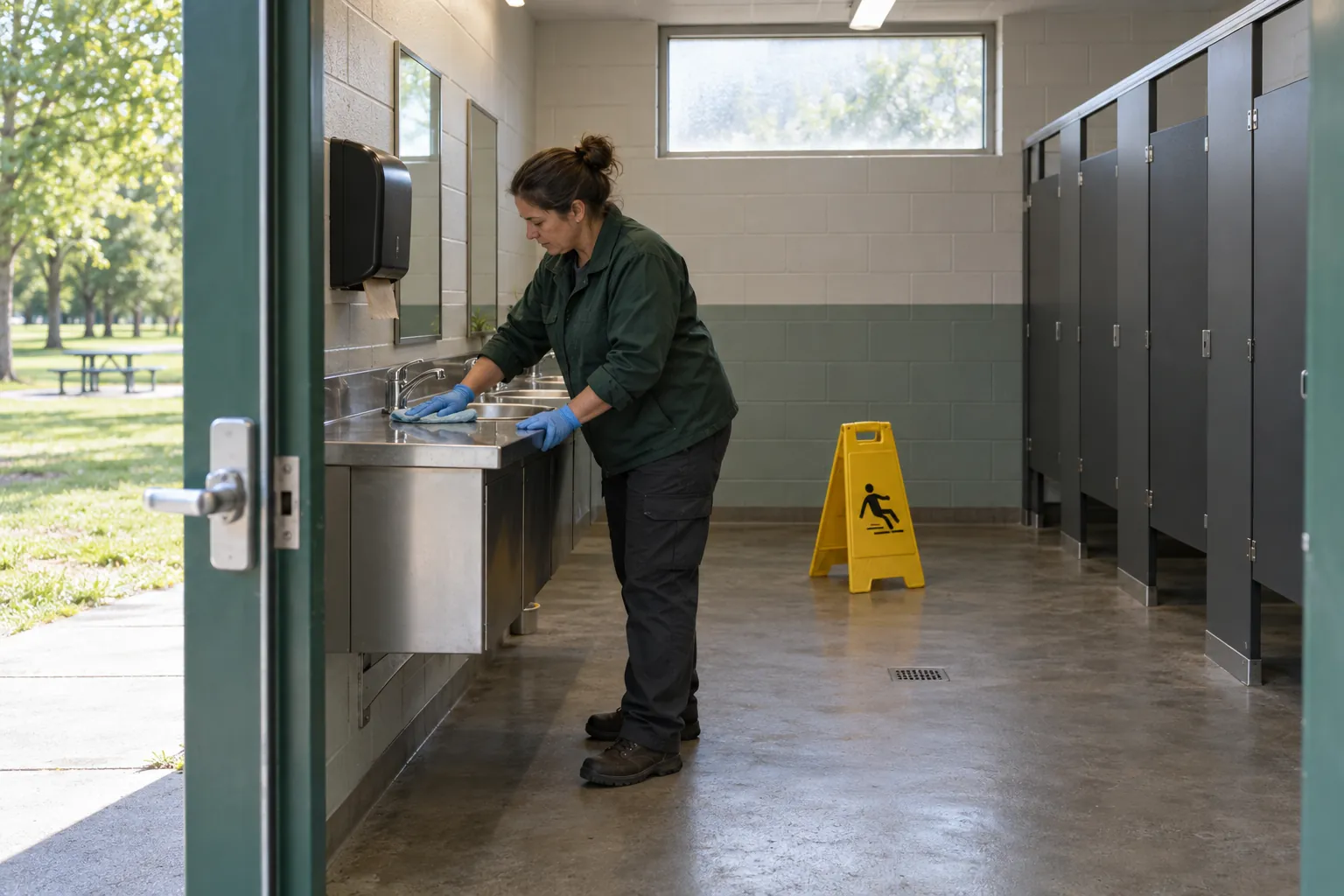
A public washroom, or public restroom, is cleaned for people nobody on the crew will ever meet, at all hours, and often with no attendant. This guide covers running one well in Canada: whose rules apply, what a cleaning covers, how often to visit when it is busy, handling needles and body fluids safely, barrier-free washrooms, and letting the public report a problem.
01
Who runs public washrooms, and whose rules apply
Public washrooms in Canada are run by municipalities in parks, beaches, libraries and community centres; by transit agencies and airports; by malls, arenas and event venues; and at highway rest areas. Many are visited by a custodian or a janitorial contractor on a round and otherwise left to the public.
No single Canadian law says how often a washroom open to the public must be cleaned. What applies depends on the province and on who employs the people who clean and use it; federal law covers only federally regulated work, such as airports and interprovincial transport. Several duties meet in the room:
- The workers who clean it. The provincial occupational health and safety law protects custodians and janitorial staff from the hazards of the job: cleaning chemicals under WHMIS, discarded needles, body fluids, working alone and aggressive members of the public.
- Workers who use it. Where the same washroom is also provided for staff, the workplace washroom rules apply to it. In Ontario, sections 23.1 and 25.3 of the Occupational Health and Safety Act require washroom facilities provided for workers to be kept clean and sanitary, with records of cleaning kept and made available under Ontario Regulation 480/24. The province's guidance, Maintaining clean washroom facilities for workers, says the record, posted in or near the washroom or available to workers electronically, includes the date and time of the two most recent cleanings, and that inspectors decide whether a washroom has been provided for workers "based on the context and facts they find in the workplace". A mall washroom used by store staff, or a station washroom used by transit employees, may well be caught.
- Federally regulated workplaces. At an airport or an interprovincial bus terminal, the Canada Occupational Health and Safety Regulations (SOR/86-304) apply to toilet rooms used by employees: section 9.2 requires them to be kept "in a clean and sanitary condition" and section 9.4 requires each one to be "cleaned at least once every day that it is used". Section 9.17 requires menstrual products in each toilet room, and a covered container for their disposal in a single-toilet room or in each stall of a room with more than one toilet.
- The building itself. New and altered washrooms must meet the building code the province has adopted, most of them based on the National Building Code of Canada 2020, which includes accessibility requirements for plumbing facilities. Ontario has its own Building Code; its page on accessibility in Ontario's Building Code says most buildings must have barrier-free washrooms in public areas.
Because the law leaves the frequency to the owner, it belongs in the scope of work, washroom by washroom, together with who handles repairs and how quickly: the public judges a clean washroom with a broken lock as a dirty one.
02
What a public washroom cleaning covers
A public washroom takes harder use than a staff washroom, from people with no reason to look after it, and every visitor judges its cleanliness. A full cleaning, done at least once a day in every washroom that is open, covers these tasks:
- Toilets and urinals: bowls, rims, seats, hinges, flush handles and sensors, and the floor around the base, scrubbed, cleaned and disinfected; flushing properly.
- Sinks, taps and countertops: wiped, cleaned and dried, with soap scum and stains removed; hot and cold water running, sensors working, no standing water.
- Stalls: doors, latches, partitions, coat hooks and the sanitary disposal container in each stall.
- Touch points: door handles and push plates, stall latches, flush levers, tap handles, dispenser levers, hand dryer buttons and the baby change table.
- Supplies: toilet paper, hand soap, paper towels or a working hand dryer, and menstrual products where they are provided, restocked before they run out.
- Garbage: bins emptied and relined, sanitary containers serviced on schedule, sharps disposal boxes checked where they are fitted.
- Floors and drains: swept and mopped, with mops and cloths kept for washrooms only, with attention to the base of toilets and urinals where odours start; drains clear; wet floor signs out until dry.
- Walls, mirrors and graffiti: spot-cleaned on every cleaning, with offensive graffiti removed the same day.
- Deficiencies: leaks, a plugged toilet, a broken latch, a burnt-out light, a hand dryer that has stopped, found and reported.
- The entrance: litter, outside lighting, posted hours and, in winter, snow and ice on the path.
Periodic cleaning belongs on its own schedule, weekly or monthly as use demands: descaling fixtures, deep-cleaning grout and partitions, dusting vents and high ledges, machine-scrubbing floors. Seasonal park washrooms also need an opening cleaning in spring and a closing check in the fall, recorded like any other.
The Canadian Centre for Occupational Health and Safety (CCOHS), in Sanitation and Infection Control for Cleaning Staff, gives the order that stops a cleaning from being wasted: "Clean visibly dirty or soiled surfaces with soap and water or a cleaning product before disinfecting." It also advises cleaning staff to "Create a checklist of all surfaces that must be cleaned, especially touch points" and to "Record when cleaning and disinfection has occurred." For a room-by-room washroom or restroom cleaning checklist, see the washroom cleaning checklist guide.
03
How often, and what changes at peak times
The right frequency follows foot traffic, not the clock. As a starting point, which each owner should adjust to what their own washrooms show:
- Every 30 to 60 minutes at peak: transit stations at rush hour, airport concourses, malls on a Saturday, arenas and stadiums during an event, beach and park washrooms on a hot summer weekend.
- Every one to two hours: busy libraries and community centres, food courts and recreation centres through the day.
- Two or three visits a day: quieter neighbourhood parks, trailheads and small branch libraries.
- A full cleaning at least once a day in every washroom that is open, usually before opening or after closing.
A beach washroom needs its checks on summer afternoons; a station washroom peaks at the commute; an arena needs a check at each intermission and straight after the game. An hourly round through a quiet morning with nothing during the lunch rush produces a full log and a washroom people complain about.
For an event, plan a full cleaning and restock before the doors open, frequent checks throughout with one named person per washroom block, and a full cleaning afterwards. Portable toilets are serviced by the rental company, but the event team still checks them between services.
04
Needles, body fluids and working alone, handled safely
Public washroom cleaning carries risks that office cleaning does not. They belong in the hazard assessment, and every custodian or cleaner should be trained in them before working a round alone.
Discarded needles and sharps. CCOHS's page for cleaning staff is direct: "Try not to touch a sharp object such as a needle. Use a dustpan or shovel to move it." It says to put sharp objects in a puncture-resistant container, such as a bucket with a secure lid, and warns: "Do not reach your hand into any waste container, receptacle, or pile of waste which may contain hazardous waste." In practice that means:
- carry tongs or a pick-up tool and a puncture-resistant sharps container on the cart with the other cleaning tools and equipment, and take the container to the needle;
- look before reaching: into garbage bins, behind toilet tanks, on top of dispensers, under sanitary containers and in the gap behind a paper towel dispenser;
- never push garbage down in a bin with a hand or a foot; CCOHS also says "Do not compact infectious waste";
- change a wall-mounted sharps box before it is overfull; CCOHS's Needlestick and Sharps Injuries says sharps containers "should be removed and replaced when they are three-quarters full";
- if someone is pricked, the same page says to rinse the site thoroughly with running water and clean it gently with soap and water, to "Report the incident and exposure immediately to your employer", and to follow medical advice for treatment and follow-up.
Blood, vomit and other body fluids. CCOHS's Routine Practices treat "all blood, body fluids, secretions, excretions" as potentially infectious. Close the stall or the washroom, wear disposable gloves, clean the spill up first, then decontaminate the area with an approved disinfectant (the cleaning staff page also gives a 1:100 dilution of household bleach) and throw out soiled cleaning materials "in a leak-proof plastic bag". The vomit cleanup and blood spill cleanup guides go through each step.
Working alone. A custodian cleaning a park washroom at 6 a.m. or a transit washroom late at night is often out of sight and hearing of anyone else, which is what CCOHS's Working Alone – General calls working alone. It recommends a check-in procedure with a named contact, a set interval and a plan if a worker does not check in. Some provinces make this law: in British Columbia, section 4.21 of the Occupational Health and Safety Regulation, Part 4 requires a written procedure for checking the well-being of a worker assigned to work alone, including the time between checks. Check your own province's rule.
Damage and misuse. Record damage when it is found, with the time and a photo; make it safe, for example by locking a stall with a broken door; and report it. Custodians should not confront anyone behaving aggressively: they should leave and report it. A record of repeated damage by washroom and time of day makes the case for better lighting or different hours.
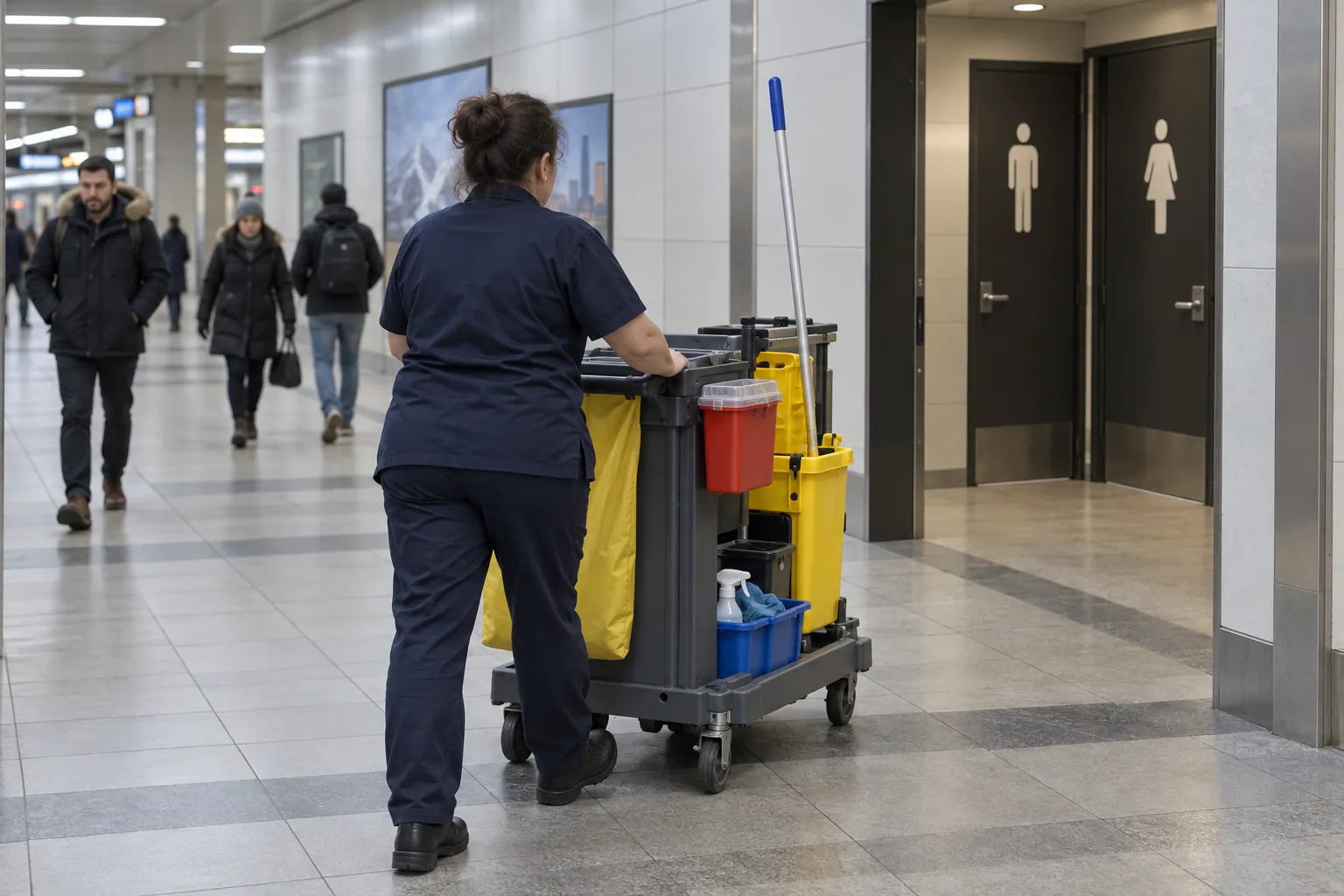
05
Barrier-free washrooms, and letting the public report problems
A barrier-free washroom or universal washroom needs the same cleaning and a few more checks. One that is dirty, locked without explanation or used to store a janitorial cart fails the people with the fewest alternatives. Add these to every visit:
- Clear turning space: nothing stored in the room, and garbage bins placed so they do not block the space beside the toilet or the approach to the sink.
- Grab bars: clean, secure and not loose on the wall.
- The door: the power door operator works, the door opens easily, and the lock works from inside and can be opened from outside in an emergency.
- The emergency call button or pull cord, where one is fitted: not tied up or looped over a bar, and, on the schedule the owner sets, tested to show that it is answered.
- Change tables: the baby change table, and any adult-sized change table, clean, folding properly and undamaged, with a fault reported and the table taken out of use until it is repaired.
The design is set by the building code when the washroom is built or renovated; Ontario's page notes that existing buildings are not affected "unless an extensive renovation is planned". Keeping the room usable every day is the team's job, and the cleaning record is often where a broken door operator is first noticed.
Public reporting. The first people to find a problem are the public. A clear sign in each washroom saying how to report a plugged toilet, a broken latch or an empty dispenser, with a reference for the washroom, turns them into an early warning. It only works if the report reaches the crew on duty and someone closes it. The maintenance request form guide covers how to route a report to the person who can fix it.
06
Where the public washroom record fails, and what SiteClara does about it
Public washrooms are spread across a park system, a transit line or a mall, and the crew moves between them. A paper log on each door tells a supervisor nothing until someone collects it, a missed visit is found by the public first, and a plugged toilet reported through a city's general enquiry line can take days to reach the custodian who could have locked that stall in the morning.
SiteClara puts a printed QR poster in each washroom, with an optional NFC tag behind it. The custodian scans the code or taps the tag on their own phone, with no app to install, sees the scheduled checks due there and marks them done or says what stopped them, with a photo when it helps. Damage, a plugged toilet or a sharps box that needs collecting is reported on the spot and goes onto the team's list of open jobs until someone closes it. On a site led by the building owner, such as a city running its own park washrooms, public reporting can also be switched on at the same tags, so a visitor can report a problem where they find it; sites run by a cleaning contractor start with staff-only tags.
The supervisor sees what is due, done and missed across every washroom, can record the reason a check was missed, and can escalate a job to the building manager. The supervisor reviews the day, and the approved report goes to nominated contacts at 8 a.m. the next morning, showing what was reported, completed and still open.
07
Questions people ask
How often should a public washroom be cleaned?
At least once a day, and more often where traffic is heavy. No Canadian law sets a frequency for washrooms used only by the public, but where workers use them the rules are close to daily: section 9.4 of the Canada Occupational Health and Safety Regulations says each personal service room "shall be cleaned at least once every day that it is used", and CCOHS's summary of Sanitation and Toilet Facilities in the Workplace notes that federal and Quebec rules require daily cleaning. For touch points, CCOHS's Sanitation and Infection Control for Cleaning Staff says to "Clean at least once per day but more frequent cleaning (every 2 to 3 hours) may be necessary."
What are the requirements for a washroom cleaning checklist in Ontario?
Ontario does not prescribe a checklist, but it sets a standard and a record for washrooms provided for workers. The province's guidance, Maintaining clean washroom facilities for workers, says they must be "maintained in a clean and sanitary condition" and that employers must "keep, maintain, and make available records of cleaning", under the Occupational Health and Safety Act and Ontario Regulation 480/24. Inspectors may consider "the actual condition of the washroom facility, such as visible soiling", "the frequency of cleaning, based on the type of washroom facility and the level of use" and "the appropriateness of cleaning practices used to maintain clean and sanitary conditions in the context of the particular workplace". A checklist that follows those three points, with the date and time of each cleaning recorded, covers what an inspector may look at.
Do you have to keep a washroom cleaning log?
In Ontario, for washrooms provided for workers, yes. The province's Maintaining clean washroom facilities for workers says the posted records include "the date and time of the two most recent cleanings of the washroom facility", posted "in a conspicuous place in or near the washroom facility" or kept electronically where workers can access them. Elsewhere, CCOHS's Sanitation and Infection Control for Cleaning Staff advises cleaning staff to "Record when cleaning and disinfection has occurred."
What should a public washroom cleaning checklist include?
Every surface that is cleaned, with the touch points called out. CCOHS's Sanitation and Infection Control for Cleaning Staff advises cleaning staff to "Create a checklist of all surfaces that must be cleaned, especially touch points", to "Clean visibly dirty or soiled surfaces with soap and water or a cleaning product before disinfecting", and to "Wear personal protective equipment and clothing as appropriate for the products you are working with or cleaning." In a public washroom the touch points are door handles, stall latches, flush levers, taps, dispensers, hand dryer buttons and the change table.
08
Further reading, and a list to take away
Start with your own province's occupational health and safety regulation; in Ontario, the province's washroom guidance and O. Reg. 480/24; at airports and other federally regulated workplaces, Part IX of the Canada Occupational Health and Safety Regulations. CCOHS's pages cited above are short and practical, and its summary of Sanitation and Toilet Facilities in the Workplace notes that some jurisdictions, federal and Quebec among them, require daily cleaning. For barrier-free design, ask the local building department which code edition applies.
Before the next busy season, check that:
- each public washroom has a cleaning frequency written into the scope of work, with more visits at its own peak times;
- full cleanings, quick checks and periodic deep cleaning are scheduled separately;
- washrooms also used by staff are identified, and in Ontario the record of cleaning is posted or available electronically for them;
- every custodian is trained in sharps and body fluids before working alone, with tongs, a sharps container and a spill kit on the cart;
- there is a check-in procedure for anyone cleaning washrooms alone, early, late or in remote parks;
- damage is recorded with a photo and made safe on the day it is found;
- barrier-free washrooms are checked for clear space, the door operator, the lock and the call button on every visit;
- the public can see how to report a problem, and someone acts on it the same day;
- hours are posted and the closing check is recorded.
Sources
Every document this guide quotes or links to, in the order it first cites them.
- Occupational Health and Safety Act ontario.ca
- Ontario Regulation 480/24 ontario.ca
- Maintaining clean washroom facilities for workers ontario.ca
- Canada Occupational Health and Safety Regulations laws-lois.justice.gc.ca
- National Building Code of Canada 2020 nrc.canada.ca
- Accessibility in Ontario's Building Code ontario.ca
- Sanitation and Infection Control for Cleaning Staff ccohs.ca
- Needlestick and Sharps Injuries ccohs.ca
- Routine Practices ccohs.ca
- Working Alone – General ccohs.ca
- Occupational Health and Safety Regulation, Part 4 worksafebc.com
- Sanitation and Toilet Facilities in the Workplace ccohs.ca
Related guides
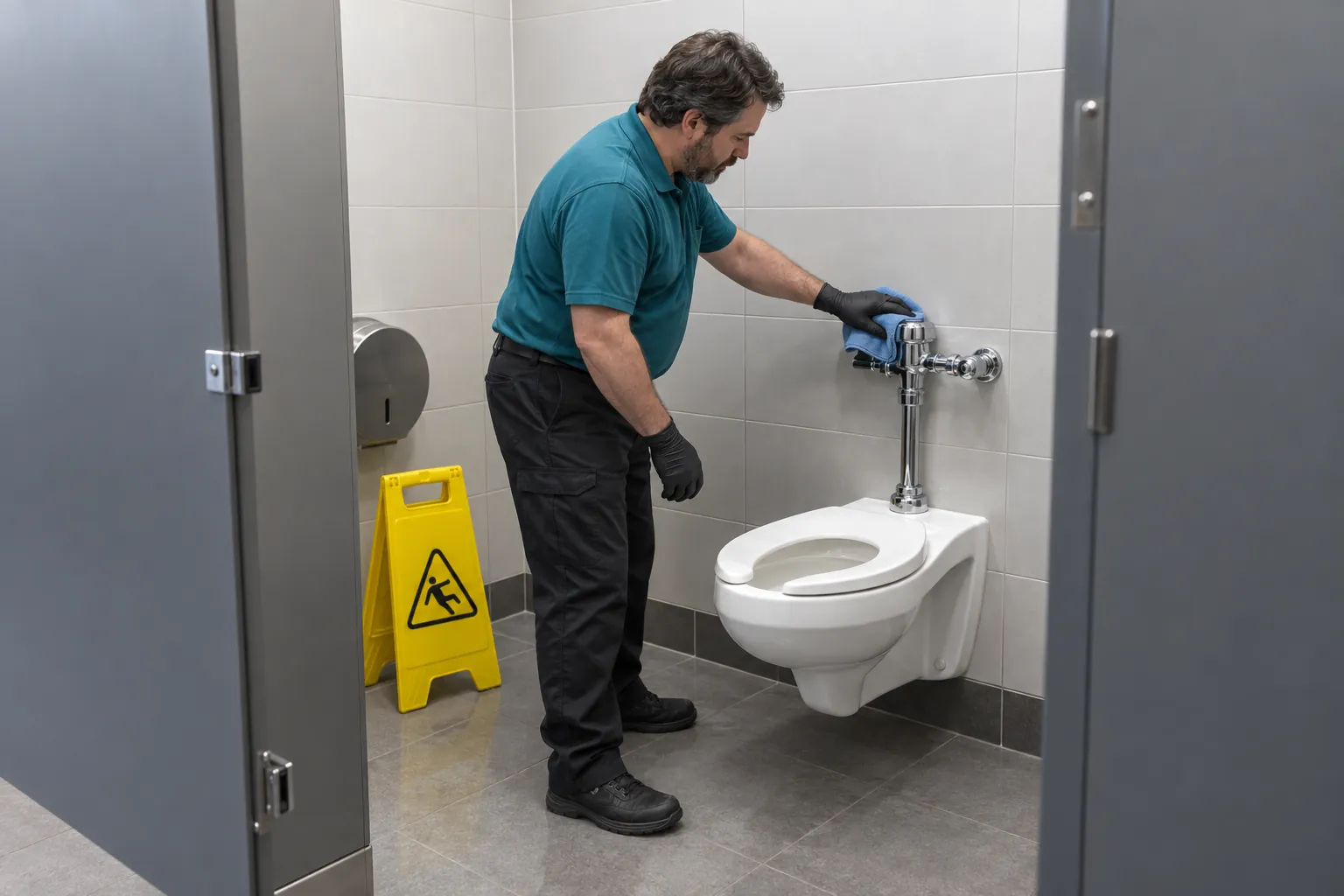 CleaningWashroom cleaning checklist: what to check, how often, and Ontario's new cleaning recordsWhat a workplace washroom cleaning checklist should cover, how often to clean, and Ontario's posted cleaning records required since January 1, 2026.
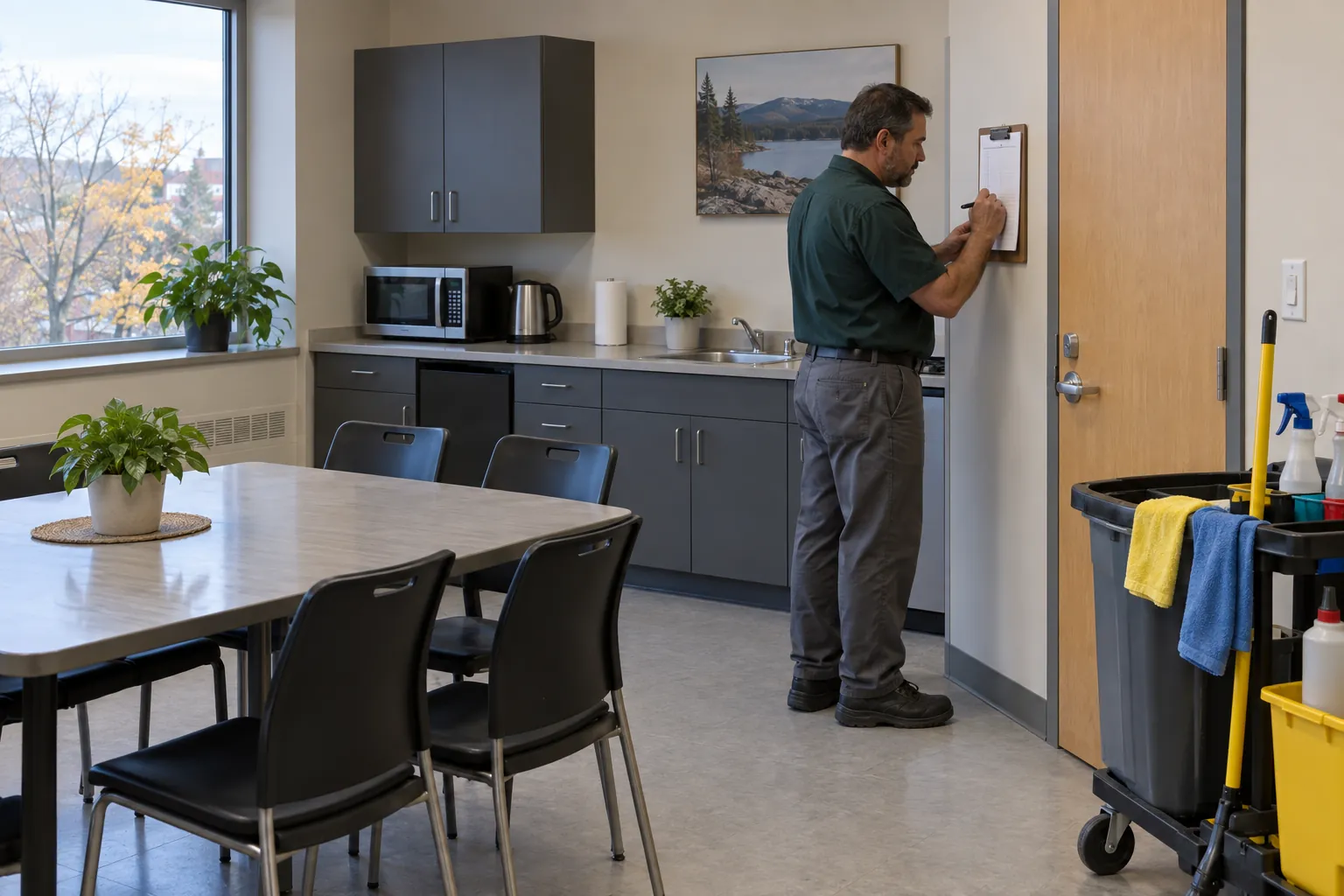 CleaningCleaning log sheet: what to record, who fills it in, and what the law in Canada asks forWhat a cleaning log sheet should record, where Canadian workplaces use one, what Ontario and federal rules require, and how to keep a log people believe.
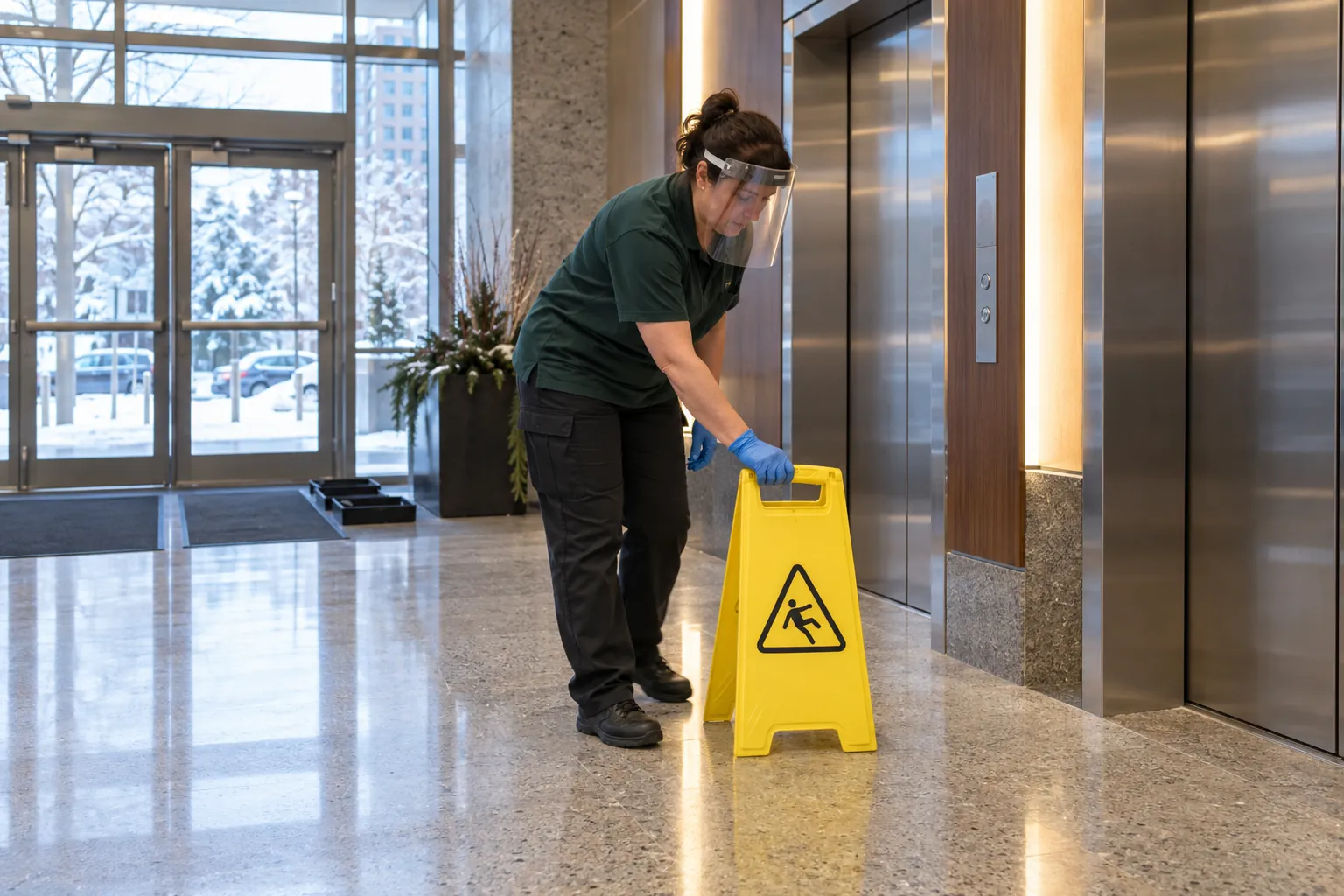 CleaningVomit cleanup and norovirus cleaning: a workplace procedureHow to clean up vomit safely at work in Canada: the spill kit, step-by-step procedure, disinfectant choice for norovirus, outbreak cleaning and the record to keep.
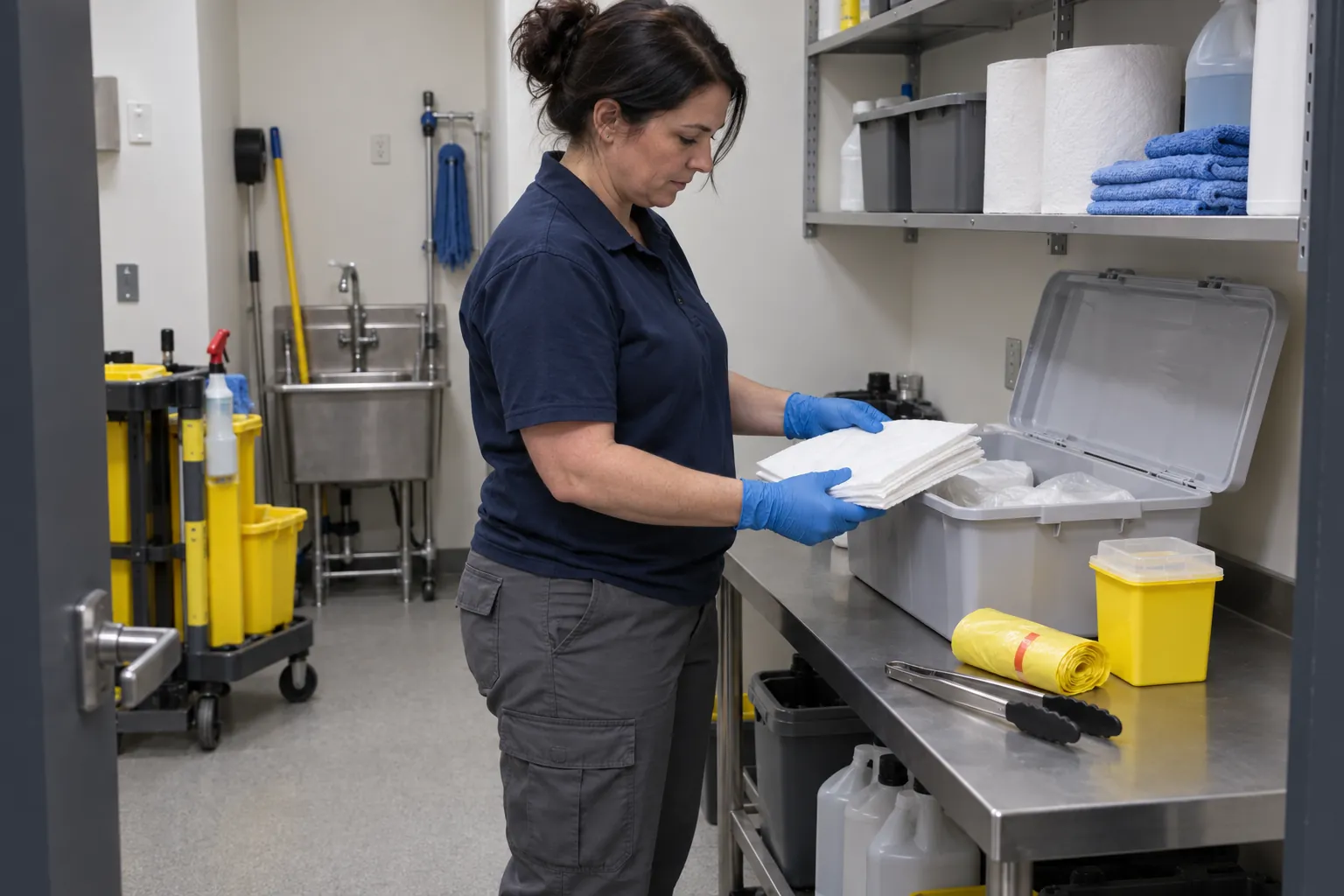 CleaningBlood spill cleanup: a workplace procedure for CanadaHow to clean up a blood spill at work in Canada: the kit, a step-by-step procedure, bleach strengths, needles in the spill, exposures and the record to keep.