Premises and facilities management
Condo manager duties: the licence, the code and the record
A condo manager's duties are to run the day-to-day operations of a condominium corporation on behalf of its board of directors: the finances, the contracts and vendors, the contractors and staff, the records, and communication with owners.

In Ontario, British Columbia and Alberta the role is licensed, and in Ontario it has its own code of ethics. This guide covers what the law says a condo manager is, the duties the role usually carries, the ethics and contract rules, how the manager oversees the building between visits, and the records a manager keeps and hands back.
01
What a condo manager is, and the law that licenses the role
A condominium is run by a corporation made up of its owners, acting through an elected board of directors. Most boards are volunteers, so they hire a condo manager, usually through a management company, to do the corporation's work day to day. The board sets policy and approves budgets and contracts; the manager carries them out and reports back.
In Ontario the role is defined in the Condominium Management Services Act, 2015. Section 1 says that condominium management services means any of the following services provided to or on behalf of a condominium corporation:
- "Collecting or holding contributions to the common expenses or other amounts levied by, or payable to, the corporation."
- "Exercising delegated powers and duties of the corporation or its board of directors", including making payments to third parties, negotiating or entering into contracts, and "supervising employees or contractors hired or engaged by the corporation".
Section 34(1) then says: "No person shall provide condominium management services unless licensed as a condominium management provider or as a condominium manager." The provider is the company; the manager is the individual. Section 51(3) adds that, subject to the regulations, a licensed condominium manager works through a licensed provider rather than on their own account. From the other side, section 17.0.1 of the Condominium Act, 1998 says a corporation "shall not enter into an agreement" for condominium management services unless the provider or manager is licensed.
Ontario Regulation 123/17 (General) sets three classes of licence for condominium managers: limited, general and transitional general. A limited licensee works under supervision; section 22 says the supervising licensee "shall oversee the work of the licensee being supervised" and "be readily available to assist". The Condominium Authority of Ontario's page What Condo Managers Do confirms that managers "must hold a licence issued by the Condominium Management Regulatory Authority of Ontario" (CMRAO), and section 36 of the regulation requires the registrar to publish each licensee's name, licence number, expiry date and class, free of charge, so a board can check before it signs.
02
Condo manager duties, listed
The Condominium Authority of Ontario says each corporation "makes its own decisions about the role of the condo manager and their specific duties", and lists common ones: liaising between residents and the board, providing expertise to the board, managing owner contributions to common expenses, attending board meetings, managing documents and records, managing banking and finances, implementing an emergency management plan and responding to emergencies, issuing meeting notices, monitoring the corporation's insurance, responding to complaints, and "overseeing the work of any third-party service providers or contractors". In practice a condo property manager's week draws on all of these:
- Finance: preparing the draft budget for the board, collecting common expense fees and chasing arrears, paying suppliers within the limits the board has delegated.
- Governance: preparing board meeting packages and minutes, sending notices of owners' meetings, supporting the annual general meeting, and preparing the periodic information certificates and status certificates the corporation must issue.
- Contracts, vendors and contractors: tendering and administering contracts for janitorial and custodial work, security, elevators, fire protection and snow removal, and checking the work is done.
- Maintenance: running the maintenance plan for the common elements, handling maintenance requests from owners and residents, and planning the long-term repair and replacement work the reserve fund study sets out.
- Staff: supervising the building superintendent, cleaners and other site staff the corporation employs, including their health and safety.
- Compliance: keeping fire safety plan duties, inspections and tests on schedule, and enforcing the declaration, by-laws and rules fairly.
The management contract should say what the board decides and what the manager does, including spending limits, site visits and meeting attendance. The most common friction between a board and its manager is a task each assumed the other was doing.
03
The code of ethics and the management contract
Ontario sets a code of ethics for every licensee in Ontario Regulation 3/18. Several sections describe the job as much as they restrict it:
- Section 5: "provide conscientious, courteous and responsive service and demonstrate reasonable knowledge, skill, judgment and competence".
- Section 7: make and keep "all records that the licensee reasonably requires for the purpose of providing condominium management services", in addition to those the Act requires.
- Section 12: keep a client informed in a timely manner of "all significant steps" the licensee takes, and of "information about the condition of the property or assets" where the licensee has a contractual obligation to manage, maintain, repair or protect them.
- Section 13: "promote and protect the best interests of the licensee's clients".
- Section 16: a licensee with a contractual obligation to look after the property "shall be diligent in executing these obligations" and shall not exaggerate, misrepresent or conceal material facts about it.
Before a contract is signed, Ontario Regulation 4/18 requires more. Under section 4 the management company must carry errors and omissions insurance and fidelity insurance, and give the corporation certificates showing the insurer, policy number, amounts and dates. Under section 5 the licensee must disclose in writing the services and associated costs, whether any services will be provided by someone else, and any material interest or financial benefit the licensee has in another business serving the client. Section 52 of the Condominium Management Services Act adds a continuing duty to disclose in writing any interest in a contract to which the client is a party, and section 53 forbids a licensee to solicit proxies for a meeting about the election or removal of directors or about the licensee.
British Columbia puts its limits in the Strata Property Act, Part 4. Under section 39, a strata management contract may be cancelled without penalty on two months' notice, by the strata corporation after a 3/4 vote at a general meeting, or by the manager, whatever the contract says.
A useful contract, in any province, names each service and its fee, the spending limit, site visits and board meetings included, response times, what the monthly report contains, and how the contractors on site will be checked.
04
Running the building: manager, super and contractors
A condo manager is rarely in one building all day. A portfolio manager may visit each corporation weekly or monthly; a large building may have an on-site manager. Either way, most work on the common elements is done by others: the building superintendent, the janitorial contractor, the security or concierge company, and trades on call. The manager's duty is to see that it happens.
A working pattern for a mid-sized building:
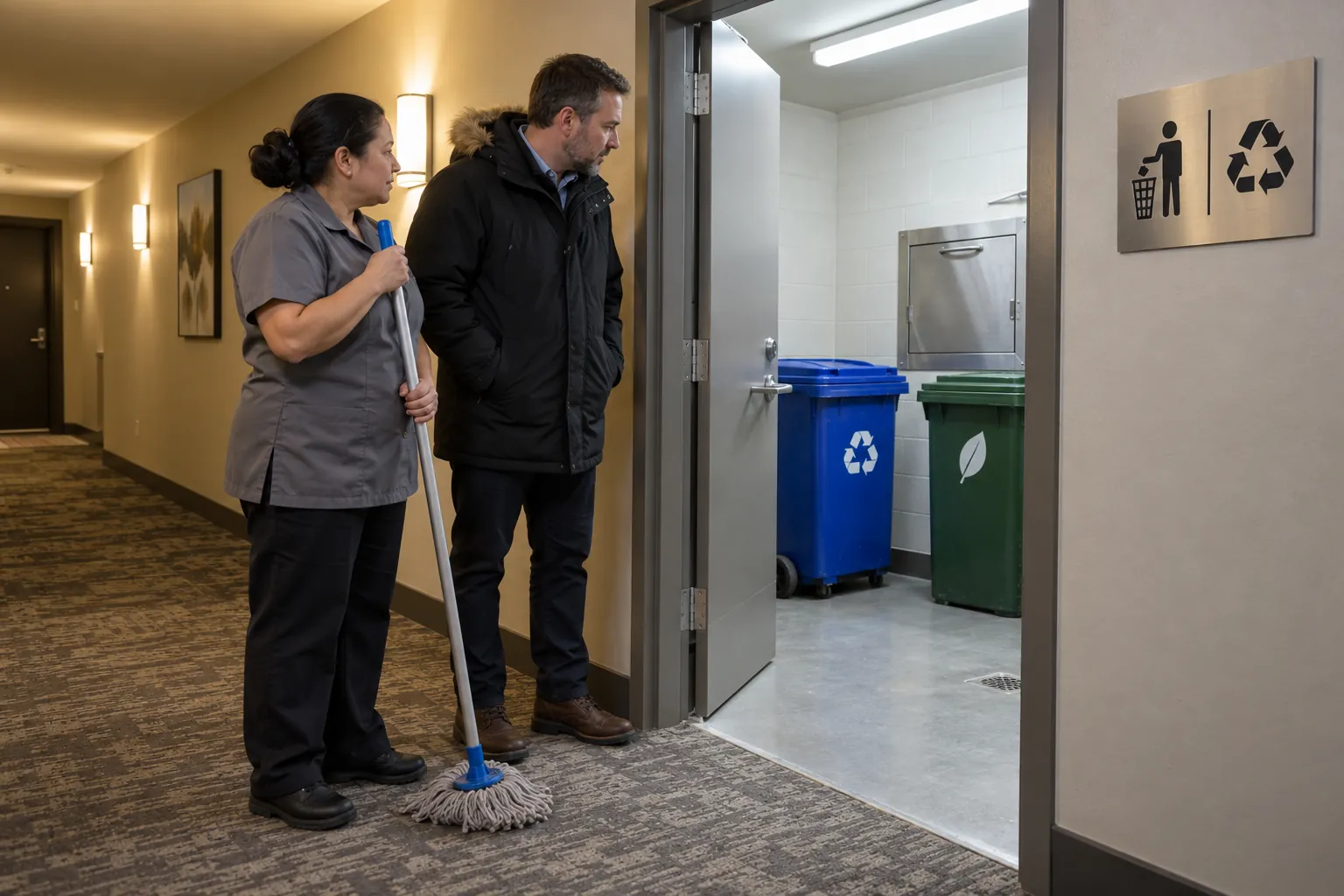
- A walk of the building on each visit: lobby, corridors, stairwells, garbage rooms, garage, amenity and mechanical rooms, noting anything missed.
- Maintenance requests logged as they arrive, sent to the super or a trade, and followed until closed.
- Contractor checks against the scope: was the garage swept, was the ramp salted before the morning rush.
- Fire and life safety: inspections and tests by the fire protection contractor on schedule, deficiencies tracked to repair, and the fire safety plan current.
- A monthly report to the board covering finances, open work, contractor performance, incidents and anything needing a decision.
Two statutes shape this work in Ontario. Where the corporation employs a superintendent or cleaners, it is their employer under the Occupational Health and Safety Act, and section 25(2)(h) requires an employer to "take every precaution reasonable in the circumstances for the protection of a worker"; the manager usually carries that out. And Division B, Sentence 1.1.2.1.(1) of the Ontario Fire Code says that where the Code requires tests, corrective measures or operational procedures, "records shall be made noting what was done and the date and time it was done", kept at the building for the Chief Fire Official. Other provinces have their own equivalents.
05
Records: the corporation's, the manager's, and the handover
Condo management runs on records, and the law distinguishes three kinds.
The corporation's records. Section 55(1) of the Ontario Condominium Act requires the corporation to "keep adequate records", including the financial records, the minute book, the declaration, by-laws and rules, reserve fund studies and "a copy of all agreements entered into by or on behalf of the corporation". Section 26.3 of the Act, with section 11.1(4) of Ontario Regulation 48/01, requires a periodic information certificate to owners at least twice a year, within 60 days after the end of the first and third quarters of the fiscal year, and section 45(2) of the Act an annual general meeting within six months of the end of each fiscal year. The manager usually prepares all of these, but they belong to the corporation. In British Columbia, section 35 of the Strata Property Act lists the records the strata corporation must prepare and keep, and section 36 lets owners inspect them.
The manager's own records. Section 34 of Ontario Regulation 123/17 requires a licensee to keep, among other things, documentation of all disclosures made to the client and "every contract" entered into with a condominium corporation, for at least six years. Section 6 of Ontario Regulation 4/18 requires a licensee holding records for a client to keep them "securely, accurately, and with care", and to make them available for inspection when asked.
The handover. When the contract ends, section 54(1) of the Condominium Management Services Act requires the licensee to transfer "all documents and records relating to the client", and section 54(3) forbids holding them back as a means of pressure. Section 35 of Ontario Regulation 123/17 sets the deadline at 15 days after termination, or 30 days for a record the contract required but which did not yet exist. In British Columbia, section 37 of the Strata Property Act gives a strata manager four weeks.
The records that are hardest to hand over are the operational ones: which checks the site team did, which faults were reported and when they were fixed. They often live in a superintendent's binder, a contractor's clipboard and the manager's inbox. For each routine check or job, a useful record shows:
- where: the location in the building;
- what: the check done or the fault found, in plain words;
- who and when: the named person and the time, recorded at the time;
- what stopped it: the reason a check was missed or held up;
- the outcome: when a fault was fixed and by whom, or why it is still open;
- a photo where it helps.
06
Where the record fails, and what SiteClara does about it
Condo managers usually have good records of what the office does, such as budgets, minutes and contracts, and weak records of what happens on site between visits. The janitorial sign-off sheet in the chute room is filled in for the week on Monday. A resident mentions a flickering stairwell light to the concierge on Saturday and the manager hears about it at the board meeting. When the board asks how the contractors are doing, the honest answer is a feeling.
SiteClara puts a printed QR poster at each location, such as a lobby entrance, a garbage room, a garage ramp, a stairwell or an amenity room, with an optional NFC tag behind it. The super, the janitorial staff or a contractor scan the code or tap the tag with their own phone, with no app to install, see the scheduled checks due there, and mark them done or say what stopped them, with a photo when one is asked for. An issue reported at the poster goes onto the team's list of open jobs until someone closes it. The supervisor's queue groups open jobs by building and floor, and a supervisor can escalate a job to the building manager, who can answer it.
Each day the contractor's supervisor reviews the day, gives the reason for any check that was missed, and approves a report that goes to the condo manager and other nominated contacts the next morning, showing what was reported, what was completed, what is still open and how the scheduled checks went.
07
Questions people ask
What are the responsibilities of a condo manager?
To manage the corporation's day-to-day operations for the condo board, within the duties the board delegates. The Condominium Authority of Ontario's page What Condo Managers Do says condo managers act "on behalf of the condo board in the management of day-to-day operational activities", and lists liaising between residents and the board, managing owner contributions to common expenses, managing documents and records, managing banking and finances, responding to complaints and overseeing third-party service providers or contractors. The board still sets policy and approves budgets and contracts.
What is the difference between a property manager and a condo manager?
A property manager usually acts for the owner of rental property; a condo manager acts for a condominium corporation and its board. British Columbia's Real Estate Services Act draws the line in section 1: rental property management services are provided "to or on behalf of an owner of rental real estate", and strata management services "to or on behalf of a strata corporation". In Alberta, RECA's licence types page says "Condominium management is a separate industry from property management and requires a distinct licence", and a company offering both must run them as separate brokerages.
Do you need a licence to be a property manager in Canada?
It depends on the province and on what is managed. In British Columbia, section 3(1) of the Real Estate Services Act requires a licence, unless exempt, to provide rental property management or strata management services to another for pay. In Alberta, RECA's licence types page says a real estate brokerage licence is required for property management services and a condominium management brokerage licence for condominium management services. In Ontario, section 34(1) of the Condominium Management Services Act, 2015 requires a licence to provide condominium management services. Elsewhere, ask your province's regulator.
08
Where to read more, and a list to take away
In Ontario, start with the Condominium Management Services Act, 2015 and its regulations (O. Reg. 123/17, O. Reg. 3/18 and O. Reg. 4/18), the Condominium Act, 1998, and the Condominium Authority of Ontario's What Condo Managers Do. In British Columbia, read the Strata Property Act, Part 4 and the Real Estate Services Act; in Alberta, RECA's licence types page.
If you are hiring a condo manager, or reviewing the one you have, check that:
- the management company and the individual manager are licensed in your province, and you have checked the public register;
- you have the certificates of errors and omissions and fidelity insurance, and the written disclosures of services, costs, subcontracting and interests;
- the contract lists each service and fee, the spending limit, site visits, meeting attendance, response times and what the monthly report contains;
- fire protection inspections, tests and deficiencies are tracked, and the fire code records are kept at the building;
- the manager can show that contracted janitorial, security and snow work was done, not just invoiced;
- the corporation's records are kept so they can be inspected and handed over complete when the contract ends.
Sources
Every document this guide quotes or links to, in the order it first cites them.
- Condominium Management Services Act, 2015 ontario.ca
- Condominium Act, 1998 ontario.ca
- Ontario Regulation 123/17 (General) ontario.ca
- What Condo Managers Do condoauthorityontario.ca
- Real Estate Services Act bclaws.gov.bc.ca
- Licence types reca.ca
- Ontario Regulation 3/18 ontario.ca
- Ontario Regulation 4/18 ontario.ca
- Strata Property Act, Part 4 bclaws.gov.bc.ca
- Occupational Health and Safety Act ontario.ca
- Ontario Fire Code ontario.ca
- Ontario Regulation 48/01 ontario.ca
Related guides
 Premises and facilities managementCondo maintenance: looking after the common elements, and proving itWho maintains a condo's common elements under Ontario's Condominium Act and other provinces' laws, what the work covers, how often, and what the record should show.
 Premises and facilities managementProperty manager duties in Canada: licensing, legal duties and the daily recordWhat a property manager does in Canada: provincial licensing, the owner's duties under occupiers', tenancy and fire law, the daily work and the records.
 Premises and facilities managementBuilding superintendent duties: what the super does, and how to show it was doneWhat a building superintendent does in Canada: the landlord's duties a super carries out, heat and vital services, fire safety, working alone and the daily record.
 Premises and facilities managementMaintenance request forms: what to capture, how fast to answer, and what to keepWhat a maintenance request form should capture, how requests are prioritized and closed, and what Ontario, Toronto and BC rules say about repairs and records.