Security patrols
Condo security: what the corporation must do, what the guards should do, and how the board knows it was done
Condo security is the condominium corporation's responsibility: in Ontario the Condominium Act, 1998 gives the corporation a duty to control, manage and administer the common elements, and its board decides how to keep them safe, usually with a concierge or licensed security guards, fob access control, cameras and regular patrols.
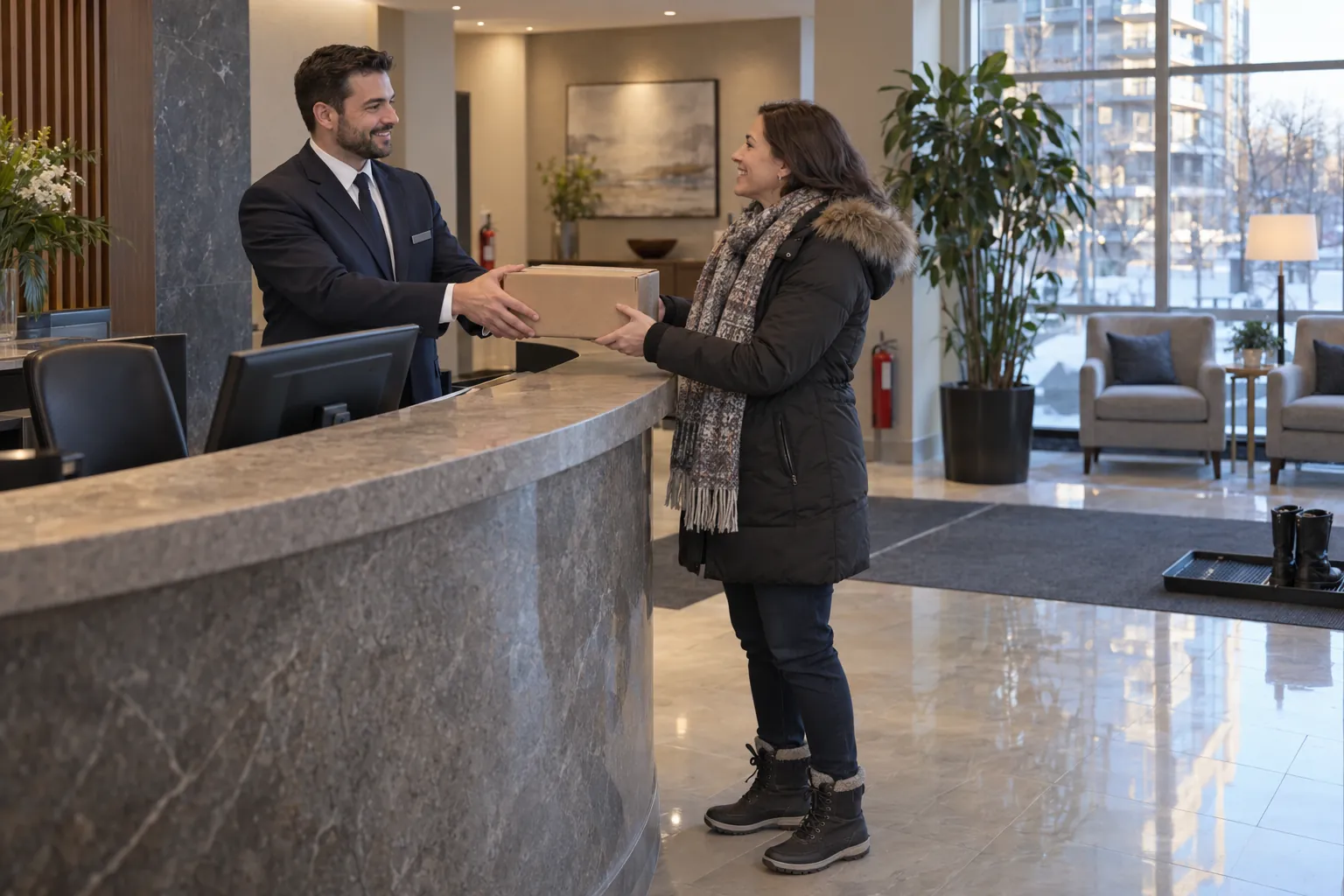
The law sets the duty and leaves the means to the board, so two buildings on the same street can have very different security. This guide covers the duty in Ontario and British Columbia, what condo building security takes in practice, when a concierge needs a security guard licence, the rules for fobs and security cameras, and the patrol and incident records that show the board what its security actually did.
01
Who is responsible for condo security, and the law behind it
A condominium is run by a condominium corporation made up of its unit owners, acting through an elected board of directors. In Ontario, section 17(1) of the Condominium Act, 1998 says the objects of the corporation are “to manage the property and the assets, if any, of the corporation on behalf of the owners”, and section 17(2) adds that the corporation “has a duty to control, manage and administer the common elements and the assets of the corporation”. The common elements, from the lobby to the parking garage, are everything that is not a unit, and their security is part of that duty.
Section 17(3) gives the corporation a duty “to take all reasonable steps” to ensure that owners, occupiers, and the corporation's own agents and employees comply with the Act, the declaration, the by-laws and the rules. Section 58(1)(a) lets the board make rules respecting the use of the units and common elements to “promote the safety, security or welfare of the owners and of the property”, and section 58(2) says those rules “shall be reasonable”. And section 117(1) forbids any person, “through an act or omission”, to cause a condition or activity in a unit or the common elements that is likely to damage the property or cause an injury or an illness to an individual.
The corporation is also an occupier. Ontario's Occupiers' Liability Act defines an occupier to include a person with “responsibility for and control over the condition of premises or the activities there carried on, or control over persons allowed to enter the premises”, and section 3(1) says an occupier owes a duty to take such care as is reasonable “to see that persons entering on the premises, and the property brought on the premises by those persons are reasonably safe while on the premises”.
In British Columbia, a condo is a strata. Section 3 of the Strata Property Act says the strata corporation “is responsible for managing and maintaining the common property and common assets of the strata corporation for the benefit of the owners”, and section 4 says its powers and duties “must be exercised and performed by a council”. Under section 119(2) in Part 7 of the Strata Property Act, the bylaws may provide for “the control, management, maintenance, use and enjoyment” of the strata lots, common property and common assets, which is where a strata's security rules sit. Other provinces have their own condominium statutes.
None of these duties tells a board to hire a guard. The means are the board's choice: a 24-hour concierge, a guard on nights only, a mobile patrol, or fobs and cameras alone. Whatever it chooses, the question after an incident is the same: what did the corporation do, and can it show it?
02
What condo building security covers in practice
In a typical mid-sized or high-rise building in Canada, condo security covers:
- The front desk: signing in visitors, contractors and trades, taking parcels, and booking the service elevator for move-ins and move-outs.
- Access control: issuing and deactivating fobs, keeping the fob register, managing master keys, and watching for tailgating at the lobby and garage doors.
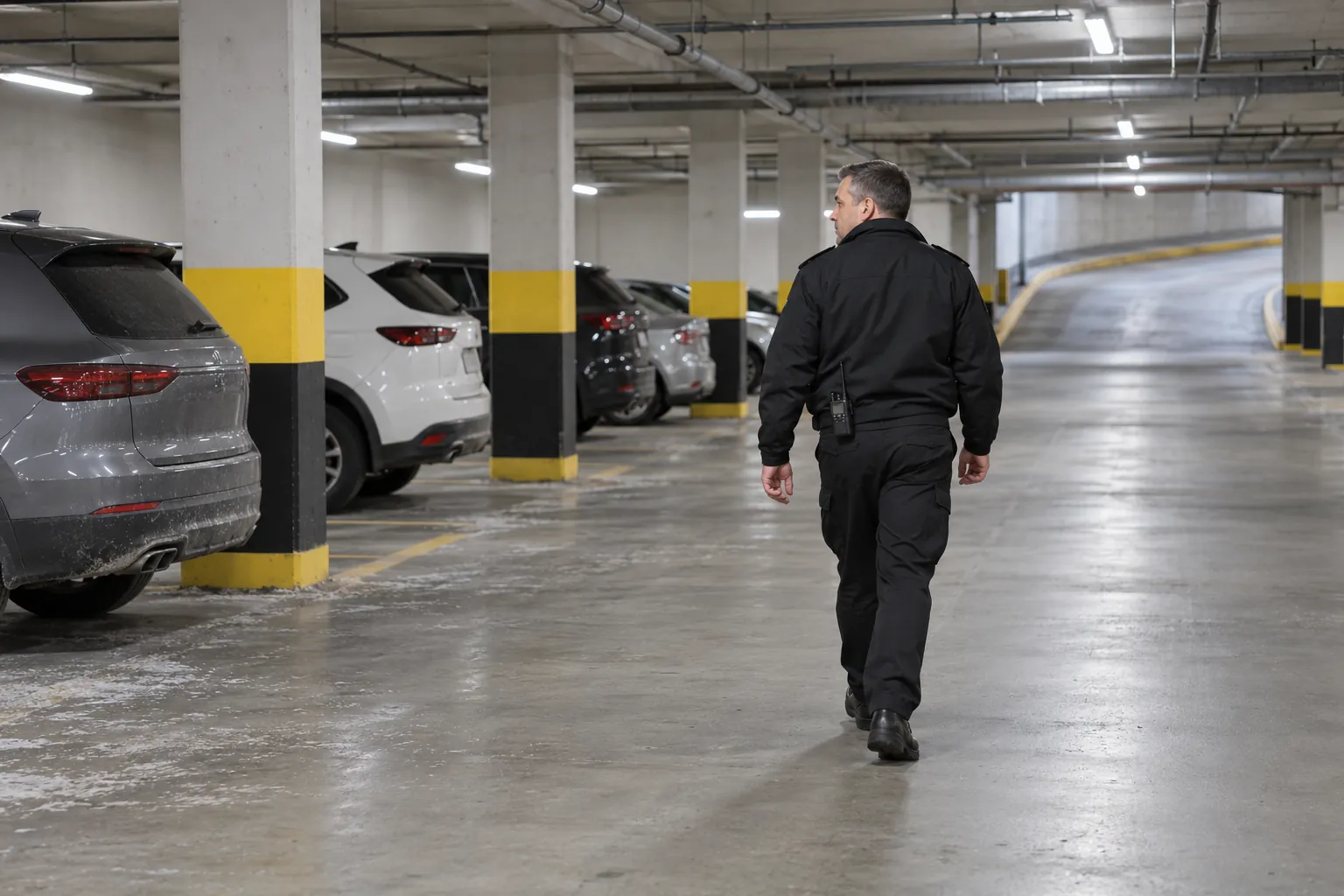
- Patrols of the common elements on a set route at set times: the parking garage on every level, stairwells, garbage and recycling rooms, the loading dock, amenity rooms, the pool and gym, roof and mechanical room doors, and the perimeter.
- Cameras: watching the monitors at the desk, and finding and preserving footage when there is an incident.
- Fire and life safety: responding to the fire alarm, meeting the fire department, and carrying out the duties the building's fire safety plan gives its supervisory staff.
- Incidents: noise and nuisance complaints, trespassers, water leaks, elevator entrapments, medical emergencies and suspicious behaviour, and calling police, fire or paramedics when needed.
- Rule enforcement: recording breaches of the rules for the property manager to follow up.
- Hazards and deficiencies: a door that does not latch, a burnt-out light in the garage, a leak, an icy ramp, a blocked exit, reported to whoever fixes them.
Fire safety is the part with the most precise law. In Ontario, Section 2.8 of Division B of the Ontario Fire Code (O. Reg. 213/07) applies to a residential occupancy where the occupant load exceeds 10 and to any building of 4 storeys or more, counting storeys below grade, which takes in most condo buildings. Sentence 2.8.2.1.(2) requires a fire safety plan that provides for “the appointment and organization of supervisory staff to carry out fire safety duties”, Sentence 2.8.1.2.(1) says supervisory staff “shall be instructed in the fire emergency procedures as described in the fire safety plan before they are given any responsibility for fire safety”, and Article 2.8.1.4. says any keys or special devices needed to operate the fire alarm system or reach fire protection equipment “shall be readily available to on-duty supervisory staff”. In a high building within Subsection 3.2.6. of Division B of the Building Code, Sentence 2.8.3.2.(5) requires a supervisory staff fire drill “at least every three months”. Where the concierge or guards are named as supervisory staff, those duties belong in their post orders and their training.
Where security is the only team on site overnight, its records become the record of what happened when nobody else was there.
03
Concierge or licensed security guard: what the law in Ontario and BC requires
Many condos call the front desk “concierge security”, and the title matters less than the work. In Ontario, section 2(4) of the Private Security and Investigative Services Act, 2005 (PSISA) defines a security guard as “a person who performs work, for remuneration, that consists primarily of guarding or patrolling for the purpose of protecting persons or property”. Section 2(5)(c) gives as an example “performing services to prevent the loss of property through theft or sabotage in an industrial, commercial, residential or retail environment”. A desk whose work is primarily guarding and patrolling the building is security guard work, whatever the uniform says.
Section 6 of the PSISA then says no person shall act as a security guard “or hold himself or herself out as one” unless they hold the appropriate licence and are employed by a licensed business entity, a registered employer or an employer that is not required to register. That gives a board two routes:
- A contract with a licensed security company, which employs, trains and supervises the guards. This is the usual arrangement.
- Its own guards, employed by the corporation or its management company. Section 5 requires a business entity that employs a security guard, other than one selling guard services to the public, to register as an employer, and the guards still need their own licences.
While working, section 35(1) requires a licensed guard to carry the licence, identify themselves as a security guard on request and produce the licence on request, and section 35(2) requires a uniform that complies with the regulations, except, under section 35(3), for a bodyguard or someone “performing services to prevent the loss of property through theft or sabotage in an industrial, commercial, residential or retail environment”. The code of conduct in Ontario Regulation 363/07 requires every individual licensee, while working as a security guard, to “refrain from exercising unnecessary force” and to “respect the privacy of others by treating all information received while working as a private investigator or security guard as confidential”, except where disclosure is required as part of the work or by law. In a residential building, where the desk sees who comes and goes from every unit, that last duty matters most.
In British Columbia, section 2 of the Security Services Act says an individual “must not engage in any kind of security work” without a valid security worker licence for that kind of work, unless they are exempt by regulation or “the registrar determines that the security work in which the individual is engaged is incidental to the individual's primary work”. A strata unsure whether its front desk needs licensed staff should ask the registrar.
Licensed or not, a condo guard has no police powers. In Ontario, section 2(1) of the Trespass to Property Act makes it an offence not to leave premises “immediately after he or she is directed to do so by the occupier of the premises or a person authorized by the occupier”. Section 9(1) lets the occupier or a person authorized by the occupier arrest without warrant a person they believe on reasonable and probable grounds to be on the premises in contravention of section 2, and section 9(2) requires someone who is not a police officer to “promptly call for the assistance of a police officer” and hand the person over. Whether the guards are authorized to give trespass directions, and when they call police instead, should be written in the post orders.
04
Fobs, access control and condo security cameras: the rules
Fobs and cameras protect the building and collect information about the people in it. In Ontario, the board's tool is rules under section 58 of the Condominium Act, which must be reasonable and consistent with the Act, the declaration and the by-laws, and under sections 58(6) and 58(7) take effect only after notice to the owners, who may requisition a meeting to vote on them. A good fob rule says who may hold a fob, how many per unit, and that a lost or misused fob is deactivated; the register matching each fob to a unit is what lets the desk switch off the one a former tenant never returned.
Cameras are a privacy question as well as a security one. The Office of the Privacy Commissioner of Canada's Guidelines for Overt Video Surveillance in the Private Sector name four private-sector privacy laws: the federal PIPEDA, Alberta's and British Columbia's Personal Information Protection Acts, and Quebec's Act respecting the protection of personal information in the private sector. The federal Privacy Commissioner's page How PIPEDA applies to charitable and non-profit organizations says the federal Act “applies to organizations that collect, use or disclose personal information in the course of commercial activities”, so whether it reaches a particular condominium corporation depends on what the corporation is doing. Whichever law applies, those guidelines are a sound model. They note that under PIPEDA and the Alberta and British Columbia private-sector privacy Acts, the information “does not need to be recorded” to count, and they set out ten steps, including:
- Determine whether a less privacy-invasive alternative to video surveillance would meet your needs.
- Develop a policy on the use of video surveillance.
- Limit the use and viewing range of cameras as much as possible.
- Store any recorded images in a secure location, with limited access, and destroy them when they are no longer required for business purposes.
- Periodically evaluate the need for video surveillance.
British Columbia is more specific. BC's Personal Information Protection Act applies to strata corporations, and the Information and Privacy Commissioner's Privacy guidelines for strata corporations and strata agents say that surveillance systems “may include video or audio recordings, key fob entry systems, and other technologies that record or track information about identifiable individuals”. Before installing or activating a system, a strata should write down the purpose for each area and be prepared to justify it “on the basis of verifiable, specific concerns about the personal safety of people living there or about protection of property”. It may be reasonable in a parking area that has had break-ins despite other measures, but not necessarily in a fitness room or pool. In one case (Order P21-06) the OIPC concluded that a strata could keep a key fob inventory for certain purposes but “could not conduct surveillance on the movements of residents using its key fob system”. The guidelines recommend a written policy, a bylaw authorizing the surveillance, and keeping recordings “for only 10 days unless they are needed for a longer period because of a specific investigation”.
For any board, that reduces to: a written purpose for each camera, signs that say cameras are in use, cameras that do not look into units, washrooms or change rooms, a named person who may view and copy footage, a retention period that deletes footage on schedule, and a log of every time footage is viewed or released, including to police.
05
Patrol rounds, incident reports and the shift record
A condo security guard's responsibilities are set by the post orders, and a board can only judge them by the record they leave:
- Patrol rounds at set times on a route through the garage levels, stairwells, garbage rooms, amenity rooms, loading dock and exterior doors, checking at each point that doors latch, lights work and nothing is out of place.
- A shift log, kept as the shift goes, with times for rounds, visitors, contractors, alarms and anything unusual.
- Incident reports for anything that may need follow-up: what happened, where, when, who was involved, who was called and what footage exists; see the security officer report.
- The guard's notebook: see the security guard notebook.
- Key and fob logs: master keys signed out and back, fobs issued and deactivated.
- Deficiency reports passed to the property manager or superintendent, and followed until closed.
The guards are workers too. In Ontario, whoever employs them, whether the security company or the condominium corporation, has duties under the Occupational Health and Safety Act: section 32.0.3(1) requires an employer to “assess the risks of workplace violence that may arise from the nature of the workplace, the type of work or the conditions of work”, and section 32.0.2(2) requires a program that includes “measures and procedures for summoning immediate assistance when workplace violence occurs or is likely to occur” and for workers to report incidents. The post orders should say how a lone guard on nights calls for help.
A board rarely reads a shift log. It wants to know each month whether the rounds were done, what incidents there were, which deficiencies are still open and what keeps recurring, such as the same garage door propped open. The security company's monthly report should answer that, and the property manager should be able to check it against the records underneath.
06
Where the condo security record fails, and where SiteClara fits
Condo security records are good at incidents and weak at routine. A break-in produces a report and footage; a quiet night produces “all secure” at 6 a.m. for every round. The garage patrol on a paper log looks the same whether it was walked or not. A resident tells the desk on Saturday that the stairwell door on level P2 no longer closes, and the property manager hears about it at the board meeting.
SiteClara gives the routine rounds a record. A printed QR poster, with an optional NFC tag behind it, sits at each checkpoint: a garage level, a stairwell, the garbage room, the loading dock, the pool, a roof door. The guard or concierge scans the code or taps the tag on their own phone, with no app to install, and marks the scheduled check done, or says what stopped them, such as a room locked for a booking. The time and the named person are recorded as it happens, with a photo when the check asks for one. A deficiency found on the round is reported there and goes onto the team's list of open jobs until someone closes it.
The security supervisor sees what is due, done and missed, and records the reason a check was missed. A job that needs the building can be escalated to the property manager to answer. Each day the supervisor reviews the totals and photos, adds a note and approves a report that goes to the property manager and other nominated contacts at 8 a.m. the next morning, showing what was reported, what is still open and how the scheduled rounds went.
07
Questions people ask
What are the responsibilities of a condo security guard?
A condo security guard controls access to the building, signs in visitors and contractors, patrols the common elements, watches the cameras, responds to alarms and incidents, carries out the fire safety plan's duties where named as supervisory staff, and records what happened on the shift. The exact list is set by the building's post orders. In Ontario, work that consists primarily of guarding or patrolling to protect persons or property is security guard work under section 2(4) of the Private Security and Investigative Services Act, 2005, and needs a licence.
Do condos have security?
Many condos have some security, but no single kind is required by law. The corporation has a duty to control, manage and administer the common elements under section 17(2) of Ontario's Condominium Act, 1998, and the board chooses how: a staffed concierge or guard desk, a mobile patrol, fobs and cameras, or a mix, paid for from the common expenses.
Can a condo board install security cameras?
Yes, but it should be able to justify each camera. The federal Guidelines for Overt Video Surveillance in the Private Sector advise trying less privacy-invasive alternatives first, establishing the reason, writing a policy, limiting viewing range and telling people. In BC, the Commissioner's Privacy guidelines for strata corporations and strata agents say a strata should also pass a bylaw authorizing the use of surveillance for purposes stated in the bylaw.
How long should condo security camera footage be kept?
In British Columbia, the Information and Privacy Commissioner's Privacy guidelines for strata corporations and strata agents say a strata should, as a general rule, keep video and other recordings for only 10 days unless they are needed for a longer period because of a specific investigation, and that systems should keep information for the shortest reasonable time, usually anywhere from 24 hours to 10 days. Elsewhere, the federal Guidelines for Overt Video Surveillance in the Private Sector say to store recorded images securely and destroy them when they are no longer required for business purposes.
08
Further reading, and a list to take away
In Ontario, start with the Condominium Act, 1998 (sections 17, 58 and 117), the Private Security and Investigative Services Act, 2005 with O. Reg. 363/07, and Section 2.8 of Division B of the Ontario Fire Code. In British Columbia, the Strata Property Act, the Security Services Act and the Commissioner's strata privacy guidelines. For cameras anywhere in Canada, the federal video surveillance guidelines.
Before the board's next review of condo security, check that:
- the post orders say what the desk and the patrols do, and were reviewed in the last year;
- anyone doing guarding or patrolling work holds a licence for the province, and the employer is licensed or registered;
- the guards on the desk have experience in residential buildings, and a new guard is shown the building's route, rules and fire safety plan before working a shift alone;
- the guards know the fire safety plan and their duties under it, and have the keys it says they need;
- the patrol route covers the garage, stairwells, garbage rooms, amenity rooms and exterior doors, at set times;
- each round, incident and handover is recorded as it happens, not at the end of the shift;
- the fob register matches the units, and lost fobs are deactivated the same day;
- each camera has a written purpose, signs, a retention period and a named person who may release footage;
- deficiencies found on rounds reach the property manager and are tracked until closed;
- the monthly security report shows rounds done and missed, incidents and open items, and the manager checks it against the records.
Sources
Every document this guide quotes or links to, in the order it first cites them.
- Condominium Act, 1998 ontario.ca
- Occupiers' Liability Act ontario.ca
- Strata Property Act bclaws.gov.bc.ca
- Part 7 of the Strata Property Act bclaws.gov.bc.ca
- Ontario Fire Code (O. Reg. 213/07) ontario.ca
- Private Security and Investigative Services Act, 2005 ontario.ca
- Ontario Regulation 363/07 ontario.ca
- Security Services Act bclaws.gov.bc.ca
- Trespass to Property Act ontario.ca
- Guidelines for Overt Video Surveillance in the Private Sector priv.gc.ca
- How PIPEDA applies to charitable and non-profit organizations priv.gc.ca
- Privacy guidelines for strata corporations and strata agents oipc.bc.ca
- Occupational Health and Safety Act ontario.ca
Related guides
 Security patrolsSecurity post orders: what they should say, and how to keep them workingSecurity post orders in Canada: what they are, what to put in them, how Ontario's PSISA and fire and safety law shape them, and how to check guards follow them.
 Security patrolsSecurity guard duties and responsibilities: what the role involves in Canada, and how it is checkedSecurity guard duties in Canada: provincial licences, patrols, access control, incidents and the notebook, the limits of the role, and how the work is checked.
 Premises and facilities managementCondo maintenance: looking after the common elements, and proving itWho maintains a condo's common elements under Ontario's Condominium Act and other provinces' laws, what the work covers, how often, and what the record should show.
 Security patrolsGuard tour systems in Canada: how they work, what they prove, and how to choose oneHow guard tour systems record security patrols in Canada – wands, RFID, NFC, QR codes, GPS apps – what the data shows, and what to check before choosing one.