Cleaning
Daycare cleaning checklist: what to clean, how often, and who checks it
A daycare cleaning checklist lists every item and surface in a child care centre with how often it must be cleaned and disinfected – after each use, daily, weekly or monthly – and who does it.
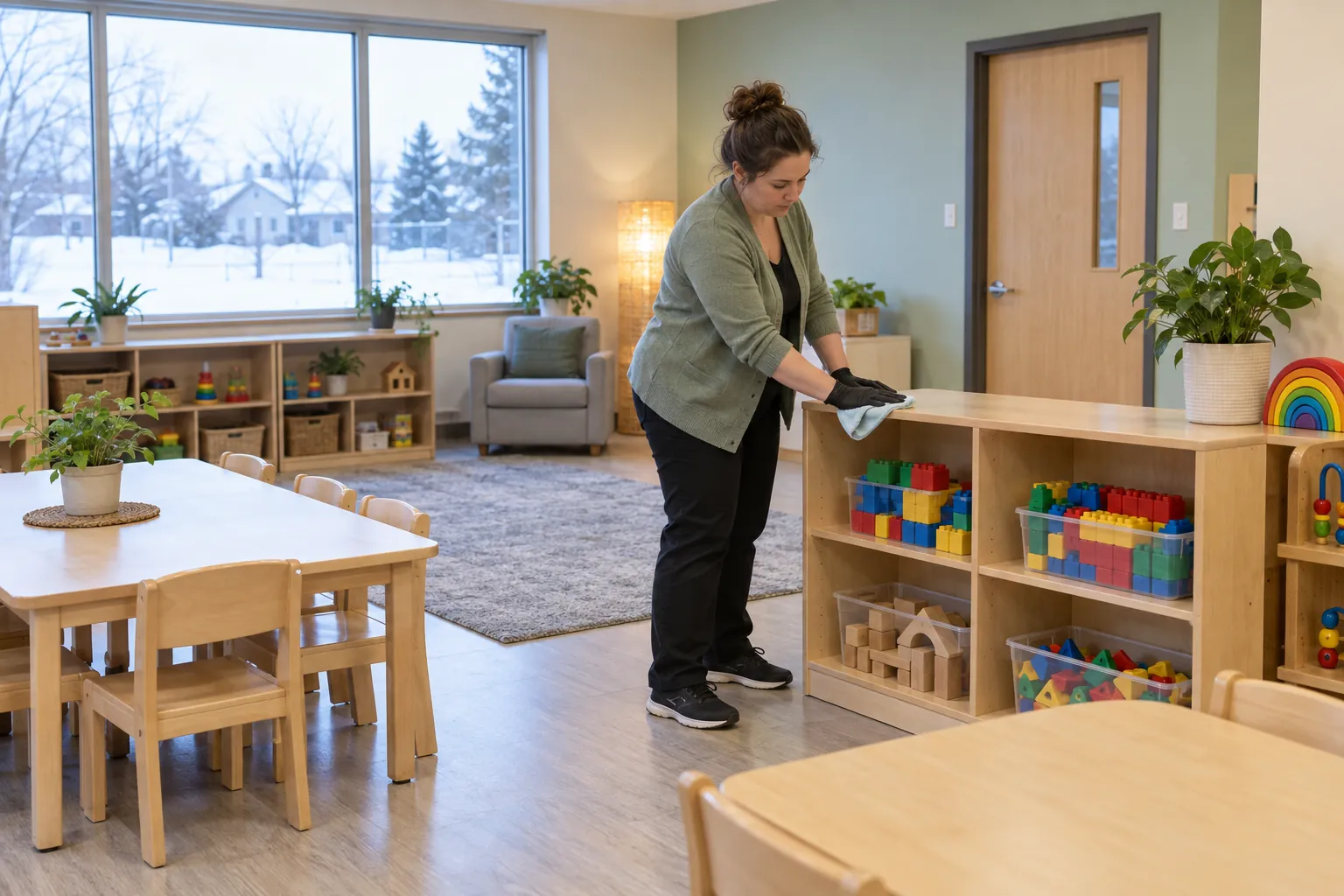
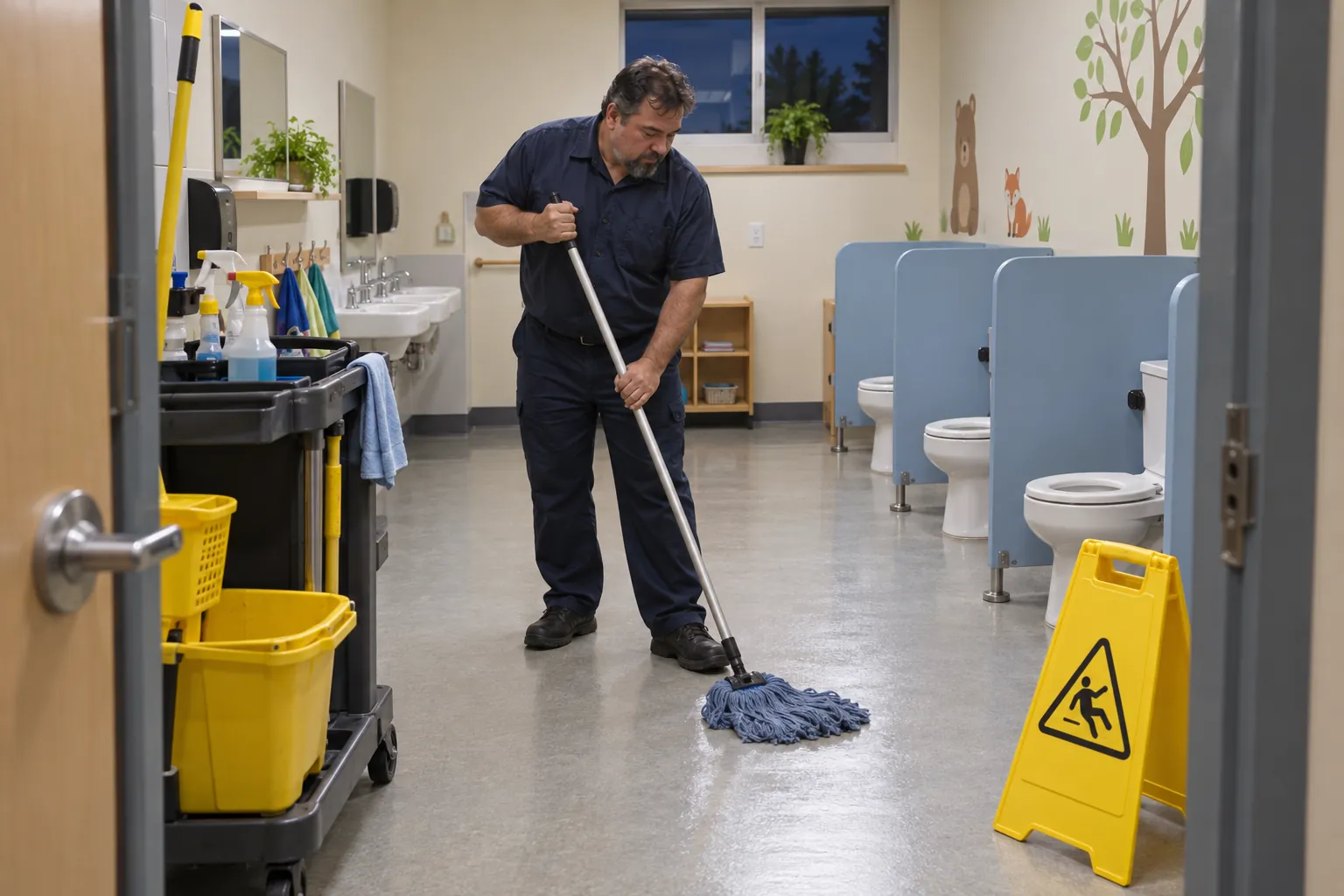
Much of that work happens while the children are there: educators wipe the diaper change pad after every change and sanitize the tables after every snack, and a custodian or janitorial crew does the floors, washrooms and garbage once the children have gone home. A good checklist gives children and staff a consistent routine that limits the spread of germs and illness, and follows what the licensing rules and the local public health unit expect. This guide follows Ontario's rules, with notes for the rest of Canada.
01
The rules behind a daycare cleaning checklist in Ontario
No Ontario law prints a cleaning checklist for child care. What the law does is make cleanliness a condition of the licence and hand the detail to public health. In Ontario, licensed child care is governed by the Child Care and Early Years Act, 2014 (CCEYA) and its general regulation, Ontario Regulation 137/15. Three parts of that regulation matter most for cleaning:
- Section 13: the premises must comply with the local health laws and with any rule, direction or order of the local board of health or medical officer of health that may affect the provision of child care, and subsection 13 (3) says at all times it is used as a child care centre, not just when the licence is applied for.
- Section 32: any direction of a medical officer of health about a matter that may affect a child's health or well-being must be carried out by the staff. A copy of any report by the medical officer of health or the fire department is kept on the premises, with a record of all inspections.
- Section 15: every centre has designated space for washing, dressing and toileting, and for storing cleaning materials and anything else that could harm a child, which must be inaccessible to children.
The regulation also governs the outdoor play space. Under subsection 24 (5), every centre must have a playground safety policy reflecting CSA standard CAN/CSA-Z614, carry out daily, monthly and annual inspections of the outdoor play space, fixed play structures and surfacing, and maintain a playground repair log. That is an inspection duty, not a cleaning one, but it falls to the same people at the same time of day.
Under sections 30 and 31 of the CCEYA, a ministry inspector may enter a child care centre at any reasonable time without a warrant and examine or demand records relevant to the inspection. A cleaning record that exists only in someone's memory is not much use on that day.
02
What a daycare cleaning checklist covers
Public Health Ontario publishes two documents for licensed child care centres in Ontario: the Infection Prevention and Control (IPAC) in Child Care Centres checklist (May 2025), a self-assessment for licensees, and its companion, the Child Care Centre Cleaning and Disinfection Schedule, which your own public health unit may add to. Between them, a daycare cleaning checklist covers:
- Toys and sensory play: mouthed toys, other toys, plush toys and dress-up clothes, water tables and water toys, play dough, indoor play sand, sensory tables and storage bins, indoor play structures and nature-based items.
- Sleep room: cots, cribs, mattresses, linen and bedding, each dedicated to one child and labelled, or cleaned and disinfected between children if shared.
- Eating area: high chairs and table tops (sanitized, not just wiped), bibs, face cloths and towels.
- Washrooms and diaper change: toilets, potty seats and toilet inserts, diaper change pads and tables, counters and hand washing sinks, toothbrush holders and floors, with soap, paper towels and toilet paper in dispensers.
- General areas: floors, carpets and area rugs, vinyl mats, shelving, cushion covers, garbage containers and the high-touch surfaces everyone uses, such as door knobs, light switches and railings.
- Outdoor play: covered sandboxes raked daily, a daily look for sharp objects and animal droppings before the children go out, stagnant water removed, damaged equipment taken out of use.
- Products and storage: disinfectants in date, used as the label says, WHMIS-labelled if decanted, and kept where children cannot get at them.
Two things set a daycare apart from a commercial cleaning checklist. Much of the work happens during the day, done by educators, because it follows the children: a mouthed toy, a diaper change, a snack. And cleaning and disinfection are different steps: PHO's checklist says items are cleaned (washed, rinsed and dried) before they are disinfected, a one-step product still needs pre-cleaning when an item is heavily soiled, and mouthed items are rinsed with potable water afterwards.
03
How often: after each use, daily, weekly and monthly
PHO's Cleaning and Disinfection Schedule sets the minimum frequencies below. Its footnote matters as much as the table: every item is also cleaned and disinfected as needed, when visibly soiled or during periods of increased illness, in addition to the minimum.
The IPAC checklist adds detail worth copying into the wording: a diaper change pad with a liner is cleaned and disinfected at the end of the day; cot linens are dedicated to one child; cleaning cloths and mop heads are laundered separately from linens and dress-up clothes; and water table water is replaced after every use, potable, with nothing added.
During an outbreak, the frequency of disinfection of high-touch surfaces goes up, the disinfectant must suit the suspected or identified pathogen, and sensory and water play, dress-up and plush toys are stopped. Follow the public health unit's direction; section 32 of O. Reg. 137/15 makes carrying it out a licence duty.
04
Who does what: educators, custodians and the janitorial contractor
Most centres split the checklist between two groups of people, and the split is where things go missing.
- Educators and room staff do the after-each-use work because only they are there when it is needed: the diaper change pad, the mouthed toy, the high chair, the water table. They also do the morning check of the outdoor play space before the children go out.
- The custodian, cook or janitorial contractor usually does the evening and weekly work: floors, washrooms, garbage, carpets, shelving and the deeper toy and cot cleaning. In a centre inside a school, that may be the school board's custodial staff, working to the board's routine rather than the centre's.
- The supervisor, whom subsection 6 (4) of the regulation puts in charge of the program, the children and the staff, owns the checklist: they make sure it matches the public health unit's expectations, that each item has a person, and that gaps are noticed the same day.
Write the split down, naming the role for each item. "Diaper table, daily" leaves each side assuming the other did it. "Diaper table: room staff after each change if no pad is used; evening cleaner daily clean and disinfect" does not.
If the cleaning is contracted out, put the checklist into the janitorial scope of work item by item, with the frequencies above as the minimum, and agree the products. PHO's checklist asks for disinfectants with a Health Canada drug identification number (DIN) or natural product number, in date and used as the manufacturer says, including contact time and dilution. Bleach solution is checked with test strips and replaced daily.
Do not forget the washrooms that staff use. Under subsection 25.3 (3) of the Occupational Health and Safety Act, every employer that provides washroom facilities for workers must keep, maintain and make available records of their cleaning. Since 1 January 2026, Ontario Regulation 480/24 has set how: the record includes the date and time of the two most recent cleanings and is posted in or near the washroom, or electronically with directions for workers. The province's guidance, Maintaining clean washroom facilities for workers, explains the rule. A daycare is an employer, so its staff washroom is covered.
05
What good evidence looks like, and how it is checked
A cleaning sheet is more convincing to a public health inspector or a ministry program adviser when it has these features:
- One line per clean, written at the time. The date, the actual time, and initials or a name that identify one person. A row of ticks in one pen, filled in at the end of the week, tells an inspector only that someone owns a pen.
- Clean and disinfect recorded as different steps where the schedule treats them differently, with the product used when it matters, such as a change of disinfectant during an outbreak.
- Room by room. An infant room and a preschool room have different items and different frequencies; one sheet for the whole centre hides which room was missed.
- Problems written down, not just fixed. A torn cot mattress cover, a broken toy, a potty seat that no longer cleans properly, a dispenser that is empty: note it, who was told and when it was put right.
- A supervisor's check on an unannounced walk-through, with their initials and what they found, so that the sheet is more than self-certification.
- Kept, and findable. Keep the sheets for a period your policy states, where the supervisor can find them.
Use PHO's IPAC checklist the way it is intended, as a self-assessment. Walk the centre with it every few months and set a date for each action item. Its last section asks for written IPAC policies, including cleaning and disinfection, updated and reviewed by staff annually. The annual public health inspection then checks something you have already checked, and the gaps are ones you found first.
06
Where the paper checklist fails, and what SiteClara does about it
Paper works when one supervisor, one cook and one evening cleaner know each other and the building. It struggles when the evening cleaning is done by a contractor who never meets the day staff, or when an organization runs several centres and wants to know what happened rather than be told it was fine. Nobody notices a missed evening clean until the morning, and nobody can tell from a column of initials whether they were written at 6 p.m. or at 7 a.m. the next day.
SiteClara replaces the clipboard for the building's cleaning with a tag at each room or washroom door: a printed QR code, with an NFC tag behind it if staff would rather tap than scan. The cleaner scans or taps it on their own phone, with no app to install, and marks the cleaning done; the time and the person are recorded as it happens. If something is wrong, such as a broken dispenser or a torn cot cover, they report it there, with a photo if it helps, and it goes onto the team's list of open jobs until someone closes it.
Scheduled cleanings are set per location, each with its own due time. Staff see what is due and mark it done, or say what stopped them, and the supervisor sees what was done and what was missed and can record why. At the end of the day the supervisor reviews it, adds a note, and the approved report goes to the operator or the client at 8 a.m. the next morning, showing what was completed and what is still open.
07
Questions people ask
What do daycares clean with?
A cleaner first, then a disinfectant. Public Health Ontario's Infection Prevention and Control (IPAC) in Child Care Centres checklist expects items to be cleaned (washed, rinsed and dried) before they are disinfected, and every disinfectant to be in date with a drug identification number (DIN) or natural product number (NPN) assigned by Health Canada, with short contact times preferred. Disinfectants are prepared and used as the manufacturer says, including contact time and dilution; if bleach is used, its concentration is checked with test strips and the solution is replaced daily. High chairs are cleaned and sanitized after each use and tables before and after use, items that infants or young children mouth are rinsed with potable water after disinfection, and any product decanted from its original container is labelled as WHMIS requires.
What goes on a weekly childcare cleaning schedule?
In Ontario, Public Health Ontario's Child Care Centre Cleaning and Disinfection Schedule puts these on the weekly list: plush toys and dress-up clothes (laundered), play dough (discarded), sensory storage bins, indoor play structures, cots, cribs, linen, bedding and mattresses (after each use if shared), toothbrush holders, garbage containers (disinfected) and cushion covers (laundered). Shelving and outdoor play structures are monthly, and indoor play sand is discarded monthly. The weekly and monthly items come on top of the after-each-use and daily ones, and anything visibly soiled, or anything during a period of increased illness, is cleaned and disinfected as needed.
08
Further reading, and a checklist to take away
In Ontario, start with Public Health Ontario's Infection Prevention and Control for Child Care Centres page, which links the IPAC checklist and the cleaning and disinfection schedule, then read sections 13, 15, 24 and 32 of O. Reg. 137/15, and ask your local public health unit for its own child care resources. The Infection Prevention and Control Protocol, 2019 shows what the annual inspection looks at.
Outside Ontario, check your own province's child care licensing regulation and its health authority. In British Columbia, for example, section 13 of the Child Care Licensing Regulation (B.C. Reg. 332/2007) requires the facility, furniture, equipment and fixtures to be clean and in good repair while children are in attendance, section 15 requires sleeping equipment to be used by one child at a time and kept clean, and section 46 forbids changing diapers on a surface used for food. Licensing there runs through the medical health officer.
Before you print the next batch of sheets, check that:
- every item on PHO's schedule, or your own province's equivalent, appears on the checklist with its minimum frequency;
- each item names the role responsible, and each room has its own sheet;
- cleaning and disinfection are separate steps where the schedule treats them differently, and high chairs and tables are sanitized, not just wiped;
- each line carries the actual time and initials that identify one person;
- disinfectants have a DIN or NPN, are in date, are used at the right dilution and contact time, and are kept where children cannot get at them;
- there is room to record faults, who they were reported to and when they were put right;
- the daily outdoor check and the playground repair log are kept, and kept separately from cleaning;
- the staff washroom's two most recent cleanings are posted or available electronically;
- the supervisor initials it on unannounced visits, and the sheets are kept where they can be found.
Sources
Every document this guide quotes or links to, in the order it first cites them.
- Child Care and Early Years Act, 2014 ontario.ca
- Ontario Regulation 137/15 ontario.ca
- Infection Prevention and Control Protocol, 2019 files.ontario.ca
- Ontario Public Health Standards ontario.ca
- Infection Prevention and Control (IPAC) in Child Care Centres checklist publichealthontario.ca
- Child Care Centre Cleaning and Disinfection Schedule publichealthontario.ca
- Occupational Health and Safety Act ontario.ca
- Ontario Regulation 480/24 ontario.ca
- Maintaining clean washroom facilities for workers ontario.ca
- Infection Prevention and Control for Child Care Centres publichealthontario.ca
- Child Care Licensing Regulation bclaws.gov.bc.ca
Related guides
 CleaningHigh-touch surfaces: what counts, how often to clean them, and how to prove itHigh-touch surfaces in Canadian workplaces: what counts, how often to clean and disinfect them, how to do it properly, and how to check it was really done.
 CleaningHealth Canada approved disinfectants: what the DIN tells you, and how to use itHow to tell a Health Canada approved disinfectant: the DIN, what the label must show, how to check it, and what the Biocides Regulations changed.
 CleaningWashroom cleaning checklist: what to check, how often, and Ontario's new cleaning recordsWhat a workplace washroom cleaning checklist should cover, how often to clean, and Ontario's posted cleaning records required since January 1, 2026.
 CleaningSchool cleaning checklist: what custodians clean, how often, and how to show it was doneA school cleaning checklist for Canadian schools: classrooms, washrooms, hallways, gym and entrances, with daily, weekly and summer tasks and how to record them.