Cleaning
School cleaning checklist: what custodians clean, how often, and how to show it was done
A school cleaning checklist lists every area of the school, from classrooms and washrooms to hallways, entrances, the gym and the cafeteria, with the tasks each area needs and how often they are done: daily, weekly, over the holidays and in the summer.
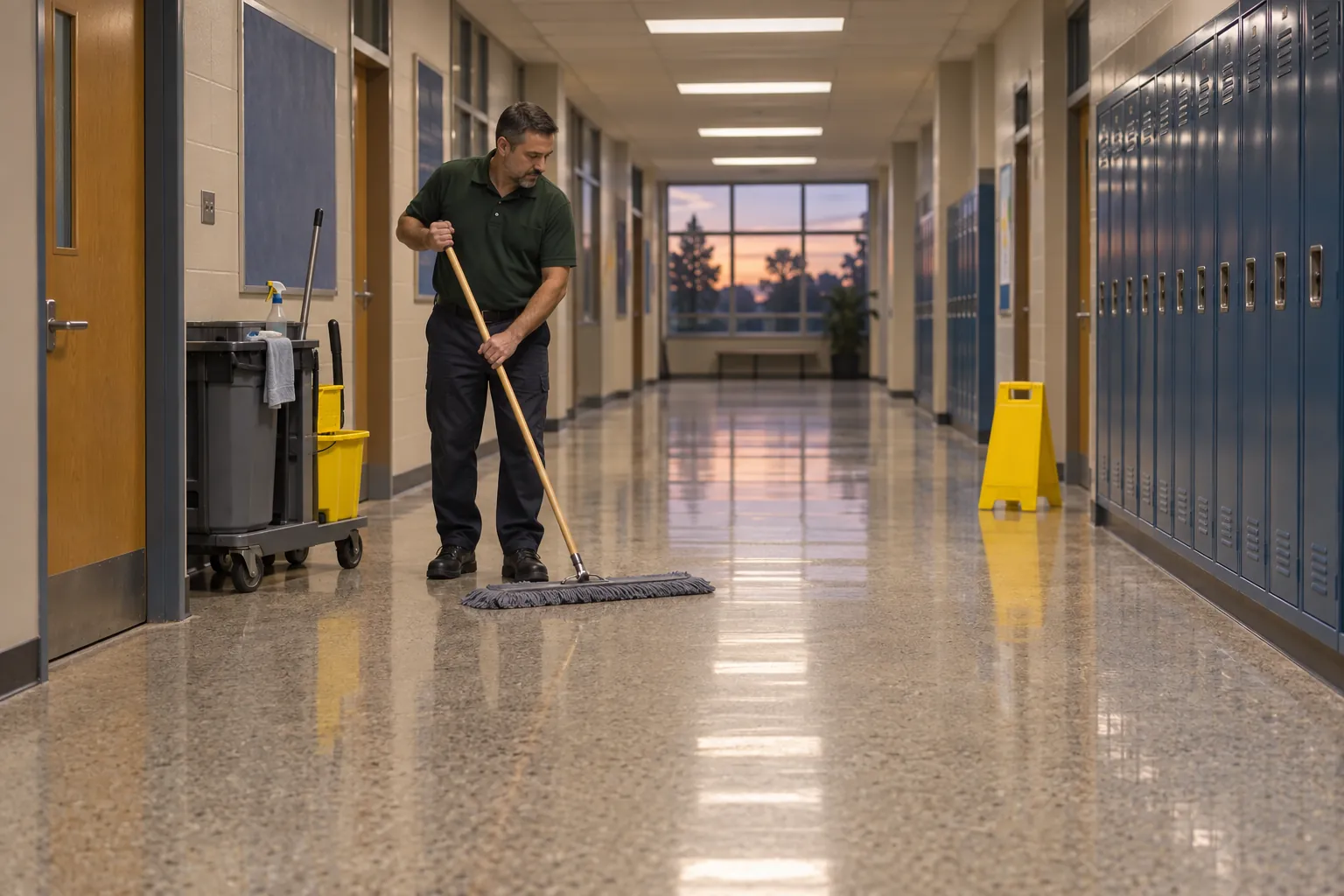
A school is cleaned in the few hours when students are not in it, and judged every minute they are. This guide sets out those tasks for a Canadian school area by area, what needs daily attention and what can wait for the summer, who is responsible under provincial law, and how to keep a record the principal and the board's facility services can rely on.
01
The duty behind a school cleaning checklist in Canada
No Canadian law prescribes a school cleaning checklist, but several set the outcome it has to deliver. Education is provincial, so each province and territory has its own Education Act or School Act, and the duty to keep a school clean usually sits with the school board, not with the custodian who does the work.
In Ontario, section 170(1), paragraph 8 of the Education Act requires every board to "keep the school buildings and premises in proper repair and in a proper sanitary condition". Section 265(1)(j) gives the principal the duty "to give assiduous attention to the health and comfort of the pupils, to the cleanliness, temperature and ventilation of the school", and clause (k) requires the principal to report promptly to the board and to the medical officer of health "the unsanitary condition of any part of the school building or the school grounds". Under section 11(3)(l) of Regulation 298 (Operation of Schools – General), the principal must "inspect the school premises at least weekly" and report to the board any repairs that are needed and "any lack of attention on the part of the building maintenance staff of the school".
A school is also a workplace, and workplace health and safety law is provincial too. In Ontario, section 25.3 of the Occupational Health and Safety Act requires an employer to ensure that the washroom facilities, if any, that it provides for the use of workers "are maintained in a clean and sanitary condition", and to "keep, maintain and make available records of the cleaning of washroom facilities as prescribed". The province's guidance, Maintaining clean washroom facilities for workers, explains the records rule in Ontario Regulation 480/24, in force since January 1, 2026: the date and time of the two most recent cleanings, posted in a conspicuous place in or near the washroom, or posted electronically where workers can access it, with workers told where and how to find it. The rule concerns washrooms provided for workers, such as staff washrooms, and inspectors decide on the facts they find in the workplace; ask your board how it applies in your building.
In British Columbia, the BC Centre for Disease Control's Public Health Communicable Disease Guidance for K-12 Schools (September 13, 2023), which the Ministry of Education and Child Care builds its own provincial guidelines on, puts the cleaning standard simply: "Regular cleaning and disinfection can help prevent the spread of communicable diseases. Cleaning of frequently touched surfaces should occur in line with regular practices and when visibly dirty." Other provinces publish their own school guidance through the ministry of education and the provincial public health agency; in Quebec, read the French-language sources.
02
What a school cleaning checklist covers, area by area
Every school is different, but the same areas appear in almost every custodial schedule. Each needs its own list of tasks, and the high-traffic areas, washrooms and eating areas, where a healthy learning environment is most easily lost, deserve the most regular attention:
- Classrooms: empty garbage and recycling bins; dust window sills and shelves; sweep and damp-mop hard floors or vacuum carpet; wipe desks, tables and chairs; clean whiteboards and chalkboards and their ledges; clean and disinfect high-touch surfaces such as door handles, light switches and shared equipment; clean sinks and drinking fountains. In many elementary schools students eat lunch at their desks, so desks are also lunch tables.
- Kindergarten rooms: floors children sit and play on, low tables, cubbies, toys and the room's own washroom, on the room's own schedule.
- Washrooms: clean toilets, urinals, sinks, taps and mirrors; mop floors; restock toilet paper, and refill soap and paper towel dispensers; empty sanitary product containers; check for leaks, blocked drains, broken dispensers and graffiti. Students and parents judge a school's hygiene first by its washrooms.
- Hallways, stairwells and lockers: sweep and mop, wipe handrails and door push plates, clear litter from locker bays and coat hooks.
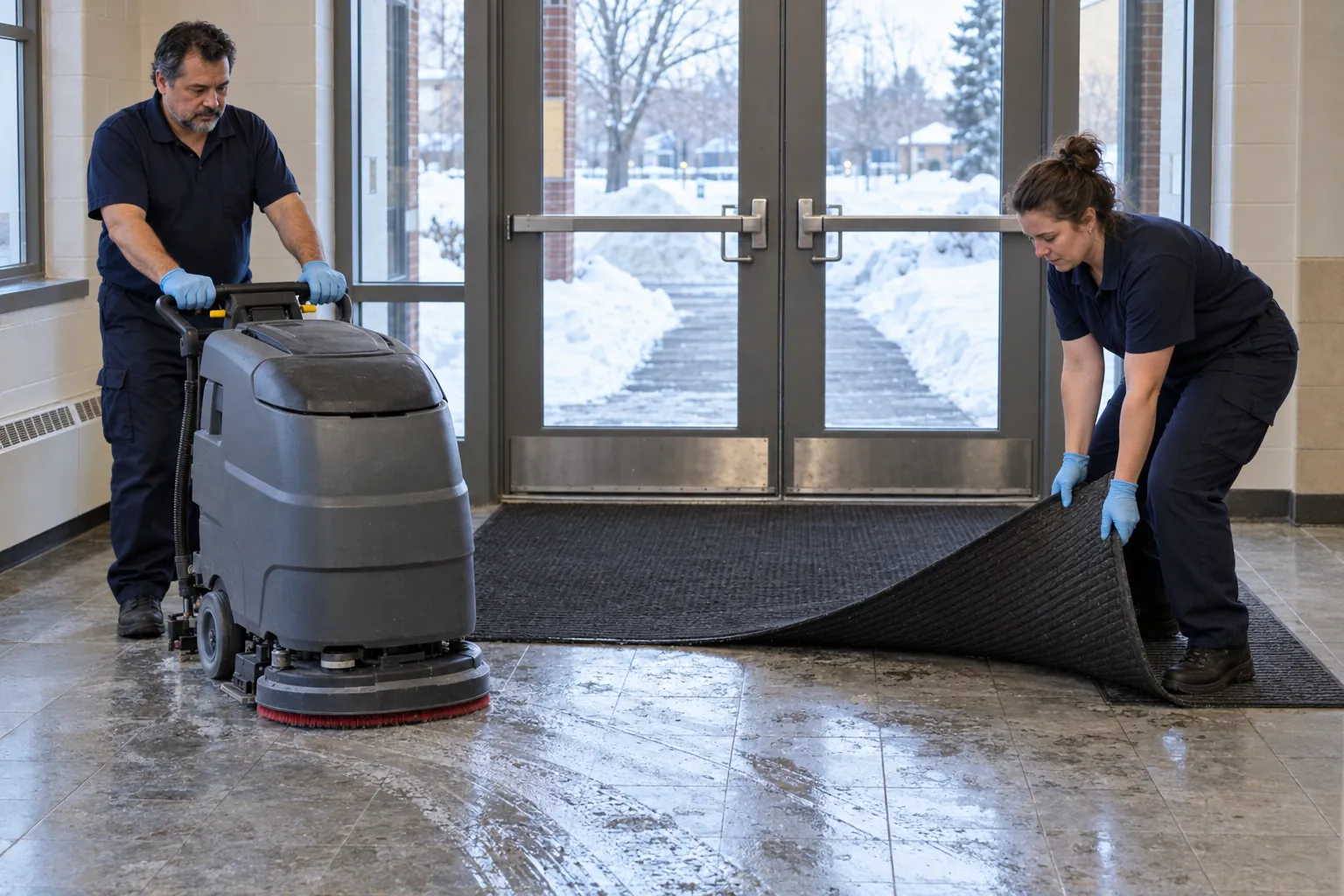
- Entrances and vestibules: walk-off matting, glass doors and the floor inside the door. From November to April this is where salt, sand and slush come in, and where slips happen.
- Gymnasium and change rooms: the gym floor cleaned by the method its finish needs, benches, showers and change room washrooms.
- Cafeteria or lunchroom: tables and chairs wiped after each lunch period, floor swept and mopped, garbage and organics emptied. Where a food service operator runs the kitchen, the checklist should say where its cleaning ends.
- Library, science labs and technology shops: surfaces, sinks and floors, with lab and shop benches cleaned only as far as the teacher's own clean-up leaves off.
- Main office, health room and staff room: counters, the health room cot and sink, the staff room kitchen, fridge and microwave.
- Portables: the same classroom tasks, plus the ramp and steps, which are easy to leave off the list.
Keep the custodial room on the checklist too. Hazardous products used at work should carry a WHMIS label with a safety data sheet on hand, be stored securely away from students, and be used by staff who have had WHMIS training. Colour-coded cloths and mops keep washroom equipment apart from classroom equipment. Surface disinfectants sold in Canada carry an 8-digit identification number on the label. Since May 31, 2025 they are regulated as biocides, which Health Canada's page on biocides says "include both surface disinfectants and surface sanitizers"; a product still carrying a drug identification number, or DIN, has until May 31, 2029 to move across. A disinfectant is used where the schedule or an outbreak calls for it, not in place of cleaning, because soil left on a surface stops it working.
03
Daily, weekly, holiday and summer tasks
School cleaning follows the school day and the school year. A workable checklist splits tasks into rhythms, so the custodial team can tell what must be done every day from what can wait:
- The evening clean, after dismissal: classrooms, washrooms, hallways, entrances, the gym, the office and staff room, with garbage emptied and frequently touched surfaces cleaned throughout.
- During the school day: washroom checks after recess and lunch, spills and accidents dealt with as they happen, the cafeteria cleaned between lunch periods, and entrances kept dry in winter. This is usually the day custodian, not the evening crew.
- After community use: a gym, library or classroom used under a community permit in the evening or on the weekend needs cleaning before students return on Monday. The permit, not the timetable, decides when.
- Weekly: high dusting within reach, interior glass, spot-cleaning walls, baseboards, gym floor care, the outside garbage enclosure, and a closer look at the rooms the daily clean passes quickly. Some boards add a monthly list for tasks such as vents, light fixtures and the tops of cupboards. This is where most checklists quietly slip.
- Winter break and March break: the periodic tasks that cannot wait a year, such as scrubbing entrance floors after salt season, carpet spot-cleaning and cleaning out the lockers left empty.
- The summer clean: the July and August deep cleaning program, when hard floors are stripped and refinished, carpets extracted, lights and vents cleaned, and furniture moved so every room is cleaned end to end. Summer programs are usually planned by the board's facility services and dated room by room.
How often a school needs more than its routine clean depends on use and on illness. When the local public health unit is involved in an outbreak, follow its advice on enhanced cleaning of washrooms and frequently touched surfaces, and on which product to use, for as long as it lasts.
04
Who does what in school cleaning
School cleaning is split between people who are rarely in the building at the same time:
- The evening custodians, board staff or a janitorial contractor, carry out the daily clean after dismissal and the summer program.
- The day custodian deals with spills, washroom checks, lunch clean-up and entrances during the school day.
- The head custodian or head caretaker leads the crew, assigns areas, checks the work, orders supplies and is the day-to-day link with the principal; school custodian duties sets out the role in full.
- The principal holds the statutory attention to cleanliness in Ontario, walks the weekly inspection and reports to the board what needs fixing or has been neglected.
- The board's facility services set the cleaning standard, staff the schools or manage the contract, and plan the summer program.
- Teachers and staff keep rooms clear enough to be cleaned and report problems.
- The food service operator, where there is one, cleans its kitchen and servery to its own food safety plan.
Write the split down. Most disputes in school cleaning happen in the gaps between these people: who wipes the cafeteria tables between lunch periods, who clears the staff room fridge, who checks the washrooms at lunch, and who cleans up after a Saturday permit.
05
How to check the checklist is being followed
A checklist ticked by the person who did the work is a starting point, not assurance. Whether the board uses its own custodians or a janitorial contractor, it needs to know the cleaning is done the same way every night. Schools usually add three kinds of checking:
- A morning walk by the head custodian or principal before the bell, when the result of the evening clean is easiest to see.
- The weekly inspection the principal already owes the board in Ontario, which is a natural place to note washrooms, entrances and rooms that are not up to standard.
- Quality inspections against the board's cleaning standard or the contract's scope of work, scoring a sample of rooms as janitorial quality control describes, jointly with the contractor where there is one, followed by a review each term of results, complaints, missed cleans, staffing and the summer program.
Students, staff and parents notice quickly when cleanliness slips, and the early signs are predictable: full garbage cans in the morning, sticky desks after lunch, washrooms without soap or paper towel by the end of the day, and salt tracked down the hallway. A school with a struggling custodial crew or contractor usually knows from complaints long before it has the evidence to act. That is why a record of each clean, and of each missed one with the reason, matters when staffing or the contract is reviewed.
Good evidence is specific. It names the area, the task, the person and the time it was done, not a row of initials written at the end of a shift. It shows what was not done and why: a room locked, a permit group still in the gym, a product out of stock. And it reaches the person who has to act on it the next morning, not a binder in the custodial room.
06
Where the school cleaning record fails, and what SiteClara does about it
Most school cleaning happens between four and eleven at night, when the principal and the board's staff have gone home. The record is a signing sheet in the custodial room or an assurance from the contractor, and the first sign of a missed clean is a teacher's email the next morning.
SiteClara puts a printed QR poster at each location on the checklist, such as each washroom, the cafeteria, each hallway and the gym, with an optional NFC tag behind it. Staff posters can be placed where students are unlikely to reach them. A custodian scans the code or taps the tag on their own phone, with no app to install, sees the checks due there, and marks each one done or explains what stopped them, with a photo when one is asked for. A fault such as a blocked toilet, a broken dispenser or a leaking tap can be reported there, and it goes onto the team's list of open jobs until someone closes it; the supervisor can escalate it to whoever manages the building.
The head custodian or contract supervisor sees what was done and what was missed, and can record why. They review the day's checks and photos, add a note and approve the daily report, which goes to the principal or the board's facility services contact at 8 a.m. the next morning, before students arrive, showing what was completed, what is still open and how the scheduled checks went.
07
Questions people ask
What are the typical tasks of a school cleaner?
Canada's National Occupational Classification 2021, unit group 65312: Janitors, caretakers and heavy-duty cleaners, which lists school custodian and school janitor among its example titles, says they "clean and maintain the interior and exterior of commercial, institutional and residential buildings and their surrounding grounds". Its main duties include to "Empty trash cans and other waste containers", "Sweep, mop, scrub and wax hallways, floors and stairs", "Wash windows, interior walls and ceilings", "Clean and disinfect washrooms and fixtures" and "Clean snow and ice from walkways and parking areas". In a school, a checklist turns those duties into specific tasks for each area, with a frequency for each.
What are 10 ways to keep my school clean?
Public health guidance does not give a list of ten, but it does name two habits every school can build on. British Columbia's Public Health Communicable Disease Guidance for K-12 Schools says "Cleaning of frequently touched surfaces should occur in line with regular practices and when visibly dirty", and that "schools should facilitate regular opportunities for students and staff to wash their hands", with plain soap and water or an effective hand sanitizer. In practice that means high-touch surfaces on the daily list, washrooms checked and restocked during the day, and every other area given its own tasks and frequency, as the checklist in this guide sets out.
08
Further reading, and a list to take away
In Ontario, read sections 170 and 265 of the Education Act, section 11 of Regulation 298, and the province's guidance Maintaining clean washroom facilities for workers. In British Columbia, read the Public Health Communicable Disease Guidance for K-12 Schools. Elsewhere, start with your province's education ministry, its public health agency and your local public health unit. For products, the Canadian Centre for Occupational Health and Safety's WHMIS – General explains labels, safety data sheets and training, and Health Canada's biocides page explains how surface disinfectants are authorized.
Before the next term starts, check that your school cleaning checklist:
- lists every area of the school, including kindergarten rooms, the health room, change rooms and portables;
- gives each area specific tasks and a frequency;
- covers washroom checks and spills during the school day, not only the evening clean;
- covers entrances and matting through the winter;
- says who cleans up after community permits, and when;
- says where the food service operator's cleaning ends and the custodians' begins;
- sets out the summer program room by room, with dates;
- covers WHMIS labels, safety data sheets, colour coding and a secure custodial room;
- says how each clean is recorded, including any posted washroom record your province requires, and who sees the record;
- is reviewed each term with the custodial team or contractor.
Sources
Every document this guide quotes or links to, in the order it first cites them.
- Education Act ontario.ca
- Regulation 298 (Operation of Schools – General) ontario.ca
- Occupational Health and Safety Act ontario.ca
- Maintaining clean washroom facilities for workers ontario.ca
- Ontario Regulation 480/24 ontario.ca
- Public Health Communicable Disease Guidance for K-12 Schools bccdc.ca
- Biocides canada.ca
- Working Alone – General ccohs.ca
- National Occupational Classification 2021, unit group 65312: Janitors, caretakers and heavy-duty cleaners noc.esdc.gc.ca
- WHMIS – General ccohs.ca
Related guides
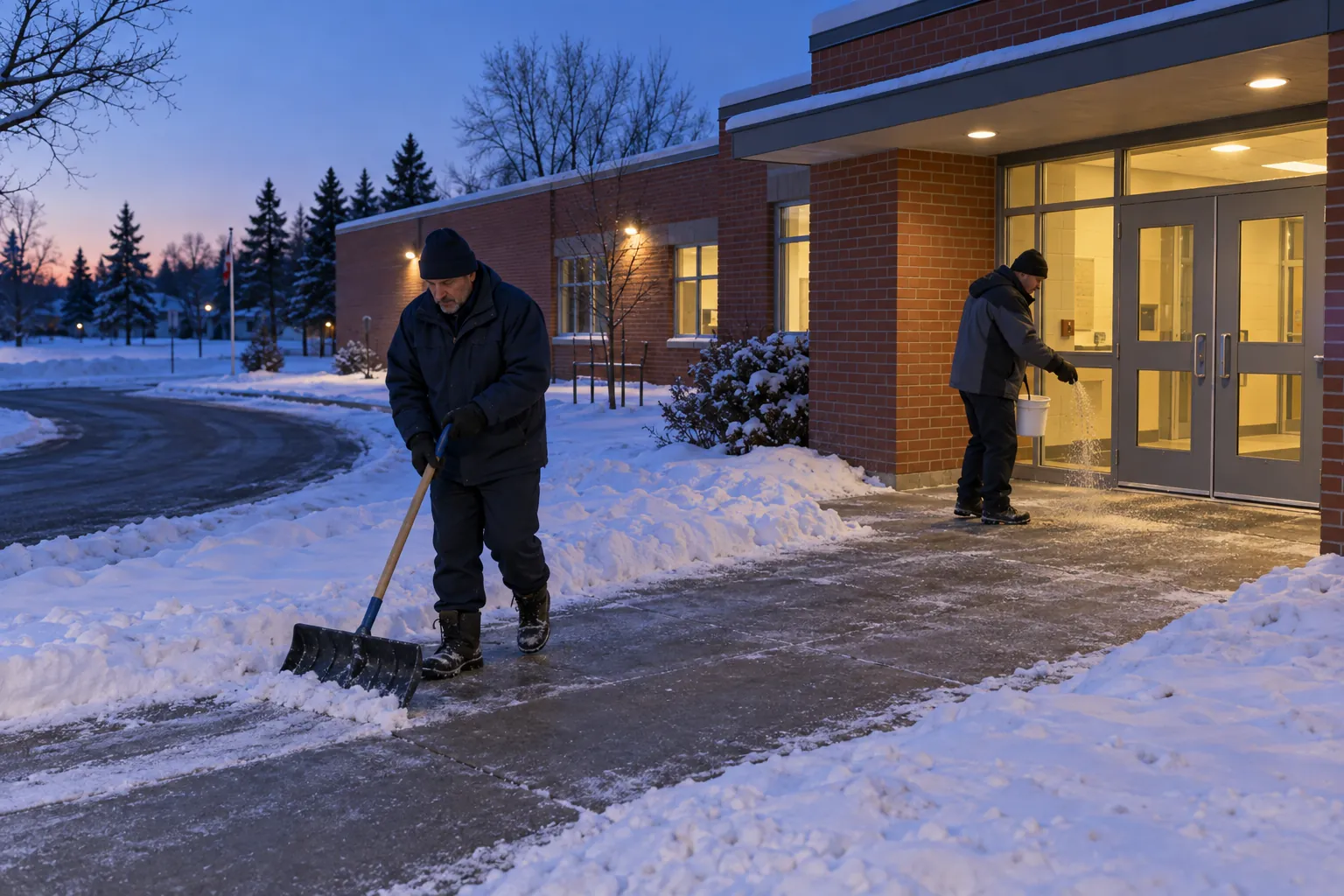 Premises and facilities managementHead custodian duties: the school custodian's role, routine checks and recordsWhat a school head custodian or head caretaker does in Canada: the duties, daily and weekly checks, water flushing, fire drills, snow, safety and the records.
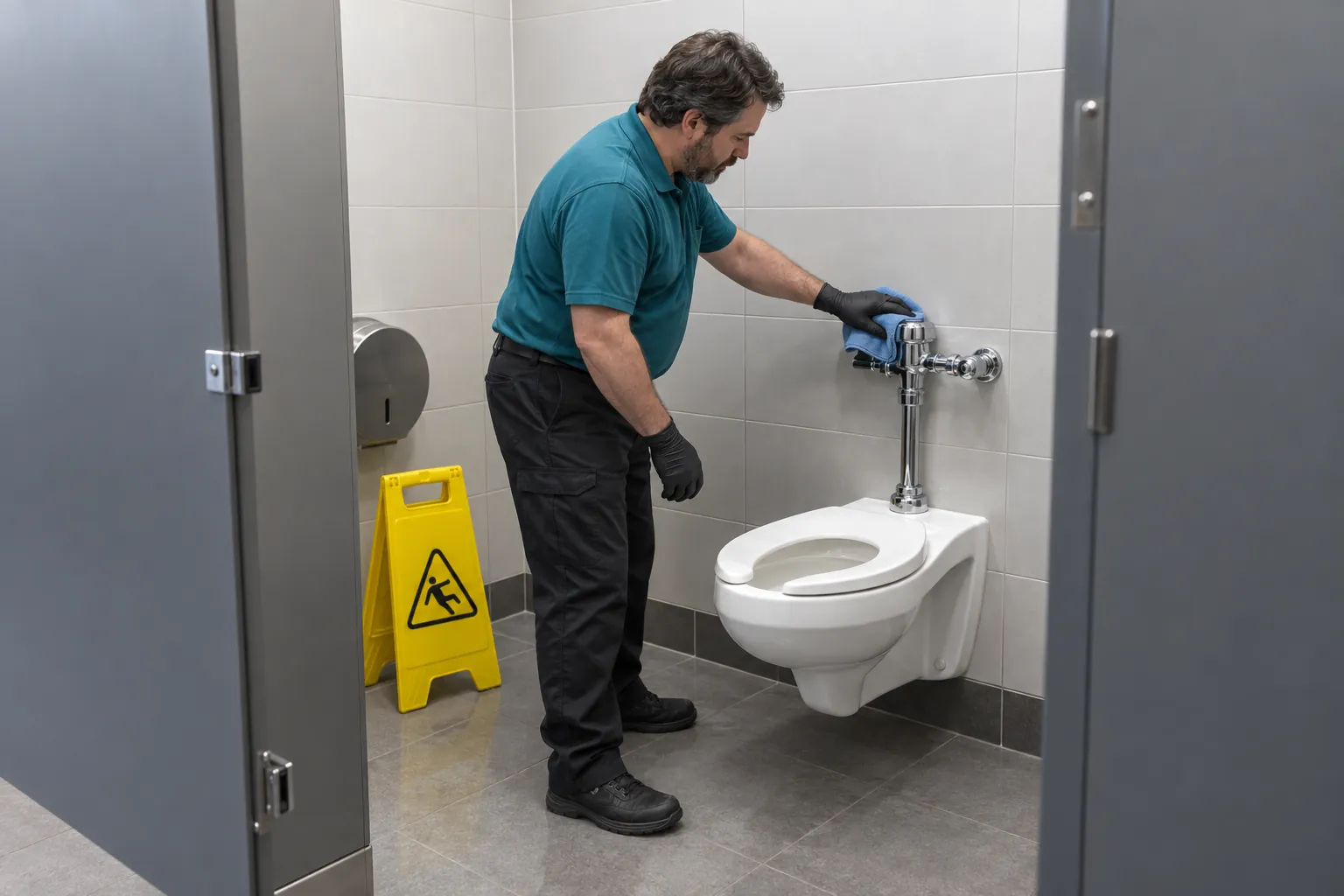 CleaningWashroom cleaning checklist: what to check, how often, and Ontario's new cleaning recordsWhat a workplace washroom cleaning checklist should cover, how often to clean, and Ontario's posted cleaning records required since January 1, 2026.
 CleaningHigh-touch surfaces: what counts, how often to clean them, and how to prove itHigh-touch surfaces in Canadian workplaces: what counts, how often to clean and disinfect them, how to do it properly, and how to check it was really done.
 CleaningJanitorial quality control: how to inspect, correct and show the standard heldHow janitorial quality control works in Canada: QA versus QC, inspections, sampling, corrective action, CIMS, the PIDAC audit model and records that hold up.