Cleaning
Cleaning log sheet: what it records, who signs it, and what it proves
A cleaning log sheet is the page on the wall or in the folder where each clean is written down as it happens: the area, the time, the person, and anything that could not be done.
In New Zealand no law asks for one by name, but the duties under the Health and Safety at Work Act 2015, and a food business's food control plan, are much easier to show with one. This guide covers where log sheets are used, what they should record, who signs, how long to keep them, and what a line on one can and cannot prove.
01
What a cleaning log sheet is, and the duties behind it
A cleaning log sheet is a running record of cleaning work in one area: each visit, the time it was finished, the name of the person who did it and, where there is a second column, the person who checked it. It is different from a cleaning schedule, which says what should happen and how often, and from a cleaning checklist, which lists the cleaning tasks in one visit. The log is the evidence that the schedule was followed. People call it a cleaning record, a cleaning register or a cleaning sign-off sheet; the job is the same.
No New Zealand law requires a cleaning log sheet by name. The duties it helps to show are these:
- The primary duty of care. Under section 36 of the Health and Safety at Work Act 2015 (HSWA), as WorkSafe's Introduction to the Health and Safety at Work Act 2015 – special guide puts it, "A PCBU must ensure, so far as is reasonably practicable, the health and safety of workers, and that other people are not put at risk by its work." A PCBU is a person conducting a business or undertaking.
- The duty of whoever manages or controls the workplace. Under section 37, that PCBU "must ensure that, so far as is reasonably practicable, the workplace, the means of entering and exiting the workplace, and anything else arising from the workplace are without health and safety risks to any person." In a leased building that is often the owner or its property manager for the common areas, and the tenant inside its own space.
- Clean facilities for workers. The Health and Safety at Work (General Risk and Workplace Management) Regulations 2016 cover toilets, drinking water, hand-washing and eating and break facilities. WorkSafe's guidance on General risk and workplace management – part 1 explains regulation 12: "PCBUs must ensure, so far as is reasonably practicable, that workplace facilities are sufficient in number and maintained to be in good working order, and are clean, safe, and accessible."
- Food safety. A café, staff canteen, rest home kitchen or school kitchen operating under the Food Act 2014 with the Ministry for Primary Industries' Template Food Control Plan – Simply Safe & Suitable (S39-00006, August 2026) has to show its verifier "your cleaning procedures and how you know surfaces and equipment have been cleaned and sanitised".
The log does not create any of these duties, and filling it in does not discharge them. What it does is turn "the cleaning gets done" into something a manager, a client, a verifier or an inspector can read: this area, this time, this person.
02
Where cleaning log sheets are used
Log sheets turn up wherever a space is cleaned more than once a day, or where someone other than the cleaner needs to know the clean happened:
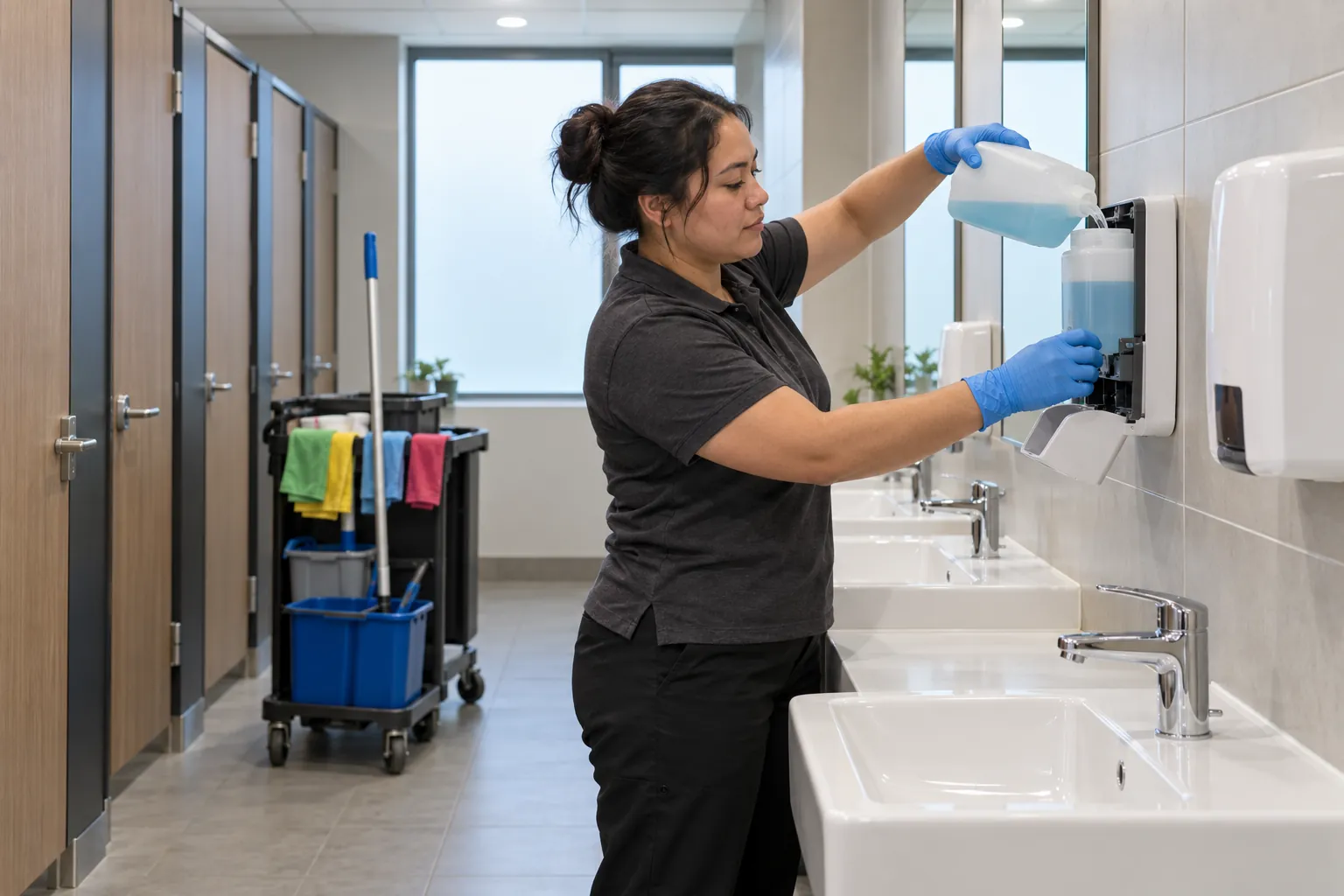
- Toilets and bathrooms. The bathroom cleaning log sheet on the back of the door in an office, shopping centre, service station or council facility, recording each check through the day. The toilet cleaning checklist covers what each check should include.
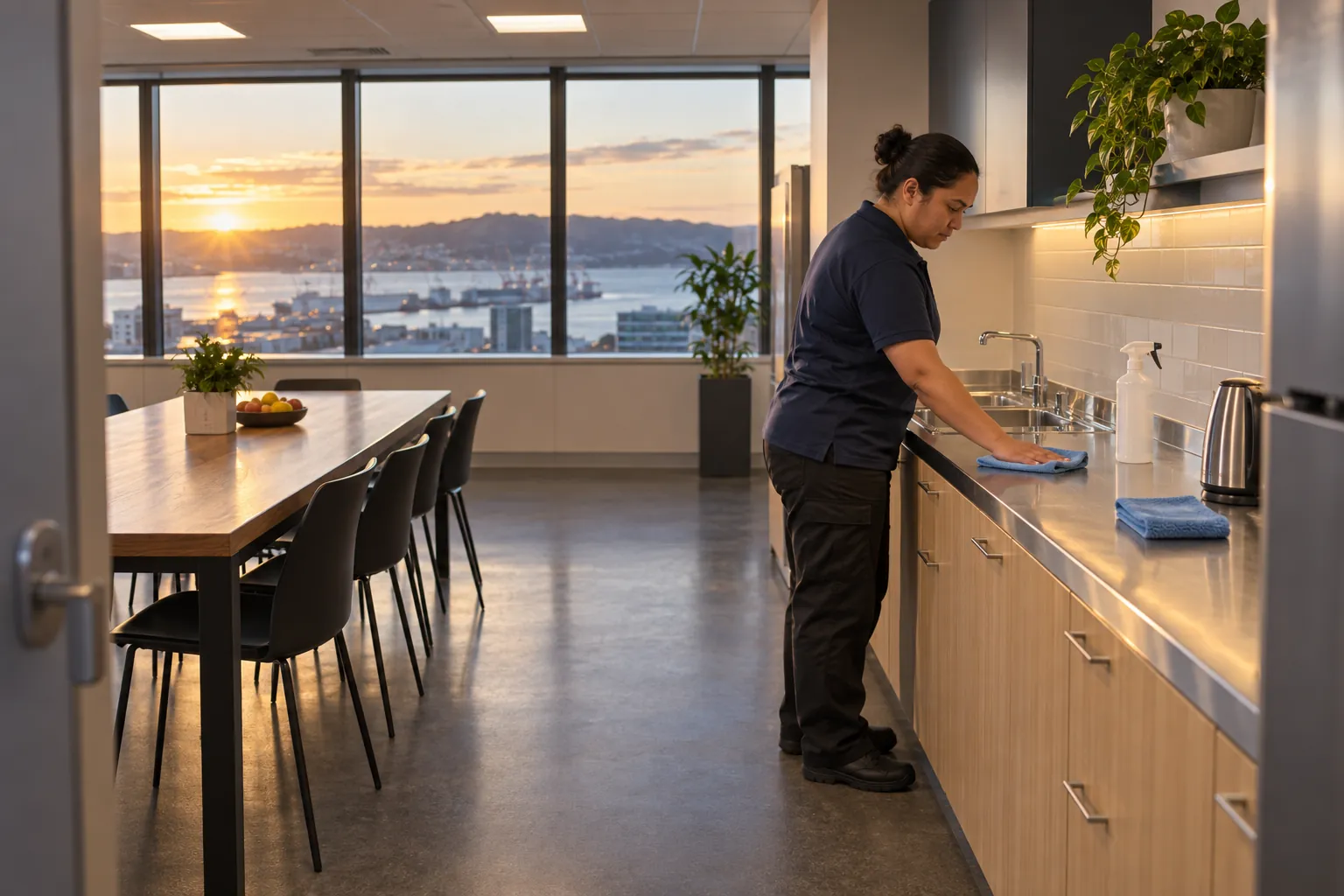
- Staffrooms, lunchrooms and kitchenettes. Benches, sinks, fridges and microwaves in shared tenant kitchens, where nobody quite owns the mess.
- Food preparation areas. The cleaning schedule and closing clean in a café, canteen or commercial kitchen, kept alongside the rest of the food control plan records.
- Changing rooms, showers and gyms. Wet areas in a leisure centre, a factory or a hospital, where floors and drains matter as much as surfaces.
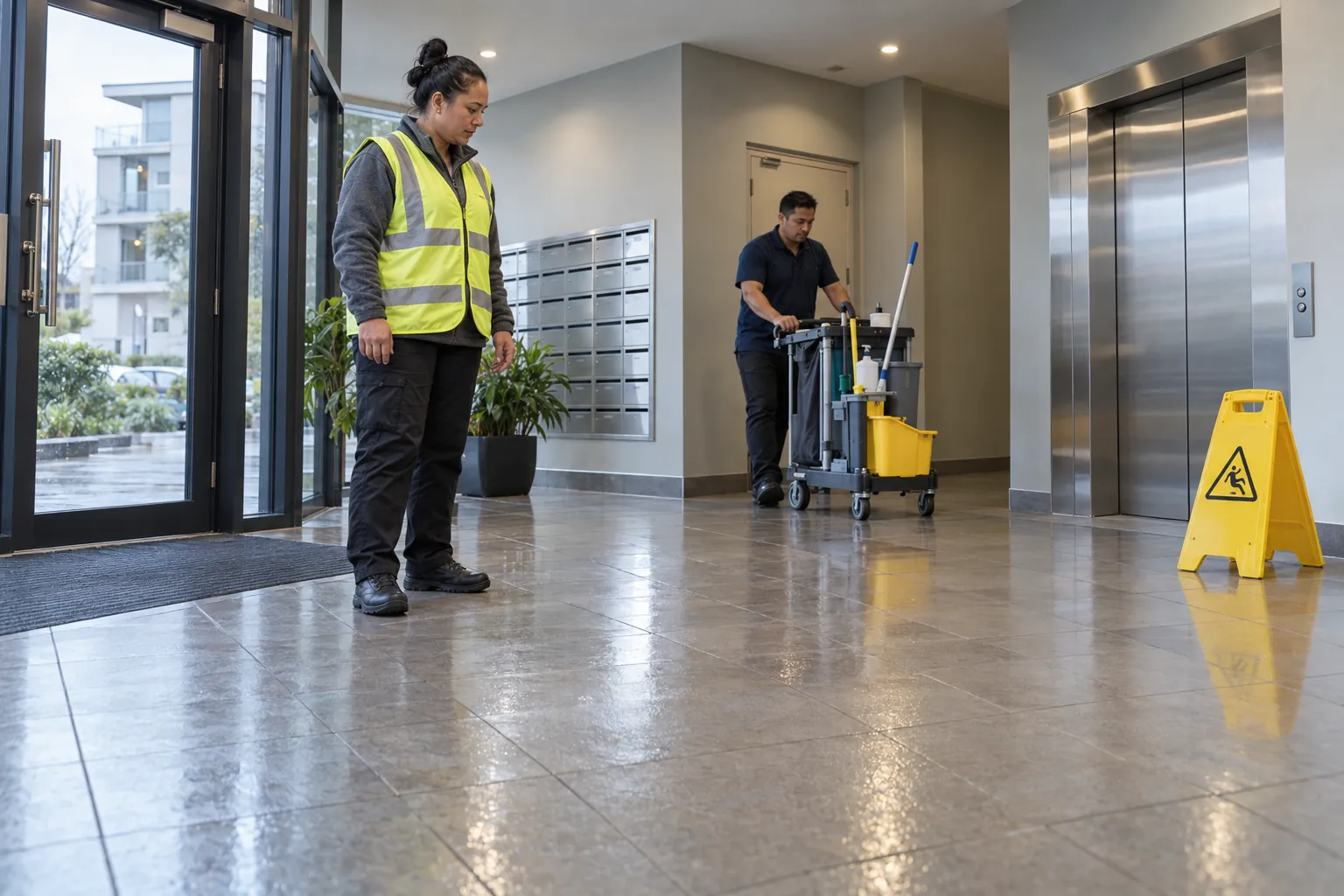
- Common areas in shared buildings. Lobbies, lifts, stairwells and bin rooms in an office block, a body corporate apartment building or a retail centre, cleaned by a contractor engaged by the owner or the body corporate's manager.
- Schools, early learning centres and rest homes. Classrooms, nappy change areas, dining rooms and residents' bathrooms, where cleaning is part of how the service shows it looks after people.
- Periodic work. Carpet cleans, high-level dusting, window cleaning and the kitchen deep clean, logged when finished so the next one can be booked.
In each case the sheet answers a question someone will ask later about the cleanliness of a space: was this area cleaned, when, by whom, and did anyone check?
03
What a cleaning log sheet should record
MPI's food control plan template gives a test that works well beyond food. It says all records must "be accurate, easy to read, identify what was done, when it was done, who did it." A cleaning log sheet built to that test, whether it starts from a free template, a spreadsheet or a printed page, carries:
- The area, named so there is no doubt which one: "Level 3 unisex toilets", not "toilets".
- What was done: a short list of the tasks for that area, or a reference to the checklist that sets them out, with the product where it matters. In a food area, say whether surfaces were cleaned, sanitised or both: the template reminds businesses that "Cleaning and sanitising are different. You cannot sanitise unless you have cleaned first."
- The date and the time finished, written when the work was finished, not when it was due.
- The name or initials of the person who did it, clear enough to identify one person.
- Anything not done, and why: the room was in use, the product ran out, the area was closed for a repair.
- Faults found and who was told: a blocked toilet, a leaking tap, a broken dispenser, a slippery floor that stays wet.
- The checker's initials and time, in a separate column, for the supervisor or client who inspected the area.
- What happened next when a check found a problem, and when it was put right.
Keep a signature list for everyone who writes on the sheets, so that a set of initials can be traced to a person months later. A log whose initials nobody can put a name to is a record of very little.
04
Who fills it in, who checks it, and what a signature means
Most arguments about cleaning logs are really arguments about what a line on one was meant to say. It helps to write it down, on the sheet or in the procedure:
- The cleaner signs to say: I did these tasks, in this area, and finished at this time. They sign for their own work only, never for a colleague, and never before the work is done.
- The supervisor signs to say: I looked at this area at this time, and it met the standard, or it did not and this is what happened. That is a different statement, made after looking, by someone who did not do the clean. The cleaning supervisor duties guide covers that role.
- The client or property manager, where they sign at all, signs to say: I have seen the log, or walked the area, and accept it. That matters most at a handover, such as a tenancy ending or a building reopening.
A line on the log does not mean the area is still clean an hour later, and a supervisor's initials do not turn a clean they never saw into a checked one. Three habits empty a log of its value: filling in the day's times in advance, one person signing for the whole team, and completing the sheet from memory at the end of the shift.
In a shared building there are usually several PCBUs with duties about the same thing: the owner, the property or body corporate manager, the tenants and the cleaning company. WorkSafe's Overlapping duties – quick guide says "Businesses must so far as is reasonably practicable consult, cooperate and coordinate activities with all other businesses they share overlapping duties with", and lists as a common gap the case where "a business assumes another business is taking care of a particular health and safety issue". Agreeing who keeps the cleaning log, who reads it, and who acts on a fault written on it closes one of those gaps. The overlapping duties guide goes further.
05
How often to log, how to review it, and how long to keep it
The frequency on the log should follow the use of the space, not a round number. A busy food court toilet may need checking every hour; a meeting room once a day. MPI's template says "Food contact surfaces and equipment need to be cleaned every day that they are used", and that surfaces not used for a few days "should be cleaned before they are used again to remove dust and dirt that has settled in between use". Set the frequency in the cleaning schedule or contract, then make the log's rows match it, so that a gap shows as an empty row rather than disappearing. A cleaning schedule template and a log sheet can share a page: the routine down one side, a row for each clean across it.
A log only helps you track the cleaning if someone reads it. Assign one person to review it, and decide how often and what they do when it shows a gap:
- Daily, the supervisor looks for missed rows and faults with no action, and follows them up before the next shift.
- Weekly or monthly, the cleaning company and the client look at the pattern: the same area missed on the same day, the same fault written up three times.
- At the contract meeting, the logs are the evidence both sides refer to, instead of impressions.
How long to keep a log depends on why it exists. For a food business the MPI template says "Keep a copy of all documents or records required for at least 4 years." For an ordinary workplace, keep cleaning logs for as long as the contract, the client or the insurer requires, and write that period down.
Do not confuse the cleaning log with records the law sets out separately. If someone is seriously hurt, say by a fall on a wet floor, that may be a notifiable event, and WorkSafe's special guide says "The PCBU must keep records of notifiable events for at least five years from the date the regulator was notified about the event." The cleaning log for that floor may be useful evidence, but it is not that record.
WorkSafe's page Understanding the changes to the health and safety law (updated 13 July 2026) says the Health and Safety at Work Amendment Bill was passed on 1 July 2026 and that the changes come into effect on 1 April 2027, including a focus on critical risks and proportionate duties for businesses with fewer than 20 workers. The page does not describe a change to cleaning records; check it again before that date.
06
Where the cleaning log fails, and what SiteClara does about it
Paper cleaning logs fail in the same few ways. The sheet on the back of the toilet door gets filled in for the afternoon at lunchtime. The supervisor's column is initialled in the office on Friday. The folder lives in the cleaners' cupboard, so the property manager or the tenant never sees it. A fault written in the margin reaches nobody who can fix it. And when a complaint arrives three weeks later, nobody can say whether a line was written at 2pm or at 6pm.
SiteClara records the clean at the place it was done. A printed QR poster at each area, with an optional NFC tag behind it, lets the cleaner scan or tap with their own phone, with no app to install, and mark the scheduled checks for that location done, or explain what stopped them. Their name and the time are recorded as it happens, and they can add a photo of the finished area when the check asks for one. A fault found on the round, such as a leaking tap or a broken dispenser, goes onto the team's list of open jobs until someone closes it.
The supervisor sees what is due, done and missed across the building, and can record the reason a check was missed. At the end of the day they review what was done, add a note and approve the report, which goes to nominated managers or client contacts the next morning, showing what was completed, what is still open and how the scheduled checks went. Where a cleaning company and a building's own staff work in the same building, each sees its own work.
Where a record is required by law or by a plan, SiteClara is the working record the team fills in during the shift, not the statutory one. A food business's food control plan records, the safety data sheets and the hazardous substances inventory, and the record of a notifiable event stay where they are.
07
Questions people ask
Where can I find a printable cleaning log sheet template?
For a food business, from the Ministry for Primary Industries. Its Record templates (version 2, February 2026), made for the Simply Safe & Suitable food control plan, include a "Cleaning plan/schedule" page, with columns for the items and areas to be cleaned, how often, the cleaning method and who does the task, and a "Daily cleaning tasks" page, with columns for the date, the cleaning task and "Task done by (add initials)". MPI also publishes them as a Record template – Word version and a Record template – Excel version, and says you can "copy these templates and make changes to meet your business needs". Both cleaning pages say it is optional to record this information, so a toilet or common-area log in an office can start from the daily page and add the time finished and a checker's column.
Can a cleaning log sheet be kept in Excel or on a phone instead of on paper?
Yes. MPI's Record keeping guidance (version 1, February 2026) lists several ways, including "Type up your records in a spreadsheet", printing the templates and filing them in a ring binder, and writing on a whiteboard, where records "could include cleaning schedules and temperature checks", then photographing it. It also suggests a QR code that links to your online files, placed where you record, so that you can scan it "with your phone" and enter the record. Whatever the format, the record still has to meet the food control plan template's test: accurate, easy to read, and showing what was done, when it was done and who did it.
08
Further reading, and a list to take away
WorkSafe publishes the Introduction to the Health and Safety at Work Act 2015 – special guide, the interpretive guidelines General risk and workplace management – part 1 on workplaces and facilities, the Overlapping duties – quick guide and guidance on safety data sheets. For food businesses, MPI explains how to use a template Food Control Plan, and the Simply Safe & Suitable template's cleaning card sets out what a verifier will ask to see.
Before you print or revise a cleaning log sheet, check that:
- each sheet is for one named area, with its tasks or its checklist named;
- the rows match the frequency in the schedule or contract, so a missed clean shows as a gap;
- it records the time the work was finished, by the person who did it;
- every set of initials can be traced to one person, with a signature list kept;
- there is a separate column for a checker who did not do the work;
- things not done and faults found have a place to go, and someone who acts on them;
- the building's PCBUs have agreed who keeps the log and who reads it;
- someone reviews it, and you know how long it is kept and why.
Sources
Every document this guide quotes or links to, in the order it first cites them.
- Introduction to the Health and Safety at Work Act 2015 – special guide worksafe.govt.nz
- General risk and workplace management – part 1 worksafe.govt.nz
- Template Food Control Plan – Simply Safe & Suitable mpi.govt.nz
- Safety data sheets worksafe.govt.nz
- Overlapping duties – quick guide worksafe.govt.nz
- Understanding the changes to the health and safety law worksafe.govt.nz
- Record templates mpi.govt.nz
- Record template – Word version mpi.govt.nz
- Record template – Excel version mpi.govt.nz
- Record keeping guidance mpi.govt.nz
- Use a template Food Control Plan mpi.govt.nz
Related guides
 CleaningToilet cleaning checklist: what a New Zealand workplace checks, and how it shows itA toilet cleaning checklist for New Zealand workplaces: the HSWA facilities duty, what to check, how often, checks against cleans, and a record people believe.
 CleaningCommercial cleaning checklist: area by area, for New Zealand workplacesA commercial cleaning checklist for New Zealand offices and shared buildings, area by area, with the HSWA duties behind it, how to use it and how it is checked.
 CleaningCleaning supervisor duties: what the role involves in New Zealand, and what good looks likeWhat a cleaning supervisor does in New Zealand: the main duties, a typical shift, the HSWA side, managing the team, checking the work and reporting to the client.
 CleaningOffice cleaning checklist: what a New Zealand office cleans, how often, and how it shows itAn office cleaning checklist for New Zealand workplaces: the HSWA duty, daily, weekly and periodic tasks, who owns each one, and how to show the work was done.