Fire and water checks
Evacuation chairs: the duty behind them, the checks, servicing and training
An evacuation chair, or evac chair, is a stair descent chair, described in HM Government guidance as looking like a deckchair with skis and wheels underneath, that one or two trained people use to take someone who cannot manage the stairs down an escape stair in an emergency.
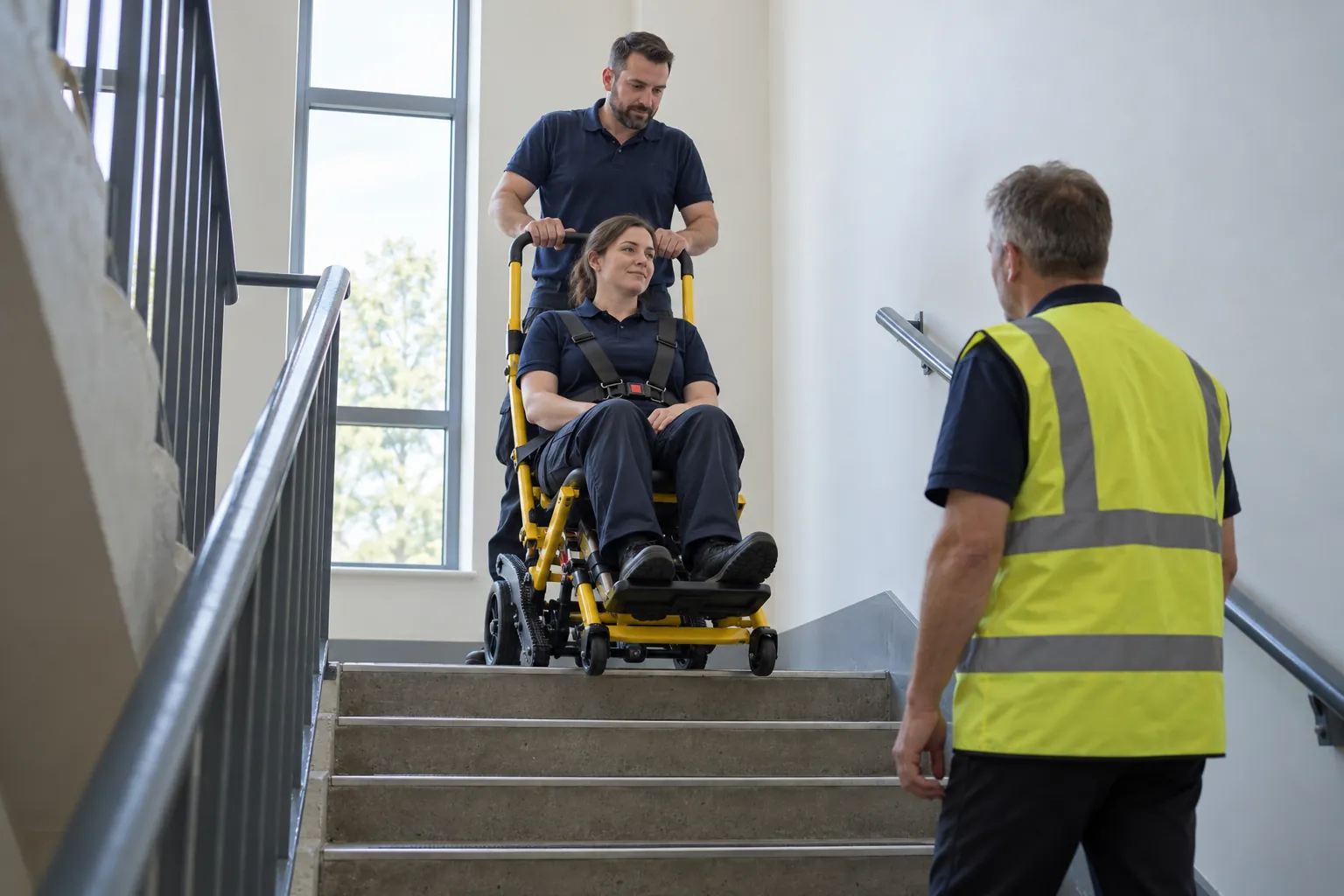
No UK law names the evacuation chair as compulsory, but in England and Wales the Regulatory Reform (Fire Safety) Order 2005 requires the responsible person to plan for everyone in the building to get out safely, disabled people included, and where that plan relies on carrying someone down a stair, a chair is often how it is done. A chair only helps if it is where it should be, in working order, and used by people who have practised. This guide covers the duty, when a chair is the right answer, the routine check, servicing and training, and what a good record shows.
01
Is an evacuation chair a legal requirement? The duty behind it
No regulation in the UK says a building must have an evacuation chair. The law requires an outcome: that everyone who may be in the premises can get out safely if there is a fire, and a chair is one way of meeting that duty for people who cannot use the stairs unaided.
In England and Wales the duty sits with the responsible person under the Regulatory Reform (Fire Safety) Order 2005: usually the employer, or the owner, landlord, occupier or managing agent with control of the premises. Under article 9 of the Fire Safety Order they must assess the fire risks, review the assessment when things change, and record it, including any group of persons identified as especially at risk. Article 14 requires that, in the event of danger, people can evacuate the premises as quickly and as safely as possible, and article 15 requires evacuation procedures, including safety drills, and enough competent persons nominated to carry them out.
The government's supplementary guide, Fire safety risk assessment: means of escape for disabled people (first published in 2007, with its GOV.UK page updated in September 2023 to summarise its legal status; it applies to England), says the fire safety risk assessment must include an emergency evacuation plan for all people likely to be in the premises, including disabled people, and "such an evacuation plan should not rely upon the intervention of the Fire and Rescue Service to make it work." If the only way a wheelchair user on the third floor gets out is a fire crew arriving, the plan fails that test.
Equality law points the same way. The guide, written under the Disability Discrimination Act 1995, says that failing to provide for the safe evacuation of disabled people may be viewed as discrimination. In England, Scotland and Wales that Act has been replaced by the Equality Act 2010, whose section 20 duty to make reasonable adjustments includes taking reasonable steps to provide an auxiliary aid where a disabled person would otherwise be at a substantial disadvantage. Scotland and Northern Ireland have their own fire safety law with similar duties: the Fire (Scotland) Act 2005 and the Fire Safety Regulations (Northern Ireland) 2010.
02
When a chair is the right answer, and when it is not
The government guide treats a chair as a fallback. For people with mobility impairments, the preferred options are horizontal evacuation to outside or into another fire compartment, or a fire evacuation lift. Only where those are not available may it be necessary to carry someone down an escape stair. Of evacuation chairs, section 4.4.1 of the guide says:
- they are operated by one or two people and require training and practice to use;
- disabled people may not feel confident using them, and a wheelchair user cannot always transfer into one or stay seated in it;
- so they "should not be considered as an automatic solution to the escape requirements of wheelchair users";
- their rear wheels help on the flat, but they are not suitable for long distances;
- a chair is unlikely to be of much use unless both the user and the operator are well trained and familiar with it.
Check too that the person is within the weight capacity the manufacturer states for the chair, and that they can be seated in it safely and held secure by its straps. If they cannot, the plan needs another way out for them.
So the decision starts with the person, not the equipment. In the guide's own example, a health club discusses a member's escape needs at induction, provides a chair at gym level, and trains every instructor on it. Where a chair is part of the arrangements, it usually sits within:
- A personal emergency evacuation plan (PEEP) for an employee or regular visitor, agreed with them, naming the route, the chair and the people who will help.
- A standard plan for occasional visitors, held at reception, setting out the options the building can offer.
- A refuge on the stair landing, a protected place to wait while the chair and its operators arrive. The guide says people should never be left in a refuge to wait for the Fire and Rescue Service.
- Other carry-down methods, such as the person's own wheelchair or a stable office chair. The guide says none should be attempted without appropriate training, and all need a risk assessment and professional moving and handling training for the operators.
In blocks of flats in England that are at least 18 metres or seven storeys high, or more than 11 metres high with a simultaneous evacuation strategy, the Fire Safety (Residential Evacuation Plans) (England) Regulations 2025, in force from 6 April 2026, add a separate duty to offer residents who would have difficulty evacuating a person-centred assessment and plan; they name no equipment.
03
Where the chair lives, and the routine check
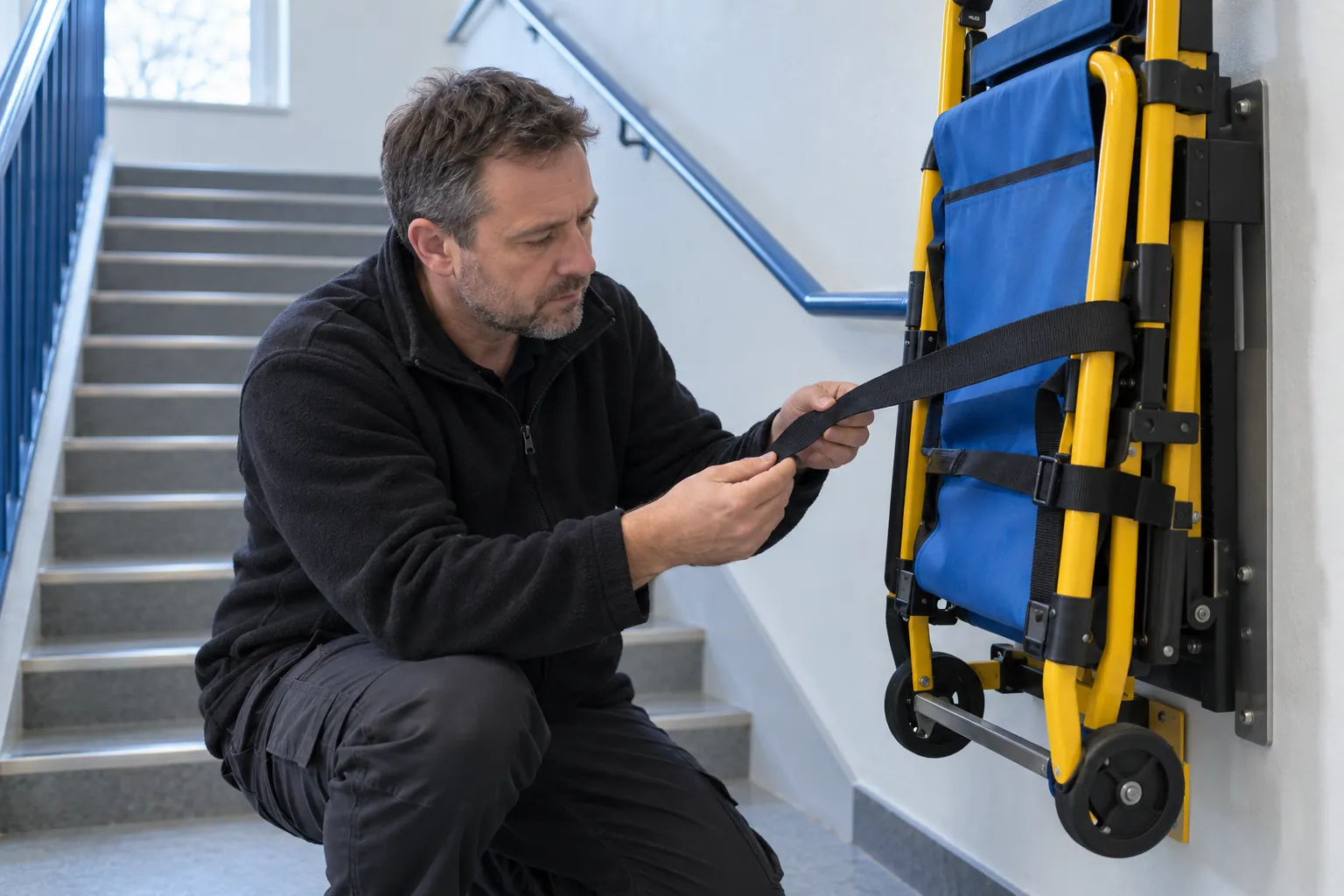
A chair belongs at the head of the stair the plan expects it to be used on, on the floor where it will be needed, not in a ground-floor store room. It usually hangs on a wall bracket or sits in a cover or cabinet on a landing or beside a refuge, clear of the route itself: article 14 requires routes to emergency exits to be kept clear, so a chair parked across a landing becomes the hazard it was bought to solve. The risk assessment decides how many chairs there are and on which stairs.
Between services, someone on site should look at each chair on a regular round, at the frequency the manufacturer's instructions and the fire risk assessment set; on many sites it joins the weekly or monthly fire safety checks in the workplace. A short routine check covers:
- It is there, in its marked position on the right floor, not borrowed, moved for decorating or put in a cupboard.
- It is accessible: not blocked by furniture or deliveries, and the bracket or cover opens easily.
- Its location sign, where one is fitted, is in place and visible.
- The chair is complete and undamaged: frame not bent or cracked, seat fabric not torn, head support and handles present.
- Straps and buckles are not frayed, and fasten and release properly.
- Tracks or skis and wheels are free of damage and debris, and the wheels turn.
- It unfolds and locks open, if the manufacturer's checklist asks for that, and folds away again.
- The instructions on the chair are legible, and the service label, where there is one, is in date.
Follow the manufacturer's own checklist where it differs, since each design has its own parts to check. A fault or a missing chair needs reporting at once to whoever can fix or replace it, with a stop-gap for anyone who relies on that chair until it is back. A check that records the same torn strap every week for a month has done half its job.
04
Servicing, maintenance and inspection
An evacuation chair an employer provides for staff to use is work equipment under the Provision and Use of Work Equipment Regulations 1998 (PUWER). Regulation 5 of PUWER requires work equipment to be maintained in an efficient state, in efficient working order and in good repair, and article 17 of the Fire Safety Order asks the same of equipment provided for fire safety, under a suitable system of maintenance. In a shared building, article 17 lets the responsible person make arrangements with the other occupiers, who must co-operate.
Where equipment is exposed to conditions liable to cause dangerous deterioration, regulation 6 of PUWER requires inspection at suitable intervals, with each result recorded and kept until the next. Regulation 6 does not apply to equipment for lifting loads including persons, which falls under the Lifting Operations and Lifting Equipment Regulations 1998 (LOLER). Whether a particular chair is treated as lifting equipment is for the manufacturer and the competent person who services it to say; if it is examined under LOLER, that written report is the record that matters.
The servicing interval comes from the manufacturer's instructions. HSE's guidance on maintenance of work equipment advises planning maintenance with the manufacturer's maintenance instructions, keeping any maintenance log up to date, giving workers a way to report damaged or faulty equipment, and having the work done only by people competent to do it. For a chair that usually means the manufacturer, its approved engineer or a specialist service company. A useful service record for each chair shows:
- the chair's location and its serial number or asset reference;
- the date of the service, who carried it out, and for which company;
- what was found and which parts were replaced;
- whether the chair was left in service or taken out, and why;
- when the next service is due.
Keep the service reports with the fire safety log book, so that a fire risk assessor, an insurer or an inspecting officer from the fire and rescue service can see the whole picture in one place.
05
Evacuation chair training and practice
The guide says that when chairs are bought, "a suitable training system" must be put in place too, and that regular practices should take place. That is the weak point on many sites: the chair is on the wall, the person trained on it at installation has left, and nobody on the rota has unfolded it since. Practice in calm conditions is what gives the people who operate a chair confidence with it before a real emergency.
The law behind the training is general. Article 21 of the Fire Safety Order requires employees to be given adequate safety training when they start and when they face new or increased risks, repeated periodically where appropriate. Regulation 9 of PUWER requires everyone who uses work equipment, and any employee who supervises or manages its use, to have received adequate training. The guide adds that escape helpers' training should include disability awareness, disability evacuation etiquette, and moving, lifting and handling techniques. Good evacuation chair training covers:
- When the chair is used in this building's plan and when it is not, including refuges, alternatives and the person's own wishes.
- Unfolding, positioning and folding the chair, on the stair it will be used on where possible.
- Transferring and securing a passenger with dignity, and what to do if they cannot transfer.
- The descent: controlling speed, turning on landings, and moving on the flat at the bottom.
- Communication between operators, with the passenger and with whoever co-ordinates the evacuation.
- The routine check, so operators know what a chair in good order looks like.
No regulation sets a refresher interval for chair operators, but section 3.4 of the guide says escape plans should be practised regularly and at least every six months, with carry-down simulated where that avoids unnecessary risk to the disabled person. In most cases practices need not include the disabled person: the guide suggests trained operators take turns being moved in the chair, which builds their confidence, and says it is best to limit a chair's use by disabled people to the real thing.
The number of trained operators should come from the risk assessment and cover every shift, holidays and sickness. Two trained people who both work weekday mornings leave no operator on a Saturday. Record each practice, who took part, when, and on which chair, alongside fire marshal training and drills; the fire marshal checklist covers those.
06
Where the record fails, and what SiteClara does about it
Evacuation chairs fail quietly. Nobody uses one until it is needed, so the evidence that it is ready lives in the routine checks, the easiest to skip. The tick is written at the desk, not on the landing; the chair moved to the basement during a refurbishment is still ticked on the fourth floor; the torn strap noted on a sheet never reaches anyone who can order a new one.
SiteClara puts a printed QR poster, with an NFC tag behind it if staff prefer to tap, beside each chair's position. Whoever does the round scans or taps with their own phone, with no app to install, sees the checks due at that chair and marks each one done, or explains what stopped them. The time and the named person are recorded as it happens, with a photo when one is asked for.
A fault found on the check, such as a frayed strap, a stiff wheel or a missing chair, is reported there with a photo and goes onto the team's list of jobs until someone closes it. The supervisor sees which checks are due, done and missed, records why one was missed, and can escalate a job to the building manager. Each day the supervisor approves a report that goes to nominated management or client contacts the next morning, showing how the scheduled checks went and what is still open.
07
Questions people ask
Is it a legal requirement to have an evacuation chair?
No UK law requires one by name. The government guide Fire safety risk assessment: means of escape for disabled people says the emergency evacuation plan must cover everyone likely to be in the premises, disabled people included, and "should not rely upon the intervention of the Fire and Rescue Service to make it work". Where that means carrying someone down a stair, the fire risk assessment may conclude that a chair and trained operators are needed.
What is an evacuation chair?
A chair for taking someone who cannot use the stairs down an escape stair. The government guide Fire safety risk assessment: means of escape for disabled people says it "looks like a deckchair with skis and wheels underneath" and slides down the stair, and that it is operated by one or two people and requires training and practice to use.
How safe are evacuation chairs?
That depends on the person and on training. The government guide Fire safety risk assessment: means of escape for disabled people says a chair is unlikely to be of much use unless both the user and the operator are well trained and familiar with it, and warns that disabled people may not feel confident in them, that a wheelchair user cannot always transfer into one or stay seated once in it, and that they "should not be considered as an automatic solution to the escape requirements of wheelchair users". It adds that a suitable training system must be put in place when chairs are bought.
What are the alternatives to evac chairs?
The preferred options in the government guide Fire safety risk assessment: means of escape for disabled people for people with mobility impairments are horizontal evacuation to outside the building, horizontal evacuation into another fire compartment, or a fire evacuation lift. Carrying someone down a stair, in a chair or by another method, comes in where those are not available or not in operation.
How often should an evac chair be serviced?
At the interval the manufacturer's instructions set, by a competent person. Regulation 5 of the Provision and Use of Work Equipment Regulations 1998 requires work equipment to be maintained in an efficient state, in efficient working order and in good repair, but no regulation sets one interval for evacuation chairs.
How often should evacuation chair training be refreshed?
No regulation sets an interval. Article 21 of the Regulatory Reform (Fire Safety) Order 2005 requires employees' safety training to be repeated periodically where appropriate, and the government guide Fire safety risk assessment: means of escape for disabled people says escape plans should be practised on a regular basis and at least every six months.
08
Further reading, and a list to take away
The main reference is the government's Fire safety risk assessment: means of escape for disabled people, covering PEEPs, refuges, lifts and carry-down methods. GOV.UK's fire safety and evacuation plans page says to make special arrangements for people with mobility needs, such as people to help wheelchair users get downstairs if there is a fire. Your local fire and rescue service can advise; in Scotland and Northern Ireland, read the guidance for your own law.
For each evacuation chair in your building, make sure that:
- the fire risk assessment says why it is needed and where it goes;
- anyone who may need it has a PEEP, or there is a standard plan for visitors;
- it sits at the head of the right stair, clear of the route, with its position signed;
- it is checked on a regular round, and faults go to someone who will fix them;
- it is serviced at the manufacturer's interval, with the report kept;
- enough people on every shift are trained, and the plan is practised at least every six months;
- nobody is left in a refuge to wait for the fire and rescue service;
- checks, services, training and practices are recorded where the fire arrangements are reviewed.
Sources
Every document this guide quotes or links to, in the order it first cites them.
- Article 9 of the Fire Safety Order legislation.gov.uk
- Article 14 legislation.gov.uk
- Article 15 legislation.gov.uk
- Fire safety risk assessment: means of escape for disabled people gov.uk
- Section 20 duty to make reasonable adjustments legislation.gov.uk
- Fire (Scotland) Act 2005 legislation.gov.uk
- Fire Safety Regulations (Northern Ireland) 2010 legislation.gov.uk
- Fire Safety (Residential Evacuation Plans) (England) Regulations 2025 legislation.gov.uk
- Regulation 5 of PUWER legislation.gov.uk
- Article 17 of the Fire Safety Order legislation.gov.uk
- Regulation 6 of PUWER legislation.gov.uk
- Maintenance of work equipment hse.gov.uk
- Article 21 of the Fire Safety Order legislation.gov.uk
- Regulation 9 of PUWER legislation.gov.uk
- Fire safety and evacuation plans gov.uk
Related guides
 Fire and water checksPersonal emergency evacuation plans: who needs one, what goes in it, and keeping it trueWhat a PEEP is, when the law requires one at work and in high-rise flats, how to write and review it, and the checks the plan depends on.
 Fire and water checksFire drill procedure: planning, running and recording a fire drillHow to plan and run a fire drill in a UK workplace, how often the guidance says to hold one, what the law requires, and what the fire drill record should show.
 Fire and water checksFire marshal checklist: the daily and weekly checks, and the job in an evacuationWhat a fire marshal or fire warden checks each day and week, their role in an evacuation, the law behind the role, and how to keep a record that stands up.
 Fire and water checksFire safety log book: what to record, who keeps it and for how longWhat a fire safety log book should contain, from alarm tests to drills and servicing, who keeps it, how long for, and whether paper or digital is better.