Cleaning
Public toilet cleaning: frequencies, safety and accessibility
Public toilet cleaning is the regular cleaning, disinfecting and restocking of toilets open to the public, on a schedule the provider sets, because no law fixes how often it must be done.
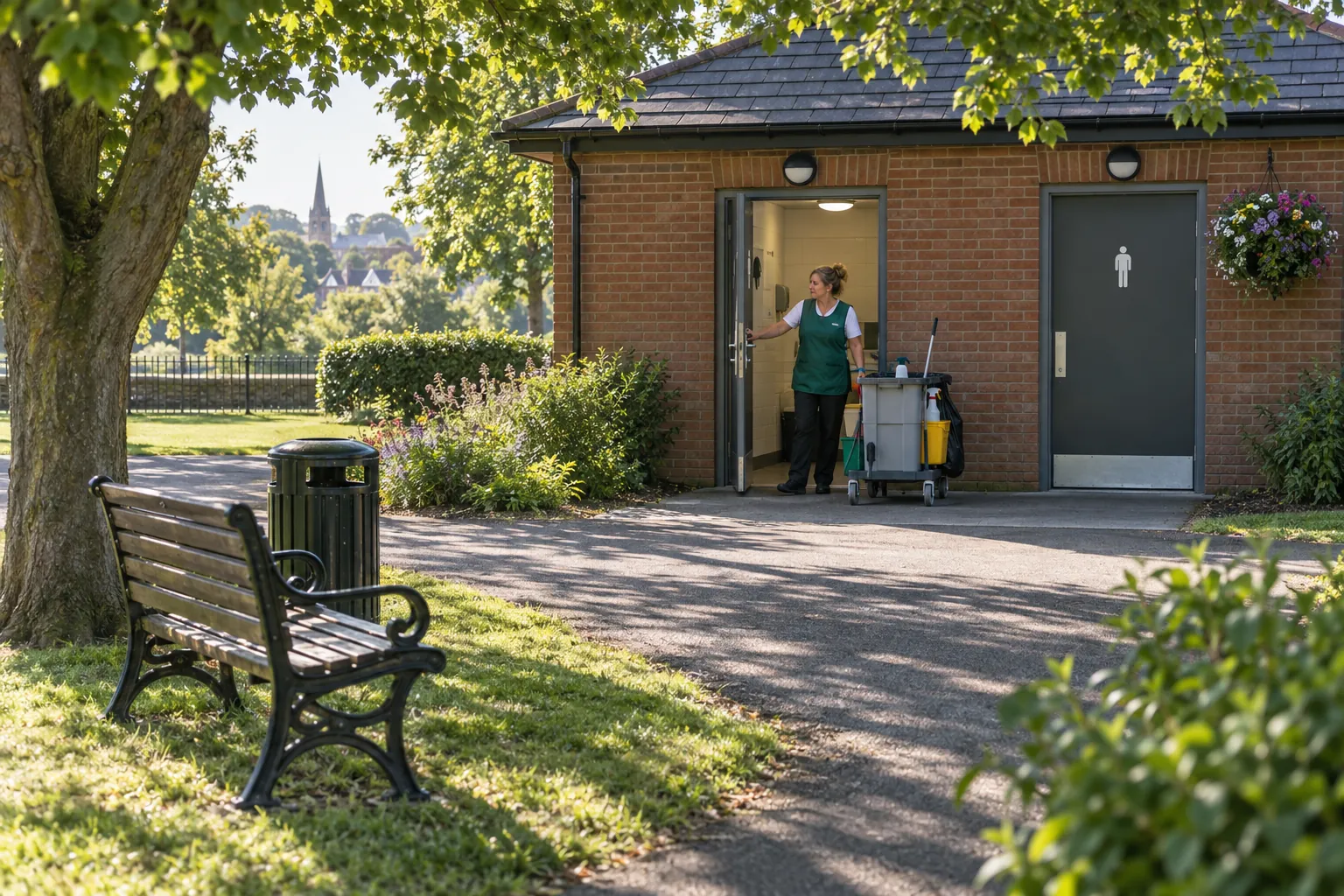
The toilets are cleaned for people nobody on the team will meet, at all hours, often without an attendant. This guide covers running them well: who is responsible, what a clean covers, how often to visit at peak times, handling needles and vandalism safely, accessible and Changing Places toilets, and letting the public report a problem.
01
Who provides public toilets, and what the law requires
Councils in England have a power, not a duty, to provide public toilets: section 87 of the Public Health Act 1936 says a county council, local authority or parish council in England "may" provide them, and lets the council that does make byelaws on the conduct of people using them and charge a fee. Public toilets are a public amenity run by many different bodies: councils, town and parish councils, transport operators at stations and bus stations, parks and heritage sites, shopping centres, stadiums, event organisers and venues. Some are staffed by an attendant during opening hours; many are not.
In Wales, the Public Health (Wales) Act 2017 requires each local authority to prepare and publish a local toilets strategy, which covers access to toilets for public use, including those in businesses and public buildings. Many councils also run community toilet schemes, in which local businesses agree to let the public use their toilets.
Whoever provides them, once toilets are open to the public the same duties apply:
- Health and safety. The Health and Safety at Work etc. Act 1974 protects both the cleaning staff and the public who use the facility, so far as is reasonably practicable.
- COSHH. The Control of Substances Hazardous to Health Regulations 2002 cover cleaning chemicals and biological hazards, including bodily fluids and discarded needles.
- Equality. The Equality Act 2010 requires service providers in Great Britain to make reasonable adjustments for disabled people, which in practice means accessible toilets that are kept clean, working and not used as a store room. Northern Ireland has its own disability discrimination law with similar effect.
- Water systems. Taps, cisterns and any showers are within the scope of the HSE Approved Code of Practice L8 on legionella.
- Building standards. New and altered toilet blocks must meet building regulations; in England, Approved Document M covers access and, for certain large new buildings used by the public, Changing Places toilets.
No law sets how often a public toilet must be cleaned. That is a decision for the provider, and it should be written into the cleaning specification or the contract, with a cleaning schedule for each facility based on its usage. Where a cleaning service is contracted out, the contract should also say who handles maintenance and how quickly faults are fixed, because a well-maintained toilet and a clean one are judged together by the public.
02
What a public toilet clean covers
A public toilet takes harder use than a workplace washroom, from users who have no reason to look after it, so regular cleaning to a high standard is what keeps it hygienic and tidy. A full clean, done at least daily in any toilet that is open, covers:
- Toilets and urinals: bowls, rims, seats, flush handles and the floor around them, cleaned and disinfected.
- Basins, taps and hand dryers: cleaned, with water running and dryers working.
- Cubicles: doors, locks, partitions, coat hooks and sanitary bins.
- Floors: swept and mopped with a disinfectant cleaner, with extra attention at the base of toilets and urinals, where unpleasant odours start.
- Touch points: door handles, push plates, flush buttons, lock turns and baby change units.
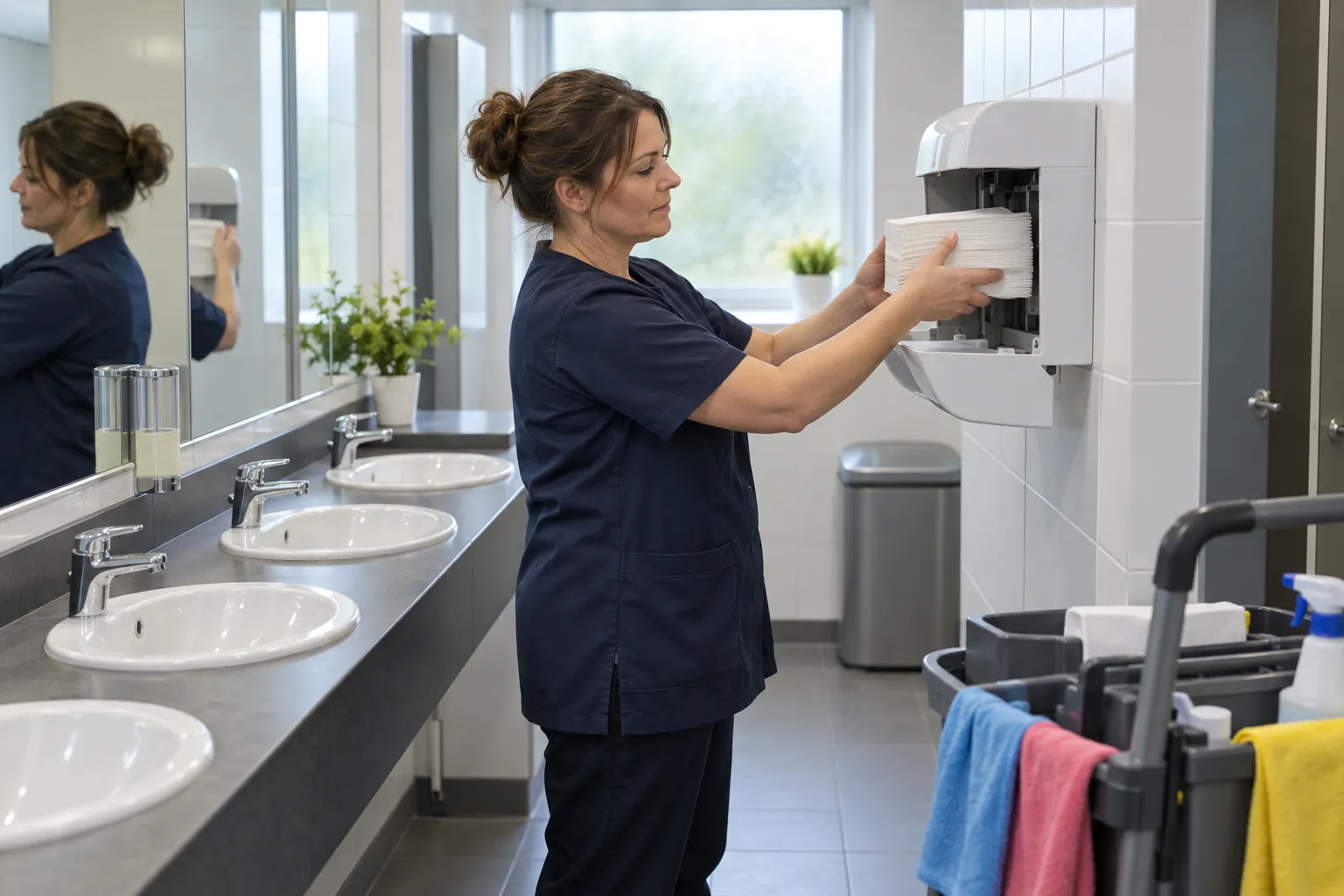
- Supplies: toilet paper, soap and paper towels restocked; dispensers checked, because hand hygiene fails first when the soap runs out and these essential supplies are what users notice.
- Waste: general bins emptied, sanitary bins serviced by the contractor on schedule.
- Walls, mirrors and graffiti: spot-cleaned daily, with graffiti removed promptly.
- Faults: leaks, blocked toilets, broken locks, lights and hand dryers found and reported.
- The approach and entrance: litter, signage, opening hours and the lighting outside.
Deep cleans belong on a periodic schedule: descaling urinals and toilets, cleaning grout, removing dust from high-level surfaces and vents, machine-scrubbing floors and pressure-washing where the fittings are designed for it. Automatic self-cleaning units still need regular visits to restock, clean what the cycle misses and check that they work.
03
How often, and what changes at peak
The right frequency follows footfall. As a starting point, many providers work to something like:
- Every 30 to 60 minutes at peak: stations, bus stations, shopping centres, stadiums, festivals and events, and seafront or park toilets on busy summer days.
- Every one to two hours: busy town-centre toilets during the day and venue toilets through an event.
- Two or three visits a day: lightly used toilets in quieter parks or villages.
- A full clean at least daily, usually at opening or after closing, in every toilet that is open.
Checks should follow the pattern of use, not the clock alone. A seafront block needs visits concentrated in summer afternoons; a station toilet peaks at rush hours; a stadium needs checks at half-time and immediately after the final whistle. An hourly visit through a quiet morning and nothing during the lunchtime surge produces a full sheet and a toilet the public complains about.
For an event, plan three phases: a full clean and stock-up before the doors open, frequent checks throughout with a named person responsible for each block, and a full clean afterwards. Temporary and portable toilets need servicing by the hire company on an agreed schedule, and the event team still needs to check them between services.
04
Needles, bodily fluids and vandalism, handled safely
Public toilet cleaning carries risks that ordinary office cleaning does not. They should be covered by the risk assessment and the COSHH assessment, and every cleaner should be trained in them before working alone, with ongoing training and refreshers so that best practices do not drift.
Discarded needles and sharps
- Never pick up a needle by hand, even when wearing gloves. Use a litter picker or tongs and a puncture-resistant sharps container, taken to the needle rather than the other way round.
- Look before reaching: into bins, behind cisterns, under sanitary bins and in paper towel dispensers. Never push waste down in a bin with a hand or a foot.
- Dispose of full sharps containers through the provider's clinical waste arrangements.
- If someone is pricked, the standard first aid is to encourage the wound to bleed, wash it with soap and running water without scrubbing, cover it, and get medical advice urgently from occupational health or an emergency department.
- Employers usually offer hepatitis B vaccination to staff whose risk assessment shows they may be exposed.
Bodily fluids: use a spill kit, disposable gloves and apron, and the disinfectant the COSHH assessment names, and close the cubicle or toilet until it is done.
Vandalism and misuse: record damage when it is found, with a photo, the time and the location; make it safe, for example by closing a cubicle with a broken door or taping off a broken fitting; and report it to whoever repairs it. Offensive graffiti should come off the same day. Cleaners should not confront anyone behaving aggressively; they should leave and report it. A record of repeated damage to the toilet facilities, by location and time, is what supports a case for better lighting, CCTV outside the entrance, or different opening hours.
05
Accessible toilets, Changing Places, and letting the public report problems
Accessible toilets need the same cleanliness and more. An accessible toilet that is dirty, locked without explanation or used to store cleaning equipment fails the people who have the fewest alternatives. Add these to every check:
- The emergency cord hangs free to near floor level, is not tied up or looped over a rail, and the alarm works and is answered.
- Clear space: nothing stored in the room, bins placed so they do not block the transfer space beside the toilet.
- Grab rails, the basin and the dryer are clean, secure and reachable from the toilet.
- The lock and door work easily, and where a National Key Scheme (RADAR) lock is fitted, it works with the standard key, which is available from Disability Rights UK.
- Baby change units are clean, fold properly and are not broken.
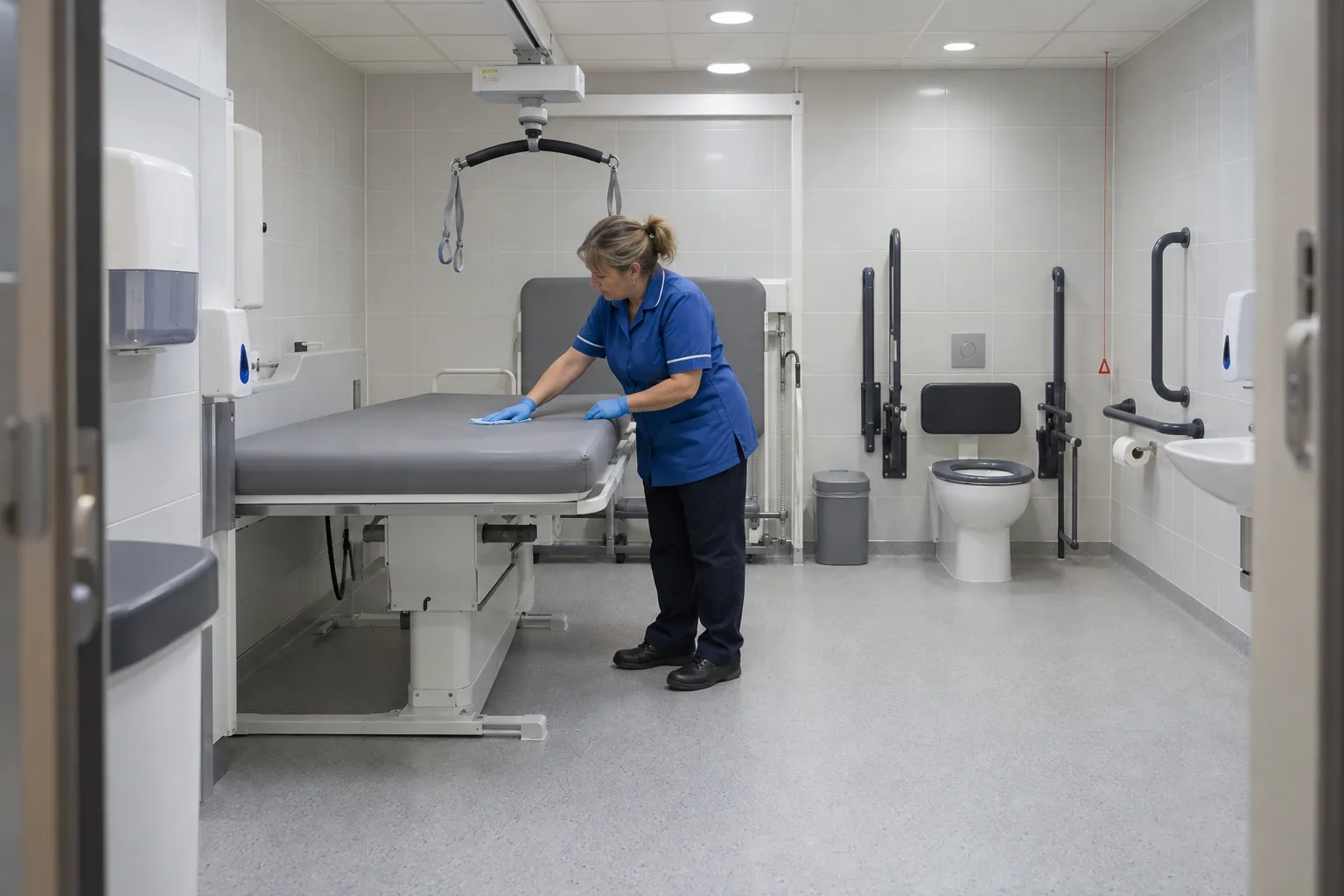
Changing Places toilets are larger accessible toilets for people who cannot use a standard accessible toilet, with a height-adjustable adult-sized changing bench, a ceiling track hoist, a peninsular toilet with space on both sides, and room for up to two carers. The design is set out in BS 8300. Cleaning the room is a normal job, with the bench and the hoist controls treated as touch points. Check that the hoist is charged and works, and report a fault at once so that maintenance can ensure it is repaired, because without it the room cannot be used. The hoist also needs a thorough examination by a competent person under the Lifting Operations and Lifting Equipment Regulations 1998, at least every six months for equipment that lifts people. That is separate from cleaning, but the cleaning record is often where a fault is first noticed. Changing Places toilets are listed on a public map, and if one is out of use, the listing should say so.
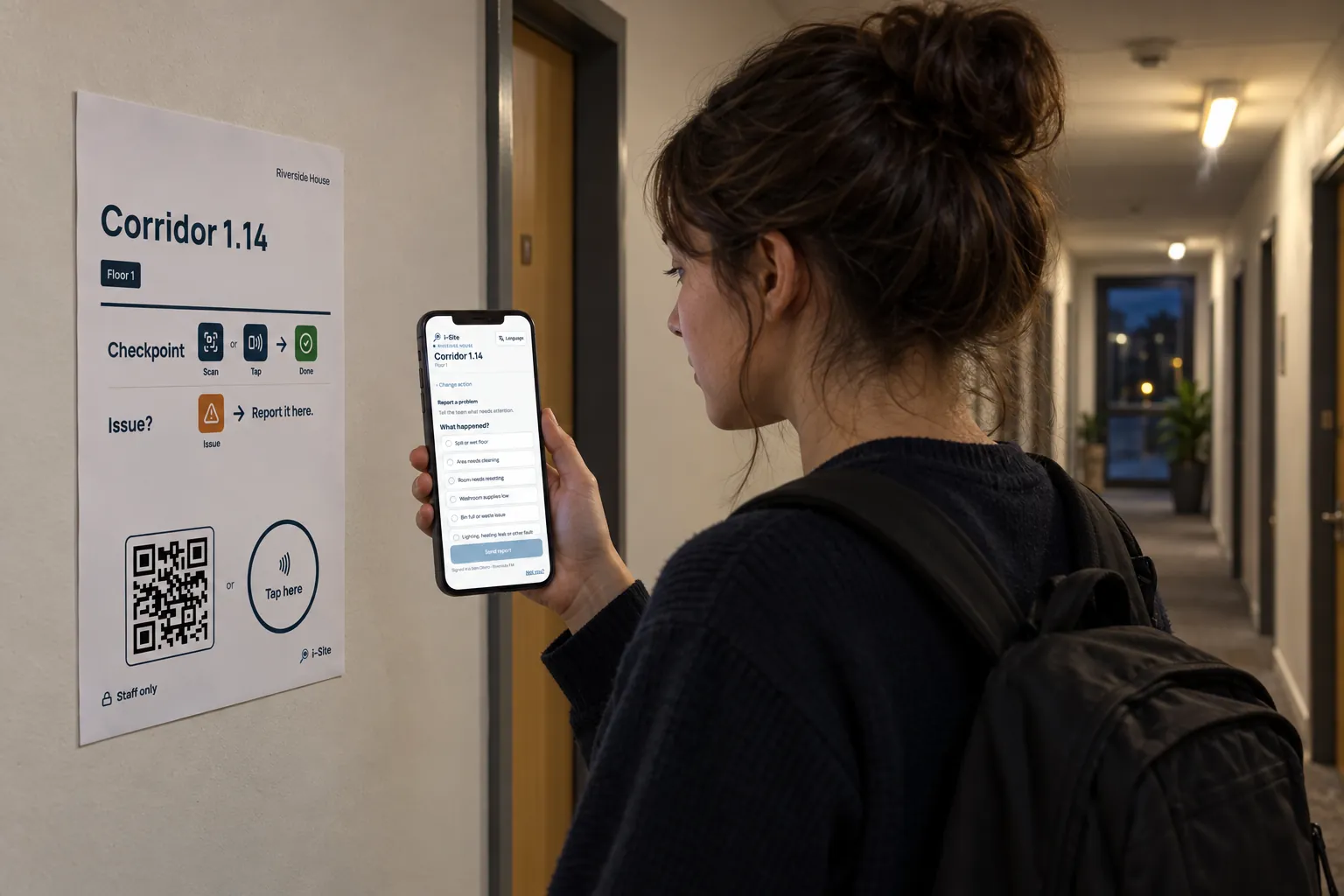
Public reporting. The people who find a problem first are the public. A clear sign at each block, saying how to report a blocked toilet, a broken lock or a missing supply, with a reference for the location, turns them into an early warning. The report is only useful if it reaches the team on duty quickly and someone closes it; a phone number that goes to voicemail at the weekend teaches people not to bother. The fault reporting system guide covers how to set this up.
06
Where the public toilet record fails, and what SiteClara does about it
Public toilets are spread across a borough, a station estate or a showground, and the cleaning team moves between them. The public's view of the provider, and its reputation, rests on how well it can maintain them. A paper sheet in each block tells a manager nothing until someone collects it; a missed visit is found by the public before anyone else; and damage reported by a member of the public on a council website can take days to reach the person who could have closed the cubicle that morning.
SiteClara puts a printed QR poster in each toilet block, with an optional NFC tag behind it. The cleaner scans the code or taps the tag on their own phone, with no app to install, sees the scheduled checks due there and marks them done or explains what stopped them, with a photo when it helps. Damage, a blockage or a needle bin that needs collecting is reported on the spot and goes onto the team's list of jobs until someone closes it. Because a council or venue running its own toilets is a building-owner-led site, public reporting can be allowed at the same tags, so a visitor can report a problem where they find it.
The supervisor sees what is due, done and missed across every block, can record the reason a check was missed, and can escalate a job to the building manager. Each morning at 8am the approved report for the previous day goes to nominated management or client contacts, showing what was reported, completed and still open, and how scheduled checks went.
07
Questions people ask
How often should a public toilet be cleaned?
No law sets how often a public toilet must be cleaned, so the provider decides it and should set it out in the cleaning specification or contract. Cambridge City Council's public toilets page, for example, says the council cleans each of its sites every day it is open and will prioritise a visit when the public report a problem; that is one council's practice, not a rule.
What are the rules of using a public toilet?
For council toilets in England, the enforceable rules are any byelaws the council has made: section 87(3) of the Public Health Act 1936 lets a council that provides public sanitary conveniences make byelaws as to the conduct of people using or entering them. The same section lets the council charge a fee for their use.
08
Further reading, and a list to take away
The Health and Safety Executive publishes guidance on COSHH, on biological agents and needlestick injuries, on lifting equipment under LOLER, and the legionella Approved Code of Practice L8. The Changing Places Consortium publishes guidance on Changing Places toilets and runs the public map. Disability Rights UK runs the National Key Scheme. The British Toilet Association campaigns for better public toilet provision and publishes guidance for providers. In Wales, the Welsh Government publishes statutory guidance on local toilets strategies.
Before the next busy season, check that:
- each toilet block has a cleaning frequency written down, with more visits at its own peak times;
- full cleans, checks and periodic deep cleans are scheduled separately;
- every cleaner is trained in handling sharps and bodily fluids before working alone, with sharps containers and spill kits on the round;
- damage is recorded with a photo and made safe on the day it is found;
- accessible toilets are checked for the cord, clear space and working lock on every visit;
- Changing Places hoists are checked for charge and function, with their thorough examination booked separately;
- the public can see how to report a problem, and someone acts on it;
- opening and closing times are posted and the closing check is recorded.
Sources
Every document this guide quotes or links to, in the order it first cites them.
- Section 87 of the Public Health Act 1936 legislation.gov.uk
- Public Health (Wales) Act 2017 legislation.gov.uk
- Control of Substances Hazardous to Health Regulations 2002 legislation.gov.uk
- Equality Act 2010 legislation.gov.uk
- Approved Document M gov.uk
- Lifting Operations and Lifting Equipment Regulations 1998 legislation.gov.uk
- Cambridge City Council's public toilets page cambridge.gov.uk
Related guides
 CleaningToilet check sheet: what to record and how to make it credibleWhat a washroom check sheet should record, how often to check, the legal duty behind it, and how to keep a record a client or inspector will believe.
 Premises and facilities managementFault reporting system: how faults are reported, prioritised and closedHow a fault reporting system for a building should work: how occupants report faults, how facilities teams log and prioritise them, and how a fault is closed.
 CleaningCleaning specification: what it should say, and how to show it is metWhat a cleaning specification should contain, input and output standards, setting frequencies by area, and how to show the specification is being delivered.
 Fire and water checksLegionella checks: the routine monitoring, and the record that shows it was doneThe routine legionella checks in hot and cold water systems under HSE's L8 and HSG274: flushing, temperatures, who does them and what the record should show.