Premises and facilities management
COSHH in Ireland: the chemical agents risk assessment, and the checks that keep it true
COSHH, the Control of Substances Hazardous to Health Regulations, is UK law and does not apply in Ireland, where regulation 4 of the Safety, Health and Welfare at Work (Chemical Agents) Regulations 2001 to 2026 requires every employer to identify the hazardous chemical agents at the workplace and make a written assessment of the risk they pose, enforced by the Health and Safety Authority (HSA).
Also written for United Kingdom · United States · Australia · South Africa
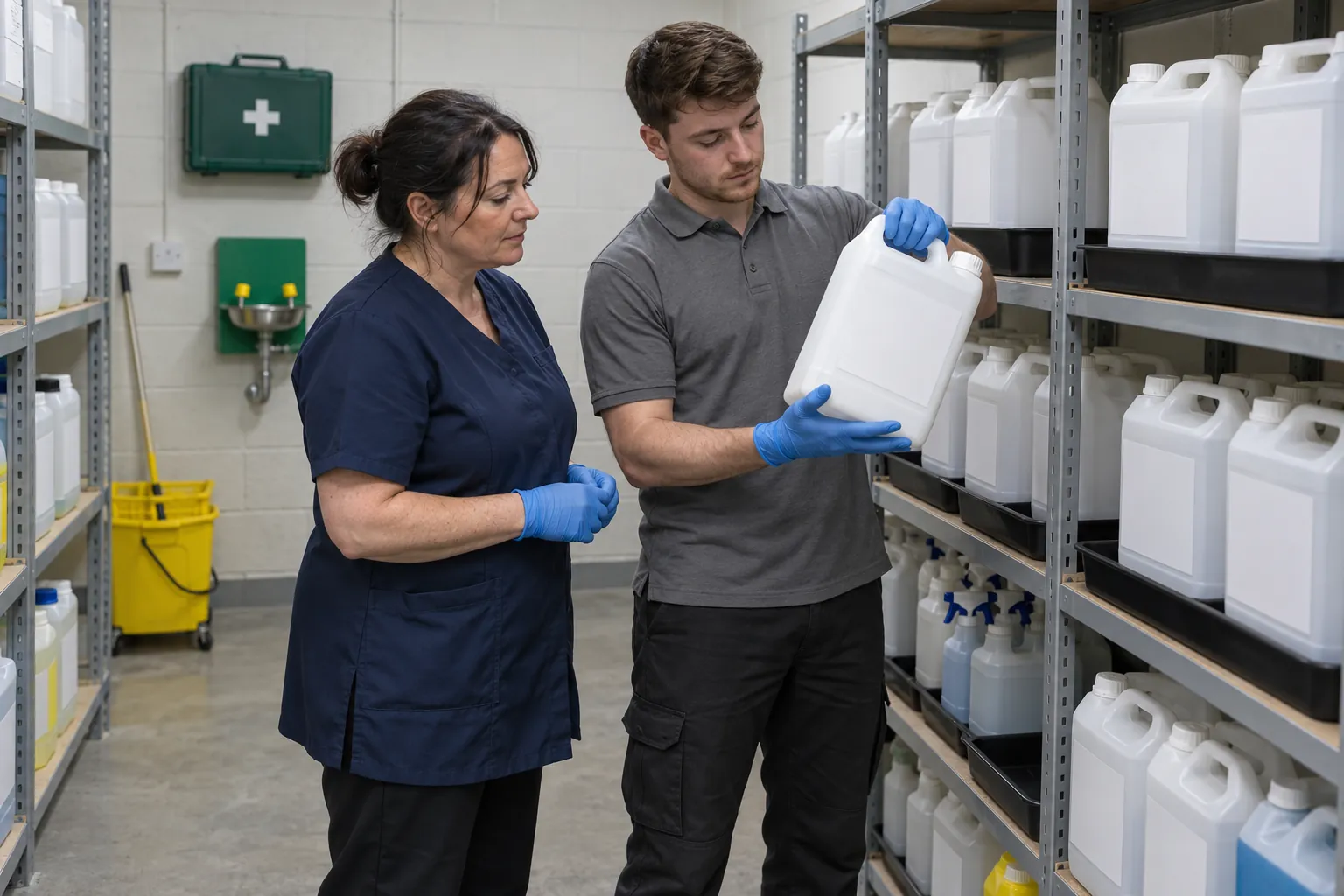
For a cleaning company, a school, a nursing home or an office with its own cleaners, that means the bleach, the toilet cleaner, the degreaser and the concentrate in the dosing cupboard, and the hours of wet work that no label warns about. This guide covers what the Irish law requires, why a COSHH assessment written for Great Britain does not meet it, the steps of a chemical risk assessment, what it should say about cleaning products, and the routine checks that show the controls are still working.
01
COSHH and the Irish law: the Chemical Agents Regulations
The HSA's Chemical Agents Legislation page is plain: the COSHH Regulations "are UK Regulations and do not apply in Ireland". People still say COSHH, and suppliers still send COSHH sheets, but the duty an HSA inspector asks about is Irish.
It is in the Safety, Health and Welfare at Work (Chemical Agents) Regulations 2001 (S.I. No. 619 of 2001), amended in 2015, by the Chemical Agents (Amendment) Regulations 2021 and by the Chemical Agents (Amendment) Regulations 2026, in operation from 9 April 2026, which say all four may be cited together as the Chemical Agents Regulations 2001 to 2026. The HSA says they apply wherever hazardous chemical agents are used or generated: "Once any hazardous substance is used or generated, for example, cleaning chemicals or welding, then the Regulations apply."
Regulation 4 is the assessment. Every employer must determine whether hazardous chemical agents are present and assess the risk to employees' safety and health, and:
- take into account the agents' hazardous properties, the supplier's information including the safety data sheet, the level, type and duration of exposure, the quantities stored and in use, any occupational exposure limit value, the effect of the preventive measures, any health surveillance findings, and foreseeable significant exposure in maintenance or an accidental release (regulation 4(1)), assessing several agents "in combination" (4(2));
- record it in writing, with no exemption for a small business (4(3)), identifying the measures taken or to be taken (4(6));
- review it regularly, and immediately if there is reason to suspect it is no longer valid, the work has changed significantly, health surveillance shows it to be necessary, or exposure monitoring finds an occupational exposure limit value exceeded (4(5)).
Regulation 4(7) adds that for a new activity involving hazardous chemical agents, "work shall not commence" until the assessment has been made and its preventive measures implemented.
The Regulations work alongside the Safety, Health and Welfare at Work Act 2005, whose section 19 requires a written risk assessment of every place of work. The HSA's 2026 Code of Practice for the Chemical Agents Regulations and the Carcinogens, Mutagens and Reprotoxic Substances Regulations, in operation from 9 April 2026, replaced the 2024 Code and lists the occupational exposure limit values; under section 61 of the 2005 Act it is admissible in evidence in a prosecution.
02
What a chemical risk assessment covers in practice
Since the Chemical Agents (Amendment) Regulations 2015, a "hazardous chemical agent" is one meeting the criteria for a physical or health hazard class under the EU's CLP Regulation (EC) No 1272/2008, classified or not, or any agent that may present a risk "because of its physico-chemical, chemical or toxicological properties and the way it is used or is present in the workplace", including any with an occupational exposure limit value. A "chemical agent" itself is, in the words of the HSA's Chemical Agents Legislation page, "any chemical element or compound, on its own or admixed", whether produced, used or released by a work activity, including as waste.
The HSA says the assessment "should be based on activities involving chemicals", because the risk depends on how a product is stored, transported, used, generated or disposed of. Its chemicals risk assessment page adds that chemicals can cause harm "ranging from mild skin irritation to cancer", by inhalation, skin contact, ingestion or injection, either at once or many years after exposure. Its guidance Safety in Contract Cleaning shows what that means for cleaners:
- The products: acids and bases in bathroom and descaling products, which can cause severe burns; solvents and detergents in degreasers; disinfectants, which can cause allergic reactions and burns; fragrances and colouring agents, which can cause allergic reactions.
- Dilution: too little or too much product both create risks.
- Mixing: bleach should not meet ammonia, toilet cleaners or drain cleaners, because "a harmful gas can be created".
- Wet work: detergents, bleaches, disinfectants and ammonia "are all likely to cause dermatitis", which the guidance calls "the most common type of occupational disease in Ireland".
- Sprays and mists: cleaners are at increased risk of asthma and other respiratory problems, and sprays or the mist from a pressure washer increase the risk of breathing substances in.
People matter as much as products. Regulation 3(6) extends the employer's duties to everyone else at work who may be exposed, and the HSA asks whether people working nearby, visitors or maintenance staff can be, and whether any vulnerable groups, such as pregnant or nursing employees, are.
03
The five steps of a chemical risk assessment
The HSA's chemicals risk assessment page sets out five steps, and warns that "a generic assessment is unlikely to meet the requirements of the legislation".
- Make a list. Walk round, check the purchase orders, and list every chemical brought in or generated by the work or its waste, such as dust or fumes, organised by job or activity.
- Identify the hazards from the label (signal word, pictogram, hazard and precautionary statements) and the safety data sheet.
- Assess exposure: how each chemical is used and how often, by which routes (breathing in, skin contact), how much, for how long, by how many people, whether it is mixed or heated, and who else could be exposed.
- Control the risks with measures that prevent or reduce exposure: eliminate, substitute, then engineering controls, work practices, training, hygiene, storage and emergency procedures, with personal protective equipment as "the last line of defence". The HSA asks you to specify "the exact glove type, filter type etc."
- Record and review. Write the findings down, discuss them with employees, make an action plan saying who does what by when, and review at least once a year and whenever people, equipment, materials or work patterns change.
The HSA offers a free Chemical Agents Risk Assessment Template and inventory template. Its Chemical Agents Risk Assessment Template Supporting Information (2025) says the template "is not an approved or statutory form", that using it "does not guarantee compliance", and that chemical risk assessments "should be included with your other risk assessments as part of your safety statement". It ties the order of controls to the nine general principles of prevention in Schedule 3 to the 2005 Act, which include replacing dangerous substances with less dangerous ones and "the giving of priority to collective protective measures over individual protective measures".
04
What the assessment should say about cleaning products
Regulation 6 makes the order of controls a duty: replace a hazardous agent with one that is "not hazardous or less hazardous", then design the work and engineering controls to minimise release, then extract at source, and only where exposure cannot be prevented otherwise, use personal protective equipment. Regulation 5 adds washing facilities and keeping the quantity of chemicals in the work area to the minimum. For a cleaning contract the assessment usually records:
- Product choice: a policy of buying less harmful chemicals, or replacing more harmful ones, as Safety in Contract Cleaning expects.
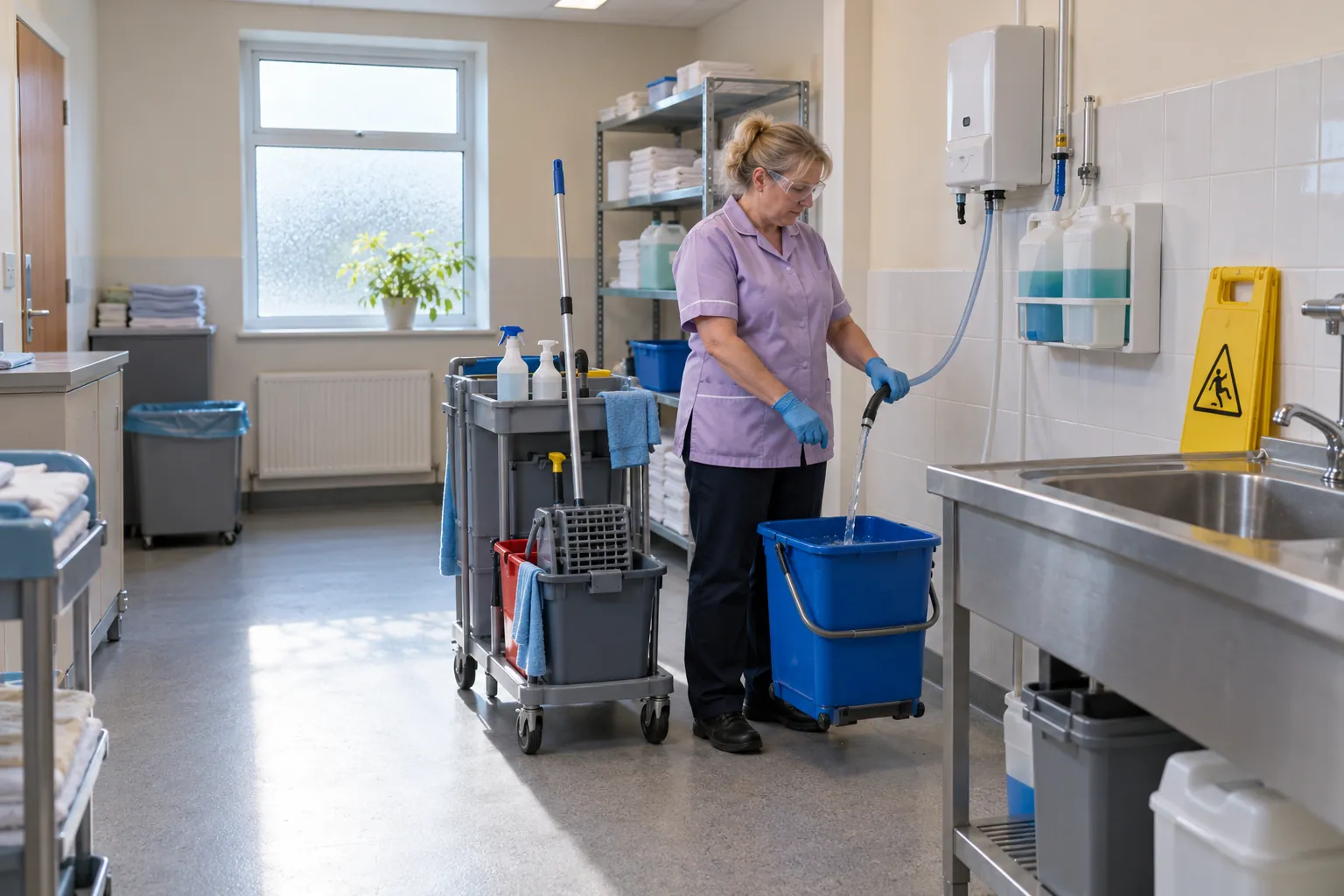
- Dilution by measure: pre-measured products or dosing devices, so nobody measures by eye.
- Labels: regulation 9(3) requires every container and pipe holding a hazardous chemical agent to be clearly labelled with its contents and hazards, and a refilled spray bottle is a container.
- Storage: segregation "taking account of the incompatibility of certain hazardous chemical agents" (regulation 6(2)(a)), with flammables apart from oxidisers, in a secure store.
- Protection: powder-free vinyl or nitrile gloves resistant to splashes, goggles where the assessment calls for them, and respiratory protection only after every other option, chosen from section 8 of the safety data sheet.
- Upkeep: controls and equipment properly maintained and used (regulation 6(1)(b)); employees must use them, put them back and report a defect "forthwith" (regulation 7).
Regulation 8 requires an action plan for accidents, incidents and emergencies, including safety drills at regular intervals and first aid facilities: for a cleaners' store, a spill kit, eyewash and a short instruction. Regulation 9 requires employees to have the assessment's findings, training and access to the safety data sheets, which the cleaning guidance says "should be in English and should be easily accessible to the worker". Where the assessment shows a risk to health, regulation 10 requires the employer to make appropriate health surveillance available, under the responsibility of an occupational healthcare professional; in cleaning, that usually means watching for dermatitis and asthma. Regulation 5(2) lifts regulations 6, 8 and 10 only where the quantities present mean a minimal risk.
Contract cleaning adds a second employer. The cleaning guidance says a risk assessment should be done for each place of work before cleaning starts there, and that the client should make its own risk assessment available to the cleaners. Section 21 of the 2005 Act requires employers sharing a workplace to co-operate and inform each other, "including by the exchange of safety statements or relevant extracts".
05
The inventory, the records, and keeping the assessment alive
The HSA says the employer must identify every chemical agent at the place of work, "so a chemical inventory (List) is a good idea", and that it helps find out-of-date or unused chemicals for safe disposal. The inventory says what is on the shelf; the assessment says how people use it safely. The records that follow are:
- the written risk assessment (regulation 4(3)), with its measures and next review date;
- safety data sheets: the HSA's information sheet Safety Data Sheets for Hazardous Chemicals (November 2023) says each must have 16 headings, be in English and match the label, be kept where all employees know and can reach it, and that "a record of the SDS's must be kept for a minimum of 10 years";
- exposure and health records, where measurements or health surveillance are needed (regulation 10).
Controls drift, and in cleaning nearly every control depends on someone doing the right thing at the right time. The template's supporting information says controls "should be monitored to ensure that they are working". Routine checks that keep the assessment true include:
- the chemical store: lids on, labels intact, incompatible products apart, nothing unlabelled, the door locked;
- trolleys and floor cupboards: only products the assessment covers, every spray bottle labelled;
- the dilution point: working, not leaking, set to the instructions;
- the spill kit, eyewash and gloves: complete, in date and in stock;
- the safety data sheets: current, one copy each, where staff can find them;
- the people: new starters trained before they use a product, sore hands reported and followed up.
A missed check is evidence too. An eyewash found empty in March, with the reason recorded, gives the review something to act on; a store-door sheet ticked for the whole month in one pen gives it nothing.
06
Where the record fails, and what SiteClara does about it
Most chemical risk assessments do not fail on paper. The document is in the safety statement folder, signed and dated. What fails is the routine it relies on: the store that has collected unlabelled spray bottles, the eyewash that ran dry in spring, the evening starter never shown the dilution chart. Nobody notices until a splash, a rash or an inspection, and then nobody can show when the store was last checked, or by whom.
SiteClara records those routine checks where they happen. A printed QR poster, with an NFC tag behind it if staff prefer to tap, sits at each place a check is scheduled: the chemical store, the dilution point, the cleaners' cupboard on each floor. Staff scan or tap with their own phone, with no app to install, and see the checks due there. They mark each one done or explain what stopped them, with a photo when one is asked for, such as the store shelf or the eyewash date, and the time and the named person are recorded as it happens. A problem found on a check, such as a leaking container or an empty spill kit, is reported there and stays on the team's list of jobs until someone closes it.
The supervisor sees which checks are due, done and missed, and records the reason one was missed. Each day they approve a report that goes to nominated management or client contacts the next morning, showing what was completed, what was reported and what is still open: a working record made at the time, which the annual review can draw on.
07
Questions people ask
Does COSHH apply in Ireland?
No. The HSA's Chemical Agents Legislation page says the Control of Substances Hazardous to Health (COSHH) Regulations "are UK Regulations and do not apply in Ireland". The Irish equivalent is the Safety, Health and Welfare at Work (Chemical Agents) Regulations 2001 to 2026, which apply wherever hazardous chemical agents, such as cleaning chemicals, are used or generated.
Who do the Chemical Agents Regulations apply to?
Every employer where hazardous chemical agents are used or generated, not only businesses that make chemicals. The HSA's Chemical Agents Legislation page says that "once any hazardous substance is used or generated, for example, cleaning chemicals or welding, then the Regulations apply". Regulation 3(6) extends the employer's duties, apart from health surveillance, to every other person at work there who may be exposed, such as contractors' staff and maintenance workers.
What substances does a chemical risk assessment cover?
Any chemical, in gas, liquid or solid form, that has the potential to cause harm. The HSA's chemicals risk assessment page lists solids such as dusts and fibres, liquids or mists such as bleach, and gases and vapours such as chlorine or ammonia, including mixtures such as degreasers. It covers chemicals brought in, such as solvents and cleaning agents, and those generated by processes or waste, such as welding fumes or carbon monoxide from exhausts.
Will a UK COSHH assessment do in Ireland?
No. The HSA's chemicals risk assessment page says "COSHH assessments are UK requirements and do not meet the Irish legal requirements for risk assessments". A supplier's sheet can inform your assessment, but the assessment must be your own, of your own work, under regulation 4 of the Chemical Agents Regulations.
What are the chemical regulations in Ireland?
For workplace exposure, the Chemical Agents Regulations 2001 to 2026 and, for carcinogens, mutagens and reprotoxic substances, the CMRS Regulations 2024 and 2026, alongside the general duties of the Safety, Health and Welfare at Work Act 2005. The HSA's 2026 Code of Practice sets the occupational exposure limit values and notes that the EU's REACH and CLP Regulations, which govern safety data sheets and labels, are also relevant.
08
Further reading, and a list to take away
The law is the Chemical Agents Regulations 2001 and its amendments, on the Irish Statute Book. The HSA's chemicals risk assessment page has the steps, inspectors' worked examples and the free templates, and its CLP pages explain labels and pictograms.
For a chemical risk assessment that holds up in Ireland, check that:
- it is made under the Chemical Agents Regulations, not copied from a COSHH assessment for Great Britain;
- every chemical on site is on the inventory with its use, hazard, location and a current safety data sheet in English;
- it is written down, covers dilution, mixing, wet work and spills, and names the exact gloves and goggles;
- safer products were considered before protective equipment;
- the cleaning team has been told the findings and trained on the labels;
- contractor and client have exchanged the risks each brings;
- the store, eyewash, spill kit and gloves are checked on a schedule, with missed checks recorded and explained;
- health surveillance is made available where dermatitis or asthma is a risk;
- it sits in the safety statement with the other health and safety risk assessments, and is reviewed at least yearly, and sooner when anything changes.
Sources
Every document this guide quotes or links to, in the order it first cites them.
- Chemical Agents Legislation hsa.ie
- Safety, Health and Welfare at Work (Chemical Agents) Regulations 2001 irishstatutebook.ie
- Chemical Agents (Amendment) Regulations 2021 irishstatutebook.ie
- Chemical Agents (Amendment) Regulations 2026 irishstatutebook.ie
- Safety, Health and Welfare at Work Act 2005 irishstatutebook.ie
- 2026 Code of Practice for the Chemical Agents Regulations and the Carcinogens, Mutagens and Reprotoxic Substances Regulations hsa.ie
- Chemical Agents (Amendment) Regulations 2015 irishstatutebook.ie
- Chemicals risk assessment hsa.ie
- Safety in Contract Cleaning hsa.ie
- Legislation relevant to biological agents hsa.ie
- Chemical Agents Risk Assessment Template Supporting Information hsa.ie
- Safety Data Sheets for Hazardous Chemicals hsa.ie
- CLP pages hsa.ie
Related guides
 Premises and facilities managementSafety statement: what the 2005 Act requires, and how to show it is followedWhat a safety statement must contain under section 20 of the Safety, Health and Welfare at Work Act 2005, who needs one, when to review it and how to show it works.
 CleaningCleaning supervisor duties: what the role involves in Ireland, and what good looks likeWhat a cleaning supervisor does in Ireland: the duties, a typical shift, the 2005 Act and 2007 Regulations, the contract cleaning ERO, checking work and reporting.
 Premises and facilities managementHealth and safety inspection checklist: what to walk, what to record, and what the HSA looks forA workplace health and safety inspection in Ireland: the 2005 Act and 2007 Regulations, what to walk, how often, recording actions, and what an HSA inspector asks.
 Premises and facilities managementThe Safety, Health and Welfare at Work Act 2005: the duties that land on a site, and the records they createThe Safety, Health and Welfare at Work Act 2005: what it asks of employers, employees and those in control of a site, its records, and how the HSA enforces it.