Cleaning
Hazardous chemicals register: what goes on it, and how to keep it true
A hazardous chemicals register is the list of every hazardous chemical used, handled or stored at a workplace, kept together with the current safety data sheet for each one, which regulation 346 of the model Work Health and Safety Regulations requires a person conducting a business or undertaking (PCBU) to prepare, keep at the workplace and keep up to date.
Also written for United Kingdom · United States · South Africa
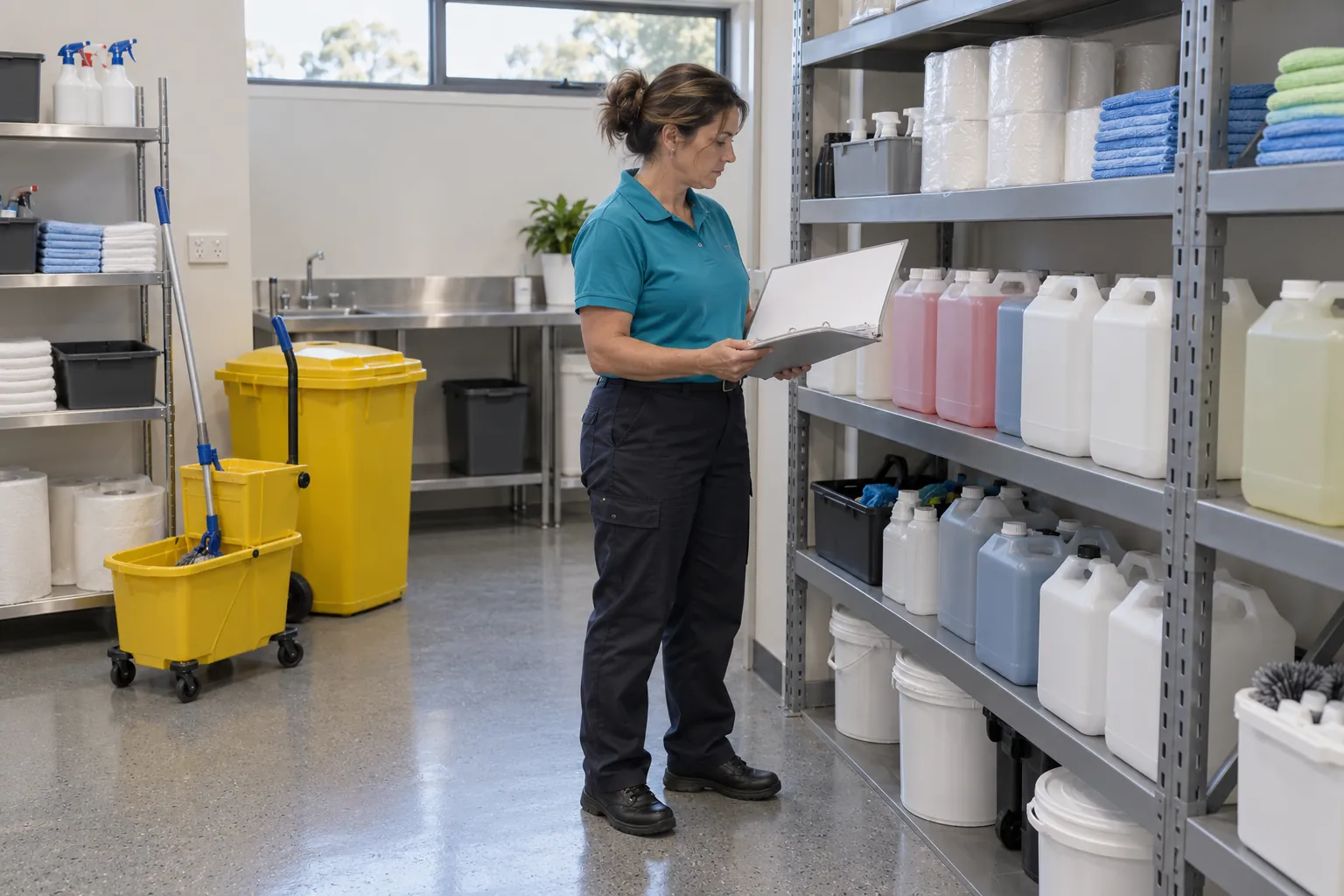
For a cleaning contractor or a building with its own cleaners, that means the floor stripper, the washroom cleaning products, the degreaser, the bleach and the pool chlorine, each with a current safety data sheet that is easy to find. This guide covers what the law requires in the states and territories that use the model laws and in Victoria, what goes on the register and what can stay off it, how to keep the safety data sheets current, how a register differs from a manifest, and the routine checks that keep the register matched to the shelf.
01
What the law requires: regulation 346 and the safety data sheet
Australia's work health and safety laws are made state by state from a national model. Every state and territory except Victoria has adopted the model Work Health and Safety Act and Regulations, so the same duties appear in each one's own regulation under the same numbers. They are shown here in Queensland's version, the Work Health and Safety Regulation 2011 (Qld). Victoria works under its own Occupational Health and Safety Act 2004 and Occupational Health and Safety Regulations 2017, covered below.
Regulation 346 says a person conducting a business or undertaking (PCBU) at a workplace must ensure that "a register of hazardous chemicals used, handled or stored at the workplace is prepared and kept at the workplace" and that "the register is maintained to ensure the information in the register is up to date". It then sets out three things:
- What the register must include (regulation 346(2)): "a list of hazardous chemicals used, handled or stored" and "the current safety data sheet for each hazardous chemical listed".
- Who must be able to reach it (regulation 346(3)): it must be "readily accessible" to a worker involved in using, handling or storing a hazardous chemical, and to anyone else likely to be affected by a hazardous chemical at the workplace.
- What it does not cover (regulation 346(4)): chemicals in transit, unless there is a significant or frequent presence of them at the workplace, and consumer products for which the PCBU is not required to obtain a safety data sheet.
Keeping the register is a legal requirement, not a matter of good practice. In Queensland the maximum penalty for failing to prepare and maintain the register is 60 penalty units, and for failing to make it readily accessible, 36 penalty units.
The register stands on a second duty. Regulation 344 of the Work Health and Safety Regulation 2011 (Qld) requires the PCBU to obtain "the current safety data sheet" for a hazardous chemical from its manufacturer, importer or supplier when the chemical is first supplied to the workplace, or at the latest before it is used, and again when the safety data sheet is amended. The current safety data sheet (SDS) must be readily accessible to the workers who use, handle or store the chemical, and to an emergency service worker or anyone else likely to be exposed to it.
A "hazardous chemical" is defined in the regulation's dictionary as a substance, mixture or article that satisfies the criteria for one or more hazard classes in the GHS, the Globally Harmonised System of Classification and Labelling of Chemicals (Seventh revised edition, as modified by schedule 6). A chemical is excluded only if its sole classifications are certain listed categories, such as acute toxicity category 5, skin irritation category 3, flammable gas category 2, or the environmental hazards to aquatic life and the ozone layer. Regulation 341 of the WHS Regulation 2011 (Qld) still accepts a third-edition (GHS 3) label on a chemical supplied before 1 January 2023, so older stock may carry the older label.
02
What goes on the register, and what can stay off it
SafeWork NSW's Code of Practice: Managing risks of hazardous chemicals in the workplace, based on Safe Work Australia's model code, describes the register simply: it "is a list of the product names of all hazardous chemicals used, handled or stored at the workplace accompanied by the current SDS for each hazardous chemical listed", and "it must be updated as new hazardous chemicals are introduced to the workplace or when the use of a particular hazardous chemical is discontinued".
The law prescribes no template, whatever the register is called: a chemical register, a hazardous chemical register or an SDS register. SafeWork NSW publishes a hazardous substance register template in its Easy to do WHS toolkit, which tells you to list all the hazardous chemicals used or stored at your workplace and keep their current safety data sheets with the register. Its columns are the product name, its application, whether the product is labelled and whether the safety data sheet is available. Most registers kept by cleaning and facilities teams add a few more:
- Product name, exactly as it appears on the label and the safety data sheet;
- What it is used for and where: washroom descaling, kitchen degreasing, floor stripping, the pool plant;
- Where it is kept: the cleaners' store on level 2, the plant room, the dilution unit;
- The hazard, from section 2 of the safety data sheet: corrosive, flammable, skin irritant;
- The safety data sheet's date, so a sheet more than five years old stands out;
- Whether the containers are labelled, including bottles filled from a concentrate.
Consumer products are the common question. Regulation 344(4) lifts the safety data sheet duty for a consumer product where it is reasonably foreseeable that it will be used at the workplace only in quantities and in a way consistent with household use, and incidental to the work; regulation 346(4) then lifts the register duty with it. A consumer product is one packed primarily for a household consumer or for office use, in the way and quantity intended for that use, and regulation 344(5) still requires enough information about its safe use, handling and storage to be readily accessible.
The NSW code draws the line with an example: using a consumer chemical for its usual purpose, "for example, washing dishes in the lunchroom", needs no safety data sheet. But it warns that domestic chemicals may present greater risks in the workplace "where domestic cleaning chemicals are purchased from a supermarket and used at a workplace in a way or quantity which is not consistent with home use", and that in that case you should obtain the safety data sheet.
03
Keeping the safety data sheets current
A register is only as good as the safety data sheets in it, and the commonest fault is an old one. The rules that set the clock are these:
- The manufacturer or importer reviews it. Regulation 330 of the WHS Regulation 2011 (Qld) requires the manufacturer or importer to review the safety data sheet "at least once every 5 years" and to amend it whenever necessary to keep it correct and current.
- The sheet carries its date. Schedule 7 requires it to state the date it was last reviewed, or prepared, and an Australian emergency telephone number, in English, under 16 set headings in a fixed order, from identification and hazards to transport, regulatory and other relevant information.
- A new supply can trigger a new sheet. Under regulation 344(2), a chemical is treated as first supplied to the workplace again if it has not been supplied there for 5 years, so the PCBU must obtain the current sheet at that point.
- Only the Australian manufacturer's or importer's sheet will do. The NSW code says you may obtain a third party safety data sheet, but "by itself a third party SDS is not sufficient to meet your duty to obtain a safety data sheet".
- You may not edit it. Regulation 345 of the WHS Regulation 2011 (Qld) allows a PCBU that is not the manufacturer or importer to change a safety data sheet only by attaching a translation that clearly says it is not part of the original.
WorkSafe Victoria's compliance code turns this into a practical test: employers need to ensure that all safety data sheets in the register "have issue dates within the last five years", and that a product permanently discontinued and removed from the workplace is taken off the register.
On access, the NSW code says the safety data sheet "should be kept in a location near the work area where the substance is used", on paper or electronically, and that all workers likely to be exposed must know how to find it. An electronic database is acceptable if it is readily available, workers know how to use it, and a backup such as hard copies is also provided. For a night cleaner in a client's building, that means a folder or a working screen in the store, not a file at head office.
04
Register or manifest, and the rules in Victoria
A register and a manifest are different documents. The NSW code says a manifest "is a written summary of specific types of hazardous chemicals with physical hazards, acute toxicity or skin corrosion", required only where quantities exceed prescribed thresholds, and that "its primary purpose is to provide the emergency services organisations with information on the quantity, classification and location of hazardous chemicals at the workplace", with site plans and emergency contact details.
- The register (regulation 346): every workplace that uses, handles or stores hazardous chemicals; for workers and others affected; a list and the safety data sheets.
- The manifest (regulation 347 of the WHS Regulation 2011 (Qld)): only where a schedule 11 hazardous chemical, or group of them, exceeds its manifest quantity; in the form schedule 12 sets; kept where the primary emergency service organisation agrees, available for inspection and readily accessible to that organisation.
- Notifying the regulator (regulation 348): in writing, immediately it is known that the manifest quantity will be exceeded or at least 14 days before, whichever is earlier; likewise before a significant change in the risk; and as soon as practicable after the chemical stops being used, handled or stored there, if it is not likely to be again.
- Placards (regulations 349 and 350): where the schedule 11 placard quantities are exceeded.
Appendix D of the NSW code reproduces the placard and manifest quantities. Check them against what is actually held, including a pool or spa plant's chlorine stock, not against what the building usually orders.
In Victoria, the hazardous substances duties are in Part 4.1 of the Occupational Health and Safety Regulations 2017. WorkSafe Victoria's Compliance code: Hazardous substances says employers must prepare and maintain a register for all hazardous substances supplied to their workplace (regulation 162), containing "a list of the product identifiers of all hazardous substances supplied to the workplace" and "accompanied by the SDS for each of these substances". It must be readily accessible to any employee who may be exposed (regulation 162(3)), with a copy in each relevant work area.
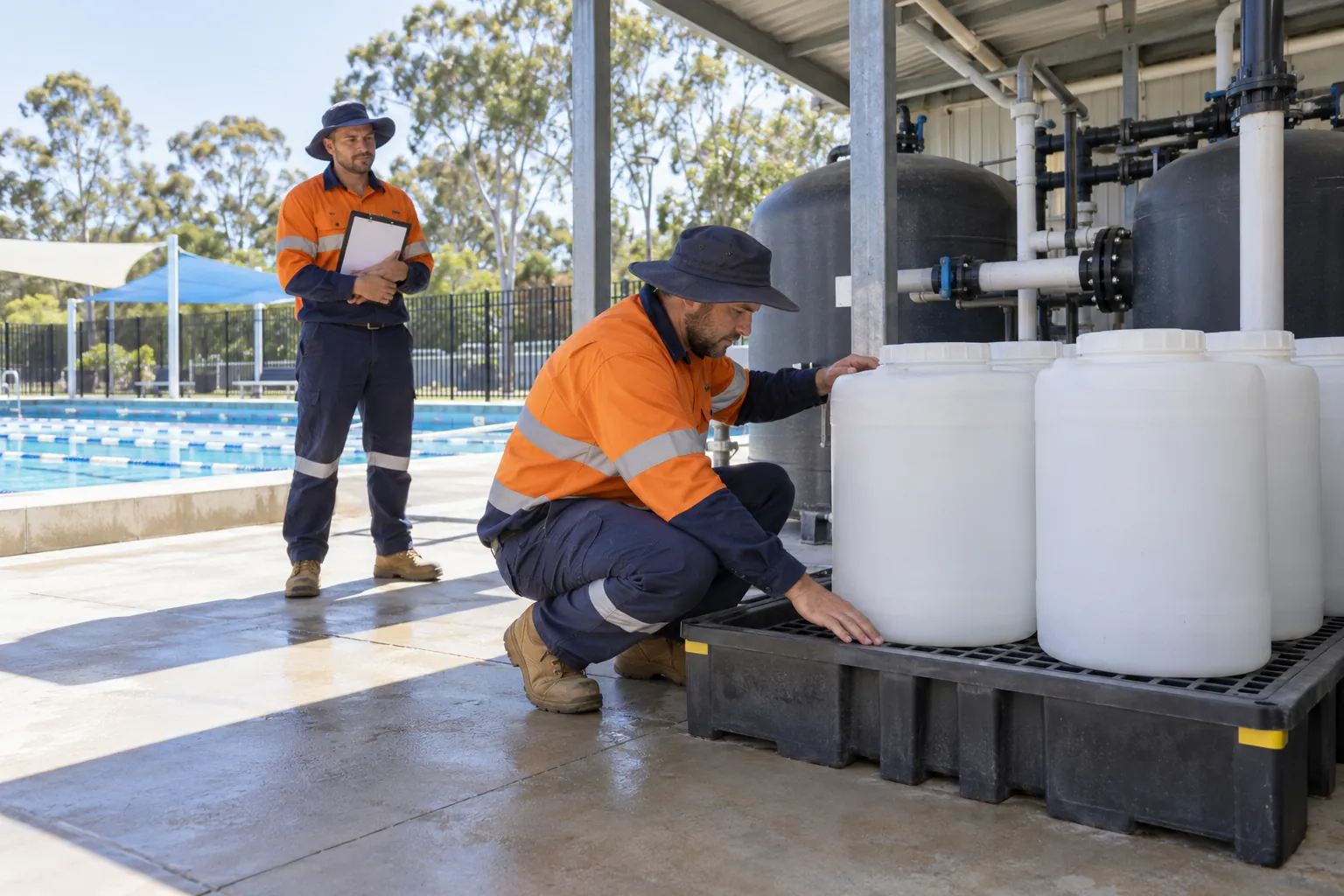
Two differences matter. Victoria's hazardous substances are defined by Part 3 (Health Hazards) of the GHS, so a product that is only flammable is not a hazardous substance there, though it may be a dangerous good. And the compliance code notes that dangerous goods storage and handling law requires its own register of dangerous goods, but that an employer may keep a single register for both where all the dangerous goods are also hazardous substances, as its Appendix B shows. WorkSafe Victoria's page for the code warns that it "has not yet been updated" for the changes introduced by the newer storage and handling regulations, so check those directly.
05
Who keeps the register, and the checks that keep it true
The legal duty sits with each PCBU at the workplace, and a building often has several. A cleaning contractor brings its own products into a client's building; the client may have chemicals of its own in a workshop, kitchen or pool plant. Each must ensure that a register of the hazardous chemicals used, handled or stored at the workplace is prepared, kept there and kept up to date. Section 46 of the Work Health and Safety Act 2011 (Qld) adds that where more than one person has a duty in relation to the same matter, each must, so far as is reasonably practicable, "consult, cooperate and coordinate activities" with the others. The NSW code points out that cleaners are "often exposed to both the hazardous chemicals they use in the course of their work, such as cleaning products, and the hazardous chemicals used in the workplace by other workers", so the contractor's supervisor and the building manager should swap registers.
The register also drives review. Regulation 352 of the WHS Regulation 2011 (Qld) requires control measures for a hazardous chemical to be reviewed and, as necessary, revised "following any change to the safety data sheet for the hazardous chemical or the register of hazardous chemicals", after certain health monitoring results or air monitoring findings, and "at least once every 5 years". A new product on the register is a prompt to look again at the risks associated with it and how it is stored, diluted and used.
Between reviews, the register drifts from the shelf in small ways. Routine checks that keep the two together include:
- New stock: every product delivered to the store is on the register with its current safety data sheet before it is used, as regulation 344 requires.
- Labels: regulation 342 of the WHS Regulation 2011 (Qld) requires a chemical transferred or decanted at the workplace to be correctly labelled, unless it is used immediately and the container thoroughly cleaned. The NSW code says a container of unknown contents should be marked, for example "Caution – do not use: unknown substance", and stored in isolation until identified.
- Segregation: the NSW code says acids "should never be stored with alkaline chemicals", and that hazardous chemicals should not be stored above or below incompatible ones.
- Spills: regulation 357 of the WHS Regulation 2011 (Qld) requires, so far as is reasonably practicable, a spill containment system where a solid or liquid hazardous chemical is used, handled or stored and could spill or leak; check that the bunding is intact and the spill kit complete.
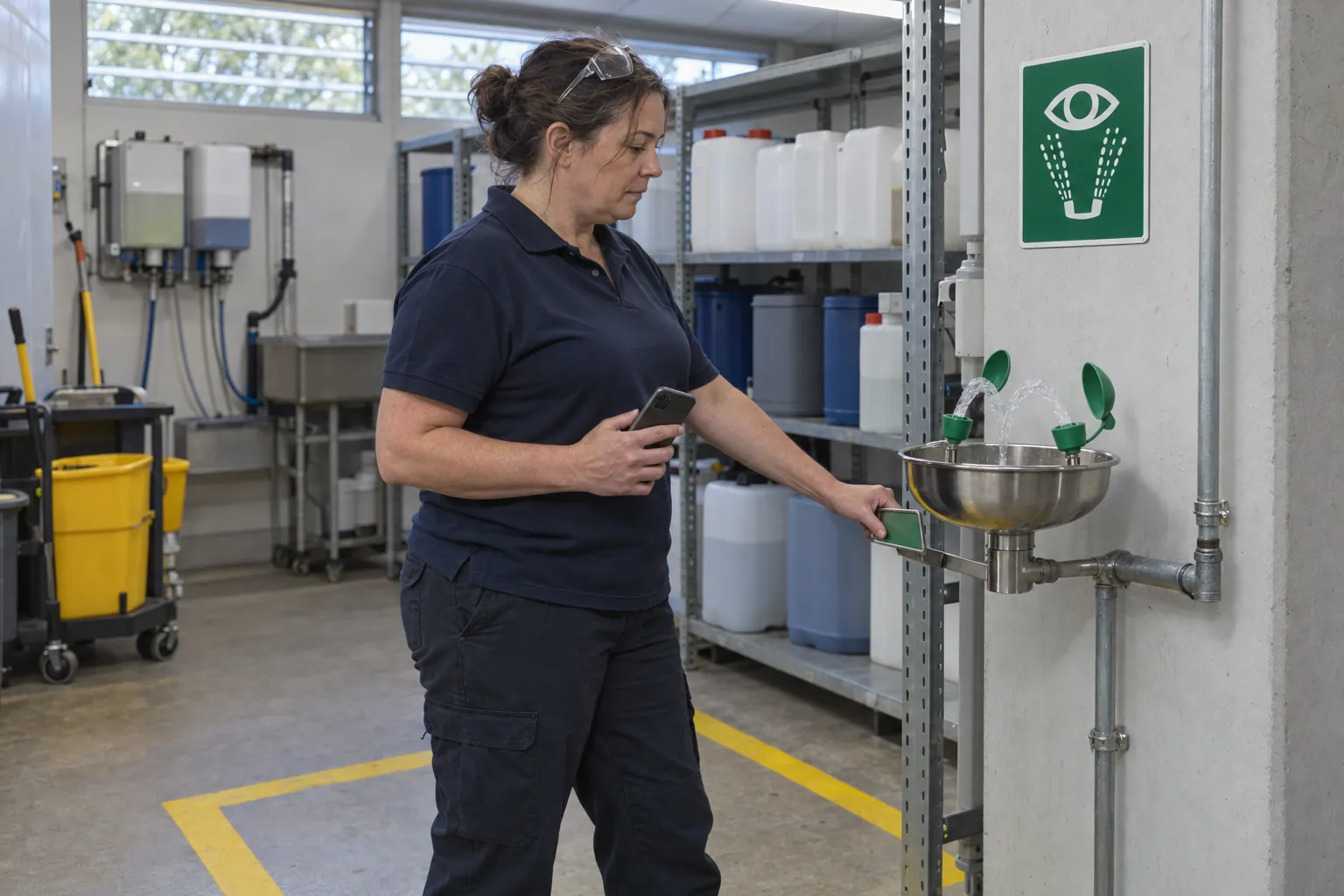
- Safety equipment: regulation 362 of the WHS Regulation 2011 (Qld) requires safety equipment needed to control a chemical risk to be "provided, maintained and readily accessible", which includes the eyewash in the store.
- Products no longer used: removed from the store and the register together.
The NSW code says training should cover "the availability of SDS for all hazardous chemicals, how to access the SDS, and the information that each part of the SDS provides", and regulation 379 requires the PCBU to provide the supervision necessary to protect a worker who uses, handles or stores a hazardous chemical.
06
Where the record fails, and what SiteClara does about it
Most hazardous chemicals registers fail without anyone deciding to let them. The binder was complete on the day it was compiled. Then a new degreaser arrived from a different supplier, the floor stripper's safety data sheet was reissued, and the night cleaner filled an unlabelled spray bottle because the labelled one was empty. Nobody notices until an inspector or an auditor asks to see the safety data sheet, or an incident needs it, and then nobody can say when the store was last checked against the register, or by whom.
SiteClara records those routine checks where they happen. A printed QR poster, with an NFC tag behind it if staff prefer to tap, sits at each place a check is scheduled: the chemical store, the dilution point, the cleaners' cupboard on each floor, the pool plant room. Staff scan or tap with their own phone, with no app to install, and see the checks due there. They mark each one done or explain what stopped them, with a photo when one is asked for, such as the store shelf or the register folder in its place. The time and the named person are recorded as it happens. A problem found on a check, such as an unlabelled bottle or a product missing from the register, is reported there and goes onto the team's list of jobs until someone closes it.
The supervisor sees which checks are due, done and missed, and records the reason one was missed. Each day they approve a report that goes to nominated management or client contacts the next morning, showing what was completed, what was reported and what is still open: a working record made at the time, rather than a sheet signed before the audit.
07
Questions people ask
What document is required for all hazardous chemicals?
A current safety data sheet, prepared by the Australian manufacturer or importer. Regulation 344 of the Work Health and Safety Regulation 2011 (Qld), as in the other states and territories that use the model laws, requires a PCBU to obtain it when the chemical is first supplied to the workplace, or before it is used, and to make it readily accessible to the workers who use, handle or store the chemical. The register under regulation 346 then lists each hazardous chemical with that sheet; consumer products used as a household would are the main exception.
Is a hazardous substances register the same as a hazardous chemicals register?
Nearly. "Hazardous substances" is Victoria's term: WorkSafe Victoria's Compliance code: Hazardous substances describes the register required by regulation 162 of the Occupational Health and Safety Regulations 2017, covering substances classified for health hazards. Under the model WHS Regulations the register is of hazardous chemicals, which also covers physical hazards such as flammability.
How often should safety data sheets be updated?
The manufacturer or importer must review a safety data sheet at least once every five years under regulation 330 of the WHS Regulation 2011 (Qld), and amend it whenever needed to keep it correct and current. The PCBU must obtain the amended sheet when the chemical is next supplied, and WorkSafe Victoria's compliance code says every sheet in the register should have an issue date within the last five years.
Where do I get a safety data sheet?
From the manufacturer, importer or supplier of the chemical. SafeWork NSW's Code of Practice: Managing risks of hazardous chemicals in the workplace says that if the SDS is not supplied, you must contact the manufacturer, importer or supplier to obtain one before the chemical is used, and that a third party SDS on its own is not enough: the Australian manufacturer's or importer's SDS must be obtained. Under regulation 330 of the Work Health and Safety Regulation 2011 (Qld), the manufacturer or importer must provide the current SDS to anyone likely to be affected by the chemical who asks for it.
08
Where to read the official guidance, and a list to take away
Read Part 7.1 of your state or territory's Work Health and Safety Regulations, in particular regulations 344, 346, 347 and 352, and its approved code of practice on managing risks of hazardous chemicals, such as SafeWork NSW's, which is based on Safe Work Australia's model code and refers to Safe Work Australia's fact sheet on hazardous chemicals registers. In Victoria, read WorkSafe Victoria's hazardous substances health and safety guide and its compliance code, with Part 4.1 of the OHS Regulations 2017.
For a hazardous chemicals register that holds up, check that:
- every hazardous chemical used, handled or stored at the workplace is listed by the name on its label;
- each has the Australian manufacturer's or importer's current safety data sheet, dated within the last five years, and the register is kept at the workplace where workers can reach it;
- a new product is added, and a discontinued one removed, before or as it changes on the shelf;
- decanted chemicals are labelled, unknown containers are isolated, and acids and alkalis are stored apart;
- the quantities held are checked against the manifest and placard thresholds;
- each PCBU on a shared site knows what the others bring in, and the store is checked against the register on a schedule, with a missed check recorded and a reason given.
Sources
Every document this guide quotes or links to, in the order it first cites them.
- Work Health and Safety Regulation 2011 (Qld) legislation.qld.gov.au
- Code of Practice: Managing risks of hazardous chemicals in the workplace safework.nsw.gov.au
- Hazardous substance register template safework.nsw.gov.au
- Compliance code: Hazardous substances worksafe.vic.gov.au
- Section 46 of the Work Health and Safety Act 2011 (Qld) legislation.qld.gov.au
- Hazardous substances health and safety guide worksafe.vic.gov.au
Related guides
 Premises and facilities managementEmergency shower and eyewash stations: when you need one, and how to know it will workWhen an Australian workplace needs an emergency shower or eyewash station, what WHS law, the codes and AS 4775 say, where to put one and how to check it works.
 CleaningCleaning supervisor duties: what the role involves in Australia, and what good looks likeWhat a cleaning supervisor does in Australia: the Cleaning Services Award, WHS duties, a typical shift, managing the team, checking the work and reporting.
 CleaningCommercial cleaning checklist: area by area, and how to know it is followedA commercial cleaning checklist for Australian offices and shared buildings, area by area, with the WHS duties behind it and how a supervisor checks it is followed.
 Premises and facilities managementWorkplace inspection checklist: what WHS law asks, what to walk, and what to do nextWorkplace inspections under Australian WHS law: the duties behind them, what the checklist covers, how often, recording findings, and HSRs' right to inspect.