Cleaning
Cleaning supervisor duties: what the role involves in Ireland, and what good looks like
A cleaning supervisor's duties are to organise and lead the cleaning staff, check the work against the agreed standards, keep the team safe, look after equipment and supplies, and report to the client, so that the building is cleaned as specified every day.
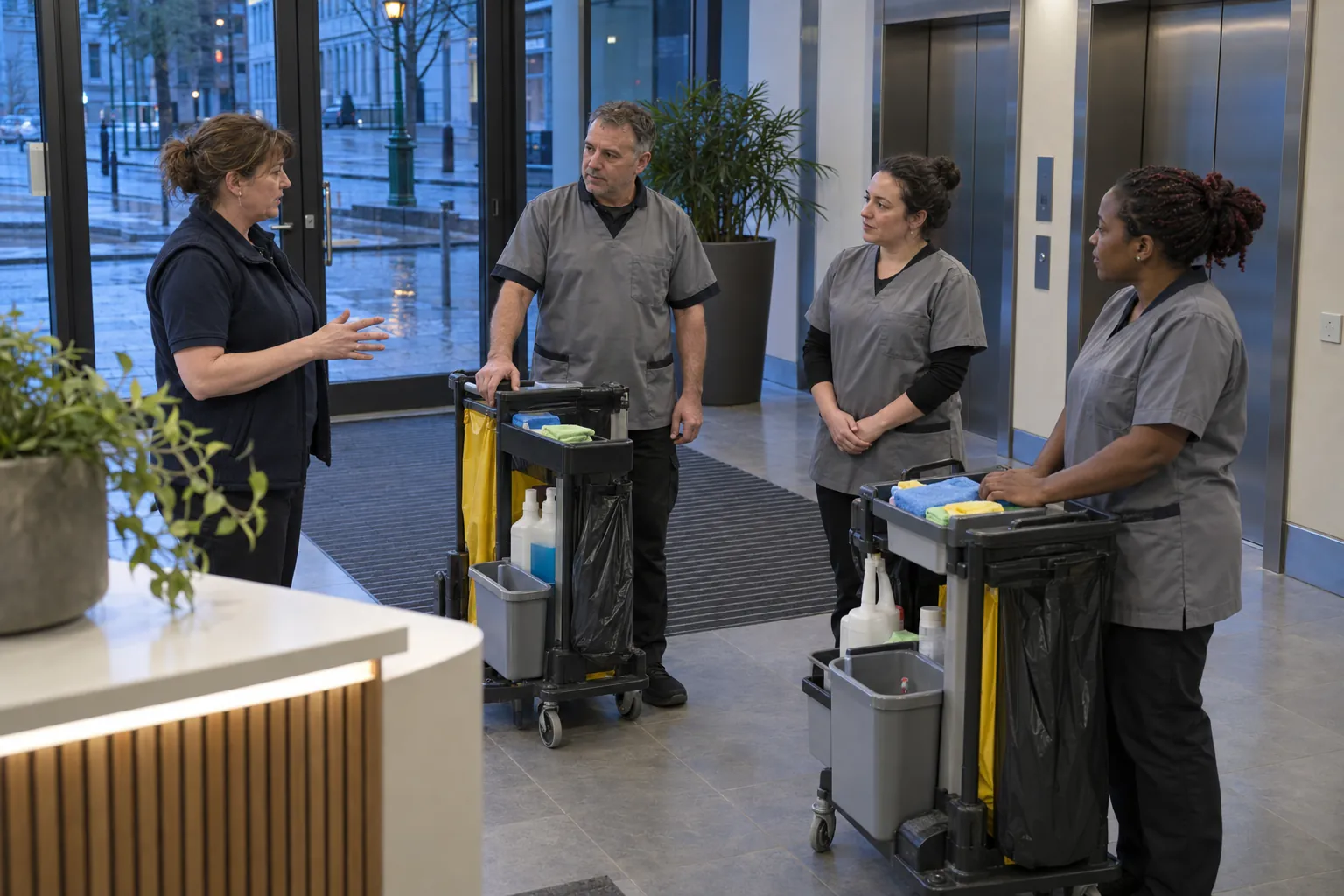
In Ireland the job sits on top of the Safety, Health and Welfare at Work Act 2005, the General Application Regulations 2007 and, for contract cleaners, the sector's Employment Regulation Order. This guide covers the main duties, a typical shift, the health and safety side as the Health and Safety Authority sets it out, and the records a good supervisor keeps for their own employer and for the client.
01
What a cleaning supervisor is, and the law behind the role
A cleaning supervisor is responsible for a team of cleaning operatives on one or more sites: allocating the work, checking it, keeping people safe, and making sure the building is cleaned to the agreed standard and on time. In Ireland the role exists in contract cleaning companies, in in-house facilities teams in offices, colleges and shopping centres, and under other names in hospitals, nursing homes and hotels: site supervisor, team leader, housekeeping supervisor, household services supervisor.
On a small site the supervisor is usually a working supervisor, cleaning alongside the team for part of the shift. On a large one, such as a hospital, a campus or a busy retail centre, supervising is the whole job. Either way, the supervisor sits between the operatives and the contract or area manager, and is usually the person the client's facilities manager sees most.
The legal duties belong to the employer, but on site the supervisor is how they are carried out. Three pieces of Irish law shape the job:
- Section 8 of the Safety, Health and Welfare at Work Act 2005 requires every employer to ensure, so far as is reasonably practicable, the safety, health and welfare at work of their employees. Section 8(2)(g) spells out "providing the information, instruction, training and supervision necessary" to achieve that. Supervision is written into the employer's general duty, and the supervisor is the person who does it.
- The Safety, Health and Welfare at Work (General Application) Regulations 2007 (S.I. No. 299 of 2007) set the outcome the client needs. Regulation 18 requires that "every place of work is kept in a clean state" with dirt, refuse and waste "removed by a suitable method as frequently as necessary", and that the floor of every workroom is cleaned the same way. Regulation 20 requires sanitary and washing facilities to be provided, maintained and kept in a clean state.
- The Employment Regulation Order (Contract Cleaning Industry Joint Labour Committee) 2025, in effect since 17 October 2025 according to the Workplace Relations Commission, fixes the statutory minimum pay and conditions for people employed by businesses providing cleaning and janitorial services in hospitals, offices, shops, factories, apartment buildings, hotels, airports and similar establishments.
A supervisor rarely signs the safety statement or sets the pay, but is the person an HSA inspector, a client or an operative will ask on the night.
02
The main duties and responsibilities
Job descriptions vary by employer and sector, but the duties of a cleaning supervisor usually include:
- Organising the work: allocating areas and tasks so that the whole cleaning specification is covered in the hours on the contract, and changing the plan when someone is out or the building's use changes.
- Leading the team: briefing operatives, covering absence, dealing with lateness and performance, and helping the area manager with recruitment and inductions.
- Training: showing new starters the methods, the equipment, the chemicals and the site, and spotting when refresher training is needed.
- Inspecting the work: walking the building to check the standard, and making sure anything missed is put right.
- Periodic work: planning deep cleans, hard floor maintenance, carpet cleaning and high-level work around the building's hours, whether the team does it or a specialist contractor.
- Health and safety: making sure the risk assessments and chemical assessments are followed, PPE is worn, wet floors are managed and accidents are reported.
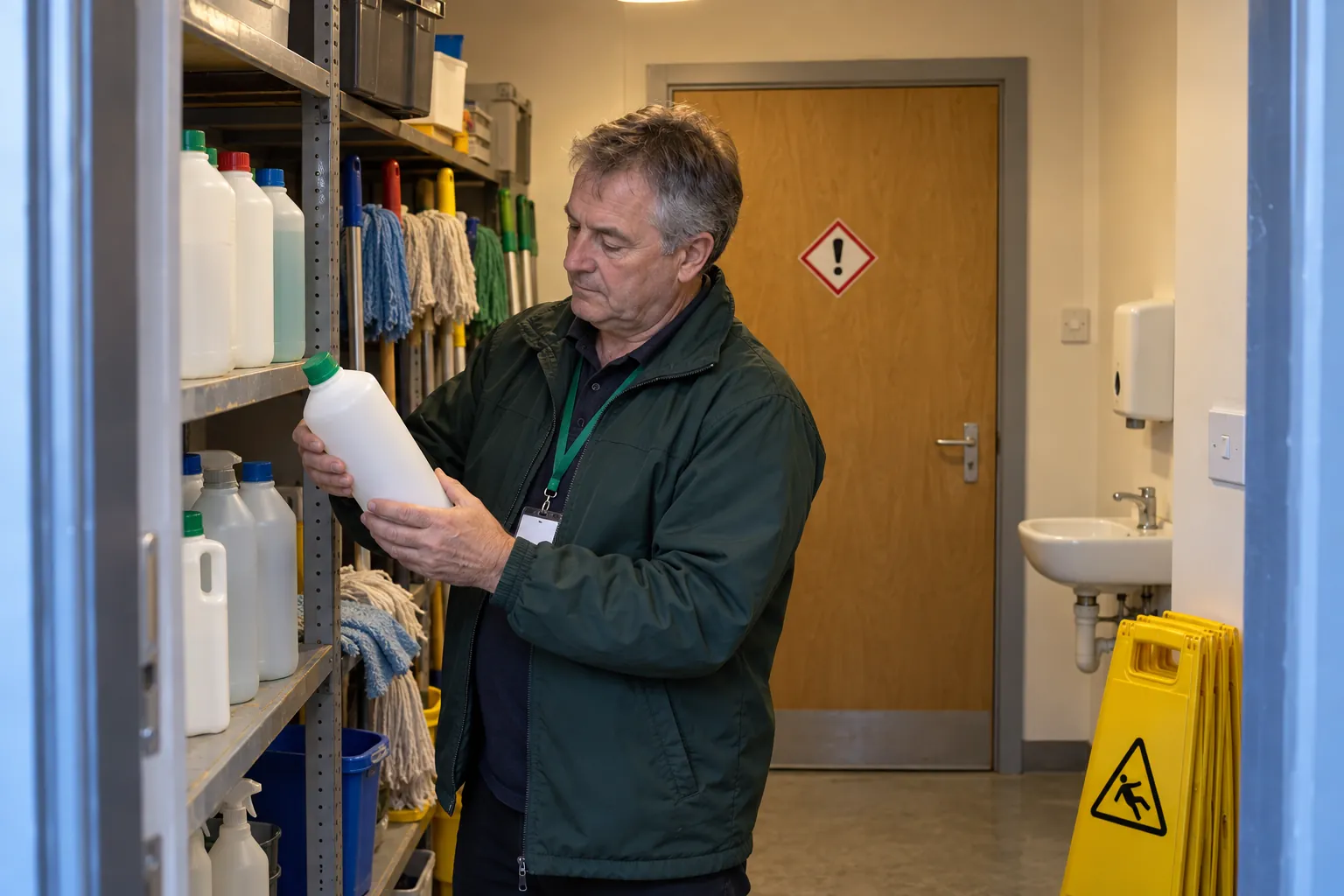
- Equipment and supplies: keeping machines safe and working, ordering chemicals and consumables, and keeping the cleaners' store locked and tidy.
- Client liaison: being the first point of contact for the client, the facilities manager or, in an apartment development, the owners' management company's managing agent; taking requests and complaints and reporting back.
- Records: check sheets, inspection results, training records, accident and incident records, and the handover to the next shift.
- Keys and access: key holding, alarm codes, locking up, and reporting anything found wrong with the building.
The setting changes the emphasis. In a hospital or nursing home, infection prevention and control shapes the methods and audits, and the supervisor works with ward and department managers. In a hotel the role merges with housekeeping. In a school it means fitting around the timetable, working with the caretaker and planning the summer deep clean.
03
What a typical shift looks like
Every site is different, but a supervisor's shift on a contract cleaning site often runs like this:
- Before the shift: check who is in, who is out and how the gap will be covered; read any messages or requests from the client.
- Briefing: a few minutes with the team covering changes, events in the building, faults reported and the areas that need extra attention today.
- During the shift: walk the building, check rooms, washrooms and common areas as the work progresses, help where the team is stretched, deal with spillages and urgent requests, and answer building users.
- Scheduled checks: make sure the planned checks through the day, such as toilet checks, have actually happened, not only been signed for.
- Faults: report leaks, broken fittings and blocked toilets to whoever fixes them, and follow up the ones still open.
- End of shift: confirm what was done and record why anything was not, lock up, secure machines and chemicals, and hand over anything outstanding to the next shift or the client.
Early and evening shifts are the norm in offices and schools; day supervisors in hospitals, airports and shopping centres spend more time on reactive cleaning.
04
Managing people and keeping them safe
Most of what makes a good supervisor is people management. Cleaning teams in Ireland are often part-time, working unsocial hours, sometimes across several sites, and often include people for whom English is a second language. The 2005 Act anticipates that: section 10 requires instruction, training and supervision to be given "in a form, manner and, as appropriate, language that is reasonably likely to be understood by the employee concerned", and training to be given on recruitment, on a change of task and when new equipment or systems of work come in. A demonstration in the operative's own language beats a signed sheet they could not follow.
Section 10(5) matters on contract sites too. Every employer must make sure that people at work in its place of work who are employees of another employer, such as the contract cleaners, receive instructions on the risks to them there. A good supervisor asks the client for the fire procedures, restricted areas and known hazards on day one, and passes them on.
The health and safety side is where supervisors carry most responsibility in practice:
- Chemicals: the HSA's page on chemical agents risk assessment names detergents and bleach among the chemicals in almost every workplace, and says the Chemical Agent Regulations 2001 to 2021 set what the assessment must cover, adding that "a generic assessment is unlikely to meet the requirements". Operatives use only the approved products, at the right dilution, with the PPE the assessment requires, and safety data sheets are at hand.
- PPE: Schedule 2 of the 2007 Regulations lists "work with acids and caustic solutions, disinfectants and corrosive cleaning substances" among the activities that may need protective clothing.
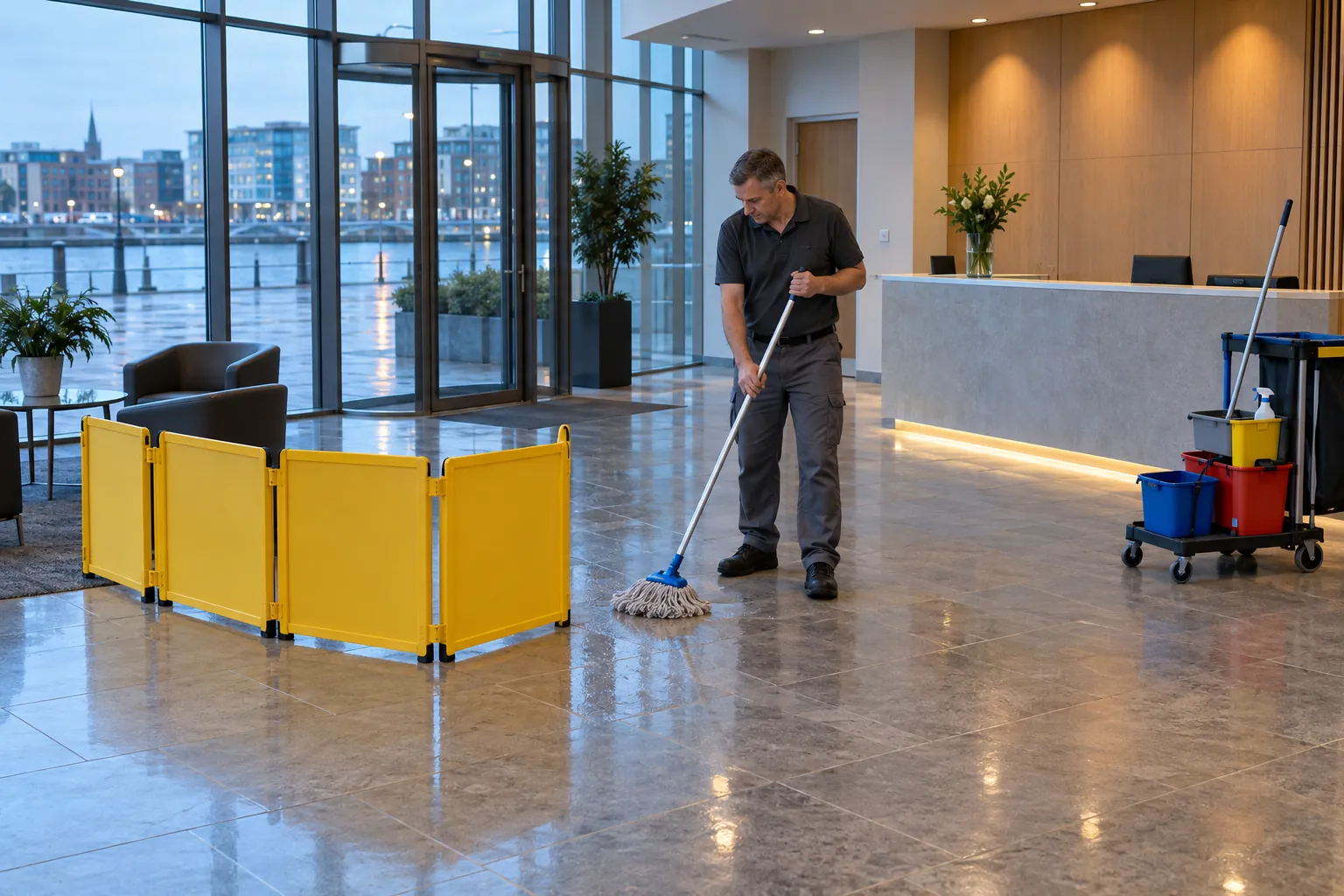
- Floors: the HSA's guidance on floor cleaning to control slips points out that most people who slip on a floor being cleaned are not cleaners, and that a sign or a cleaner standing by does not guarantee nobody slips. Its steps are to identify the risks, communicate, replace the method where a better one exists, reschedule the cleaning to quieter times, equip the team properly and segregate the wet area.
- Manual handling: Regulation 69 of the 2007 Regulations requires the employer to avoid manual handling where it can, for example with trolleys and mechanical equipment, and to reduce the risk where it cannot. Bags of waste, buckets of water and machines on stairs are the usual loads.
- Accidents: every accident and near miss is recorded and passed to the employer promptly. The HSA's page on accident and dangerous occurrence reporting explains that an injury must be reported to the Authority where the employee cannot carry out their normal work for more than three consecutive days, excluding the day of the accident, and that non-fatal accidents are reported within ten working days. The employer makes that report; the supervisor makes sure the employer knows in time.
- Vetting: in schools, crèches, nursing homes and other settings where the work is relevant work with children or vulnerable persons under the National Vetting Bureau (Children and Vulnerable Persons) Acts 2012 to 2016, section 12 of the 2012 Act requires the organisation to receive a vetting disclosure before the person starts. Clients often require Garda vetting of contract cleaners in these settings as a condition of the contract, and the supervisor makes sure nobody is rostered there before it is in place.
Employees have duties as well. Section 13 of the 2005 Act requires them to co-operate with their employer, make correct use of the equipment and protective clothing provided, and report "as soon as practicable" any defect in the place of work or the systems of work that might endanger anyone. A supervisor who makes reporting easy, and visibly acts on what is reported, gets far more of it.
Pay, contracts, discipline and recruitment usually sit with the area manager or HR. The WRC's summary of Employment Regulation Orders notes that where an ERO applies, a prescribed notice setting out the statutory pay and conditions must be posted in the place of employment and wage records kept for three years. When a contract changes hands under a transfer of undertakings, the contract cleaning ERO requires the outgoing contractor to give every worker a written statement of their terms up to two weeks before the transfer date, or at the earliest opportunity where the client has not given 30 days' notice.
05
Checking the work and reporting to the client
Keeping the place of work clean is the purpose of the job, so a cleaning supervisor needs to know at any point whether the building is clean and whether the scheduled work was done. That takes two kinds of checking:
- Inspecting quality: regular inspections against the standard in the specification, sampling different areas and times of day, with failures put right and recorded. Many contracts add a joint audit with the client each month or quarter.
- Confirming delivery: that each scheduled clean and check actually happened, when and by whom, and that anything missed is known and explained before the client finds it.
A toilet can be checked on time and still fall short, and a clean office can hide a meeting room nobody reached. A good supervisor tracks both, and reports on the commercial cleaning checklist the contract actually specifies rather than a generic one.
Reporting to the client is where a supervisor earns trust. A short, honest report of what was done, what was missed and why, and what is still open is worth more than a long one that says everything went well. Clients rarely mind an explained gap; they mind finding it themselves, especially in a washroom or at a front entrance.
Good supervisors also work sideways: with security and reception about access, with maintenance about faults, and, in an apartment development, with the managing agent who acts for the owners' management company rather than with individual residents.
06
Where the supervisor's record fails, and what SiteClara does about it
Much of a supervisor's day is spent finding out what has happened: whether the toilet checks were done, whether the leak by the lifts was reported, whether the evening operative reached the top floor. On paper that means walking the building reading sheets on the backs of doors, some of them signed for the whole day in advance, and writing an end-of-shift report from memory. When a client asks what happened last Tuesday, the answer depends on who remembers.
SiteClara is built to give the supervisor that picture without the walk. Each location has a printed QR poster, with an optional NFC tag behind it. Enrolled staff scan or tap on their own phone, with no app to install, see the checks due there and mark each one done or say what stopped them, with a photo when one helps. Faults are reported on the spot and go onto the team's list of open jobs until someone closes them.
The supervisor sees what is due, done and missed, can record the reason a check was missed from their company's own list, and works from a queue of open jobs grouped by building and floor, escalating a job to the building manager when it needs them. At the end of the day they review the totals and photos and approve the daily report, which goes to nominated managers or client contacts the next morning, showing what was completed, what is still open and how the scheduled checks went.
07
Questions people ask
What are the responsibilities of a cleaning supervisor?
To make sure the building is cleaned to the agreed standard and that the cleaning staff do it safely: allocating the work, training and briefing the team, inspecting the results, managing equipment and supplies, and reporting to the client. The outcome the client relies on is set by Regulation 18 of the General Application Regulations 2007, which requires that "every place of work is kept in a clean state" and that the floor of every workroom is cleaned "as frequently as necessary to maintain an appropriate level of safety and health".
What are supervisor duties and responsibilities in Irish health and safety law?
The Act places the duties on the employer, and supervision is one of them. Section 8(2)(g) of the Safety, Health and Welfare at Work Act 2005 requires the employer to provide "the information, instruction, training and supervision necessary" for employees' safety, health and welfare, and section 10 of the Act requires that instruction, training and supervision are given in a form, manner and language the employee is reasonably likely to understand, with training on recruitment, on a change of task and when new equipment or systems of work come in. The supervisor is usually the person who carries these out on site.
What are the 10 responsibilities of a supervisor?
Irish law has no list of ten. The nearest thing is section 8(2) of the Safety, Health and Welfare at Work Act 2005, which sets out the employer's particular duties from (a) to (l), among them managing and conducting work activities safely, safe systems of work, protective clothing and equipment, emergency plans, reporting accidents and dangerous occurrences, and providing supervision. On a cleaning contract a supervisor carries many of them out day to day.
08
Skills, training and where to read more
Most cleaning supervisors in Ireland come up through the role of operative, and employers look for practical experience of methods and equipment, the ability to organise a team and a shift, clear communication and reliability. The skills that matter most day to day are leadership, attention to detail on inspections and a steady hand with the client. For many the role is the first step in a career towards area or contract manager.
Useful training includes manual handling, chemical safety, first aid and a supervisory health and safety course. The primary sources are free to read:
- Safety, Health and Welfare at Work Act 2005, section 8, with section 19 on risk assessment and section 20 on the safety statement, which must be brought to employees' attention at least annually and to new recruits when they start.
- General Application Regulations 2007, Regulations 18 and 20 on cleanliness and sanitary facilities, and Regulation 69 on manual handling.
- The HSA's guidance on lone workers, floor cleaning to control slips and accident and dangerous occurrence reporting.
- The WRC's page on the contract cleaning Employment Regulation Order.
A good cleaning supervisor, at the end of each shift, can say:
- who was on site, and how any absence was covered;
- that every area in the specification was allocated to someone;
- which scheduled tasks and checks were done, and why any were not;
- what was inspected, what fell short and what was put right;
- which faults were reported, to whom, and which are still open;
- that any accident or near miss was recorded and passed to the employer;
- that machines, chemicals and keys are secure;
- what the client has been told.
Sources
Every document this guide quotes or links to, in the order it first cites them.
- Section 8 of the Safety, Health and Welfare at Work Act 2005 irishstatutebook.ie
- The Safety, Health and Welfare at Work (General Application) Regulations 2007 irishstatutebook.ie
- The Employment Regulation Order (Contract Cleaning Industry Joint Labour Committee) 2025 workplacerelations.ie
- Guidance on lone workers hsa.ie
- Section 10 irishstatutebook.ie
- Chemical agents risk assessment hsa.ie
- Floor cleaning to control slips hsa.ie
- Accident and dangerous occurrence reporting hsa.ie
- Section 12 of the 2012 Act irishstatutebook.ie
- Section 13 of the 2005 Act irishstatutebook.ie
- Employment Regulation Orders workplacerelations.ie
- Section 19 on risk assessment irishstatutebook.ie
- Section 20 on the safety statement irishstatutebook.ie
Related guides
 CleaningCommercial cleaning checklist: area by area, for Irish workplacesA commercial cleaning checklist for Irish offices and shared premises, area by area: the 2007 Regulations behind it, using it on shift and checking it is followed.
 CleaningOffice cleaning checklist: what to clean, how often, and a record that shows it was doneWhat an office cleaning checklist should cover in an Irish workplace, how often each task is done, the duty in Regulation 18 of the 2007 Regulations, and the record.
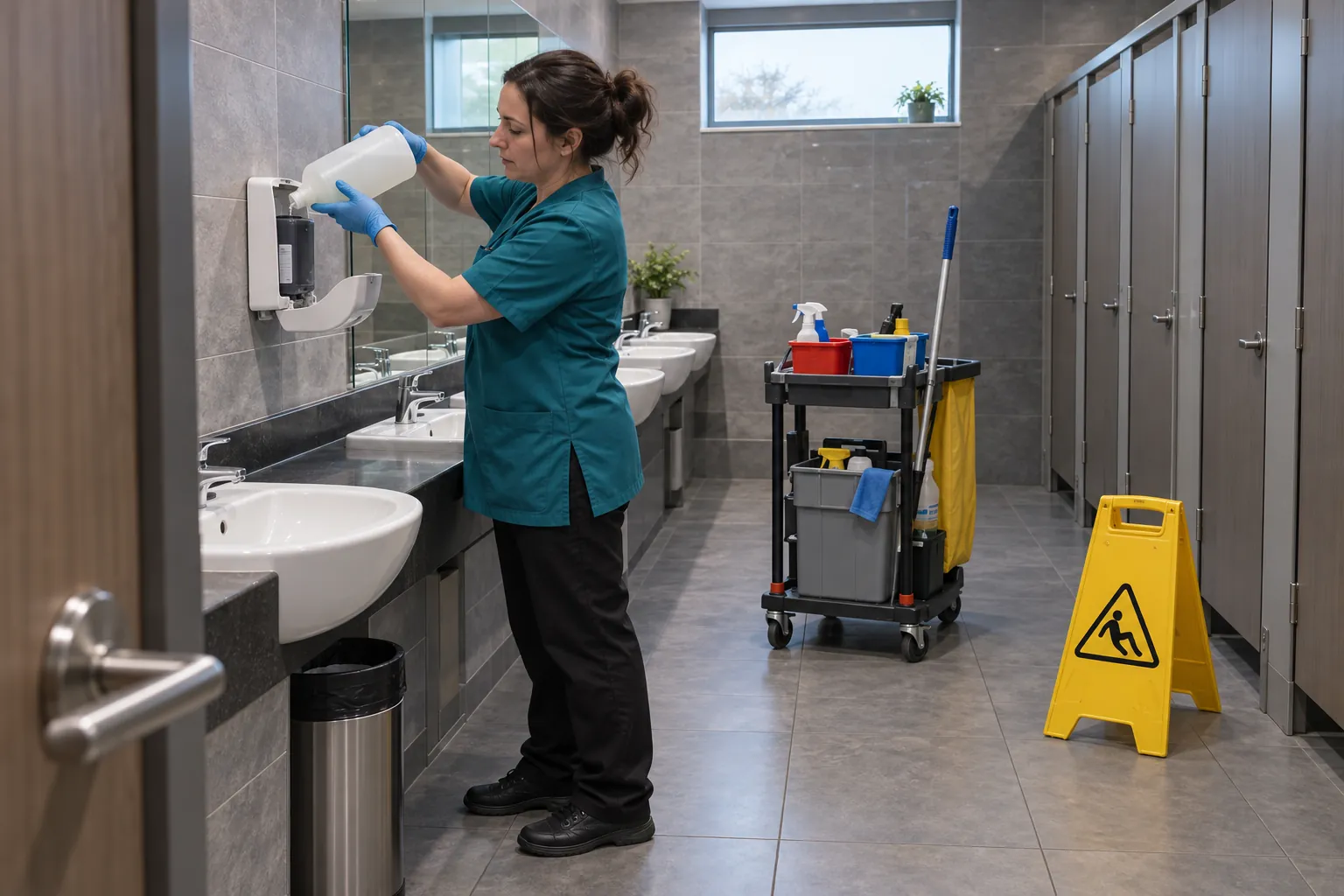 CleaningToilet cleaning checklist: what to check, how often, and a record that stands upWhat a toilet cleaning checklist should cover in an Irish workplace, how often to check, the duty in Regulation 20 of the 2007 Regulations, and a credible record.
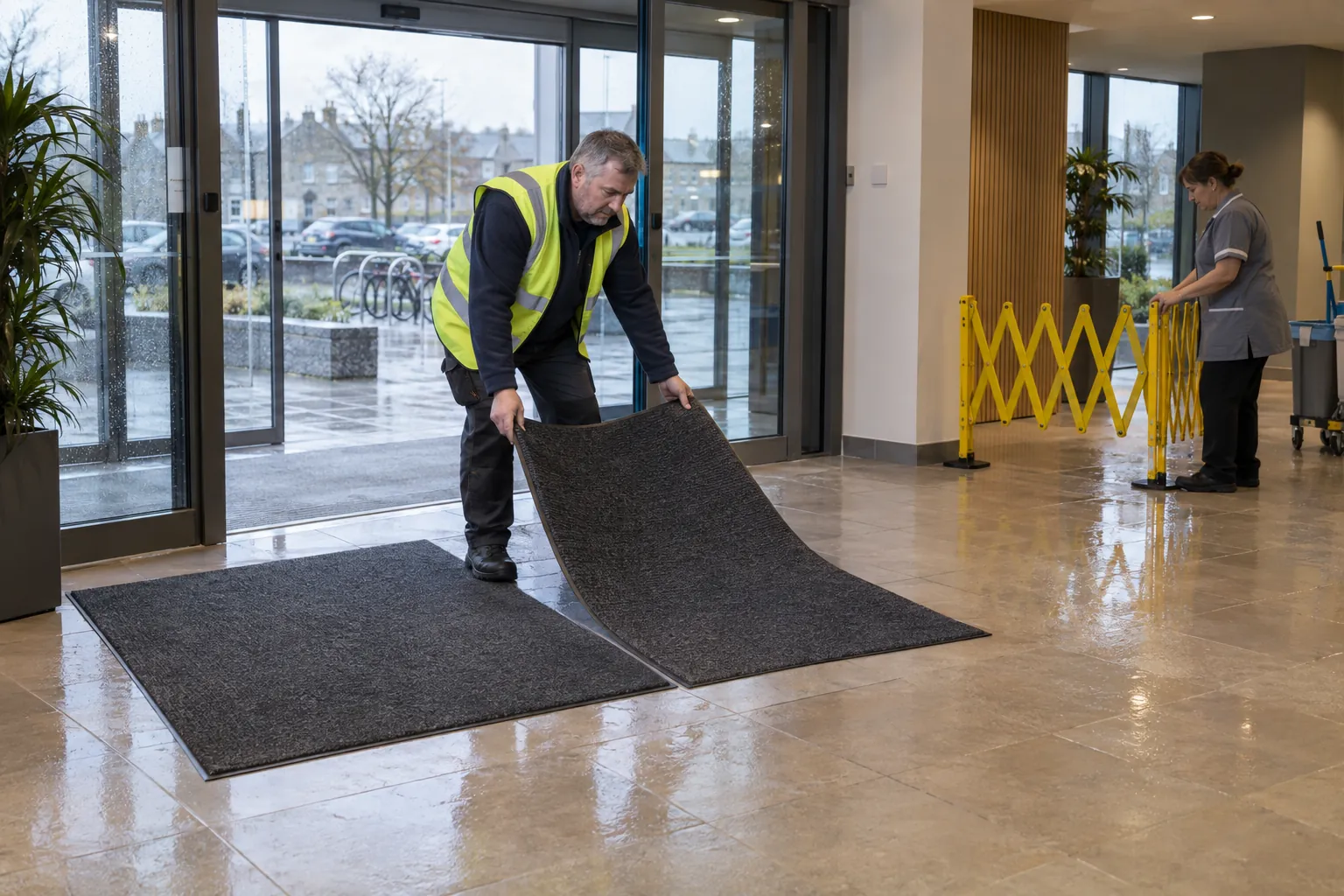 Premises and facilities managementSlips, trips and falls: what Irish law requires, and how to prevent them day to dayPreventing slips, trips and falls in Irish workplaces: the 2005 Act and 2007 Regulations, spills, floor cleaning, entrances, stairs and the checks that show it.