Cleaning
Green cleaning in New Zealand: what it means, and how to show it is happening
Green cleaning is environmentally friendly cleaning: keeping a building properly clean with less harm to the people in it and to the environment outside it, through fewer and safer chemicals, correct dilution, methods that need less product, and less waste.
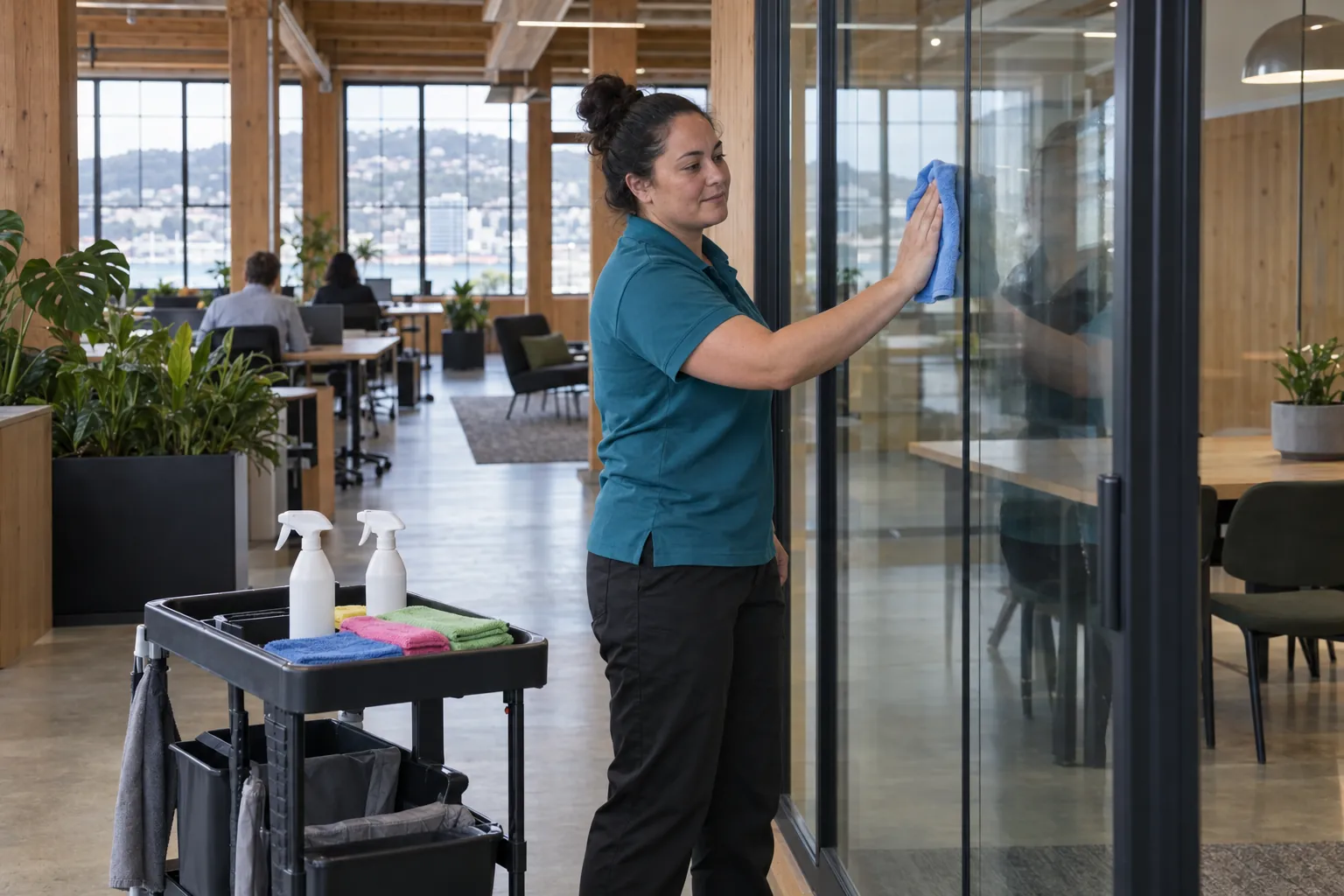
In New Zealand there is no law that requires it, but there is a national ecolabel with a published standard for cleaning services, and the rules on hazardous substances, stormwater and advertising claims apply whether a contract says green or not. This guide covers what green cleaning involves, what the Eco Choice Aotearoa standards ask for, and how a client or a cleaning company can show it is actually happening.
01
What green cleaning is, and what defines it in New Zealand
Green cleaning, sometimes called eco or sustainable cleaning, is running a cleaning service with the least practicable harm: products that are less hazardous and break down in the environment, methods that use less chemical and water, and less sent to landfill. It is not a lower standard: a green-cleaned office still has to be clean. In the cleaning industry the term is used loosely, so a client should ask any business offering it what exactly it means.
No New Zealand statute requires green cleaning, and the phrase has no legal definition. What gives it a meaning here is the national ecolabel. The Ministry for the Environment's page About Eco Choice Aotearoa says: "Eco Choice Aotearoa is the New Zealand Government's official ecolabel." The standards themselves record that it was known as Environmental Choice New Zealand until June 2023, and that the programme is managed by the New Zealand Ecolabelling Trust. The Ministry's page adds that businesses cannot pay to join; they have to pass audits that include site visits.
Two Eco Choice Aotearoa standards matter for cleaning:
- EC-58-19 Detergents and Cleaning Products (revised June 2023) sets criteria for the products themselves, including the commercial and institutional cleaning products used by cleaning companies for offices, institutions, warehouses and industrial facilities.
- EC-45-18 Cleaning Services (revised June 2023) sets criteria for the service: the contract, the products bought, the way cleaners dilute and apply them, training, spills, waste and energy. It covers commercial premises such as offices and retail, institutional premises such as schools and hospitals, and residential premises, delivered by a contractor or by in-house cleaning staff.
EC-45-18 explains that the programme operates to ISO 14024, the international standard for Type I environmental labels. In plain terms, a labelled product or service has been checked by a third party against published criteria, rather than described as green by whoever sells it. The practices those two standards describe are the most useful working definition of green cleaning here, whether or not a contractor holds a licence.
Three sets of rules apply to every cleaning service regardless: the Health and Safety at Work Act 2015 (HSWA) and its Hazardous Substances Regulations 2017; council rules that keep contaminants out of stormwater; and the Fair Trading Act 1986, which governs green claims.
02
What green cleaning covers in practice
Read together, the two Eco Choice Aotearoa standards describe a service in which most of the gain comes from ordinary decisions made every day. On a typical commercial site, green cleaning covers:
- Products: ecolabelled cleaning chemicals, sanitary paper products, soaps and toiletries for everything the green service covers (EC-45-18 clause 5.3), in a short range rather than a cupboard of specialities.
- Dilution and dispensing: "a system for correctly diluting chemicals that minimises worker exposure (eg dosage devices, dispensing units, measuring cups etc.)", and applicators that do not lead to overuse.
- Methods that need less chemical: the standard names "the use of microfibre cloths to reduce chemical usage", with a procedure for laundering cloths and mop heads.
- No routine disinfection: "Disinfection is excluded from the category", and the licensed service needs a "written instruction that disinfectants shall not be used". Where a site genuinely needs disinfection, such as a clinical area, it can still be provided, but the agreement must list it as outside the licence, and it must not be marketed as the licensed service.
- Cleaning to need: "Where cleaning is carried out to a predetermined schedule, this shall aim to minimise unnecessary cleaning."
- Drains, spills and waste: cleaners know which drains go to the sewer and which are stormwater, every chemical spill is recorded, and the building's sorted recycling stays sorted.
- Training: initial, site-specific and annual, adapted for staff with limited English.
- Energy and vehicles: support for the building's own energy objectives, and vehicles serviced and driven to save fuel.
EC-45-18 also asks the company to propose daytime cleaning where it can offer it.
03
Choosing products: what an ecolabel checks, and what the law still requires
Most of the risk in cleaning chemicals is in what they contain and how concentrated they are when handled. EC-58-19 deals with the first: a licensed product must not be formulated with a list of banned substances that includes EDTA, NTA and DTPA, alkylphenol ethoxylates, "reactive chlorine compounds such as sodium hypochlorite", quaternary ammonium salts that are not readily biodegradable, and compounds containing arsenic, cadmium, chromium, lead or mercury. General-purpose and commercial cleaning products must not contain volatile organic compounds in excess of 10% by weight, and "All surfactants must be readily biodegradable and anaerobically degradable." Products whose purpose is disinfecting are excluded from the standard, as are tablet toilet bowl cleaners and urinal blocks.
Choosing a safer product is also what health and safety law asks for when a hazard cannot simply be removed. Under HSWA, a PCBU must eliminate risks to health and safety so far as is reasonably practicable and, where that is not possible, minimise them. WorkSafe's quick guide Identifying, assessing and managing work risks (July 2017) sets out the hierarchy of controls, in which one of the first ways to minimise a risk, alongside isolation and engineering controls, is "Substituting (wholly or partly) the hazard giving rise to the risk with something that gives rise to a lesser risk (eg using a less hazardous thing, substance or work practice)." It adds that personal protective equipment "should not be the first or only control measure considered". A milder product that does the job is substitution; gloves alone are not.
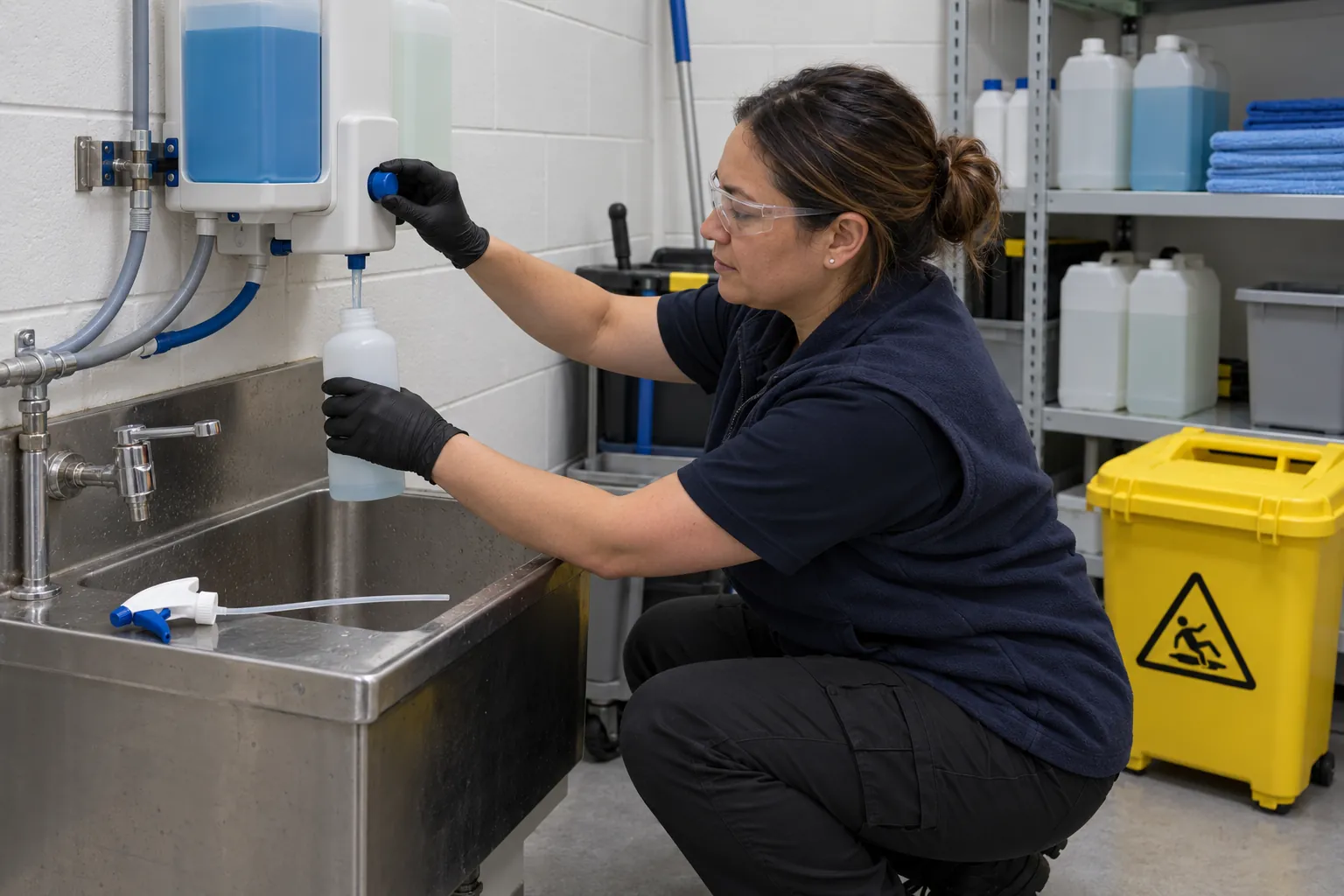
WorkSafe's page on safety data sheets says "A current SDS for each hazardous substance (or a condensed version of the key information from the safety data sheet, for example a product safety card) must be kept with your inventory", readily accessible to people who may handle or be exposed to the substance. Its page on labelling covers the spray bottle, the most common container in any cleaners' cupboard: a hazardous substance decanted into another container must be labelled in English with the product or chemical name and a hazard pictogram and hazard statement. "If it's for immediate use then labelling is not required", but the container must then be thoroughly cleaned straight afterwards. WorkSafe adds that you should "never put hazardous substances in food or drink containers, even if they're labelled."
A dispensing unit that fills labelled bottles at the right dilution does three jobs at once: less concentrate used, less contact with it, and correct labels. On a large site with several cleaners' cupboards, it also means the care taken over dilution no longer depends on each person judging it by eye.
04
Methods, water and waste: what good practice looks like on site
The product is only half of it. A well-chosen product used at double strength from an unlabelled bottle is not green cleaning. EC-45-18 clause 5.4 lists what a cleaning company must make available to its cleaners, and it reads as a practical checklist for any site:
- information on each chemical's hazards, instruction on safe handling, and suitable PPE where it is needed;
- easily understood written instructions on dilution, use and disposal, with diagrams where they help staff with limited English;
- instructions on rinsing, refilling, recycling or disposing of used containers;
- instructions on inspecting and maintaining tools and equipment;
- a process for reviewing these instructions so they stay up to date.
Water is where green cleaning most often meets the rules of the local council or regional council. EC-45-18 requires the service agreement to identify "Drains connected to sewers suitable for cleaning staff use", "as shall any stormwater drains to avoid." The reason is simple. Otago Regional Council's Only drain rain page explains that stormwater is not treated: "whatever goes into the drain outside your house – whether it's poured in intentionally or washed down with rainwater – enters our waterways without being treated." It also warns: "Biodegradable detergents still pollute the environment!" Mop water and the rinse from washing bins belong in a cleaner's sink, never in the grate in the car park. Rules vary by council, so check yours.
Spills are the other way a small mistake reaches the environment. EC-45-18 clause 5.5.1 requires spill procedures every cleaner can understand, suitable spill kits, and "recording of all chemical spills on a readily accessible report form or logbook". A spill kit nobody has checked since it was installed may not be there when it is needed.
Waste has two sides. The cleaning company's own waste, from empty containers to worn mop heads, is separated for recycling and reported. The building's waste is the occupants', but the cleaners carry it out, and EC-45-18 clause 5.6.2 asks them to support the building's recycling programme, keep sorted recyclables separate and report problem areas. A recycling scheme fails quietly when both bags go into the same wheelie bin at the end of the night.
05
Green claims, licences and the evidence behind them
A cleaning company that tells a client its service is green is making an environmental claim, and the Commerce Commission's Environmental Claims Guidelines (July 2020) set out how the Fair Trading Act 1986 applies to it. The Commission gives "ECO FRIENDLY" and "CHEMICAL FREE" as examples of vague claims that are easy to misread and hard to back up. It says "You must have reasonable grounds for a claim when you make it", meaning evidence, test results or similar credible information. Pictures of forests or words like green or eco can make an implied claim, and "Implied claims are still capable of being misleading." On logos, it warns that businesses should be careful of creating their own environmental logos, which may suggest independent certification that does not exist.
For a client, the better question is not "is your service green?" but what exactly is green about it, and what is the evidence:
- Is the service licensed? Under EC-45-18, "An Eco Choice licence is not an endorsement for the cleaning company or provider itself, but applies specifically to individual cleaning services" that meet the standard, and wherever the label appears "the Label must be accompanied by the Licence Number". Ask which service the licence covers and whether it is yours. A company may offer licensed and unlicensed services side by side.
- Which products are used on this site? A product list with the ecolabel licence for each, and the safety data sheets that go with them.
- What does the contract say? EC-45-18 clause 5.2 requires a written agreement with a schedule of standard cleaning, anything outside the licence clearly marked, and the site's hazards and drains identified.
- What records are kept? The standard's own model: ecolabelled chemical purchases recorded at least quarterly per full-time-equivalent cleaner, consumables bought, training records per employee, the spill log and waste reports.
Purchase records per cleaner are an honest measure: if chemical use per full-time-equivalent cleaner falls after dosing units and microfibre arrive, the method is working; if it climbs, someone is free-pouring.
Finally, EC-45-18 clause 6 requires "a system for monitoring the quality of cleaning service delivery against the service agreement/contract and for taking corrective action if required", and a way for the client and provider to exchange written feedback. A service that uses less chemical but leaves washrooms dirty has not succeeded, and the cleaning supervisor is usually the person who has to show both.
06
Where the record fails, and what SiteClara does about it
Most green cleaning programmes are written well and checked badly. The policy says dosing units, microfibre and labelled bottles; on a wet Tuesday night the dosing unit is broken, a bottle has been filled unlabelled from the concentrate, the spill kit was raided months ago, and the mop bucket went down the drain by the loading dock. None of it shows in a quarterly purchase report, and the claim on the tender stays green while the practice drifts.
SiteClara records the routine checks that keep the practice in line with the policy. A printed QR poster, with an optional NFC tag behind it, goes at each place where a check is scheduled, such as the cleaners' cupboard, the dispensing station, the spill kit or the bin room. Staff scan or tap with their own phone, with no app to install, see the checks due there, for example "dosing unit working", "all bottles labelled", "spill kit complete" or "recycling kept separate", and mark each one done or say what stopped them. The time and the named person are recorded as it happens, with a photo when one is asked for. A problem found, such as a broken dispenser or an empty spill kit, goes onto the team's list of open jobs until someone closes it.
A supervisor sees what is due, done and missed, records the reason a check was missed, and each day reviews and approves a short report for nominated managers or the client, sent the next morning. That gives the provider a dated record of the checks made on site, alongside the purchase and training records the standard asks for.
07
Questions people ask
What are green cleaning methods?
Ways of cleaning that need less chemical, less water and less waste. Eco Choice Aotearoa's EC-45-18 Cleaning Services asks for "a system for correctly diluting chemicals that minimises worker exposure (eg dosage devices, dispensing units, measuring cups etc.)", instruction or training on "cleaning methods that minimise or eliminate the need for chemical use wherever possible, e.g. the use of microfibre cloths to reduce chemical usage", a "written instruction that disinfectants shall not be used" in the general service, and a schedule that aims "to minimise unnecessary cleaning".
What is the hourly rate for a cleaner in NZ?
No official rate is set for cleaning work, but an employed cleaner aged 16 or over who is not a starting-out worker or trainee must be paid at least the adult minimum wage. Employment New Zealand's Minimum wage rates and types gives it as $23.95 an hour from 1 April 2026, reviewed every year. What a cleaning company charges a client is a commercial matter that no official source sets.
What do professional cleaners recommend never doing at home?
Two rules from official guidance apply at home as much as at work. WorkSafe's Labelling page says "never put hazardous substances in food or drink containers, even if they're labelled", and "It's never safe to have hazardous substances in unlabelled, or incorrectly labelled, containers." Otago Regional Council's Only drain rain explains that "Most stormwater isn't treated before it drains into our local waterways", so cleaning water goes down a sink or toilet, where it is treated, never the drain outside, and it warns: "Biodegradable detergents still pollute the environment!"
08
Further reading, and a list to take away
The two Eco Choice Aotearoa standards are the most useful documents to read in full; check for the current version before relying on any clause quoted here.
- Ministry for the Environment: About Eco Choice Aotearoa.
- Eco Choice Aotearoa: EC-45-18 Cleaning Services and EC-58-19 Detergents and Cleaning Products.
- WorkSafe New Zealand: safety data sheets, labelling and Identifying, assessing and managing work risks.
- Commerce Commission: Environmental Claims Guidelines.
- Otago Regional Council: Only drain rain, and your own council's stormwater rules.
A list to take away:
- Write what green means on your site into the specification in specific terms, using EC-45-18 as the checklist.
- Use a short range of ecolabelled products, with safety data sheets kept with the inventory for any that are hazardous.
- Fit dosing units, and label every bottle that is not used and emptied straight away.
- Use microfibre where it does the job, and keep routine disinfection out of the general service.
- Mark which drains go to the sewer and which are stormwater, and tell every cleaner.
- Keep a checked spill kit at each chemical store, and record every spill.
- Measure chemical purchases per full-time-equivalent cleaner each quarter.
- Make only claims you can back up, and check on site that the practice matches the policy.
Sources
Every document this guide quotes or links to, in the order it first cites them.
- About Eco Choice Aotearoa environment.govt.nz
- EC-58-19 Detergents and Cleaning Products ecochoiceaotearoa.org.nz
- EC-45-18 Cleaning Services ecochoiceaotearoa.org.nz
- Identifying, assessing and managing work risks worksafe.govt.nz
- Safety data sheets worksafe.govt.nz
- Labelling worksafe.govt.nz
- Only drain rain orc.govt.nz
- Environmental Claims Guidelines comcom.govt.nz
- Minimum wage rates and types employment.govt.nz
Related guides
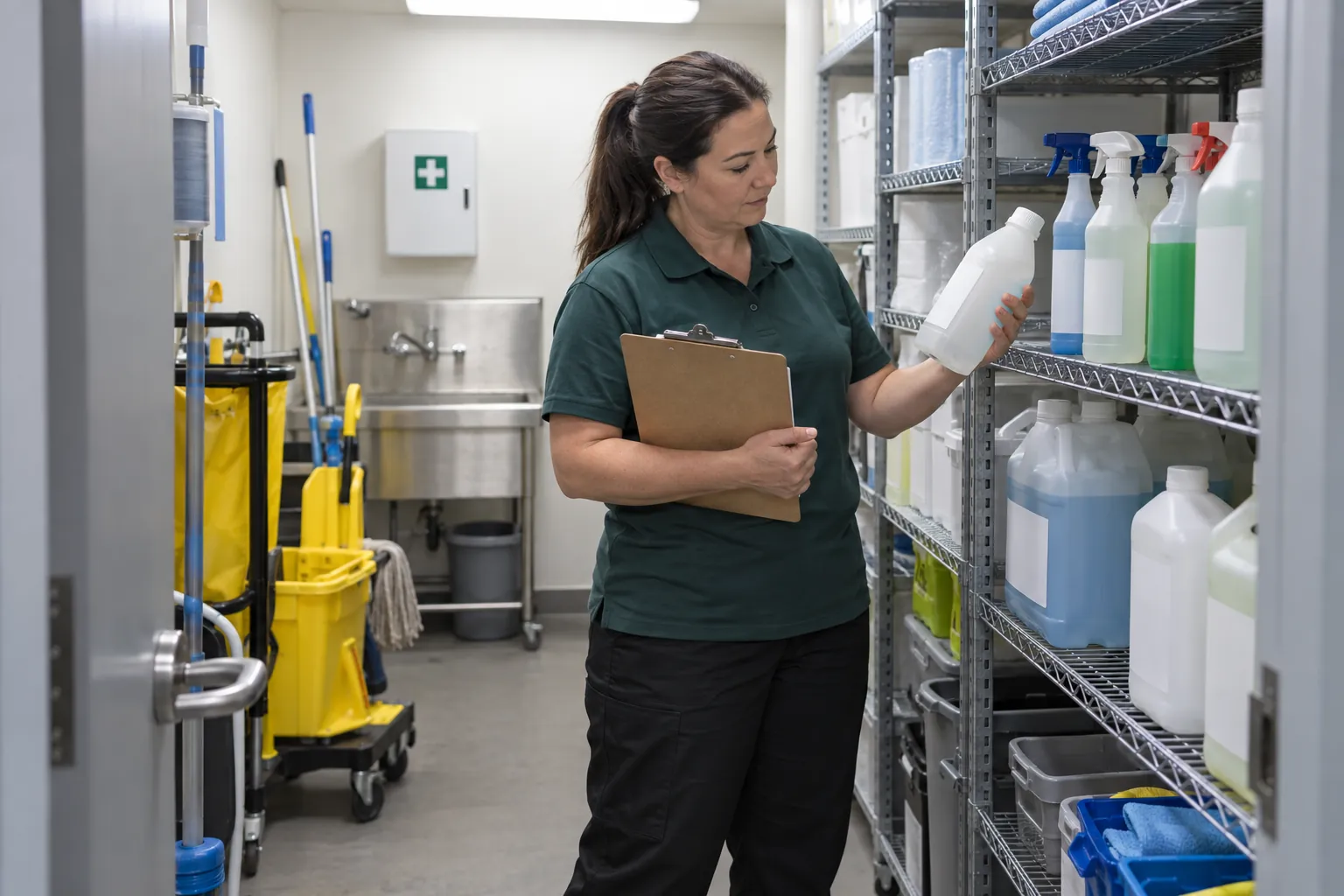 CleaningHazardous substances inventory: what it must hold, and how to keep it trueWhat a hazardous substances inventory must contain in New Zealand, who keeps one in a shared building, when to update it, and how it sits with SDSs and labels.
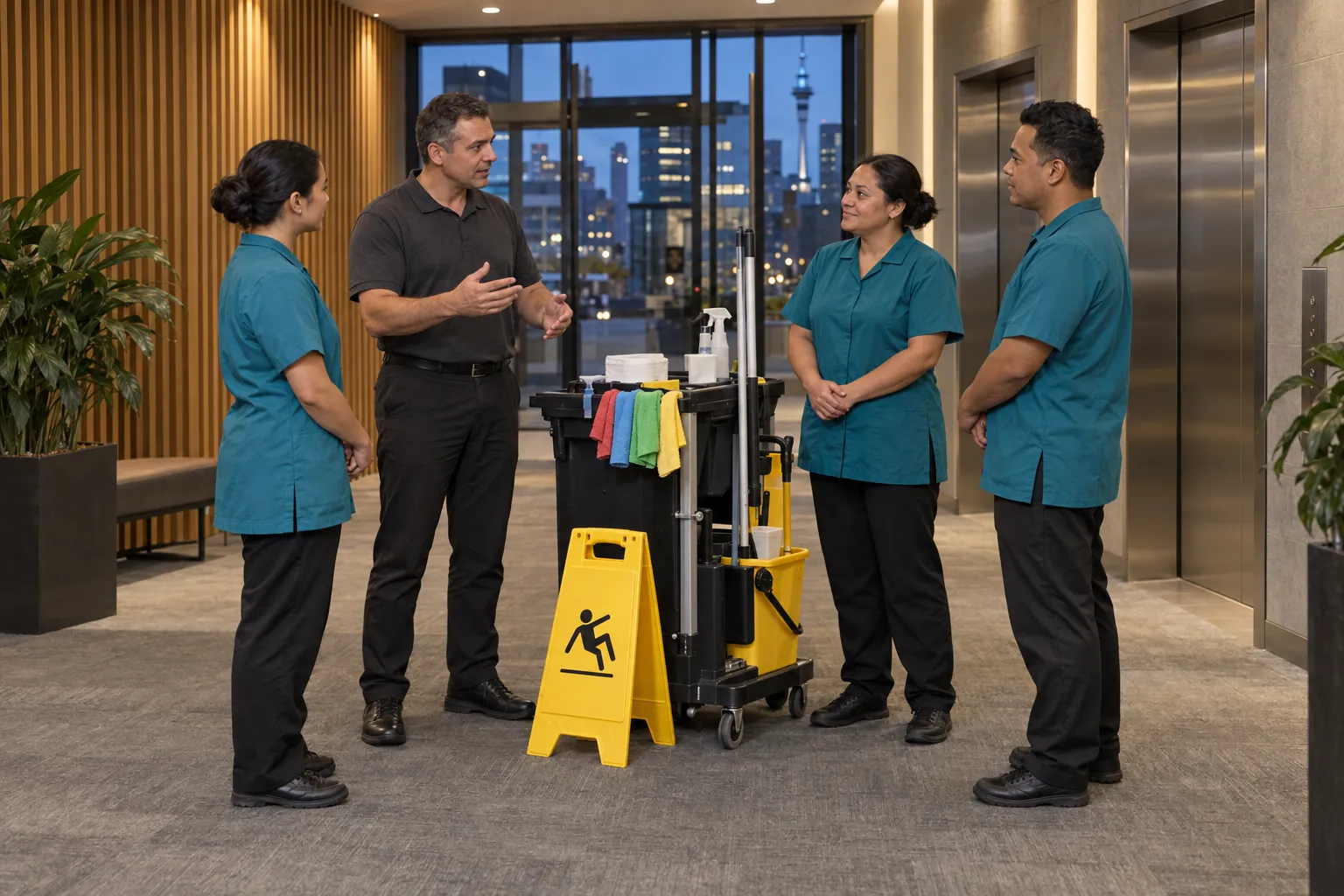 CleaningCleaning supervisor duties: what the role involves in New Zealand, and what good looks likeWhat a cleaning supervisor does in New Zealand: the main duties, a typical shift, the HSWA side, managing the team, checking the work and reporting to the client.
 CleaningCommercial cleaning checklist: area by area, for New Zealand workplacesA commercial cleaning checklist for New Zealand offices and shared buildings, area by area, with the HSWA duties behind it, how to use it and how it is checked.
 CleaningOffice cleaning checklist: what a New Zealand office cleans, how often, and how it shows itAn office cleaning checklist for New Zealand workplaces: the HSWA duty, daily, weekly and periodic tasks, who owns each one, and how to show the work was done.