Cleaning
Office cleaning checklist: what a New Zealand office cleans, how often, and how it shows it
An office cleaning checklist is a structured list of every cleaning task in an office, from bins, desks and floors to the kitchen, toilets and high-touch surfaces, with how often each is done and who does it.
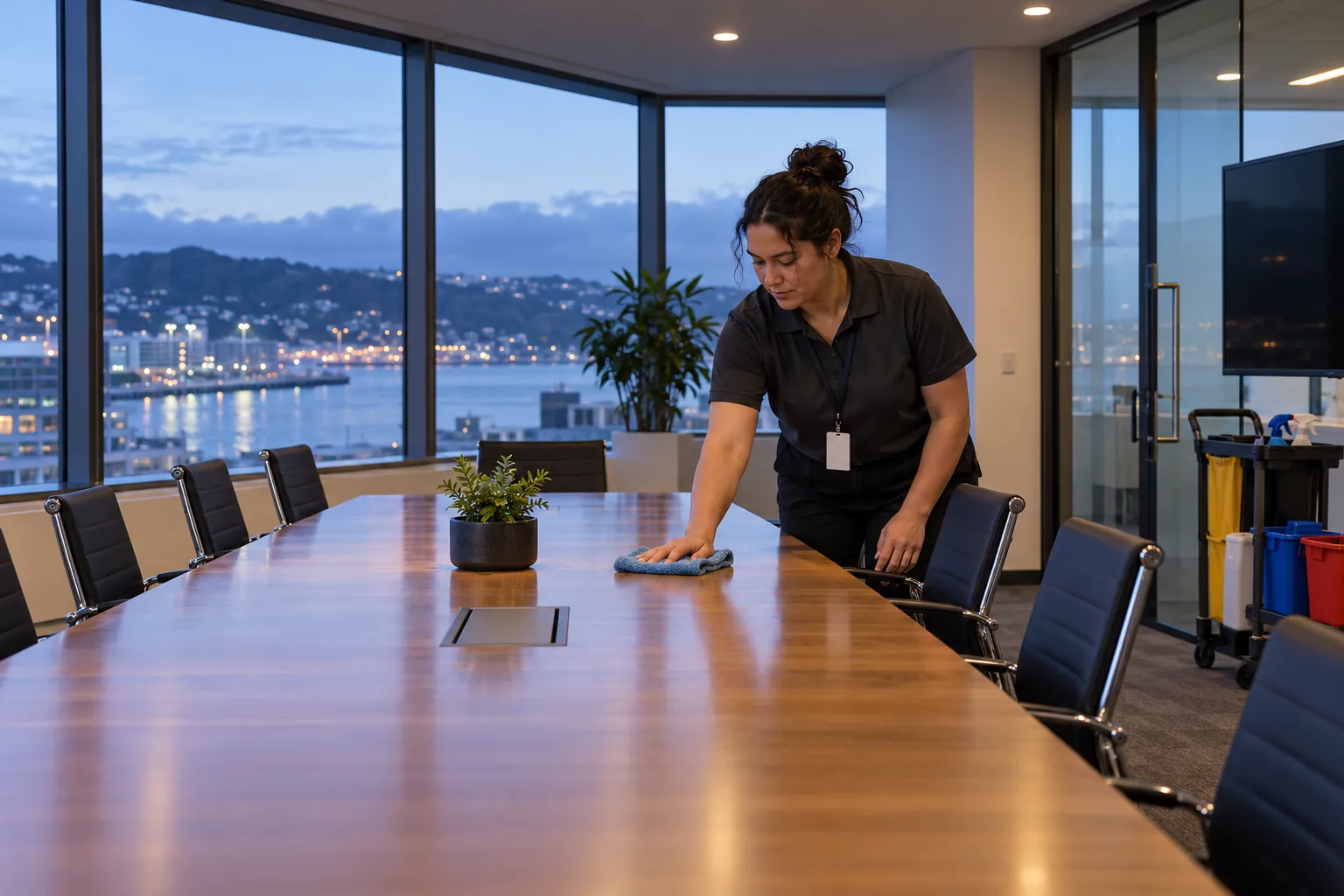
It turns "keep the office clean" into tasks a cleaner can do and a supervisor can check. In New Zealand the duty behind it sits with the PCBU under the Health and Safety at Work Act 2015, whether the cleaning is done in-house or by a contract cleaner. This guide sets out what the checklist should cover, which tasks are daily and which can wait, who does what in a shared building, and how to show the list is actually being worked through.
01
The duty behind an office cleaning checklist
No New Zealand law says an office must have a written cleaning checklist. The law sets the outcome, and the checklist is how most businesses and building managers show they are achieving it. The duty sits with the PCBU (person conducting a business or undertaking) under the Health and Safety at Work Act 2015 (HSWA). WorkSafe's Introduction to the Health and Safety at Work Act 2015 special guide summarises the parts that matter for cleaning:
- The primary duty of care (section 36). A PCBU must ensure, so far as is reasonably practicable, the health and safety of workers and that "other people are not put at risk by its work". That includes "providing and maintaining a work environment that is without risks to health and safety", "ensuring the safe use, handling and storage of plant, structures and substances" and "providing adequate facilities for the welfare at work of workers".
- The PCBU who manages or controls a workplace (section 37) must ensure, so far as is reasonably practicable, that "the workplace, the means of entering and exiting the workplace" are without health and safety risks to any person. In a multi-tenanted office building that is often the landlord or its property manager for the lobby, lifts and stairs, and the tenant for its own floor.
- Workers (section 45) must "take reasonable care for their own health and safety" and "comply, so far as reasonably able, with any reasonable instruction given by the PCBU". That covers the office staff who leave a spill on the kitchen floor as much as the cleaner.
The Health and Safety at Work (General Risk and Workplace Management) Regulations 2016 add the detail. WorkSafe's guidelines on General risk and workplace management – part 1 explain that regulation 11 requires adequate facilities for workers, including toilets, drinking water, hand-washing facilities and eating and break facilities, and that regulation 12 requires PCBUs to ensure, so far as is reasonably practicable, that the facilities are "sufficient in number and maintained to be in good working order, and clean, safe, and accessible". Under regulation 10, surfaces must be "designed, installed, and maintained to allow work to be carried out without risks to health and safety".
WorkSafe's fact sheet on workplace and facilities requirements puts the whole thing in one sentence: "Workplaces must be clean, healthy, safe, accessible and well maintained so work can be carried out without risks to worker health and safety." It adds that floors and other surfaces should be "flat, stable and dry", and that the PCBU must engage with its workers "when making decisions about facilities". An office cleaning checklist is where those words become Tuesday night's work.
02
What an office cleaning checklist covers
Whether the office is a single floor in a central-city tower, a suburban business park unit or a council service centre, most office cleaning checklists cover the same areas. List every one, including the rooms nobody visits, because the room left off the list is the one never cleaned:
- Entrance and reception: entrance matting, hard floors, glass doors, the reception counter and visitor seating. This is where rain and grit come in from the street.
- Open-plan areas and private offices: desks, chairs, bins, carpet and hard floors, partitions and the touch points people share.
- Meeting rooms: tables, chairs, whiteboards, screens, remotes and conferencing kit.
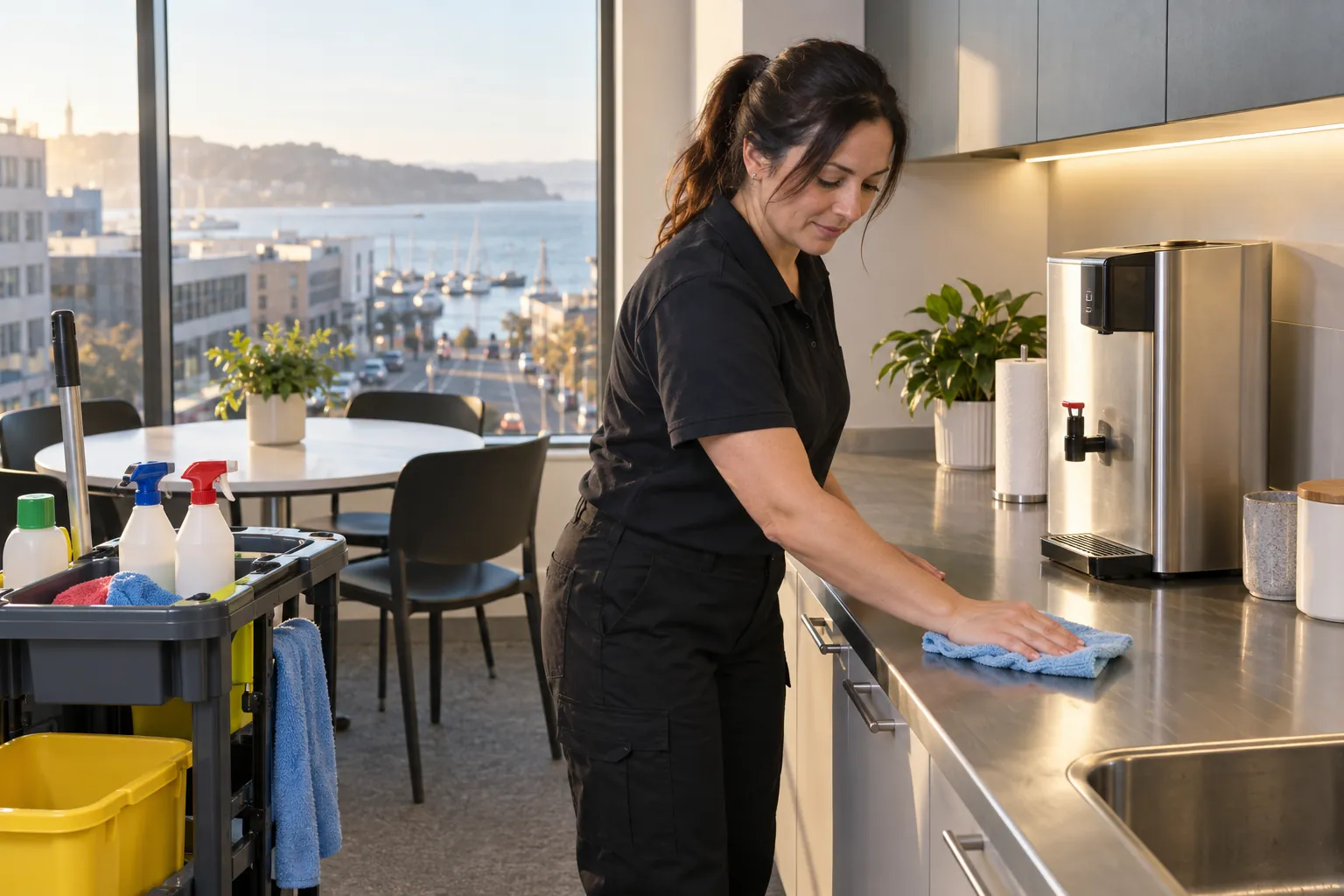
- Kitchen, kitchenette or staffroom: benches, sinks and taps, the fridge, microwave, dishwasher, zip or urn and coffee machine, tables and the floor beneath them.
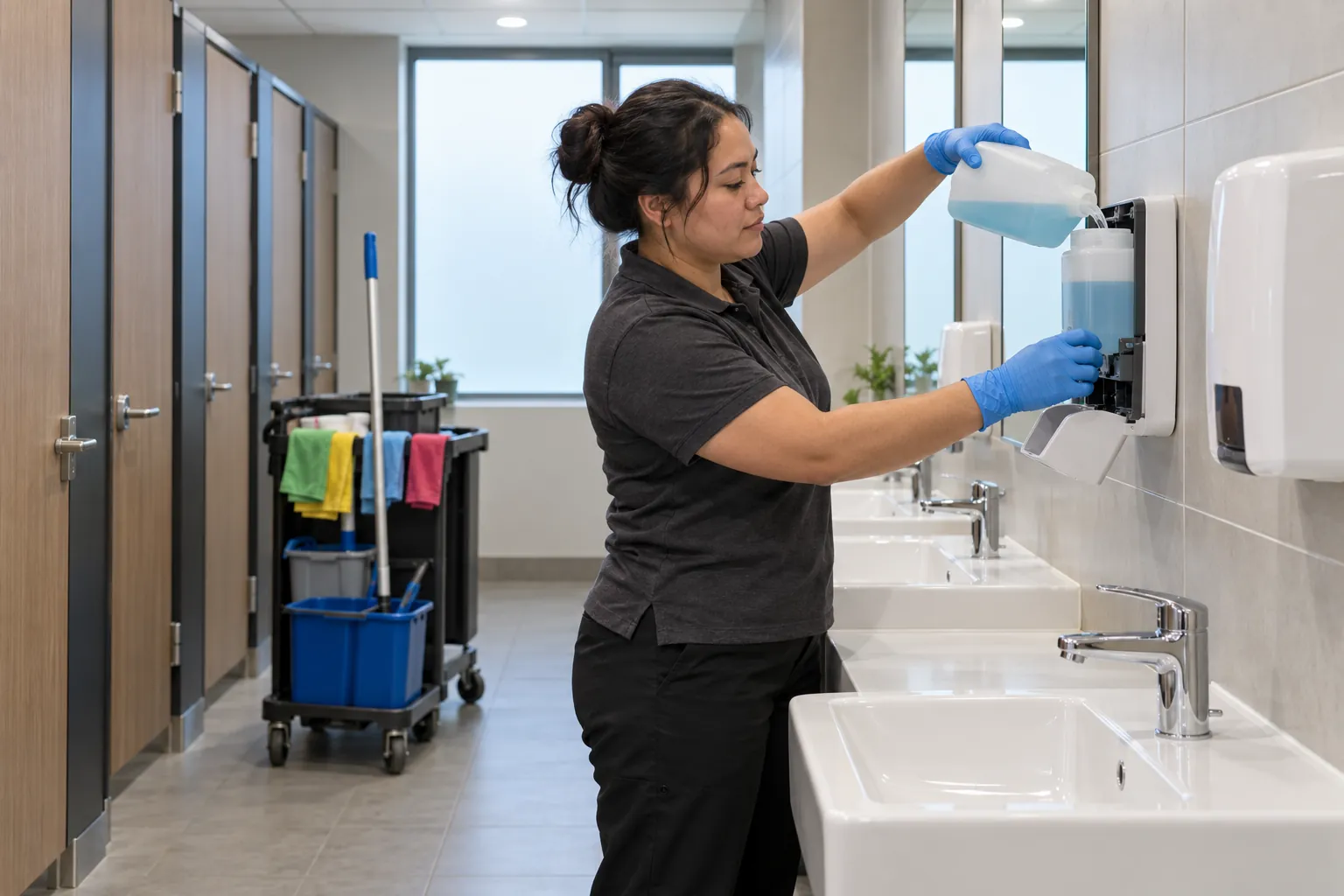
- Toilets and showers: pans, urinals, basins, mirrors, dispensers, sanitary bins, cubicle partitions and floors, with soap, paper and hand towels restocked. The toilet cleaning checklist covers these in more detail.
- Corridors, stairs and lifts: floors, handrails, lift buttons, door push plates and kick plates.
- Shared equipment: printers and copiers, shared phones and hot-desk keyboards, wiped with a product that will not damage them.
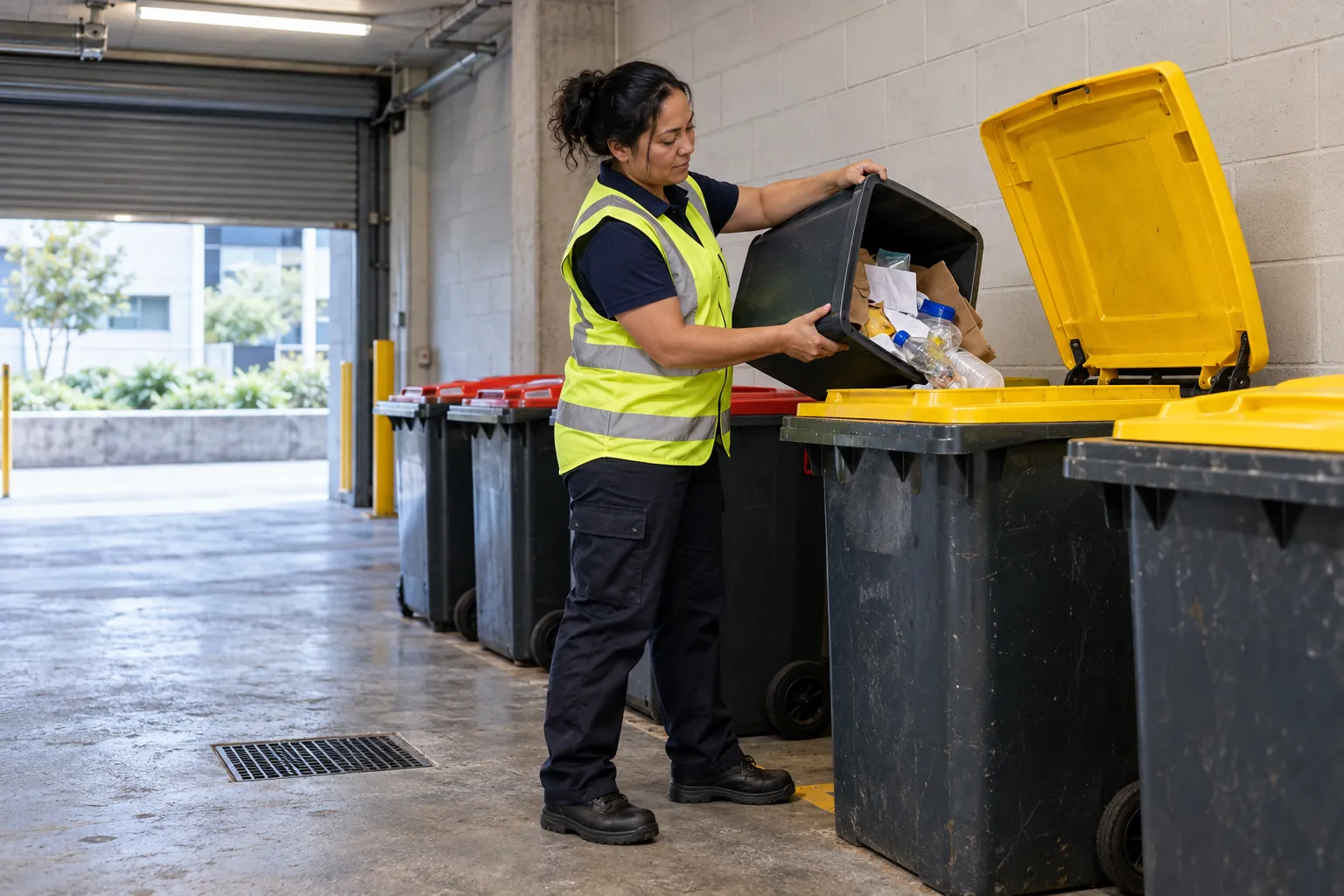
- Waste and recycling: general waste, mixed recycling, food scraps where the office separates them, and the bin store or loading dock.
- Low-use areas: the comms cupboard, storerooms, the first aid room or quiet room, the end-of-trip facility with its showers and lockers, and the cleaners' cupboard itself.
Write each item as a task a person can do and someone else can check: "vacuum carpet in the open-plan area, including under clear desks" rather than "floors". A checklist written in general words is easy to tick and impossible to audit. If a commercial cleaning checklist covers the whole building, the office checklist is the part of it for your floor or tenancy.
03
The checklist: daily, weekly, monthly and periodic tasks
Frequencies follow foot traffic and risk, not habit. An office of two hundred people five days a week and an office of twelve with most staff working from home on Mondays and Fridays need the same areas on the list but very different frequencies. As a starting point for a typical office:
Daily
- Empty bins and recycling, replace liners, and take waste to the bin store.
- Clean toilets fully and restock soap, toilet paper and hand towels.
- Clean kitchen benches, sinks, taps and the outside of appliances; load or empty the dishwasher if that is in the contract; wipe tables.
- Wipe high-touch surfaces, and disinfect them where the checklist says so: door handles and push plates, light switches, lift buttons, handrails, shared phones and printer panels.
- Vacuum or mop entrance and reception floors, and check the entrance matting is flat.
- Spot-clean glass doors and partitions at hand height.
- Clear and wipe meeting room tables, and put chairs back.
- Check the kitchen and toilets again in the middle of the day in a busy office, especially after lunch.
Weekly
- Vacuum all carpeted areas, if not done daily, and mop hard floors throughout.
- Dust clear desks, window sills, partition tops, shelves and furniture.
- Clean inside the microwave; wipe the fridge shelves and door seals.
- Wipe shared equipment and hot-desk keyboards and mice.
- Clean internal glass and mirrors fully, not just the smudges.
Monthly
- High-level dusting of air-conditioning grilles and vents, light fixtures, blinds and the tops of cupboards; report any failed lights for maintenance.
- Clean skirtings, door frames and kick plates.
- Descale taps, shower heads and the zip or urn.
- Clear out and deep clean the kitchen fridge, with notice to staff first.
- Clean chair bases and under desks.
Periodic, on a calendar with dates, because they are never urgent on any given day:
- Carpet shampoo or hot-water extraction, typically once or twice a year and more often on main walkways.
- Hard floor machine scrub, strip and reseal.
- Upholstery cleaning.
- Windows inside and out. Above ground floor, outside glass is work at height and a job for a specialist contractor.
- Deep clean of toilets and showers, including grout and extract fans.
Desks cause most arguments. Many cleaners clean only clear desks, so a checklist that says "wipe desks" should say whether that means every desk or only those left clear. The same goes for the fridge, personal mugs and kitchen cupboards: decide who is responsible, write it on the checklist, and tell staff.
04
Who does what, in your tenancy and the shared building
An office cleaning checklist only works if every task has an owner. In most New Zealand offices there are several:
- The cleaning contractor or in-house cleaners do the scheduled cleaning, usually early morning or in the evening when the office is quiet, and supply the products and their safety data sheets.
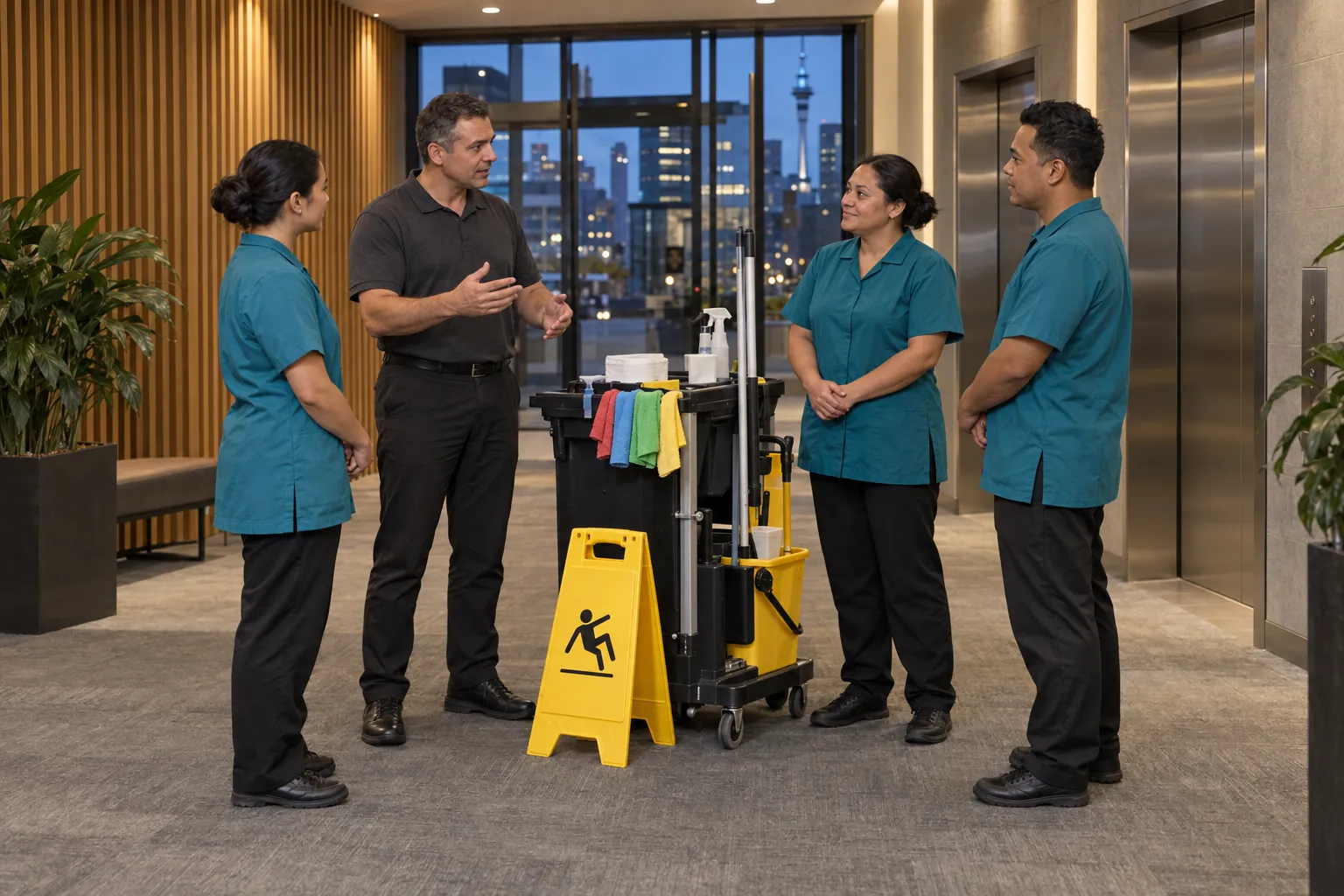
- The cleaning supervisor or area manager plans routes, covers absences, checks the work and deals with complaints. The cleaning supervisor duties guide covers the role.
- The office manager or facilities manager owns the checklist, agrees changes with the contractor and receives requests.
- The landlord or property manager, in a multi-tenanted building, usually cleans the lobby, lifts, stairs, shared toilets and bin store under its own contract, and recovers the cost through outgoings.
- Office staff keep their desks clear enough to be cleaned, clean up after themselves in the kitchen, and report spills and problems.
Each business in that list is a PCBU with duties over the same floor. WorkSafe's overlapping duties quick guide says businesses must "consult, cooperate and coordinate activities with all other businesses they share overlapping duties with". Agreeing who does what is allowed and sensible, but "this does not mean they no longer hold any responsibility for their workers", and a business "must still monitor the other business to ensure they follow through on what was agreed". Contracting out the cleaning moves the work, not the duty: the tenant still needs to know the checklist is being kept.
Write the split down. Shared toilets on a floor, end-of-trip facilities and the bin store are where tasks fall between the tenant's cleaner and the landlord's, and nobody does them.
Cleaning chemicals belong on the checklist too. WorkSafe's page on safety data sheets says: "It is mandatory to have a current safety data sheet for each of the hazardous substances in your workplace regardless of the quantity you hold", and that it must be "readily accessible". Consumer products used in household quantities are exempt from the sheet, but "information about the safe use, handling, and storage of the substance" must still be readily accessible to workers. Say which products may be used, where they are stored, and where the sheets are kept. Colour-coded cloths and mops, with separate colours for toilets and kitchens, stop cleaning spreading germs from one to the other. For hygiene, remove the dirt before you disinfect: MPI's Guidance for Developing Good Operating Practice Procedures: Cleaning and Sanitising, written for food businesses, says "Sanitising is only effective if the surface being sanitised has already been thoroughly cleaned", which is as true of an office kitchen bench.
05
How to check the checklist is being kept
A checklist is a promise. Whether it is being kept is a separate question, and it needs its own answer. The usual ways to keep office cleaning honest, whether the work is in-house or contracted, are:
- Walk-rounds: the supervisor or office manager inspects a sample of areas against the checklist at different times and without warning, and notes what they find.
- Joint audits: client and contractor walk the floor together each month or quarter and score it against the specification, which settles disagreements before they turn into disputes.
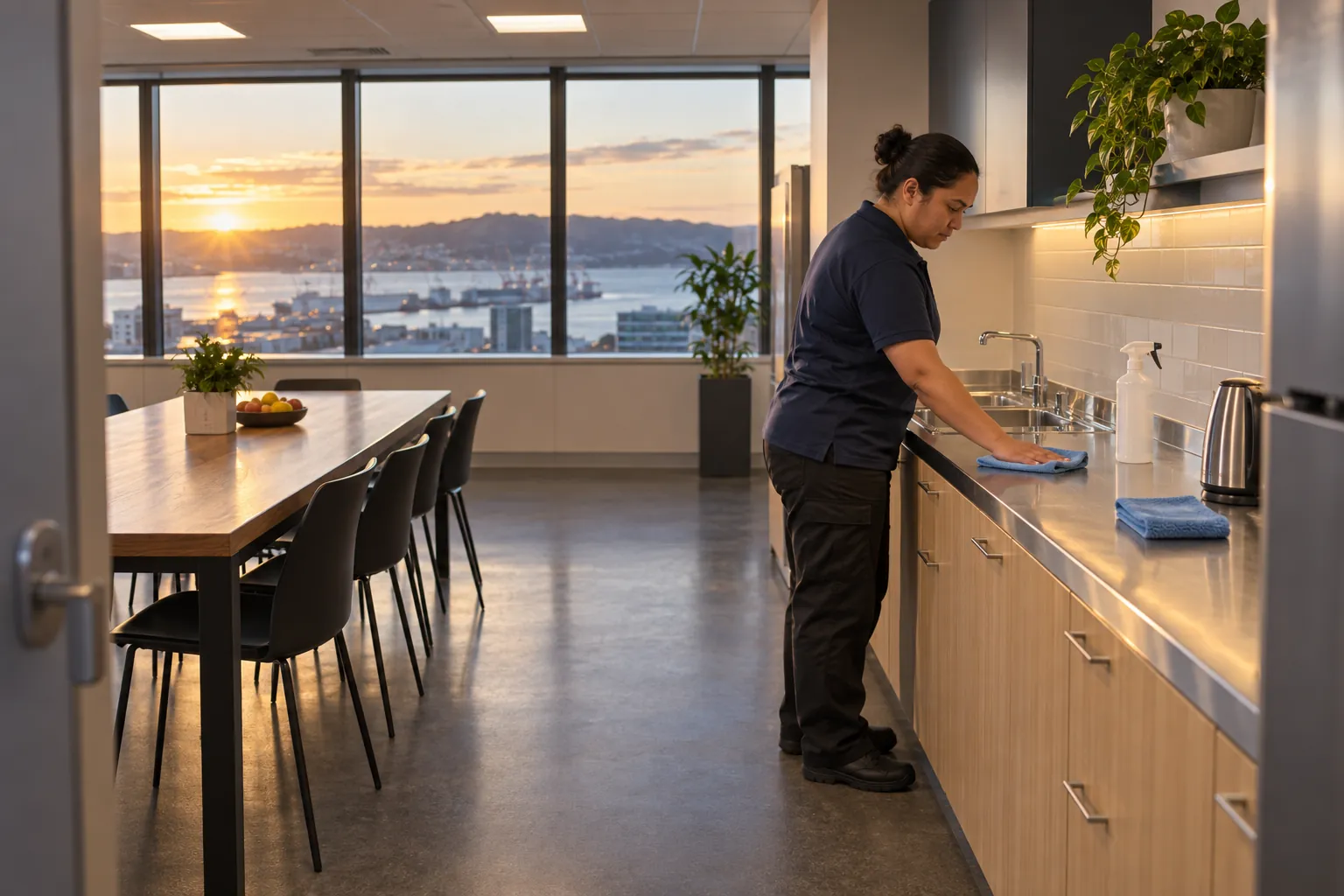
- Records of work done: sheets or logs showing each task or check was carried out, by whom and when. The cleaning log sheet guide covers what a useful one records.
- Requests and complaints: logged with the time they were raised and the time they were put right, so the same complaint coming back is visible.
Slips are the obvious cleaning risk in an office. WorkSafe's page on slips, trips and falls names "slipping on a wet floor (which is wet because something is spilt on it, or because of weather conditions or cleaning processes)" and "poor housekeeping and obstructed views – leading to people tripping over loose carpet, mats, trailing cables, boxes or bags". The checklist should say when floors are mopped, so that it is not the middle of the morning rush, and that wet floor signs go out while the floor is wet and come away when it is dry.
The checklist is also a control in the risk management sense, and controls need maintaining. WorkSafe's guidelines on General risk and workplace management – part 2 explain that regulation 7 requires controls to be maintained so that they remain effective, and that regulation 8 requires them to be reviewed and revised when, among other triggers, a control fails to control the risk as intended, the workplace changes, or a health and safety representative asks for a review in the circumstances the regulation sets out. Review the office checklist when the office changes: a new floor, hybrid working that empties the building on Fridays, a kitchen refit, or a complaint that keeps coming back. A checklist written for a full office five days a week wastes money on quiet days and falls short on busy ones.
06
Where the office cleaning record fails, and what SiteClara does about it
Most offices can show a checklist. Far fewer can show it was followed. The work happens out of hours, when nobody from the client is in; the record is a sheet on the back of the cleaners' cupboard door, sometimes ticked for the week in advance, or a line in the contractor's monthly report. A missed kitchen clean comes to light when someone complains about the fridge, not on the night it was missed, and the landlord's cleaner and the tenant's cleaner each assume the shared toilet was the other's.
SiteClara records those checks where they happen. A printed QR poster, with an optional NFC tag behind it, goes at each location on the checklist, such as the kitchen, each toilet block and reception. The cleaner scans the code or taps the tag with their own phone, with no app to install, and sees the scheduled checks due there. They mark each one done, or explain what stopped them, and the named person and the time are recorded as it happens, with a photo when the check asks for one. A problem found on the round, such as a leaking tap or a broken soap dispenser, goes onto the team's list of open jobs until someone closes it.
The supervisor sees what is due, done and missed, and records the reason when a check was missed. At the end of the day they review the checks and photos, add a note and approve the report, which goes to the office manager or client the next morning, showing what was completed, what is still open and how the scheduled checks went, for example 12 of 12 completed. A contractor and its client can work from the same site, each seeing its own work.
07
Questions people ask
What should I include on my office cleaning list?
Every task, how often it is done, who does it and what it needs. MPI's Guidance for Developing Good Operating Practice Procedures: Cleaning and Sanitising, written for food businesses but a sound pattern for any workplace, says a cleaning schedule should show "what tasks are to be carried out (both routine and periodic cleaning activities)", "when/how often tasks need to be carried out", "who is responsible for doing them" and "what equipment/chemicals are needed for each task". It also suggests checks of the cleaning itself, such as visual inspection and "observing that cleaning and sanitising practices meet requirements".
What does office cleaning usually include?
At the least, the facilities the law requires to be kept clean. WorkSafe's fact sheet on Workplace and facilities requirements lists the facilities every workplace must provide: "toilets, drinking water, hand-washing facilities, eating and break facilities, a place for unwell workers to rest if it is unreasonable for them to leave the workplace". WorkSafe's guidelines on General risk and workplace management – part 1 say regulation 12 requires those facilities to be maintained in good working order and kept "clean, safe, and accessible". Beyond that, an office list usually adds bins and recycling, desks and meeting rooms, floors, kept "flat, stable and dry" as the fact sheet asks of floors and other surfaces, and the high-touch surfaces people share.
08
Further reading, and a list to take away
WorkSafe New Zealand publishes the introduction to HSWA, the general risk and workplace management guidelines, the workplace and facilities fact sheet, the overlapping duties guidance and the safety data sheet guidance cited above, all free on its website. The Health and Safety at Work Act 2015 and the Health and Safety at Work (General Risk and Workplace Management) Regulations 2016 themselves are on the New Zealand Legislation website.
Before you agree the next version of your office cleaning checklist, check that:
- every area is listed, including the comms cupboard, storerooms and end-of-trip facilities;
- each task is specific enough for a supervisor to check;
- each task has a frequency: daily, through the day, weekly, monthly or periodic;
- periodic work has dates on a calendar;
- high-touch surfaces are named, not left to judgement;
- the checklist says who cleans desks, the fridge and personal areas;
- the split with the landlord's or property manager's cleaner is written down;
- there is a current safety data sheet for each commercial cleaning product on site;
- you know how completed work will be recorded, and who will see the record;
- there is a date to review the checklist against how the office is actually used, with staff asked for their view.
Sources
Every document this guide quotes or links to, in the order it first cites them.
- Introduction to the Health and Safety at Work Act 2015 special guide worksafe.govt.nz
- General risk and workplace management – part 1 worksafe.govt.nz
- Workplace and facilities requirements worksafe.govt.nz
- Overlapping duties quick guide worksafe.govt.nz
- Safety data sheets worksafe.govt.nz
- Guidance for Developing Good Operating Practice Procedures: Cleaning and Sanitising mpi.govt.nz
- Slips, trips and falls worksafe.govt.nz
- General risk and workplace management – part 2 worksafe.govt.nz
Related guides
 CleaningCommercial cleaning checklist: area by area, for New Zealand workplacesA commercial cleaning checklist for New Zealand offices and shared buildings, area by area, with the HSWA duties behind it, how to use it and how it is checked.
 CleaningToilet cleaning checklist: what a New Zealand workplace checks, and how it shows itA toilet cleaning checklist for New Zealand workplaces: the HSWA facilities duty, what to check, how often, checks against cleans, and a record people believe.
 CleaningCleaning supervisor duties: what the role involves in New Zealand, and what good looks likeWhat a cleaning supervisor does in New Zealand: the main duties, a typical shift, the HSWA side, managing the team, checking the work and reporting to the client.
 CleaningCleaning log sheet: what it records, who signs it, and what it provesWhat a cleaning log sheet should record in a New Zealand workplace, who fills it in and who checks it, how long to keep it, and what a signature on it can prove.