Cleaning
Hazardous substances inventory: what it must hold, and how to keep it true
A hazardous substances inventory is the list a New Zealand workplace must keep of every hazardous substance used, handled, manufactured or stored there, including hazardous waste, with each one's name, the maximum amount likely to be on site, its location, its storage and segregation requirements and its safety data sheet.
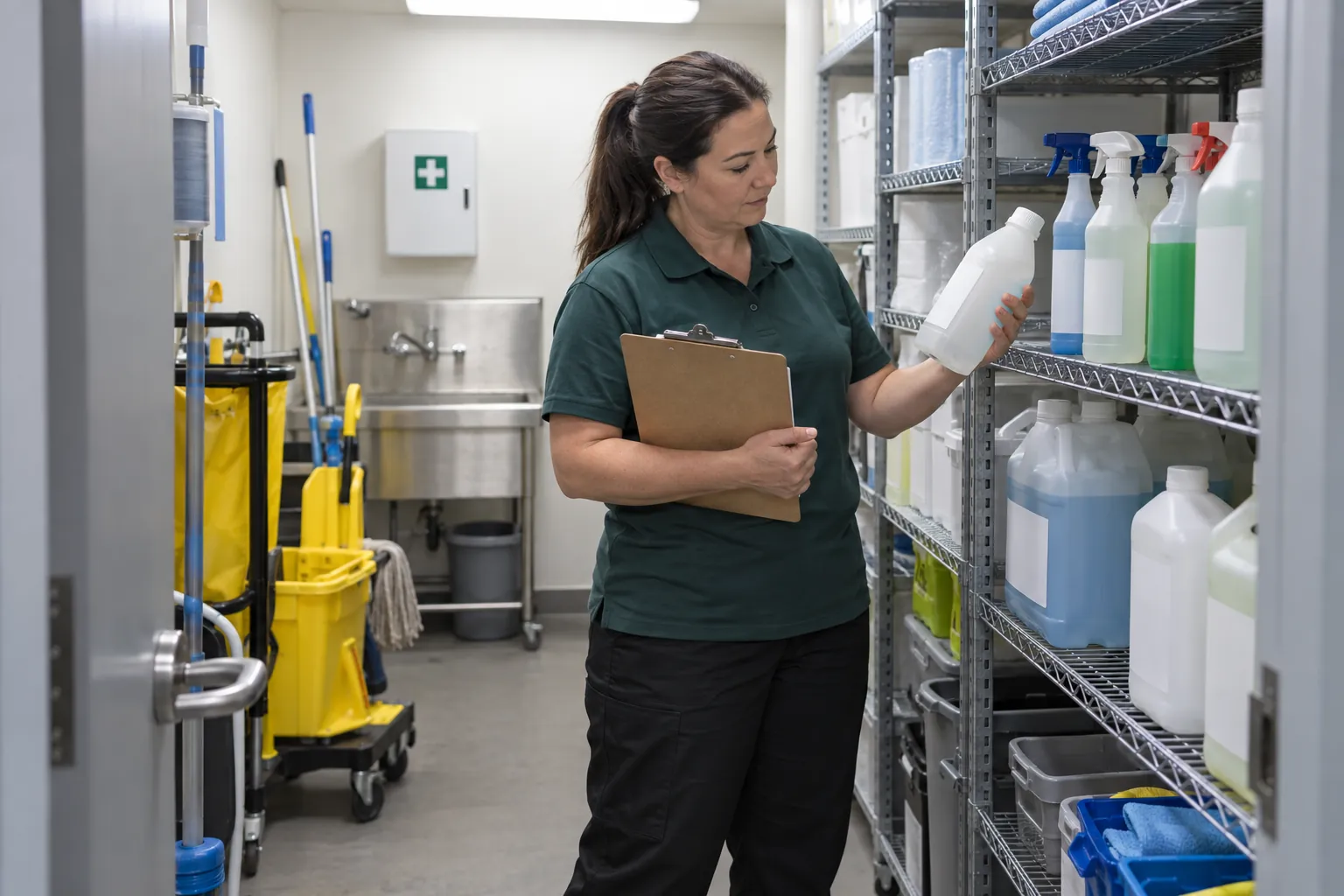
Almost every building has some: cleaning concentrates in the cleaners' cupboard, pool chemicals, LPG for the barbecue on the staff deck, diesel for the generator, paints and solvents in the maintenance store. Under the Health and Safety at Work (Hazardous Substances) Regulations 2017, the business that manages or controls a workplace where they are kept must list them in an inventory, keep it up to date and have it ready for emergency services. This guide explains what the inventory must contain, who keeps it in a shared building, how to build it and manage it over time, and how it works with safety data sheets and labels.
01
What a hazardous substances inventory is, and what the law requires
A hazardous substances inventory is a list of every hazardous substance used, handled, manufactured or stored at a workplace, including hazardous waste, with enough information about each one to know where it is, how much of it there could be and how it must be stored. It is one of the few hazardous substances controls that applies whatever the quantity.
The duty sits in the Health and Safety at Work (Hazardous Substances) Regulations 2017, made under the Health and Safety at Work Act 2015 (HSWA). WorkSafe New Zealand's quick guide Inventory requirements for hazardous substances (May 2019) sums it up. As a PCBU with management or control of a workplace where hazardous substances are present, you must:
- "prepare and keep a list (an inventory) of all the hazardous substances used, handled, manufactured or stored at your workplace, including hazardous waste";
- "keep the inventory up-to-date";
- "make sure the inventory is available to emergency services attending the workplace."
WorkSafe's page on the hazardous substances inventory adds a point that saves a great deal of wasted effort: "An inventory must be kept up-to-date but it's not a daily calculation of quantities held." It is a list of what you have, where, and the most you are likely to have, not a stocktake.
WorkSafe's page on the role of the EPA and WorkSafe explains that the Environmental Protection Authority "has responsibility for approving and classifying hazardous substances; while WorkSafe implements and enforces workplace requirements provided in the Health and Safety at Work (Hazardous Substances) Regulations." The inventory is a workplace requirement, so it is WorkSafe's.
The inventory is also where every other control starts. WorkSafe's Working safely with hazardous substances practical guide (August 2025) puts it bluntly: "the only way to know which controls you have to follow is to know what hazardous substances you have and in what quantities by creating an inventory."
02
What goes in the inventory
The quick guide sets out what the inventory must include for each hazardous substance:
- the product or chemical name and UN number, if there is one. The UN number is in section 14 of the safety data sheet (SDS); if there is none, you do not need to include one;
- the maximum amount likely to be at the workplace;
- its location, specific enough to find it, such as a flammable goods cabinet or a named storage room;
- any specific storage and segregation requirements, from section 7 (handling and storage) and section 10 (stability and reactivity) of the SDS, which also lists incompatible materials;
- an SDS, or a condensed version of the key information from it, such as a product safety card.
Hazardous waste goes in too. The quick guide describes it as waste likely to meet the classification criteria for substances with explosive, flammable, oxidising, toxic or corrosive properties. For each kind of waste, record an identifier describing it as closely as possible (the guide's example is "chlorinated solvent waste"), the maximum quantity likely to be there, its location and any storage and segregation requirements. Hazardous waste does not need an SDS.
WorkSafe recommends a few more columns that are not strictly required but make the inventory far more useful, because they are what the Hazardous Substances Calculator needs to tell you your controls:
- the HSNO approval number and, where it applies, the group standard name, from section 15 of the SDS. Many cleaning products are approved under a group standard; the practical guide gives HSR002530 Cleaning Products as its example;
- the hazard classification, from section 2 of the SDS;
- the UN class and packing group;
- whether the substance is a gas, liquid or solid;
- for flammable liquids, the container size and whether the container is open or closed.
Container size matters more than it looks. The quick guide notes that you will need a location compliance certificate for flammable liquids if you store 50 litres or more in an open container, 100 litres or more in closed containers larger than 5 litres, or 250 litres or more in closed containers of up to 5 litres. A maintenance store that has slowly filled with tins of thinners can cross a threshold without anyone deciding it should.
03
Who needs an inventory in a building, and who keeps it
The duty falls on the PCBU with management or control of the workplace where the substances are. In a single-occupier building that is usually straightforward. In a multi-tenant office, a shopping centre, a school or a unit title development, several businesses may each hold substances: the owner or property manager (plant room chemicals, generator fuel, pool chemicals), each tenant (its own stores), the contract cleaning company (concentrates, floor strippers and sealers kept in the cleaners' cupboard), and maintenance contractors who keep materials on site.
WorkSafe's Overlapping duties quick guide says that businesses "must so far as is reasonably practicable consult, cooperate and coordinate activities with all other businesses they share overlapping duties with." For hazardous substances that means agreeing, in writing, who lists which stores, and making sure the emergency services will find one complete picture of the building rather than three partial ones. The guide also warns that a reasonable agreement with another business "does not mean they no longer hold any responsibility for their workers", and that businesses must "monitor the other business to ensure they follow through on what was agreed."
A laboratory is a special case. The quick guide says a PCBU with management or control of a laboratory used for research and development, teaching or analytical testing must keep an inventory of everything in it as part of the laboratory's emergency response plan. For a secondary school, that means the science laboratory's inventory also belongs in its emergency response plan.
Whoever keeps it, involve the people who handle the substances every day: the practical guide asks PCBUs to engage workers in identifying hazards, and cleaners and caretakers know what is really on the shelves.
04
Building the inventory, and keeping it up to date
WorkSafe's practical guide and quick guide describe the same basic steps:
- Walk the building and list every substance you find, in every store, cupboard, plant room and vehicle bay. Include everything to begin with, even the products you do not think are hazardous.
- Get an SDS for each one from its manufacturer, importer or supplier.
- Decide which are hazardous, from the label and the hazards identification section of the SDS. Only hazardous substances go into the inventory; the practical guide notes that something can be harmful without being a classified hazardous substance (its example is wood dust), and its risks still need managing.
- Record the required information, and the useful extras, in the Workbook, the quick guide's template, a spreadsheet or the Calculator.
- Enter the substances into the Calculator to find the key controls, then put those controls in place and check the SDS for any others.
The Hazardous Substances Toolbox, run by WorkSafe, hosts the free Calculator, which "helps you create your inventory and tells you the controls you need to put in place", and the Workbook, which gives instructions and an inventory form. The quick guide warns that the Calculator gives each inventory a PIN, and that WorkSafe cannot reset it if it is lost. The EPA's Approved hazardous substances with controls database lets you look up a substance's classifications and controls by name or approval number; it does not cover group standards, so a cleaning product approved under one will not appear there.
The inventory can be on paper or electronic; if electronic, the quick guide asks for a backup, such as a printed copy, that emergency service workers can reach.
When to update it. The quick guide says to update the inventory "whenever there is a change to the information that is kept in it", such as the substances or the maximum amounts likely to be there, and also when the information on the SDS changes or you move substances to a different location. In a building that usually means:
- a new cleaning contract starts, or the cleaning company changes its product range;
- a product is discontinued, replaced or reformulated, and the new SDS reads differently;
- a store is moved, for example when a fit-out takes over the old cleaners' room;
- a new plant item or a contractor brings chemicals that stay on site.
Each update is also a prompt to look again at the controls. The quick guide's example is a new substance that needs to be stored inside secondary containment.
05
Safety data sheets, labels and the emergency services
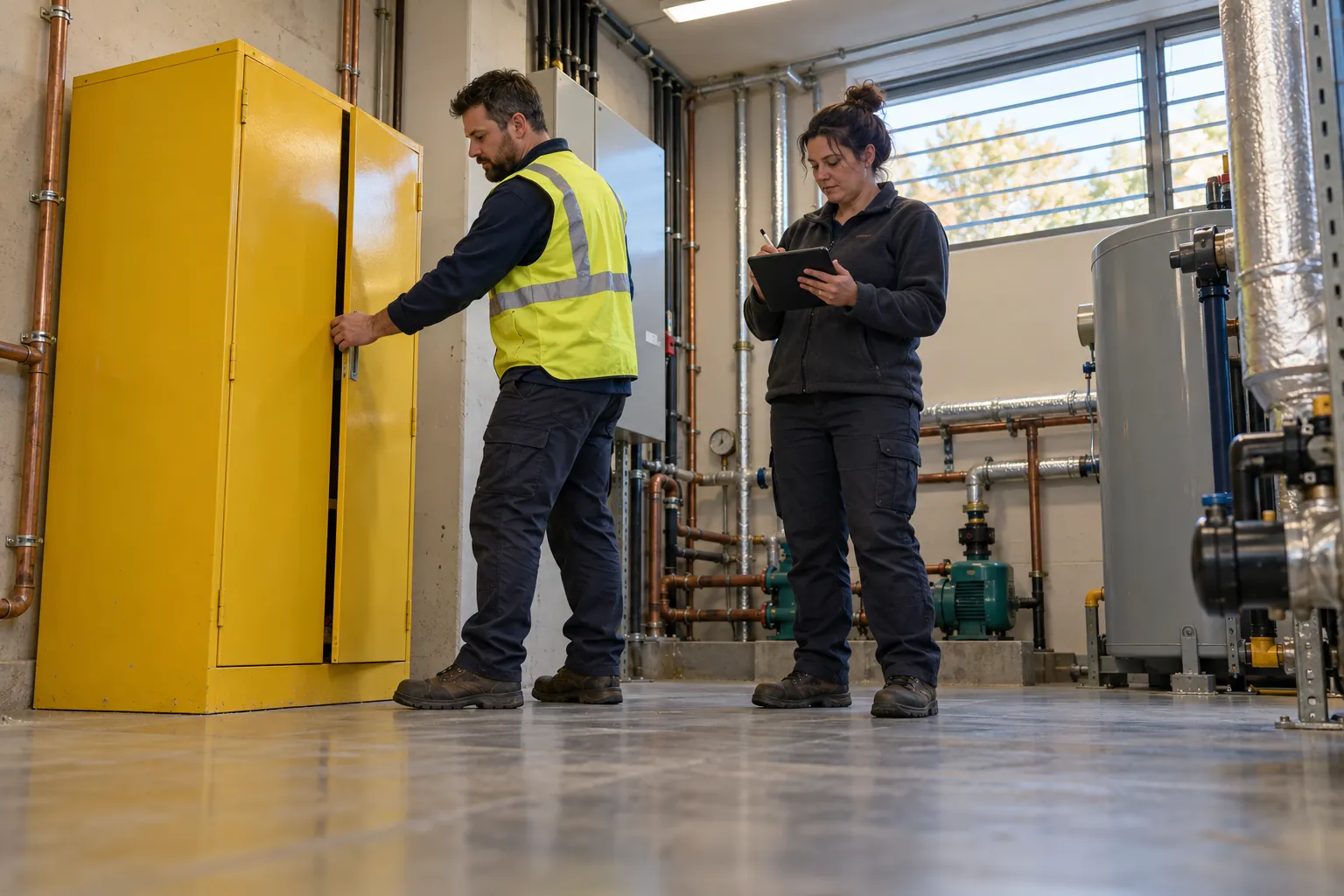
The inventory does not stand alone. WorkSafe's page on safety data sheets says "It is mandatory to have a current safety data sheet for each of the hazardous substances in your workplace regardless of the quantity you hold", and that a current SDS, or a condensed version, "must be kept with your inventory." A PCBU must obtain an SDS when a substance is first supplied, including when it is the first supply in five years, and when it is first supplied after the SDS has been amended. The practical guide adds: ask your supplier for an updated SDS if yours is more than five years old.
Workers do not need access to the inventory itself, the quick guide says, but they must be able to reach the SDS and understand its safety information. The practical guide is frank that an SDS can be hard to follow, particularly for someone who speaks English as a second language, and says to explain it rather than leave people to read it alone. That matters for many contract cleaning teams.
Labels are the other half. WorkSafe's labelling guidance says: "If you decant or transfer substances from a large container into smaller ones (eg for ease of use), the containers must be labelled", with the product or chemical name and a hazard pictogram and hazard statement consistent with the substance's classification. The practical guide adds two plain rules: "It is never safe to have hazardous substances in unlabelled containers", and never put hazardous substances in food or drink containers. A trigger bottle filled from a 20-litre drum is exactly the case these rules are written for.
Where to keep it. The quick guide says the inventory must be kept at the workplace and made readily accessible to any emergency service worker attending, during an emergency and after the building has been evacuated. It recommends hard copies on site for quick access, and says you can give copies to your local branch of Fire and Emergency New Zealand. In practice that means a copy somewhere a firefighter can reach without going back inside, such as with the fire alarm panel or the evacuation information at the main entrance, agreed with whoever runs the building's fire evacuation scheme.
06
Where the inventory fails, and what SiteClara does about it
Inventories fail slowly: a new floor sealer arrives without its SDS, a product is decanted into an unlabelled spray bottle, drums pile up in a plant room that is not on the list, or the cleaners' store moves during a refit and nobody updates the location column. The inventory still says what should be there; nobody has looked. When an inspector, a compliance certifier or a firefighter asks, the question is whether the list matches the shelves today.
SiteClara records the routine checks that keep it matched. A printed QR poster, with an optional NFC tag behind it, sits at each place where a check is scheduled, such as the cleaners' cupboard, the chemical store or the plant room door. Staff scan or tap with their own phone, with no app to install, see the checks due there, for example "labels legible and decanted bottles labelled", "SDS folder present" or "nothing stored that is not on the list", and mark each one done or say what stopped them. The time and the named person are recorded as it happens, with a photo when one is asked for. A problem found, such as a new product with no SDS, goes onto the team's list of open jobs until someone closes it.
A supervisor sees what is due, done and missed, records the reason a check was missed, and each day reviews and approves a short report for nominated managers or the client, sent the next morning. When the inventory is next reviewed, that gives the person updating it a dated trail of what was found and put right, rather than a guess.
07
Questions people ask
What are the inventory requirements for hazardous substances?
For each hazardous substance, the name and UN number if it has one, the maximum amount likely to be at the workplace, its location, any specific storage and segregation requirements, and a current safety data sheet or a condensed version of its key information, with any hazardous waste listed too. That is the list on WorkSafe's page Inventory, which adds that the inventory "represents the maximum quantity of each hazardous substance likely to be at each workplace" rather than a daily count.
Is there a hazardous substances inventory template?
Yes. WorkSafe's page Inventory recommends the Calculator and Workbook on the Hazardous Substances Toolbox, which let you "create, edit and access your inventory online" and see the key requirements that apply across all your substances. The quick guide Inventory requirements for hazardous substances ends with a template table and worked examples.
How can I find an SDS?
Ask the supplier. WorkSafe's page Safety data sheets says "The supplier of a hazardous substance to a workplace must provide a HSNO compliant SDS with their products", and the business being supplied must obtain one when the substance is first supplied and again when it is first supplied after the SDS has been amended.
Is there a list of hazardous substances in New Zealand?
The Environmental Protection Authority's Approved hazardous substances with controls database lets you look up an approved substance by name or by the HSNO approval number in section 15 of its SDS, and shows its hazard classifications and controls. It does not cover group standards, under which many cleaning products are approved; those are published separately.
What types of hazardous substances are there?
New Zealand classifies them by the kind of hazard. The EPA's page New Zealand's hazard classification system says the seventh revised edition of the Globally Harmonised System (GHS 7) assigns classifications based on a substance's physical hazards (such as flammability), human health hazards (such as acute toxicity) and environmental hazards (such as being hazardous to the aquatic environment). Each classification has a hazard class, the nature of the hazard, and a hazard category, its severity: "The lower the category number, the more severe the hazard."
08
Further reading, and a list to take away
Start with WorkSafe's quick guide Inventory requirements for hazardous substances, which ends with a template table and worked examples (acetone in a flammable goods cabinet, LPG in a locked cage), then the fuller practical guide Working safely with hazardous substances. WorkSafe's overview What the Hazardous Substances Regulations mean for you sets the inventory alongside the other duties: labels, signs, storage, training and emergency planning. The Calculator and Workbook are on the Hazardous Substances Toolbox. Our guide to the hazard register covers the wider risk management the inventory feeds into.
Before you sign off a hazardous substances inventory, check that:
- every store, cupboard, plant room and vehicle bay in the building has been walked, including the cleaning contractor's and any tenant's;
- each substance has its name, UN number if it has one, maximum likely amount, location and storage and segregation requirements;
- hazardous waste is listed, with an identifier, quantity, location and storage requirements;
- there is a current SDS or condensed version for every substance, kept with the inventory, and an updated one has been asked for wherever the SDS held is more than five years old;
- flammable liquid quantities have been checked against the location compliance certificate thresholds;
- the businesses sharing the building have agreed who lists which stores;
- a copy is where emergency services can reach it after an evacuation, and any electronic version has a backup;
- the inventory carries a last-updated date, and changes of product, contract or store trigger an update;
- decanted containers are labelled, and there is a record that someone regularly checks the stores against the list.
Sources
Every document this guide quotes or links to, in the order it first cites them.
- Inventory requirements for hazardous substances worksafe.govt.nz
- Hazardous substances inventory worksafe.govt.nz
- Role of the EPA and WorkSafe worksafe.govt.nz
- Working safely with hazardous substances hazardoussubstances.govt.nz
- Overlapping duties quick guide worksafe.govt.nz
- Hazardous Substances Toolbox hazardoussubstances.govt.nz
- Approved hazardous substances with controls epa.govt.nz
- Safety data sheets worksafe.govt.nz
- Labelling worksafe.govt.nz
- New Zealand's hazard classification system epa.govt.nz
- What the Hazardous Substances Regulations mean for you worksafe.govt.nz
Related guides
 Premises and facilities managementHazard register: what HSWA expects, and how to keep one that is usedWhat a hazard register is under New Zealand's HSWA, what goes in it, how to assess and control risks, when to review it, and what changes on 1 April 2027.
 Premises and facilities managementOverlapping duties: sharing health and safety when several PCBUs work in one buildingOverlapping duties under HSWA 2015: when PCBUs share a building or a contracting chain, how to consult, co-operate and co-ordinate, and how to show it works.
 CleaningCleaning supervisor duties: what the role involves in New Zealand, and what good looks likeWhat a cleaning supervisor does in New Zealand: the main duties, a typical shift, the HSWA side, managing the team, checking the work and reporting to the client.
 CleaningGreen cleaning in New Zealand: what it means, and how to show it is happeningWhat green cleaning means in New Zealand: the Eco Choice Aotearoa standards, safer products and methods, the rules that still apply, and how to prove a green claim.