Cleaning
Commercial cleaning checklist: area by area, for New Zealand workplaces
A commercial cleaning checklist is the list of cleaning tasks a team works from in an office or other commercial building: what gets done in each area, how often (daily, weekly or periodically), in what order, and what gets written down.
In New Zealand it sits under the Health and Safety at Work Act 2015 and its general risk and workplace management regulations, which ask for workplace facilities that are clean, safe and accessible. This guide sets out a checklist for offices and other commercial buildings area by area, then covers how to use it on shift and how the business paying for the cleaning can tell it is being followed.
01
The duty behind a commercial cleaning checklist
No New Zealand law requires a commercial cleaning checklist by name. The law requires a safe workplace with proper facilities, and the checklist is how a cleaning team, and the business paying for it, shows the routine cleaning behind that is being done. The duties fall on the PCBU (person conducting a business or undertaking), and in a commercial building there are usually several: the tenant, the building owner or its property manager, and the company providing the commercial cleaning services.
The starting point is the Health and Safety at Work Act 2015 (HSWA). WorkSafe's Introduction to the Health and Safety at Work Act 2015 special guide sets out the two sections that matter most here:
- The primary duty of care (section 36). A PCBU must ensure, so far as is reasonably practicable, the health and safety of workers and that other people are not put at risk by its work. That includes "providing and maintaining safe systems of work" and "providing adequate facilities for the welfare at work of workers".
- The duty of a PCBU who manages or controls a workplace (section 37). That PCBU must ensure, so far as is reasonably practicable, that "the workplace, the means of entering and exiting the workplace, and anything else arising from the workplace are without health and safety risks to any person."
The Health and Safety at Work (General Risk and Workplace Management) Regulations 2016, usually shortened to the GRWM Regulations, add the detail. WorkSafe's guidelines General risk and workplace management – part 1 explain three regulations a cleaning checklist serves directly:
- Regulation 10, general workplace facilities: people must be able to move around "both under normal working conditions and in an emergency", and "Surfaces are designed, installed, and maintained to allow work to be carried out without risks to health and safety."
- Regulation 11, the duty to provide certain workplace facilities: toilets, drinking water, hand-washing facilities, and facilities for eating and taking breaks.
- Regulation 12, the duty to provide facilities in sufficient number and to maintain them: "PCBUs must ensure, so far as is reasonably practicable, workplace facilities are sufficient in number and maintained to be in good working order, and are clean, safe, and accessible."
Cleaning chemicals fall under the Health and Safety at Work (Hazardous Substances) Regulations 2017, covered in section 04, and where food is prepared for sale the Food Act 2014 and the food control plan govern cleaning in those areas.
The checklist is not the contract. The specification says what is cleaned and to what standard, the schedule says how often, and the checklist is the working list for a shift or an area, with space to record what was done and found.
02
What a commercial cleaning checklist covers
Commercial buildings range from a floor of offices above a shop to a multi-tenant tower or a medical centre, but the same areas turn up in almost all of them. Divide the checklist by area, so each part can be completed and checked on its own:
- Entrance, foyer and reception, where most grit and water come in.
- Open-plan offices and meeting rooms.
- Kitchens, tea rooms and the smoko room.
- Toilets, showers and end-of-trip facilities; the toilet cleaning checklist covers these in detail.
- Corridors, stairwells and lifts, and the high-touch surfaces across the building: door handles, switches, push plates.
- Rubbish, recycling and food scraps, up to the bin room or enclosure.
- Anything specialist: a staff gym, a clinic, a shop floor or a commercial kitchen, each with its own list.
In a multi-tenant building, or a unit-titled building run by a body corporate, write down who cleans what. The tenant's cleaner usually does the tenancy, and the landlord or body corporate engages one for the foyer, lifts, stairwells and shared toilets. The bin room and the car park stairs are where cleaning falls between two contracts; they belong on exactly one list. Leave out anything the contract does not cover, or the team will be ticking work it never does.
03
The checklist, area by area
The tasks below are a starting point for a typical office or mixed commercial building; the office cleaning checklist goes further on office floors. Adjust them to the building, and take the frequencies from the schedule. Daily tasks come first; weekly and periodic tasks follow.
Entrance, foyer and reception
- Vacuum entrance matting and shake out or swap removable mats; check they lie flat.
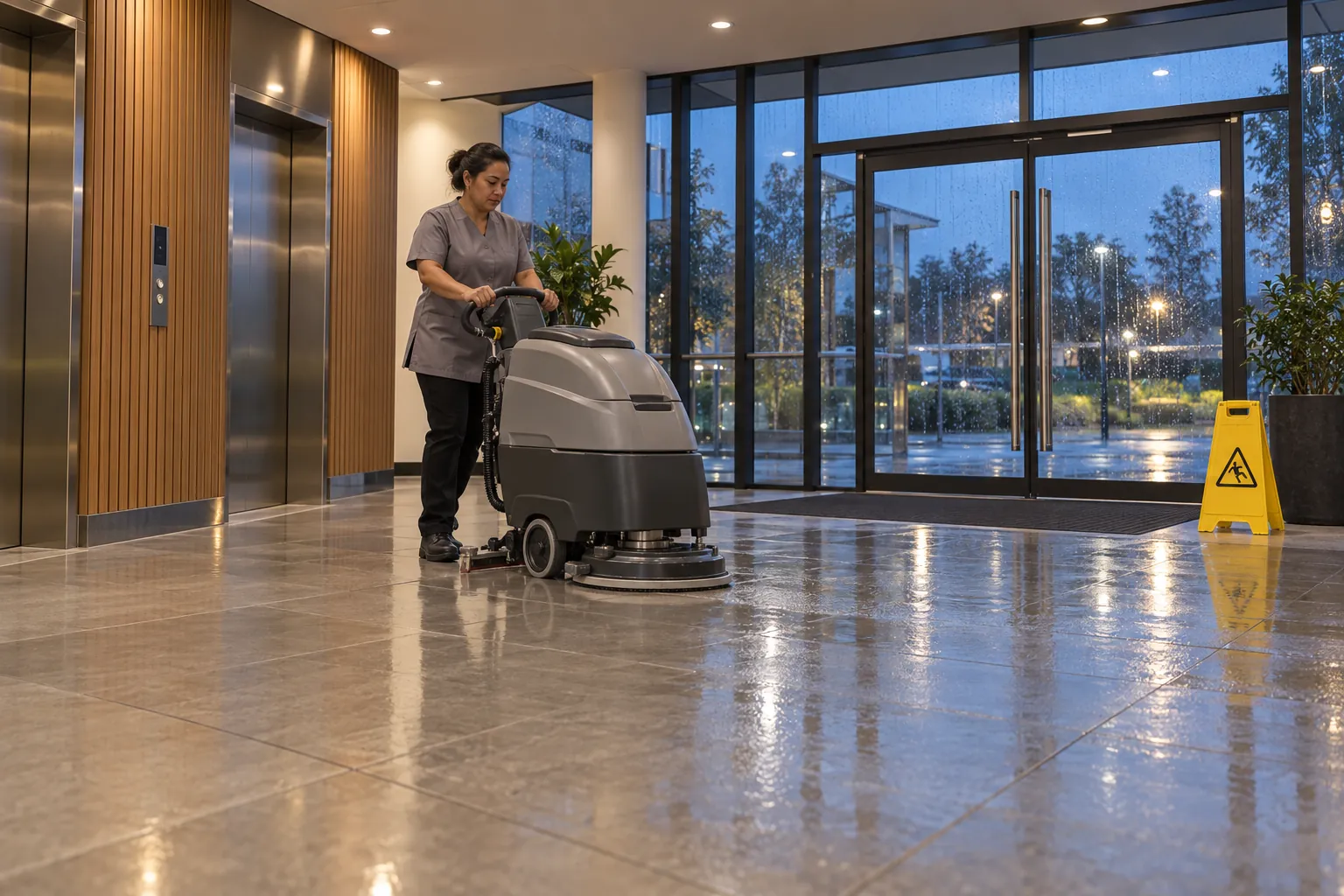
- Clean hard floors by vacuuming and mopping, or with a scrubber-dryer; check again in wet weather.
- Clean the glass of entrance doors and screens at hand height.
- Wipe the reception counter, visitor seating, sign-in screen and door push plates.
- Empty bins and check the area is clear of trip hazards.
Offices and desks
- Empty rubbish and recycling bins and replace liners.
- Wipe each clear desk; do not move papers or equipment unless the specification says so.
- Wipe shared keyboards, phones and printer controls where agreed.
- Vacuum carpets and walkways, with the busiest routes daily; spot-clean spills.
- Dust window sills, ledges and partition tops within reach.
Meeting rooms
- Clear cups and litter; wipe tables and chairs.
- Clean whiteboards if left clean-ready, and wipe control panels and remotes.
- Vacuum or mop and reset furniture to the standard layout.
Kitchens, tea rooms and the smoko room
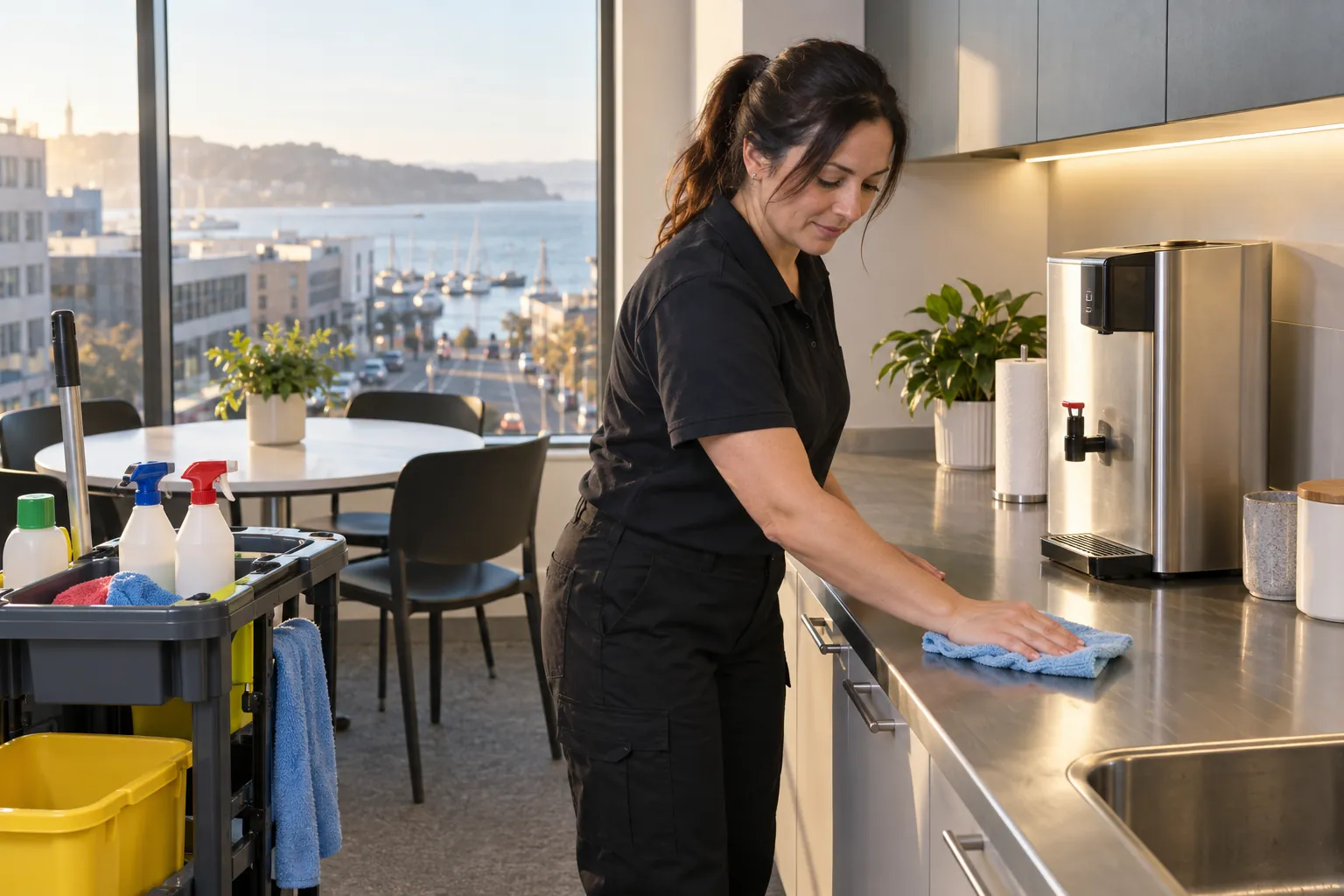
- Clean and sanitise benches, sinks and taps.
- Wipe appliance fronts, handles and controls: fridge, microwave, jug, zip or instant hot water unit, dishwasher.
- Load or empty the dishwasher if the contract includes it.
- Empty food scraps, rubbish and recycling.
- Mop the floor and restock hand soap and paper towels.
- Where food is prepared for sale, follow the cleaning in the food control plan: in a commercial kitchen it takes precedence over this list.
Toilets and showers
- Clean and disinfect pans, urinals, seats and flush buttons.
- Clean basins, taps, mirrors, cubicle doors, locks and partitions.
- Restock toilet paper, soap, paper towels and sanitiser; check hand dryers work.
- Empty rubbish bins and check sanitary bins are within capacity.
- Mop the floor, working towards the door, and report any leak, blockage or broken fitting.
Corridors, stairwells and lifts
- Vacuum or mop floors and stair treads.
- Wipe handrails, door handles, push plates and lift buttons.
- Check exits and escape routes are clear of trolleys, cleaning gear and rubbish, and that no fire door has been wedged open to make the round easier.
Weekly, monthly and periodic
- Weekly: dust high ledges and skirtings, spot-clean doors and frames, clean inside microwaves and fridges, clean internal glass, chair bases and bin exteriors.
- Monthly: dust air vents and grilles, clean light switches and sockets thoroughly, wash internal bins.
- Periodic, often quarterly or annually: extract-clean carpets, strip and reseal hard floors, deep clean toilets and kitchens, and outside windows by a specialist.
04
How to use the checklist on shift
A checklist only improves cleaning if it matches how the work is really done. A few habits make the difference.
- Write it in route order. The list should follow the path the cleaner walks, so that it is read as the work progresses rather than looked at at the end of the shift.
- Clean from top to bottom and from clean to dirty. High surfaces before low ones, dry dusting before wet cleaning, and toilets last or with separate equipment, so that dirt and germs are not carried from one area to the next.
- Use a colour-coded system. Most cleaning companies use separate colours of cloth, mop and bucket for toilets, general areas and kitchens, so that equipment used on a toilet is never used on a kitchen bench. Put the colour for each area on the checklist.
- Name the product, and keep its information to hand. WorkSafe's page on safety data sheets says "It is mandatory to have a current safety data sheet for each of the hazardous substances in your workplace regardless of the quantity you hold", readily accessible, and its hazardous substances inventory page says "Businesses are required to have an inventory of all their hazardous substances". Consumer products used in the quantities (and, for the inventory, the ways) of household use are exempt, though workers must still have ready access to information on safe use, handling and storage; commercial concentrates are not exempt. See the hazardous substances inventory guide.
- Deal with wet floors properly. WorkSafe's slips, trips and falls page names a floor that is wet "because something is spilt on it, or because of weather conditions or cleaning processes" as a cause of slips. Its page on the risks in offices says to "Clean any spills immediately and dry the floor and use signage" and to "Consider scheduling cleaning for times when there are fewer people around." A wet floor sign goes out while the floor is wet and comes away when it is dry.
- Record exceptions, not only ticks. A task that could not be done, because a room was locked or a meeting overran, should say so. So should a fault found: a leaking tap, a broken light, a dispenser that will not close.
- Make time for it. A list longer than the hours on site gets completed on paper, not in the building.
Keep one checklist per area or per route, not one for the whole building. When something is missed, a list per area shows where; a single sheet for the building shows only that the shift ended.
Much commercial cleaning is done early or late, often by one person in an empty building. The primary duty's "safe systems of work" covers that too: who knows the cleaner is there, and what they do if they are hurt. WorkSafe's guidelines on regulation 9 say workers "should only do the tasks they have the adequate knowledge or experience to do, or they should be adequately supervised", worth remembering when a new cleaner is handed the checklist on their first night.
05
How to check the checklist is being followed
A completed checklist shows that the work was recorded. Whether it was done, and done well, needs someone else to look. The usual layers are:
- The supervisor's walk-round. A short, regular inspection of a sample of areas against the checklist, at varied times, including first thing in the morning when the night's work is fresh. The cleaning supervisor duties guide covers the role.
- A quality audit. A scored inspection against the standards in the specification, often monthly and sometimes jointly with the client or the property manager.
- Complaints and requests. Every complaint is a data point: where it was, what time, and whether the checklist for that area showed the task as done.
- Completion against the schedule. How many of the scheduled tasks were completed, and why the rest were not. A figure of 100% every day with no exceptions usually means nobody is looking.
Checking is not only good management; it is part of the duty when more than one business shares a building. WorkSafe's overlapping duties quick guide says businesses "must so far as is reasonably practicable consult, cooperate and coordinate activities with all other businesses they share overlapping duties with". Handing the cleaning to a contractor is a reasonable agreement, but it "does not mean they no longer hold any responsibility for their workers"; the business "must still monitor the other business to ensure they follow through on what was agreed." For a tenant or a property manager, that means checking the cleaner's work, not only paying the invoice; see the overlapping duties guide.
Review the checklist when the building's use changes: a new tenant, different hours, a café in the foyer. WorkSafe's General risk and workplace management – part 2 explains that PCBUs must "review and, as necessary, revise the control measures", including when a control fails or the workplace changes. If the same toilet keeps running out of paper by mid-morning, the checklist is the control to revise, and the cleaners will usually know why.
06
Where the checklist record fails, and what SiteClara does about it
The paper checklist is completed by the person whose work it records, often at the end of the shift, and lives in a folder in the cleaners' cupboard. A tenant who wants to know whether the kitchen was cleaned last night has to take someone's word for it, and a cleaning company with twenty buildings finds out about a missed floor when the complaint arrives.
SiteClara puts a printed QR poster at each area on the checklist, with an optional NFC tag behind it. A member of the team scans the code or taps the tag on their own phone, with no app to install, and sees the scheduled checks due at that location. They mark each one done, or explain what stopped them, and can add a photo when the check asks for one. The time and the named person are recorded as it happens. A fault found on the round, such as a leaking tap or a broken dispenser, can be reported there and goes onto the team's list of open jobs until someone closes it.
The supervisor sees what is due, done and missed across the building, records the reason a check was missed, and sees open jobs by building and floor. At the end of the day they review and approve the report, which goes to nominated managers or client contacts the next morning: what was completed, what is still open and how the scheduled checks went. Where a record is required by law or by a plan, SiteClara is the working record, not the statutory one; the safety data sheets, the inventory and a food control plan's records stay where they are.
07
Questions people ask
What is included in commercial cleaning?
At the least, the facilities the law says a workplace must have. WorkSafe's guidelines General risk and workplace management – part 1 list them under regulation 11, among them toilets, drinking water, hand-washing facilities, facilities for eating and taking breaks, and somewhere for a worker who is unwell to rest. Under regulation 12, PCBUs must ensure, so far as is reasonably practicable, that these are "maintained to be in good working order, and are clean, safe, and accessible". Most contracts add the entrance, offices, meeting rooms, corridors, stairs, lifts and rubbish, as the checklist above does.
What is a standard cleaning checklist?
There is no standard one in New Zealand law. The same WorkSafe guidelines, General risk and workplace management – part 1, say that which facilities are adequate depends on matters including the "size, location and nature of the workplace" and the "number and composition of the workers at the workplace". A good checklist is written for the building: divided by area, with daily, weekly and periodic tasks, and room to record what was not done.
What supplies do you need for commercial cleaning?
Besides colour-coded cloths, mops and buckets, and products to clean and disinfect each area, a commercial cleaner needs the paperwork for its chemicals. WorkSafe's page on safety data sheets says "It is mandatory to have a current safety data sheet for each of the hazardous substances in your workplace regardless of the quantity you hold", and that the full sheet or a condensed version "must be readily accessible to people who may handle, or be exposed to, the hazardous substance". Consumer products used in household quantities are exempt, though workers must still have ready access to information on safe use, handling and storage; commercial concentrates are not.
08
Further reading, and a list to take away
WorkSafe New Zealand publishes the general risk and workplace management guidelines, the overlapping duties quick guide, and guidance on hazardous substances and slips. Where the building has a commercial kitchen, the Ministry for Primary Industries explains that a food control plan "sets out what steps a business making or selling higher-risk foods needs to take to make safe food", and cleaning in those areas follows it. Where the building has an approved evacuation scheme, Fire and Emergency New Zealand's page on how to maintain your scheme warns that "Failure to maintain an approved evacuation scheme can lead to the closure of the building".
Before you hand a commercial cleaning checklist to the team, check that it:
- is divided by area and written in the order the work is done;
- matches the specification, with nothing on it the contract does not cover;
- says who cleans the shared areas in a multi-tenant or body corporate building;
- names the colour code and the product for each area, with a current safety data sheet for every commercial chemical;
- has room to record tasks not done, and why, and faults found;
- fits the hours on site, with safe arrangements for anyone working alone;
- is checked by someone other than the person who completed it;
- has a date for review when the building's use changes.
Sources
Every document this guide quotes or links to, in the order it first cites them.
- Introduction to the Health and Safety at Work Act 2015 special guide worksafe.govt.nz
- General risk and workplace management – part 1 worksafe.govt.nz
- Safety data sheets worksafe.govt.nz
- Hazardous substances inventory worksafe.govt.nz
- Slips, trips and falls worksafe.govt.nz
- Offices worksafe.govt.nz
- Overlapping duties quick guide worksafe.govt.nz
- General risk and workplace management – part 2 worksafe.govt.nz
- Food control plan mpi.govt.nz
- Maintain your scheme fireandemergency.nz
Related guides
 CleaningOffice cleaning checklist: what a New Zealand office cleans, how often, and how it shows itAn office cleaning checklist for New Zealand workplaces: the HSWA duty, daily, weekly and periodic tasks, who owns each one, and how to show the work was done.
 CleaningToilet cleaning checklist: what a New Zealand workplace checks, and how it shows itA toilet cleaning checklist for New Zealand workplaces: the HSWA facilities duty, what to check, how often, checks against cleans, and a record people believe.
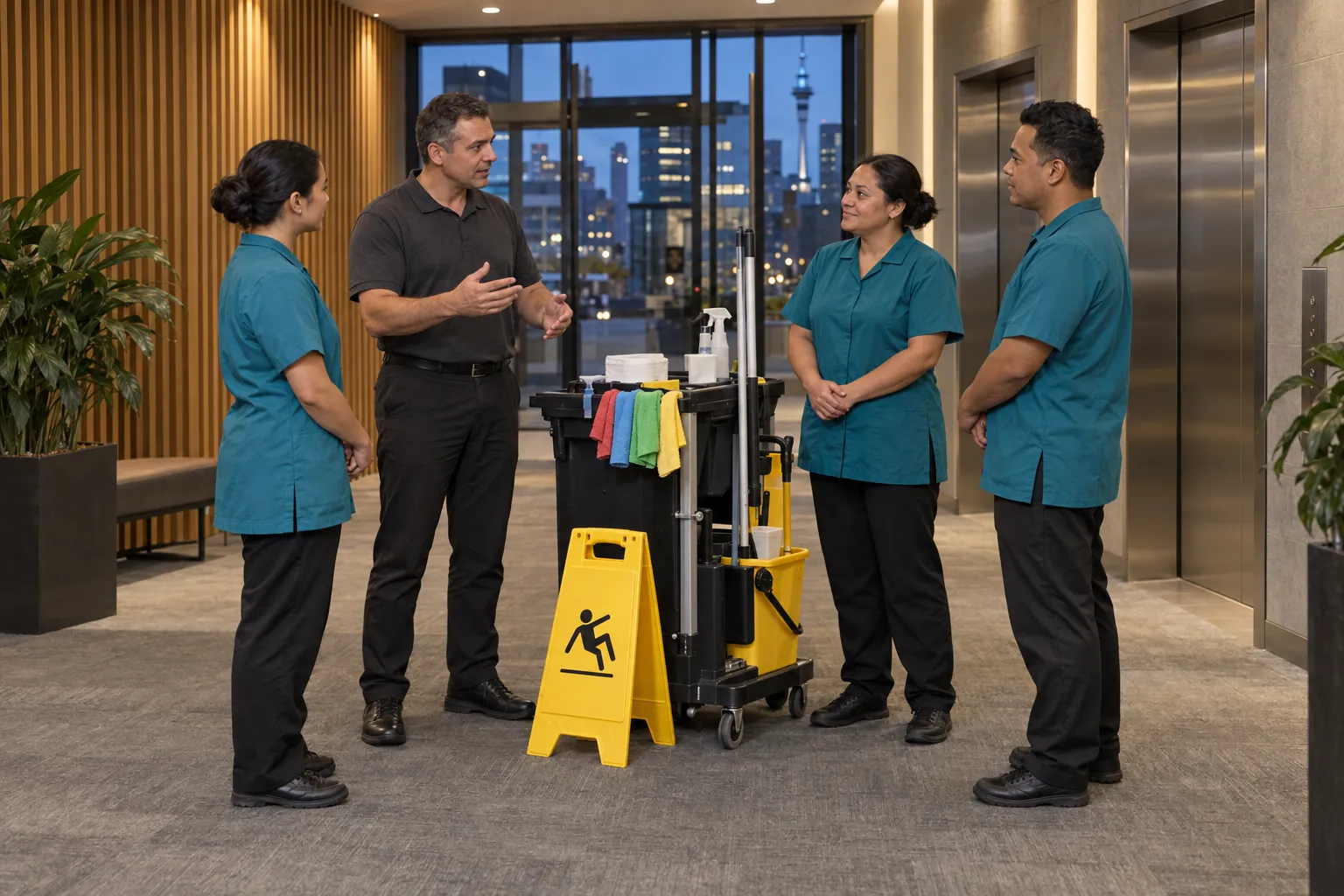 CleaningCleaning supervisor duties: what the role involves in New Zealand, and what good looks likeWhat a cleaning supervisor does in New Zealand: the main duties, a typical shift, the HSWA side, managing the team, checking the work and reporting to the client.
 CleaningCleaning log sheet: what it records, who signs it, and what it provesWhat a cleaning log sheet should record in a New Zealand workplace, who fills it in and who checks it, how long to keep it, and what a signature on it can prove.