Premises and facilities management
Concierge duties: what a building concierge does, and how the work is shown
A building concierge's duties are to run the front desk of a block of flats or an office building: welcoming residents, tenants and visitors, controlling who comes in, taking in parcels, looking after keys, walking the communal areas, reporting faults and keeping the log, under a job description set by the employer or managing agent rather than by any statute.
Also written for United States

That is a different job from the hotel concierge who books tables, taxis and theatre tickets for guests, although the two share a desk-side manner. This guide covers the duties of a residential and commercial concierge in the UK, the front of house security part of the role and when it needs an SIA licence, the fire and safety checks a concierge is often asked to carry out, and how the work can be set, recorded and checked.
01
What a building concierge is, and the rules behind the role
In a UK building, a concierge is the person on the front desk who looks after the building and the people in it on behalf of whoever runs it. In a residential block that is usually the managing agent, a housing association or a build-to-rent operator; in an office or a multi-let building it is the landlord's facilities management team. The job goes by several names: concierge, porter, front of house officer, reception security officer, building attendant. Some concierges are employed directly by the building's owner or agent; many are supplied under contract by a facilities management or security company.
No statute sets out what a concierge must do. The duties come from the job description, the contract and, for a security-led post, the site's assignment instructions. What the law does is shape parts of the job:
- Security licensing. Under the Private Security Industry Act 2001, guarding premises against unauthorised access, disorder or damage is manned guarding, a licensable activity, and Schedule 2, paragraph 2 says that guarding premises against unauthorised access includes "being wholly or partly responsible for determining the suitability for admission to the premises of persons applying for admission". So a desk that decides who may come in can be security work (see section 04).
- Fire safety. The Regulatory Reform (Fire Safety) Order 2005 applies in England and Wales to offices and to the parts of a residential building used in common, such as entrance halls, corridors and stairs; its definition of domestic premises leaves out anything "used in common by the occupants of more than one such dwelling". The duties belong to the responsible person, but the concierge often carries out the routine checks.
- Health and safety. The employer must assess and manage the risks of the job, including working alone at night, under the Health and Safety at Work etc. Act 1974 and the regulations made under it.
- Data protection. Visitor books, parcel logs, CCTV and incident notes hold personal data and fall under the UK GDPR and the Data Protection Act 2018.
Fire safety law differs in Scotland and Northern Ireland, where the building's own fire risk assessment is the guide.
02
The duties of a building concierge
A building concierge job description usually includes most of these, weighted to the building and the hours:
- Front of house: greeting residents, tenants and visitors, answering questions, giving directions and being the first point of contact for anyone who needs help.
- Access control: checking who is coming in, signing in visitors and contractors, issuing and recovering passes and fobs, and refusing entry to people who should not be there.
- Post and parcels: taking in deliveries, logging them, storing them securely and handing them over to the right person, with a record of who collected what and when.
- Keys: holding contractor keys, plant room keys and, in some blocks, residents' spare keys, issuing them against a signature and checking they come back.
- Contractors: letting contractors in, checking they are expected, showing them where the asbestos and permit information is held, and seeing them off site.
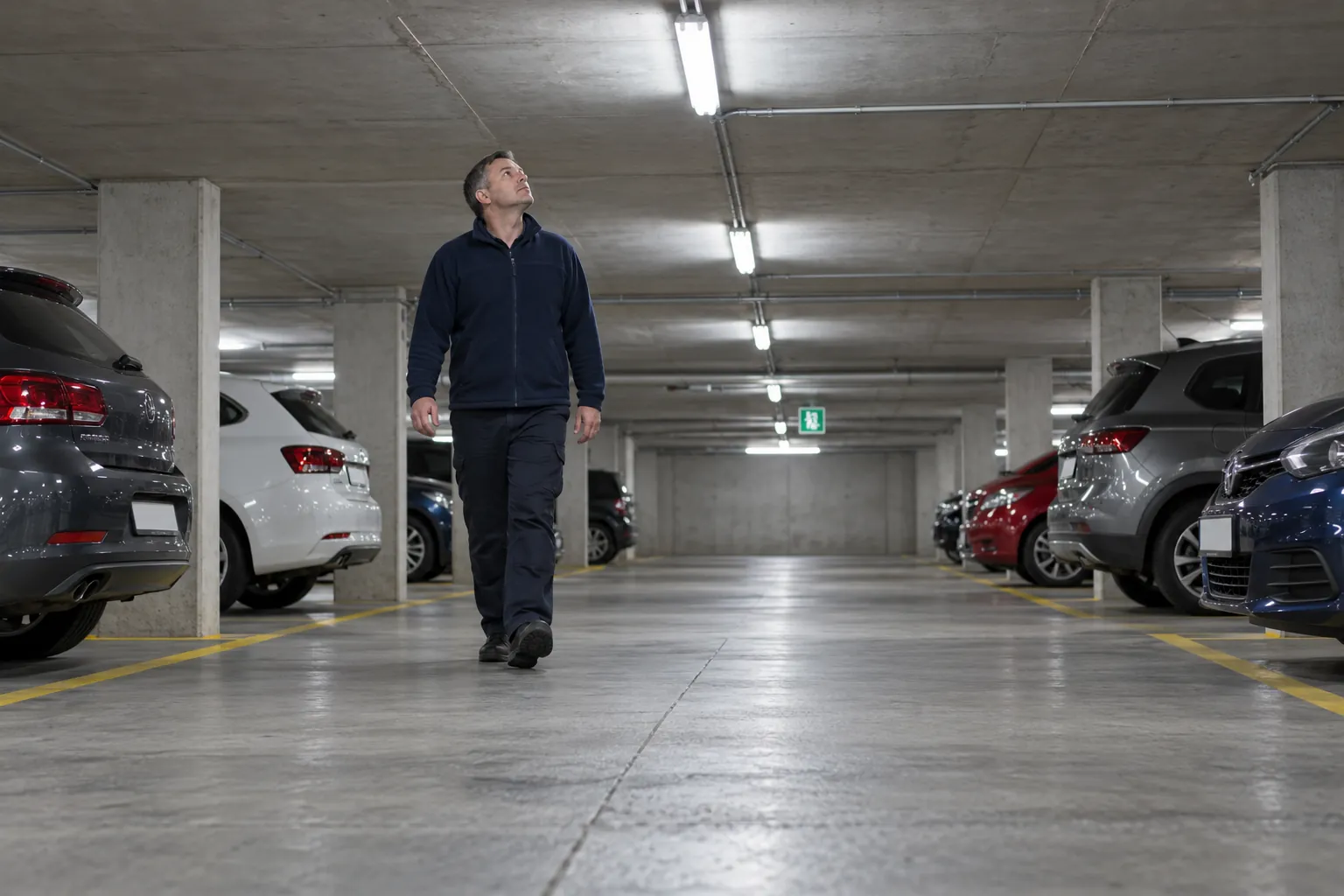
- Rounds of the building: walking the communal areas, car park, bin store and roof access at set times, checking that lights work, escape routes are clear, fire doors close, lifts run and nothing has been damaged or dumped.
- Fault reporting: passing faults found on a round, or reported by residents and tenants, to whoever fixes them, and following up until they are fixed.
- Monitoring: watching CCTV, door entry and alarm panels where the building has them, and responding to alarms.
- Emergencies: helping with evacuation when the fire alarm sounds, calling the emergency services, meeting them on arrival and handing over information about the building.
- Records and handover: keeping the daily occurrence book or log, and handing over to the next shift with open issues, keys out and anything to watch.
03
How the job differs between residential and office buildings
The core of the role is the same everywhere, but the setting changes the emphasis.
- Residential blocks and build-to-rent: a residential concierge knows the residents, deals with their requests, takes in their parcels and dry cleaning, lets in their contractors, deals with noise and nuisance complaints in line with the lease or tenancy terms, and reports repairs in the common parts to the managing agent. Many residential posts are 24 hours, with a night concierge working alone.
- Offices and multi-let buildings: a commercial concierge, often called front of house or reception security, runs visitor management for several tenants, issues passes, controls the turnstiles and goods-in, and acts as the eyes of the building manager on the floors and in the car park.
- Hotels: the hotel concierge is a guest service role in hospitality, handling guests' requests during their stay, from local information and events to transport and restaurant reservations. The National Careers Service hotel porter job profile lists tasks such as arranging taxis, booking tickets, making reservations and running errands, and says that with experience a porter could become "a concierge, working front of house". Most of this guide is about the building concierge, not the hotel one.
In residential blocks in England, a concierge is often the person who carries out the checks the Fire Safety (England) Regulations 2022 require of the responsible person. Since 23 January 2023, in a multi-occupied residential building over 11 metres high, the responsible person must check all communal fire doors every three months and use best endeavours to check flat entrance doors every year; in a high-rise building of 18 metres or 7 storeys or more, lifts for firefighters and essential firefighting equipment must be checked every month, and the fire and rescue service told if they are out of action for more than 24 hours. The duty stays with the responsible person; the concierge does and records the check. See the guide to communal fire door checks for what each check involves.
04
Reception and front of house security, and when a licence is needed
Reception security, sometimes sold as concierge security, is the part of the concierge's job that keeps the wrong people out without making the building unwelcoming. In practice it means:
- knowing who is expected, and checking anyone who is not with the person they have come to see before they go beyond the reception area;
- issuing visitor passes and getting them back, and keeping the visitor record accurate;
- watching for tailgating at doors and turnstiles, and for people trying doors on the upper floors;
- checking contractors against the planned works and any permit to work;
- knowing the building's evacuation and lockdown arrangements and who to call.
Whether the concierge needs an SIA licence depends on what they do and who employs them, not on the job title. The Security Industry Authority's guidance, Find out if you need an SIA licence, says a front line licence is needed by anyone who personally performs a licensable front line activity as part of their job, and that "this applies to any job role". It also says you do not usually need a licence if you work in-house, employed directly by the organisation that uses your services, except for door supervision at licensed premises and vehicle immobilising in Northern Ireland. So a concierge supplied under a contract for services whose job includes guarding the building, deciding who may come in, or patrolling to deter intruders will normally need a security guarding licence.
The Act also draws boundaries. Under Schedule 2, paragraph 2, checking only that people have paid or hold "invitations or passes allowing admission" is not manned guarding, and nor is responding to a sudden or unexpected occurrence incidentally to work that is not wholly or mainly security. The SIA gives the example of a receptionist who helps evacuate people when the fire alarm sounds. Key holding is licensable under Schedule 2, paragraph 6, but not when a person holds keys only "for purposes incidental to the provision" of services that are not security work. Where a contracted post sits close to these lines, settle it with the provider before the post starts.
Some buildings with public access will also have duties under the Terrorism (Protection of Premises) Act 2025, known as Martyn's Law. Its standard duty requirements factsheet says the Act received Royal Assent on 3 April 2025 and that premises in scope will need procedures for evacuation, invacuation, lockdown and communication; those requirements are not yet in force.
05
How concierge duties are set, recorded and checked
The duties for each concierge post belong in writing: the contract or service specification, which sets the hours and the service; the job description; and the site's instructions, which say what to check, when, where to record it and who to call. For a security-led front of house post, BS 7499:2026 Provision of static guarding security services. Code of practice, revised in August 2026, covers assignment instructions, site records, key management and performance evaluation, and many providers work to it.
The records a well-run concierge desk keeps are usually these:
- The daily log: what happened on each shift, in time order, written as it happens.
- The visitor and contractor record: who came in, who they saw, when they left.
- The key log: which key went to whom, when, and when it came back.
- The parcel log: what arrived, for whom, and who collected it.
- The round record: which areas were walked and checked, when, and what was found.
- The fault list: what was reported, to whom, and whether it has been fixed.
- The handover: open issues, keys out and anything the next shift must watch.
The supervisor, contract manager or managing agent then checks the work: by visits, at night as well as by day; by reading the log and fault list for gaps and repeat problems; by comparing rounds completed with rounds scheduled; and by listening to residents and tenants, who notice quickly when the desk is empty or a fault is ignored.
Night concierges often work alone. The Health and Safety Executive's guidance Lone working: Protect those working alone counts security staff among lone workers and says employers must manage the health and safety risks before people work alone. For a concierge that means a lone working risk assessment, a way of keeping in touch, and clear instructions on what not to do alone, such as confronting an intruder or entering a flat.
06
Where the concierge's record fails, and where SiteClara fits
Most of a good concierge's work leaves no trace. A round that finds nothing is written up as "all in order" at the end of the shift, the fire door check is ticked on a sheet behind the desk, and the leak a resident mentioned goes into the log and no further. When a managing agent or client asks whether the building was walked last night, the answer is a handwritten book and somebody's memory.
SiteClara gives the routine part of the job a record. A printed QR poster, with an optional NFC tag behind it, sits at each place a check is due: the bin store, a fire door on each landing, the car park, the plant room door, the roof access. The concierge scans the code or taps the tag on their own phone, with no app to install, sees the checks due there and marks each one done, or explains what stopped them, with a photo when one is asked for. The time and the named person are recorded as it happens. A fault found on the round is reported there and goes onto the team's list of jobs until someone closes it, and a poster in a communal area can let residents or tenants report a fault the same way.
The supervisor sees what is due, done and missed, records the reason when a check was missed, and can escalate a job to the building manager, who can answer it. Each day the supervisor reviews the totals and photos, adds a note and approves a short report, which goes to nominated contacts such as the managing agent or the client at 8am the next morning, showing what was reported, what was completed, what is still open and how the scheduled checks went.
07
Questions people ask
Is a concierge like a receptionist?
A building concierge does a receptionist's job and more: the National Careers Service receptionist job profile describes receptionists as "the first point of contact for visitors to an organisation", greeting visitors, managing signing in and security passes and dealing with post and deliveries, all of which a concierge does too. A concierge usually adds the building itself: rounds of the communal areas, keys, contractors, fault reporting and the first response to alarms, often around the clock.
Does a concierge need an SIA licence?
A concierge needs an SIA licence when they personally carry out a licensable activity, such as guarding the building against unauthorised access or deciding who is suitable to be admitted, under a contract for services; the SIA's guidance Find out if you need an SIA licence says this applies to any job role. A concierge employed in-house by the building's owner does not usually need one, and helping to evacuate a building when the fire alarm sounds is not, on its own, licensable.
What skills does a concierge need?
A concierge needs customer service skills above all: the National Careers Service hotel porter job profile, a role it says can lead with experience to "a concierge, working front of house", lists "customer service skills", "excellent verbal communication skills", "active listening skills" and the ability to work well with others. A building concierge also needs the care to keep accurate logs, a calm manner in an emergency and, for a contracted security-led post, an SIA licence.
What are the two golden keys of a concierge?
The two crossed golden keys are the mark of Les Clefs d'Or, the Union Internationale des Concierges d'Hotels: the Les Clefs d'Or home page says its hotel concierges are "distinguished by the golden crossed keys on their lapels" and describes them as "local experts who have spent years getting to know their cities". They mark membership of a professional association of hotel concierges, not a qualification for a building concierge.
08
Further reading, and a list to take away
The Security Industry Authority's licensing guidance is on GOV.UK and the Private Security Industry Act 2001 on legislation.gov.uk. The Home Office's fact sheets on the Fire Safety (England) Regulations 2022 explain the checks in residential blocks; BSI publishes BS 7499:2026, the HSE covers lone working and the ICO covers CCTV.
Before a concierge starts on a building, or when you review the post, check that:
- the duties are written down, including the rounds, the checks and their times;
- it is clear whether the post needs an SIA licence, and if so that it is held and in date;
- the concierge knows which fire safety checks are theirs, how often and where they are recorded;
- visitors, contractors, keys and parcels each have a record, and someone reads them;
- faults go to a named person and are followed up until fixed;
- there is a lone working risk assessment and a way of keeping in touch at night;
- the concierge has had training in the building's fire, evacuation and incident procedures;
- the managing agent or client can see, each day, what was done and what is still open.
Sources
Every document this guide quotes or links to, in the order it first cites them.
- Private Security Industry Act 2001 legislation.gov.uk
- Schedule 2, paragraph 2 legislation.gov.uk
- Regulatory Reform (Fire Safety) Order 2005 legislation.gov.uk
- Health and Safety at Work etc. Act 1974 legislation.gov.uk
- Data Protection Act 2018 legislation.gov.uk
- Hotel porter job profile nationalcareers.service.gov.uk
- Fire Safety (England) Regulations 2022 gov.uk
- Find out if you need an SIA licence gov.uk
- Schedule 2, paragraph 6 legislation.gov.uk
- Standard duty requirements factsheet gov.uk
- BS 7499:2026 Provision of static guarding security services. Code of practice knowledge.bsigroup.com
- Lone working: Protect those working alone hse.gov.uk
- Video surveillance (including guidance for organisations using CCTV) ico.org.uk
- Receptionist job profile nationalcareers.service.gov.uk
- Les Clefs d'Or home page lesclefsdor.org
Related guides
 Premises and facilities managementBuilding manager responsibilities: the duties, the daily work and the recordWhat a building manager is responsible for in UK commercial and residential buildings: legal duties, daily work, contractors and the records that prove it.
 Premises and facilities managementManaging agent responsibilities in residential block managementWhat a managing agent does for a block of flats in England and Wales: service charges, the RICS code, repairs, fire safety in common parts, and records.
 Premises and facilities managementCaretaker duties: what the job involves, and how to show it was doneCaretaker duties in halls, churches, offices, flats and schools: opening and locking, routine checks, minor repairs, cleaning and working alone safely.
 Security patrolsDaily occurrence book: what to record, and how to keep one that stands upDaily occurrence book (DOB): what to record, how to write entries that stand up, how it differs from an incident report, and paper or digital.