Premises and facilities management
Concierge duties: what a building concierge does, and how to show it was done
A building concierge's duties are to staff the lobby desk of an apartment or office building: greeting residents, tenants and visitors, receiving packages and deliveries, taking service and maintenance requests, controlling keys and fobs, and acting first in an emergency.
Also written for United Kingdom
No federal or state law defines the concierge role, so the duties are whatever the property manager writes into the job description and the desk manual. That makes the written duties, and a record of what was done, the whole of the job's standard. This guide covers what a concierge is and when the desk becomes regulated security work, the duties in practice, how a concierge differs from a front desk agent, a doorman and a security officer, the rules that reach the desk, and how a property manager can tell the shift was done.
01
What a building concierge is, and when the desk becomes security work
O*NET, the occupational database sponsored by the U.S. Department of Labor, describes Concierges (39-6012.00) as people who "assist patrons at hotel, apartment, or office building with personal services" and who "may take messages; arrange or give advice on transportation, business services, or entertainment; or monitor guest requests for housekeeping and maintenance." This guide is about the concierge at the lobby desk of an apartment building, a condo, a student housing block or an office tower, whose day is residents, tenants, visitors, packages and the building itself.
No federal or state statute sets concierge duties. A residential or commercial concierge works to a job description, a desk manual (sometimes called the concierge post orders) and the property manager's instructions, and the employer may be the owner, the management company or a contract concierge or security firm.
When the desk is security work. The line that matters is licensing. There is no federal license; each state decides who counts as a security guard. In New York, Article 7-A of the General Business Law, the Security Guard Act of 1992, section 89-f defines a security guard as a person employed by a security guard company to principally perform functions such as protecting people or property from harm, theft or unlawful activity, deterring, observing, detecting or reporting incidents, or responding to security system alarms. A "security guard company" includes any employer that employs guards for its own use, so an owner or management company that employs its own desk staff to do principally security work is covered as well as a contract firm. Under section 89-g, no person may be employed as a security guard or act as one without the registration the article requires, and the Department of State's security guard training requirements call for an 8 hour pre-assignment course, 16 hours of on-the-job training and 8 hours of annual in-service training.
California draws the line differently. Business and Professions Code section 7574.01 defines a proprietary private security officer as an unarmed person employed by one employer whose primary duty is to provide security services for that employer, who is required to wear a distinctive uniform clearly identifying them as a security officer, and who is likely to interact with the public. A concierge whose main job is guest service sits outside both definitions; one whose job is mostly access control, alarm response and patrol may not, which is why the written duties matter. Check with the state's regulator before giving a concierge desk security work.
02
Concierge duties in practice
A concierge job description for a residential or office building typically lists most of these concierge responsibilities. The desk manual says which apply in this building, and how:
- Residents, tenants and guests. Greeting people, answering questions, taking messages and giving directions.
- Visitors. Signing guests and visitors in, calling up to the resident or host, issuing visitor passes where the building uses them, and following the building's rules for who may go up unescorted.
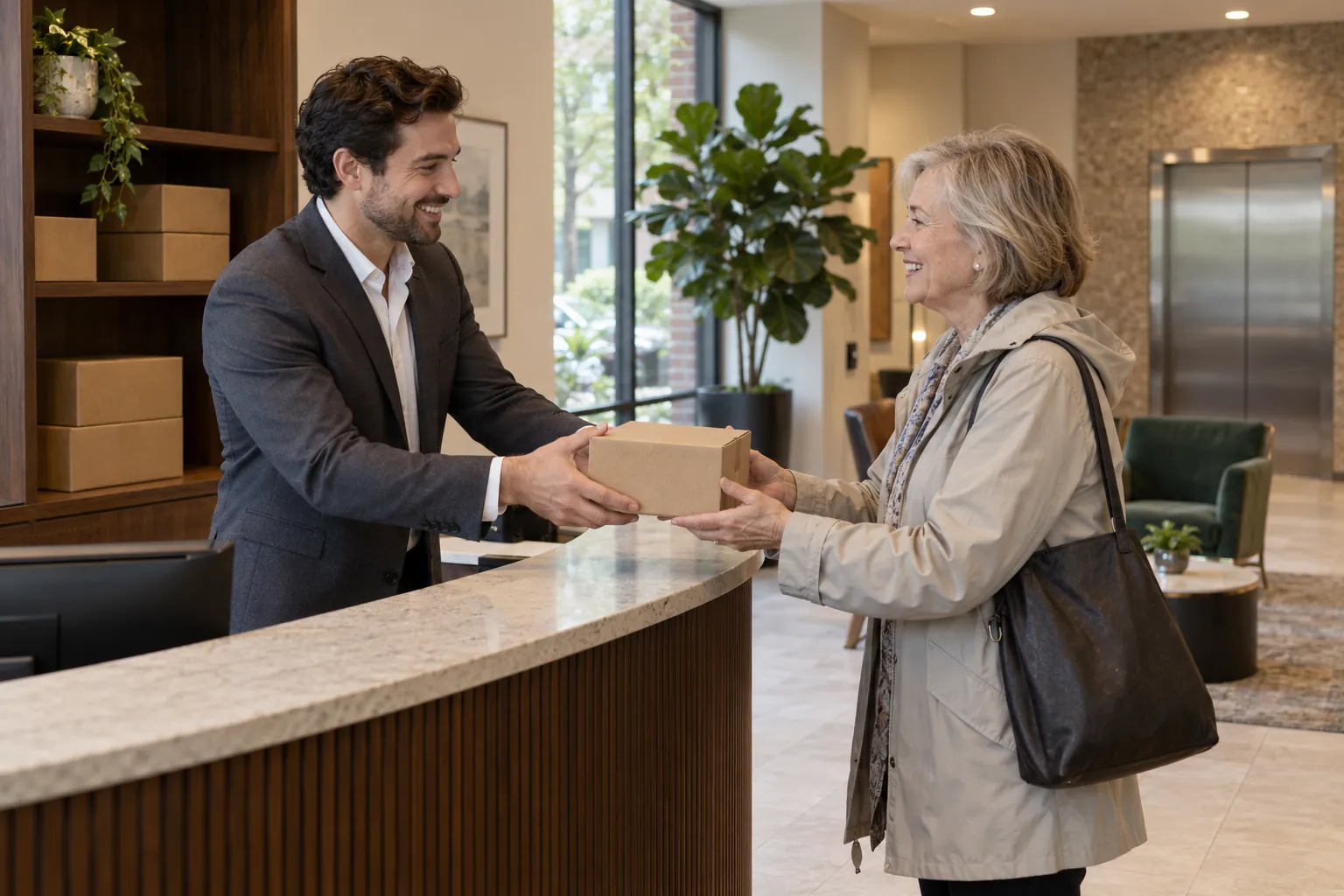
- Packages and deliveries. Receiving packages, couriers, food deliveries and dry cleaning, logging them, storing them in the package room or lockers, notifying the resident and recording who collected each item.
- Service and maintenance requests. Taking requests and fault reports from residents and tenants, entering them as work orders, and telling the building engineer, superintendent or day porter when something needs attention now: a spill in the lobby, a light out in the garage, an elevator out of service.
- Contractors, vendors and move-ins. Confirming that a contractor is expected, booking the service elevator and elevator pads for a move, checking the certificate of insurance where the building requires one, and signing contractors out.
- Keys, fobs and access cards. Issuing and recovering keys and fobs under the building's key control rules, and keeping the key log.
- Amenity spaces. Booking the party room, guest suite or conference room, and checking the space before and after use.
- The lobby and common areas. Keeping the lobby presentable, and on many properties walking short rounds of the mailroom, package room, amenity floors and garage entrance.
- Lost and found. Logging found items and returning them, under the building's lost and found procedure.
- Emergencies. The desk's part in the building's emergency plan: calling 911, alerting management, meeting the fire department, and responding to an elevator entrapment call where the desk receives them.
- Records. The desk log, the package log, the key log and a written handover to the next shift.
Residential concierge duties lean toward packages, guests and service requests; office concierge duties toward visitors, contractors and tenant services.
The skills are customer service ones. O*NET's Concierges (39-6012.00) summary lists customer and personal service as the first knowledge area for the job and active listening and speaking as its first skills, and says some positions need little or no previous experience while others need several months to a year, with anything from a few days to a year of on-the-job training. The knowledge specific to the building, such as who may go up unescorted and which contractors are expected, comes from the desk manual.
03
Concierge, front desk agent, doorman and security officer: who does what
The titles overlap, and the same person may hold more than one. In general use:
- Concierge. A service role at the lobby desk: residents, visitors, packages, requests and the building's day-to-day information. Customer service comes first.
- Hotel concierge. In the hospitality industry, the concierge's tasks lean toward guests' personal requests: O*NET's task list starts with providing information about local shopping, dining and nightlife, making reservations and giving directions. A building concierge does some of this, but most of the day is the building itself.
- Front desk agent. In a hotel, the person who checks guests in and out and handles bookings and payments. In an apartment or office building the title is often used for the same job as the concierge; O*NET lists Front Desk Agent and Lobby Concierge among the concierge's job titles.
- Doorman or door attendant. Common in large city apartment buildings: the door, taxis, deliveries arriving and the sidewalk, often alongside a concierge at the desk.
- Security officer. Access control, patrols, alarm response and incident reports, under a state license. The front desk security officer is the security version of the lobby post, and works to security post orders.
- Superintendent or building engineer. The building's systems and repairs. The concierge reports the fault; the super or engineer fixes it. In New York City, the superintendent rule for apartment buildings is a separate duty from anything at the desk.
So concierge vs front desk is usually a matter of emphasis. What matters is that the job description says which duties this desk carries, especially anything that sounds like security, and who the concierge calls for everything else.
04
Exits, emergencies, suspicious mail and threats: the rules that reach the desk
There is no OSHA standard for concierges. But the desk controls the lobby, handles the mail and is often the only staffed point in the building at night, so several general rules apply to the post. Federal OSHA covers private employers; where one of the 22 OSHA-approved State Plans covering private workers applies (21 states and Puerto Rico), the state's rules apply instead, and they must be at least as effective as OSHA's.
Exits stay usable. Under OSHA's design and construction requirements for exit routes, 29 CFR 1910.36, employees must be able to open an exit route door from the inside at all times without keys, tools or special knowledge. Under 29 CFR 1910.37, exit routes must be free and unobstructed, and no materials or equipment may be placed, either permanently or temporarily, within the exit route. For a concierge that means package overflow, move-in boxes and delivery carts never go into a stairwell or across an exit corridor. Local fire codes, enforced by the authority having jurisdiction, add their own rules.
The emergency action plan. Where an OSHA standard requires one, 29 CFR 1910.38, emergency action plans, requires procedures for reporting a fire or other emergency, for emergency evacuation, and to account for all employees after evacuation, among other elements; an employer with 10 or fewer employees may communicate the plan orally. The concierge's part belongs in the desk manual word for word; see the emergency action plan guide for the rest.
Suspicious mail and packages. The concierge handles more packages than anyone in the building. The United States Postal Inspection Service's guidance on suspicious mail lists signs such as no return address, excessive tape and postage, and misspelled or badly written words, and advises isolating the item, keeping a safe distance, washing your hands and calling the Postal Inspectors, with local authorities if medical attention is needed.
Threatening calls. The desk phone is often the building's public number. CISA's Bomb Threat Checklist provides instructions on how to respond to a bomb threat and the information that will help law enforcement; a copy belongs beside the phone, and the bomb threat checklist guide covers how to use it.
Workplace violence. OSHA's workplace violence page defines workplace violence as any act or threat of physical violence, harassment, intimidation or other threatening behavior that occurs at the work site, and says there are currently no specific OSHA standards for it. It names customer service agents and others who may work alone or in small groups among the workers at increased risk, and working late at night as a risk factor. A concierge alone at the desk overnight fits all three, so the desk manual should say what the concierge does when a visitor becomes aggressive: step back, do not physically intervene, call for help and record what happened.
05
How a concierge shift runs, and how the desk is checked
The same routine every shift lets a relief concierge take over and a property manager see what was done.
- Start of shift. Read the handover log and any notices from management. Count keys, fobs and visitor passes against the log. Check the phone and intercom, and that packages are stored out of exit routes.
- Through the day. Residents, visitors, contractors and deliveries as above. Each package logged in and logged out with the name of whoever collected it. Each service request entered as a work order with the time, the location and who reported it, rather than passed on by word of mouth.
- Rounds. Where the desk manual calls for them, short walks at set times: amenity rooms after bookings, the garage entrance, the trash room, the lobby restrooms. Anything wrong is reported there and then.
- Incidents. Anything unusual written up as it happens, with the time, the place, what was seen, what was done and who was told.
- End of shift. Recount keys and fobs, chase any package past its hold time, and write the handover for the next concierge: open requests, expected deliveries, contractors still in the building.
How the property manager checks the desk. The concrete questions are the useful ones: how many service requests were taken, and how many were closed; which packages have been waiting more than a week; whether the amenity room was checked after Saturday's party; whether the garage light reported on Monday is still out. A common area inspection by the manager, walking the same spaces the concierge is meant to check, is the simplest test of whether the rounds happen.
06
Where the record fails, and where SiteClara fits
The desk manual says the concierge checks the party room after every booking and walks the package room, the trash room and the garage entrance at 6 p.m. and 10 p.m. The desk log says rounds done, written at the end of the shift. A resident tells the concierge that the garage light is out; the concierge mentions it to whoever is passing, and the light is still out a week later because nobody wrote it down where the engineer would see it. When a resident complains about the state of the party room, nobody can say whether it was checked, by whom, or when.
SiteClara turns the rounds and checks in the desk manual into a record. A printed QR poster, with an optional NFC tag behind it, goes at each point the manual names: the package room, the amenity rooms, the trash room, the garage entrance, the desk itself for the start-of-shift and end-of-shift checks. The concierge scans the code or taps the tag on their own phone, with no app to install, sees the checks due at that point and marks them done, or says what stopped them, such as a room still in use. The time and the named person are recorded as it happens, with a photo when one helps. A fault found on the round, or reported to the desk, is reported at that point and goes onto the team's list of jobs, routed to the people who handle it, until someone closes it.
A supervisor sees what was due, done and missed, with the reason where one was given, and a job that needs the building manager can be escalated to them to answer. Each day the supervisor reviews the totals and photos and approves a report that goes to the nominated management contacts the next morning, showing how the scheduled checks went and what is still open.
07
Questions people ask
Is a concierge like a receptionist?
Partly: both staff a front desk, greet visitors and take messages, but a building concierge also serves the people who live or work there, with packages, service requests, keys and amenity bookings. O*NET's Concierges (39-6012.00) summary describes the role as assisting patrons at a hotel, apartment or office building with personal services, including monitoring guest requests for housekeeping and maintenance.
What are typical concierge services?
In a hotel, the task list in O*NET's Concierges (39-6012.00) summary starts with providing information about local shopping, dining, nightlife or recreation, making reservations for dinner, spa treatments or golf tee times, getting tickets to special events, and giving directions to guests. In an apartment or office building the typical services are the building's own: receiving packages, signing in visitors, taking maintenance requests, issuing keys and fobs and booking amenity rooms, as the building's job description sets them.
Does a concierge need a security guard license?
Not for guest service alone, but it depends on the state and on what the job really is. New York's General Business Law section 89-f covers people employed, by a contract security firm or in-house by the building's owner or manager, to principally protect people or property, deter or report unlawful activity, or respond to alarms, and California's Business and Professions Code section 7574.01 covers uniformed in-house officers whose primary duty is security. Check with the regulator in the state where the building is.
How much does a concierge make?
O*NET's Concierges (39-6012.00) summary gives median wages of $18.73 an hour, or $38,950 a year, for 2025, across all settings including hotels.
08
Further reading, and a list to take away
Start with O*NET's concierge summary, your state's security guard law if the desk does any security work, OSHA's exit route and emergency action plan standards, and the suspicious mail and bomb threat guidance above.
Before the next concierge starts at the desk, check that:
- the job description says which duties this desk carries, and which belong to security, the super or the engineer;
- if any duty is principally security work, the state's registration or license rules have been checked;
- the desk manual covers visitors, packages, service requests, contractors, keys and amenity bookings;
- every service request becomes a work order with a time and a location, not a word in passing;
- packages, carts and move-in boxes are kept out of stairwells and exit corridors;
- the desk's part in the emergency action plan is written down, with the Bomb Threat Checklist and the suspicious mail steps beside the phone;
- the desk manual says what to do when a visitor becomes aggressive, and the concierge working alone knows who to call;
- rounds have set times and a record made at the point, not at the end of the shift;
- faults reported at the desk reach someone who will fix them, and someone checks they were fixed;
- the handover is written and read at every change of shift.
Sources
Every document this guide quotes or links to, in the order it first cites them.
- Concierges (39-6012.00) onetonline.org
- Security Guard Act of 1992 nysenate.gov
- Section 89-f nysenate.gov
- Section 89-g nysenate.gov
- Security guard training requirements dos.ny.gov
- Business and Professions Code section 7574.01 leginfo.legislature.ca.gov
- OSHA-approved State Plans osha.gov
- Design and construction requirements for exit routes, 29 CFR 1910.36 osha.gov
- 29 CFR 1910.37 osha.gov
- 29 CFR 1910.38, emergency action plans osha.gov
- Guidance on suspicious mail uspis.gov
- Bomb Threat Checklist cisa.gov
- Workplace violence page osha.gov
Related guides
 Security patrolsFront desk security officer: what the lobby post does, and how to show it was doneWhat a front desk security officer does in the US: the state license, visitors and deliveries, exit and emergency rules, the shift and how it is checked.
 CleaningDay porter duties: what the job covers, and how to prove the roundsWhat a day porter does in an occupied building, a sample daily route, the OSHA rules behind the work, and how to show a client the rounds really happened.
 Premises and facilities managementCommon area inspection checklist: what to check, how often, and the record to keepA common area inspection checklist for apartment, condo and commercial buildings: what to check, how often, the codes and case law behind it, and the record to keep.
 Security patrolsKey control: how to know who holds every key, and prove itA key control program for US buildings: the key register, issuing and returning keys, audits, lost keys and rekeying, and what OSHA, HIPAA and Texas law say.