Premises and facilities management
Fridge temperature log: the limits, the daily reading, and what to do when it is out
A fridge temperature log is the dated record of each fridge's temperature, who checked it and what was done when it was out of range, kept to show that chilled food stayed at 8°C or below, the legal limit in England, Wales and Northern Ireland, and that vaccines and refrigerated medicines stayed between 2°C and 8°C.
Also written for United States · Canada · Australia
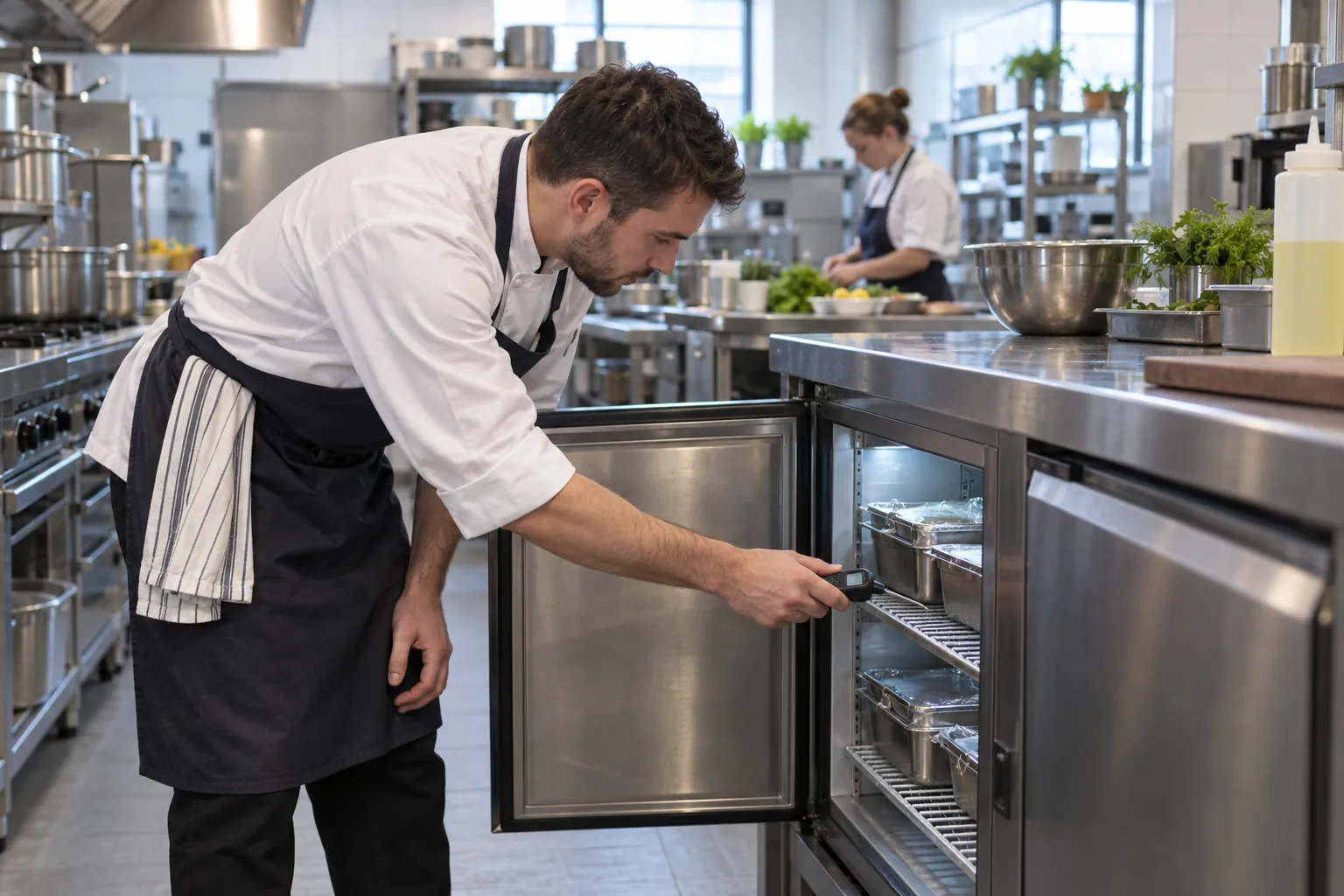
Kitchens in hotels, venues, schools and care homes keep one as part of their food safety management system; GP practices, clinics and care homes keep a separate one for the medicines fridge. This guide covers the law and guidance behind each, what a log sheet should record, how often and how to take a reading, and what to do when the figure is wrong.
01
What the law says: 8°C for chilled food, 2°C to 8°C for vaccines
Two sets of rules lie behind a fridge temperature log, and many buildings have both: kitchen fridges come under food hygiene law, and the medicines or vaccine fridge comes under clinical guidance.
Food. In England, paragraph 2 of Schedule 4 to the Food Safety and Hygiene (England) Regulations 2013 makes it an offence to keep food that is likely to support the growth of pathogenic micro-organisms or the formation of toxins, in a commercial operation, "at or in food premises at a temperature above 8 °C". The same rule is in Schedule 4 to the Food Hygiene (Wales) Regulations 2006 and the Food Hygiene Regulations (Northern Ireland) 2006. Scotland differs: Schedule 4 to the Food Hygiene (Scotland) Regulations 2006 requires food in a commercial operation to be kept in a refrigerator, a refrigerating chamber or a cool ventilated place, or above 63°C, with exceptions such as food being prepared or on display for sale, and GOV.UK's food hygiene guidance on chilling and freezing says 8°C is recommended there rather than required.
The England schedule exempts food that does not need chilling, such as food safe at ambient temperature for its whole shelf life and hot food kept at or above 63°C. It also gives two defences: food for service or on display for less than four hours, not previously kept above 8°C (paragraph 5(1)); and food above 8°C for a limited period consistent with food safety while being moved, or "for an unavoidable reason" such as handling, defrosting or a temporary breakdown of equipment (paragraph 5(2)). A log showing when a fridge failed and what was done is how you would show the second.
No regulation says "keep a fridge temperature log". The duty to record comes from Article 5 of Regulation (EC) No 852/2004, which requires a permanent procedure based on the HACCP principles, with documents and records commensurate with the nature and size of the business, and from Annex II, Chapter IX, which says food is not to be kept at temperatures that might result in a risk to health and "the cold chain is not to be interrupted".
Vaccines and medicines. Chapter 3 of UKHSA's Green Book, Storage, distribution and disposal of vaccines (the current text is dated June 2013), says vaccines should be stored as the manufacturer's summary of product characteristics says, usually at +2°C to +8°C, and that fridge temperatures "must be monitored and recorded at least once each working day". For care homes, the Care Quality Commission's page on storing medicines in care homes says providers must ensure their policies and procedures consider how staff will monitor the temperature of medicines storage areas.
02
What a fridge temperature log sheet should record
Whether it is a fridge temperature record sheet on the door, a page in the diary or a digital record, each entry should let someone who was not there see the reading, where and when it was taken, who took it and what happened next.
For a kitchen fridge or freezer:
- the date and time of the reading;
- which unit, named so nobody can confuse them: walk-in chiller, bar fridge, salad prep fridge, freezer 2;
- the temperature, and how it was taken: the display, a fridge thermometer or a probe between packs;
- the name or initials of the person who took it, written at the time;
- if it was out of range, what was done and when it was back in range.
For a vaccine or medicines fridge, the Green Book's sample refrigerator temperature record chart is headed with the health facility, a fridge identifier and the month, and has columns for the date and time, the current, minimum and maximum temperatures, a signature, a tick to show the thermometer was reset, and comments. It ends with a monthly review, with the reviewer's name and the date. Chapter 3 also asks for a separate log sheet, kept with the fridge, of servicing, defrosting, cleaning, calibration and electrical testing.
Keep the kitchen's fridge and freezer temperature log apart from the medicines one. They have different limits, different people responsible and different retention, and a care home's kitchen fridge and treatment room fridge should never share a sheet.
03
How often to check, and how to take a reading you can trust
Most kitchens in England work from the FSA's Safer food, better business for caterers pack (SFBB). Its chilled storage safe method recommends setting fridges and chilled display equipment at 5°C or below, so that chilled food is kept at 8°C or below, and says to check their temperature "at least once a day starting with your opening checks". A hotel or venue kitchen with long service hours often adds a reading before evening service; a school kitchen takes one before preparation starts. What matters is a set time, a reading taken at it, and a missed reading that shows as missed.
- Check the display against a thermometer. SFBB says you can use a unit's display or dial, but should check regularly that it is accurate with a fridge or probe thermometer.
- Probe between packs. To make sure equipment is working, check between packs of chilled food with a clean, disinfected probe; to check the food itself, put the tip in the centre or thickest part.
- Freezers. SFBB's Prove it safe method says frozen food should be kept at -18°C or below.
- Infra-red thermometers measure surface temperature only; if a reading seems high, confirm it with a clean, disinfected probe.
- Check the probe as the manufacturer says, or regularly, for example once a month: in iced water it should read between -1°C and 1°C, in boiling water between 99°C and 101°C. Outside that, replace it or have it calibrated.
Take the routine reading before deliveries arrive, when the door has not just been open, and record a defrost or clean when it happens, because a warm reading then has an explanation.
In Scotland, Food Standards Scotland's CookSafe manual does the same job as SFBB; its records include a cold food record and a monthly probe thermometer check.
04
Medicine and vaccine fridges: read, record, reset, react
A medicines fridge in a GP practice, clinic or care home is held to a tighter range and routine than a kitchen fridge. The Green Book's chapter 3 expects:
- Named people. In a GP surgery or community health service, at least two, one from the nursing team and one from administration or management, responsible for vaccines and for regular recording throughout the cold chain. They can delegate the daily reading to staff who understand the whole process.
- The right fridge. A specialised pharmaceutical refrigerator, never a domestic one, with no food, drink or specimens in it, a unique identifier, lockable or in a locked room, away from heat sources, with a switchless socket or a clearly labelled plug, and serviced at least yearly.
- The right thermometer. A maximum-minimum thermometer monitoring continually, at least one independent of mains power, calibrated annually. Alarmed digital thermometers and data loggers are available.
- Aim for the middle. Good practice is +5°C, the midpoint of the range, with vaccines kept away from the side and back walls, where they may freeze.
The daily reading follows the Green Book's four Rs:
- Read the maximum, minimum and current temperatures at the same time every day during the working week.
- Record them in a standard way on a standard form, signing each entry.
- Reset the thermometer after each reading, and when temperatures have stabilised after periods of high activity.
- React: the person recording takes action if the temperature falls outside +2°C to +8°C, and documents it.
The maximum and minimum are the point. A current reading of 5°C at 9am says nothing about the night the door was left ajar; a maximum of 11°C does. A medicine fridge temperature log with only one column is not doing the job.
Care homes follow the same logic for medicines that need a refrigerator. NICE's guideline Managing medicines in care homes (SC1) recommends that a home's process for storing medicines covers those to be stored in the refrigerator, and "the temperatures for storing medicines and how the storage conditions should be monitored".
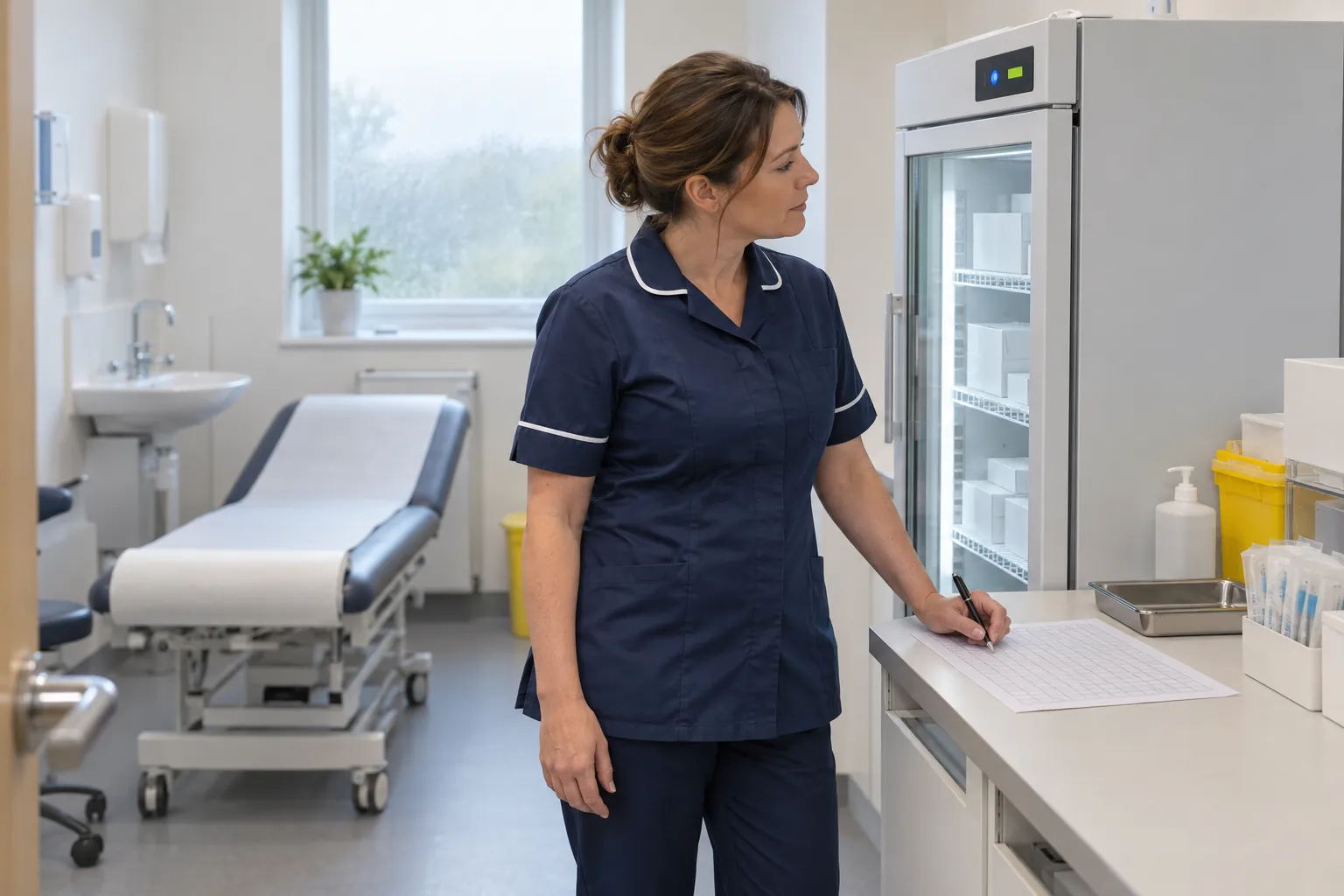
05
When the reading is out of range, and how long to keep the log
One entry showing a problem found and dealt with proves more than a month of perfect numbers.
A kitchen fridge above 8°C. Probe between packs to see whether the food or only the air is warm. If the fridge has failed, SFBB says to use other equipment or move the food to a cold area, and if you cannot, or do not know how long it has been broken down, to contact the environmental health team at your local council. Food that has not been kept chilled for more than four hours should be thrown away. Write down what went wrong and what you did in the diary, then stop it happening again: retrain, supervise, and if chilling equipment fails often, consider whether it suits the business.
A freezer not holding. SFBB's freezing safe method moves food that is still hard and icy to another freezer straight away and defrosts food that has started to soften using the defrosting safe method; food that must stay frozen, such as ice cream, cannot be refrozen once it has started to defrost.
A vaccine fridge outside +2°C to +8°C. The named individuals follow local protocols: keep the door closed until the situation is assessed, inform the provider or commissioning organisation and the local immunisation lead, establish the last reliable temperature recording and the timing and cause, quarantine and label the affected vaccines while keeping them in the cold chain, and record every detail. Whether to use a vaccine after an excursion is decided case by case; pharmacists in the local medicines management team may be able to advise.
How long to keep records. The Green Book says vaccine fridge records should be readily accessible, kept for at least one year and cover the full storage history of anything in the fridge; since shelf lives can be four years or longer, five years will generally cover it. Food law sets no fixed period. SFBB's 4-weekly review looks back over the previous weeks for persistent problems, so keep kitchen logs at least that long, and as long as your own food safety management system says.
06
Where the fridge log fails, and where SiteClara fits
The fridge log fails in familiar ways. A week of 3°C entries in the same pen, written on Friday. A morning reading taken by whoever was in first, so on the chef's day off nobody did it. A 9°C reading written down and never acted on, because the sheet has no column for what happened next. A treatment room fridge read at 5°C every day while its maximum crept up, because nobody pressed reset. Each tells an inspector the same thing: the record was filled in, not kept.
SiteClara records routine checks at the place they happen. A printed QR poster, with an optional NFC tag behind it, sits beside each fridge, freezer or cold room with a scheduled check. Staff scan or tap with their own phone, with no app to install, answer the checklist set for that location, such as the reading and whether it is in range, and mark it done or say what stopped them, with a photo of the display when one is asked for. The time and the named person are recorded as it happens.
A fault, such as a fridge running warm or a split door seal, is reported at the location and stays on the team's list of jobs until someone closes it. The kitchen manager or supervisor sees which checks are due, done and missed, records why one was missed, and approves a daily report that goes to nominated managers at 8am the next morning. In a hotel, school or care home where the premises team looks after the fridges and kitchen or clinical staff use them, everyone works from the same record. It is the working record of the round: where your food safety management system, the Green Book or your medicines policy requires a particular chart, keep that chart as they require.
07
Questions people ask
What temperature should a commercial fridge be in the UK?
Chilled food must be kept at 8°C or below; GOV.UK's chilling and freezing guidance says this is a legal requirement in England, Wales and Northern Ireland and recommended in Scotland, and says to set your fridge to 5°C or below so food stays cold enough even if the temperature changes. The FSA's Safer food, better business chilled storage and display safe method also says some foods need storing below 8°C to keep them safe, so always follow the manufacturer's storage guidance.
Is a fridge temperature log a legal requirement?
No regulation names one, but the law sets the 8°C limit and Article 5 of Regulation (EC) No 852/2004 requires a HACCP-based procedure with records suited to the business. SFBB tells caterers to check fridge temperatures at least once a day, and the Green Book says vaccine fridge temperatures must be recorded at least once each working day.
What temperature should a medicine or vaccine fridge be?
Usually +2°C to +8°C, as each product's summary of product characteristics says. UKHSA's Green Book chapter 3 recommends aiming for +5°C, the midpoint.
What temperature should a freezer be?
Frozen food should be kept at -18°C or below, according to the Prove it section of the FSA's Safer food, better business for caterers pack, which says you can use the digital display or a dial thermometer to check your freezer is keeping food at a safe temperature.
08
Official guidance, and a fridge log checklist to take away
For kitchens, read the chilling safe methods in Safer food, better business for caterers, GOV.UK's chilling and freezing guidance and Schedule 4 to the Food Safety and Hygiene (England) Regulations 2013, or in Scotland the CookSafe manual. For vaccines and medicines, read the Green Book chapter 3, the CQC's storing medicines in care homes and NICE's Managing medicines in care homes. Our EHO inspection checklist covers the other records an officer asks to see.
Before relying on your fridge temperature log, check that:
- every fridge, freezer and cold room is named on the unit and on the log;
- kitchen fridges are set at 5°C or below, freezers hold -18°C or below, and medicine fridges aim for +5°C;
- the reading is taken at a set time, starting with the opening checks, by a named person who writes it then;
- displays are checked against a probe, and the probe in iced and boiling water;
- medicine fridges are read, recorded, reset and reacted to every working day;
- every out-of-range reading has an action and a time back in range beside it;
- a missed reading shows as missed, not filled in later;
- vaccine fridge records are kept at least a year, and in practice five.
Sources
Every document this guide quotes or links to, in the order it first cites them.
- Schedule 4 to the Food Safety and Hygiene (England) Regulations 2013 legislation.gov.uk
- The Food Hygiene (Wales) Regulations 2006 legislation.gov.uk
- The Food Hygiene Regulations (Northern Ireland) 2006 legislation.gov.uk
- The Food Hygiene (Scotland) Regulations 2006 legislation.gov.uk
- Food hygiene guidance on chilling and freezing gov.uk
- Article 5 of Regulation (EC) No 852/2004 legislation.gov.uk
- Annex II, Chapter IX legislation.gov.uk
- Storage, distribution and disposal of vaccines gov.uk
- Storing medicines in care homes cqc.org.uk
- Safer food, better business for caterers gov.uk
- CookSafe manual foodstandards.gov.scot
- Managing medicines in care homes (SC1) nice.org.uk
- Safer food, better business chilled storage and display safe method assets.publishing.service.gov.uk
- Safer food, better business for caterers assets.publishing.service.gov.uk
Related guides
 Premises and facilities managementOpening and closing checks: the kitchen, the bar and the shop floorThe SFBB opening and closing checks for kitchens, what to add for a bar or shop, the fire exit checks at opening, and how the daily diary and 4-weekly review work.
 CleaningEHO inspection checklist: what the food safety officer checks, and the records behind itWhat an EHO checks on a UK food hygiene inspection, the records to have ready, how the 0 to 5 rating is worked out, and what happens after the visit.
 Premises and facilitiesPest control report: what each visit must record, and the checks between visitsWhat a UK pest control report records after each visit, the rules and codes behind it, how the inspection works, and the records a site keeps between visits.
 CleaningCare home cleaning: the schedule, the checks and the evidence CQC asks forCare home cleaning in the UK: the law, what the schedule must cover, equipment, spills and laundry, who does what, and the evidence CQC and other regulators ask for.