Premises and facilities management
Temperature log: the 5°C and 60°C rules, the daily reading and what to do when it is out
A temperature log is the dated record of each fridge, cool room, display cabinet, bain-marie or vaccine fridge's temperature, who took the reading and what was done when it was out of range, kept to show that potentially hazardous food stayed at 5°C or below or 60°C or above, as Standard 3.2.2 of the Food Standards Code requires, and that vaccines stayed between +2°C and +8°C.
Also written for United Kingdom · United States · Canada
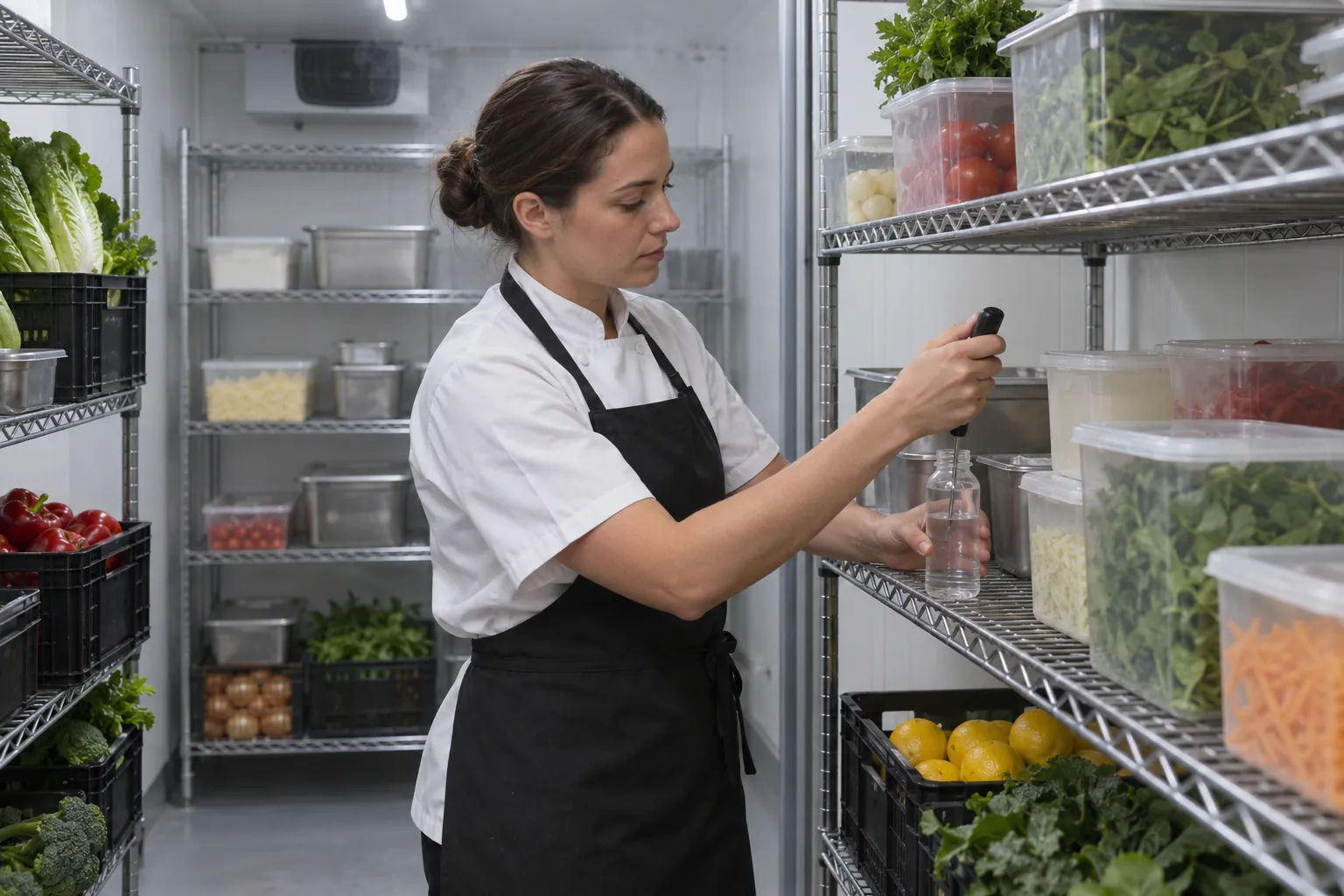
Restaurants, cafés, pubs, club bistros and caterers keep one for their cold and hot units, and since December 2023 Standard 3.2.2A has required many of them to keep it for 3 months; GP clinics and other immunisation providers keep a separate chart for the vaccine fridge, read twice a day. This guide covers the standards behind each, what a temperature log sheet should record, how to take a reading you can trust, and what to do when the figure is wrong.
01
What the standards say: 5°C or below, 60°C or above, and +2°C to +8°C for vaccines
Kitchen units come under Chapter 3 of the Australia New Zealand Food Standards Code, enforced by state and territory food authorities and councils; vaccine fridges come under the national vaccine storage guidelines and each health department's cold chain rules.
Food. Standard 3.2.2 Food Safety Practices and General Requirements defines temperature control as keeping food at 5°C or below, at 60°C or above, or at another temperature if the business can show the food's microbiological safety will not be adversely affected for the time it is kept there. Potentially hazardous food must be under temperature control when it is received (subclause 5(3)), stored (paragraph 6(2)(a)), displayed (paragraph 8(5)(a)) and transported (paragraph 10(b)). Food meant to be frozen must stay frozen; the Code sets no temperature for that, and frozen means not partly thawed.
Clause 22 requires premises handling potentially hazardous food to have a readily accessible temperature measuring device accurate to plus or minus 1°C. Clause 25 allows a safe alternative to the 5°C and 60°C limits, such as a food safety program or the 2-hour/4-hour rule, which controls time and temperature together, if the business can show it is safe.
Standard 3.2.2 does not say "keep a log". Standard 3.2.2A Food Safety Management Tools, enforceable since December 2023, does. Under section 3.2.2A–12 a category one business, a caterer or food service business that processes unpackaged potentially hazardous food into food that is both ready to eat and potentially hazardous, and serves it, must make a record substantiating each prescribed provision, which include temperature control at receipt, storage, display and transport, cooling and reheating, and keep it for 3 months. FSANZ's overview of the food safety management tools says a category two business, a retailer of potentially hazardous, ready-to-eat food that it handles unpackaged but did not make (beyond slicing, weighing, repacking, reheating or hot-holding it), needs a food safety supervisor and trained food handlers but not the records.
Vaccines. NSW Health's Vaccine Storage and Cold Chain Toolkit for Immunisation Providers (August 2020) says vaccines must be stored between +2°C and +8°C, with +5°C the optimal temperature, and calls the National Vaccine Storage Guidelines, Strive for 5, the gold standard for safe vaccine storage in Australia. The toolkit cites the 3rd edition of 2019; the Victorian Department of Health's Cold chain management page now points providers to the 4th edition.
02
What a temperature log sheet should record
Whether it is one fridge and freezer temperature log or a sheet per unit, each entry should let someone who was not there see the reading, which unit it came from, when it was taken, who took it and what happened next. FSANZ's guidance on Standard 3.2.2A says a record should include the date, the time where appropriate, and the food or activity it relates to. For a kitchen's cold and hot units:
- the date and time of the reading;
- which unit, named so nobody can confuse them: walk-in cool room, prep fridge, under-bench fridge 2, cake display, bain-marie, pie warmer, freezer;
- the temperature, and how it was taken: a probe in the food or in a bottle of water kept in the unit, an infra-red reading, or the unit's own display;
- the name or initials of the person who took it, written at the time;
- if it was out of range, what was done with the food and the unit, and when the unit was back in range.
Appendix 8 of FSANZ's Safe Food Australia, the guide to the food safety standards (fourth edition, February 2023) has a food temperature record sheet built this way: a row per cold or hot unit, an AM and a PM column for each day, and notes. Its example notes the pies were probed and fine, but the fridge was making a funny noise: the line that turns numbers into a record. Other templates cover food receipt, cooking and cooling, and the 2-hour/4-hour rule. None is mandatory, and state, territory and council regulators publish their own temperature log sheets.
Each delivery of potentially hazardous food needs a line too: the date, the food and its temperature on arrival.
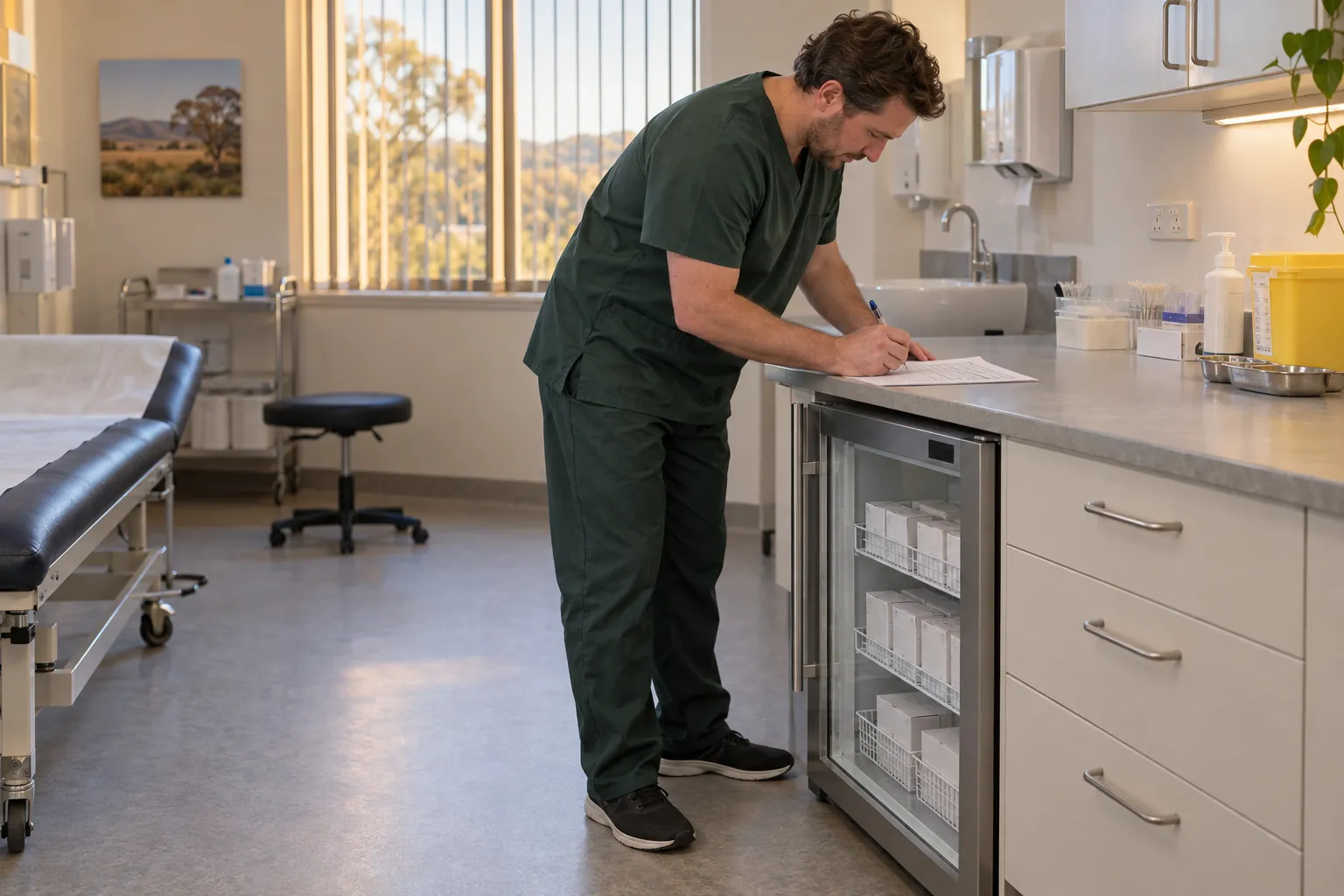
For a vaccine fridge, the reading is three figures: current, minimum and maximum, on a vaccine fridge temperature chart with the time and initials, and the thermometer reset after each reading. Keep it apart from the kitchen's sheets: the limits, the people and the reporting differ, and the staff room fridge never shares a log with the vaccine fridge.
03
How often to check, and how to take a reading you can trust
Safe Food Australia's Table 1 suggests recording the temperature of stored potentially hazardous food daily, food on display daily or as your standard operating procedure says, and deliveries each time. Use both the AM and PM columns: a fridge that fails at 2pm and is next read at 8am has had eighteen hours unwatched.
- Measure the food, not the dial. Safe Food Australia says a fixed thermometer on equipment such as a bain-marie shows the unit's operating temperature, not the food's, and that the food's temperature should still be measured directly with a probe thermometer.
- Use a bottle of water. FSANZ's storage example is a bottle of water in each cool room and fridge, probed daily and written on a sheet kept for 3 months.
- Find the worst spot. Temperatures vary within a unit, so check different areas: the warmest part of a fridge, the coolest part of a hot unit. Safe Food Australia's example is a bain-marie whose coolest corner, at the back left, becomes where the routine reading is taken.
- Let the probe settle. Wait for the reading to stabilise, probe the thickest part for the internal temperature, and clean and sanitise the probe before and after use.
- Packaged and frozen food. Lay the probe between two packs, or use an infra-red thermometer, which reads the surface only. For freezer temperatures, Standard 3.2.2 sets no figure: Safe Food Australia says food that feels hard is frozen enough, and the manufacturer's storage instructions keep its quality.
- Keep the thermometer accurate. At plus or minus 1°C, a 5°C reading means the food is between 4°C and 6°C. Have it calibrated regularly and keep it where it can be found, not in a locked drawer.
Hot-holding. A bain-marie, pie warmer or hot display must keep potentially hazardous food at 60°C or above unless a safe alternative is used. Safe Food Australia says hot-holding equipment is not for reheating: heat food quickly to at least 60°C, then put it in the unit. Log hot holding temperatures as you log a cold unit: named unit, probe reading, time, name.
Cooling. Cooked potentially hazardous food must cool from 60°C to 21°C within two hours and from 21°C to 5°C within a further four (subclause 7(3)). That belongs on its own cooking and cooling record, not the fridge log.
04
Vaccine fridges in GP clinics: twice a day, current, minimum and maximum
A vaccine fridge in a general practice, community health centre or other immunisation provider is held to a tighter range and routine than a kitchen fridge. NSW Health's toolkit expects:
- A purpose-built vaccine refrigerator. Domestic and bar fridges must not be used. It needs an audible alarm below +2°C and above +8°C, a plug labelled so nobody switches it off, a lock or a door that closes freely, and a secure room.
- Thermometers and a logger. A data logger or automated temperature monitoring system, a minimum/maximum thermometer with a digital display, and a spare portable minimum/maximum thermometer.
- Trained staff. In NSW, at least one staff member must have completed NSW Health's online cold chain module before the practice can order government-funded vaccines.
The routine:
- Twice a day, every day the practice is open, including weekends, at opening and closing: record the current, minimum and maximum temperatures on the Strive for 5 vaccine fridge temperature chart, check they have stayed between +2°C and +8°C, and reset the thermometer.
- Before taking vaccines out, check the fridge is in range.
- Once a week, download and review the data logger, set to record every 5 minutes, and relaunch it. A practice with an automated system reviews it at least weekly, notes the review on the chart, and keeps doing the manual checks.
- Once a year, do the vaccine storage self-audit, have the fridge serviced, and calibrate the thermometers and loggers and change their batteries.
The minimum and maximum are the point. A current reading of 5°C at 8am says nothing about the evening the door was left ajar; a maximum of 11°C does. Where the building's maintenance contractor looks after the fridge, agree who calls in a fault and how fast it is answered.
05
When the reading is out of range, and how long to keep the log
One entry showing a problem found and dealt with proves more than a month of perfect numbers. Safe Food Australia says that where a record shows food was stored at an unsafe temperature, for example because equipment broke down, the business must act, such as by discarding food or repairing the equipment, and should record the action.
A fridge or cool room above 5°C. Probe the food, not just the air, move what is still safe to another unit, and call in the repair. FSANZ's Food temperature and thermometers page calls 5°C to 60°C the temperature danger zone, where bacteria can grow. FSANZ's 2-hour/4-hour rule counts the total time potentially hazardous food has spent between 5°C and 60°C: under 2 hours, it can be used, sold or put back in the fridge; 2 to 4 hours, used or sold but not put back; over 4 hours, thrown away. The time is cumulative, so if you do not know how long a unit has been warm, the rule cannot help you.
A bain-marie or pie warmer below 60°C. Note the time, fix the unit, and count the time the food spent below 60°C the same way.
A vaccine fridge outside +2°C to +8°C. NSW Health treats this as a cold chain breach, except an excursion above +8°C up to +12°C for no longer than 15 minutes while restocking. Isolate the vaccines with a do not use sign, keep them between +2°C and +8°C, moving them to another vaccine fridge or a cooler if needed, download the logger to see how long and how warm, report it to the local public health unit by completing the Cold Chain Breach and Vaccine Wastage Reporting Form, and discard nothing until the public health unit says so. For privately purchased vaccines, contact the manufacturer. Outside NSW, follow your own health department's breach protocol.
How long to keep records. A category one food business keeps its Standard 3.2.2A records for 3 months, a period Safe Food Australia says reflects the incubation period of listeria, to help in foodborne illness outbreaks. Keep vaccine charts as long as your health department and accreditation require.
06
Where the temperature log fails, and where SiteClara fits
The temperature log fails in familiar ways. A week of 3°C entries in the same pen, written up on Friday. A morning reading taken by whoever opened, so on the head chef's day off nobody did it. A 9°C reading written down and never acted on, because the sheet has no column for what happened next. A vaccine fridge read at 5°C twice a day while its maximum crept up, because nobody pressed reset. Each tells an environmental health officer the same thing: the log was filled in, not kept.
SiteClara records routine checks at the place they happen. A printed QR poster, with an optional NFC tag behind it, sits beside each fridge, cool room, bain-marie or vaccine fridge with a scheduled check. Staff scan or tap with their own phone, with no app to install, answer the checklist set for that location, such as the reading and whether it is in range, and mark it done or say what stopped them, with a photo of the display when one is asked for. The time and the named person are recorded as it happens.
A fault, such as a cool room running warm, is reported at the location with a note and a photo and stays on the team's list of jobs until someone closes it. The kitchen manager or supervisor sees which checks are due, done and missed, records why one was missed, and approves a daily report that goes to nominated managers the next morning. Where a facilities team or contractor maintains the units and kitchen or clinic staff use them, both work from the same record. It is the working record of the round: where Standard 3.2.2A, your food safety program, your health department or Strive for 5 asks for a particular record or chart, keep that as they require.
07
Questions people ask
What temperature should a commercial fridge be in Australia?
5°C or below for potentially hazardous food, unless the business can show another temperature is safe. FSANZ's Keeping food at the right temperature says such food must generally always be at 5°C or colder, or 60°C or hotter.
Is a fridge temperature log a legal requirement in Australia?
For a category one food business, yes, unless it can show an authorised officer another way. Section 3.2.2A–12 of Standard 3.2.2A Food Safety Management Tools requires a record of temperature control during storage, display, receipt and transport, kept for 3 months; FSANZ's evidence tool guidance says it can be in any form, including electronic.
How often should vaccine fridge temperatures be recorded?
Twice a day, every day the practice is open, including weekends, at opening and closing. NSW Health's Vaccine Storage and Cold Chain Toolkit for Immunisation Providers asks staff to check and record the current, minimum and maximum each time, reset the thermometer, and download the data logger weekly.
What temperature should a freezer be in a food business?
Cold enough to keep the food frozen hard. Standard 3.2.2 sets no figure, and FSANZ's Safe Food Australia says food that feels hard is considered sufficiently frozen, while businesses should follow the manufacturer's storage instructions for quality and shelf life.
08
Official guidance, and a temperature log checklist to take away
For food, read Standard 3.2.2 (clauses 1, 5 to 10, 22 and 25), Standard 3.2.2A, FSANZ's Safe Food Australia with its Appendix 8 templates, and FSANZ's Thermometers page; your council's environmental health team can advise on your own kitchen. For vaccines, read the current edition of Strive for 5 and your state health department's cold chain guidance, such as NSW Health's cold chain toolkit. For the kitchen around the units, see the commercial kitchen cleaning checklist.
Before relying on your temperature log, check that:
- every fridge, cool room, freezer, display cabinet and hot-holding unit is named on the unit and the log;
- cold units hold food at 5°C or below, hot units at 60°C or above, freezers keep food frozen hard, and vaccine fridges stay between +2°C and +8°C;
- readings are of the food or a bottle of water, with a probe accurate to 1°C, not the unit's dial;
- each reading is taken at a set time by a named person who writes it then;
- vaccine fridges are read twice a day for current, minimum and maximum, reset each time, with the logger reviewed weekly;
- every out-of-range reading has an action beside it;
- a missed reading shows as missed, not filled in later;
- food records are kept at least 3 months, and vaccine charts as long as your health department asks.
Sources
Every document this guide quotes or links to, in the order it first cites them.
- Standard 3.2.2 Food Safety Practices and General Requirements legislation.gov.au
- Standard 3.2.2A Food Safety Management Tools legislation.gov.au
- Overview of the food safety management tools foodstandards.gov.au
- Vaccine Storage and Cold Chain Toolkit for Immunisation Providers health.nsw.gov.au
- Cold chain management health.vic.gov.au
- Safe Food Australia, the guide to the food safety standards (fourth edition, February 2023) foodstandards.gov.au
- Food temperature and thermometers foodstandards.gov.au
- 2-hour/4-hour rule foodstandards.gov.au
- Keeping food at the right temperature foodstandards.gov.au
- Evidence tool guidance foodstandards.gov.au
- Thermometers foodstandards.gov.au
Related guides
 CleaningCommercial kitchen cleaning checklist: what the Food Standards Code asks, task by taskA commercial kitchen cleaning checklist for Australian food businesses: what Standards 3.2.2, 3.2.3 and 3.2.2A require, daily to deep-clean tasks and the record.
 CleaningOffice kitchen cleaning: what the law asks, who does what, and a routine that survives the lunch rushOffice kitchen cleaning in Australia: what WHS law and the codes ask of eating areas, who cleans what, how often, the fridge rule, and what a good record shows.
 Premises and facilities managementPreventative maintenance: how to plan it for a building and prove it was donePreventative maintenance for Australian buildings: the WHS duty, the asset register and schedule, statutory and discretionary tasks, and keeping good records.
 Premises and facilities managementReactive maintenance: how to run it well in an Australian buildingReactive maintenance in Australian buildings: the WHS and strata duties, priorities and response times, make-safes, contractors, asbestos and closing the loop.