Premises and facilities management
Temperature log: what to record for coolers, freezers and hot food, and how to keep it honest
A temperature log is a dated record of the temperatures of coolers, freezers, hot-holding units and food being cooled, each reading written with the time and the initials of the person who took it, kept to show that time/temperature control for safety (TCS) food stays at 41°F or below or 135°F or above, the holding limits in section 3-501.16 of the FDA Food Code.
Also written for United Kingdom · Canada · Australia
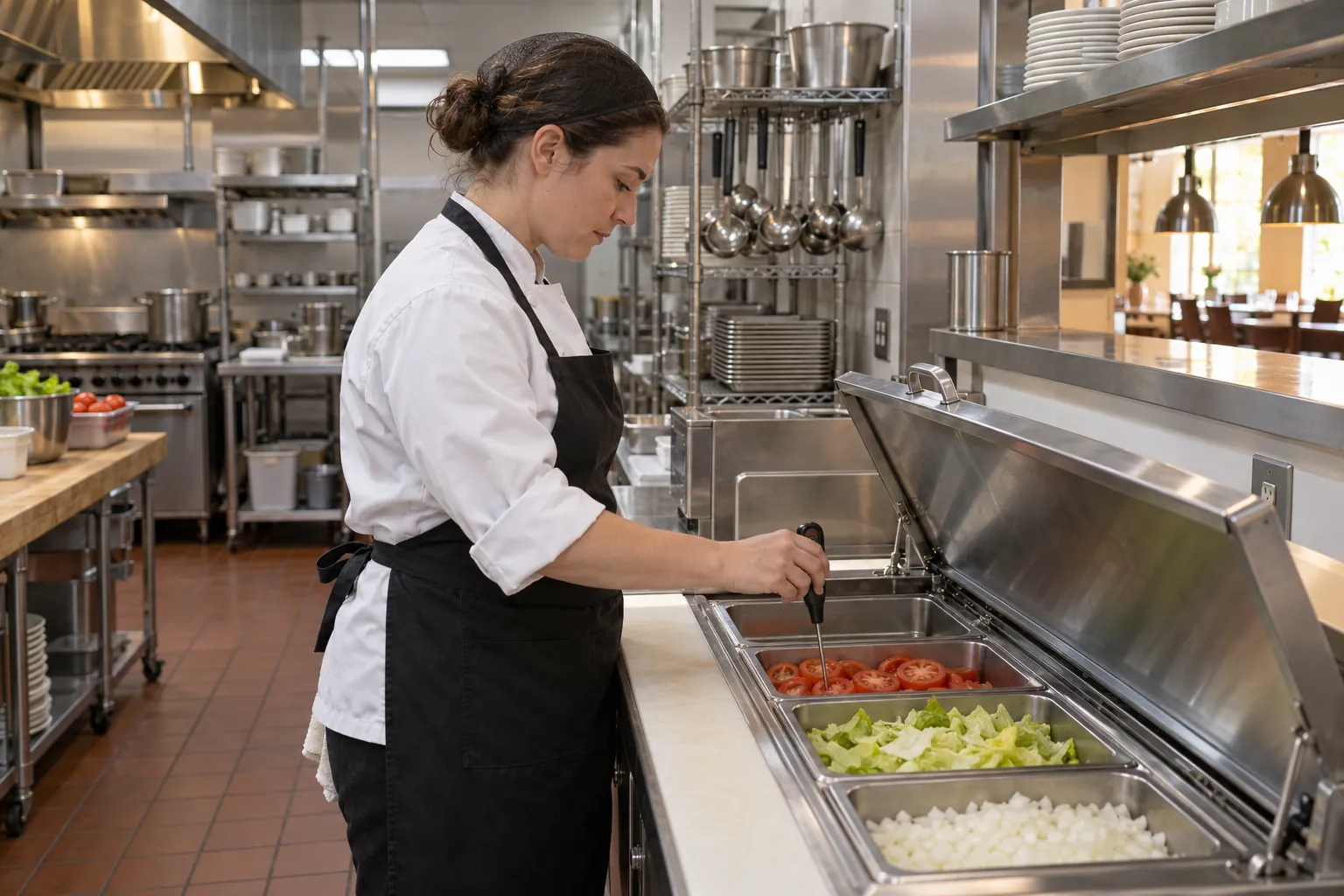
Restaurant, hotel, cafeteria and catering kitchens keep one because the health inspector asks how the person in charge knows the walk-in held overnight, and the log is the usual answer. This guide covers the rules behind the numbers, what to log and where, how often, the cooling log, what a good entry looks like, and the ways a temperature log stops being true.
01
What a temperature log is, and the rules behind the numbers
There is no single federal restaurant code. Food service in the United States is regulated by the state, county or city health department that issued the permit, and most of them base their rules on the FDA Food Code 2026, a model FDA offers "for adoption by local, state, tribal, territorial, and federal governmental jurisdictions". Adoption lags the model, so your state may enforce the 2022, 2017 or an older edition. Section numbers below are the 2026 model's.
The temperatures a kitchen temperature log tests against come from a handful of sections:
- Cold and hot holding. Under section 3-501.16 of the FDA Food Code 2026, TCS food must be held at 135°F or above, or at 41°F or less, except during preparation, cooking or cooling, or when time is used as the public health control.
- Cooling. Under section 3-501.14, cooked TCS food must be cooled from 135°F to 70°F within two hours, and from 135°F to 41°F or less within a total of six hours.
- Frozen food. Section 3-501.11 says only that stored frozen foods "shall be maintained frozen"; the model sets no freezer number, so use the target your health department's form or your equipment maker gives.
- Receiving. Under section 3-202.11, refrigerated TCS food must be 41°F or below when received, and food labeled frozen and shipped frozen by a food processing plant must be received frozen.
Does the code require a written temperature log? Mostly not in so many words. FDA's own Managing Food Safety manual for operators of food service and retail establishments says "the maintenance of records is required in the Food Code only in a limited number of cases". What the code does require is active managerial control: under section 2-103.11 the person in charge must ensure that cooling and hot and cold holding are done properly "through daily oversight of the employees' routine monitoring of food temperatures". A log is how most kitchens show that oversight, and FDA's manual counts a record keeping system among the steps of a food safety management system. Three cases go further:
- Your local code or your inspector. State and local codes amend the model, and many health departments publish their own log forms, such as the Minnesota Department of Health's cooling log and cold holding log.
- School meals. Under 7 CFR 210.13, a school food authority in the National School Lunch Program "must develop a written food safety program" based on hazard analysis and critical control point (HACCP) principles, with monitoring and recordkeeping, and 7 CFR 210.15(b)(5) requires it to keep the program's records "for a period of six months following a month's temperature records".
- Vaccines. A clinic's refrigerator temperature log is a different record with different numbers; it is covered at the end of section 3.
02
What to log: every cooler, freezer and hot-holding point
A temperature log covers every place TCS food is held, plus the equipment whose temperature is itself a safety control. In a typical restaurant, hotel or school cafeteria kitchen that means:
- Walk-in coolers and reach-in refrigerators. The unit thermometer reading, and a probe reading of the warmest food in it. Each unit used for TCS food must have its own thermometer, under section 4-204.112, "located to allow easy viewing".
- Prep-line coolers. Sandwich and pizza prep tables and under-counter drawers, where lids are opened all service and food warms fastest.
- Freezers. Walk-in and reach-in freezers, checked for temperature and for food that has started to thaw.
- Hot holding. Steam tables, hot wells, holding cabinets and buffet lines, probed to confirm hot holding temperatures of 135°F or above. Section 4-204.112(C) excuses steam tables, bain-maries and salad bars from a built-in thermometer, so their only reading is the probe.
- Cooling. Each batch of cooked food being cooled, from 135°F, on its own cooling log (section 4).
- Receiving. Refrigerated and frozen deliveries, probed or checked before they go into storage.
- Dish machines. A dish machine temperature log reads the wash tank and the final rinse. Under section 4-501.112 the hot water sanitizing rinse must reach at least 165°F in a stationary rack, single temperature machine and 180°F in all other machines, and no more than 194°F; chemical sanitizing machines are checked with test strips instead.
Section 4-302.13 also requires an "irreversible registering temperature indicator" for hot water machines, because a gauge reading 180°F does not prove the plates reached it.
Number the units on the log to match a label on each door, so "walk-in 1" and "prep cooler 3" mean the same thing to the morning cook and the night closer.
03
How often to check, and how to take a reading the inspector will trust
The Food Code sets the limits but not a checking frequency, so the frequency comes from your health department, your HACCP plan if you have one, or your own judgment of the risk. Minnesota's cold holding log, for example, makes the designated person in charge for each shift responsible, and asks for the warmest internal temperature of "multiple cold TCS food products at least once every four hours". Where no interval is set, reading every fridge and freezer at opening and closing and probing cold and hot-held food during service is a reasonable start; check it against your health department's form. Write the times into your procedures and at the top of the sheet, so a missed reading is obvious.
How the reading is taken matters as much as how often:
- Air or food. A unit thermometer reads air. The limit in section 3-501.16 is the food's temperature, so probe the internal temperature of the food at intervals, and the warmest item, not the one nearest the coil. Section 4-204.112(A) places a unit's sensor in "the warmest part of a mechanically refrigerated unit" and the coolest part of a hot unit.
- The right probe. Section 4-302.12 requires food thermometers to be "readily accessible", including one with a "small-diameter probe" for thin foods such as burger patties and fish fillets.
- Accuracy. Under section 4-203.11, a food thermometer scaled only in Fahrenheit must be accurate to ±2°F; under section 4-203.12, an air or water thermometer scaled only in Fahrenheit must be accurate to ±3°F.
- Calibration. Under section 4-502.11, food thermometers "shall be calibrated in accordance with manufacturer's specifications as necessary to ensure their accuracy". Log each calibration.
A walk-in that runs high after a delivery with the door propped is a different problem from one that runs high at 6am with nobody in the building, and only a log with times shows which.
04
The cooling log: the two-hour and six-hour clock
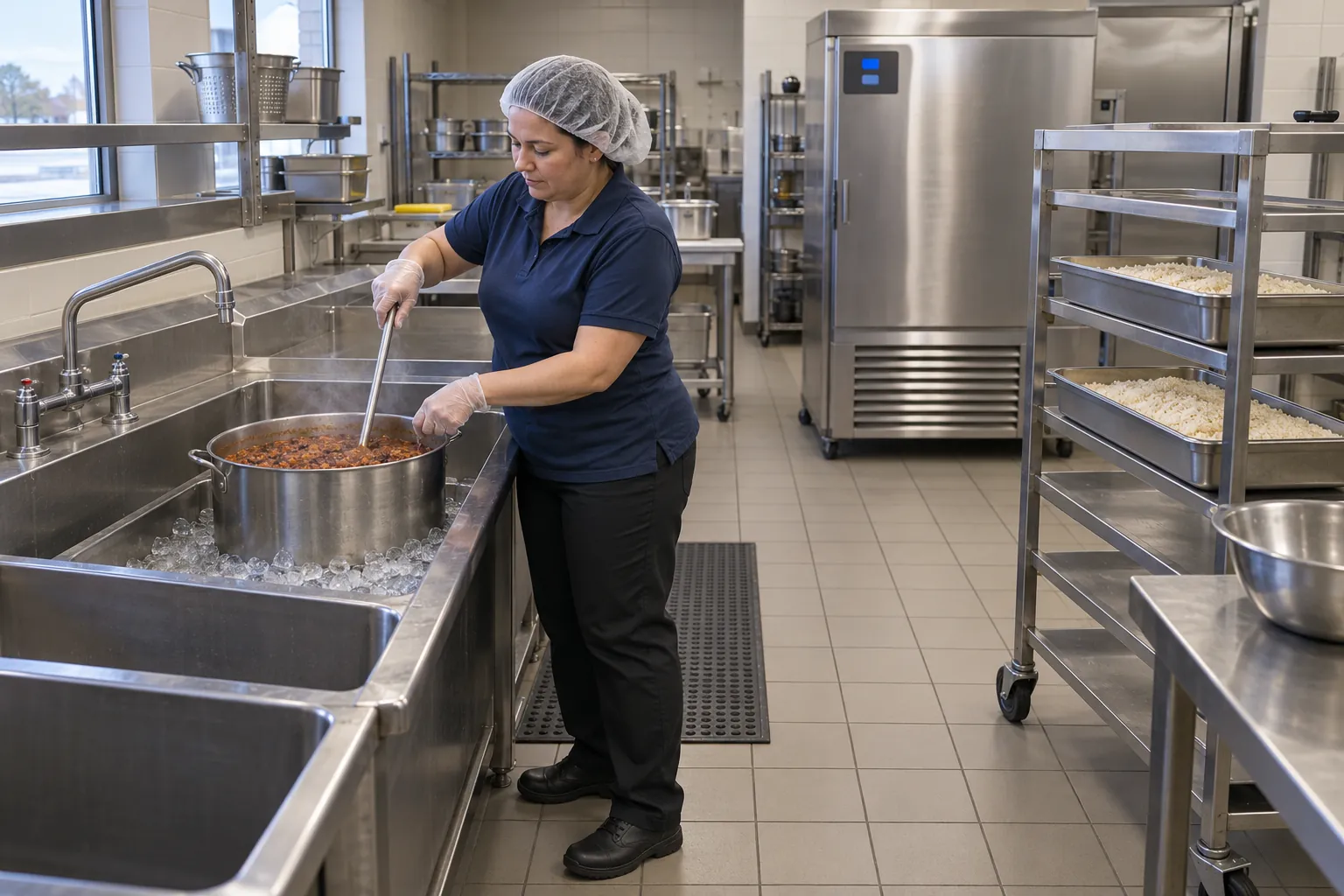
Cooling is where a kitchen temperature log matters most, because a pot of soup or a hotel pan of rice can sit in the temperature danger zone, between 135°F and 41°F, for hours and still look perfect. Under section 3-501.14 of the FDA Food Code 2026 the clock starts at 135°F: the food must be at 70°F or below within two hours, and at 41°F or below within six hours in total. Both limits apply: food that is not at 70°F within two hours has missed the requirement even if it reaches 41°F within six.
A usable cooling log has one line per batch and records:
- the food and the batch, such as "chili, 2 shallow pans";
- the date, and the time and temperature when cooling started at 135°F;
- readings at intervals (Minnesota's cooling log has columns for less than 1 hour through less than 6 hours, with the 70°F reading due before 2 hours and the 41°F reading before 6);
- the cooling method, such as shallow pans, an ice bath or a blast chiller;
- the initials of whoever took each reading;
- the corrective action if a limit was missed, and the manager's verification.
Minnesota's form tells staff to "check temperatures and take needed corrective actions BEFORE 2-hour limit and BEFORE 6-hour limit". Its worked example shows a batch that missed the limits, discarded with the note "Change cooling method and retrain": what happened to the food, and what changes next time.
Section 3-501.15 lists accepted cooling methods, such as shallow pans, an ice water bath and rapid cooling equipment, and the 2026 model adds an alternative method that needs your health department's approval: food no more than two inches deep, uncovered, in a unit that holds 41°F or less and is "equipped with an electronic system that continuously monitors time and ambient air temperature". FDA's public health reasons for the cooling methods section point out that this method "excludes direct TCS food product temperatures", so it stands or falls on that monitoring system working.
05
What a good entry looks like, and who checks the log
Whether you start from a template or from your health department's own form, every reading on a temperature log sheet, whether for a cooler, a freezer or a steam table, should carry:
- the date and the actual time of the reading, not the time it was due;
- the unit or food, by the same name or number as the label on the equipment;
- the temperature, with the unit of measure if your thermometers show both;
- the initials of the person who took it;
- what was done when it was out of range: food moved, probed again, discarded, the unit called in for repair;
- the manager's initials when the log was reviewed.
Corrective action. What happens to food found above 41°F depends on your code and on how long it has been there, which is why times matter: probe it, move it to a working unit, and decide with the person in charge. A unit that reads high twice running is a work order, not just a log entry; write down who it was reported to and when.
Review. Someone other than the person taking the readings should verify the log. FDA's Managing Food Safety manual gives examples of verification: the manager "reviews temperature logs of refrigerated products" at receiving, "such as on a weekly basis, or even daily" for high volumes, and "checks that the 'cooling log' is maintained for leftover foods on a weekly basis", including that each time and temperature is "recorded and initialed on the log sheet".
Retention. The Food Code sets no general period for keeping temperature logs. Keep them for as long as your health department or HACCP plan requires; school food authorities keep food safety program records for six months under 7 CFR 210.15(b)(5), and the CDC's toolkit says to keep vaccine temperature logs for 3 years.
Paper or digital. Continuous temperature monitoring, with a wireless sensor or data logger in each unit, records around the clock and can raise an alarm at night, which a sheet on the door cannot. It still needs someone to respond and to probe the food, which an air sensor does not.
06
Where the temperature log fails, and where SiteClara fits
A temperature log fails in ways an inspector recognizes at a glance: 38°F on every line for a month, all in the same pen; opening and closing readings filled in together at the end of the shift; a cooling log with a start time and nothing after it; a reading of 47°F with no corrective action beside it. A record that cannot be true is worse than a gap. The CDC's vaccine toolkit puts it simply: "If a reading is missed, leave a blank entry in the log." The same honesty belongs in a kitchen.
The other failure is the fault noticed and not reported: a torn door gasket, an iced-over fan, a reading creeping up for a week before anyone calls for service.
SiteClara records routine checks as they happen. A printed QR poster at each place, with an optional NFC tag, lets enrolled staff confirm a scheduled check on their own phone with no app to install: at the walk-in, the prep cooler or the dish machine they answer the task checklist for that place, mark it done, or say what stopped them, and a photo of the thermometer display can be asked for. They can report a fault, such as a torn gasket or a cooler running warm, with a note and a photo, and it stays on the team's list of jobs until someone closes it. The supervisor sees what was due, done and missed, a missed check shows as missed rather than as a blank filled in later, and the approved daily report goes to nominated managers or the client at 8am the next morning.
In a kitchen it can be the working record behind the temperature log: who was at the cooler, when, and what the display showed. The records your health department, your HACCP plan or your school food safety program requires stay where the business keeps them.
07
Questions people ask
What temperature should a restaurant refrigerator be?
Cold enough to keep TCS food at 41°F or below, the cold holding limit in section 3-501.16 of the FDA Food Code 2026, adopted with or without amendments by most state and local health departments. The limit is the food's temperature, so set the unit to hold a little below it and probe the food, not just the air.
What temperature should a commercial freezer be?
The FDA Food Code sets no freezer temperature: section 3-501.11 of the FDA Food Code 2026 says only that stored frozen foods "shall be maintained frozen". Use the target on your health department's log form or the manufacturer's setting, and log any food found thawing. Vaccine freezers are different: the CDC's toolkit sets -58°F to +5°F.
What is the 2-hour-4-hour rule for cooling food?
It is the two-stage cooling limit in section 3-501.14 of the FDA Food Code 2026: cooked TCS food must go from 135°F to 70°F within two hours, and from 135°F to 41°F or less within six hours in total, which leaves four more hours for the second stage. Missing the two-hour stage is a failure even if the food reaches 41°F within six.
How often should temperature logs be completed?
The FDA Food Code sets no frequency, so follow your health department and your own HACCP plan. The Minnesota Department of Health's Cold Holding Log is a typical example: the person in charge for each shift makes sure the warmest internal temperature of several cold TCS foods is checked "at least once every four hours" and any corrective action is recorded.
How long do you need to keep temperature logs in a restaurant?
The model code sets no general period: FDA's Managing Food Safety manual notes that "the maintenance of records is required in the Food Code only in a limited number of cases". Your state or local code, or your HACCP plan, may set one, so ask your health department. School food authorities keep food safety program records "for a period of six months following a month's temperature records" under 7 CFR 210.15(b)(5).
08
Official guidance, and a temperature log checklist to take away
Start with the code your health department enforces, through FDA's state retail and food service codes and regulations by state, and ask the department for its own temperature and cooling log forms. Then read the FDA Food Code 2026, Chapter 3 for the food limits and Chapter 4 for thermometers and warewashing, and FDA's Managing Food Safety manual for monitoring, verification and records. Schools should read 7 CFR 210.13; clinics, the CDC's vaccine storage and handling guidance.
A temperature log that will stand up:
- every cooler, freezer, prep cooler, hot-holding point and dish machine is on the sheet, named as on its label;
- cold TCS food at 41°F or below, hot at 135°F or above, cooled food at 70°F within 2 hours and 41°F within 6;
- the checking times are written at the top, and each reading carries its actual time and initials;
- food is probed, not just the air, with an accurate, calibrated thermometer;
- every out-of-range reading has a corrective action beside it;
- a missed reading is left blank, never filled in later;
- a manager reviews and initials the log on a set schedule, such as weekly, or daily for high volumes.
Sources
Every document this guide quotes or links to, in the order it first cites them.
- FDA Food Code 2026 fda.gov
- Section 3-501.16 of the FDA Food Code 2026 fda.gov
- Managing Food Safety manual for operators of food service and retail establishments fda.gov
- Cooling log health.mn.gov
- Cold holding log health.mn.gov
- 7 CFR 210.13 ecfr.gov
- 7 CFR 210.15(b)(5) ecfr.gov
- Vaccine Storage and Handling Toolkit cdc.gov
- State retail and food service codes and regulations by state fda.gov
- Vaccine storage and handling guidance cdc.gov
Related guides
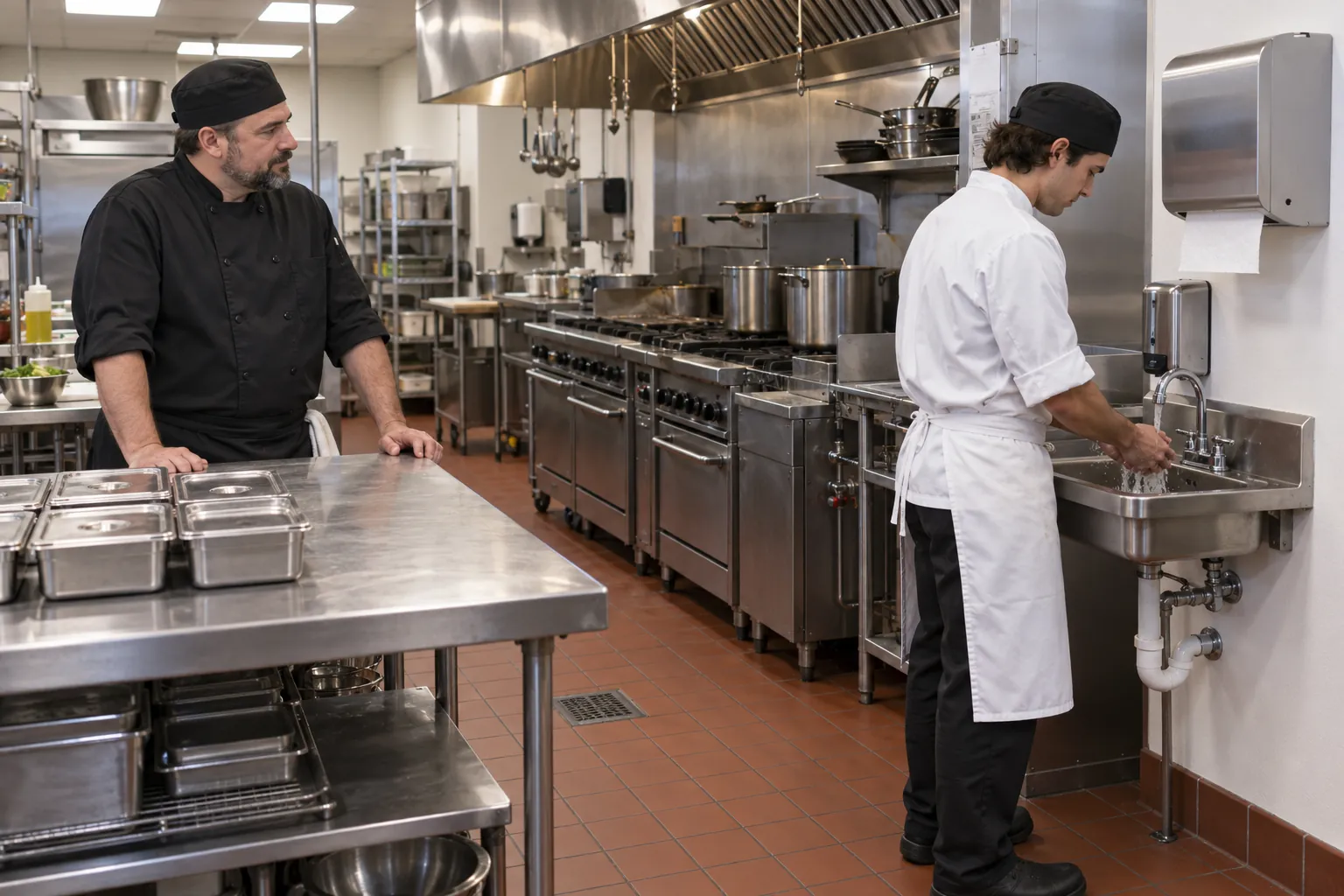 CleaningHealth inspection checklist: what the health inspector looks for, and the records behind itWhat a US health inspector checks in a restaurant or food service kitchen, how priority and core violations are fixed, and the records to have ready.
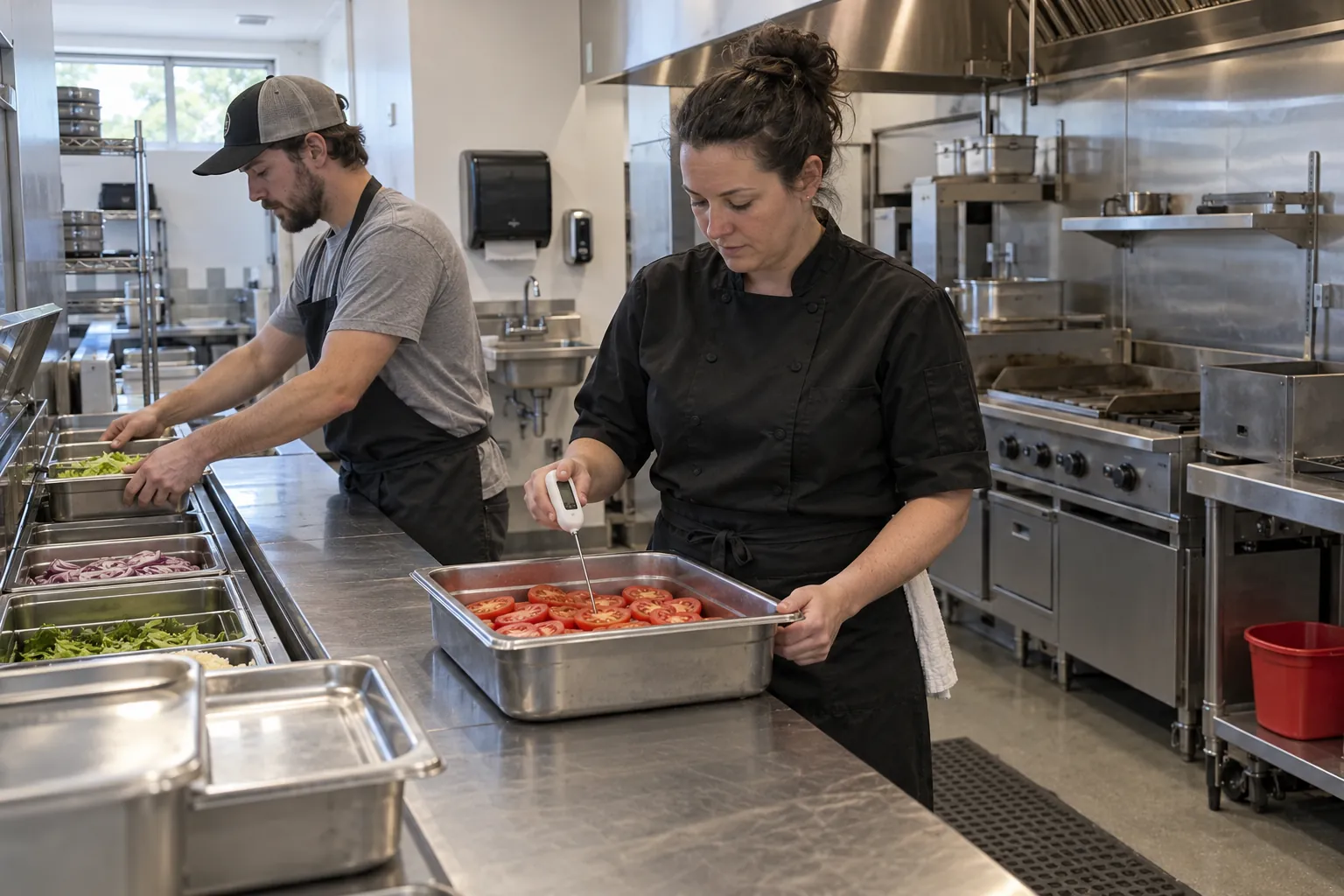 Premises and facilities managementRestaurant opening and closing checklist: what to check, place by placeA restaurant opening and closing checklist by area: kitchen, bar, dining room, restrooms and doors, with the Food Code, OSHA exit and hood checks behind each item.
 CleaningMaster sanitation schedule: building one, running it, and proving it happenedWhat a master sanitation schedule is, how it fits FDA 21 CFR 117 and USDA SSOPs, what goes on it, how often, who signs, and how to keep the record honest.
 Premises and facilities managementOperating room temperature and humidity log: the requirements, and a record that holds upOperating room humidity and temperature requirements: what CMS and ASHRAE 170 say, how to keep the log, and what to do when a reading is out of range.