Fire and water checks
Safety signs: what the law requires, from fire exit signs to warning signs
In Great Britain, safety signs are required by the Health and Safety (Safety Signs and Signals) Regulations 1996 wherever a risk assessment shows a significant risk to employees that cannot be avoided or adequately reduced in any other way, and, where necessary, fire safety signs must mark emergency routes, exits and fire-fighting equipment under the Regulatory Reform (Fire Safety) Order 2005 in England and Wales.
Also written for Ireland · New Zealand · South Africa
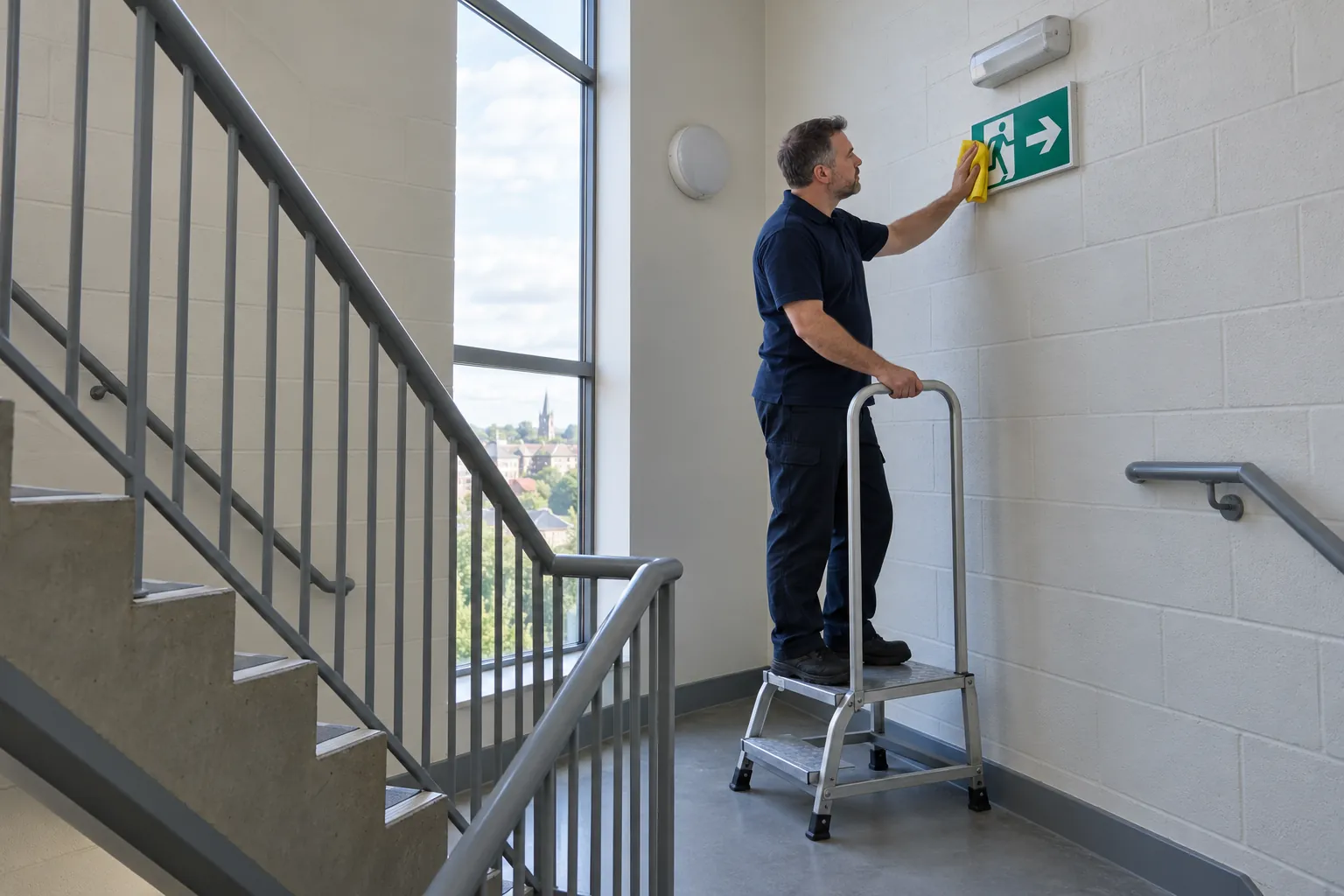
Both expect the same thing: pictogram signs in set shapes and colours, put where people will see them, and kept correct and legible. This guide covers the law, the five kinds of sign, where fire exit signs go, which health and safety signs a building needs, and the routine check that keeps them right.
01
What the law says about safety signs
Fire signs. In England and Wales, article 14 of the Regulatory Reform (Fire Safety) Order 2005 requires the responsible person to make sure, where necessary, that "emergency routes and exits must be indicated by signs" (article 14(2)(g)). Article 13(1)(b) requires non-automatic fire-fighting equipment, such as extinguishers, to be "easily accessible, simple to use and indicated by signs", and article 17 requires everything provided under the Order to be kept "in efficient working order and in good repair". The fire risk assessment decides where fire safety signage is needed. Scotland has the same two duties in regulation 13(2)(g) and regulation 12(1)(b) of the Fire Safety (Scotland) Regulations 2006, and Northern Ireland in regulation 13(2)(g) and regulation 12(1)(b) of the Fire Safety Regulations (Northern Ireland) 2010.
Health and safety signs. Under regulation 4(1) of the Health and Safety (Safety Signs and Signals) Regulations 1996, which apply in Great Britain, the duty arises where the employer's risk assessment shows that, "having adopted all appropriate techniques for collective protection", the employer "cannot avoid or adequately reduce risks to employees except by the provision of appropriate safety signs". Regulation 4(4)(a) then requires the employer to "provide and maintain" the sign in accordance with Schedule 1, which sets the shapes, colours and conditions of use, and regulation 4(3) applies that to fire safety signs required by any other law, so a fire exit sign must meet it too. Northern Ireland has the Health and Safety (Safety Signs and Signals) Regulations (Northern Ireland) 1996.
So a sign is a last resort, not a control: if a hazard can be removed, guarded or fenced off, that comes first. And signs come with a training duty: regulation 5 requires each employee to receive "suitable and sufficient instruction and training in the meaning of safety signs". HSE's guidance, Safety signs and signals (L64, third edition, 2015), says signs are required "where, despite putting in place all other relevant measures, a significant risk to the health and safety of employees and others remains".
02
The five kinds of safety sign, and the colours they use
Schedule 1 to the Safety Signs and Signals Regulations gives each kind of signboard a shape and colour, so that safety signage tells the reader what sort of message it carries before they read the pictogram. Fire signs first, because every building needs them:
- Emergency escape or first-aid signs: rectangular or square, a white pictogram on green, the green at least 50% of the sign. The fire exit sign, a running figure and a door, is one of these.
- Fire-fighting signs: rectangular or square, a white pictogram on red, the red at least 50%, showing where fire extinguishers, hose reels and fire telephones are.
- Prohibitory signs, often called prohibition signs: round, a black pictogram on white with a red edge and diagonal line, the red at least 35%. No smoking, or no access.
- Warning signs: triangular, a black pictogram on yellow with a black edge, the yellow at least 50%. Electrical hazard, slippery floor, corrosive material.
- Mandatory signs: round, a white pictogram on blue, the blue at least 50%. Eye or ear protection must be worn.
Part I of the Schedule gives the four safety colours their meanings: red for prohibition, danger alarm and fire-fighting equipment; yellow or amber for warning; blue for a mandatory action such as wearing personal protective equipment; and green for emergency escape and first aid. The Schedule also covers signs on containers and pipes, yellow and black or red and white stripes on obstacles and dangerous locations, marked vehicle routes, illuminated signs, acoustic signals such as the fire alarm, and hand signals. Where vehicles move at work, regulation 4(6) calls for the road traffic signs of the Road Traffic Regulation Act 1984, so a car park uses ordinary road signs.
03
Fire exit signs and fire safety notices: what goes where
The Home Office's Fire safety risk assessment: offices and shops, the government's guide for England and Wales (first published in 2006, so some standards it names have since been replaced), says signs must be used, where necessary, to help people find escape routes, fire-fighting equipment and emergency fire telephones. A fire risk assessment that finds no escape signs are needed "is unlikely to be acceptable to an enforcing authority other than in the smallest and simplest of premises where the exits are in regular use and familiar to employees and visitors". For fire exit signs it says:
- Pictograms, never text alone. Words may be added, "but you must not have a safety sign that uses only text".
- Arrows where needed, never on their own, and the next escape route sign always in sight.
- Above the door, not on it, since a sign on an open door cannot be seen: 2.0 to 2.5 metres above the floor over a door, 1.7 to 2.0 metres on a wall, and one height along the route where reasonably practicable.
- One scheme: styles not mixed, and in a multi-occupied building the responsible persons co-operate so every sign follows one pattern.
- Not swamped by advertising or displays, and not a few outsized signs in place of one at each turn.
Signs need light to be seen, including in an evacuation during a power cut. The guidance says all signs and notices "will need illumination to ensure they are conspicuous and legible", and that photoluminescent signs, which glow in the dark after exposure to light, "are not a substitute for appropriate emergency lighting"; and Schedule 1 requires signs that need power to have a guaranteed emergency supply. Illuminated fire exit signs are tested with the emergency lighting, as the emergency lighting log book guide explains. The code of practice is BS 5499-4:2013, Safety signs. Code of practice for escape route signing, covering the emergency exit signs E001 and E002, arrows, location, mounting, lighting and maintenance.
The same guidance lists the notices most premises need: fire action notices beside call points on escape routes and where staff gather; "Fire door keep shut" on both sides of self-closing fire doors, and "Fire door keep locked" outside locked fire-resisting cupboards and service ducts (the fire door checks guide covers the doors); "Push bar to open" above every panic bar; "Fire escape keep clear" at about eye level on the outside of exit doors that are not normally used; and signs for the fire and rescue service, such as sprinkler valves and electrical cut-offs.
In England, a high-rise residential building, which regulation 3 of the Fire Safety (England) Regulations 2022 defines as one with two or more flats that is at least 18 metres high or has at least seven storeys, also needs wayfinding signs for firefighters under regulation 8: floor and flat identification on each stair landing and in the lift lobbies, visible in low light or by torchlight.
04
Health and safety signs: which ones a building needs
No law gives a fixed list of health and safety signs, or of mandatory signs, that every workplace must display. The risk assessment decides: where a significant risk remains after everything else has been done, a sign goes there. In an office, school or block of flats that usually means:
- Plant rooms, riser cupboards and electrical intake rooms: a prohibitory sign restricting access and a warning sign for the electrical hazard.
- Cleaners' and chemical stores: the mandatory signs for the protective equipment the COSHH assessment requires.
- Wet floors: a temporary warning sign. Schedule 1 says a signboard "must be removed when the situation to which it refers ceases to exist", so a wet floor sign left on a dry floor teaches people to ignore it.
- Roof access, loading bays and car parks: prohibitory or warning signs, striped obstacles and marked pedestrian routes.
- First-aid boxes and rooms: green first-aid signs.
- Contractors' work areas: temporary signs, removed when the work ends.
Schedule 1 says signboards go "at a suitable height and in a position appropriate to the line of sight", at the entrance to an area for a general hazard or beside a specific one, "in a well-lit and easily accessible and visible location", and warns against too many signs too close together. The British Standard for choosing, positioning and maintaining signs other than escape signs is BS 5499-10:2014+A1:2023, Guidance for the selection and use of safety signs and fire safety notices, written for building owners, facility managers and whoever selects, installs and inspects signs, and covering the common areas of blocks of flats.
Where there are several occupiers, agree who looks after which signage: the landlord or managing agent is often responsible for the common parts and plant, each tenant for its own space. Gaps appear in the corridor a fit-out moved, or with the sign the last tenant took away.

05
The routine sign check
Schedule 1 requires signs to be regularly cleaned, maintained, checked, repaired and, if necessary, replaced. The Home Office guidance puts "check that all safety signs and notices are legible" among its daily checks, alongside clear escape routes, and asks: "Are you maintaining all the necessary signs and notices so that they continue to be correct, legible and understood?" The check is usually a walk of the building with the fire safety checks already scheduled. At each location it asks:
- Is the sign still there? Signs come down for decorating and are not put back.
- Can it be seen? Not hidden by a display, boxes, a notice board or a new partition.
- Is it legible? Faded, scratched or peeling signs are replaced.
- Is it still right? An arrow pointing at a wall, an exit sign over a door that is no longer an exit.
- Is it lit? A failed illuminated fire exit sign is reported as an emergency lighting fault.
- Are temporary signs gone, and is anything new missing a sign?
The check that matters most is the one after a change. A refit, new partitions, a change of use or a new tenant can leave a route signed for the old layout, so review the signs whenever the fire risk assessment is reviewed. Record what was found and what was done: a check that always says "all OK" never shows whether last month's faded sign was replaced.
06
Where the record fails, and what SiteClara does about it
Sign checks are the easiest fire safety check to skip, because a missing sign never sounds an alarm. They are ticked on the same sheet as the escape route walk, with no note of which signs were looked at, and the faded exit sign is mentioned to whoever was passing, then forgotten until a fire risk assessor finds it.
SiteClara records the check where it happens. A printed QR poster, with an optional NFC tag behind it, sits at each location, such as a floor or a stair core. The person doing the walk scans or taps it on their own phone, with no app to install, sees the checks due there, and marks each one done or explains what stopped them. A missing, faded or wrong sign is reported there with a photo and goes onto the team's list of jobs until someone closes it.
The supervisor sees what is due, done and missed, and records why a check was missed. Each day they approve a report that goes to nominated management or client contacts at 8am the next morning, showing what was reported, completed and still open, and how the scheduled checks went.
07
Questions people ask
What are the five main types of safety sign?
Schedule 1 to the Health and Safety (Safety Signs and Signals) Regulations 1996 names five kinds of signboard: prohibitory signs (round, a red edge and diagonal line on white), warning signs (triangular, black on yellow), mandatory signs (round, white on blue), emergency escape or first-aid signs (rectangular or square, white on green) and fire-fighting signs (rectangular or square, white on red).
What are the mandatory safety signs in the workplace?
There is no fixed list, of nine or any other number. Regulation 4 of the Health and Safety (Safety Signs and Signals) Regulations 1996 requires a sign where the risk assessment shows a significant risk to employees that cannot be avoided or adequately reduced in another way. A mandatory sign, in the Regulations' sense, is a round blue sign telling people to do something, such as wear eye protection. Fire exit signs are needed almost everywhere: the Home Office guide Fire safety risk assessment: offices and shops says a fire risk assessment finding none are needed is unlikely to be acceptable to an enforcing authority except in the smallest and simplest premises.
What does the fire exit sign mean?
It marks the way out in an emergency. Under Schedule 1 to the Safety Signs and Signals Regulations it is an emergency escape sign: rectangular or square, with a white pictogram on green, and a "This way" arrow sign where a direction is needed. The Home Office guide Fire safety risk assessment: offices and shops says the pictogram may be supplemented by text, but "you must not have a safety sign that uses only text".
What is the standard for fire signs in the UK?
The law sets the shapes and colours, in the Health and Safety (Safety Signs and Signals) Regulations 1996, and the fire risk assessment under the Regulatory Reform (Fire Safety) Order 2005 decides where signs go in England and Wales. The pictograms come from BS EN ISO 7010, and BS 5499-4:2013, Safety signs. Code of practice for escape route signing gives guidance on choosing, placing, mounting, lighting and maintaining escape route signs that conform to BS EN ISO 7010.
What are the requirements for emergency exit signs?
The Home Office guide Fire safety risk assessment: offices and shops says escape signs should be pictograms, with a directional arrow where needed, placed so that the next sign is always in sight, mounted 2.0 to 2.5 metres above the floor over a door or 1.7 to 2.0 metres on a wall, and lit so that they are "conspicuous and legible"; photoluminescent signs "are not a substitute for appropriate emergency lighting". Schedule 1 to the Safety Signs and Signals Regulations adds that a sign needing power must have a guaranteed emergency supply in a power cut.
08
Further reading, and a list to take away
The law is on legislation.gov.uk: the Health and Safety (Safety Signs and Signals) Regulations 1996 and the Regulatory Reform (Fire Safety) Order 2005. HSE publishes L64, the guidance on the Regulations. GOV.UK publishes the Fire safety risk assessment guides for each type of premises in Fire safety: guidance for those with legal duties, and its guide Fire safety in the workplace explains who is responsible. Its enforcement and penalties page says major penalties can bring unlimited fines and up to two years in prison; on conviction on indictment, article 32 of the Order allows a fine, imprisonment for up to two years, or both. BSI publishes the standards BS EN ISO 7010, BS 5499-4 and BS 5499-10. Your local fire and rescue service can advise on your own building.
Before the next sign walk, check that:
- the fire risk assessment says where escape, fire equipment and fire door signs are needed, and the building matches it;
- every fire exit sign is a pictogram, with arrows where the route turns and the next sign in sight;
- exit signs are lit, and illuminated ones are on the emergency lighting test schedule;
- fire action notices are beside the call points;
- health and safety signs follow the risk assessment, and temporary ones come down;
- staff have been told what the signs mean;
- the sign check is scheduled, records what it found, and is repeated after every change of layout.
Sources
Every document this guide quotes or links to, in the order it first cites them.
- Article 14 of the Regulatory Reform (Fire Safety) Order 2005 legislation.gov.uk
- Article 13(1)(b) legislation.gov.uk
- Article 17 legislation.gov.uk
- Regulation 13(2)(g) legislation.gov.uk
- Regulation 12(1)(b) legislation.gov.uk
- Regulation 13(2)(g) legislation.gov.uk
- Regulation 12(1)(b) legislation.gov.uk
- Health and Safety (Safety Signs and Signals) Regulations 1996 legislation.gov.uk
- Health and Safety (Safety Signs and Signals) Regulations (Northern Ireland) 1996 legislation.gov.uk
- Regulation 5 legislation.gov.uk
- Safety signs and signals hse.gov.uk
- Safety Signs and Signals Regulations legislation.gov.uk
- BS EN ISO 7010:2020+A8:2024 knowledge.bsigroup.com
- Fire safety risk assessment: offices and shops gov.uk
- BS 5499-4:2013 knowledge.bsigroup.com
- Regulation 3 of the Fire Safety (England) Regulations 2022 legislation.gov.uk
- Regulation 8 legislation.gov.uk
- BS 5499-10:2014+A1:2023 knowledge.bsigroup.com
- Fire safety risk assessment: offices and shops assets.publishing.service.gov.uk
- Health and Safety (Safety Signs and Signals) Regulations 1996 legislation.gov.uk
- Regulatory Reform (Fire Safety) Order 2005 legislation.gov.uk
- Fire safety: guidance for those with legal duties gov.uk
- Fire safety in the workplace gov.uk
- Enforcement and penalties gov.uk
- Article 32 of the Order legislation.gov.uk
Related guides
 Fire and water checksFire safety checks in the workplace: what to check, how often, and who does itThe routine fire safety checks a UK workplace needs, from daily escape routes to the weekly alarm test, who does each one, and what the record should show.
 Fire and water checksEmergency lighting log book: what to record, and how oftenWhat an emergency lighting log book should record, the monthly and annual tests BS 5266-1 recommends, who does each, and how to keep the record credible.
 Fire and water checksFire door checks: what a routine check looks atFire door checks in any building: gaps, seals, closers, hinges, glazing and signs, how often to check, and when to call a fire door inspector.
 Fire and water checksFire risk assessment: what the law requires, the five steps, and what the record must showWho must have a fire risk assessment, the five steps, what the written record must hold since October 2023, who can carry one out and when it must be reviewed.