Fire and water checks
Safety signs: which ones a South African workplace needs, and how to keep them in place
Safety signs are the symbolic signs that prohibit, require or warn, show the way out and mark the fire equipment, and in South Africa an employer must provide them where a hazard calls for them under regulation 2 of the General Safety Regulations made under the Occupational Health and Safety Act 85 of 1993.
Also written for United Kingdom · Ireland · New Zealand
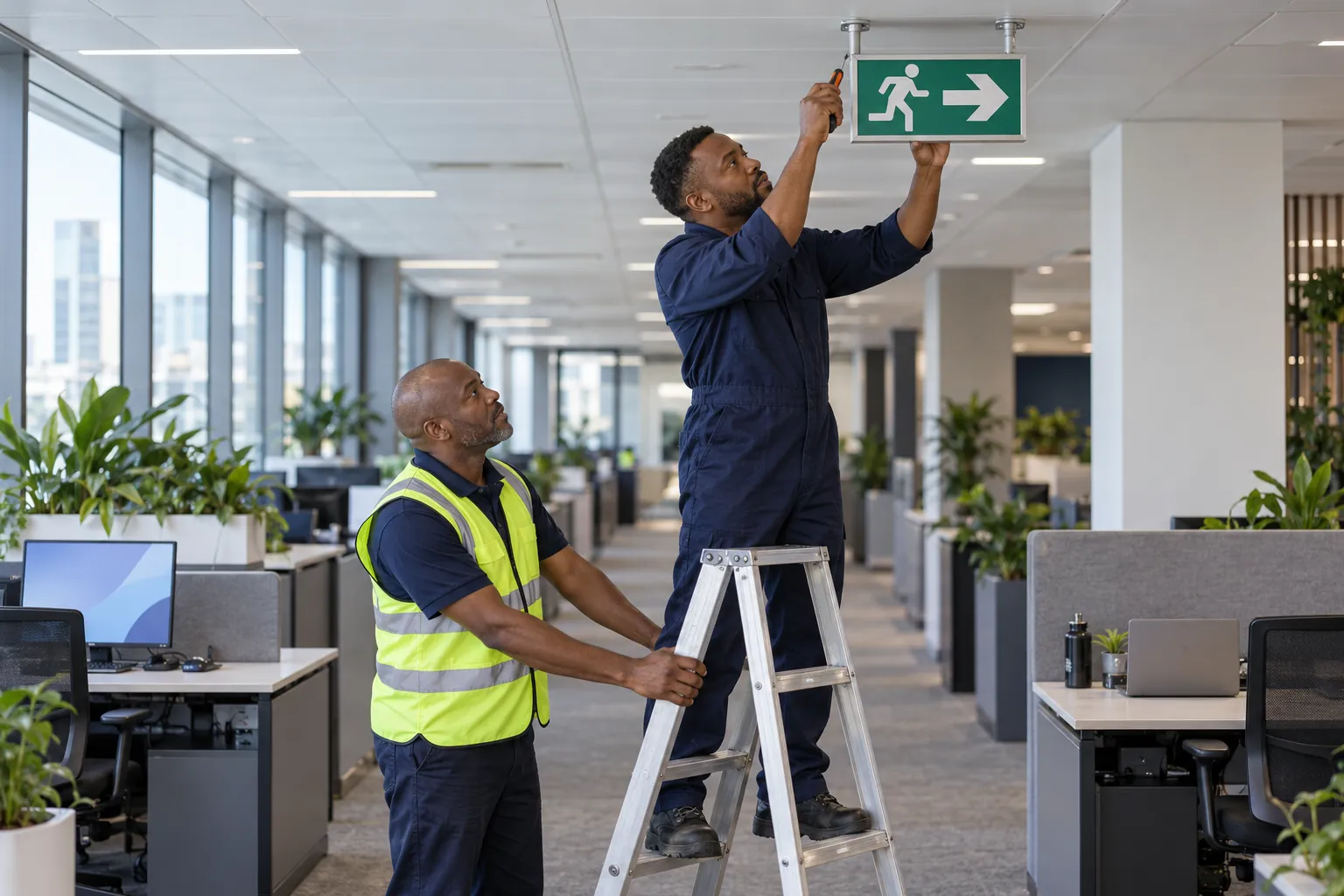
The fire by-laws of the metros quoted here also call for escape route signs, and in some cases fire equipment signs, made to SANS 1186: the South African standard for symbolic safety signs, and usually what a supplier means by a "SABS approved" sign. There is no national list of nine compulsory signs: what a building needs follows from its hazards, its escape routes and its municipality's by-law. This guide covers where the duty comes from, which signs the regulations and by-laws name, what SANS 1186 covers, where signs go, and how a site checks they are still there, legible and lit.
01
Where the duty to display safety signs comes from
Section 8(1) of the Occupational Health and Safety Act 85 of 1993 requires every employer to provide and maintain, as far as is reasonably practicable, a working environment that is safe and without risk to the health of employees, and section 8(2)(e) requires the information and instructions needed for health and safety.
The specific duty is in regulation 2 of the General Safety Regulations, 1986 (Government Notice R. 1031). Where a hazard cannot be made safe at source, regulation 2(2) requires the employer to "provide free of charge and maintain in a good and clean condition such safety equipment and facilities as may be necessary", and regulation 2(3)(d) lists among them "mats, barriers, locking-out devices, safety signs, or any similar facility that will effectively prevent slipping, unsafe entry or unsafe conditions". Regulation 2(4) forbids removing it except for cleaning, repair, maintenance, modification or replacement. The General Safety Regulations, 2025 (Government Notice 5954 of 6 March 2025) amended the regulations and kept regulations 2(2) and 2(4) among the offences in regulation 14, punishable by a fine or imprisonment of up to six months.
Regulation 2B brings symbolic signs in. Where a regulation prescribes a particular notice or sign, the employer may instead "display a corresponding symbolic sign, as contained in a safety standard incorporated for this purpose into these regulations under section 44 of the Act", and is then treated as having complied.
For fire, regulation 13J of the General Safety Regulations, as set out in the 2025 notice, requires exit doors to be kept clear and easy to open from inside, and an adequate supply of fire-fighting equipment at strategic locations. The duty also sits in two more places. Regulation T1(1)(a) of the National Building Regulations (read here in a 2008 compilation of the National Building Regulations and Building Standards Act 103 of 1977 and its regulations, which is not the official text) requires every building to be designed, constructed and equipped so that in case of fire "provision is made for the safe evacuation of such occupants or users", and regulation T1(2) deems that satisfied by compliance with SANS 10400-T:2024, The application of the National Building Regulations Part T: Fire protection. Regulation T2(2) makes it an offence to cause or permit an escape route "to be rendered less effective or to be obstructed in any way". Then the municipality's fire safety by-law governs the building in use.
In South Africa, a SANS standard is voluntary in itself and carries legal weight where a law, regulation or by-law calls it up. The three metro by-laws quoted here call up SANS 1186 by name, which is why a fire safety officer can ask whether an exit sign complies with it; other municipalities have their own by-laws.
02
Which safety signs a workplace needs
Supplier catalogues sort symbolic safety signs into five families: prohibition signs (no smoking, no naked lights, no entry); mandatory signs (wear hearing protection); warning signs (electricity, flammable material); emergency or safe condition signs (exit, direction of escape, first aid); and fire equipment signs, which show where fire extinguishers, fire hose reels and call points are. Exit signs and fire equipment signs together are what most people mean by fire safety signs. Each family has its own shape and colour, so a sign can be read before its words. SANS 1186-1 specifies the requirements for standard symbolic safety signs; it is sold by the SABS, so this guide does not reproduce its shapes and colours, and a sign should be checked against the standard or the supplier's certificate rather than a catalogue picture.
Which of them a building needs depends on what is in it. These are the signs and notices that South African regulations and the three metro by-laws name:
- Escape routes. Section 18(4) of the eThekwini Fire By-law, 2022 requires an escape route to be "clearly indicated with signage as contemplated in SANS 1186", showing the direction of travel in a fire or other emergency. Section 15(3) of the City of Cape Town Community Fire Safety By-law, 2002 requires the same "where required by the controlling authority".
- Fire-fighting equipment. Section 39(3)(c) of the City of Johannesburg Emergency Services By-laws requires the holder of a certificate of registration under the by-laws, such as one for flammable substances, to keep fire-fighting equipment "positioned prominently" or, where that is not possible, to show its position with a symbolic safety sign made to SABS 1186.
- No smoking and no naked lights. Section 31(1) of the Cape Town by-law prohibits smoking where it creates a fire hazard and requires "No Smoking" signs, complying with SABS 1186 Part 1, to be displayed as the controlling authority directs, and section 31(2) says "A person may not remove a \"No Smoking\" sign." Regulation 4(8)(a) of the General Safety Regulations requires a sign prohibiting fire, flames and naked lights at every entrance to a room, cabinet or enclosure where flammable liquid is used, sprayed or stored, and a notice prohibiting smoking at every entrance to any place where flammable liquid is used or stored.
- Flammable stores. Regulation 4(10)(e) requires a flammable liquid store to be "clearly marked with a sign indicating that it is such a store" and the amount it may hold. Section 50 of the Johannesburg by-laws requires symbolic signs prohibiting open flames and smoking in a registered flammable storeroom, in a number the Chief Fire Officer sets, at least 290 by 200 millimetres and made to SABS 1186.
- First aid. Regulation 3(6) requires "a prominent notice or sign in a conspicuous place" showing where the first aid box is kept and the name of the person in charge of it.
- No unauthorised entry. Under regulation 2C(2) the employer posts a notice at every entrance prohibiting unauthorised entry where it deems that necessary for health and safety.
- Noise zones. Regulation 11 of the Noise Exposure Regulations, 2024 (Government Notice 5953 of 6 March 2025) requires an area at or above the noise-rating limit, an 8-hour rating level of 85 dBA, to be "designated and clearly demarcated as a noise zone", and nobody may be allowed in unless effective hearing protection is worn correctly.
- Respirator zones and chemical pipework. Regulation 8(b) of the Regulations for Hazardous Chemical Agents, 2021 requires a respirator zone to be "clearly demarcated and identified by a notice", and regulation 14B(1)(d)(iv) requires hazardous chemicals in pipework to be identified "by a label or sign or in any other suitable manner".
- Escape route plans. Section 24(1) of the Cape Town by-law requires the escape route plan to be displayed in every room for sleeping in a hospital, hotel, guest house, hostel or similar occupancy.
Many sites also display the emergency evacuation plan beside the signs.
03
SANS 1186 and what "SABS approved" means
SANS 1186 is the South African National Standard for symbolic safety signs, published by the SABS in five parts. Older by-laws call it SABS 1186, its earlier designation. The current parts are:
- SANS 1186-1:2022 (Ed. 3.08), Symbolic safety signs Part 1: Standard signs and general requirements, which the SABS says "specifies requirements for standard ordinary (non-reflective) symbolic safety signs, including signs on vinyl sheets (decals)". It replaced edition 3.07 of 2015.
- SANS 1186-2:2026, Part 2: Self-luminous (radioluminescent) signs, which need no external source of power.
- SANS 1186-3:2013, Symbolic safety signs Part 3: Internally illuminated signs, box signs "illuminated by one or two separate systems of electric lighting": the familiar lit exit sign.
- SANS 1186-4:2024, Part 4: Retro-reflective signs, which shine back in headlights, useful in parking garages and yards.
- SANS 1186-5:2025, Symbolic safety signs Part 5: Photoluminescent signs, which glow for a time after the lights go out, having absorbed light while they were on.
SANS documents are sold by the SABS, so this guide names them and does not quote their content. Catalogues offer the same sign in several sizes and materials. When a supplier calls a sign "SABS approved", ask which part and edition of SANS 1186 it is made to, what material it is and whether it suits indoor or outdoor use, and for the certificate if they say the product is certified.
04
Where signs go: exits, fire equipment and hazards
The fire plans and your fire department settle the detail; the practice is this:
- Exit and direction signs, the running man with an arrow for the direction of travel, along the whole escape route: wherever someone could take the wrong turn, at stair landings, above final exit doors and along long corridors and open-plan floors. From each sign, a person should see the next.
- Fire equipment signs above or beside each fire extinguisher, fire hose reel and call point, high enough to stay visible over furniture and stock.
- Prohibition and warning signs at the entrance to the hazard, not inside it: on the door of the flammable store, generator room, switch room, plant room and chemical store, and where a noise or respirator zone begins.
- Mandatory signs where the protective equipment must be put on, beside the place it is kept.
- First aid signs at the box, with the first aider's name kept current.
- Temporary signs for wet floors, closed ablutions and work in progress, put out when the hazard starts and taken in when it ends. A wet floor sign left up all day is a sign nobody reads.
Signs must not be covered by notices, shelving or partitions, and a fit-out that moves a door must not leave the old exit sign pointing at a wall. Section 16(4) of the Johannesburg by-laws says no person may "alter, damage, misuse or render ineffective" fire-fighting equipment or a service installation, which it defines to include emergency lighting and any "symbolic safety sign".
Symbolic safety signs work for people who do not read English, and regulation 2B lets an employer display a symbolic sign from a safety standard incorporated under section 44 of the Act in place of a notice or sign a regulation prescribes; where words are added, keep them short and in the languages the site uses.
05
Checking the signs are still there, legible and lit
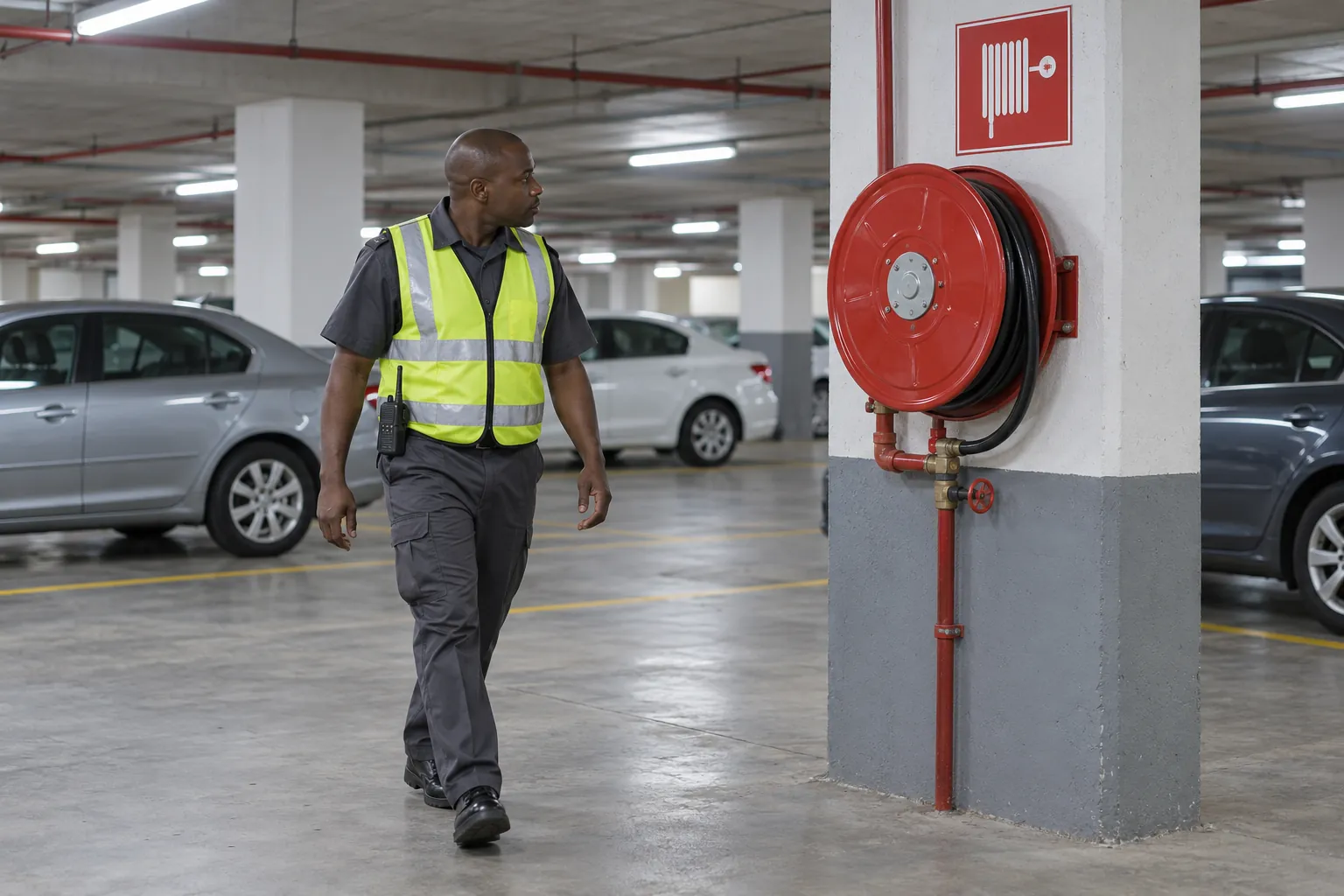
The by-laws expect signs to work all year. Section 16(1) of the City of Johannesburg Emergency Services By-laws requires every owner of a building to ensure that service installations, symbolic safety signs among them, are "installed in a manner and condition ready for use in an emergency", maintained in good working condition by a competent person, inspected by an appropriately registered and competent person at least once every 12 months, and recorded in "a comprehensive service record" furnished to the Chief Fire Officer every 12 months. Table 2 of section 31(1) of the eThekwini Fire By-law, 2022 sets a monthly interval for emergency lighting and emergency power supply, and section 31(5) requires defects to be attended to "without delay".
None of the by-laws quoted here sets a frequency for the in-house walk-round of signs. Monthly is a sensible default, on the same round as the extinguishers and the emergency lighting test. At each location, check that the sign:
- is there, and is the right sign for what is at that place now;
- can be seen from the direction people approach, with nothing hung over it or stacked in front of it;
- is legible: not faded, peeling, cracked or painted over;
- points the right way after any change to doors, partitions or layout;
- is lit, if it is an illuminated sign, and stays lit on battery during the emergency lighting test;
- is secure on the wall, door or ceiling.
Check straight away after building work or a fit-out, a change of use, a fire or evacuation, and a long power outage. A health and safety representative may also inspect the workplace at agreed intervals under section 18(1)(g) of the Act; see the workplace safety inspection checklist.
The record should show the date, the name of the person who checked, each location by name rather than one tick for the building, what was found, and for each fault who was told and when it was put right. Keep it with the fire equipment register.
06
Where the record fails, and what SiteClara does about it
Signs are installed once, signed off with the building, and forgotten. The exit sign that went dark during a run of power cuts, the fire equipment sign behind new shelving and the no-smoking sign peeled off the generator room door are seen every day by cleaners and security officers who have nowhere to report them except to whoever is passing.
SiteClara puts the check at the location. A printed QR poster, with an optional NFC tag behind it, sits at each floor, stairwell, plant room or group of fire points. Security officers, cleaners and supervisors scan the code or tap the tag on their own phone, with no app to install, see the checks due there, and mark each one done or say what stopped them, with a photo when one is asked for. The named person and the time are recorded as it happens. A fault, such as a missing sign, an unlit exit sign or a blocked fire point, is reported there with a photo and goes onto the team's list of open jobs until someone closes it.
The supervisor sees what is due, done and missed, and gives the reason when a check was missed. Each day the supervisor reviews and approves a report that goes to the client's facilities manager and other nominated contacts at 08:00 the next morning, showing what was reported, completed and still open, and how the scheduled checks went.
07
Questions people ask
What are the 9 mandatory safety signs in the workplace?
No South African law lists nine mandatory safety signs; the number comes from sign catalogues. Regulation 2 of the General Safety Regulations requires safety signs where a hazard calls for them, and particular regulations and by-laws name particular signs, such as escape route signs, no-smoking signs at flammable stores, the first aid notice and noise zone markings.
What are the SABS approved safety signs?
Signs described as SABS approved are normally signs made to SANS 1186, the South African standard for symbolic safety signs, whose Part 1 is SANS 1186-1:2022, Standard signs and general requirements. Ask the supplier which part and edition a sign is made to, and for the certificate if they say it is certified.
What are the rules for fire exit signage?
An escape route must be clearly indicated with signage to SANS 1186 showing the direction of travel in the event of fire or any other emergency: section 18(4) of the eThekwini Fire By-law, 2022 requires it outright, and section 15(3) of the City of Cape Town Community Fire Safety By-law, 2002 requires it where the controlling authority does. How many fire exit signs a building needs, and how they are lit, is part of its fire design under SANS 10400-T.
08
Where to read the official text, and a list to take away
Nationally, read regulations 2, 2B, 2C, 3, 4 and 13J of the General Safety Regulations, 1986 with the General Safety Regulations, 2025, section 8 of the Occupational Health and Safety Act 85 of 1993, and Part T of the National Building Regulations (an unofficial 2008 compilation of the Act and its regulations is on the dtic's website; confirm the current text with the municipality's building control office). Then read your municipality's fire safety by-law; those quoted here are the City of Johannesburg Emergency Services By-laws (as consolidated to 31 August 2011), the eThekwini Fire By-law, 2022 and the City of Cape Town Community Fire Safety By-law, 2002 (as amended to 2015). By-laws change, so confirm the current text with the municipality. SANS 1186-1:2022 and SANS 10400-T:2024 are sold by the SABS. Before the next round, check that:
- there is a list of every safety sign by location, kept with the fire equipment register;
- every escape route is signed in the direction of travel, from every point a person might start;
- every extinguisher, hose reel and call point is obvious or signed;
- flammable stores, plant rooms, switch rooms and noise zones are signed at the entrance;
- the first aid sign names the current first aider;
- lit exit signs are tested with the monthly emergency lighting check and after long outages;
- each check is recorded location by location, with the name and the date, and every missing, faded or unlit sign has an owner and a date.
Sources
Every document this guide quotes or links to, in the order it first cites them.
- Occupational Health and Safety Act 85 of 1993 gov.za
- General Safety Regulations, 1986 (Government Notice R. 1031) labour.gov.za
- General Safety Regulations, 2025 (Government Notice 5954 of 6 March 2025) gov.za
- 2008 compilation of the National Building Regulations and Building Standards Act 103 of 1977 and its regulations thedtic.gov.za
- SANS 10400-T:2024, The application of the National Building Regulations Part T: Fire protection store.sabs.co.za
- EThekwini Fire By-law, 2022 openbylaws.org.za
- City of Cape Town Community Fire Safety By-law, 2002 openbylaws.org.za
- City of Johannesburg Emergency Services By-laws openbylaws.org.za
- Noise Exposure Regulations, 2024 (Government Notice 5953 of 6 March 2025) gov.za
- Regulations for Hazardous Chemical Agents, 2021 labour.gov.za
- SANS 1186-1:2022 (Ed. 3.08), Symbolic safety signs Part 1: Standard signs and general requirements store.sabs.co.za
- SANS 1186-3:2013, Symbolic safety signs Part 3: Internally illuminated signs store.sabs.co.za
- SANS 1186-5:2025, Symbolic safety signs Part 5: Photoluminescent signs store.sabs.co.za
Related guides
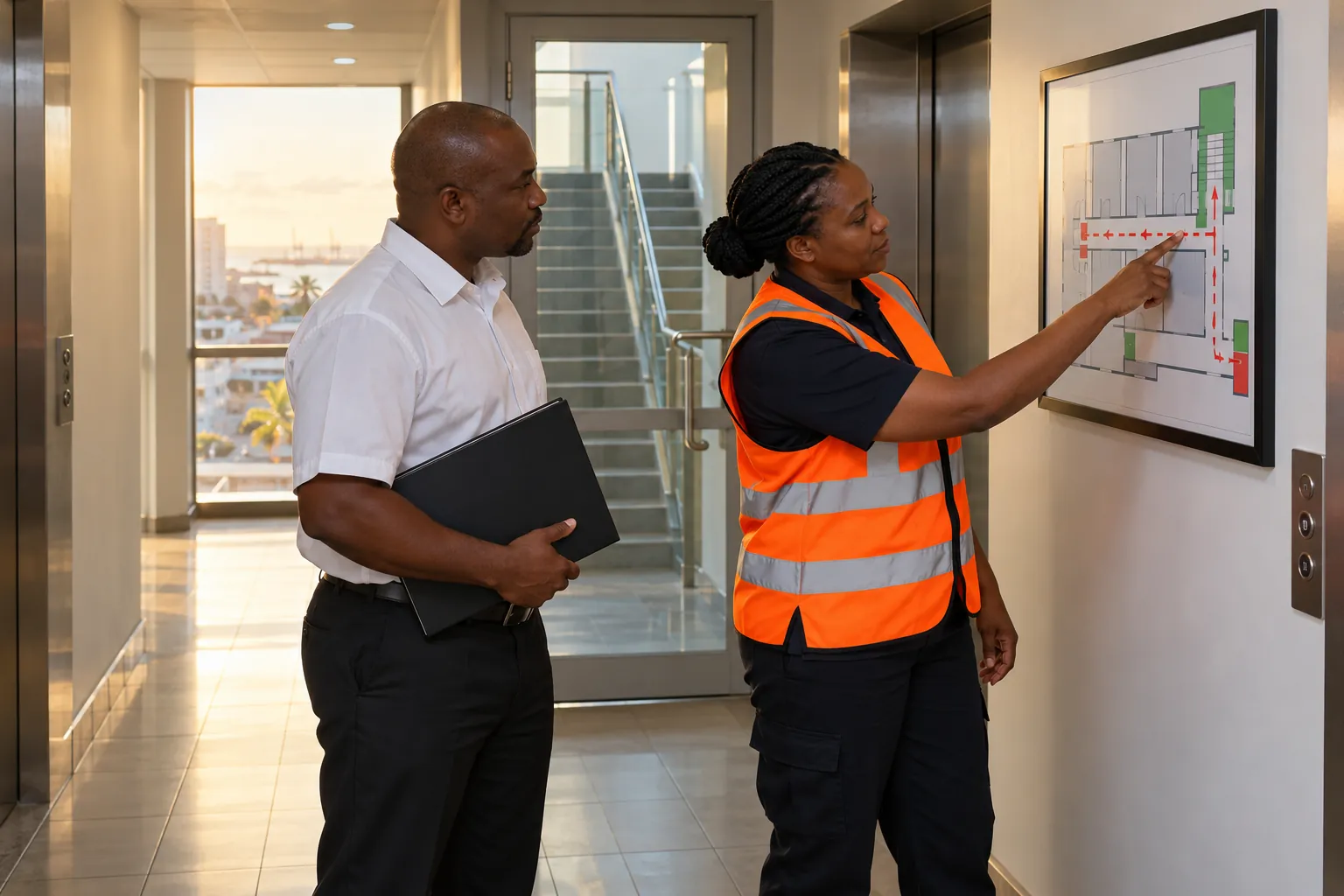 Fire and water checksEmergency evacuation plans: what goes in one, and how to keep it trueWhat an emergency evacuation plan must contain in South Africa, which by-laws require one, how often it is reviewed and tested, and keeping escape routes usable.
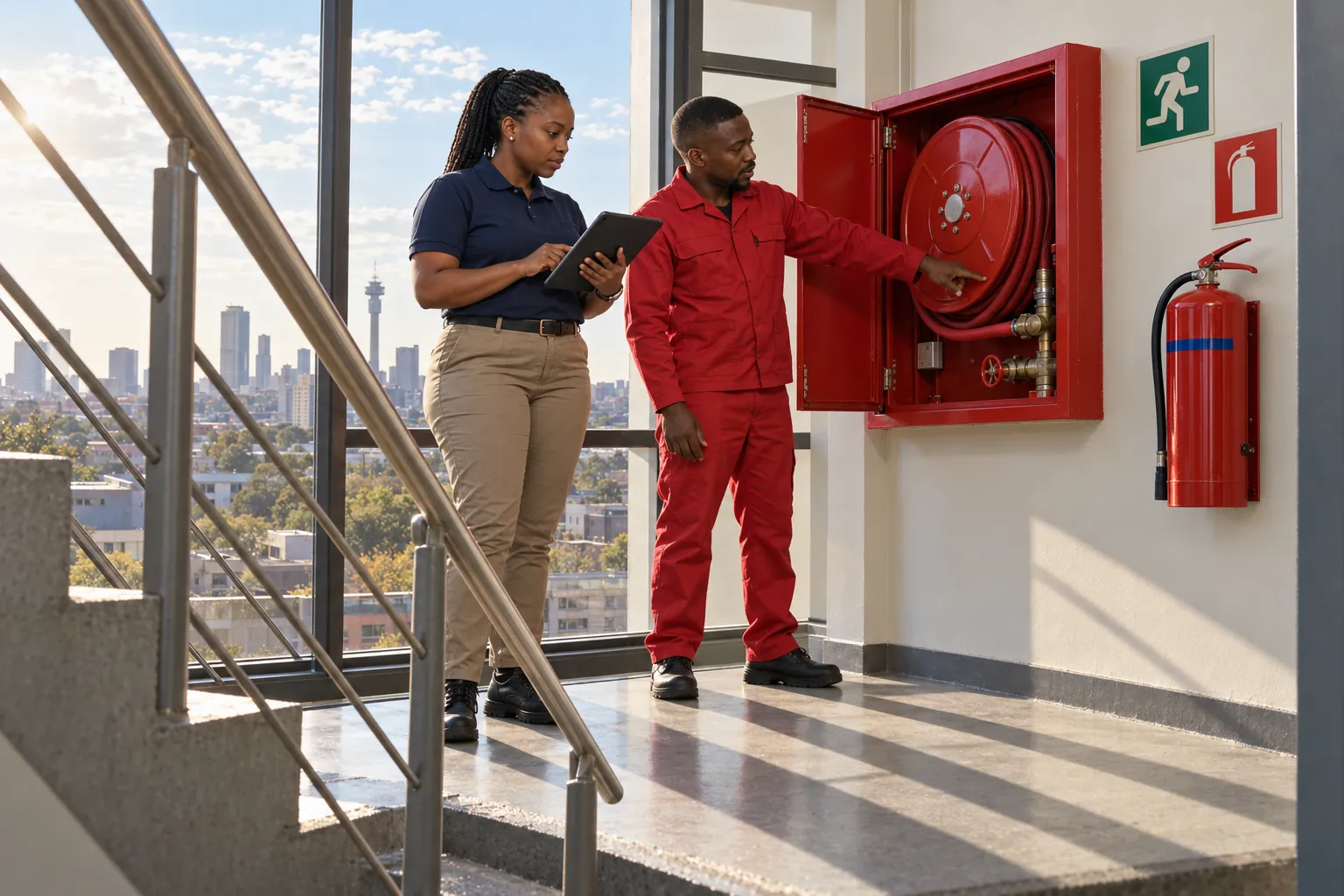 Fire and water checksFire equipment checklist: the register of everything, and when each item is dueA fire equipment checklist for South Africa: the register of every extinguisher, hose reel, hydrant and installation, service intervals and the record by-laws want.
 Fire and water checksTypes of fire extinguishers: which one for which fire, and where it belongsThe types of fire extinguishers used in South Africa, the classes of fire each is for, who decides which goes where, and who may service them under SANS 1475.
 Premises and facilities managementHealth and safety inspection checklist: what to look at, and what to do nextWhat a workplace health and safety inspection should cover in South Africa, how often, who inspects, and how to record and close findings under the OHS Act.