Fire and water checks
Safety signs in Ireland: what the law requires, from fire exit signs to warning signs
In Ireland, safety signs are required by Chapter 1 of Part 7 of the Safety, Health and Welfare at Work (General Application) Regulations 2007 wherever a hazard cannot be avoided or adequately reduced in any other way, and every sign must meet Schedule 9 to those Regulations: a pictogram without text, in a set shape and colour, kept clean, visible and in good repair.
Also written for United Kingdom · New Zealand · South Africa
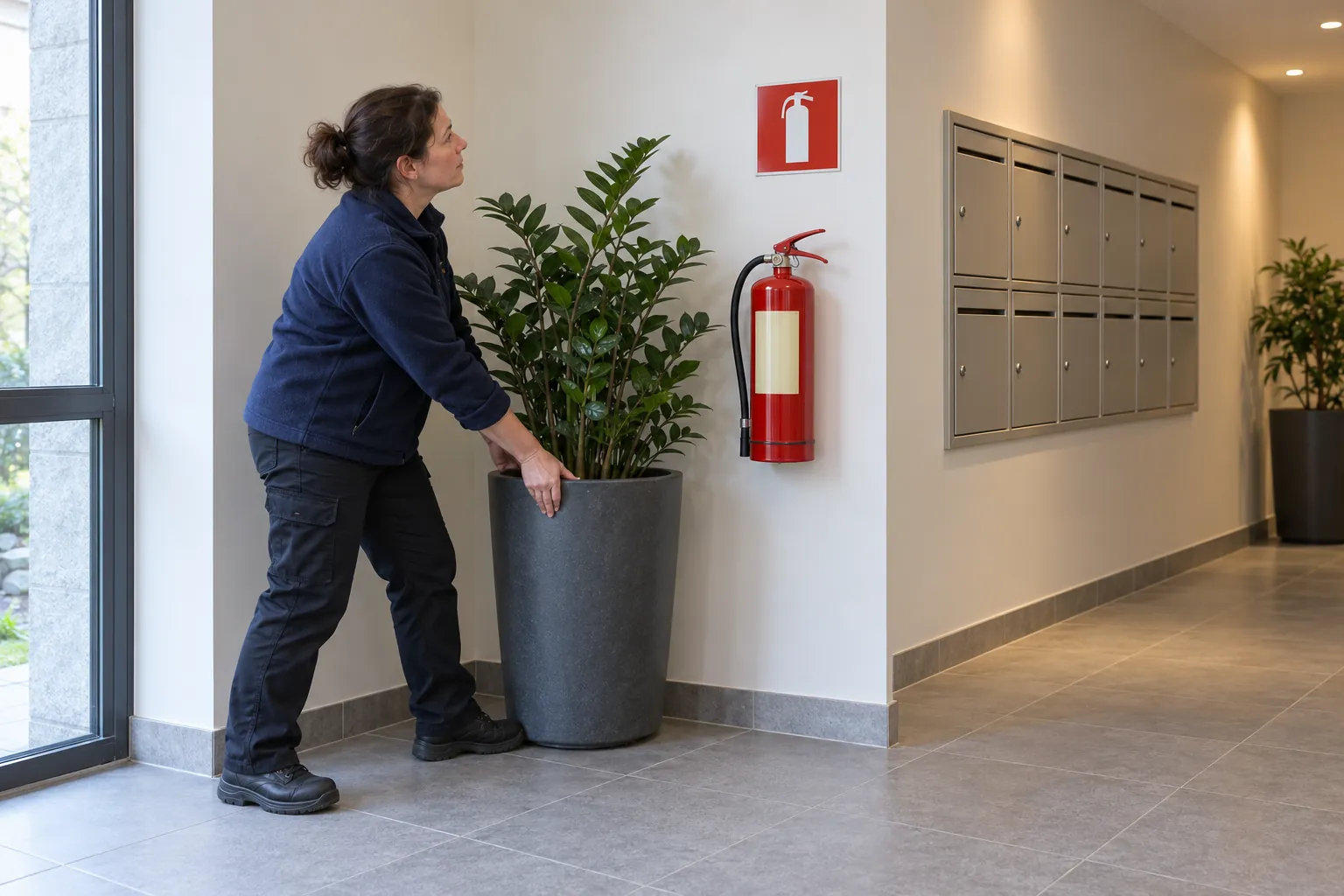
Fire signs come from the same Regulations and from fire law: emergency routes and exits must be indicated by signs, fire-fighting equipment must be marked, and the person having control of the building must make sure the fire safety measures are applied at all times. This guide covers the law, the five kinds of signboard, fire exit and fire door signs, which health and safety signs a building needs, and the routine check that keeps them right.
01
What Irish law says about safety signs
Health and safety signs. Regulation 160 of the Safety, Health and Welfare at Work (General Application) Regulations 2007 (S.I. No. 299 of 2007) requires an employer to “provide safety or health signs, or both, at the place of work where hazards cannot be avoided or adequately reduced by techniques for collective protection or measures methods or procedures used in the organisation of work”, to “ensure that such signs are in place”, and to “ensure that a safety or health sign used at work complies with Schedule 9”. The employer decides with regard to the risk assessment under section 19 of the Safety, Health and Welfare at Work Act 2005 and the safety statement under section 20. Chapter 1 of Part 7 (Regulations 158 to 162) applies to every place of work, and was amended by S.I. No. 70 of 2016, from 18 February 2016, to take account of the CLP Regulation on the classification, labelling and packaging of chemicals.
Regulation 12(g) adds that “specific emergency routes and exits are indicated by signs in accordance with Part 7 Chapter 1 and such signs are placed at appropriate points and are adequately durable”, and Regulation 13(b) requires non-automatic fire-fighting equipment, such as extinguishers, to be indicated by signs on the same terms.
Fire law. Section 18 of the Fire Services Act 1981 applies to premises with sleeping accommodation, care, entertainment, teaching or public access, and section 29 of the Licensing of Indoor Events Act 2003 added “any workplace”. Under the substituted section 18(2), the person having control must “provide reasonable fire safety measures” and “ensure that the fire safety measures and procedures … are applied at all times”. Table 1 of the Department of Housing, Local Government and Heritage's Fire Safety Guide for Building Owners and Operators (August 2023), an illustrative example for a licensed premises with a flat above, lists signs for escape routes among those measures, with a routine visual check of “signage visibility”.
A sign is a last resort, not a control. The Health and Safety Authority's Guide to Chapter 1 of Part 7: Safety Signs at Places of Work (amended 2016) says that “a system of safety signs must never be used as a substitute for necessary protective measures”. And Regulation 161 requires employees to be instructed in the signs used at work, “which must include the meaning of the signs”.
02
The five kinds of signboard, and why they carry no words
Part B of Schedule 9 sets the requirements for each kind of signboard, giving it a shape and colour so that the reader knows what sort of message it carries before they take in the pictogram:
- Prohibition signs: round, a black pictogram on white with a red edge and diagonal line, the red at least 35% of the sign. No smoking, or no entry for pedestrians.
- Warning signs: triangular, a black pictogram on yellow with a black edge, the yellow at least 50%. Electrical hazard, slippery floor, general danger.
- Mandatory signs: round, a white pictogram on blue, the blue at least 50%. Wear eye protection, wear gloves.
- Emergency escape or first-aid signs: rectangular or square, a white pictogram on green, the green at least 50%. The fire exit or emergency exit sign is one of these.
- Fire-fighting signs: rectangular or square, a white pictogram on red, the red at least 50%, marking a fire extinguisher, hose reel or other fire-fighting equipment.
Part A gives the colours their meanings: red for prohibition, danger alarm and fire-fighting equipment; yellow or amber for warning; blue for a mandatory action; green for emergency escape and first aid. Schedule 9 also covers illuminated signs, acoustic signals such as the fire alarm, where “the signal for evacuation shall be continuous”, and hand signals.
No words on the signboard. Regulation 158 defines a signboard as a shape, colours and a pictogram “without written words”. The HSA's Safety Signs FAQs explain that the pictograms “are intended to be understood, independently of the language ability of the worker viewing it”. Text may go on a separate supplementary signboard on the same carrier, provided it does not weaken the signboard. Signboards with words in place before November 2007 could stay only until 1 January 2011. The HSA guide adds one safety message per signboard: a hard hat and goggles need two signs, not one combined pictogram.
No fixed size. Schedule 9 sets no minimum size for a signboard: its “dimensions and colorimetric and photometric features” must be such that it “can be easily seen and understood”, and it must be made of “shock and weather-resistant material suitable for the surrounding environment”. A sign read from across a warehouse needs to be larger than one read at a door.
03
Fire exit signs, fire door signs and fire safety notices
Technical Guidance Document B sets out the fire safety signs a building should have when it is built, extended or materially altered, a sensible benchmark for an existing building too (individual flats need none inside). Paragraph 1.9.12 says escape route signs, “including any doorways or exits which provide access to the means of escape, are required in all buildings to which this document applies”, lit by natural, artificial or emergency escape lighting “so that they are clearly visible”. It also asks for:
- Fire equipment signs showing fixed hose reels and fire alarm call points.
- Fire door signs: under Appendix B6, a blue mandatory sign “permanently fixed between 1.6 m and 1.8 m measured vertically from the floor”, on both faces, or outside only for cupboards and service ducts: Fire door keep shut, Automatic fire door keep clear for doors on hold-open devices, and Fire door keep locked shut for risers, worded as in Diagram 86 with letters 5 mm high. Doors to and within flats or maisonettes, bedroom doors in other residential (Purpose Group 2(b)) premises, and lift entrance doors are excepted.
- Push bar signs on escape doors with push bars, to Annex A, A19 of I.S. EN 1125.
- Refuge signs at each refuge area giving the floor number, and the stairway number where there is more than one stairway. Paragraph 5.5.6.9 adds storey identification signs in each firefighting stair and lobby, with a shaft number where there is more than one firefighting shaft.
Lit, with a backup. Schedule 9 says signs “requiring some form of power shall be provided with a guaranteed emergency supply in the event of a power cut”, and that illuminated signs are checked before use “and subsequently at sufficiently frequent intervals”. Illuminated exit signs are checked with the emergency lighting, as the emergency lighting testing guide explains.
Fire safety notices. Section 5.3.3 of the Fire Safety Guide asks for written instructions on what to do on discovering a fire or hearing the alarm, “displayed in prominent positions throughout the building” with a simple floor plan of the exits (Appendix H has an example). Section 5.4 adds that all fire safety signs, notices and instructions “should be prominently displayed and be fully and clearly visible at all times. Damaged items should be repaired or replaced.” The fire door inspection guide covers the doors themselves.
04
Health and safety signs: which ones a building needs
No fixed list of health and safety signs applies to every Irish workplace. The risk assessment and safety statement decide, and in an office, school, nursing home or apartment block that usually means some of these:
- Fragile roofs: Regulation 9(1)(c) requires warning signs at the access points.
- Chemical and cleaners' stores: a warning sign where significant quantities of hazardous substances are kept, unless the container labels are enough (Schedule 9, Part C).
- Plant rooms and switchrooms: electrical warning and no-entry signs where the risk assessment calls for them.
- First aid: Regulation 165 requires first-aid equipment to be “suitably marked and easily accessible”, and the local emergency services' details “clearly displayed at each place of work”.
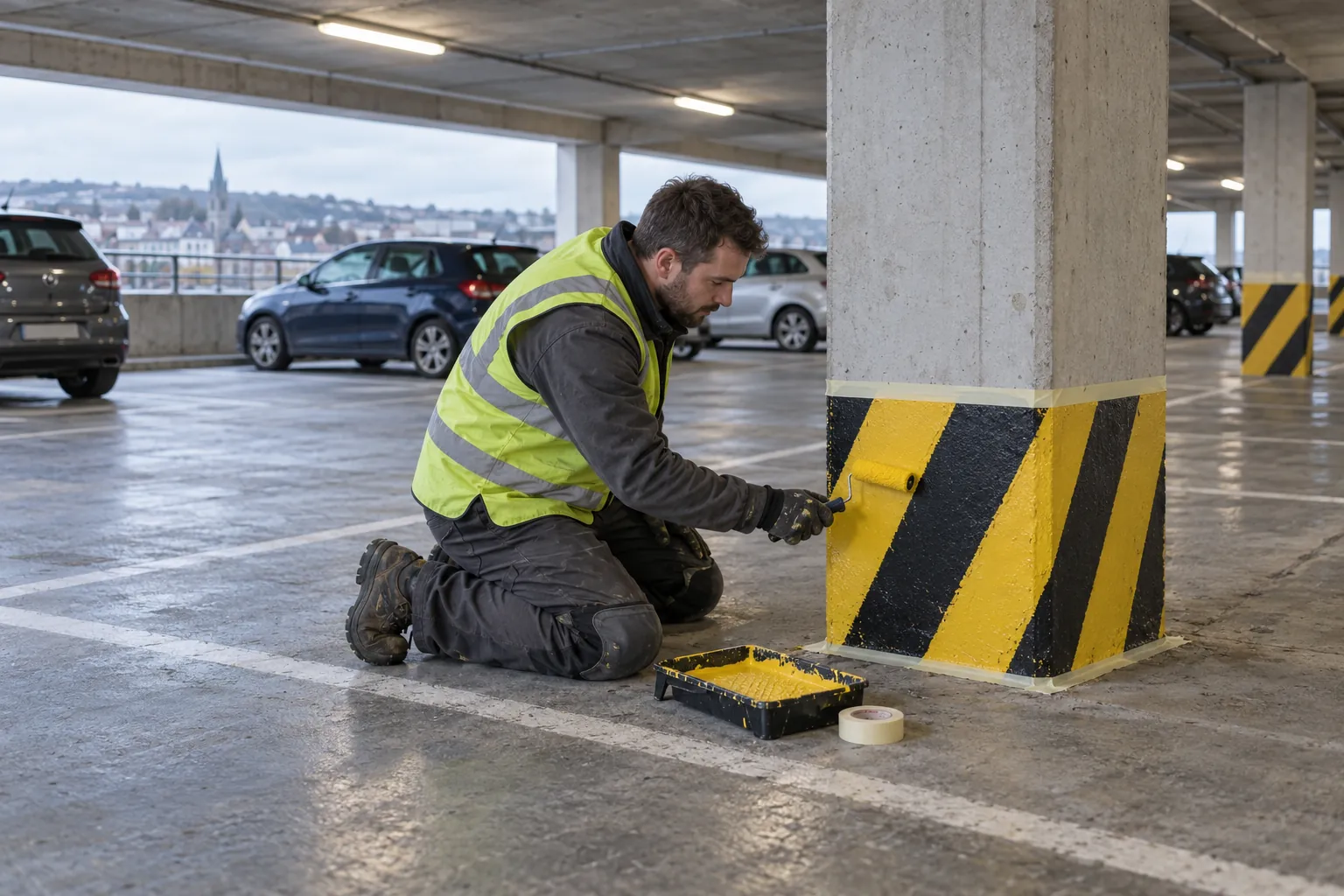
- Obstacles and drops: yellow and black, or red and white, stripes at about 45° (Part E).
- Yards and car parks: vehicle routes marked with continuous white or yellow stripes, and ordinary road traffic signs where vehicles create a risk.
- Wet floors and works: temporary warning signs, removed when the hazard has gone.
That last point is law: “the signboard shall be removed when the situation to which it refers ceases to exist” (Part B). The HSA's page on over-used temporary signs names cleaned floors, spills, ice and rain at entrances, and warns that “warning signs alone may not be adequate for many circumstances”. The HSA guide adds that signs left in place “undermine the effectiveness of other signage”.
Signs go at a suitable height in the line of sight, “in a well-lit and easily accessible and visible location”, and Schedule 9 warns against “too many signs too close together”. In a shared building, agree who looks after which fire safety signs and health and safety signs: the Fire Safety Guide says that where fire safety responsibilities are shared, who does what “should be clear to all parties involved”. In an apartment block, the person having control may be the owners' management company, a property services company acting for it, or several parties sharing the duty, depending on the arrangements in place.
05
The routine sign check
Schedule 9 requires signs to be “cleaned, maintained, checked repaired, and if necessary replaced on a regular basis”, and names what defeats one: “poor design, insufficient number, incorrect positioning, poor state of repair or incorrect functioning”. Table 2 of the Fire Safety Guide puts fire safety signs into the daily check that “escape routes are clearly indicated, sign-posted and adequately illuminated”, and the HSA's emergency escape and fire fighting checklist asks whether escape routes “and associated lighting and signs” are regularly checked.
The sign check usually rides on the workplace fire safety checklist walk-round: a glance daily, and a closer look location by location on a schedule. At each location:
- Is the sign still there? Signs come down for painting and are not put back.
- Can it be seen? Not hidden by a display, boxes or a new partition.
- Is it legible? Faded, peeling or dirty signs are cleaned or replaced.
- Is it still right? An arrow pointing at a wall, an exit sign over a door that no longer leads out.
- Is it lit? A dark exit sign is an emergency lighting fault.
- Have temporary signs come down, and does anything new need a sign?
The check that matters most follows a change. A new partition, tenant or change of use can leave a route signed for the old layout, and section 19(3) of the 2005 Act requires the risk assessment to be reviewed after a significant change: review the signs with it.
Record what was found and what was done. The example in Table 1 of the Fire Safety Guide asks the person having control to “schedule and record routine fire safety visual checks/inspections” in the fire safety register, and the HSA says that for fire-fighting equipment, fire alarms and emergency lighting, a record of the work carried out “will help to demonstrate compliance with the law”. A sheet that says “all OK” every week never shows whether last month's faded sign was replaced.
06
Where the record fails, and what SiteClara does about it
Sign checks are the easiest fire safety check to skip, because a missing sign never sounds an alarm. They are ticked on the escape route sheet with nothing to say which signs were looked at. The faded exit sign in the back stairs is mentioned to whoever was passing and forgotten, and in a shared building nobody is sure whose job the plant room signs are until a fire officer asks.
SiteClara records the check where it happens. A printed QR poster, with an optional NFC tag behind it, sits at each location on the round, such as a floor or a stair core. The person doing the walk scans the code or taps the tag on their own phone, with no app to install, sees the checks due there, and marks each one done or says what stopped them, with a photo when one is asked for. A missing, faded or wrong sign reported there goes onto the team's list of jobs and stays open until someone closes it.
The supervisor sees what is due, done and missed, records why a check was missed, and approves a daily report that goes to nominated contacts the next morning: the person having control, the owners' management company's managing agent or a client's facilities manager.
07
Questions people ask
What are the 5 main safety signs?
Prohibition signs (a red circle and diagonal line), warning signs (a yellow triangle), mandatory signs (a blue circle), emergency escape or first-aid signs (a green rectangle or square) and fire-fighting signs (a red rectangle or square). They are the five kinds of signboard in Part B of Schedule 9 to the General Application Regulations 2007, which the HSA's Guide to Chapter 1 of Part 7: Safety Signs at Places of Work reprints with the pictograms to use.
How do you identify safety signs?
By shape and colour, before the symbol: the HSA's Safety Signs FAQs give red for prohibition, yellow for caution, green for positive action and blue for mandatory actions, with discs for prohibitions and instructions, triangles for warnings, and squares and rectangles for emergency and information signs. Fire-fighting signs are red squares or rectangles.
What would you say on a fire exit sign?
Nothing on the signboard itself: in Ireland a fire exit sign is a white pictogram on green, and the HSA's Safety Signs FAQs say signboards put in place after 1 November 2007 “should not contain text”. Words such as “This way”, which Schedule 9 shows as a supplementary information signboard, may go beside it on the same carrier, provided they do not adversely affect the effectiveness of the signboard.
What is the standard for fire exit signs?
I.S. EN ISO 7010, the registered safety signs standard: paragraph 1.9.12 of the Department's Technical Guidance Document B 2024, Volume 1 says further information on signs is contained in it, and Appendix E lists I.S. EN ISO 7010:2020 with amendment A6 of 2023. The sign must also meet Schedule 9 to the 2007 Regulations: a white pictogram on a green rectangle or square, the green at least 50% of the sign.
Do fire exit signs need to be lit?
Yes. Paragraph 1.9.12 of Technical Guidance Document B 2024, Volume 1 says escape route signs should be illuminated by natural, artificial or emergency escape lighting “so that they are clearly visible”, and Schedule 9, reprinted in the HSA's Guide to Chapter 1 of Part 7: Safety Signs at Places of Work, requires signs “requiring some form of power” to have “a guaranteed emergency supply in the event of a power cut”.
Who is responsible for safety signs in a workplace?
The employer, for health and safety signs: Regulation 160 of the 2007 Regulations, reprinted in the HSA's Guide to Chapter 1 of Part 7: Safety Signs at Places of Work, requires them to provide the signs and “ensure that such signs are in place”. For fire safety signs, the person having control of the premises has the section 18(2) duty explained in the Department's Fire Safety Guide for Building Owners and Operators, which says that where those responsibilities are shared, who does what “should be clear to all parties involved”.
08
Further reading, and a list to take away
Start with the HSA's Guide to Chapter 1 of Part 7: Safety Signs at Places of Work, which reprints Schedule 9 with examples. The Irish Statute Book has the General Application Regulations 2007 as first made, without the 2016 amendment. For fire signs, read the Department's Fire Safety Guide for Building Owners and Operators (sections 3, 5.3.3 and 5.4, Tables 1 and 2) and paragraph 1.9.12 and Appendix B6 of Technical Guidance Document B 2024, Volume 1 (reprinted January 2026). The NSAI publishes I.S. EN ISO 7010. Under section 18(4) of the 1981 Act, the fire authority may give advice on a particular building.
Before the next sign walk, check that:
- the risk assessment and safety statement say which signs are needed, and the building matches them;
- every escape route and exit is signed, and every extinguisher, hose reel and call point marked;
- every signboard is a pictogram, with any words on a supplementary signboard;
- fire doors carry their blue signs, and push bar doors theirs;
- illuminated exit signs are on the emergency lighting check schedule;
- fire action notices with a floor plan are displayed;
- temporary signs come down when the hazard has gone;
- staff know what the signs mean;
- in a shared building, who looks after which signs is written down;
- the sign check is scheduled, records what it found, and is repeated after every change of layout.
Sources
Every document this guide quotes or links to, in the order it first cites them.
- Safety, Health and Welfare at Work (General Application) Regulations 2007 irishstatutebook.ie
- Section 19 of the Safety, Health and Welfare at Work Act 2005 irishstatutebook.ie
- Section 18 of the Fire Services Act 1981 irishstatutebook.ie
- Section 29 of the Licensing of Indoor Events Act 2003 irishstatutebook.ie
- Fire Safety Guide for Building Owners and Operators assets.gov.ie
- Guide to Chapter 1 of Part 7: Safety Signs at Places of Work hsa.ie
- Safety Signs FAQs hsa.ie
- Technical Guidance Document B 2024, Fire Safety, Volume 1 gov.ie
- Over-used temporary signs hsa.ie
- Emergency escape and fire fighting hsa.ie
- Technical Guidance Document B 2024, Volume 1 assets.gov.ie
Related guides
 Fire and water checksWorkplace fire safety checklist: what to check, how often, and who does itA workplace fire safety checklist for Ireland: the daily, weekly and monthly checks under the Fire Services Acts, who does each one, and what to record.
 Fire and water checksEmergency lighting testing in Ireland: the checks, the tests, and the recordEmergency lighting testing in Ireland: the legal duty, the daily and weekly checks, quarterly and annual tests to I.S. 3217, and what the logbook should show.
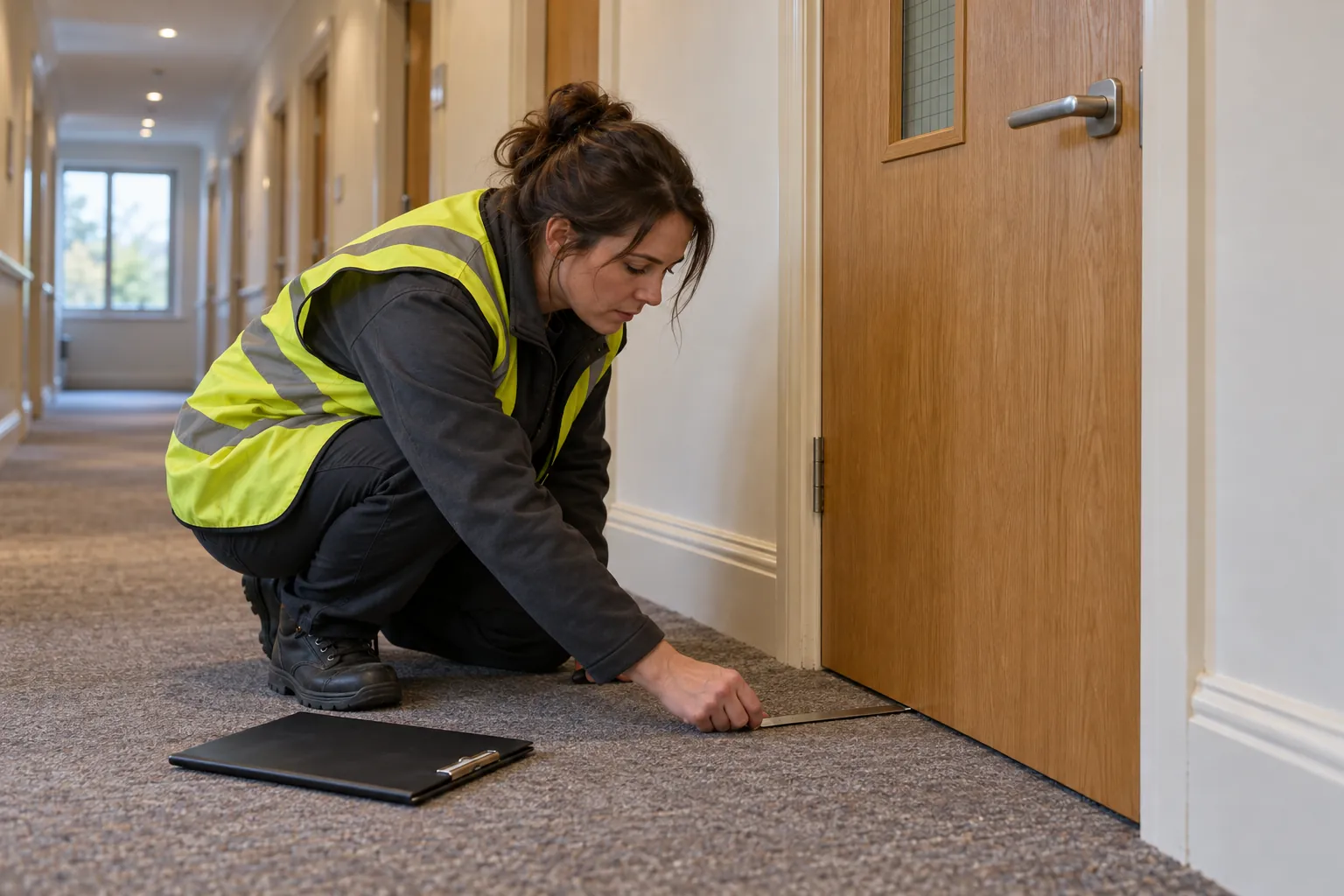 Fire and water checksFire door inspection: the duty, the checks and the recordFire door inspection in Ireland: the section 18(2) duty, the six-monthly check in the Department's guide, what a competent person looks at, and the register.
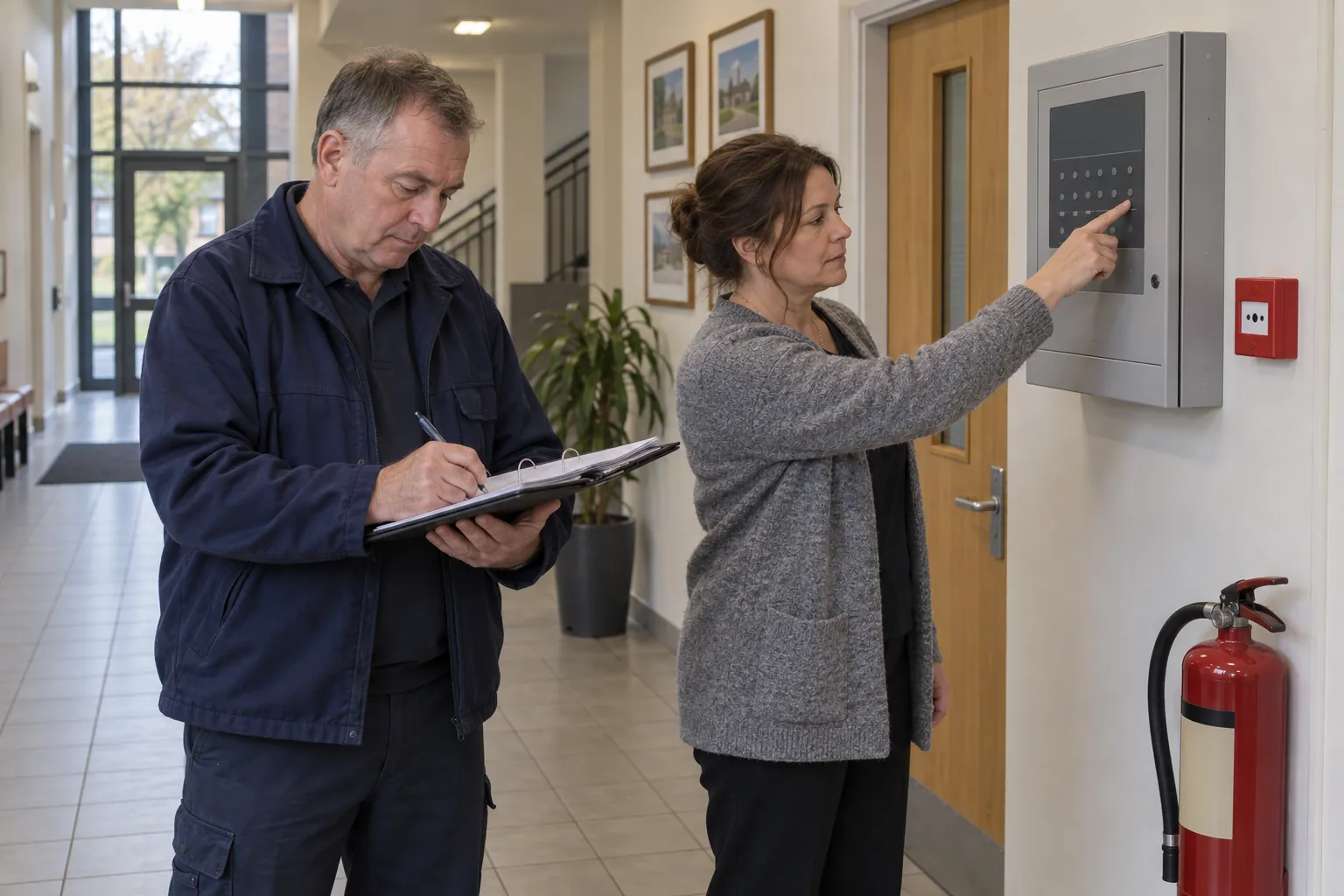 Fire and water checksFire safety register: what to record, who keeps it and how to make it credibleWhat a fire safety register should hold under section 18(2) of the Fire Services Acts, the routine checks behind it, who keeps it, and what makes it credible.