Fire and water checks
Safety signs in New Zealand: which signs a building needs, and how to keep them right
A safety sign gives one safety message through a set shape, a safety colour and a symbol or text, and in New Zealand Building Code clause F8 requires signs in and about buildings that identify escape routes, emergency-related safety features, potential hazards and accessible facilities, clearly visible and readily understandable in every foreseeable condition, emergencies included.
Also written for United Kingdom · Ireland · South Africa
On top of that sit WorkSafe's hazardous substances signage rules, the fire action notice required by Fire and Emergency New Zealand's evacuation regulations, and the warning signs a PCBU puts up to manage its own risks, for which the joint standard NZS/AS 1319:1994 sets the shapes, colours and symbols. This guide sets out what the colours and shapes mean, which signs a non-domestic building usually needs, how exit and evacuation signs are checked under the compliance schedule, and what the building team can do to keep every sign present, legible and right.
01
Where the rules on safety signs come from
No single New Zealand document lists every safety sign a building must carry. The Building Code sets the baseline. Building Code clause F8, Signs has the objective of safeguarding people "from injury or illness resulting from inadequate identification of escape routes, or of hazards within or about the building". Its functional requirement, F8.2, is that "signs must be provided in and about buildings to identify: (a) escape routes, (b) emergency-related safety features, (c) potential hazards, and (d) accessible routes and facilities for people with disabilities." The performance clauses add that signs "must be clearly visible and readily understandable under all conditions of foreseeable use, including emergency conditions" (F8.3.1), and that hazard signs must be placed "so that people encounter the signs before encountering the potential hazard" (F8.3.2). F8.2 does not apply to detached dwellings or inside household units.
MBIE's Acceptable Solution F8/AS1 (second edition, amendment 4, effective 1 January 2017) "describes one way of meeting the requirements of NZBC Clause F8", and most of the detail in this guide comes from it. Four other sources add signs of their own:
- Hazardous substances. WorkSafe's quick guide Hazardous substance signage (August 2025) says: "You must display signs whenever you store hazardous substances over a specified amount (threshold) in your workplace", with the thresholds in Schedule 3 of the Health and Safety at Work (Hazardous Substances) Regulations 2017.
- The fire action notice. Fire and Emergency New Zealand's page on regulations for building owners explains that, under regulation 7 of the Fire and Emergency New Zealand (Fire Safety, Evacuation Procedures, and Evacuation Schemes) Regulations 2018, owners must post "clear, distinct, and legible signs and notices at appropriate places in the building" summarising the evacuation procedure.
- Asbestos. WorkSafe's guidance on managing asbestos in your building or workplace says that if you find or assume asbestos material, "you must clearly indicate where it can be found", by labels, written records or signs at entrances.
- The PCBU's own risks. The primary duty of care under the Health and Safety at Work Act 2015 is to ensure, so far as is reasonably practicable, the health and safety of workers and of others put at risk by the work.
A sign is the weakest tool for that duty. WorkSafe's Identifying, assessing and managing work risks (July 2017) says to eliminate a risk first, so far as is reasonably practicable, and lists "warning signs" as an administrative control measure, used alongside isolation and PPE. A wet floor sign does not dry the floor.
The design standard for workplace safety signs is NZS/AS 1319:1994 Safety signs for the occupational environment, listed on MBIE's Building CodeHub as valid from 17 April 1994. It covers signs "to regulate and control safety related behaviour, to warn of hazards and to provide emergency information including fire protection information", sorted into regulatory, caution (warning) and emergency-related information, but not the exit signs specified in AS 2293.1 for use inside buildings. F8/AS1 takes its pictograms from ISO 3864, ISO 7010, AS 2293.3 and the HSNO code of practice for signage instead.
02
What the colours and shapes mean
F8/AS1 defines a safety sign as one that "comprises a geometric form and a safety colour, together with a safety symbol or text" and "gives a particular safety message". A sign is clearly visible when the nearest one is "visible and readable at the maximum distance from which it needs to be viewed" by someone without a visual impairment or wearing corrective lenses.
F8/AS1 gives each safety colour a meaning in its Table 3:
- Safety red: stop and prohibition. A prohibition sign is circular, with a white background, a red circular band and crossbar, and a black symbol that does not obliterate the crossbar.
- Safety yellow: caution, risk of danger. A caution sign is an equilateral triangle with a yellow background, a black border and a black symbol or text, used to indicate hazards such as fire, explosion, radiation and chemicals.
- Safety green: safe condition. A safe condition sign is rectangular or square, with a green background over half the face and a white symbol or text. Exit signs are white on safety green.
- Safety blue: instruction. In F8/AS1 blue appears on escalator and moving walk signs, with the cross in safety red.
Some signs have set colours of their own. A No Exit sign is white text on safety red. The sign beside every machine room door reads DANGER Entry of unauthorised persons prohibited in safety red on white, with DANGER in letters 50 mm high. Call point signs are white and safety red. The fire action notice is safety blue with a white border and white lettering. And, as WorkSafe's First aid at work quick guide (February 2020) notes, most first aid kits carry "a white cross on a green background".
F8/AS1 also sets the language and lettering. A sign may be a pictogram alone, English text with or without a pictogram, Māori text plus English text or a pictogram, or any other language, including Braille, alongside one of those. Where a pictogram and text are combined, the text follows the pictogram. Lettering is a vertical block type, and exit sign letters must be at least 75 mm high for a viewing distance of 16 metres, 100 mm at 24 metres and 150 mm at 32 metres, with no letters under 100 mm in theatres, cinemas, public halls and shopping spaces holding more than 100 people. Photoluminescent signs multiply the minimum by 1.3, with a maximum viewing distance of 24 metres.
03
Exit, fire and building signs
These are the signs F8/AS1 places in most non-domestic buildings:
- Exit signs at each point on the open path where the door to a final exit or exitway cannot be seen, at each door giving access to one, and along the route through the exitway. A sign marking a door goes on the leaf at or above handle height, or on a wall within 600 mm, where it cannot be hidden when the door is open. The wording is "Exit" or "Emergency Exit", with a direction arrow where needed.
- No Exit on any door from an exitway that leads to another level rather than a final exit, and a sign beside the lock where an exit door has a delayed unlocking device, stating the time delay.
- Illumination. In buildings that need emergency lighting under clause F6, exit signs must be lit, internally, externally or by photoluminescent material. A photoluminescent sign must give at least 30 mcd/m² for the duration F6 requires and be charged by at least 100 lux.
- Fire and smoke control doors carry "Fire Door, keep closed" or "Smoke Control Door, keep closed" on both sides, or "Fire Door (automatic closing) do not obstruct" where a closer is fitted, at least 90 mm × 50 mm with letters at least 8 mm high.
- Call points carry a sign giving the method of operation and the emergency telephone number.
- Lifts have "In the event of fire use the stairs" at each landing call button, and stairs show the floor level at each landing.
- Accessible facilities carry the International Symbol of Access, mounted consistently between 1,400 mm and 1,700 mm above the floor, and every toilet is signed for male, female, unisex or accessible use.
Then the fire action notice, which summarises the routes to safety, the alarm signals, the firefighting equipment, the provision for anyone needing assistance and how to alert Fire and Emergency. FENZ says it must have "a safety blue background and a white border", white lettering, printed lettering "no less than 5 mm high", and any handwritten spaces white and at least 10 mm high. FENZ publishes typed and handwritten templates.
04
Hazard, workplace and temporary signs
Hazard signs depend on what the building holds and what happens in it:
- Hazardous substances. Above the Schedule 3 threshold, WorkSafe's quick guide says signs must state that hazardous substances are present, the general type of hazard and the immediate emergency response. In a building, they go at every vehicle and pedestrian entrance to the building and to the land; for a dedicated room, at each entrance to the room, with HAZCHEM for class 2, 3, 4, 5, 6, 8 or 9 substances. WorkSafe's hazardous substances signs page adds that the words and pictograms "must be clearly visible and legible from not less than 10 metres away", and the quick guide asks for durable materials resistant to sunlight, which for an outdoor store means a sign that will not fade in the sun. Our guide to the hazardous substances inventory covers keeping track of what is held.
- Asbestos. Labels on or next to identified asbestos where that is safe, the register or site plan, and weatherproof signs, securely attached, at entrances.
- Electrical. F8/AS1 requires a caution sign wherever bare active conductors are exposed: at each termination, at intervals of no more than 15 metres, and in each room they pass through.
- Non-potable water. Outlets not suitable for drinking carry a prohibition sign with a pictogram at least 100 mm high.
- First aid and defibrillators. The First aid at work quick guide says to "use first aid signs to clearly show the location of first aid equipment and first aid rooms", and that an AED should be "clearly signed".
- Slips and level changes. WorkSafe's slips, trips and falls page says to signpost slippery areas and to "use signs to warn workers to look out for a level change" where a ramp is not possible.
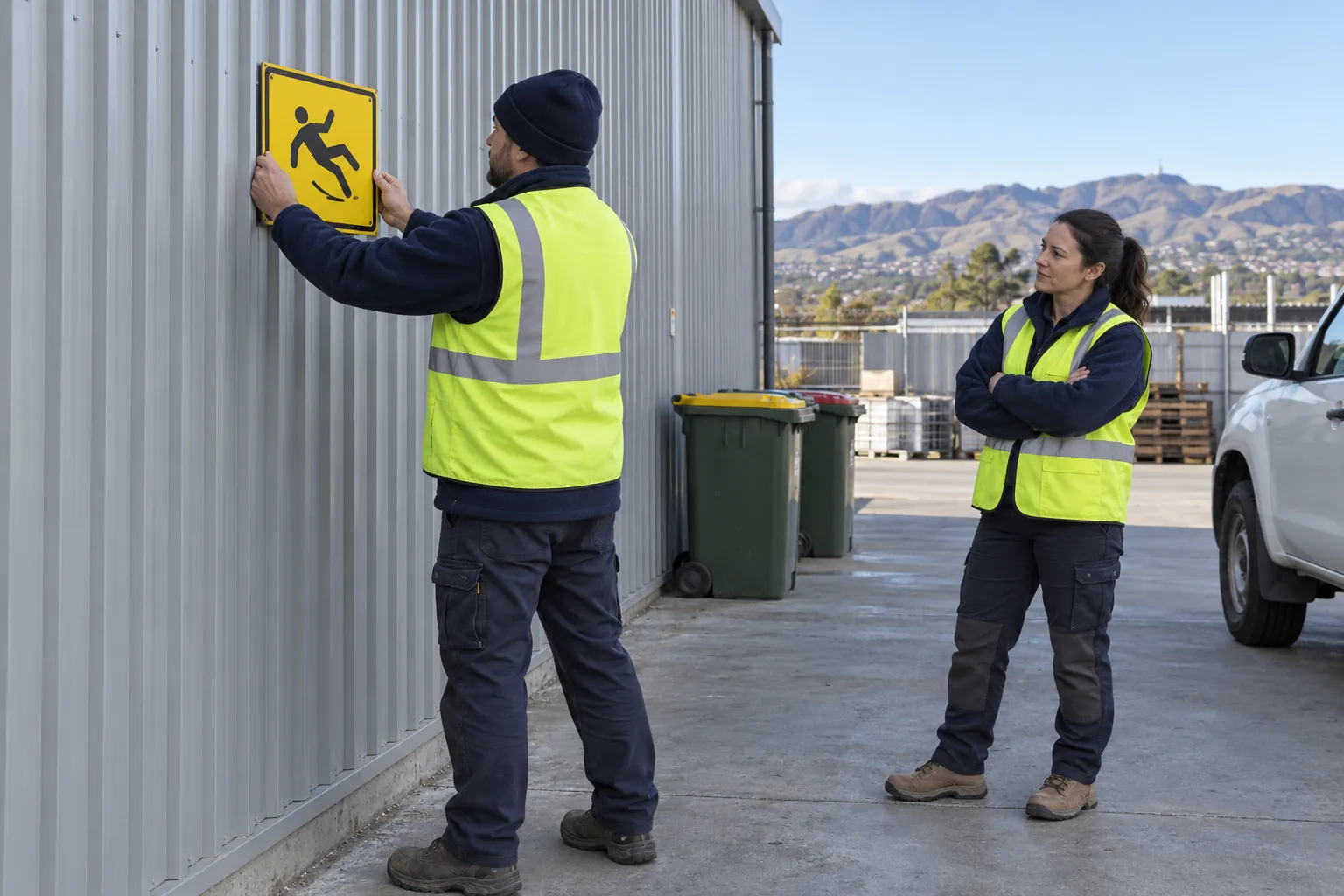
Temporary signs are the ones most often wrong. In WorkSafe's worked example of a café hazard table, the control for greasy floors includes "wet floor signs to be placed at entry when floors are wet". For a cleaning crew the sign goes out with the mop and comes back with it: a sign left on a dry floor teaches people to ignore it.
Placement matters too. WorkSafe's hazardous substances guide says not to put signs where objects may hide them, beside doors or gates that cover them when open, above doors, or where smoke could conceal them.

05
Checking signs, and keeping them right
Some signs are part of the building's compliance schedule. MBIE's page on specified systems and compliance schedules lists signs relating to specified systems 1 to 13 and, as part of a means of escape from fire, "signs for communicating information intended to facilitate evacuation". MBIE's Compliance Schedule Handbook labels them SS 14/2 (such as a call point instruction sign or a lift's rated load) and SS 15/4 (exit, directional and no exit signs, where the means of escape contains one or more of specified systems 1 to 6, 9 and 13).
The handbook's content guideline suggests these minimum checks:
- Monthly, illuminated signs: of the correct type, present and in the right locations, legible, and illuminated.
- Annually, signs not required to be illuminated: of the correct type, present and in the right locations, and legible.
- Tested, signs required to be illuminated: they "remain illuminated in the event of a failure of the main lighting supply, for the same duration as required by Clause F6", using the procedures for emergency lighting (SS 4).
- Responsive maintenance to ensure "signs remain correctly-positioned and legible" and the escape route is identified.
Your own compliance schedule, not the handbook, sets what applies to your building, and the IQP's inspections stand behind the annual Form 12A and the building warrant of fitness.
Signs outside the schedule need keeping too. WorkSafe's hazardous substances guide says to change signs "as soon as possible" when the type, class or quantity of substances changes, and to make sure they are "clean, in good repair and not covered or obscured". FENZ's information sheet on evacuation procedures and schemes advises owners to "review your evacuation procedures, employee training and signage regularly". WorkSafe's risk guidance adds a review of control measures at scheduled periods and after incidents or near misses.
A walk-round by the building team covers, floor by floor:
- Exit and directional signs present, lit where they should be, and pointing the right way after any fit-out.
- Fire action notices at the places in the building chosen for them, legible and current.
- Fire door, call point and lift signs in place, not painted over.
- Hazard, first aid and AED signs matching what is really there.
- Nothing new blocking a sign: shelving, display stands, partitions, an open door.
It is a look, not a test: running signs on battery is for whoever the compliance schedule names. Record each missing or damaged sign, who it went to and when it was replaced.
06
Where the record fails
Signs fail quietly. A fit-out moves a corridor and the exit sign now points at a wall. A fire action notice gives details nobody has checked since it went up. A HAZCHEM sign is missing from a new chemical store. Whoever notices tells whoever is passing, and the monthly check sheet in the plant room is filled in from memory.
SiteClara is built for that everyday part. A tag at each point on the route, such as a stairwell, a final exit, a chemical store or a floor's fire action notice, lets the person doing the walk-round scan it with their own phone and confirm what they checked, with a photograph when one is asked for, so the record shows which point was looked at, by whom and when. A check that was due and not done shows as not done, and the supervisor records why. A missing or damaged sign reported at the tag goes to the team responsible and stays on the list until it is closed, and a daily report tells the building manager what was checked and what is still open.
It is just as important to say what SiteClara does not do. It does not make, supply or design signs, and it does not decide which signs a building or a workplace needs. It does not test illuminated or photoluminescent signs. It is not an IQP and does not inspect, maintain or certify SS 14/2, SS 15/4 or any other specified system, and it is not a Form 12A or a building warrant of fitness. It does not work out hazardous substances thresholds, and it is not an evacuation scheme or a fire action notice. Where a compliance schedule requires a particular record, SiteClara is the working record of the building team's checks, not the statutory one. It is not a CAFM system and does not manage assets, planned maintenance, rostering or time and attendance.
07
Questions people ask
What are the 5 main safety signs?
No New Zealand rule names five, but the colours sort signs into four meanings plus fire signs. F8/AS1 uses safety red for stop and prohibition, safety yellow for caution, safety green for safe condition such as exit signs, and safety blue for instruction, while fire equipment signs, such as call point and hydrant signs, use safety red. NZS/AS 1319:1994 groups the same signs as regulatory, caution (warning) and emergency-related information, including fire signs.
What are the 9 mandatory safety signs in the workplace?
There is no list of nine mandatory signs in New Zealand law. A mandatory sign is an instruction, such as to wear hearing protection (F8/AS1 gives safety blue the meaning "instruction"), and which ones a workplace needs follows from its own risk assessment. WorkSafe's Identifying, assessing and managing work risks calls personal protective equipment "the least effective type of control", so a sign telling people to wear it should not be the first or only control. The signs required in particular cases come from Building Code clause F8, the hazardous substances signage rules, the fire action notice and the asbestos rules described above.
What do prohibition signs signify?
That something must not be done. In Acceptable Solution F8/AS1 safety red means "stop" and "prohibition", and a prohibition sign is circular, with a white background, a red circular band and crossbar, and a black symbol that does not obliterate the crossbar. F8/AS1 uses one to mark water outlets that are not suitable for drinking.
When should safety signs be used in the workplace?
When a rule requires one, and to warn of a risk that cannot be eliminated. WorkSafe's Identifying, assessing and managing work risks says the first step is to try to eliminate the risk, and treats warning signs as an administrative control used alongside others: to protect workers from passing traffic at a roadwork site, it pairs barriers, warning signs and high visibility gear. Clause F8, reprinted in Acceptable Solution F8/AS1, requires hazard signs to be placed so that people encounter them before the hazard, and WorkSafe's Hazardous substance signage quick guide requires signs whenever hazardous substances are stored above the threshold.
Why are safety signs in the workplace so important?
People cannot avoid a hazard, or find a way out, that nobody has shown them. One objective of clause F8, reprinted in Acceptable Solution F8/AS1, is to "safeguard people from injury or illness resulting from inadequate identification of escape routes, or of hazards within or about the building". WorkSafe's Hazardous substance signage quick guide says signs let workers, emergency service workers and visitors know which hazardous substances are in the workplace, the hazards associated with them, and the first actions to take in an emergency.
Can you make your own safety signs?
Yes, if the sign meets the same rules as a bought one: the rules set what a sign must show and how, not who makes it. WorkSafe's Hazardous substance signage quick guide says signs from safety equipment suppliers should generally meet its requirements, "but you also have a duty to make sure that signs contain the information that they are required to display", and that signs must be in English, legible from no less than 10 metres in rain or changing light, and made of durable materials resistant to sunlight. Building signs follow the colours, shapes and lettering sizes in F8/AS1.
08
Where to read more, and a list to take away
Start with MBIE's clause F8 page and F8/AS1 for building signs, and the Compliance Schedule Handbook for SS 14/2 and SS 15/4. FENZ's regulations for building owners covers the fire action notice and its templates. WorkSafe's Hazardous substance signage quick guide covers storage signs. Standards New Zealand sells NZS/AS 1319:1994. See also our guides to emergency lighting testing, the fire evacuation scheme and specified systems.
Before the next IQP visit or fit-out, check that:
- you know which signs your compliance schedule lists under SS 14/2 and SS 15/4, and who checks them;
- every escape route is signed, and illuminated signs stay lit on battery;
- fire action notices are posted at appropriate places in the building, with current details;
- hazard signs match what is stored now;
- temporary signs are put out and taken in by the people doing the work;
- each missing or damaged sign has a record of who it went to and when it was replaced.
Sources
Every document this guide quotes or links to, in the order it first cites them.
- Building Code clause F8, Signs building.govt.nz
- Acceptable Solution F8/AS1 building.govt.nz
- Hazardous substance signage worksafe.govt.nz
- Regulations for building owners fireandemergency.nz
- Managing asbestos in your building or workplace worksafe.govt.nz
- Primary duty of care worksafe.govt.nz
- Identifying, assessing and managing work risks worksafe.govt.nz
- NZS/AS 1319:1994 Safety signs for the occupational environment codehub.building.govt.nz
- First aid at work worksafe.govt.nz
- Building tenants and occupants fireandemergency.nz
- Hazardous substances signs worksafe.govt.nz
- Slips, trips and falls worksafe.govt.nz
- Specified systems and compliance schedules building.govt.nz
- Compliance Schedule Handbook building.govt.nz
- Information sheet on evacuation procedures and schemes fireandemergency.nz
Related guides
 Fire and water checksEmergency lighting testing in New Zealand: what the compliance schedule asks, and what the building team can doEmergency lighting testing in New Zealand: Building Code F6, specified system SS 4, AS/NZS 2293.2, the IQP's six-monthly and annual checks, and the BWoF records.
 Fire and water checksFire evacuation scheme: which buildings need one, and how to keep it workingWhich New Zealand buildings need an approved fire evacuation scheme, what it contains, how it is kept up with trial evacuations or training, and what to tell FENZ.
 CleaningHazardous substances inventory: what it must hold, and how to keep it trueWhat a hazardous substances inventory must contain in New Zealand, who keeps one in a shared building, when to update it, and how it sits with SDSs and labels.
 Fire and water checksIQPs and specified systems: who inspects what, and what the owner must keepWhat an IQP is, the specified systems SS 1 to SS 16, how to engage IQPs, what they inspect and what is left to the owner, and how the Form 12A works in New Zealand.